503 http://dx.doi.org/10.9713/kcer.2015.53.4.503
PISSN 0304-128X, EISSN 2233-9558
Adsorption of Ammonia on Municipal Solid Waste Incinerator Bottom Ash Under the Landfill Circumstance
Jun Yao*,**, Qingna Kong*,†, Huayue Zhu*, Zhen Zhang*, Yuyang Long***and Dongsheng Shen***
*College of Life Science, Taizhou University, Linhai 317000, China
**Department of Environmental Engineering, Zhejiang University, Hangzhou 310029, China
***Zhejiang Provincial Key Laboratory of Solid Waste Treatment and Recycling, Zhejiang Gongshang University, Hangzhou, 310018, China (Received 23 November 2014; Received in revised form 23 February 2015; accepted 3 March 2015)
Abstract − The adsorption characteristics of ammonia on MSWI bottom ash were investigated. The effect of the vari- ation of the landfill environmental parameters including pH, anions and organic matter on the adsorption process was discussed. Results showed that the adsorption could be well described by pseudo-second-order kinetics and Langmuir model, with a maximum adsorption capacity of 156.2 mg/g. The optimum adsorption of ammonia was observed when the pH was 6.0. High level of ion and organic matter could restrict the adsorption to a low level. The above results sug- gested that MSWI bottom ash could affect the migration of ammonia in the landfill, which is related to the variation of the landfill circumstance.
Key words: Adsorption, Ammonia, MSWI Bottom Ash, Landfill
1. Introduction
Incineration, due to the primary advantages of hygienic control, vol- ume reduction, mass reduction and energy recovery, has become an attractive way for municipal solid waste (MSW) treatment in China [1]. Till 2013, there were a total 138 MSW incinerators (MSWI) in China, with a treatment capacity of 122,649 t/d [2]. Because of the incineration process, a large volume of MSWI bottom ash is produced [3].
Nowadays, MSWI bottom ash is either reused as a secondary construc- tion material or disposed in landfills with MSW [4]. In many countries and areas, such as China, Japan and Taiwan, MSWI bottom ash is allowed to be disposed in the MSW landfill site [5-7]. Moreover, large amounts of MSWI bottom ash have been used as the liner, protection layer and leachate drainage layer instead of natural minerals (e.g., gravel, sand, till, and clay) [8-10].
MSWI bottom ash has high porosity and large surface area. It also contains several hydr (oxide) minerals (e.g., aluminum (hydr)-oxides, iron (hydr)-oxides) and layered double hydroxides (e.g., Friedel’s salt), which have great adsorption ability [11-14]. Several researchers have used MSWI bottom ash as the adsorbent towards heavy metals, dyes, organic matter and sulfur compounds [15-18]. On the other hand, due to the lack of the nitrogen degradation pathway in the anaerobic system, nitrogen pollution is a long-term problem in landfills. According to our previous research, the level of ammonia in the leachate ranged from 159 to 2298 mg/L (see Fig. S1). A high level of ammonia released from the landfill can cause the eutrophication of waters. When MSWI bot- tom ash is disposed or reused in the landfill, the ammonia in the leach-
ate might be adsorbed by the bottom ash. Therefore, the migration and release of the ammonia can be changed. Several researches have inves- tigated the environmental impact of the disposal or reuse of MSWI bot- tom ash in the landfill. However, to our knowledge to date, most of these researches focus on the metal pollution. Few studies have been done to investigate the effect of MSWI bottom ash on the migration of ammonia in the landfill.
In this work, the adsorption characteristics of ammonia on MSWI bottom ash were investigated by batch experiments. The kinetics and isotherms of the adsorption were investigated. The effects of the varia- tion of environmental parameters, such as the pH and ion competition, on the adsorption were also examined. We aim to provide insights into the effect of MSWI bottom ash on the migration of ammonia when it was disposed or reused in the landfill.
2. Materials and Methods
2-1. MSWI bottom ash sampling
Bottom ash from MSWI incinerator was taken from the Green Energy MSWI plant in Zhejiang province, East China. The plant consists of three parallel incinerator stokers with an MSW treatment capacity of 650 t/d.
The source MSW was collected from several residential areas of Hang- zhou without any industrial solid waste. The operating temperature of the incinerators was 850-1,100oC, and the residence time of waste in the incinerator was about 50 min. Bottom ash underwent water quenching and magnetic separation before it was sampled. The sampling period lasted for 5 days. Approximately 25 kg fresh bottom ash sample was taken daily from the plant. A total 125 kg bottom ash sample was obtained.
Then, the bottom ash sample was mingled and homogenized. Subse- quently, an approximate 25 kg of the MSWI bottom ash was oven- dried and ground into less than 154 µm by the grinder for bulk compo- sition analysis and adsorption test.
†To whom correspondence should be addressed.
E-mail: [email protected]
This is an Open-Access article distributed under the terms of the Creative Com- mons Attribution Non-Commercial License (http://creativecommons.org/licenses/by- nc/3.0) which permits unrestricted non-commercial use, distribution, and reproduc- tion in any medium, provided the original work is properly cited.
2-2. Characterization
The content of individual elements in the MSWI bottom ash sample was analyzed after it was digested according to the method of Yama- saki [19]. 0.5 g air dried sample was weighed into a Teflon beaker. 2.5 mL HNO3 and 2.5 mL HClO4 were added and heated on the hot plate at 150oC for 2~3 h. After cooling, 2.5 mL HClO4 and 5 mL HF were added and heated at 150oC for 15 min, and then 5 mL HF was added until the residue became almost dry. The residue was dissolved in 5 mL HNO3 and diluted to 100 mL. The elemental concentrations in the solution were determined by ICP-OES (Thermo Electron Corporation IRIS/AP, USA). The samples were digested and analyzed in triplicate. The ammo- nia content of MSWI bottom ash was also determined according to the Chinese standard HJ 634-2012. The mineralogy of the bottom ash sam- ples was investigated by XRD (Rigaku D/max-r B, Japan).
2-3. Batch adsorption studies
Batch adsorption experiments were conducted and equilibrated by using a model KYC-1102 air-temperature-controlled shaker (Ningbo Jiangnan Instrument Factory, China) at 100 rpm. The solution was then continually flushed with N2 to avoid contact with the atmosphere. Batch experiments were conducted in triplicate to ensure the accuracy of the obtained data.
According to our previous research, the level of ammonia in landfill leachate ranged from 159 to 2298 mg/L (see Fig. S1). Therefore, the initial concentration of ammonia used in this study was 2000 mg/L.
The adsorption kinetics process of ammonia on MSWI bottom ash was studied by adding 100 mL ammonia solution (2000 mg/L) and 2.0 g MSWI bottom ash to a 100 mL beaker for the contact time ranging from 5 to 250 min at 25oC.
Isotherm studies were conducted with a constant MSWI bottom ash dosage (2.0 g) and 100 mL ammonia solution with the initial concen- trations varying from 50 to 3000 mg/L. The mixture was equilibrated at 25oC for 160 min.
The effect of pH on the adsorption was conducted at the range from 5.0 to 10.0, which corresponded to the variation of leachate pH [20].
100 mL ammonia solution (2000 mg/L) and 2.0 g MSWI bottom ash were added and equilibrated at the desired temperature for 160 min.
The coexisting ions, such as Na+, Mg2+ and Fe3+, were imposed to explore their impacts on the adsorption. The concentration of Na+, Mg2+
and Fe3+ ranged from 500 to 3000 mg/L, 100 to 1000 mg/L and 100 to 1000 mg/L, respectively, which were set according to the previous lit- erature report [21]. The mixture was equilibrated at 25 oC for 160 min.
Acetic acid and toluene were imposed to investigate the effect of organic matter on the adsorption, respectively. The concentration of the acetic acid ranged from 8000 to 40000 mg/L, which corresponded to the variation of COD in the leachate (see Fig. S2, 1.0 g acetic acid equal to 1.06 g COD). The concentration of the toluene ranged 1.0 to 12.0 mg/L, which was set according to the previous study [22]. The mixture was equilibrated at 25oC for 160 min.
After the adsorption, the samples were centrifuged and the ammonia concentration in supernatant was determined immediately.
The amount of ammonia absorbed on MSWI bottom ash (qt) and the removal percentage of nitrite (η%) were calculated according to Eqs.
(1) and (2), respectively.
(1) (2) where C0 and Ct are initial and instantaneous concentrations of ammonia (mg/L), respectively; V is the volume of the solution (L) and m is the mass of MSWI bottom ash.
3. Results and Discussion
3-1. Characterization of MSWI bottom ash
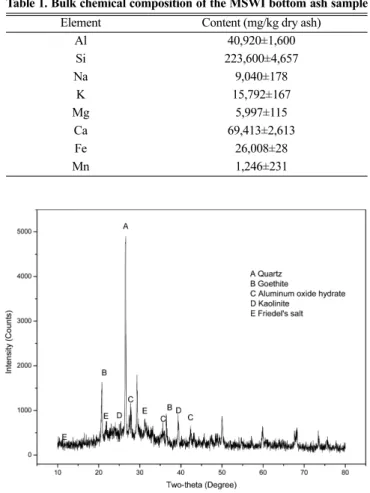
The bulk chemical composition of MSWI bottom ash is exhibited in Table 1. The result shows Si was the major element, which accounted for more than 20%. High levels were found for Ca, Al and Fe, whose content exceeded 20,000 mg/kg. Moreover, the content of Na, K and Mg was above 5,000 mg/L. As MSWI bottom ash was a high tempera- ture product under the oxygen-enriched circumstance, CaO, Al2O3 and Fe2O3 might largely exist in it, which might be transformed into Ca(OH)2, Al(OH)3 and Fe(OH)3 after the water quench treatment. And due to the complicated composition of MSWI bottom ash, the pres- ence of some secondary minerals, such as the aluminosilicate and cal- cium aluminum compounds, was expected. Note that no ammonia was observed in MSWI bottom ash, as most of the nitrogen was transformed to the nitrogen oxides under the oxygen-enriched circumstance.
To further explore the mineral composition, the XRD pattern of qt=(C0–Ct) V/m×
η%=(C0–Ct) 100/C× 0
Fig. 1. XRD pattern of the MSWI bottom ash sample.
Table 1. Bulk chemical composition of the MSWI bottom ash sample Element Content (mg/kg dry ash)
Al 40,920±1,600
Si 223,600±4,657
Na 9,040±178
K 15,792±167
Mg 5,997±115
Ca 69,413±2,613
Fe 26,008±28
Mn 1,246±231
MSWI bottom ash was investigated (Fig. 1). The result confirmed the existence of quartz (SiO2), goethite (FeO(OH)) and aluminum oxide hydrate ((Al2O3)5H2O). Among the minerals, goethite and aluminum oxide hydrate were reported to have a certain adsorption capacity for various pollutants [23,24]. Kaolinite (Al2(Si2O5)(OH)4) and Friedel’s salt (Ca2Al(OH)6(H2O)2) were also observed. Kaolinite is a 1:1 phyllo- silicate comprised of neutral layers containing an octahedral sheet of aluminum hydroxide bound to a tetrahedral sheet of silicon oxide through a plane of shared O atoms. It has a great adsorption capacity for ions [25]. Friedel’s salt is a layer double hydroxide consisting of cationic brucite layers and interlayer anion. It is also reported to have great adsorption capacity due to its high specific area and ion exchange capacity [26]. The presence of these minerals suggested that MSWI bottom ash might have the adsorption capacity for the ammonium ion.
3-2. Adsorption of ammonia on MSWI bottom ash 3-2.1. Adsorption kinetics
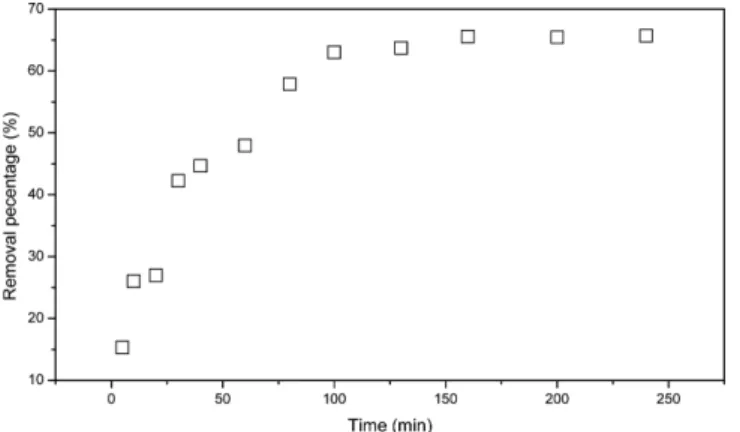
The time-adsorption profile of the ammonia on MSWI bottom ash is shown in Fig. 2. The adsorption was rapid during the first 30 min, when 42.2% of the ammonia removal percentage was observed. Afterwards, the removal percentage showed a gradual increase. About 63.0% of the ammonia removal percentage was achieved at 100 min. The equilib- rium was established after 160 min, when 65.6% of the removal per- centage was reached.
Kinetic parameters are helpful for the prediction of adsorption rate, which gives important information for the efficiency of adsorption. To analyze the adsorption rate of the ammonia on MSWI bottom ash, three kinetic models including the Lagergren-first-order model (Eq. (3)), pseudo-second-order kinetic model (Eq. (4)) and intra-particle mass transfer diffusion model (Eq. (5)) were used to understand the dynam- ics of the adsorption process.
The Lagergren-first-order model is expressed as:
(3) where qe and qt are the amount of nitrite adsorbed (mg/g) on the adsorbents at the equilibrium and at time t, respectively; k1 is the rate constant of adsorption (L/min). Values of k1 are calculated from the plots of log(qe-qt) versus t.
The pseudo-second-order kinetic model is expressed as:
(4)
where k2 is the rate constant of the pseudo-second-order adsorption (g/mg min). Values of k2 are obtained from plotting (t/qt) versus t.
The intra-particle mass transfer diffusion model is expressed as:
(5) where c is the intercept (mg/g) and kid is the intra-particle diffu- sion rate constant (mg/g min1/2), which can be evaluated from the slope of the linear plot of qt versus t1/2.
The kinetic parameters (k1, k2, kid, qe, c) and correlation coefficients (R2) are summarized in Table 2. Compared with the Lagergren-first- order model and intra-particle mass transfer diffusion model, the value of the correlation coefficient (R2) of the pseudo-second-order kinetic model was closer to 1.0, which shows that the pseudo-second-order kinetic model was more suitable to describe the adsorption process of the ammonia on MSWI bottom ash.
3-2-2. Adsorption isotherms
The adsorption isotherms provide a relationship between the solute concentration in the solution and the amount of ammonia adsorbed on the solid phase when the two phases are at equilibrium. The adsorption data were fitted by two common adsorption models: Langmuir and Freundlich [27-29]. The Langmuir (Eq. (6)) and Freundlich (Eq. (7)) models are represented by the following equations:
(6)
(7) where Ce is the equilibrium concentration (mg/L); qo is the max- imum amount of the ammonia ion per unit weight of MSWI bottom ash (mg/g); qe is the amount adsorbed per unit mass of adsorbent, and b is the binding energy constant (L/mg). For the Freundlich model, n is the heterogeneity factor and KF is the Freundlich con- stant (L/mg).
The results of the experimental data fitted to the equations and the parameters are shown in Fig. 3 and Table 3. The correlation coeffi- cients (R2) of Freundlich and Langmuir were 0.965 and 0.994, respec- tively. This result indicated the Langmuir model was more suitable to
log q( e–qt) logqe k1t 2.303 --- –
=
t qt ---- 1
k2qe2 --- 1
qe ----t +
=
qt=kidt1/2+c
qe bq0Ce 1 bC+ e ---
=
qe=KFCe1/n
Fig. 2. Ammonia removal percentage as a function of shaking time (conditions: V=100 mL; ammonia concentration=2000 mg/L;
MSWI bottom ash dosage=2.0 g; T=298 K).
Table 2. Kinetic parameters of ammonia adsorption on MSWI bottom ash
Lagergren-first-order Pseudo-second-order Intra particle diffusion
qe (mg/g) k1 R2 qe (mg/g) k2×104 R2 kid c R2
137.626 0.0311 0.925 146.627 2.929 0.994 7.710 35.852 0.861
describe the adsorption compared with the Freundlich model. Accord- ing to the model result, the adsorption capacity of ammonia on MSWI bottom ash was 156.2 mg/g. The high adsorption capacity indicated that the migration of ammonia in the landfill could be alternated by MSWI bottom ash.
3-2-3. Effect of pH on the adsorption
As shown in Fig. 4, the adsorption of ammonia on MSWI bottom ash depended on the pH. The removal percentage shows a slight increase when the pH increased from 4.0 to 6.0. This might be because the increase of pH could decrease the concentration of H+, which could
compete for the active adsorption sites with NH4+. The removal per- centage showed a reduction when the pH increased from 6.0 to 10.0.
The further increase of pH might result in the precipitation of the met- als in MSWI bottom ash, which might occupy the active adsorption sites and reduce the adsorption capacity of MSWI bottom ash.
3-2-4. Effect of coexisting anions on the adsorption
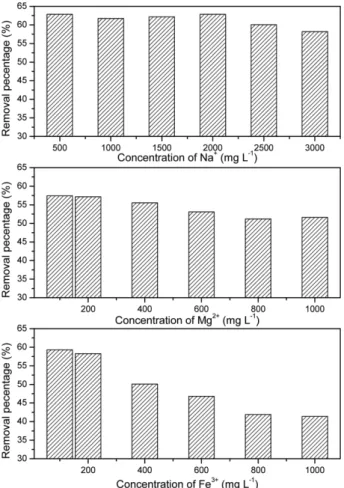
Landfill leachate contains various ions which may affect the adsorp- tion process. In this study, the effect of Na+, Mg2+ and Fe3+ on the adsorption of ammonia on MSWI bottom ash was investigated. The result showed the presence of Na+, Mg2+ and Fe3+ could restrict the adsorption (Fig. 5). The presence of 3000 mg/L of Na+, 1000 mg/L of Mg2+ and 1000 mg/L of Fe3+ decreased the ammonia percentage removal from 65.6% to 58.2%, 51.6% and 41.4%, respectively.
3-2-5. Effect of the organic matter on the adsorption
Landfill leachate contains high level of organic matter. The high level of the organic matter might affect the ammonia adsorption on MSWI bottom ash. In this study, the acetic acid and toluene were selected to represent the polar and nonpolar organic matter, respectively [22]. Due to the increase of the acetic acid, the pH of the solution decreased from 10.7 to 6.8, which could increase the removal percentage of ammonia according to the result of the pH study. However, the removal percent- age of ammonia decreased sharply from 65.6% to 10.9% when the con- Fig. 3. Isotherm for adsorption of ammonia on MSWI bottom ash
(conditions: V=100 mL; MSWI bottom ash dosage=2.0 g;
T=298 K).
Fig. 4. Effect of pH on the ammonia adsorption on MSWI bottom ash.
Table 3. Langmuir and Freundlich isotherm parameters and correlation coefficients for the adsorption of ammonia on MSWI bottom ash at 298 K
Freundlich model constants Langmuir model constants KF (L/mg) n R2 qo (mg/g) b (L/mg) R2
5.242 2.180 0.965 156.2 0.00344 0.994
Fig. 5. Effect of Na+, Mg2+ and Fe3+ on the ammonia adsorption on MSWI bottom ash.
centration of the acetic acid increased to 40000 mg/L (Fig. 6(a)). This result shows the acetic acid in the leachate could restrict the adsorption of ammonia on MSWI bottom ash. Besides, the removal percentage decreased from 65.6% to 60.5% when the concentration of the toluene increased to 12.0 mg/L (Fig. 6(b)). This result suggested that the tolu- ene in the leachate had a slighter effect on the adsorption compared with the acetic acid.
3-3. Effect of MSWI bottom ash on the migration of ammonia in the landfill
The adsorption study showed MSWI bottom ash had considerable adsorption capacity for the ammonia. The capacity of the ammonia on MSWI bottom ash was 156.2 mg/g. Therefore, the migration of the ammo- nia could be altered by MSWI bottom ash in the landfill. The adsorp- tion was affected by the variation of pH, ion and organic matter level in the leachate. The high level of ion and organic matter was usually observed at the acidogenic stage of the landfill, due to the fermentation of the refuse. The fermentation also resulted in the low pH of the land- fill. Such a condition could restrict the adsorption to a low level. Com- pared to the acidogenic stage, the level of the ion and organic matter was lower and the leachate pH was closer to neutral at the methane pro- duction stage and mature stage. This condition was beneficial for the adsorption of ammonia on MSWI bottom ash. Therefore, it seems the effect of MSWI bottom ash on the migration of ammonia in the landfill is greater at the methane production stage and mature stage than the acidogenic stage.
4. Conclusions
MSWI bottom ash has considerable adsorption capacity for ammo- nia. The observed adsorption capacity of ammonia on MSWI bottom ash was 156.2 mg/g. Therefore, the migration of the ammonia in the landfill could be affected by MSWI bottom ash. The adsorption pro- cess fit well to the pseudo-second-order kinetics and Langmuir model.
The presence of Na+, Mg2+ and Fe3+ as well as organic matter could restrict the adsorption process. The variation of pH could also affect the adsorption process. According to the above results, the landfill circum- stance at the methane production stage and mature stage was benefi- cial for adsorption. Thus, the migration of ammonia was more greatly affected at the methane production stage and mature stage than the aci- dogenic stage.
Ackowledgment
This work was financially supported by Natural Science Foundation of Zhejiang province with Grant No. LQ13B070001 and LY12B07003, the Postdoctoral Science Foundation of China Grant No. 2013M541785.
References
1. Wan, X., Wang, W., Ye, T., Guo, Y. and Gao, X., J. Hazard.
Mater., 134, 197(2006).
2. National Bureau of Statistics of China, China Statistical Yearbook 2013, China statistical press, Beijing(2014).
3. Chimenos, J. M., Segarra, M., Fernändez, M. A. and Espiell, F., J. Hazard. Mater., 64, 211(1999).
4. Youcai, Z., Lijie, S. and Cuojian, L., J. Hazard. Mater., 95, 47 (2002).
5. Inanc, B., Inoue, Y., Yamada, M., Ono, Y. and Nagamori, M., J.
Hazard. Mater., 141, 793(2007).
6. Lo, H. M. and Liao, Y. L., J. Hazard. Mater., 142, 512(2007).
7. Yao, J., Kong, Q. N., Li, W. B., Zhu, H. Y. and Shen, D. S., J.
Mater. Cycles. Waste. Manag., 16, 775(2014).
8. Lo, H. M., The Impact of Increasing the Incinerator Ash Con- tent on Landfill Site Biostabilization, PhD Thesis, University of Southampton, Southampton, UK(2000).
9. Travar, I., Lidelöw, S., Andreas, L., Tham, G. and Lagerkvist, A., Waste Manage., 29, 1336(2009).
10. Su, L. H., Guo, G. Z., Shi, X. L., Zuo, M. Y., Niu, D. J., Zhao, A.
H. and Zhao, Y. C., Waste Manage., 33, 1411(2013).
11. Islam, M. and Patel, R., J. Hazard. Mater., 190, 659(2011).
12. Yang, S., Saffarzadeh, A., Shimaoka, T. and Kawano, T., J. Haz- ard. Mater., 267, 214(2014).
13. Yao, J., Kong, Q. N., Zhu, H. Y., Long, Y. Y. and Shen, D. S., Chem. Eng. J., 254, 479(2014).
14. Yao, J., Kong, Q. N., Zhu, H. Y., Long, Y. Y. and Shen, D. S., Chemosphere, 119, 267(2015).
15. Shim, Y. S., Kim, Y. K., Kong, S. H., Rhee, S. W. and Lee, W.
K., Waste Manage., 23, 851(2003).
16. Mittal, A., Mittal, J., Kurup, L. and Singh, A. K., J. Hazard.
Mater., 138, 95(2006).
17. Ducom, G., Radu-Tirnoveanu, D., Pascual, C., Benadda, B. and Fig. 6. Effect of acetic acid and toluene on the ammonia adsorption on
MSWI bottom ash.
Germain, P., J. Hazard. Mater., 166, 1102(2009).
18. Chiang, Y. W., Ghyselbrecht, K., Santos, R. M., Meesschaert, B.
and Martens, J. A., Catal. Today, 190, 23(2012).
19. Yamasaki, S., Digestion Method for Total Element Analysis. In:
Japanese Society of Soil Science and Plant Nutrition (ed) Soil Environment Analysis, Hakuyusya, Tokyo(1997).
20. Long, Y., Lao, H. M., Hu, L. F. and Shen, D. S., Bioresour. Technol., 99, 2787(2008).
21. Kjeldsen, P., Barlaz, M. A., Rooker, A. P., Baun, A., Ledin, A.
and Christensen, T. H., Crit. Rev. Environ. Sci. Technol., 32, 297 (2002).
22. Öman, C. B. and Junestedt, C., Waste manage., 28, 1876(2008).
23. Wei, Y. M., Shimaoka, T., Saffarzadeh, A. and Takahashi, F., J.
Hazard. Mater., 187, 534(2011).
24. Yao, J., Li, W. B., Kong, Q. N., Xia, F. F. and Shen, D. S., Fuel, 93, 99(2012).
25. Tribe, L., Hinrichs, R. and Kubicki, J. D., J. Phys. Chem. B, 116, 11266(2012).
26. Zhang, D. N., Jia, Y. F., Ma, J. Y. and Li, Z. B., J. Hazard. Mater., 195, 398(2011).
27. Shen, C. S., Shen, Y., Wen, Y. Z., Wang, H. Y. and Liu, W. P., Water Res., 45, 5200(2011).
28. Shirzad-Siboni, M., Khataee, A., Vafaei, F. and Joo, S. W., Korean J. Chem. Eng., 31, 1451(2014).
29. Mubarak, N. M., Thines, R. K., Sajuni, N. R., Abdullah, E. C., Sahu, J. N., Ganesan, P. and Jayakumar, N. S., Korean J. Chem.
Eng., 31, 1582(2014).