665 http://dx.doi.org/10.9713/kcer.2016.54.5.665
PISSN 0304-128X, EISSN 2233-9558
Single cell-strain 부터 유래된 무세포 효소 시스템을 이용한 톨루엔 및 아세트산 분해
장재현 · 김예지 · 노태용 · 박중곤† 경북대학교 화학공학과 41566 대구광역시 북구 대학로 80
(2016년 4월 12일 접수, 2016년 5월 31일 수정본 접수, 2016년 6월 1일 채택)
Degradation of Toluene and Acetic Acid Using Cell-Free Enzyme System from Single Cell-Strain
Jae Hyun Jang, Yeji Kim, Tae Yong Roh and Joong Kon Park†
Department of Chemical Engineering, Kyungpook National University, 80, Daehak-ro, Buk-gu, Daegu, 41566, Korea (Received 12 April 2016; Received in revised form 31 May 2016; accepted 1 June 2016)
요 약
본 연구에서는 톨루엔 분해 균주인 Pseudomonas putida와 아세트산 분해 균주인 Cupriavidus necator에 무세포 효 소 시스템(cell-free enzyme system)을 적용하여 톨루엔과 아세트산에 대한 분해 가능성을 확인하는 실험을 수행하였다.
P. putida는 톨루엔 존재 하에서만 toluene dioxygenase를 생성하여 톨루엔을 cis-toluene dihydrodiol로 분해하며, C.
necator는 acetyl coenzyme A synthetase-1을 생성하여 아세트산을 acetyl CoA로 전환시켜 생존에 필요한 ATP나 생분 해성(biodegradable) 고분자인 Polyhydroxyalkanoate (PHA)를 합성한다. P. putida의 톨루엔 분해 효소인 toluene dioxygenase는 유도효소이기 때문에 toluene dioxygenase 생성 전과 후로 나누어 실험을 진행하였다. P. putida의 톨루 엔 분해능력 확인을 위한 gas chromatography (GC) 분석 결과, 대조군과 toluene dioxygenase 생성 전인 실험군 1에서 는 검출된 톨루엔의 양이 거의 유사하였으나, toluene dioxygenase 생성 후인 실험군 2에서는 검출된 톨루엔의 양이 대 조군 및 실험군 1에 비해 감소하였다. 또한 C. necator의 아세트산 분해능력 확인을 위한 gas chromatography-mass spectrometer (GC-MS) 분석 결과, 무세포 효소 시스템을 적용한 실험군에서는 아세트산에 대한 피크가 검출되지 않았 다. 따라서 P. putida와 C. necator는 무세포 효소 시스템 적용 후에도 톨루엔 및 아세트산 분해 능력이 유지되었으나, P. putida는 무세포 효소 시스템을 적용하기 전에 유도 효소를 생성하는 과정이 필요하다.
Abstract – This study deals with the possible degradation of toluene and acetic acid when subjected to cell-free enzyme system from the toluene degrading bacteria Pseudomonas putida and acetic acid degrading bacteria Cupriavi- dus necator. P. putida produces toluene dioxygenase only under the existence of toluene in culture medium and toluene is degraded to cis-toluene dihydrodiol by this enzyme. C. necator produces acetyl coenzyme A synthetase-1 and con- verts acetic acid to acetyl CoA in order to synthesize ATP to need for growth or PHA which is biodegradable polymer.
In case of toluene degradation, the experiment was conducted before and after production of toluene dioxygenase as this enzyme, produced by P. putida, is an inducible enzyme. Toluene was detected using gas chromatography (GC). Similar amount of toluene was found in control group and before production of toluene dioxygenase (experimental group 1).
However, reduction in toluene was detected after the production of toluene dioxygenase (experimental group 2). Acetic acid was detected through application of gas chromatography-mass spectrometer (GC-MS). The results showed the ace- tic acid peak was not detected in the experimental group to apply cell-free enzyme system. These results show that the cell-free enzyme system obtained from P. putida and C. necator retained the ability to degrade toluene and acetic acid.
However, P. putida needs to produce the inducible enzyme before preparation of the cell-free enzyme system.
Key words: Cell-free enzyme system, Pseudomonas putida, Cupriavidus necator, Toluene, Acetic acid
†To whom correspondence should be addressed.
E-mail: [email protected]
This is an Open-Access article distributed under the terms of the Creative Com- mons Attribution Non-Commercial License (http://creativecommons.org/licenses/by- nc/3.0) which permits unrestricted non-commercial use, distribution, and reproduc- tion in any medium, provided the original work is properly cited.
1. 서 론
톨루엔은 높은 휘발성으로 인하여 적은 양에 의해서도 심한 악취 를 풍긴다. 톨루엔은 두통, 인지기능 장애, 혼수 등 마취작용을 유 발하고, 톨루엔에 노출되는 시간이 점점 증가할수록 만성적으로 중추신경계 장애, 시력 저하, 근육 마비, 심지어 사망에까지 이르 게 하는 인체에 매우 유해한 물질이다. 공기 중에 휘발되면 자외선 에 의해 분해되어 오존을 생성하고 스모그(smog)를 유발하는 등 대기오염을 일으키는 위험한 물질이다[22]. 아세트산도 높은 휘발 성을 가지며, 공장 폐수로부터 발생하거나, 혐기 상태에서의 생물 학적 분해에 의해 발생하기 때문에 주로 하수처리장, 쓰레기매립 장, 생활폐수 등에서 발생한다[1]. 아세트산은 낮은 농도의 수용액 상으로 존재하면 살균능력이 있기 때문에 음식물의 부패를 막는 등의 이점이 있지만, 높은 농도로 액상이나 기상으로서 존재하면 톨루엔과 같이 인체에 유해한 물질이다. 아세트산을 호흡기로 흡 입하면 천식 및 호흡곤란 등이 일어나고, 장기적으로는 만성 기관 지염을 유발할 수 있다. 또한 피부, 눈에 접촉하면 화상 및 피부질 환 등이 일어날 수 있다. 따라서 이러한 톨루엔과 아세트산을 다른 공해물질을 생산하지 않는 친환경적으로 분해하는 방법을 찾는 것 이 시급하다.
무세포 효소 시스템은 미생물 유래의 효소를 이용하는 방법으로, 미생물을 이용하는 시스템에서 발생하는 활성온도 및 저해(inhibition) 등의 몇 가지 단점을 보완할 수 있다[4]. 무세포 효소 시스템은 효 소의 활성온도가 미생물의 활성온도에 비해 높기 때문에 열적 안정 성이 뛰어나다. 예를 들면 일반적인 미생물의 활성온도는 약 25~35oC이지만, Planococcussp. strain S5에 의해 생성되는 catechol 분 해관여효소인 catechol 2,3-oxygenase의 경우, 효소 활성온도가 60oC로 미생물이 생존하지 못하는 온도에서도 catechol 분해가 가능하다는 장점이 있다[2,3,23]. 무세포 효소 시스템은 필요한 효소만을 사용할 수 있기 때문에 미생물을 이용하였을 때 발생하는 glucose effect, pasteur effect 등에 의한 저해도 막을 수 있다는 장점이 있다[4,5].
또한 칼슘 알지네이트(Ca-alginate)등의 캡슐에 효소를 고정화함으 로써 효소의 재사용 및 안정화를 통하여 기존 미생물을 이용하였을 때에 비해 보다 저렴하고 높은 수율을 얻을 수 있다는 연구도 진행 되었다[6,7].
이전 연구에서 톨루엔을 분해하는 균주로 Pseudomonas putida 가 발견되었고[8], 아세트산을 분해하는 균주로 Cupriavidus necator가 발견되었다[9]. 그러나 이전의 연구와 같은 미생물에 의 한 분해는 앞서 언급한 바와 같은 몇 가지 단점이 존재한다. 이러 한 단점을 해결할 수 있는 방법이 바로 무세포 효소 시스템을 적용 하는 것이다. 본 연구실의 이전 연구에서 폐기물인 맥주 폐 효모액 (Waste of Beer Fermentation Broth)에 무세포 효소 시스템을 적용하여 바이오 에탄올을 생산하고[10], Gluconacetobacter hansenii PJK (KCTC 10505BP)에 무세포 효소 시스템을 적용하여 바이오 셀룰 로오스를 생산하는 연구가 진행되었다[11]. 따라서 이번 연구에서 는 무세포 효소 시스템의 생물공학적 적용을 위해 앞서 설명한 톨 루엔 분해 균주인 P. putida와 아세트산 분해 균주인 C. necator를 이용하여 단일 균주 유래 무세포 효소 시스템을 제조하고, 그 세포 용해물이 각각 톨루엔 및 세트산에 대한 분해기능을 갖는지 파악 하여 균주에 대한 무세포 효소 시스템의 개발 가능성에 대해 알아 보고자 한다.
2. 실 험
2-1. 사용 균주, 배지 조성 및 배양 조건
본 연구에서는 2가지의 균주를 이용하였다. 톨루엔 분해 균주인 Pseudomonas putida (P. putida, KCTC 1452)와 아세트산 분해 균 주인 Cupriavidus necator (C. necator, KCTC 2337)는 미생물자원 센터(KCTC)에서 동결 건조된 상태로 분양받았다. 미생물 배양에 이용한 배지는 KCTC medium인 beef extract 3 g/L, peptone 6 g/L 를 포함하는 NB 배지(pH 7)를 이용하였다. 균주 보관을 위한 고체 배지는 NB배지조성에 agar 15g/L를 첨가한 NB-ager 배지(pH 7)를 이용하였고, 미생물배양은 100 mL의 배지가 함유된 250 mL 삼각 플라스크 2개에 고체배지에서 보관중인 colony 형태의 두 균주를 루프(loop)를 이용하여 각각 액체배지에 접종한 후 30oC, 150 rpm 하에 서 진탕배양 하였다.
2-2. 단일 균주 유래 무세포 효소 시스템 제조 및 식별 본 연구에서 이용한 두 가지 균주를 이용하여 단일 균주 유래 무 세포 효소 시스템을 제조하기 위해, 배양이 완료된 2가지 배양액에 425~600 µm직경의 Glass beads (Sigma Aldrich, G9268)를 121oC, 15psi에서 20분간 멸균처리 후 상온에서 냉각시킨 다음 vial에 첨가 하여 bead-beating을 진행하였다. 2개의 20 mL vial에 5 mL 부피만 큼 냉각된 glass beads를 넣고 5 mL의 미생물 배양액(pre-culture)을 각각 넣은 후 vortex를 이용해 15분간 bead-beating 진행하였고, bead-beating에 의해 발생한 마찰열에 의해 효소가 변성되는 것을 방지하기 위해서 매 3분마다 얼음물에 담가 냉각시켰다[12]. 이후 잔여 세포 파괴물(cell debris) 및 파쇄되지 않은 세포를 제거하기 위해 Whatman® microfilter (0.45 µm pore diameter; GE Life Sciences, USA) 에 통과시킨 후 세포 용해물(cell-lysate)을 얻었고[6,12], 무세포 효소 시스템이 적용된 것을 식별하기 위하여 세포 용해물과 미생물 배양 액을 NB-agar 배지에 30oC에서 각각 2일간 배양한 후 colony 형 성 여부를 확인하였다.
2-3. 톨루엔 및 아세트산 분해 실험
무세포 효소 시스템이 적용된 두 균주의 톨루엔 및 아세트산 분해 능력을 알아보기 위해, 대조군으로는 250 mL 삼각플라스크 2개에 각각 100 mL의 증류수와 톨루엔 50 ppm 및 100 mL의 증류수와 아세트산 50 ppm 을 넣어서 제조하였으며, 실험군으로는 250 mL 삼각플라스크 2개에 각각 95 mL의 증류수와 P. putida 및 C.
necator의 세포 용해물을 각각 5 mL 넣어 100 mL 용액 2개를 제조 하고 마찬가지로 톨루엔 및 아세트산을 각각 50 ppm 농도로 넣었 다. 이후 30oC, 150 rpm에서 5일간 진탕배양 하였고, 배양 후 플라 스크 내에 남아있는 톨루엔을 확인하기 위해 가스크로마토그래피 Table 1. Operating conditions of gas chromatography [21]
Instrument Agilent 7890A
Column HP5 (30 m × 0.25 mm × 0.25 µm)
Oven temp. 40oC (15 min) → 20oC/min → 260oC (10 min) Injection temp. 250oC
Detector temp. 300oC Carrier gas N2 (1 mL/min) Headspace GERSTEI MPS Pretreatment 70oC (10 min)
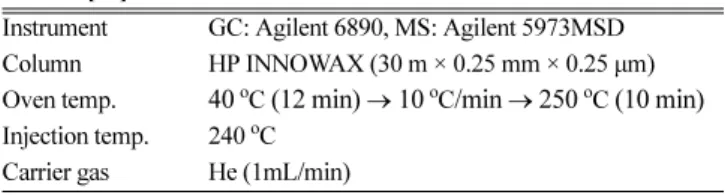
(GC, Agilent 7890A, USA)를 이용하였으며 또한 배양 후 플라스 크 내에 남아있는 아세트산을 확인하기 위해 가스크로마토그래피- 질량분석계(GC: Agilent 6890, MS: Agilent 5973MSD, USA)를 이용하였다. GC 및 GC-MS의 분석조건은 Table 1 및 2에 나타내 었다.
2-4. 유도 효소(Inducible enzyme) 실험
앞서 실시한 톨루엔 및 아세트산 분해 실험에서 무세포 효소 시 스템을 적용하였을 때 분해 능력이 사라진다면, 두 가지 균주의 톨 루엔 및 아세트산 분해 효소를 상시 효소가 아닌 유도 효소로 가정 할 수 있다. 따라서 이에 대한 추가 실험을 다음과 같이 진행하였다.
유도 효소 생성을 위해, 앞서 설명한 방법대로 미생물 배양액을 제 조하고, 배양액에 톨루엔 및 아세트산을 50 ppm농도로 각각 넣어 준 뒤 30oC, 150 rpm에서 24시간 동안 추가로 배양하여 두 균주가 톨루엔 및 아세트산을 분해하도록 하였다. 이후 배양액을 bead- beating을 진행한 뒤 2개의 250 mL 삼각플라스크에 95 mL의 증류 수를 넣은 후, 세포 용해물을 각각 5 mL넣어 100 mL의 용액 2개를 제조하고 톨루엔 및 아세트산을 50 ppm 농도로 넣어 30oC, 150 rpm에서 5일간 진탕배양 하였다. 이후 GC 및 GC-MS를 이용 하여 남아있는 톨루엔 및 아세트산을 확인하였다.
3. 결과 및 고찰
3-1. Colony 형성 여부 확인
일반적인 배양액과 달리 무세포 효소 시스템은 미생물의 세포막 을 파쇄하기 때문에 미생물이 살아있지 못한다. 따라서 세포 용해 물을 NB-agar 배지에 배양하면 살아있는 균이 없기 때문에 colony 가 형성되지 않고, 이를 통해 미생물 배양액과 세포 용해물의 colony 형성 여부를 확인함으로써 무세포 효소 시스템이 적용되었 는지를 간단하게 식별할 수 있다.
본 연구에서 이용된 두 균주에 대하여, 각각의 미생물 배양액과 세포 용해물을 NB-agar 배지에 배양한 사진을 Fig. 1 및 2에 나타
내었다. Fig. 1은 P. putida, Fig. 2는 C. necator에 대하여 미생물 배 양액과 세포 용해물을 나타낸 것으로, 공통적으로 (a)와 대조하여 (b)에서 colony가 존재하지 않는다는 것을 볼 수 있다. 이를 통해 세 포 용해물에는 살아있는 세포가 존재하지 않으며, 따라서 무세포 효소 시스템이 제대로 적용되었다는 것을 확인할 수 있다.
3-2. 톨루엔 분해
이전 연구에서 P. putida는 탄소원 및 에너지원으로써 톨루엔, 벤 젠 등을 이용하는 것으로 알려졌으며[18], 이 중 톨루엔을 분해하는 효소는 toluene dioxygenase로 밝혀졌다[8]. 이 효소는 전자가 플라 보단백질(flavoprotein)에 의해 NADH에서 ferredoxinTOL으로 운 반되고, ferredoxinTOL에 운반된 전자가 iron-sulfur protein-TOL (ISPTOL)에 전달된 후 산소와 결합하여 톨루엔을 cis-toluene dihydrodiol 로 분해한다[13,19,20]. 이전 연구에서는 cis-toluene dihydrodiol의 생성량을 측정함으로써 toluene dioxygenase의 생성 여부를 확인하였고, 톨루엔 존재 하에서 배양된 균주에서만 cis-toluene dihydrodiol이 형성되는 것을 확인하였다. 이를 통해 톨루엔 분해 효소인 toluene dioxygenase는 톨루엔 존재 하에서만 합성되는 유도효소임이 밝혀 졌으며, 또한 tod operon에 의해서 생산량이 조절된다는 것이 밝혀 졌다[13-15,19].
P. putida의 톨루엔 분해 능력 측정을 알아보기 위해 GC 분석을 이용한 잔여 톨루엔 농도 측정 및 몰 수 계산 결과를 Table 3에 나 타내었다. 대조군에 남아있는 톨루엔의 몰 수는 0.0269 mmol로 나 타났고, 실험군 1에 남아있는 톨루엔의 몰 수는 0.0258 mmol로 나 타났다. 잔여 톨루엔 양이 대조군과 실험군 1에서 거의 유사했음에 따라 톨루엔 분해 능력이 사라진 것으로 간주하여 유도 효소 실험 을 진행하였고, 이에 대한 잔여 톨루엔 부피 및 몰 수를 실험군 2에 나타내었다. 실험군 2에서의 잔여 톨루엔 몰 수는 0.0232 mmol로 나타났으며, 잔여 톨루엔 몰 수가 대조군에 비해 0.0037 mmol이 낮다는 것은 P. putida에 무세포 효소 시스템을 적용하면 톨루엔 분 해 능력이 완전히 사라지지는 않으나, P. putida를 톨루엔이 포함된 배지에 배양하여 유도 효소 생산 단계를 거쳐야 한다는 것을 알 수 있다.
3-3. 아세트산 분해
C. necator의 아세트산 분해 능력을 알아보기 위해 GC-MS 분석 결과로 나온 피크(peak)를 Fig. 3에 나타내었다. Fig. 3(a)는 대조군 의 아세트산 피크 측정 결과이고, Fig. 3(b)는 실험군의 아세트산 피크 측정 결과 이다. GC-MS 분석 결과, Fig. 3(a)의 머무름 시간 Fig. 1. Confirmation of colony about P. putida, pre-culture (a) and
cell-lysate (b).
Table 2. Operating conditions of gas chromatography-mass spectrometer [21]
Instrument GC: Agilent 6890, MS: Agilent 5973MSD Column HP INNOWAX (30 m × 0.25 mm × 0.25 µm) Oven temp. 40oC (12 min) → 10oC/min → 250oC (10 min) Injection temp. 240oC
Carrier gas He (1mL/min)
Fig. 2. Confirmation of colony about C. necator, pre-culture (a) and cell-lysate (b).
(retention time) 20.626 min에서 존재하던 피크가 (b)에서는 사라진 것을 볼 수 있었다. 이 피크에 대한 mass spectrum을 Fig. 4(a)에 나 타내었고, 아세트산에 대한 mass spectrum library (reference)를 (b) 에 나타내었다. Fig. 4(b)의 아세트산 reference mass spectrum에서 분자 이온(molecular ion)은 m/z=60 (CH3COOH)이고, base 이온은 m/z=45 이므로, fig 4(a)의 분자이온에 해당하는 m/z와 base 이온에 해당하는 m/z 및 조각(fragment) 이온에 해당하는 m/z 값이 reference 와 유사하게 검출되었기 때문에, Fig. 3(a)에서 검출된 피크는 아세 트산에 해당하는 피크임을 알 수 있다. C. necator는 아세트산, 프 로피온산 등의 지방산(fatty acid)을 분해하여 성장에 이용하거나, 고분자와 유사한 특성을 갖고 있어 생분해성 물질로 이용되는 PHA와 같은 고분자 물질 합성에 이용되는데[9,16], 이 균주는 acetyl coenzyme A synthetase-1를 이용하여 아세트산을 acetyl CoA로 전환 시킨 후 이를 바로 PHA 합성에 이용하거나 시트르산 회로(TCA cycle)를 거쳐 ATP를 합성하는데 이용하고 또한 아세트산을 succinyl-CoA로
전환시킨 후 PHA를 합성하는데 이용한다[17]. 이 중 아세트산을 acetyl CoA로 전환 시키는 acetyl coenzyme A synthetase-1은 ATP 합성을 위한 필수적인 효소이기 때문에 상시 효소이고, 아세트산의 피크가 Fig. 3(b)에서 나타나지 않은 것으로 보아 C. necator는 P.
putida와 달리 추가 단계를 거칠 필요 없이 무세포 효소 시스템 적 용 후에도 아세트산을 분해할 수 있는 능력을 유지하는 것으로 판 단된다.
4. 결 론
본 연구에서는 톨루엔 분해 균주인 P. putida와 아세트산 분해 균 주인 C. necator에 대해 단일 균주 유래 무세포 효소 시스템을 적용 하여 각각의 분해 능력이 유지되는지에 대하여 실험을 진행하였다.
P. putida가 생산하는 toluene dioxygenase는 전자가 NADH, ferredoxin 및 iron-sulfur protein를 거쳐 산소와 결합하여 톨루엔을 cis-toluene Fig. 3. GC-MS peak of acetic acid to remain after acetic acid was degraded by C. necator, control group (a) and experimental group (b).
Table 3. Concentration, volume and mole of toluene after shaking incubation at 30oC, 150 rpm and 120 h
Toluene Liquid Gas Total
Concentration (ppm) Volume (µL) Concentration (ppm) Volume (µL) Volume (µL) Mole (mmol)
*Control 7.41 0.741 11.34 2.120 2.861 0.0269
**Experimental Group 1 7.69 0.769 10.94 1.969 2.738 0.0258
***Experimental Group 2 11.15 1.115 7.32 1.354 2.469 0.0232
*Control: water + toluene
**Experimental Group 1: toluene-uninduced cell-lysate of P. putida + toluene
***Experimental Group 2: toluene-induced cell-lysate of P. putida + toluene
dihydrodiol로 분해하며, C. necator는 TCA cycle을 통해 ATP를 합 성하거나 생분해성 고분자인 PHA를 합성하기 위해 아세트산을 이 용하는데, 이 과정에서 아세트산을 acetyl CoA로 분해하는 효소인 acetyl coenzyme A synthetase-1가 생성된다. P. putida는 무세포 효 소 시스템을 적용하였을 때, 톨루엔 분해 능력이 사라진 것을 볼 수 있었지만, 톨루엔을 함께 넣어 배양한 미생물 배양액에 대하여 무 세포 효소 시스템을 적용하였을 때는 분해 능력이 유지되었다. C.
necator는 무세포 효소 시스템을 적용하였을 때, 아세트산의 농도를 보여주는 가스 크로마토그래피-질량분석기에서 아세트산의 피크가 실험군에서는 사라진 것을 볼 수 있었다. 따라서 P. putida와 같이 유도 효소를 갖는 균주가 있기 때문에 무세포 효소 시스템을 생물 공학적으로 적용할 때는 이용 하려는 균주의 특성을 고려한 후 적 절한 단계를 거쳐 적용해야 할 필요성이 있다. 본 연구 결과는 무세 포 효소 시스템을 개발하기 위하여 필요한 효소준비 방법에 대한 유용한 정보를 제시함으로써, 무세포 효소 시스템을 기존보다 간편 하게 개발 할 수 있으므로, 무세포 효소 시스템은 다양한 분야로 그 응용 범위가 확장될 것이다.
References
1. Ahn, J. W., Kim, Y. H., Kim, K. H. and Song, H. N., “A Review of Analytical Method for Volatile Fatty Acids as Designated Offensive Odorants in Korea,” Analytical Science and Technol- ogy, 25(2), 91-101(2012).
2. Hupert-Kocurek, K., Guzik, U. and Wojcieszynska, D., “Characteri- zation of Catechol 2,3-dioxygenase from Planococcussp. strain S5 Induced by High Phenol Concentration,” Acta. Biochim. Pol., 59(3), 345-351(2012).
3. Fan, L. H., Zhang, Z. J., Yu, X. Y., Xue, Y. X., Wang, M. M. and Tan, T. W., “In vitro Assembly of Minicellulosomes with Two Scaffoldins on the Yeast Cell Surface for Cellulose Saccharifica-
tion and Bioethanol Production,” Process Biochem., 48(3), 430- 437(2013).
4. Khattak, W. A., Ullah, M. W., Ul-Islam, M., Khan, S., Kim, M.
A., Kim, Y. and Park, J. K., “Development Strategies and Regulation of Cell-free Enzyme System for Ethanol Production: a Molecu- lar Prospective,” Appl Microbiol. Biotechnol., 98(23), 9561-9578 (2014).
5. Welch, P. and Scopes, R. K., “Studies on Cell-free Metabolism:
Ethanol Production by a Yeast Glycolytic System Reconstituted From Purified Enzymes,” J. Biotechnol., 2(5), 257-273(1985).
6. Ullah, M. W., Khattak, W. A., Ul-Islam, M., Khan, S. and Park, J. K., “Encapsulated Yeast Cell-free System: A Strategy for Cost-effective and Sustainable Production of Bio-ethanol in Consecutive Batches,” Biotechnol. Bioprocess Eng., 20(3), 561- 575(2015).
7. Ullah, M. W., Khattak, W. A., Ul-Islam, M., Khan, S. and Park, J. K., “Bio-ethanol Production Through Simultaneous Saccharification and Fermentation Using An Encapsulated Reconstituted Cell- free Enzyme System,” Biochem. Eng. J., 91, 110-119(2014).
8. Yeh, W. K., Gibson, D. T. and Liu, T.-N., “Toluene Dioxygenase:
A Multicomponent Enzyme System,” Biochem. Biophys. Res.
Commun., 78(1), 401-410(1977).
9. Chakraboyty, P., Gibbons, W. and Muthukumarappan, K., “Conver- sion of Volatile Fatty Acids Into Polyhydroxyalkanoate by Ralstonia Eutropha,” J. Appl. Microbiol., 106(6), 1996-2005(2009).
10. Khan, S., Khattak, W. A., Ullah, M. W., Yu, B. and Park, J. K.,
“Enhanced Bio-ethanol Production via Simultaneous Saccharifi- cation and Fermentation Through a Cell Free Enzyme System Prepared by Disintegration of Waste of Beer Fermentation Broth,”
Korean J. Chem. Eng., 32(4), 694-701(2015).
11. Ullah, M. W., Ul-Islam, M., Khan, S., Kim, Y. and Park, J. K.,
“Innovative Production of Bio-cellulose Using a Cell-free System Derived from a Single Cell Line,” Carbohydr Polym., 132, 286- Fig. 4. Mass spectrum of acetic acid from GC-MS, this study (a) and reference (b).
294(2015).
12. Khattak, W. A., Ul-Islam, M., Ullah, M. W., Yu, B. and Park, J.
K., “Yeast Cell-free Enzyme System for Bio-ethanol Production at Elevated Temperatures,” Process Biochem., 49(3), 357-364(2014).
13. Finette, B. A., Subramanian, V. and Gibson, D. T., “Isolation and Characterization of Pseudomonas Putida PpF1 Mutants Defective in the Toluene Dioxygenase Enzyme System,” J. Bacteriol., 160(3), 1003-1009(1984).
14. Zylstra, G. J., McCombie, W. R., Gibson, D. T. and Finette, B.
A., “Toluene Degradation by Pseudomonas putida F1: Genetic Organization of the tod Operon,” Appl Environ Microbiol., 54(6), 1498-1503(1988).
15. Subramanian, V., Liu, T. -N., Yeh, W. K. and Gibson, D. T., “Tol- uene Dioxygenase: Purification of An Iron Sulfur Protein by Affin- ity Chromatography,” Biochem. Biophys. Res. Commun., 91(3), 1131-1139(1979).
16. Lee, S. Y., “Bacterial Polyhydroxyalkanoates,” Biotechnol Bioeng, 49(1), 1-14(1996).
17. Wang, J., Yue, Z. B., Sheng, G. P. and Yu, H. Q., “Kinetic Analysis on the Production of Polyhydroxyalkanoates from Volatile Fatty Acids by Cupriavidus Necator with a Consideration of Substrate Inhibition, Cell Growth, Maintenance, and Product Formation,”
Biochem. Eng. J., 49(3), 422-428(2010).
18. Gibson, D. T., Koch, J. R. and Kallio, R. E., “Oxidative Degrada- tion of Aromatic Hydrocarbons by Microorganisms: I. Enzymatic Formation of Catechol from Benzene,” Biochemistry, 7(7), 2653- 2662(1968).
19. Rogers, J. E. and Gibson, D. T., “Purification and Properties of cis- Toluene Dihydrodiol Dehydrogenase from Pseudomonas putida,”
J. Bacteriol., 130(3), 1117-1124(1977).
20. Ziffer, H., Jerina, D. M., Gibson, D. T. and Kobal, V. M., “Absolute Stereochemistry of the (+)-cis-1,2-dihydroxy-3-methylcyclohexa- 3,5-diene Produced from Toluene by pseudomonas putida,” J. Am.
Chem. Soc., 95(12), 4048-4049(1973).
21. Lee, J. S., “Biological Treatment of Wastewater in Automobile Paint Shop,” MS. Thesis, Kyungpook National University, Daegu, Korea (2015).
22. Kim, J. Y., Yoon, S. M., Park, K., Yoon, S. K., Kil, I. S., Park, H.
J. and Rhee, Y., “Investigation on Desorption Characteristics of VOCs Adsorbed on Used Activated Carbons Collected from Paint- ing Process,” Korean Chem. Eng. Res., 48(6), 752-756(2010).
23. Kim, S. S., Park, D. W., Kim, S. Y., Kim, J. H., Haam, S. J., Kim, E. and Kim, W. S., “VOC Treatment Characteristics Using Biofilter and Its Performance Enhancement with the Addition of Microorganisms,” Korean Chem. Eng. Res. (HWAHAK KONGHAK), 39(3), 340-345(2001).