127 Korean Chem. Eng. Res., 53(1), 127-130 (2015)
http://dx.doi.org/10.9713/kcer.2015.53.1.127 PISSN 0304-128X, EISSN 2233-9558
활성탄에서의 아세트산 흡착거동 연구
박경목 · 남희근 · 문성용† 한양대학교 화학공학과 133-791 서울특별시 성동구 왕십리로 222
(2014년 6월 26일 접수, 2014년 8월 8일 수정본 접수, 2014년 8월 11일 채택)
Adsorption Equilibria of Acetic Acid on Activated Carbon
Kyong-Mok Park, Hee-Geun Nam and Sungyong Mun†
Department of Chemical Engineering, Hanyang University, 222 Wangsimni-ro, Seongdong-gu, Seoul 133-791, Korea (Received 26 June 2014; Received in revised form 8 August 2014; accepted 11 August 2014)
요 약
본 연구에서는 활성탄을 흡착제로 사용하여 아세트산의 흡착 평형 실험을 313.15, 323.15 K에서 수행하였다. 아세 트산의 흡착평형 데이터를 Langmuir, Bi-Langmuir, Freundlich model로부터의 계산 결과와 비교하였다. 이 과정에서 각 model 내 isotherm parameter는 실험값과 계산값의 차이의 제곱의 합을 최소화하는 방식으로 결정하였다. 비교 결과 활성탄상에서의 아세트산의 흡착평형 데이터를 가장 잘 설명해주는 model은 Bi-Langmuir model이었음을 확인하였다.
Abstract − In this study, the adsorption equilibria of acetic acid on activated carbon were investigated at the tempera- tures of 313.15 K and 323.15 K. The obtained adsorption data were then fitted by Langmuir, Bi-Langmuir, and Freundlich models, in which the relevant model parameters were determined by minimizing the sum of the squares of deviations between experimental data and calculated values. The comparison results revealed that Bi-Langmuir model could account for the adsorption equilibrium data of acetic acid with the highest accuracy among the three adsorption models considered.
Key words: Activated Carbon, Acetic Acid, Adsorption Equilibria, Bi-Langmuir Model
1. 서 론
다양한 작용기를 가진 유기산들은 여러 유용한 물질들로 변환될 수 있기 때문에 화학 산업에서 부가가치가 높은 물질로 알려져 있다.
이러한 유기산들의 생산 비용 상당 부분은 분리 및 회수 공정에 있 기 때문에 이 부분의 효율 향상을 위한 흡착제의 선정이 중요하다 [1].
이와 같은 흡착제의 선정은 분리시키고자 하는 물질에 대한 선택도 뿐만 아니라 흡착제 구입 가격 또한 중요한 고려 사항이 될 수 있다.
이와 같은 관심사를 다루기 위해 본 연구에서는 비교적 가격이 저렴 한 것으로 알려진 활성탄을 이용하여 아세트산을 효과적으로 흡착 시켜 분리 및 회수하는 공정 개발에 필요한 흡착 평형 데이터와 관 련 파라미터 등의 측정을 수행할 것이다.
아세트산을 분리 및 회수하는 공정은 과거 문헌에서도 여러 차례 보고된 바 있다[1,2]. 주목할 만한 과거의 아세트산 분리 사례는 ion-
exclusion resin 또는 PVP 흡착제를 이용한 아세트산 분리였다[1, 2].
이 두 경우 모두 아세트산 분리에 효과적인 것으로 보고되고 있다.
본 연구에서는 이전의 흡착제들보다 가격이 비교적 저렴한 것으로 알려진 활성탄을 이용한 아세트산 분리 및 회수 가능성을 파악해보 고자 하였다.
흡착평형 데이터의 측정은 다양한 방법을 이용하여 예측할 수 있 다. 여러 방법들 중 본 연구에서는 batch equilibrium method를 사용 하여 흡착평형 데이터를 측정하고 아울러 이 데이터들을 잘 설명해 줄 수 있는 흡착평형 모델식과 관련 파라미터 등을 결정하였다. 이 과정에서 Langmuir, Bi-Langmuir, Freundlich model을 사용하였으 며 이와 같은 접근 방법은 과거 여러 문헌에서 확인할 수 있다[3,4].
2. 실 험 2-1. 실험재료 및 장치
본 연구에서 시약으로 사용된 아세트산은 Mallinckrodt Baker Inc.
(Paris, KY)에서 구입하였다. 그리고 컬럼에 충진된 활성탄은 Calgon Carbon(Pittsburgh, PA)에서 구입한 CPGLF 12×40(Lot number : S06330NJ5)이며, 역청탄(bituminous coal)을 원료로 제조되었다.
†To whom correspondence should be addressed.
E-mail: [email protected]
‡이 논문은 한양대학교 배성열 교수님의 정년을 기념하여 투고되었습니다.
This is an Open-Access article distributed under the terms of the Creative Com- mons Attribution Non-Commercial License (http://creativecommons.org/licenses/by- nc/3.0) which permits unrestricted non-commercial use, distribution, and reproduc- tion in any medium, provided the original work is properly cited.
단 신
128 박경목 · 남희근 · 문성용
Korean Chem. Eng. Res., Vol. 53, No. 1, February, 2015
균일한 크기의 활성탄을 얻기 위해 체눈 크기가 25, 40 mesh ASTM 인 두 개의 sieves(Chung Gye Sang Gong Sa, Seoul, Korea)와 shaker (HST-203S, Hanbaek ST Co., Korea)를 사용해 그 구간 내의 활성 탄을 분리하고, 진공 오븐(HST-501VS, Hanbaek ST Co., Korea)에 서 건조시켰다. 그리고 흡착평형실험은 진탕 배양기(HST-201SL, Hanbaek ST Co., Korea)내에서 진행되었다. 실험결과를 분석하기 위한 HPLC에서 이동상의 유속을 조절해주기 위해 Waters 515 HPLC pump를 사용하였으며, eluent인 DDW는 Milli-Q system (Millipore, Bedford, MA)에서 얻었다. Eluent의 온도는 Water bath (BW-10G, Jeio-Tech Co., LTD, Korea)를 이용해 40oC로 유지시켜 주었다. 시료는 Rheodyne 7725i manual injector를 통해 주입하였으 며, injection volume은 5 μL이다. Waters 2414 RI detector로 아세 트산 농도를 분석하였다.
2-2. 실험방법
실험의 동일성을 위해 체를 이용하여 425~710 μm 크기 분포를 지닌 활성탄을 얻어 진공 오븐에서 50oC를 유지하여 20시간 이상 건조시켰다. 100 mL 삼각플라스크에 활성탄 10 g과 아세트산 용액 100 mL를 넣어 밀봉하였다. 이 때, 각각의 아세트산의 농도는 0.9 g/L 단위로 0.9~9 g/L이다. 이 플라스크들을 진탕 배양기에 넣어 각각 40oC 및 50oC에서 150 rpm으로 20시간 이상 흡착을 진행시켰다.
Incubator 내에서의 흡착 시간은 사전 테스트를 통해 평형에 충분히 도달되는 시간으로 정하였다.
평형에 도달한 후 각 시료의 농도를 분석하기에 앞서, 삼각플라스 크에서의 상등액을 5 μm filter paper로 filtering을 해 주었다. Filtering 한 시료는 HPLC 시스템을 이용하여 분석하였는데, single-component 흡착이므로 분석용 컬럼 없이 Waters 2414 RI detector로 분석이 가 능하였다. 시료의 농도는 calibration curve에서의 면적과 농도와의 관계식을 통해 구할 수 있었다.
(1)
아세트산의 흡착량(qe)은 위의 식을 통해 구할 수 있는데, V는 liquid phase의 부피를, Ci는 초기 농도를, Ce는 평형상태에서의 농도를, m은 건조된 흡착제의 질량을 나타낸다.
3. 결과 및 고찰
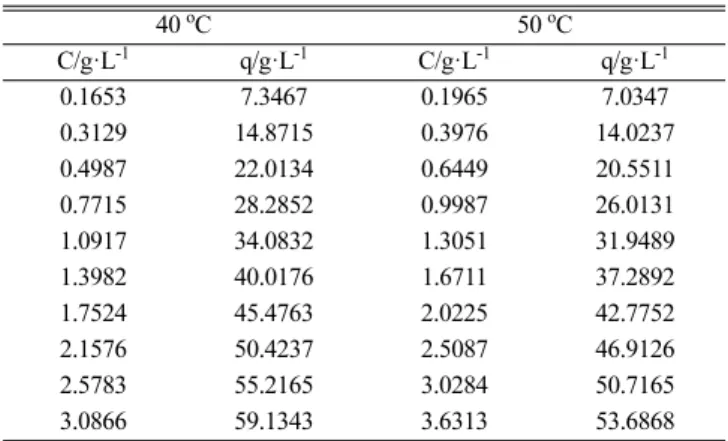
313.15 K와 323.15 K에서 활성탄에 대한 아세트산의 흡착 실험 결과를 Table 1에 나타내었으며, 이를 바탕으로 네 가지 adsorption equilibrium model 즉, Langmuir, Bi-Langmuir, Freundlich isotherm model에 적용시켜 보았다.
(2)
(3)
(4) Langmuir isotherm은 균일한 표면상에서의 흡착을 전제로 하여 세워졌으며, 식 (2)와 같이 나타낼 수 있다[5]. qe(g·kg-1)는 평형상태
에서 활성탄에 흡착된 물질의 양을 나타내며 Ce(g·L-1)는 평형상태에서의 solution의 농도를 의미한다. qm(g·kg-1)과 ki(L·g-1)는 Langmuir parameter들로서 각각 최대 흡착량 및 흡착 에너지와 관계된 parameter이다. 식 (2)~(5)에 나타나 있는 아래첨자 i는 온도를 나타 내며, i가 포함된 각 변수는 그 온도에서의 parameter를 의미한다.
qm은 고정된 값으로 온도의 영향을 받지 않지만, ki는 equilibrium constant로서 온도에 따라 다른 값을 나타낸다[6-9]. 따라서 ki는 vant’s Hoff equation을 따르며 식 (6)과 같이 표현될 수 있다[6].
(5)
식 (5)에서, k0는 pre-exponential factor이며, ΔH는 흡착과정에서의 enthalpy를 의미하며, RT과 는 각각 기체 상수 및 흡착반응에서의 온도를 나타낸다.
Bi-Langmuir isotherm은 식 (3)에서 보는 것처럼 두 개의 Langmuir term으로 구성되어, 두 개의 흡착 site를 가지고 있는 흡착제에서의 물질의 흡착을 잘 설명해준다[10]. 이 흡착 site는 non-selective site와 selective site로 나눌 수 있으며, qns(g·kg-1)와 kns,i(L·g-1)는 non-selective site에서의 최대 흡착량 및 흡착 에너지를, qe(g·kg-1)와 ks,i(L·g-1)는 selective site에서의 최대 흡착량 및 흡착 에너지를 나타낸다. 일반적으로 non-selective site에 비해 selective site에서 보다 강한 interaction이 작용하기 때문에 ks,i값이 kns,i값보다 더 크다. 반면에 qs값은 qns에 비해 작은 값을 가진다[11-13].
식 (4)는 에너지 차원에서의 불균일한 표면 흡착을 다루는 Freundlich equation이며, ai(g·kg-1)와 1/n은 각각 Freundlich affinity parameter 및 exponential Freundlich coefficient이다[14,15].
이러한 3가지의 adsorption equilibrium model의 parameter들은 GA(genetic algorithm)을 통해 구하였다. Initialization, crossover, mutation, elitism 과정을 거쳐 값들을 구하도록 MATLAB 7.0에서 프로그래밍 하였는데, 식 (6)을 목적함수로 두어 실험 데이터와의 오 차가 최소가 되는 값을 선정하였다.
(6)
N은 은 fitting하기 위한 실험 데이터의 개수를 나타내며, 40oC와 50oC 실험 결과를 바탕으로 isotherm parameter를 구하기 때문에 N의 qe V C( i–Ce)
---m
=
qe qmkiCe 1 k+ iCe ---
=
qe qnskns i,Ce 1 k+ ns i,Ce
--- qsks i,Ce 1 k+ s i,Ce --- +
=
qe aiCe
1n---
=
ki k0exp ΔH RT---
⎝– ⎠
⎛ ⎞
=
F (qcal i, –qexp i,)2
i 1=
∑
N=
Table 1. Single-component adsorption equilibrium data of acetic acid on activated carbon in the temperature range from T=(40 to 50)oC
40oC 50oC
C/g·L-1 q/g·L-1 C/g·L-1 q/g·L-1
0.1653 7.3467 0.1965 7.0347 0.3129 14.8715 0.3976 14.0237 0.4987 22.0134 0.6449 20.5511 0.7715 28.2852 0.9987 26.0131 1.0917 34.0832 1.3051 31.9489 1.3982 40.0176 1.6711 37.2892 1.7524 45.4763 2.0225 42.7752 2.1576 50.4237 2.5087 46.9126 2.5783 55.2165 3.0284 50.7165 3.0866 59.1343 3.6313 53.6868
활성탄에서의 아세트산 흡착거동 연구 129
Korean Chem. Eng. Res., Vol. 53, No. 1, February, 2015 값은 20이다. 그리고 GA를 통해 얻은 각각의 Langmuir, Bi-Langmuir,
Freundlich equation model의 standard deviation value는 식 (7)을 통해 구하였다.
(7)
N은 식 (6)에 쓰인 변수와 같은 것으로 실험 데이터의 개수를 나타 내며, P는 fitting한 각각의 isotherm model의 parameters 개수를 의 미한다. 즉, Langmuir model에서는 P가 3, Bi-Langmuir model에서는 P가 6, Freundlich model에서 P값은 3을 가진다. 그리고 각 isotherm model에 따른 standard deviation value는 Table 2에 나타내었다.
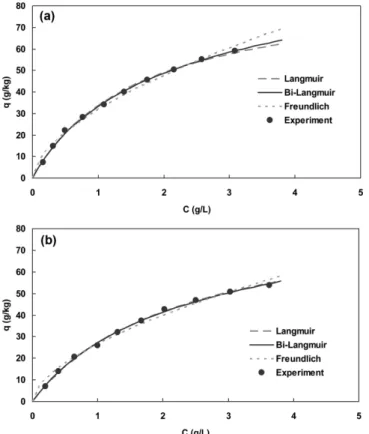
온도에 따른 각 물질의 실험데이터와 isotherm을 적용하여 fitting한 결과를 Fig. 1에 나타내었다. 그림에서 보듯이 Langmuir, Bi-Langmuir, Freundlich model 모두 실험결과와 비슷한 경향을 보였다. 이 세 종 류의 isotherm model 중 Bi-Langmuir model이 가장 잘 일치하는 경 향을 보였고, 그 다음은 Langmuir model이 잘 일치하는 경향을 보 여주었다. Freundlich model의 경우는 앞의 두 model보다는 더 큰 deviation을 보였다. 이와 같은 경향은 Table 2의 standard deviation 결과에서도 확인할 수 있다.
온도에 따른 흡착 거동을 비교하기 위해 실험 데이터와 가장 근 접하게 일치한 Bi-Langmuir model을 적용하여 fitting한 결과를 Fig. 2에 나타내었다. 아세트산이 온도가 증가함에 따라 동일한 solution의 농 도에서 활성탄에 흡착하는 물질의 양이 줄어드는 것을 볼 수 있다. 아울 러 Table 3에 나타낸 Langmuir equilibrium parameter와 Freundlich affinity parameter 값이 온도가 증가함에 따라 감소함을 확인하였다. 이 결 과는 활성탄상에서의 아세트산 흡착이 발열흡착과정임을 의미한다.
4. 결 론
활성탄에 대한 아세트산의 흡착 실험을 313.15, 323.15 K에서 실 시하였다. 그리고 실험 데이터 결과를 바탕으로 genetic algorithm을 사용하여 Langmuir, Bi-Langmuir, Freundlich isotherm model의 parameter 를 구하였다. 실험 데이터와 isotherm model을 함께 fitting 해 보았을 때, Bi-Langmuir model이 실험 결과를 가장 잘 설명해 주는 것으로 확인되었다.
감 사
본 연구는 미래창조과학부의 지원으로 수행한 중견연구자 지원사 업(NRF-2012R1A2A2A01019790)의 연구결과입니다.
σ
qcal i, –qexp i,
( )2
i 1=
∑
NN P– ---
=
Table 2. Standard deviation value for each isotherm model Component Isotherm Standard deviation (σ)
Acetic acid
Langmuir 0.8587
Bi-Langmuir 0.8407 Freundlich 1.8712
Fig. 1. Comparison of the fit of various isotherm equations for the adsorption of acetic acid on activated carbon. (a)40oC, (b)50oC.
Fig. 2. Bi-Langmuir isotherms of acetic acid onto activated carbon at different temperatures.
Table 3. Parameters of Langmuir, Bi-Langmuir, and Freundlich isotherms
Isotherm Parameters
Langmuir qs k40 k50
89.6777 0.5987 0.4313
Bi-Langmuir qns qs kns,40 ks,40 kns,50 ks,50
65.8855 64.2494 0.0850 0.7787 0.0530 0.5966
Freundlich a40 a50 n
31.7570 26.5802 1.7064
130 박경목 · 남희근 · 문성용
Korean Chem. Eng. Res., Vol. 53, No. 1, February, 2015
References
1. Xie, Y., Phelps, D., Lee, C. H., Sedlak, M., Ho, N. and Wang, N.
H. L., “Comparison of Two Adsorbents for Sugar Recovery from Biomass Hydrolyzate,” Ind. Eng. Chem. Res., 44, 6816-6823(2005).
2. Xie, Y., Chin, C. Y., Phelps, D., Lee, C. H., Lee, K. B., Mun, S.
and Wang, N. H. L., “A Five-Zone Simulated Moving Bed for the Isolation of Six Sugars from Biomass Hydrolyzate,” Ind.
Eng. Chem. Res., 44, 9904-9920(2005).
3. Lee, J. W., Jung, H. J., Moon, H. and Moon, I. S., “Adsorption Equilibria of Maltooligosaccharides on Activated Carbon,” Korean Chem. Eng. Res., 37(6), 890-896(1999).
4. Jin, Y., Choi, D. K. and Row K. H., “Adsorption Isotherms of Caffeine on Molecular Imprinted Polymer,” Korean J. Chem.
Eng., 25(4), 816-818(2008).
5. Langmuir, I., “The Constitution and Fundamental Properties of Solids and Liquids” , J. Am. Chem. Soc., 38, 2221-2295(1916).
6. Ruthven, D. M., “Principles of Adsorption and Adsorption Pro- cesses,” John Wiley & Sons., NewYork, 1984.
7. Kim, J. K., Abunasser, N., Wankat, P. C., Stawarz, A. and Koo, Y. M., “Thermally Assisted Simulated Moving Bed Systems,”
Adsorption., 13, 579-584(2005).
8. Jin, W. and Wankat, P. C., “Thermal Operation of Four-Zone Simu- lated Moving Beds,” Ind. Eng. Chem. Res., 46, 7208-7220(2007).
9. Al-Muhtaseb, S. A., Abu Al-Rub, F. A. and Al Zarooni, M.,
“Adsorption Eqilibria of Nitrogen, Methane and Ethane on BDH Activated Carbon,” J. Chem. Eng. Data., 52, 60-65(2007).
10. Graham, D., “The Characterization of Physical Adsorption Sys- tems. I. The Equilibrium Function and Standard Free Energy of Adsorption,” J. Phys. Chem., 57, 665-669(1953).
11. Jacobson, S., Golshan-Shirazi, S. and Guiochon, G., “Chromato- graphic Band Profiles and Band Separation of Enantiomers at High Concentration,” J. Am. Chem. Soc., 112, 6492-6498(1990).
12. Jacobson, S., Golshan-Shirazi, S. and Guiochon, G., “Isotherm Selection for Band Profile Simulations in Preparative Chroma- tography,” AIChE J., 37, 836-844(1991).
13. Fornstedt, T., Sajonz, P. and Guiochon, G., “Thermodynamic Study of an Unusual Chiral Separation. Propranolol Enantiomers on an Immobilized Cellulase,” J. Am. Chem. Soc., 119, 1254-1264(1997).
14. Freundlich, H. M. F., “Over the Adsorption in Solution,” Z. Phys.
Chem., 57, 385-471(1906).
15. R. Sips., “On the Structure of a Catalyst Surface,” J. Chem. Phys., 16, 490-495(1948).
16. Alzaydien, A. S. and Manasreh, W., “Equilibrium, Kinetic and Thermodynamic Studies on the Adsorption of Phenol onto Acti- vated Phosphate Rock,” Int. J. Phys. Sci., 4, 172-181(2009).
17. Mittal, A., Kurup, L. and Mittal, J., “Freundlich and Langmuir Adsorption Isotherms and Kinetics for the Removal of Tartrazine from Aqueous Solutions using Hen Feathers,” J. Hazard, Mater., 146, 243-248(2007).
18. Gueu, S., Yao, B., Adouby, K. and Ado, G., “Kinetics and Ther- modynamics Study of Lead Adsorption onto Activated Carbons from Coconut and Seed Hull of the Palm Tree,” Int. J. Environ.
Sci. Tech., 4, 11-17(2007).