1. INTRODUCTION
Precise vehicle localization is critical for safe driving of autonomous vehicles. GPS is widely used for position recognition. However, positioning accuracy of GPS is unreliable in urban areas. In order to solve this problem, techniques for precisely recognizing the position through the combination of various sensors (GPS, IMU, camera, LIDAR, etc.) have been continuously studied.
Recently, vehicle localization techniques based on intensity map using 3D LIDAR have been extensively studied. Levinson et al. (2007), Levinson & Thrun (2010) and Hata & Wolf (2014) have presented a vehicle localization method based on road intensity maps using 3D LIDAR. Wolcott & Eustice (2014) presented a vehicle localization method based on road intensity maps using cameras. Such road intensity map based
Precise Vehicle Localization Using 3D LIDAR and GPS/DR in Urban Environment
Jun-Hyuck Im, Gyu-In Jee
†Department of Electronics Engineering, Konkuk University, Seoul 05029, Korea
ABSTRACT
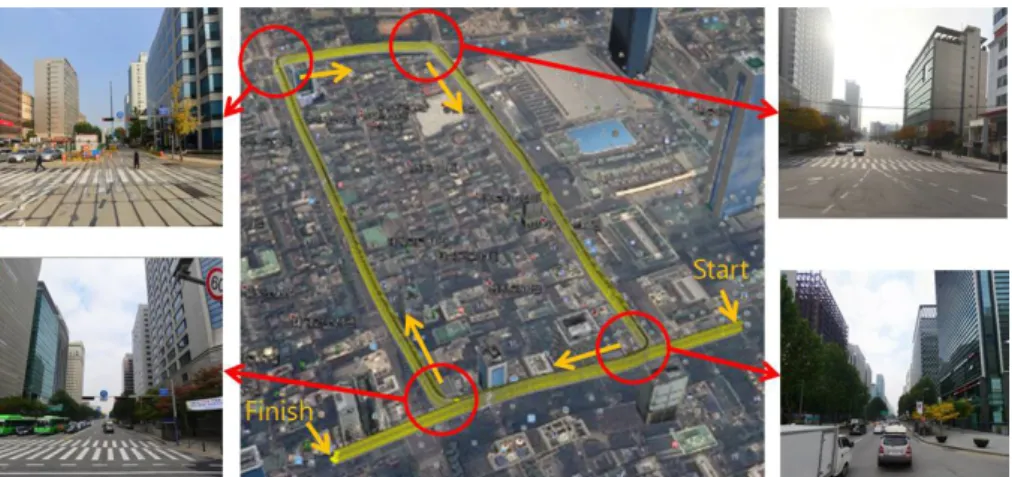
GPS provides the positioning solution in most areas of the world. However, the position error largely occurs in the urban area due to signal attenuation, signal blockage, and multipath. Although many studies have been carried out to solve this problem, a definite solution has not yet been proposed. Therefore, research is being conducted to solve the vehicle localization problem in the urban environment by converging sensors such as cameras and Light Detection and Ranging (LIDAR). In this paper, the precise vehicle localization using 3D LIDAR (Velodyne HDL-32E) is performed in the urban area. As there are many tall buildings in the urban area and the outer walls of urban buildings consist of planes generally perpendicular to the earth's surface, the outer wall of the building meets at a vertical corner and this vertical corner can be accurately extracted using 3D LIDAR. In this paper, we describe the vertical corner extraction method using 3D LIDAR and perform the precise localization by combining the extracted corner position and GPS/DR information. The driving test was carried out in an about 4.5 km-long section near Teheran-ro, Gangnam. The lateral and longitudinal RMS position errors were 0.146 m and 0.286 m, respectively and showed very accurate localization performance.
Keywords: precise vehicle localization, 3D LIDAR, vertical corner, GPS/DR, urban environment
vehicle localization techniques show high accuracy. However, as shown in Fig. 1, these methods have a problem in that intensity varies depending on the weather conditions of the road surface and the brightness of day and night. Particularly, the localization performance deteriorates severely in the vehicular congestion section since the road surface cannot be scanned by the LIDAR.
While there are many high buildings in urban areas that block GPS signals and the positioning accuracy of GPS is poor,
Received Feb 14, 2017 Revised Feb 20, 2017 Accepted Feb 21, 2017
†
Corresponding Author E-mail: [email protected]
Tel: +82-2-450-3070 Fax: +82-2-3437-5235 Fig. 1. Intensity map (left: wet road, right: dry road).
these high buildings can be a very good landmark for map information in the case of the precise localization method using 3D LIDAR. Map information can be represented in various forms such as 2D/3D occupancy grid map, 3D point cloud, 2D corner feature points, 2D contour (line), and 3D vertical plane. In this paper, we focused on the fact that the outer wall of the building is almost flat and perpendicular to the ground. The vertical corners of the building's exterior walls can be very good landmark information and can be extracted very precisely using the 3D LIDAR's distance information.
Also, performance deterioration does not occur in the vehicular congestion section. The present author proposed a method to utilize vertical corners of urban buildings for precise vehicle localization in a previous study (Im et al. 2016).
However, previous studies have assumed that the initial position of the vehicle is known, and the position and attitude change used in the time update of Extended Kalman Filter was calculated using Iterative Closest Point (ICP) algorithm.
ICP is not suitable for real-time implementation due to the long computation time even though ICP provides accurate position and attitude variations. In this paper, we performed vehicle precise positioning using low - cost commercial GPS/DR sensor information instead of ICP and analyzed the positioning performance after driving test near Teheran-ro, Gangnam in urban area.
This paper is organized as follows. Section 2 explains the definition and extraction of corners, and Section 3 describes the Kalman filter configuration. In Section 4, the experimental results are analyzed and in Section 5, conclusions are given.
2. CORNER DEFINITION AND EXTRACTION METHODS
2.1 Corner Definition
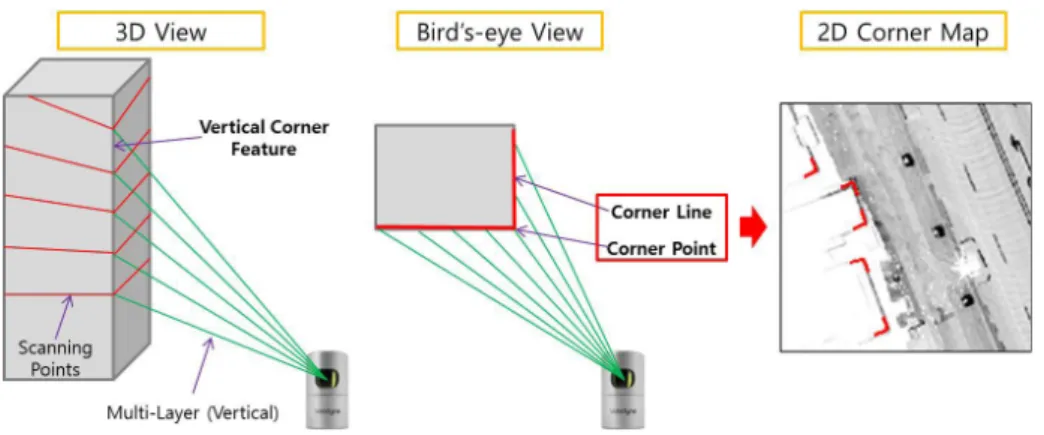
In general, a corner is a point or an edge that is generated
when two lines or faces meet. The exterior walls of the building are mostly almost flat and perpendicular to the ground. Therefore, there are four or more vertical corners in each building. These vertical corners are easily and accurately extracted using 3D LIDAR.
In this paper, vertical corners are projected on the ground and used as point landmarks in the 2D horizontal plane.
Fig. 2 explains the corner definition. A corner consists of one corner point and two corner lines. Fig. 3 shows the attributes of the corner feature. Corner points are represented at the 2D horizontal position in the ENU coordinate system. The corner line has directionality with respect to the corner point.
Therefore, as shown in Fig. 3, the corner line is represented by the direction angle (θ
1, θ
2) in the ENU coordinate system.
2.2 Corner Extraction
In this paper, Velodyne HDL-32E 3D LIDAR sensor is used and we only use the top eight layers out of the 32 layers to scan the ground because we extract the vertical corners of the building. Also, the scan data was processed for each layer.
Corner extraction requires accurate line extraction. The line extraction algorithm is presented by many researchers such as Arras & Siegwart (1997), Siadat et al. (1997), Borges
Fig. 3. Attribute of the corner feature.
Fig. 2. Corner definition.
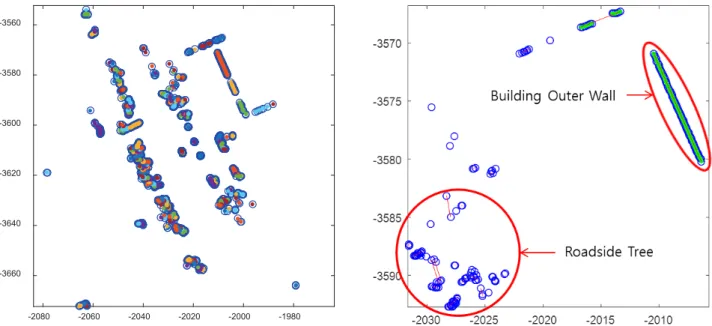
& Aldon (2004) and Harati & Siegwart (2007). In particular, Nguyen et al. (2005) presented a paper that compares the performance of several line extraction algorithms and Iterative-End-Point-Fit (IEPF) algorithm showed the best performance and computation time. Therefore, the lines in this paper are extracted using IEPF algorithm. Fig. 4 shows the result of line extraction using IEPF algorithm. In order to easily figure out the line extraction result, it is divided into several arbitrary colors.
In Fig. 4, most of the extracted line components are a collection of scan points reflected by the street trees. Therefore, these outliers should be eliminated. Fig. 5 shows the reflected scan points on the exterior wall of the building and street trees. As shown in the figure, the scan points reflected by the
exterior wall of the building and street trees can be clearly distinguished. In the case of street trees, the variance in the distance between the extracted line and their scan points is much larger than the exterior wall of the building. Using these characteristics, outliers such as street trees can be easily removed. The left side of Fig. 6 is the pseudo code for outlier removal.
In the pseudo code, Var Threshold is a reference value for determining the outliers and is set considering the LIDAR distance measurement error (within about 5 cm, 95%). After outlier removal process, only the line components, which are finally determined as the outer wall of the building, are extracted as shown in the right side of Fig. 6. The corner candidates are extracted from the extracted line components
-2080 -2060 -2040 -2020 -2000 -1980
-3660 -3640 -3620 -3600 -3580 -3560
Fig. 4. Line extraction result using the IEPF algorithm.
Fig. 6. Pseudo code for outlier removal (left), line extraction result after outlier removal (right).
Fig. 5. Laser scanning points reflected by the leaves and the outer wall of
the building.
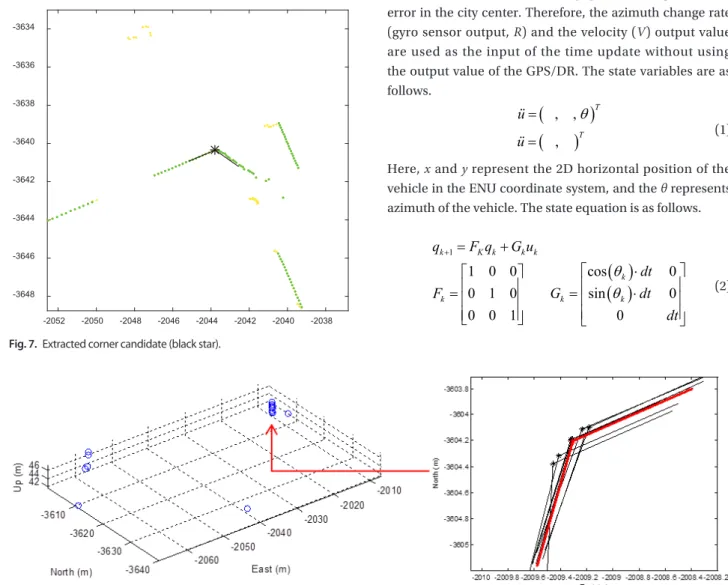
by the above-mentioned corner definition. Fig. 7 shows the extracted corner candidates.
As shown in Fig. 7, the point where a line and a line meet is extracted as a corner candidate. This process is repeated for eight layers. The left side of Fig. 8 shows the 3D position of the corner candidates extracted from the eight layers.
As shown on the left in Fig. 8, the corner candidates for each layer extracted from the same corner will have the same 2D horizontal position. Thus, when corner candidates having the same horizontal position are overlapped in certain area, the corner candidates are finally determined as corners. However, as shown on the right side of Fig. 8, the position of extracted corner candidates (black stars) for each layer for the same corner has a measurement error.
Therefore, the average value (red star) of the position of the extracted corner candidates for each layer is selected as the representative position of the finally determined corner. Fig.
9 shows the final extracted corners.
In Fig. 9, the yellow part shows the outlier such as street trees, and the green part shows the line component extracted to the outer wall of the building. The black stars represent the extracted corner candidates, and the red stars indicate the corner from which they were ultimately extracted.
3. KALMAN FILTER CONFIGURATION
3.1 Time Update
Time update uses the output value of GPS/DR. The GPS/
DR sensor uses a Micro-Infinite CruzCore DS6200 and the azimuth accuracy is within 5° of the open area. Since the 3D rotation cycle of the 3D LIDAR is set to 0.1 second, the used filter is also updated in a cycle of 0.1 second. In point landmark-based positioning, the error of position and attitude variation of the vehicle is very important. However, the GPS/DR sensor used in this paper has a large variation error in the city center. Therefore, the azimuth change rate (gyro sensor output, R) and the velocity (V) output value are used as the input of the time update without using the output value of the GPS/DR. The state variables are as follows.
( )
( )
, , ,
T T
ü ü
θ
=
= (1)
Here, x and y represent the 2D horizontal position of the vehicle in the ENU coordinate system, and the θ represents azimuth of the vehicle. The state equation is as follows.
( ) ( )
1
1 0 0 cos 0
0 1 0 sin 0
0 0 1 0
k K k k k
k
k k k
q F q G u
dt
F G dt
dt θ
θ
+
= +
⋅
= = ⋅
(2)
-2052 -2050 -2048 -2046 -2044 -2042 -2040 -2038 -3648
-3646 -3644 -3642 -3640 -3638 -3636 -3634
Fig. 7. Extracted corner candidate (black star).
Fig. 8. 3D position of corner candidates (left), corner determination result (right).
3.2 Measurement Update
Measurement update uses range and bearing measure- ments. The measurement equation is as follows.
( ) (
2)
2tan
1i i i
i i
i
r x x y y
y y
α
−x x θ
= − + −
−
= − −
(3)
Here, r
iand α
iare the range and bearing measurements between the vehicle and i
thcorner, and x
iand y
iare the 2D position of the i
thcorner in the corner map. The measurement matrix H is as follows.
-2080 -2060 -2040 -2020 -2000 -1980
-3660 -3640 -3620 -3600 -3580 -3560
Fig. 9. Corner extraction result (8 layers).
Fig. 10. Vehicle trajectory and street view (four intersections).
Fig. 11. Corner extraction result (8 layers).
( )
( ) ( )
( )
( ) ( )
( )
( ) ( ) ( )
( ) ( )
( )
( ) ( )
( )
( ) ( )
( )
( ) ( ) ( )
( ) ( )
1 1
2 2 2 2
1 1 1 1
1 1
2 2 2 2
1 1 1 1
2 2 2 2
2 2 2 2
0 1
0 1
n n
n n n n
n n
n n n n