IntroductIon
Subfamily Sebastinae comprises seven genera and about 131 species and genus Sebastes Cuvier, 1829, is the largest taxonomic group with about 110 species. Almost of them are known to the ovoviviparity living at rocky shore in the North Pacific(Kai et al., 2003; Nelson et al., 2016).
Some authors, for example, Immamura and Yabe(2002) and Nakabo and Kai(2013) suggested that subfamily Sebastinae has been elevated to family Sebastidae status.
However, we followed about status of the family Scor- paenidae recently by Nelson et al.(2016). There are five trans-Pacific Sebastes spp: S. aleutianus, S. alutus, S.
borealis, S. ciliatus, and S. glaucus(Kai et al., 2003).
Sebastes glaucus is a lower sublittoral species distributed in the northwestern Pacific, along the coast of the Bering Sea, Sea of Okhotsk, and northern East Sea(Orr et al., 1998; Nakabo and Kai, 2013). This species rarely occurs in commercial catches in spite of the wide distribution.
Hence, there are few studies about its biology(e.g., Pan- chenko, 1995).
Recently, a single specimen having a unique yellowish brown body color was collected by gill net(90m depth) from coastal waters off Dokdo, Korea. The specimen was identified as Sebastes glaucus Hilgendorf, 1840, based on the number of dorsal fin spines and no scale at upper jaw.
Korean name and brief description of S. glaucus using Pacific Ocean samples instead of Korean’s them were previously reported by NFRDI(1999). This species has not yet found in Korean waters. Therefore, we describe the morphological characteristics of S. glaucus in order to register on the Korean fish fauna.
Counts and measurements follow those of Hubbs and Lagler(2004). Each body part was measured to the nearest 0.1mm using digital Vernier caliper. Pored scales along the lateral line were counted by stereomicroscope. The specimen was deposited at the Fisheries Resource Man- agement Division, National Institute of Fisheries Science (NIFS), Korea.
Sebastes glaucus Hilgendorf, 1880 (Korean name: Cheong-hoe-bol-rak)
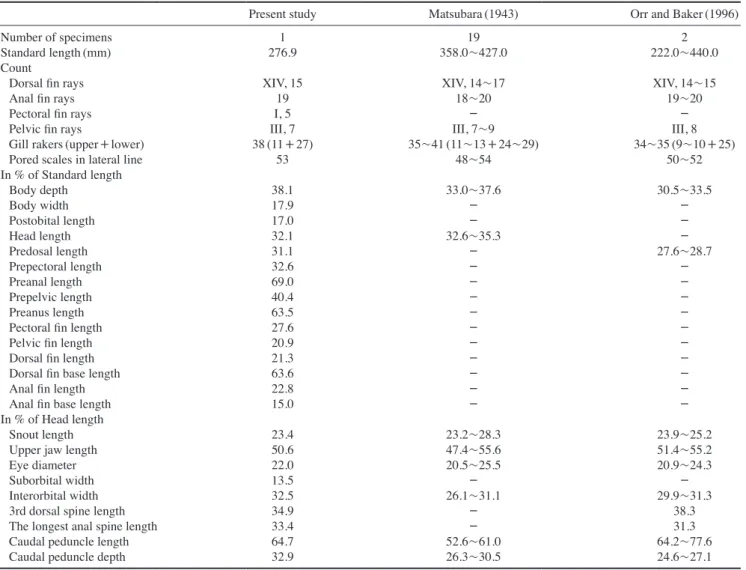
(Fig. 1, Table 1)
Sebastes glaucus: Hilgendorf, 1880: 170(type locality:
Hokkaido, Japan); Matsubara, 1943: 180(Hokkaido,
—283 — http://www.fishkorea.or.kr
* Corresponding author: Jeong-Ho Park Tel: 82-51-720-2281, Fax: 82-51-720-2277, E-mail: [email protected]
Korean Journal of Ichthyology, Vol. 28, no. 4, 283-286, December 2016 ISSn: 1225-8598(Print), 2288-3371(online)
received: october 5, 2016 revised: november 25, 2016 accepted: December 13, 2016
First Record of the Trans-Pacific Sebastes, S. glaucus (Scorpaeniformes:
Scorpaenidae) in the Korean Waters
By Moon Kyung Jeong, Hwan Sung Ji, Jin-Koo Kim
1, Sujin Lee
2, Seon Jae Hwang
2, Kangseok Hwang and Jeong-Ho Park*
Fisheries Resource Research Division, National Institute of Fisheries Science(NIFS), Busan 46083, Republic of Korea
1Department of Marine Biology, Pukyong National University, Busan 48513, Republic of Korea
2Korea Fisheries Resources Agency, 19F, Busan 48058, Republic of Korea
ABSTRACT A single specimen(276.9mm standard length) of the scorpaenid Sebastes glaucus was collected by a gill net from dokdo, East Sea, Korea. the specimen is characterized by yellowish brown body color, deep body, convex frontal region and nape, board occipital region, 14 spines at dorsal fin, and no scales at maxilla. this is the first record of S. glaucus in Korea; we therefore add the species to the Korean fish fauna. According to the nFrdI(1999), we propose the Korean name, “cheong-hoe- bol-rak” for this species.
Key words: Scorpaenidae, Sebastes glaucus, new Korean record, Dokdo, East Sea
284 Moon Kyung Jeong, hwan Sung Ji, Jin-Koo Kim, Sujin lee, Seon Jae hwang, Kangseok hwang and Jeong-ho Park
Fig. 1. Sebastes glaucus, NIFS00001, 276.9mm SL, Dokdo, East Sea, Korea.
Table 1. Comparison of meristic and morphometric characters of Sebastes glaucus
Present study Matsubara(1943) Orr and Baker(1996)
Number of specimens 1 19 2
Standard length(mm) 276.9 358.0~427.0 222.0~440.0
Count
Dorsal fin rays XIV, 15 XIV, 14~17 XIV, 14~15
Anal fin rays 19 18~20 19~20
Pectoral fin rays I, 5 - -
Pelvic fin rays III, 7 III, 7~9 III, 8
Gill rakers(upper+lower) 38(11+27) 35~41(11~13+24~29) 34~35(9~10+25)
Pored scales in lateral line 53 48~54 50~52
In % of Standard length
Body depth 38.1 33.0~37.6 30.5~33.5
Body width 17.9 - -
Postobital length 17.0 - -
Head length 32.1 32.6~35.3 -
Predosal length 31.1 - 27.6~28.7
Prepectoral length 32.6 - -
Preanal length 69.0 - -
Prepelvic length 40.4 - -
Preanus length 63.5 - -
Pectoral fin length 27.6 - -
Pelvic fin length 20.9 - -
Dorsal fin length 21.3 - -
Dorsal fin base length 63.6 - -
Anal fin length 22.8 - -
Anal fin base length 15.0 - -
In % of Head length
Snout length 23.4 23.2~28.3 23.9~25.2
Upper jaw length 50.6 47.4~55.6 51.4~55.2
Eye diameter 22.0 20.5~25.5 20.9~24.3
Suborbital width 13.5 - -
Interorbital width 32.5 26.1~31.1 29.9~31.3
3rd dorsal spine length 34.9 - 38.3
The longest anal spine length 33.4 - 31.3
Caudal peduncle length 64.7 52.6~61.0 64.2~77.6
Caudal peduncle depth 32.9 26.3~30.5 24.6~27.1
first record of Sebastes glaucus in the Korean Waters 285
Japan); Chen, 1986: 6(redescription, Japan); Orr and Baker, 1996: 94(Atka and Aleutian Islands); Nakabo, 2002; 589(key, Iwate Prefecture northward, Japan);
Love et al., 2002: 184(the northern East Sea, Okhotsk, and western Bering Sea).
Material examined. NIFS00001, single specimen, 276.9mm in standard length(SL), 35°15′11.78″N, 131°
51′10.89″E, Dokdo, East Sea, 90m depth, 20 June 2016, Daeheung-ho, gill net, collected by S.J. Lee.
Description. Meristic and morphometric characters are shown in Table 1. Body oblong and very compressed, ta- pering posteriorly; five preopercular spines fairly strong;
two hard spines with opercle, but not pointed; serrated and dulled spines on the subopercle; eyes small; no spine on lower margin of eye and parietal region; small teeth on jaws and vomer; maxilla without scales; gill slit broad and extending to ventral; every spines at fin strong; posterior margin of pectoral fin rounded with upper unbranched rays 1, middle branched rays 8 and lower unbranched rays 10; all rays at dorsal, pelvic and anal fins branched; lat- eral line curved; posterior margin of caudal fin shallowly emarginated; whole body covered with small scales.
Color of specimen. When fresh, overall body yellowish brown; head blackish brown; sclera light orange. After fixation, body dark brown flecked yellow; three dark bands, little narrower than the diameter of the pupil, radi- ate posteriorly from eye.
Distribution. Dokdo, East Sea, Korea at 90m depth (present study), Hokkaido, Iwate, Yamagata, Toyama (Nakabo and Kai, 2013), the Okhotsk Sea and Bering Sea (Orr and Baker, 1996).
Remarks. The present specimen was identified as Sebastes glaucus Hilgendorf, 1880 on the basis of body color, no spine below margin of orbit, 14 dorsal fin spines, and no small scales at maxilla(Nakabo and Kai, 2013).
Meristic and morphometric characters of the present spe- cimen agree well with those of previous descriptions of S.
glaucus(Table 1).
The species is easily distinguished from others by both the number of dorsal spine and no scales at upper jaw.
According to Kim et al.(2005), there are two species(S.
hubbsi and S. koreanus) have 14 dorsal spines in Korean waters. However, most of S. hubbsi has 13 dorsal spines (Nakabo, 2002). S. koreanus has the same number of dorsal spine S. glaucus, but they are different from dorsal rays(12~13 in S. koreanus vs. 14~17 in S. glaucus).
There are 26 and 68 Sebastes spp. in the Northwest and Northeast Pacific, respectively, excluding five trans- Pacific species(Kai et al., 2003). S. glaucus is known to
occurring at coastal deep waters and northern East Sea, however, our specimen was collected at shallow water, at a depth of approximately 90m and the northwestern Dokdo. Therefore, we describe the first Trans-Pacific re- cord of S. glaucus in the Korean waters, thus expanding its geographic distribution. We herein propose the Korean name, “Cheong-hoe-bol-rak” for this species.
AcKnoWLEdGMEntS
This study was funded by a grant from National Insti- tute of Fisheries Science(NIFS)(No: R201626), Korea.
rEFErEncES
Chen, L.C. 1986. Meristic variation in Sebastes(Scorpaenidae), with an analysis of character association a bilateral pattern and their significance in species separation. NOAA Technical Report, NMFS, 45: 1-17.
Cuvier, G. 1829. Le Règne Animal, distribué d’après son organisa- tion, pour servir de base à l’histoire naturelle des animaux et d’introduction à l’anatomie comparée. 2nd Ed. 2: 1-406.
Hubbs, C.L. and K.F. Lagler. 2004. Fishes of the Great Lakes Region, revised ed. Michigan Univ. Press, Ann Arbor, 332pp.
Hilgendorf, F.M. 1880. Uebersichtuber die Japaischen Sebastes- Arten. Sitzungsberichte der Gesellschaft Naturforschender Freunde zu Berlin, 1880: 166-172.
Imamura, H. and M. Yabe. 2002. Demise of the Scorpaeniformes (Actinopterygii: Percomorpha): an alternative phylogenetic hypothesis. Bull. Fish. Sci. Hokkaido Univ., 53: 107-128.
Kai, Y., K. Nakayama and T. Nakabo. 2003. Molecular phylogenetic perspective on speciation in the genus Sebastes(Scorpaeni- dae) from the Northwest Pacific and the position of Sebastes within the subfamily Sebastinae. Ichthyol. Res., 50: 239- Kim, I.S., Y. Choi, C.L. Lee, Y.J. Lee, B.J. Kim and J.H. Kim. 2005. 244.
Illustrated book of Korean fishes. Kyo-Hak Publishing Co, Seoul, 615pp.(in Korean)
Love, M.S., M. Yoklavich and L.K. Thorsteinson. 2002. The rock- fishes of the Northeast Pacific. University of California Press, Berkeley, 404pp.
Matsubara, K. 1943. Studies on the scorpaenoid fishes of Japan.
Anatomy, phylogeny and taxonomy(II). Trans. Sigenkagaku- Kenkyusyo, 2: 147-486, pls. 1-4.
Nakabo, T. 2002. Family Scorpaenidae. In: Nakabo, T.(ed.), Fishes of Japan with pictorial keys to the species, English ed. Tokai Univ. Press, Tokyo, pp. 565-595.
Nakabo, T. and Y. Kai. 2013. Family Sebastidae. In: Nakabo, T.(ed.), Fishes of Japan with pictorial keys to the species, 3rd ed.
Tokai Univ. Press, Kanagawa, pp. 668-681.(in Japanese)
286 Moon Kyung Jeong, hwan Sung Ji, Jin-Koo Kim, Sujin lee, Seon Jae hwang, Kangseok hwang and Jeong-ho Park
Nelson, J.S., T.C. Grande and M.V.H. Wilson. 2016. Fishes of the world, 5th ed. John Wiley & Sons Inc., New Jersey, 707pp.
NFRDI. 1999. Fishes of the Pacific Ocean, 1st ed. Hanguel Grapics Co., Busan, 512pp.
Orr, J.W. and D.C. Baker. 1996. New North American Records of the Northeast Pacific Scorpaenids Adelosebastes latens and Sebastes glaucus. Alaska Fish. Res. Bull., 3: 94-102.
Orr, J.W., M.A. Brown and D.C. Baker. 1998. Guide to Rockfishes (Scorpaenidae) of the Genera Sebastes, Sebastolobus, and Adelosebastes of the Northeast Pacific Ocean. U. S. Dep.
Commer., NOAA Tech, Memo. NMFS-AFSC-95, 46pp.
Panchenko, V.V. 1995. Data on the biology of the blue rockfish Sebastes glaucus(Scorpaenidae) in the Southern Sea of Okhotsk. J. Ichthyol., 36: 130-131.
한국산 환태평양 볼락속 (Genus Sebastes), Sebastes glaucus의 최초 보고 (쏨뱅이목: 양볼락과)
정문경
·
지환성·
김진구1·
이수진2·
황선재2·
황강석·
박정호국립수산과학원 연근해자원과, 1부경대학교 자원생물학과, 2한국수산자원관리공단
요 약 : 쏨뱅이목 양볼락과에 속하는 Sebastes glaucus 1개체(표준체장 276.9mm)가 독도 북서쪽에서 자망으로
채집되었다. 본 개체는 황갈색 체색, 높은 체고, 전두부와 목덜미 부분은 볼록하고 후두부는 넓다. 또한 14개의 등
지느러미 극조 및 주상악골에 비늘이 없는 것이 특징이다. 우리나라에서 처음 보고되는 환태평양 볼락속인 이 어
류의 국명으로 NFRDI(1999)에 따라 “청회볼락”을 제안한다.
찾아보기 낱말 : 양볼락과, 청회볼락, 한국 미기록종, 독도, 동해