167 Our previous article summarized the prevalence, complica-
tions, and implications of managing chronic obstructive pul- monary disease (COPD) in cardiovascular disorders (CVD)
1. A critical limitation of the review was the predominance of cardiovascular disease and comorbid COPD data from the United States and Europe. This was mainly due to greater car- diovascular disease registries in the United States and Europe vs. the rest of the world. It becomes necessary to highlight a
“non-Western” perspective for the prevalence of COPD in CVD at the regional level for guiding clinical decisions that will optimize resources and improve patients’ quality of life.
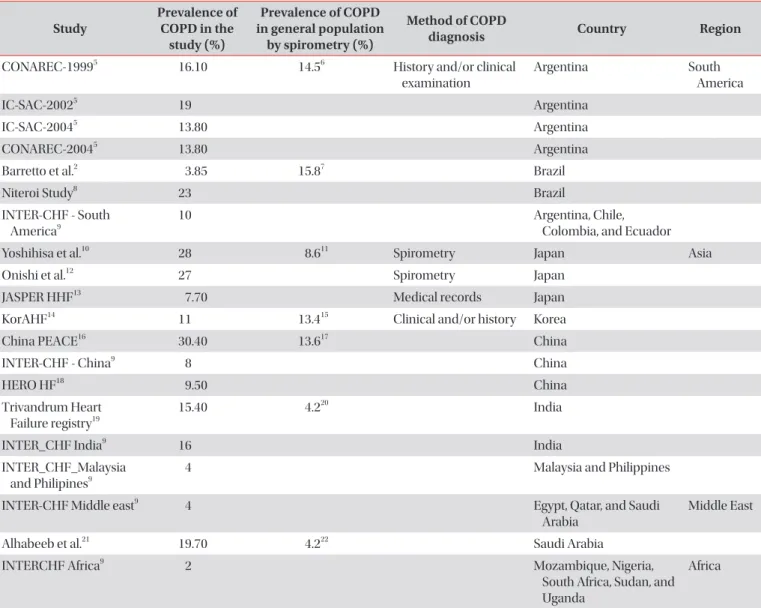
We reviewed the literature for the studies, which captured the status of comorbid COPD in cardiac patients, and were conducted in Asia, the Middle East, Africa, and South America conducted between 1981 to May 2020. The prevalence of COPD in heart failure (HF) and COPD in ischemic heart dis- ease (IHD) and atrial fibrillation (AF) across different regions have been summarized in Tables 1 and 2, respectively.
One of the critical limitations of the evidence presented above has been the use of history/physical examination to diagnose COPD in cardiovascular disease patients. The prevalence varies from 3% to 30% in HF; the differences in prevalence can be accounted by reliance on clinical examina- tion/history/medical records, instead of lung function tests,
to make a diagnosis. We now know that use of history/physi- cal examination/medication can lead to both over-diagnosis and under-diagnosis of COPD. However, in the regions under consideration, it is prudent to assume that under-diagnosis of COPD is much more common than over-diagnosis, leading to poor health outcomes and increased healthcare costs in the long run. Another factor to look at is the general prevalence of COPD in the country where studies were conducted. One would expect at-least equal or ideally higher prevalence of COPD in HF/AF/IHD versus general population (Table 1) because of the common risk factors involved in pathogenesis of both COPD and heart disease. In certain studies such as the one by Barretto et al.
2, the drastic difference in study reported COPD prevalence and general COPD prevalence might be due to recruiting bias and/or improper evaluation of airflow limitation leading to under-diagnosis of COPD.
Based on the evidence, we found that the burden of undiag- nosed COPD in CVD remains high in the non-western regions of the world. Not surprisingly, 23% of patients with CVD have been shown to have spirometry-confirmed COPD in India
3. In the middle east, 91.5% of patients with IHD with COPD were not previously diagnosed with COPD
4. The results highlight the importance of active screening for COPD in CVD patients in these regions because of the potential to reduce long-term healthcare costs and morbidity amidst the resource con- straints and predominance of risk factors for COPD and CVD progression.
Authors’ Contributions
Conceptualization: Deshmukh K, Khanna A. Methodol- ogy: Deshmukh K, Khanna A. Data curation: Deshmukh K, Khanna A. Investigation: Deshmukh K, Khanna A. Writing - original draft preparation: Deshmukh K, Khanna A. Writing - review and editing: Deshmukh K, Khanna A. Approval of final manuscript: all authors.
The Burden of Chronic Obstructive Pulmonary Disease in Cardiovascular Diseases: A Non-Western Perspective
Kartik Deshmukh, M.B.B.S.
1and Arjun Khanna, M.D., D.M.
21
Fuqua School of Business, Duke University, Durham, NC, USA;
2Department of Pulmonary Medicine, Yashoda Hospital, Delhi, India
Address for correspondence: Kartik Deshmukh, M.B.B.S.
Fuqua School of Business, Duke University, Fuqua Drive, Durham, NC 27708, USA
Phone: 1-919-3089590, Fax: 1-919-3089590
E-mail: [email protected], [email protected] Received: Nov. 29, 2020
Revised: Jan. 21, 2021 Accepted: Feb. 16, 2021 Published online: Feb. 17, 2021
cc
It is identical to the Creative Commons Attribution Non-Commercial License (http://creativecommons.org/licenses/by-nc/4.0/).
EDITORIAL
https://doi.org/10.4046/trd.2020.0151ISSN: 1738-3536(Print)/2005-6184(Online) • Tuberc Respir Dis 2021;84:167-170