Introduction
Osteoporosis is a well-known complication of chronic inflammatory airway disease attributed to the systemic in- flammatory response to the disease itself as well as due to the use of inhaled corticosteroids (ICSs) to control the disease
1. ICSs may lead to osteoporosis as glucocorticoids affect bone metabolism by stimulating osteoclast-mediated bone forma- tion and the metabolism of calcium and sex hormones
2-4. However, some recent studies have emphasized the role of the inflammatory response in chronic inflammatory airway disease in the development of osteoporosis
5-7. Osteoporosis is more common in patients with chronic obstructive pulmo- nary disease (COPD) than in those with asthma, even when
Osteoporosis in Patients with Asthma–
Chronic Obstructive Pulmonary Disease Overlap Syndrome
Jee Youn Oh, M.D., Young Seok Lee, M.D., Kyung Hoon Min, M.D., Ph.D., Sung Yong Lee, M.D., Ph.D., Jae Jeong Shim, M.D., Ph.D., Kyung Ho Kang, M.D., Ph.D. and Gyu Young Hur, M.D., Ph.D.
Division of Pulmonary, Allergy and Critical Care Medicine, Department of Internal Medicine, Korea University Guro Hospital, Seoul, Korea
Background: Osteoporosis is a common disease that occurs comorbidly in patients with chronic inflammatory airway diseases, including asthma, chronic obstructive pulmonary disease (COPD), and asthma-COPD overlap syndrome (ACOS). However, the prevalence of osteoporosis in patients with ACOS has not widely been evaluated. Therefore, we investigated the prevalence of osteoporosis and its relationship with the clinical parameters of patients with asthma, COPD, and ACOS.
Methods: This was a retrospective, cross-sectional study. Bone mineral density (BMD), lung function tests, and disease status evaluations were conducted.
Results: A total of 321 patients were enrolled: 138 with asthma, 46 with ACOS, and 137 with COPD. One hundred and ninety-three patients (60.1%) were diagnosed with osteoporosis (53.6% of asthma, 65.2% of ACOS, and 65.0% of COPD).
Patients with ACOS showed a significantly lower BMD and T-score than did those with asthma. In addition to age, sex, and body mass index (BMI), which were previously reported to be associated with BMD, BMD also had a negative correlation with the diagnosis of ACOS, as compared to a diagnosis of asthma, after adjusting for age, sex, BMI, smoking, and inhaled corticosteroid use (p=0.001). Among those patients with COPD and ACOS, BMD was negatively associated with the COPD Assessment Test (CAT) after adjustment (p<0.001). Inhaled corticosteroid was not associated with the prevalence of osteoporosis and BMD.
Conclusion: Patients with ACOS, particularly aged and lean women, should be more carefully monitored for osteoporosis as compared to patients with asthma.
Keywords: Osteoporosis; Bone Mineral Density; Asthma; Pulmonary Disease, Chronic Obstructive; Syndrome
Address for correspondence: Gyu Young Hur, M.D., Ph.D.
Division of Pulmonary, Allergy and Critical Care Medicine, Department of Internal Medicine, Korea University Guro Hospital, 148 Gurodong-ro, Guro-gu, Seoul 08308, Korea
Phone: 82-2-2626-3032, Fax: 82-2-2626-1166 E-mail: [email protected]
Received: May. 27, 2017 Revised: Jul. 6, 2017 Accepted: Aug. 5, 2017 Published online: Nov. 27, 2017
cc
It is identical to the Creative Commons Attribution Non-Commercial License (http://creativecommons.org/licenses/by-nc/4.0/).
Copyright © 2018
The Korean Academy of Tuberculosis and Respiratory Diseases.
All rights reserved.
they do not receive long-term corticosteroid treatment. This is explained by the role of inflammatory cytokines, such as tu- mor necrosis factor (TNF)-α, that stimulate osteoclastic bone resorption
5. Compared to patients with asthma, those with COPD have a higher systemic inflammatory response and secrete TNF-α, thereby resulting in more severe osteoporosis
7. Asthma-COPD overlap syndrome (ACOS) is a recently cat- egorized disease that has features of both asthma and COPD, but with a poorer outcome
8-10. However, there have not been many previous studies examining the relationship between osteoporosis and ACOS. Therefore, we compared osteoporo- sis in patients with ACOS versus those with asthma or COPD.
Materials and Methods
1. Study design
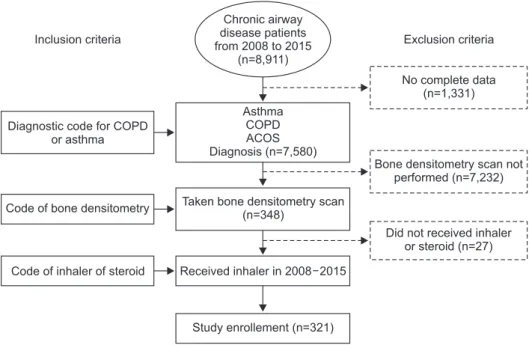
We reviewed the medical records of patients, at Korea University Guro Hospital (Seoul, Korea), who had a chronic inflammatory airway disease (asthma, COPD, or ACOS), over 20 years old, used an inhaler, and had undergone a bone densitometry scan between January 2008 and December 2015 (Figure 1). Our institutional review board approved the study (KUGH15140). Written informed consent was provided by the patients and the study conformed to the tenets of the Declaration of Helsinki. A diagnosis of COPD was made ac- cording to the American Thoracic Society and Global Initia- tive for Chronic Obstructive Lung Disease (GOLD) guidelines.
An asthma diagnosis was made based on the Global Initiative for Asthma (GINA) guidelines. An ACOS diagnosis was made when two major and two minor criteria were met among
COPD patients
11. The major criteria included a positive bron- chodilator test result (increase in predicted forced expiratory volume in the first second [FEV
1] of 15% or greater and 400 mL or greater), the presence of eosinophilia in the sputum, and a history of asthma. The minor criteria included a high total IgE level, a history of atopy, and a positive bronchodila- tor test result (increase in FEV
112% or greater and 200 mL or greater) on two or more occasions
11. A cross-sectional design was used. We then evaluated the prevalence of osteoporosis and compared bone mineral density (BMD) patients with three different types of airway diseases.
2. Methods
BMD measurements of the femoral neck, total femur (which includes the femoral neck, trochanter, and intertrochanter area), and lumbar spine (L1–4) were conducted using dual- energy X-ray absorptiometry (DXA; Hologic Discovery A, Hologic, Bedford, MA, USA). To analyze data, we used BMD measurements or a T-score based on the sex-specific mean for healthy, young asian adults, which was provided by the manufacturer. A T-score (the lowest T-score of the three mea- sured locations; lumbar, total femur, and femur neck) that was 2.5 standard deviations (SDs) below the average value was in- dicative of osteoporosis, in accordance with the World Health Organization criteria. We evaluated the following variables in patients with asthma, COPD, or ACOS: age, sex, body mass index (BMI), smoking history (over 10 pack-year current or ex-smoker was considered to have smoking history), T-score, BMD (g/cm
2), predicted FEV
1% and bronchodilator response (BDR; %) at the time of BMD taken, COPD Assessment Test (CAT) score, Asthma Control Test score, serum total IgE (IU/
Diagnostic code for COPD or asthma
Code of bone densitometry
Code of inhaler of steroid
Asthma COPD ACOS Diagnosis (n=7,580)
Taken bone densitometry scan (n=348)
Received inhaler in 2008 2015
Study enrollement (n=321)
No complete data (n=1,331)
Bone densitometry scan not performed (n=7,232)
Did not received inhaler or steroid (n=27)
Inclusion criteria Exclusion criteria
Chronic airway disease patients from 2008 to 2015
(n=8,911)
Figure 1. Study protocol. COPD: chronic obstructive pulmonary disease; ACOS:
asthma-COPD overlap syndrome.
mL), sputum eosinophil (%) and type of inhaler and medica- tions used for airway disease.
3. Statistical analysis
Clinical data are presented as the mean±SD, depending on the distribution. ANCOVA was used to compare age and sex adjusted means. Student’s t test and ANOVA with a post- hoc test (using Bonferroni method) were used for analysis
of continuous variables, while Fisher exact test was used for categorical variables. BMD and other variables were analyzed using multivariate linear regression. Statistical significance was defined as p<0.05. All statistics were analyzed using SPSS version 20.0 software (IBM Corp., Armonk, NY, USA).
Results
1. Characteristics of patients with and without osteoporosis Three hundred and twenty-one patients were analyzed:
138 with asthma, 46 with ACOS, and 137 with COPD. Among them, 193 (60.1%) were diagnosed with osteoporosis (53.6%
of asthma 65.2% of ACOS, and 65.0% of COPD; p=0.118). Pa- tients with osteoporosis were more likely to be of the female sex, older, with a lower BMI, a lower predicted FEV
1, and a higher CAT score. BMI and CAT were different between pa- tients with and without osteoporosis after adjusting for age and sex by ANCOVA (p<0.05).
2. Characteristics of patients according to asthma, COPD, and ACOS
The baseline characteristics of patients based on disease en- tities are presented in Table 1. ACOS patients were older and leaner than were patients with asthma. The predictive ability (%) of FEV
1for ACOS was lower than for asthma, and BDR (%) of ACOS was the highest among the three disease entities.
Furthermore, ACOS patients had worse symptom scores than did those with asthma or COPD.
3. Comparison of BMD among patients with asthma, COPD, and ACOS
Increased ICS use was seen in patients with asthma rather than in patients with ACOS or COPD. However, patients with Table 1. Baseline characteristics of asthma, ACOS, and COPD
Characteristic Asthma (n=138) ACOS (n=46) COPD (n=137) p-value
Age, yr 63.33±9.88 * 70.04±9.78 70.88±9.25
†<0.001
Smoking, n (%) 10 (7.2) 23 (50.0) 87 (63.5) <0.001
Male sex, n (%) 17 (12.3) 19 (41.3) 76 (55.5) <0.001
BMI, kg/m
224.73±3.61* 22.85±3.73 22.67±4.89
†<0.001
T-score (lowest) –2.49±1.09 * –3.07±1.31 –2.98±1.38
†0.001
T-score (L1–4 mean) –1.66±1.14* –2.20±1.36 –1.98±1.58
†0.034
T-score (femur total) –0.67±0.10* –1.46±1.17 –1.42±1.15
†<0.001
T-score (femur neck) –1.73±1.10* –2.22±1.18 –2.17±1.22 0.004
FEV
1predicted, % 92.25±19.83* 55.67±16.72 57.56±21.52
†<0.001
BDR, % 3.54±6.11* 12.70±6.00
‡1.43±4.46
†<0.001
CAT - 17.89±10.68 22.64±9.84 0.030
ACT 20.93±3.93 19.00±4.52 - 0.038
Sputum eosinophil, % 3.18±8.36 (n=28) 6.43±7.25 (n=14) 1.67±0.058 (n=8) 0.391 Total IgE, IU/mL 230.77±296.71 (n=62) 359.92±408.50 (n=17) 110.01±110.00 (n=8) 0.145
Systemic steroid, % 13.0 13.9 21.7 0.845
ICS, % 97.8 * 78.3
‡40.1
†<0.001
LAMA, % 4.3* 76.1
‡91.2
†<0.001
Values are presented as the mean±SD unless otherwise indicated.
*Significant differences between patients with asthma and ACOS.
†Significant differences between patients with asthma and COPD.
‡Signifi- cant differences between patients with ACOS and COPD.
ACOS: asthma-COPD overlap syndrome; COPD: chronic obstructive pulmonary disease; BMI: body mass index; FEV
1: forced expiratory vol- ume in the first second; BDR: bronchodilator response; CAT: COPD Assessment Test; ACT: Asthma Control Test; ICS: inhaled corticosteroid;
LAMA: long-acting muscarinic antagonists.
ACOS had a lower mean BMD (L1–4 mean, femur) than did patients with asthma regardless of ICS use after adjusting for age, sex, BMI, smoking, and ICS use (ANCOVA, BMD [L1–4 mean] estimated marginal mean±standard error [0.84±0.11 in Asthma, 0.76±0.02 in ACOS, 0.77±0.02 in COPD], p=0.007).
BMDs of ACOS and COPD had no significant differences, but ACOS generally had lower T-scores and BMD (L1–4, femur) than did patients with COPD (Table 1, Figure 2).
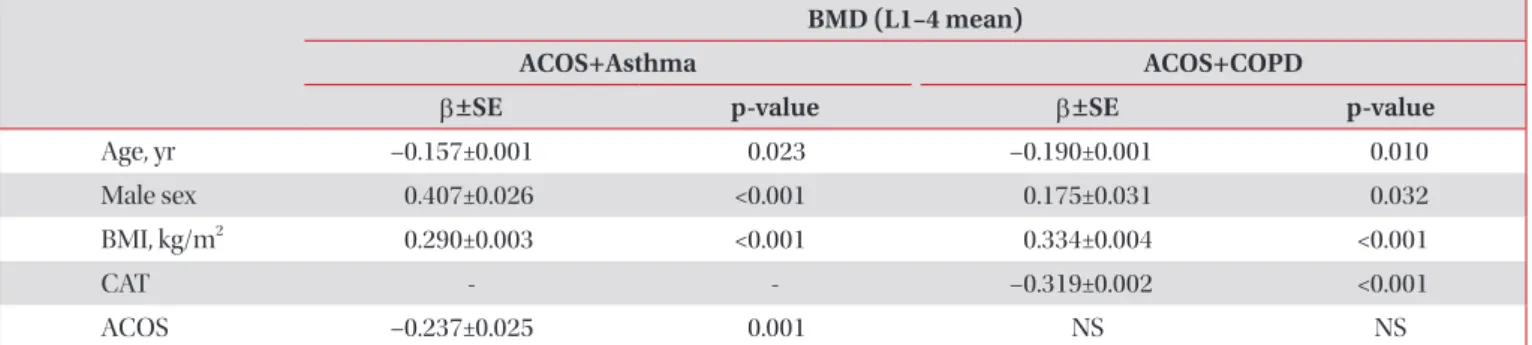
4. Association between BMD and other clinical parameters When multivariate linear regression analysis was per- formed among patients with ACOS and asthma, BMD (L1–4 mean) was negatively associated with age and a diagnosis of ACOS. Meanwhile, BMD was positively associated with male percentage and BMI after adjusting for age, sex, BMI, smoking, ICS use and diagnosis (Table 2). When multivariate linear re- gression analysis was performed among patients with ACOS and COPD, after adjusting for age, sex, BMI, smoking, ICS use and diagnosis, BMD (L1–4 mean) was negatively associated with age and CAT, while it was positively associated with male percentage and BMI (Table 2). However, BMD (L1–4 mean) was not associated with a diagnosis of ACOS compared to COPD significantly.
5. Associations of ICS use and osteoporosis
One hundred and forty-four patients (44.9%) used flutica- sone/salmeterol, 70 (21.8%) used budesonide/formoterol, and 166 (51.7%) used tiotropium. Other inhalers (budesonide, fluticasone, indacaterol, and ciclesonide) were prescribed in less than 5%, so they were excluded in analysis. There were no significant differences in the prevalence of osteoporosis between the type of ICS or other bronchodilating inhalers that were used (fluticasone/salmeterol: hazard ratio [HR], 1.404;
p=0.169; budesonide/formoterol: HR, 0.735; p=0.272; tiotro-
pium bromide: HR, 1.533; p=0.068; p=0.492). Moreover, in multivariate linear regression, ICS use was not associated with BMD significantly.
Discussion
In this study, we compared the prevalence of osteoporosis and BMD in patients with asthma, COPD, and ACOS. This study showed that osteoporosis tended to be more prevalent in patients with ACOS than in those with asthma, and BMD (L1–4 mean) was more significantly associated with a diagno- sis (ACOS vs. asthma) regardless of ICS use.
This study is to demonstrate the prevalence of osteoporosis among patients with ACOS.
Table 2. Associations of BMD (L1–4 mean) with other clinical parameters by multivariate linear regression BMD (L1–4 mean)
ACOS+Asthma ACOS+COPD
β±SE p-value β±SE p-value
Age, yr –0.157±0.001 0.023 –0.190±0.001 0.010
Male sex 0.407±0.026 <0.001 0.175±0.031 0.032
BMI, kg/m
20.290±0.003 <0.001 0.334±0.004 <0.001
CAT - - –0.319±0.002 <0.001
ACOS –0.237±0.025 0.001 NS NS
Multivariate linear regression with backward elimination was done and parameters were adjusted for age, sex, BMI, smoking, ICS use and diagnosis.
BMD: bone mineral density; ACOS: asthma-COPD overlap syndrome; COPD: chronic obstructive pulmonary disease; SE: standard errors;
BMI: body mass index; CAT: COPD Assessment Test; NS: not significant.
Figure 2. Comparison of bone mineral densities (BMDs) among pa- tients with asthma, asthma–chronic obstructive pulmonary disease overlap syndrome (ACOS), and chronic obstructive pulmonary disease (COPD). *Significant differences between patients with asthma and ACOS.
†Significant differences between patients with asthma and COPD.
0.90 0.85 0.80 0.75 0.70 0.65 0.60 0.55 0.50
BMD(g/cm)2
Asthma ACOS COPD
Diagnosis
*
*
BMD L1 4 mean BMD L1 4 lowest BMD femur total BMD femur neck