INTRODUCTION
Coffee is considered one of the most consumed beverages in the world (Hudson & Hudson, 2004). The size of the coffee industry in both the United States and the rest of the world has increased dramatically. According to Daviron and Ponte (2005), about 75% of adults in the US drink coffee, and 58% of them drink coffee every day. Americans drink approximately 400 million cups of coffee a day, and the United States is the country with the highest coffee consumption in the world with more than 150 million daily drinkers.
Ambience in service settings is considered one of the most important factors affecting customers’ emotions and satisfaction because customers in service settings tend to show more concern about the invisible factors as well as visible ones (Baker, 1986;
Mattila & Wirtz, 2001). In addition, word of mouth recommen- dation is one of the most critical elements regarding customer loyalty in order to investigate customers’ future behavioral inten- tions in various service settings (Cheng, Lam, & Hsu, 2005). Thus, studying the relationships among ambience, emotions, customer satisfaction, and word of mouth recommendation is worthwhile within the context of coffee shops.
Numerous scholars have explored that the impact of ambience in various service settings. However, no research has been con-
ducted regarding the effect of ambience on customers’ emotions, satisfaction, and word of mouth recommendation in a coffee shop setting. Thus, it would be worth studying how ambience influences customers’ emotions, satisfaction, and future behavior intentions such as word of mouth recommendation.
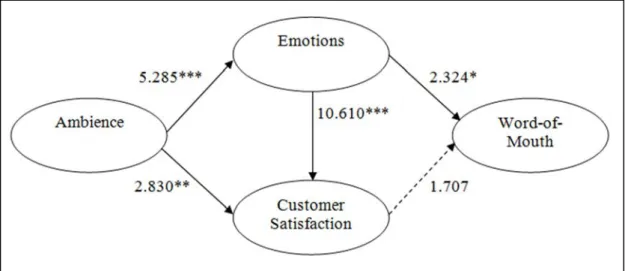
The objectives of this study were (1) to examine the effect of ambience on emotions and customer satisfaction, (2) to test the impact of emotions on customer satisfaction, and (3) to identify the influence of emotions and customer satisfaction on word of mouth recommendation.
LITERATURE REVIEWS
Influence of Ambience on Emotions and Customer Satisfaction A lot ofscholars have insisted that ambience strongly influences customers’ emotional responses and future behavior in regard to the environment (Baker, 1986; Mattila & Wirtz, 2001). Aroma, li- ghting, music and temperature are the four factors in ambience.
For example, music increases time spent for shopping and in- fluences customer notions of the service settings (North & Har- greaves, 1998). According to previous studies (Mattila & Wirtz, 2001;
North & Hargreaves, 1998), music is also able to affect sales by impacting purchasing patterns and intentions and affects cus- tomers’ feelings, such as satisfaction (Oakes, 2003). The familiarity
Ambience and Word of Mouth Recommendation:
Evaluating the Effects of Ambience Dimensions on Emotions, Customer Satisfaction, and Word of Mouth Recommendation in Coffee Shops
Sang-Hyeop Lee
1, Bee Lia Chua
2and Jong-Ho Lee
3,¶1
Sunway University, Malaysia
2
Universitiy, Putra Malaysia, Malaysia
3
Dept. of Foodservice Management, Kyungsung University, Busan 608-736, Korea
ABSTRACT: Little is known about the impact of ambience on customers’ emotions, satisfaction, and word of mouth recommenda- tion within the context of coffee shops. This study examined the relationships among ambience, emotions, customer satisfaction, and word of mouth recommendation in a coffee shop setting. A total of 303 visitors at 5 coffee shops in a Southwestern state in the U.S. completed questionnaires. Utilizing a structural equation modeling technique, this study demonstrated that ambience significantly influenced emotions and customer satisfaction. In addition, emotions significantly affected customer satisfaction and word of mouth recommendation.
Keywords: Ambience, Customer Satisfaction, Emotions, Word of Mouth Recommendation
§