https://doi.org/10.5763/kjsm.2018.36.3.135 pISSN 1226-3729 eISSN 2288-6028
초 울트라마라톤대회(622 km) 경기가 심장마커와 근손상마커에 미치는 영향
신성대학교 임상병리학과
1, 인제대학교 상계백병원 재활의학과
2, 성신여자대학교 운동재활복지학과
3신경아
1
ㆍ박용범2
ㆍ김영주3
Effects of Super-Ultramarathon Races (622 km) on Cardiac Bio-Markers and Markers of Muscle Damage
Kyung-A Shin 1 , Yongbum Park 2 , Young-Joo Kim 3
1
Department of Clinical Laboratory Science, Shinsung University, Dangjin,
2Department of Rehabilitation Medicine, Sanggye-Paik Hospital, Inje University College of Medicine, Seoul,
3Department of Exercise Rehabilitation Welfare, Soojung Campus, Sungshin University, Seoul, Korea
Purpose: Changes in serum biomarkers of cardiac and muscle damage have been studied in ultra-marathon runners for distances up to 308 km. We investigated these biomarker changes following a 622-km super-ultramarathon race.
Methods: A group of men with a mean age of 52.7±4.8 years participated. Blood samples were obtained pre-race, during the race, and post-race, to analyze the aforementioned biomarkers.
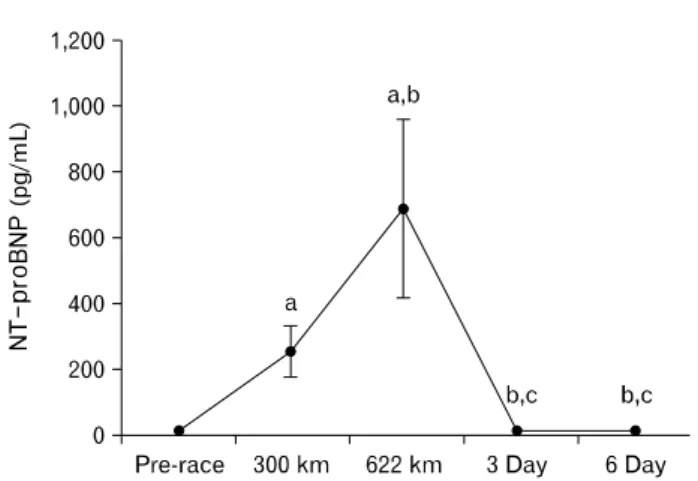
Results: Creatine kinase and creatine kinase-MB (CK-MB) levels increased during the race, and both steadily declined post-race with CK-MB declining at a slower rate. Lactic acid dehydrogenase levels overall were increased over pre-race levels. White blood cell counts increased during the race. Red blood cell decreased from pre-race to 300 km and 622 km. Platelet increased only in the recovery period. High-sensitivity C-reactive protein levels were increased throughout the race and at day 3 compared to pre-race levels. Cardiac troponin I (cTnI) levels increased during the race. N-terminal pro b-type natriuretic peptide (NT-proBNP) levels increased during the race.
Conclusion: The rise in cTnI was not clinically significant, and highly elevated NT-proBNP levels during the race indicates that myocardial burden rose linearly as running distance increased. However, no clinical risk was found as most of the markers returned to normal range during the recovery.
Keywords: Creatine kinase, Creatine Kinase-MB, N-terminal pro-BNP, Rhabdomyolysis
Received: May 31, 2018 Revised: August 13, 2018 Accepted: August 24, 2018 Correspondence: Young-Joo Kim
Department of Exercise Rehabilitation Welfare, Soojung Campus, Sungshin University, Bomun-ro 34da-gil, Seongbuk-gu, Seoul 02844, Korea Tel: +82-2-920-7942, Fax: +82-2-920-7942, E-mail: [email protected]
*This work was supported by the Sungshin University research grant of 2017.
Copyright ©2018 The Korean Society of Sports Medicine
CC