ISSN 2234-3806 • eISSN 2234-3814
http://dx.doi.org/10.3343/alm.2016.36.4.342
Liquid Chromatography-Mass Spectrometry-Based In Vitro Metabolic Profiling Reveals Altered Enzyme
Expressions in Eicosanoid Metabolism
Su Hyeon Lee, M.S.1,2, Eung Ju Kim, M.D.3, Dong-Hyoung Lee, Ph.D.1, Won-Yong Lee, Ph.D.2, Bong Chul Chung, Ph.D.1, Hong Seog Seo, M.D.3, and Man Ho Choi, Ph.D.1
Materials and Life Science Research Division1, Korea Institute of Science and Technology, Seoul; Department of Chemistry2, Yonsei University, Seoul;
Cardiovascular Center3, Korea University Guro Hospital, Seoul, Korea
Background: Eicosanoids are metabolites of arachidonic acid that are rapidly biosynthe- sized and degraded during inflammation, and their metabolic changes reveal altered en- zyme expression following drug treatment. We developed an eicosanoid profiling method and evaluated their changes on drug treatment.
Methods: Simultaneous quantitative profiling of 32 eicosanoids in liver S9 fractions ob- tained from rabbits with carrageenan-induced inflammation was performed and validated by liquid chromatography-mass spectrometry coupled to anion-exchange solid-phase pu- rification.
Results: The limit of quantification for the devised method ranged from 0.5 to 20.0 ng/mg protein, and calibration linearity was achieved (R2>0.99). The precision (% CV) and ac- curacy (% bias) ranged from 4.7 to 10.3% and 88.4 to 110.9%, respectively, and overall recoveries ranged from 58.0 to 105.3%. Our method was then applied and showed that epitestosterone treatment reduced the levels of all eicosanoids that were generated by cy- clooxygenases and lipoxygenases.
Conclusions: Quantitative eicosanoid profiling combined with in vitro metabolic assays may be useful for evaluating metabolic changes affected by drugs during eicosanoid me- tabolism.
Key Words: Eicosanoids, Arachidonic acid, Liquid chromatography-mass spectrometry, Liver S9 fraction, Epitestosterone
Received: November 2, 2015 Revision received: December 8, 2015 Accepted: March 4, 2016
Corresponding author: Man Ho Choi Materials and Life Science Research Division, KIST, 5 Hwarang-ro 14-gil, Seongbuk-gu, Seoul 02792, Korea Tel: +82-2-958-5081
Fax: +82-2-958-5059 E-mail: [email protected]
Co-corresponding author: Hong Seog Seo Cardiovascular Center, Korea University Guro Hospital, 148 Gurodong-ro, Guro-gu, Seoul 08308, Korea
Tel: +82-2-2626-3018 Fax: +82-2-863-1109 E-mail: [email protected]
© The Korean Society for Laboratory Medicine This is an Open Access article distributed under the terms of the Creative Commons Attribution Non-Commercial License (http://creativecom- mons.org/licenses/by-nc/3.0) which permits unrestricted non-commercial use, distribution, and reproduction in any medium, provided the original work is properly cited.
INTRODUCTION
Signaling lipids in inflammation control important cellular pro- cesses, and an imbalance in metabolic homeostasis may con- tribute to the pathogenesis of human diseases such as cardio- vascular and neurodegenerative diseases [1-3]. The chronic in- flammatory response is partly mediated by lipid peroxidation, uncontrolled proliferation of immune-related cells, and activa- tion of the innate immune system [4], whereas activation of the acute inflammatory response alters cytochrome P450 (CYP) ex-
pression and eicosanoid metabolism [5]. Lipid profiling can be used to map the entire spectrum of lipids in biological systems to identify changes in lipid biosynthesis and metabolism that contribute to inflammatory processes [6-8].
Eicosanoids, biological oxidative metabolites of arachidonic acid (AA), play essential roles in cellular homeostasis as well as in therapeutic applications [9, 10]. These lipid mediators, which include prostaglandins (PGs), thromboxanes (TXs), leukotrienes (LTs), and hydroxyeicosatetraenoic acids (HETEs), are gener- ated from cyclooxygenases (COXs), lipoxygenases (LOXs), and
CYP ω-hydroxylase and through non-enzymatic processes.
Compared with the analysis of individual circulating inflamma- tion markers such as nuclear factor κB, interleukin (IL)-6, IL-10, C-reactive protein, and tumor necrosis factor-α (TNF-α) [2, 8], the metabolite profiling of signaling mediators may reveal the bi- ological consequences of inflammation.
Gas chromatography-mass spectrometry (GC-MS)-based pro- filing of eicosanoids is generally performed with chemical de- rivatization because of their low volatility and polar nature [11, 12]. However, the lack of analytical stability and assay accessi- bility limits its use for clinical applications, and instead liquid chromatography-mass spectrometry (LC-MS) is widely used [6, 8, 13-15]. In particular, LC-MS-based lipidomic platforms are useful for both qualitative and quantitative determination of eicosanoids in biological specimens [8, 13-15]. Given the com- plex regulation of eicosanoid metabolism, it is beneficial to si- multaneously quantify various types of lipid mediators rather than to quantify only a limited number of eicosanoids.
Therefore, a method for LC-MS-based quantitative profiling of 32 eicosanoids was developed and validated using rabbit liver S9 fractions. The devised in vitro assay was then used to quan- tify the metabolites of AA catalyzed by COXs, LOXs, and CYP ω-hydroxylase in liver S9 fractions obtained from rabbits with systemic inflammation, which was induced by injecting 1% car- rageenan (CGN) subcutaneously. In addition to corticosteroids, which act as potent anti-inflammatory agents in the treatment of chronic inflammation [16, 17], endogenous androgens play an important role in regulating inflammation and immune re- sponses [18, 19]. After confirming the validity of our assay using two known COX inhibitors, celecoxib for COX-2 and ibuprofen for COX-1/2, an in vitro metabolic assay was applied to investi- gate the new biochemical functions of the androgen epitestos- terone, which has complex and diverse metabolic functions in endocrine physiology [20, 21].
METHODS
1. MaterialsReference standards of the 32 eicosanoids used in this study (Table 1) were obtained from Cayman Chemical (Ann Arbor, MI, USA). The following internal standards were also purchased from Cayman Chemical: 3,3,4,4-d4-6-keto PGF1α for 6-keto PGF1α, 3,3,4,4-d4-PGE2 for the seven prostaglandins and for 11-dehydro TXB2, 3,3,4,4-d4-8-iso PGF2α for the ten isopros- tanes, 6,7,14,15-d4-LTB4 for the four leukotrienes, 5,6,8,9,11, 12,14,15-d8-12(S)-HETE for TXB2 and for the five hydroxyeico-
saeonic acids, and 5,6,8,9,11,12,14,15-d8-AA for AA. Epites- tosterone was obtained from Steraloids (Newport, RI, USA). For solid-phase extraction (SPE), an Oasis MAX cartridge (1 mL, 30 mg; Waters; Milford, MA, USA) was preconditioned with 1 mL methanol followed by 1 mL deionized water. L-Ascorbic acid (reagent-grade) and formic acid (mass spectrometry-grade, 98% purity) were obtained from Sigma (St. Louis, MO, USA), while HPLC-grade methanol and acetonitrile were acquired from Burdick & Jackson (Muskegon, MI, USA). Deionized water was prepared using a Milli-Q purification system (Millipore; Bill- erica, MA, USA). Ultrafree-MC polyvinylidene fluoride mem- brane (0.1-μm pore size) filters were obtained from Millipore.
2. Preparation of liver S9 fractions from rabbits
Ten male New Zealand white rabbits (12 weeks old at the be- ginning of the experiment) were maintained under standardized conditions (21°C, 41-62% humidity) with a regular day/night (10/14 hr) cycle and free access to water and food. All animal experiments were conducted in accordance with the Korea Uni- versity Animal Science Rules and Regulations and were ap- proved by the Korea University Institutional Animal Care and Use Committee (KUIACUC20110627-1). The experimental pro- cedures and housing conditions were approved by the Commit- tee of Animal Experimentation, Hiroshima University. The ani- mals in both groups were fed a standard maintenance chow diet (K-H4 pellets; Ssniff; Soest, Germany) and the experimental group animals received regular subcutaneous injections of 1%
CGN (0.5 mL per 3 weeks). After three months of treatment, in- creased levels of serum markers of inflammation (IL-1, IL-6, and TNF-α) were confirmed and then the liver tissues were iso- lated. All samples were stored at -80°C until use.
Rabbit livers were homogenized in five volumes of 20mM po- tassium phosphate buffer containing 0.32 M sucrose and 1mM dithiothreitol (DTT) (pH 6.5). To remove the nuclei and other debris, the whole-liver homogenate was centrifuged at 800g for 10 min, and the resulting supernatant was subjected to further centrifugation at 9,000g for 30 min to yield the liver S9 fraction.
The protein content of the final supernatant was then assessed by Bradford assay.
3. Metabolic incubation of rabbit liver S9 fractions
Metabolic incubation was performed as previously described with minor modifications [22-24]. The incubation mixture con- sisted of 50 or 100μM AA, an NADPH-generating system (0.5 μmol NADP+, 5 μmol glucose-6-phosphate, 5 μmol MgCl2), 50 and 100μM celecoxib, ibuprofen or epitestosterone, and 500 μg
S9 fraction in a final volume of 0.5 mL in 40 mM potassium phosphate buffer (pH 6.5). Incubation was carried out at 37°C for 1 hr. An incubation system without COX inhibitors was used as a control. All substrates tested were added under dry condi-
tions and then the incubation mixture was added.
4. LC-MS conditions
Profiling of 32 eicosanoids was performed using an ACQUITY Table 1. Liquid Chromatography-Mass Spectrometry (LC-MS) data for the 32 eicosanoids analyzed
Compound Abbreviation Molecular weight Selected ion* Retention time
Precursor of all eicosanoids
Arachidonic acid AA 304.5 303.21 31.91
Prostaglandins (PGs)
Prostaglandin A2 PGA2 334.5 333.21 19.18
Prostaglandin B2 PGB2 334.5 333.21 19.48
Prostaglandin D2 PGD2 352.5 351.22 12.43
Prostaglandin E2 PGE2 352.5 351.22 11.21
Prostaglandin H2 PGH2 352.5 351.22 11.21
Prostaglandin J2 PGJ2 334.5 333.21 19.48
Prostaglandin F1α PGF1α 356.5 355.22 10.31
Prostaglandin F1β PGF1β 356.5 355.22 7.34
Prostaglandin F2α PGF2α 354.5 353.23 9.86
Prostaglandin F2β PGF2β 354.5 353.23 7.73
5-trans prostaglandin F2α 5-trans PGF2α 354.5 353.23 9.02
5-trans prostaglandin F2β 5-trans PGF2β 354.5 353.23 7.46
6-keto prostaglandin F1α 6-keto PGF1α 370.5 369.23 3.34
8-iso prostaglandin F2α 8-iso PGF2α 354.5 353.23 7.09
8-iso prostaglandin F2β 8-iso PGF2β 354.5 353.23 7.09
11β-prostaglandin F2α 11β-PGF2α 354.5 353.23 7.46
15-keto prostaglandin F2α 15-keto PGF2α 352.5 351.22 10.18
13,14-dihydro-15-keto prostaglandin F2α 13,14-dihydro-15-keto PGF2α 354.5 353.23 15.27
Δ12-prostaglandin J2 Δ12-PGJ2 334.5 333.21 15.87
15-deoxy-Δ12,14-prostaglandin J2 15-deoxy-Δ12,14-PGJ2 316.4 315.20 24.61
Leukotrienes (LTs)
Leukotriene B4 LTB4 336.5 335.22 21.87
Leukotriene C4 LTC4 625.8 624.21 20.77
Leukotriene D4 LTD4 496.7 495.26 20.84
Leukotriene E4 LTE4 439.6 438.23 20.98
Thromboxanes (TXs)
Thromboxane B2 TXB2 370.5 369.24 7.20
11-dehydro thromboxane B2 11-dehydro TXB2 368.5 367.22 11.24
Hydroxyeicosatetraenoic acids (HETEs)
20-hydroxyeicosatetraenoic acid 20-HETE 320.5 319.22 24.83
5(S)-hydroxyeicosatetraenoic acid 5(S)-HETE 320.5 319.22 27.19
12(S)-hydroxyeicosatetraenoic acid 12(S)-HETE 320.5 319.22 26.71
15(S)-hydroxyeicosatetraenoic acid 15(S)-HETE 320.5 319.22 26.02
12(S)-hydroxyheptadecatrienoic acid 12(S)-HHTrE 280.4 279.20 24.09
*All eicosanoids were detected in [M-H]-.
UPLC system (Waters) coupled to quadrupole/time-of-flight- mass spectrometry. Chromatographic separations were carried out on a 1.9-μm particle Hypersil gold-C18 column (50×2.1 mm;
Thermo Fisher Scientific; Waltham, MA, USA) at a flow rate of 0.25 mL/min. The gradient elution consisted of 0.1% formic acid in 95% water (solvent A) and 0.1% formic acid in 95% acetoni- trile (solvent B) controlled as follows: 0 min: 20% B; 0-15 min:
20-25% B; 15-30 min: 25-70% B; 30-35 min: 70-100% B (hold 2 min); 37-37.5 min: 100-20% B. The gradient was then re- turned to the initial condition (20% B) and held for 2.5 min be- fore running the next sample. The column and autosampler temperatures were maintained at 30°C and 4°C, respectively.
At the beginning of the experiment, selected-reaction moni- toring (SRM) mode was applied and compared with selected- ion monitoring (SIM) mode. In SRM analysis, most eicosanoids showed precursor ions at [M-H]-, except PGD2 and PGJ2, which were selected using [M-H-2H2O]- ions. However, both PGD2 and PGJ2 showed poor reproducibility in quantitative analysis, and the analytical sensitivity was not improved for many analytes compared with the results of SIM analysis (data not shown).
Therefore, all eicosanoids were detected using the negative ion- ization of the SIM mode with their [M-H]- ions as precursor ions, where hexestrol (1 μg/mL) was used as a lock solution at a flow rate of 5 μL/min. Peak identification was achieved by comparing the retention times and matching the peak height ratios of the characteristic ions to those of standards (Table 1). MS analyses were carried out under the following optimized conditions: capil- lary voltage of 3 kV, cone voltage of 36 kV, source temperature of 120°C, desolvation temperature of 350°C, cone flow rate of 50 L/hr, and desolvation flow rate of 600 L/hr. The full loop mode was used, and the injection volumes were 20 μL for 40 min runs. Data acquisition and analysis were performed using MassLynx software version 4.1 (Waters).
5. Sample pretreatment
The samples (0.5 mL) were spiked with 20 μL of the six internal standard mixtures (d4-6-keto PGF1α and d4-8-iso PGF2α: 10 μg/
mL; d4-PGE2 and d4-LTB4: 20 μg/mL; d8-12(S)-HETE: 25 μg/mL;
d8-AA: 200 μg/mL), after which 0.5 mL 0.2% formic acid and 100 μL aqueous 0.2% L-ascorbic acid were added. After loading a sample onto the Oasis MAX cartridge, the cartridge was washed with 1 mL 0.2% formic acid and then eluted off the car- tridge with 1 mL 0.1% formic acid in methanol. Combined methanol eluates were evaporated under a nitrogen stream at 40°C. The dried extracts were reconstituted in 100 μL 60%
methanol and then subjected to centrifugation through an Ul-
trafree-MC polyvinylidene fluoride membrane (0.1 μm pore size;
Millipore) for 5 min at 13,000g. Twenty microliters of the filtrate was subjected to LC-MS analysis.
Solutions of L-ascorbic acid or butylated hydroxy toluene have been widely used as antioxidants to prevent oxidative decompo- sition during biological sample preparation, and the relative effi- cacies of these solutions were assessed in this study. Measure- ment precision was found to be significantly improved by the addition of one of the two antioxidants: measurement precision for all eicosanoids was <20% when one of the two antioxidants was included and >20% in the absence of antioxidants. L- Ascorbic acid was used in this study because butylated hydroxy toluene is insoluble in water and would thus increase the col- umn-head pressure during LC-MS analysis.
6. Method validation
Eicosanoid-free samples were prepared for calibration and QC purposes, and they were prepared by percolating liver S9 solu- tions through an Oasis MAX cartridge. In this way, most eico- sanoids and other potential interfering compounds were re- tained in the cartridges, and the eluates were collected as eico- sanoid-free samples, which were confirmed by negative results for all analytes.
QC samples containing eicosanoids were quantified using the peak height ratios versus the corresponding internal standards for the eicosanoids, and calibration samples were prepared at nine different concentrations (limit of quantification [LOQ],
~400 ng/mL), which were chosen based on the sensitivity of the method. The limit of detection (LOD) and LOQ were defined as the lowest concentrations with signal-to-noise ratios of >3 and
>10, respectively. Precision was expressed as % CV and accu- racy as percent relative error (% bias), and these parameters were determined from the QC samples at three different con- centrations. Intra- and inter-day assays were assessed by ana- lyzing five replicates of samples run on five different days. Ex- traction recoveries were determined using eicosanoid-free sam- ples spiked with three different concentrations specific to each calibration range in triplicate for each eicosanoid. Absolute re- coveries were calculated by comparing the peak heights of ex- tracted samples versus those of their non-extracted counter- parts. The method was found to be linear with a correlation co- efficient of R2 >0.99 for all eicosanoids analyzed (Table 2).
7. Statistical analysis
Data were analyzed with SPSS 21.0 (SPSS Inc.; Chicago, IL, USA). Quantitative results were expressed as the mean±SD, and
groups were compared using an unpaired two-tailed Student’s t- test. P values <0.05 were considered statistically significant.
RESULTS
1. LC-MS-based analysis of eicosanoids
For sample purification experiments, an Oasis HLB cartridge (3
mL, 60 mg), which is widely used in eicosanoid analysis [13, 25], was compared with Oasis MAX cartridges (1 mL, 30 mg), which contain quaternary amine-treated mixed-mode anion-ex- change sorbent modified from the Oasis HLB sorbent. After se- quential conditioning with methanol, ethyl acetate, and metha- nolic 0.2% formic acid (2 mL each), samples were loaded onto Oasis HLB cartridges. The samples were then washed and Table 2. Validation of intra- and inter-day assays for the analysis of 32 eicosanoids in S9 fractions
Compound LOQ
(ng/mg of protein) Calibration range
(ng/mg of protein) Linearity (R2)
Intra-day (n=5) Inter-day (n=5)
Recovery Precision (%)
(% CV)
Accuracy (% bias)
Precision (% CV)
Accuracy (% bias)
AA 5 LOQ ~ 4,000 0.9991 7.5 100.5 7.2 98.5 74.4
PGA2 1 LOQ ~ 20 0.9917 7.8 99.0 8.2 97.0 105.3
PGB2 0.5 LOQ ~ 20 0.9926 8.3 92.0 10.3 94.0 100.5
PGD2 20 LOQ ~ 200 0.9903 10.8 89.5 9.3 101.6 101.5
PGE2 4 LOQ ~ 100 0.9988 7.6 95.7 7.8 94.6 92.3
PGH2 4 LOQ ~ 100 0.9988 7.6 95.7 7.8 94.6 92.3
PGJ2 0.5 LOQ ~ 20 0.9926 8.3 92.0 10.3 94.0 100.5
PGF1α 0.5 LOQ ~ 10 0.9982 6.5 101.2 6.1 104.4 90.7
PGF1β 0.5 LOQ ~ 10 0.9968 7.1 97.3 6.1 104.2 94.9
PGF2α 0.5 LOQ ~ 10 0.9947 4.7 110.9 5.0 105.9 93.3
PGF2β 0.5 LOQ ~ 10 0.9993 7.8 99.7 5.7 102.3 100.4
5-trans PGF2α 0.5 LOQ ~ 10 0.9920 9.5 104.8 7.1 101.1 90.3
5-trans PGF2β 0.5 LOQ ~ 10 0.9946 8.8 101.7 6.4 103.8 101.2
6-keto PGF1α 0.5 LOQ ~ 10 0.9930 6.9 103.1 6.5 106.3 94.4
8-iso PGF2α 0.5 LOQ ~ 10 0.9955 6.1 106.4 4.9 103.4 96.4
8-iso PGF2β 0.5 LOQ ~ 10 0.9955 6.1 106.4 4.9 103.4 96.4
11β-PGF2α 0.5 LOQ ~ 10 0.9946 8.8 101.7 6.4 103.8 101.2
15-keto PGF2α 4 LOQ ~ 100 0.9988 7.6 95.7 7.8 94.6 92.3
13,14-dihydro-15-keto PGF2α 1 LOQ ~ 20 0.9983 6.4 99.1 4.8 100.9 102.7
Δ12-PGJ2 0.5 LOQ ~ 20 0.9926 8.3 92.0 10.3 94.0 100.5
15-deoxy-Δ12,14-PGJ2 1 LOQ ~ 20 0.9962 9.2 106.5 9.3 100.9 89.6
LTB4 4 LOQ ~ 100 0.9931 9.6 97.1 9.7 103.5 59.9
LTC4 10 LOQ ~ 200 0.9911 10.0 89.7 10.1 97.5 88.7
LTD4 10 LOQ ~ 100 0.9982 9.4 90.6 10.2 97.6 78.6
LTE4 10 LOQ ~ 100 0.9969 9.3 88.4 9.7 98.7 71.0
TXB2 20 LOQ ~ 400 0.9924 8.7 102.4 8.3 105.4 78.2
11-dehydro TXB2 1 LOQ ~ 20 0.9951 6.3 104.2 8.9 103.5 102.2
20-HETE 1 LOQ ~ 50 0.9959 7.3 100.9 8.6 100.6 104.6
5(S)-HETE 2 LOQ ~ 200 0.9986 7.8 105.1 8.6 104.8 58.0
12(S)-HETE 1 LOQ ~ 100 0.9967 9.6 108.4 8.2 106.6 83.3
15(S)-HETE 2 LOQ ~ 100 0.9992 7.3 101.7 9.7 100.3 72.1
12(S)-HHTrE 4 LOQ ~ 100 0.9962 9.0 90.2 9.9 97.4 96.1
Abbreviations: See Table 1; LOQ, limit of quantification.
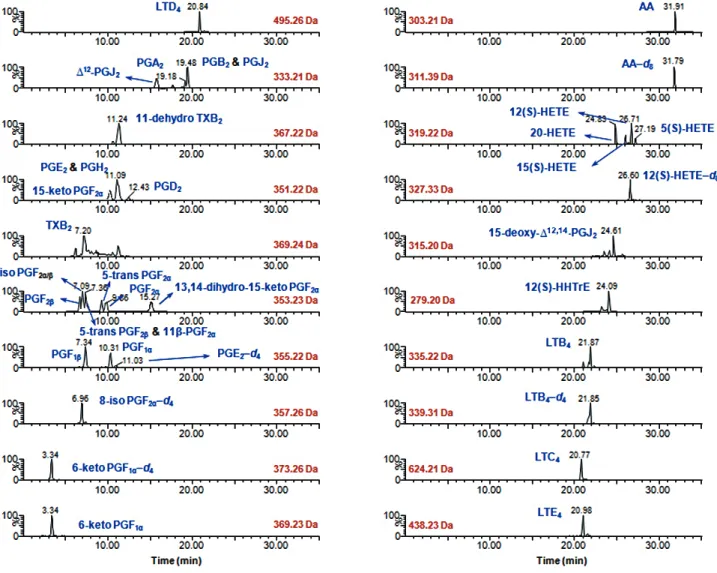
eluted with 2 mL 0.2% formic acid and ethyl acetate (2 mL, twice), respectively. For Oasis MAX cartridges, the samples were washed with 1 mL 0.2% formic acid and subsequently eluted with 1 mL methanolic 0.1% formic acid. Extraction recoveries were acceptable for all eicosanoids tested; however, some of the LTs (e.g., LTC4, LTD4, and LTE4) were detected only following SPE using the Oasis MAX cartridges. Although poor recoveries (< 60%) were obtained for LTB4 and 5(S)-HETE, the extraction efficiencies of these species were reproducible and robust (Ta- ble 2). The LC-MS-based quantitative eicosanoid profile showed meaningful chromatographic separation from 6-keto PGF1α to AA under the LC conditions used (Fig. 1).
For method validation, linearity, LOD, LOQ, precision, and ac- curacy were evaluated using calibrated samples prepared from eicosanoid-free rabbit liver S9 fractions. A calibration curve was
generated for each eicosanoid using the QC samples fortified with all reference standards at different concentrations. The de- vised method was found to be linear (R2=0.990-0.999) over the dynamic ranges. The LOD and LOQ were determined for all eicosanoids in the range of 0.5-20 ng/mg protein. Precision and accuracy were determined by analyzing three QC samples at three different concentrations for individual eicosanoids. Intra- day (n=5) precision (expressed as % CV) was 4.7-10.8%, while accuracy (expressed as % bias) was 88.4-110.9%, and inter- day (n=5) precision (% CV) and accuracy (% bias) were 4.8- 10.3% and 94.0-106.6%, respectively (Table 2).
2. In vitro eicosanoid profiles of CGN-induced inflamed livers Differences in the eicosanoid profiles of the S9 fractions obtained from rabbits with and without CGN-induced systemic inflamma-
Fig. 1. Representative LC-SIM/MS chromatograms for the 32 eicosanoids analyzed in rabbit liver S9 fractions.
Abbreviations: See Table 1; SIM, selected-ion monitoring.
tion were assessed by incubating the S9 fractions with AA (Fig.
2). After incubating the S9 fractions with AA in vitro, nine AA
metabolites catalyzed by COXs, LOXs, and CYP ω-hydroxylase were quantitatively measured. Among these, COX metabolites Fig. 2. Quantification of eicosanoids in liver S9 fractions obtained from CGN-treated rabbits and control (untreated) rabbits. Differ- ences in eicosanoid levels were examined for (A) COX-, (B) CYP ω-hydroxylase-, and (C) LOX-derived metabolites with 50 and 100 μM arachidonic acid. *P <0.05 and **P <0.01.
Abbreviations: See Table 1; CGN, carrageenan; LOX, lipoxygenase.
400 300 200 100
0
180 160 140 120 100 80 60 40 20 0
8
6
4
2
6-keto 15-deoxy TXB2 PGF2α 0
PGF1α -∆12,14-PGJ2
15(s)-HETE 12(s)-HETE 5(s)-HETE
*
20-HETE
Concentration (ng/mg protein)Concentration (ng/mg protein) Concentration (ng/mg protein)
A
C
B
*
* *
* *
** *
**
Control liver with arachidonic acid, 50μM CGN-treated liver with arachidonic acid, 50μM Control liver with arachidonic acid, 100μM CGN-treated liver with arachidonic acid, 100μM
Fig. 3. Effects of celecoxib and ibuprofen on eicosanoid production. Metabolite concentrations in the presence and absence of COX inhibi- tors (50 or 100μM) were measured. *P <0.05.
Abbreviations: See Table 1; CGN, carrageenan.
300 250 200 150 100 50 6
0
400 350 300 250 200 150 100 50 8
0 6-keto 15-deoxy TXB2 PGF2α
PGF1α -∆12,14-PGJ2
6-keto 15-deoxy TXB2 PGF2α
PGF1α -∆12,14-PGJ2
Concentration (ng/mg protein) Concentration (ng/mg protein)
A B
* ** **
CGN with AA (50μM) CGN with AA (100 μM)
CGN with AA (50μM) and Celecoxib (100μM) CGN with AA (100 μM) and Celecoxib (100μM) CGN with AA (50μM) and Ibuprofen (100μM) CGN with AA (100 μM) and Ibuprofen (100μM)
*
were found to be higher in liver S9 fractions from inflammation- induced rabbits than from control rabbits (P <0.05; Fig. 2A), whereas 20-HETE catalyzed by CYP ω-hydroxylase was signifi- cantly lower in liver S9 fractions from inflammation-induced rab- bits than from control rabbits (P <0.05; Fig. 2B). Eicosanoid me- tabolites catalyzed by LOXs generally increased in a dose-depen- dent manner in the S9 fractions prepared from CGN-treated rab- bits (P <0.05; Fig. 2C).
To validate our in vitro assay and method of eicosanoid quan- tification, two different inhibitors were tested: celecoxib, a selec- tive COX-2 inhibitor, and ibuprofen, a dual inhibitor of both COX-1 and COX-2 (Fig. 3). The COX inhibitors reduced the lev- els of COX metabolites [26]. Compared with ibuprofen, selective COX-2 inhibitor (celecoxib) showed less interference with the ir-
reversible inhibition of COX-1. In particular, ibuprofen, a nonse- lective COX inhibitor, caused greater changes in metabolite lev- els (6-keto PGF1α [the stable metabolite of PGI2], 15-deoxy- Δ12,14-PGJ2 [the stable metabolite of PGD2], and TXB2 [the stable metabolite of TXA2]) than celecoxib.
3. Biochemical roles of epitestosterone in eicosanoid metabolism
Epitestosterone was evaluated for its potential to affect meta- bolic enzyme expression in eicosanoid metabolism in CGN- treated rabbit liver S9 fractions. Epitestosterone reduced the levels of 6-keto PGF1α, 15-deoxy-Δ12,14-PGJ2, PGF2α, and TXB2 in terms of a balanced pathway toward the preferential inhibition of eicosanoids in liver S9 fractions from CGN-induced rabbit
6 5 4 3 2 1 0
20-HETE
ng/mg protein
7 6 54 3 2 10
6-keto prostaglandin F1α
ng/mg protein
*
*
400 300 200 100
0 Thromboxane B2
ng/mg protein
6 5 4 3 2 1
15-deoxy-∆0 12,14-Prostaglandin J2
ng/mg protein
*
*
10 8 6 4 2 0
Prostaglandin F2α
ng/mg protein
180 150 120 90 60 30
0 15(s)-HETE
ng/mg protein
100 80 60 40 20
0 12(s)-HETE
ng/mg protein
180 150 120 90 60 30
0 5(s)-HETE
ng/mg protein
CGN treated Epitestosterone, 50μM Epitestosterone, 100μM
Fig. 4. Changes in eicosanoid metabolism affected by epitestosterone in liver S9 fractions from CGN-induced rabbit models of inflamma- tion. Different levels of arachidonic acid (50 or 100μM) were tested. Differences among eicosanoid levels after treatment with epitestoster- one (50 or 100μM) were measured (n=8, each concentration). *P <0.05.
Abbreviations: See Table 1; CYP, cytochrome P450; LOX, lipoxygenase; CGN, carrageenan.
models of inflammation. Among these, the levels of 6-keto PGF1α and 15-deoxy-Δ12,14-PGJ2 significantly decreased follow- ing both 50 and 100μM epitestosterone treatment compared with non-treated samples (P <0.05). All HETEs measured, ex- cept 5(S)-HETE and PGF2α were generally suppressed, but the differences were not statistically significant (Fig. 4). Induction of both COX-1 and COX-2 by inflammatory mediators does not in- crease all PGs produced by a given cell type.
DISCUSSION
We developed an LC-MS method for the quantitative profiling of eicosanoids from CGN-treated rabbit liver S9 fractions as an in vitro eicosanoid metabolic assay. We applied this assay to evalu- ate metabolic alterations in eicosanoid levels affected by epites- tosterone, which may regulate inducible COX enzymes since it is an endogenous androgen [18, 19].
Comprehensive LC-MS-based methods previously reported for the measurement of eicosanoids in biological specimens ex- hibited good chromatographic properties as well as reliability, which are ideal features of a lipidomics platform [6, 8, 13-15].
To optimize the accuracy and reproducibility in the quantifica- tion of eicosanoids in liver S9 fractions, sub-2 μm particle LC columns were used, as these columns selectively eliminated in- terference in the liver S9 fraction, combined with anion-ex- change SPE purification. The devised method successfully sep- arated most eicosanoids with good peak shapes and with reten- tion times ranging from 3.34 for 6-keto PGF1α to 31.91 for AA, while PGE2 and PGH2, 8-iso PGF2α and PGF2β, 5-trans PGF2β
and 11β-PGF2α co-eluted (Fig. 1).
Sample preparation techniques involving SPE were also opti- mized to concentrate the analytes and reduce sample complex- ity in the liver S9 fractions. Oasis HLB cartridges contain a unique copolymer sorbent that allows for highly selective extrac- tion of various lipid molecules [13, 24, 27]. Under SPE condi- tions, both the sample loading and washing steps are critical for preventing sample loss and improving extraction selectivity.
When six different SPE methods were compared to determine the overall extraction recovery of 13 stable isotope-labeled eico- sanoids added to the blood plasma [14, 15], the Oasis HLB protocol not only efficiently removed matrix interference, but also could not detect LTs, including LTC4, LTD4, and LTE4, which were measured by our method with the Oasis MAX cartridges.
According to our initial experiments, no eicosanoids were de- tected in both the loading and washing fractions using the Oasis MAX procedure, unlike in the case of the Oasis HLB procedure,
and thus the Oasis MAX was used to remove background inter- ference derived from the liver S9 fractions.
In general, PGs and TXs, the formation of which is catalyzed by COX isoenzymes, play a key role in inflammatory response activation and significantly increase in inflamed tissues [26, 28].
As LOX metabolites, 5- and 12-HETEs also increased by inflam- mation [29], while 20-HETE was suppressed by systemic in- flammation in vivo [5]. In this study, S9 fractions from rabbit models of systematic inflammation induced by CGN treatment exhibited enhanced formation of the three PGs, TXB2, and three HETEs compared with those from control rabbits (excluding 20- HETE, the levels of which were decreased; Fig. 2). In contrast to COX-1, which produces PGI2, TXA2, PGD2, and 12(S)-HHTrE, COX-2 catalyzes the formation of PGE2 and may increase the levels of PGE2, PGF1α, and TXB2 [30]. In both in vivo and in vitro experiments, celecoxib has been shown to inhibit 5-LOX but not the other LOXs [31]. In this study, the levels of all detected HETEs, including 20-HETE, 5(S)-HETE, 12(S)-HETE, and 15(S)-HETE, were not altered by celecoxib or ibuprofen (data not shown). As expected, the levels of other metabolites such as 6-keto PGF1α, 15-deoxy-Δ12,14-PGJ2, PGF2α, and TXB2 were re- duced by each of these inhibitors (Fig. 3). This result is compa- rable to those of a previous report that demonstrated that acute inflammation decreased the production of some eicosanoid me- tabolites, particularly of 20-HETE [32].
Regarding the effects on eicosanoid metabolism, COX-cata- lyzed metabolites were reduced after epitestosterone treatment, while LOX metabolites did not significantly change (Fig. 4). Fol- lowing epitestosterone treatment at 50μM, four COX metabolites were dose-dependently suppressed, but some were not altered following treatment with 100μM epitestosterone. This may be because of the fluctuating inhibitory activity of epitestosterone for COXs and LOXs, which leads to different responses towards in- flammation, depending on the samples tested, e.g., pure en- zyme or cell homogenates [33]. The serum levels of androgens, including testosterone and dehydroepiandrosterone sulfate, are inversely correlated with the disease severity of rheumatoid ar- thritis [19]. In particular, as a major androgen, testosterone has immune-modulating properties and may stimulate anti-inflam- matory cytokines such as IL-10 [34]. Epitestosterone, a naturally occurring steroid hormone, is an epimer of testosterone. Its bio- logical significance is controversial, as it has been suggested to act as a biologically inactive metabolite or may have antiandro- genic effects by competing with testosterone for androgen recep- tor binding sites [20, 21]. The antiandrogenic effects of epites- tosterone on androgenic alopecia have been proposed to result
from its competition with testosterone for binding to androgen re- ceptors [35], but hair loss may also be prevented by its anti-in- flammatory actions because androgenic alopecia is closely asso- ciated with inflammation [36]. We suggest that epitestosterone uses a similar mode of action on COX-1 as ibuprofen; however, epitestosterone needs to be further investigated as a potential in- hibitor of COX-dependent inflammation.
This study has several limitations. First, our in vitro experi- ments evaluating metabolic alterations caused by epitestoster- one were conducted in inflamed rabbit liver S9 fractions; how- ever, lipid metabolism in rabbits differs from that in humans [37]. Additionally, fixed doses of epitestosterone were used in the in vitro experiments and thus are not representative of doses present in human circulating blood. The present study focused more on the development of an LC-MS-based in vitro screening assay to identify metabolic changes in eicosanoids than on in- flammation-associated responses.
In conclusion, an in vitro assay coupled with a novel LC-MS assay was developed to quantitatively determine eicosanoid sig- natures. The method was validated using the known COX inhibi- tors—celecoxib and ibuprofen. Moreover, changes in the levels of a large number of eicosanoids were measured, thereby shed- ding light on the coordinated effects of epitestosterone on inhib- iting the release of AA metabolites associated with lipid metabo- lism. Given the complex physiological processes involved in anti-inflammatory responses in cells, our results do not indicate that epitestosterone has an anti-inflammatory effect but reveal metabolic suppression of COX-mediated metabolites of AA in the presence of epitestosterone. The present method will be useful for assessing the biochemical responses of eicosanoid metabolism affected by the pharmacometabolic actions of in- flammatory mediators.
Authors’ Disclosures of Potential Conflicts of Interest
No potential conflicts of interest relevant to this article were re- ported.
Acknowledgments
This study was supported in part by a grant from the Korea In- stitute of Science and Technology Institutional Program (Project No. 2E26110) and a grant from the Bio & Medical Technology Development Program (NRF-2013M3A9B6046413) through the Ministry of Science, ICT & Future Planning.
REFERENCES
1. Musiek ES, Milne GL, McLaughlin B, Morrow JD. Cyclopentenone eico- sanoids as mediators of neurodegeneration: a pathogenic mechanism of oxidative stress-mediated and cyclooxygenase-mediated neurotoxici- ty. Brain Pathol 2005;15:149-58.
2. Wymann MP and Schneiter R. Lipid signalling in disease. Nat Rev Mol Cell Biol 2008;9:162-76.
3. Serhan CN, Chiang N, Van Dyke TE. Resolving inflammation: dual anti- inflammatory and pro-resolution lipid mediators. Nat Rev Immunol 2008;
8:349-61.
4. Balazy M. Eicosanomics: targeted lipidomics of eicosanoids in biological systems. Prostaglandins Other Lipid Mediat 2004;73:173-80.
5. Theken KN, Deng Y, Kannon MA, Miller TM, Poloyac SM, Lee CR. Acti- vation of the acute inflammatory response alters cytochrome P450 ex- pression and eicosanoid metabolism. Drug Metab Dispos 2011;39:22-9.
6. Han X and Gross RW. Global analyses of cellular lipidomes directly from crude extracts of biological samples by ESI mass spectrometry: a bridge to lipidomics. J Lipid Res 2003;44:1071-9.
7. Morrow JD and Roberts LJ. The isoprostanes: unique bioactive prod- ucts of lipid peroxidation. Prog Lipid Res 1997;36:1-21.
8. Masoodi M and Volmer DA. Comprehensive quantitative determination of PUFA-related bioactive lipids for functional lipidomics using high-res- olution mass spectrometry. Methods Mol Biol 2014;1198:221-32.
9. Buczynski MW, Dumlao DS, Dennis EA. Thematic review series: pro- teomics. An integrated omics analysis of eicosanoid biology. J Lipid Res 2009;50:1015-38.
10. Haeggström JZ, Rinaldo-Matthis A, Wheelock CE, Wetterholm A. Ad- vances in eicosanoid research, novel therapeutic implications. Biochem Biophys Res Commun 2010;396:135-9.
11. Tsikas D and Zoerner AA. Analysis of eicosanoids by LC-MS/MS and GC-MS/MS: a historical retrospect and a discussion. J Chromatogr B Analyt Technol Biomed Life Sci 2014;964:79-88.
12. Tsikas D and Suchy MT. Protocols for the measurement of the F2-iso- prostane, 15(S)-8-iso-prostaglandin F2α, in biological samples by GC-MS or GC-MS/MS coupled with immunoaffinity column chromatography. J Chromatogr B Analyt Technol Biomed Life Sci 2014;doi:10.1016/
j.jchromb.2104.12.019.
13. Yang J, Schmelzer K, Georgi K, Hammock BD. Quantitative profiling method for oxylipin metabolome by liquid chromatography electrospray ionization tandem mass spectrometry. Anal Chem 2009;81:8085-93.
14. Ostermann AI, Wilenberg I, Schebb NH. Comparison of sample prepara- tion methods for the quantitative analysis of eicosanoids and other oxy- lipins in plasma by means of LC-MS/MS. Anal Bioanal Chem 2015;407:
1403-14.
15. Willenberg I, Ostermann AI, Schebb NH. Targeted metabolomics of the arachidonic acid cascade: current state and challenges of LC-MS analy- sis of oxylipins. Anal Bioanal Chem 2015;407:2675-83.
16. Adcock IM and Lane SJ. Corticosteroid-insensitive asthma: molecular mechanisms. J Endocrinol 2003;178:347-55.
17. Barnes PJ. How corticosteroids control inflammation: quintiles prize lecture 2005. Br J Pharmacol 2006;148:245-54.
18. Loria RM, Inge TH, Cook SS, Szakal AK, Regelson W. Protection against acute lethal viral infections with the native steroid dehydroepiandros- terone (DHEA). J Med Virol 1988;26:301-14.
19. Cutolo M. Androgens in rheumatoid arthritis: when are they effectors?
Arthritis Res Ther 2009;11:126.
20. Stárka L, Bicíková M, Hampl R. Epitestosterone - an endogenous anti- androgen? J Steroid Biochem 1989;33:1019-21.
21. Bicíková M, Kanceva R, Lapcík O, Hill M, Stárka L. The effect of epites- tosterone on the plasma levels of LH and FSH in ovariectomized imma- ture rats. J Steroid Biochem Mol Biol 1993;44:321-4.
22. Choi MH, Skipper PL, Wishnok JS, Tannenbaum SR. Characterization of testosterone 11β-hydroxylation catalyzed by human liver microsomal cy- tochrome P450. Drug Metab Dispos 2005;33:714-8.
23. Chalbot S and Morfin R. Human liver S9 fractions: metabolism of dehy- droepiandrosterone, epiandrosterone and related 7-hydroxylated deriva- tives. Drug Metab Dispos 2005;33:563-9.
24. Lee SH, Lee DH, Lee J, Lee WY, Chung BC, Choi MH. Comparative GC- MS based in vitro assays of 5α-reductase activity using rat liver S9 frac- tion. Mass Spectrom Lett 2012;3:21-4.
25. Zhang B and Saku K. Control of matrix effects in the analysis of urinary F2-isoprostanes using novel multidimensional solid-phase extraction and LC-MS/MS. J Lipid Res 2007;48:733-44.
26. Ricciotti E and FitzGerald GA. Prostaglandins and inflammation. Arterio- scler Thromb Vasc Biol 2011;31:986-1000.
27. Choi MH and Chung BC. Bringing GC-MS profiling of steroids into clini- cal applications. Mass Spectrom Rev 2015;34:219-36.
28. Dobrian AD, Lieb DC, Cole BK, Taylor-Fishwick DA, Chakrabarti SK, Nadler JL. Functional and pathological roles of the 12- and 15-lipoxy- genases. Prog Lipid Res 2011;50:115-31.
29. Issan Y, Hochhauser E, Guo A, Gotlinger KH, Kornowski R, Leshem-Lev D, et al. Elevated level of pro-inflammatory eicosanoids and EPC dys- function in diabetic patients with cardiac ischemia. Prostaglandins Oth-
er Lipid Mediat 2013;100-101:15-21.
30. Erol K, Sirmagul B, Kilic FS, Yigitaslan S, Dogan AE. The role of inflam- mation and COX-derived prostanoids in the effects of bradykinin on iso- lated rat aorta and urinary bladder. Inflammation 2012;35:420-8.
31. Maier TJ, Tausch L, Hoernig M, Coste O, Schmidt R, Angioni C, et al.
Celecoxib inhibits 5-lipoxygenase. Biochem Pharmacol 2008;76:862- 72.
32. Abdel-Razzak Z, Loyer P, Fautrel A, Gautier JC, Corcos L, Turlin B, et al.
Cytokines down-regulate expression of major cytochrome P-450 enzymes in adult human hepatocytes in primary culture. Mol Pharmacol 1993;
44:707-15.
33. Vane JR and Botting RM. New insights into the mode of action of anti- inflammatory drugs. Inflamm Res 1995;44:1-10.
34. Malkin CJ, Pugh PJ, Jones RD, Kapoor D, Channer KS, Jones TH. The ef- fect of testosterone replacement on endogenous inflammatory cytokines and lipid profiles in hypogonadal men. J Clin Endocrinol Metab 2004;89:
3313-8.
35. Choi MH, Yoo YS, Chung BC. Biochemical roles of testosterone and epitestosterone to 5 alpha-reductase as indicators of male-pattern bald- ness. J Invest Dermatol 2001;116:57-61.
36. Magro CM, Rossi A, Poe J, Manhas-Bhutani S, Sadick N. The role of in- flammation and immunity in the pathogenesis of androgenetic alopecia.
J Drug Dermatol 2011;10:1404-11.
37. Yanni AE. The laboratory rabbit: an animal model of atherosclerosis re- search. Lab Anim 2004;38:246-56.