Baltic Way 1998
Warsaw, November 8, 1998
Problems
1. Let Z+ be the set of all positive integers. Find all functions f :Z+ → Z+ satisfying the following conditions for all x, y ∈ Z+:
f (x, x) = x , f (x, y) = f (y, x) , (x + y)f (x, y) = yf (x, x+y) .
2. A triple of positive integers (a, b, c) is called quasi-Pythagorean if there exists a triangle with lengths of the sides a , b , c and the angle opposite to the side c equal to 120◦. Prove that if (a, b, c) is a quasi-Pythagorean triple then c has a prime divisor greater than 5 .
3. Find all pairs of positive integers x , y which satisfy the equation 2x2+ 5y2= 11(xy − 11) .
4. Let P be a polynomial with integer coefficients. Suppose that for n = 1, 2, 3, . . . , 1998 the number P (n) is a three-digit positive integer.
Prove that the polynomial P has no integer roots.
5. Let a be an odd digit and b an even digit. Prove that for every positive integer n there exists a positive integer, divisible by 2n, whose decimal representation contains no digits other than a and b .
6. Let P be a polynomial of degree 6 and let a , b be real numbers such that 0 < a < b . Suppose that P (a) = P (−a), P (b) = P (−b) and P0(0) = 0 . Prove that P (x) = P (−x) for all real x.
7. LetR be the set of all real numbers. Find all functions f : R → R satisfying for all x, y ∈ R the equation
f (x) + f (y) = f (f (x)f (y)) .
8. Let Pk(x) = 1 + x + x2+ · · · + xk−1. Show that
n
X
k=1
µn k

Pk(x) = 2n−1Pn
³1 + x 2
´
for every real number x and every positive integer n .
9. Let the numbers α , β satisfy 0 < α < β < π/2 and let γ and δ be the numbers defined by the conditions:
(i) 0 < γ < π/2 , and tan γ is the arithmetic mean of tan α and tan β ; (ii) 0 < δ < π/2 , and 1
cos δ is the arithmetic mean of 1
cos α and 1 cos β. Prove that γ < δ .
10. Let n > 4 be an even integer. A regular n -gon and a regular (n−1)-gon are inscribed into the unit circle. For each vertex of the n -gon consider the distance from this vertex to the nearest vertex of the (n−1)-gon, measured along the circumference. Let S be the sum of these n distances. Prove that S depends only on n , and not on the relative position of the two polygons.
11. Let a , b and c be the lengths of the sides of a triangle with circumradius R . Prove that
R > a2+ b2 2√
2a2+ 2b2− c2 . When does equality hold?
12. In a triangle ABC , 6 BAC = 90◦. Point D lies on the side BC and satisfies 6 BDA = 26 BAD . Prove that
1
|AD| = 1 2
µ 1
|BD| + 1
|CD|
¶ .
13. In a convex pentagon ABCDE , the sides AE and BC are parallel and
6 ADE =6 BDC . The diagonals AC and BE intersect at P . Prove that
6 EAD =6 BDP and 6 CBD =6 ADP .
14. Given a triangle ABC with |AB| < |AC|. The line passing through B and parallel to AC meets the external bisector of angle BAC at D . The line passing through C and parallel to AB meets this bisector at E . Point F lies on the side AC and satisfies the equality |F C| = |AB|. Prove that
|DF | = |F E|.
15. Given an acute triangle ABC . Point D is the foot of the perpendicular from A to BC . Point E lies on the segment AD and satisfies the equation
|AE|
|ED| = |CD|
|DB| .
Point F is the foot of the perpendicular from D to BE . Prove that
6 AF C = 90◦.
16. Is it possible to cover a 13 × 13 chessboard with forty-two tiles of size 4 × 1 so that only the central square of the chessboard remains uncovered? (It is assumed that each tile covers exactly four squares of the chessboard, and the tiles do not overlap.)
17. Let n and k be positive integers. There are nk objects (of the same size) and k boxes, each of which can hold n objects. Each object is coloured in one of k different colours. Show that the objects can be packed in the boxes so that each box holds objects of at most two colours.
18. Determine all positive integers n for which there exists a set S with the following properties:
(i) S consists of n positive integers, all smaller than 2n−1;
(ii) for any two distinct subsets A and B of S , the sum of the elements of A is different from the sum of the elements of B .
19. Consider a ping-pong match between two teams, each consisting of 1000 players. Each player played against each player of the other team exactly once (there are no draws in ping-pong). Prove that there exist ten players, all from the same team, such that every member of the other team has lost his game against at least one of those ten players.
20. We say that an integer m covers the number 1998 if 1, 9, 9, 8 appear in this order as digits of m . (For instance, 1998 is covered by 215993698 but not by 213326798 .) Let k(n) be the number of positive integers that cover 1998 and have exactly n digits (n > 5) , all different from 0 . What is the remainder of k(n) in division by 8 ?
Solutions
1. Answer: f (x, y) = lcm (x, y) is the only such function.
We first show that there is at most one such function f . Let z > 2 be an integer. Knowing the values f (x, y) for all x, y with 0 < x, y < z , we compute f (x, z) for 0 < x < z using the third equation (with y = z − x);
then from the first two equations we get the values f (z, y) for 0 < y 6 z . Hence, if f exists then it is unique.
Experimenting a little, we can guess that f (x, y) is the least common multi- ple of x and y . It remains to verify that the least-common-multiple function satisfies the given equations. The first two are clear, and for the third one:
(x + y) · lcm (x, y) = (x + y) · xy
gcd(x, y) = y · x(x + y) gcd(x, x + y) =
= y · lcm (x, x + y) .
2. By the cosine law, a triple of positive integers (a, b, c) is quasi-Pythagorean if and only if
c2= a2+ ab + b2. (1)
If a triple (a, b, c) with a common divisor d > 1 satisfies (1), then so does the reduced triple ³a
d,b d,c
d
´. Hence it suffices to prove that in every irreducible quasi-Pythagorean triple the greatest term c has a prime divisor greater than 5 . Actually, we will show that in that case every prime divisor of c is greater than 5 .
Let (a, b, c) be an irreducible triple satisfying (1). Note that then a , b and c are pairwise coprime. We have to show that c is not divisible by 2 , 3 or 5 .
If c were even, then a and b (coprime to c ) should be odd, and (1) would not hold.
Suppose now that c is divisible by 3 , and rewrite (1) as
4c2= (a + 2b)2+ 3a2. (2)
Then a + 2b must be divisible by 3 . Since a is coprime to c , the number 3a2 is not divisible by 9 . This yields a contradiction since the remaining terms in (2) are divisible by 9 .
Finally, suppose c is divisible by 5 (and hence a is not). Again we get a contradiction with (2) since the square of every integer is congruent to 0 ,
1 or −1 modulo 5; so 4c2− 3a2 ≡ ±2 (mod 5) and it cannot be equal to (a + 2b)2. This completes the proof.
Remark. A yet stronger claim is true: If a and b are coprime, then every prime divisor p > 3 of a2+ ab + b2 is of the form p = 6k + 1 . (Hence every prime divisor of c in an irreducible quasi-Pythagorean triple (a, b, c) has such a form.)
This stronger claim can be proved by observing that p does not divide a and the number g = (a + 2b)a(p−3)/2 is an integer whose square satisfies
g2 = (a + 2b)2ap−3 = (4(a2+ ab + b2) − 3a2)ap−3≡ −3ap−1≡
≡ −3 (mod p) .
Hence −3 is a quadratic residue modulo p. This is known to be true only for primes of the form 6k+1 ; proofs can be found in many books on number theory, e.g. [1].
Reference. [1] K. Ireland, M. Rosen, A Classical Introduction to Modern Number Theory, Second Edition, Springer-Verlag, New York 1990.
3. Answer: x = 14 , y = 27 .
Rewriting the equation as 2x2− xy + 5y2− 10xy = −121 and factoring we get:
(2x − y) · (5y − x) = 121 .
Both factors must be of the same sign. If they were both negative, we would have 2x < y < x
5, a contradiction. Hence the last equation represents the number 121 as the product of two positive integers: a = 2x − y and b = 5y −x, and (a, b) must be one of the pairs (1, 121), (11, 11) or (121, 1).
Examining these three possibilities we find that only the first one yields integer values of x and y , namely, (x, y) = (14, 27) . Hence this pair is the unique solution of the original equation.
4. Let m be an arbitrary integer and define n ∈ {1, 2, . . . , 1998} to be such that m ≡ n (mod 1998). Then P (m) ≡ P (n) (mod 1998). Since P (n) as a three-digit number cannot be divisible by 1998, then P (m) cannot be equal to 0 . Hence P has no integer roots.
5. If b = 0 , then N = 10na meets the demands. For the sequel, suppose b 6= 0.
Let n be fixed. We prove that if 1 6 k 6 n , then we can find a positive integer mk < 5k such that the last k digits of mk2n are all a or b . Clearly, for k = 1 we can find m1 with 1 6 m1 6 4 such that m12n ends with the digit b . (This corresponds to solving the congruence m12n−1 ≡ b
2 modulo 5 .) If n = 1 , we are done. Hence let n > 2 .
Assume that for a certain k with 1 6 k < n we have found the integer mk. Let c be the (k+1) -st digit from the right of mk2n (i.e., the coefficient of 10k in its decimal representation). Consider the number 5k2n: it ends with precisely k zeros, and the last non-zero digit is even; call it d . For any r , the corresponding digit of the number mk2n+ r5k2n will be c + rd modulo 10 . By a suitable choice of r 6 4 we can make this digit be either a or b , according to whether c is odd or even. (As before, this corresponds to solving one of the congruences r ·d
2 ≡ a − c
2 or r ·d
2 ≡ b − c
2 modulo 5 .) Now, let mk+1= mk+ r5k. The last k+1 digits of mk+12n are all a or b . As mk+1< 5k+4·5k = 5k+1, we see that mk+1has the required properties.
This process can be continued until we obtain a number mn such that the last n digits of N = mn2n are a or b . Since mn < 5n, the number N has at most n digits, all of which are a or b .
Alternative solution. The case b = 0 is handled as in the first solution.
Assume that b 6= 0. We prove the statement by induction on n, postulating, in addition, that N (the integer we are looking for) must be an n -digit number.
For n = 1 we take the one-digit number b . Assume the claim is true for a certain n > 1 , with N ≡ 0 (mod 2n) having exactly n digits, all a or b ; thus N < 10n. Define
N∗=½ 10nb + N if N ≡ 0 (mod 2n+1) , 10na + N if N ≡ 2n(mod 2n+1) . Clearly, N∗ is an (n+1) -digit number, satisfying
N∗≡½ 0 + 0 (mod 2n+1) in the first case, 2n+ 2n(mod 2n+1) in the second case.
In both cases N∗ is divisible by 2n+1, and we have the induction claim.
The result follows.
6. The polynomial Q(x) = P (x) − P (−x), of degree at most 5, has roots at
−b, −a, 0, a and b; these are five distinct numbers. Moreover, Q0(0) = 0 , showing that Q has a multiple root at 0 . Thus Q must be the constant 0 , i.e. P (x) = P (−x) for all x.
7. Answer: f (x) ≡ 0 is the only such function.
Choose an arbitrary real number x0 and denote f (x0) = c . Setting x = y = x0 in the equation we obtain f (c2) = 2c . For x = y = c2 the equation now gives f (4c2) = 4c . On the other hand, substituting x = x0
and y = 4c2 we obtain f (4c2) = 5c . Hence 4c = 5c , implying c = 0 . As x0 was chosen arbitrarily, we have f (x) = 0 for all real numbers x . Obviously, the function f (x) ≡ 0 satisfies the equation. So it is the only solution.
8. Let A and B be the left- and right-hand side of the claimed formula, respectively. Since
(1 − x)Pk(x) = 1 − xk , we get
(1 − x) · A =
n
X
k=1
µn k

(1 − xk) =
n
X
k=0
µn k

(1 − xk) = 2n− (1 + x)n
and
(1 − x) · B = 2 µ
1 − 1 + x 2

· 2n−1Pn
µ 1 + x 2

=
= 2n µ
1 −µ 1 + x 2
¶n
= 2n− (1 + x)n.
Thus A = B for all real numbers x 6= 1. Since both A and B are polyno- mials, they coincide also for x = 1 .
Remark. The desired equality can be also proved without multiplication by (1 − x), just via regrouping the terms of the expanded Pk’s and some more manipulation; this approach is more cumbersome.
9. Let f (t) =p
1 + t2. Since f00(t) = (1 + t2)−3/2 > 0 , the function f (t) is
strictly convex on (0, ∞) . Consequently, 1
cos γ = q
1 + tan2γ = f (tan γ) = fµ tan α + tan β 2

<
< f (tan α) + f (tan β)
2 =1
2
µ 1
cos α+ 1 cos β

= 1
cos δ , and hence γ < δ .
Remark. The use of calculus can be avoided. We only need the midpoint- convexity of f , i.e., the inequality
s 1 + 1
4(u + v)2<1 2
p1 + u2+1 2
p1 + v2
for u, v > 0 and u 6= v , which is equivalent (via squaring) to 1 + uv <p(1 + u2)(1 + v2) .
The latter inequality reduces (again by squaring) to 2uv < u2+ v2, holding trivially.
Alternative solution. Draw a unit segment OP in the plane and take points A and B on the same side of line OP so that 6 P OA = 6 P OB = 90◦,
6 OP A = α and 6 OP B = β (see Figure 1). Then we have |OA| = tan α,
|OB| = tan β , |P A| = 1
cos α and |P B| = 1 cos β.
B
Q
A O
P
C
Figure 1
α β
N
Let C be the midpoint of the segment AB . By hypothesis, we have
|OC| = tan α + tan β
2 = tan γ , hence 6 OP C = γ and |P C| = 1 cos γ. Let Q be the point symmetric to P with respect to C . The quadrilateral P AQB is a parallelogram, and therefore |AQ| = |P B| = 1
cos β. Eventu- ally,
2
cos δ = 1
cos α+ 1
cos β = |P A| + |AQ| > |P Q| = 2 · |P C| = 2 cos γ , and hence δ > γ .
Another solution. Set x = α + β
2 and y =α − β
2 , then α = x+y , β = x−y and
cos α cos β = 1
2(cos 2x + cos 2y) =
= 1
2(1 − 2 sin2x) + 1
2(2 cos2y − 1) = cos2y − sin2x .
(3)
By the conditions of the problem, tan γ = 1
2
³sin α
cos α+ sin β cos β
´= 1
2· sin(α + β)
cos α cos β = sin x cos x cos α cos β and
1 cos δ = 1
2
³ 1
cos α+ 1 cos β
´= 1
2· cos α + cos β
cos α cos β = cos x cos y cos α cos β . Using (3) we hence obtain
tan2δ − tan2γ = 1
cos2δ− 1 − tan2γ = cos2x cos2y − sin2x cos2x cos2α cos2β − 1 =
= cos2x(cos2y − sin2x)
(cos2y − sin2x)2 − 1 = cos2x
cos2y − sin2x− 1 =
= cos2x − cos2y + sin2x
cos2y − sin2x = sin2y
cos α cos β > 0 , showing that δ > γ .
10. For simplicity, take the length of the circle to be 2n(n − 1) rather than 2π . The vertices of the (n−1)-gon A0A1. . . An−2 divide it into n−1 arcs of length 2n . By the pigeonhole principle, some two of the vertices of the n -gon B0B1. . . Bn−1 lie in the same arc. Assume w.l.o.g. that B0 and B1
lie in the arc A0A1, with B0 closer to A0 and B1 closer to A1, and that
|A0B0| 6 |B1A1|.
Consider the circle as the segment [0, 2n(n−1)] of the real line, with both of its endpoints identified with the vertex A0 and the numbers 2n, 4n, 6n, . . . identified accordingly with the vertices A1, A2, A3, . . . .
For k = 0, 1, . . . , n−1, let xk be the “coordinate” of the vertex Bk of the n -gon. Each arc BkBk+1 has length 2(n − 1). By the choice of labelling, we have
0 6 x0< x1= x0+ 2(n − 1) 6 2n
and, moreover, x0− 0 6 2n − x1. Hence 0 6 x061 .
Clearly, xk = x0+ 2k(n − 1) for k = 0, 1, . . . , n−1. It is not hard to see that (2k − 1)n 6 xk62kn if 1 6 k 6 n
2, and (2k − 2)n 6 xk6(2k − 1)n if n
2 < k 6 n − 1. These inequalities are verified immediately by inserting xk= x0+ 2k(n − 1) and taking into account that 0 6 x061 .
Summing up, we have:
1) if 1 6 k 6 n
2, then Bk lies between Ak−1 and Ak, closer to Ak; recalling that Ak has “coordinate” 2kn , we see that the distance in question is equal to 2kn − xk = 2k − x0;
2) if n
2 < k 6 n − 1, then Bk lies between Ak−1 and Ak, closer to Ak−1; the distance in question is equal to xk− (2k − 2)n = x0− 2k + 2n;
3) for B0, the distance in question is x0. The sum of these distances evaluates to
x0+
n/2
X
k=1
(2k − x0) +
n−1
X
k=n/2+1
(x0− 2k + 2n)
Note that here x0 appears half of the times with a plus sign and half of the times with a minus sign. Thus, eventually, all terms x0 cancel out, and the value of S does not depend on anything but n .
11. Answer: equality holds if a = b or the angle opposite to c is equal to 90◦. Denote the angles opposite to the sides a , b , c by A , B , C , respectively.
By the law of sines we have a = 2R sin A , b = 2R sin B , c = 2R sin C . Hence, the given inequality is equivalent to each of the following:
R > 4R2(sin2A + sin2B) 2q
8R2(sin2A + sin2B) − 4R2sin2C ,
2(sin2A + sin2B) − sin2C > (sin2A + sin2B)2, (sin2A + sin2B)(2 − sin2A − sin2B) > sin2C , (sin2A + sin2B)(cos2A + cos2B) > sin2C .
The last inequality follows from the Cauchy–Schwarz inequality:
(sin2A + sin2B)(cos2B + cos2A) >
>(sin A · cos B + sin B · cos A)2= sin2C .
Equality requires that sin A = λ cos B and sin B = λ cos A for a certain real number λ , implying that λ is positive and A , B are acute angles.
From these two equations we conclude that sin 2A = sin 2B . This means that either 2A = 2B or 2A + 2B = π ; in other words, a = b or C = 90◦. In each of these two cases the inequality indeed turns into equality.
PSfrag replacements
A B
C
O
M
a b
c
Figure 2
Alternative solution. Let A , B , C be the respective vertices of the triangle, O be its circumcentre and M be the midpoint of AB (see Figure 2). The length mc= |CM| of the median drawn from C is expressed by the well-
known formula
4m2c = 2a2+ 2b2− c2.
Hence the inequality of the problem can be rewritten as 4Rmc>a2+ b2, or 8Rmc>4m2c+ c2. The last inequality is equivalent to
|mc− R| 6pR2− (c/2)2, or ¯
¯|MC| − |OC|¯
¯ 6 |OM|, which is the triangle inequality for triangle COM .
Equality holds if and only if the points C , O , M are collinear. This happens if and only if a = b or 6 C = 90◦.
Remark. Yet another solution can be obtained by setting R = abc
4S (where S denotes the area of the triangle) and expressing S by Heron’s formula. After squaring both sides, cross-multiplying and cancelling a lot, the inequality reduces to (a2−b2)2(a2+b2−c2)2>0 , with equality if a = b or a2+b2= c2. PSfrag replacements
A B C O M a b c
A B
C
O D
E
Figure 3
12. Let O be the circumcentre of triangle ABC (i.e., the midpoint of BC ) and let AD meet the circumcircle again at E (see Figure 3). Then
6 BOE = 26 BAE =6 CDE , showing that |DE| = |OE|. Triangles ADC and BDE are similar; hence |AD|
|BD| = |CD|
|DE|, |AD|
|CD| =|BD|
|DE| and finally
|AD|
|BD|+|AD|
|CD| =|CD|
|DE|+|BD|
|DE| = |BC|
|DE| =|BC|
|OE| = 2
which is equivalent to the equality we have to prove.
Alternative solution. Let 6 BAD = α and 6 CAD = β . By the conditions of the problem, α + β = 90◦ (hence sin β = cos α ), 6 BDA = 2α and
6 CDA = 2β . By the law of sines,
|AD|
|BD| = sin 3α
sin α = 3 − 4 sin2α and
|AD|
|CD| =sin 3β
sin β = 3 − 4 sin2β = 3 − 4 cos2α . Adding these two equalities we get the claimed one.
PSfrag replacements A B C O M a b c A B C O D E
A B
C D
E
F P
C1 C2
Figure 4
13. Let C1 and C2 be the circumcircles of triangles AED and BCD , respec- tively. Let DP meet C2 for the second time at F (see Figure 4). Since
6 ADE = 6 BDC , the ratio of the lengths of the segments EA and BC is equal to the ratio of the radii of C1 and C2. Thus the homothety with centre P that takes AE to CB , also transforms C1 onto C2. The same homothety transforms the arc DE of C1 onto the arc F B of C2. Therefore
6 EAD =6 BDF =6 BDP . The second equality is proved similarly.
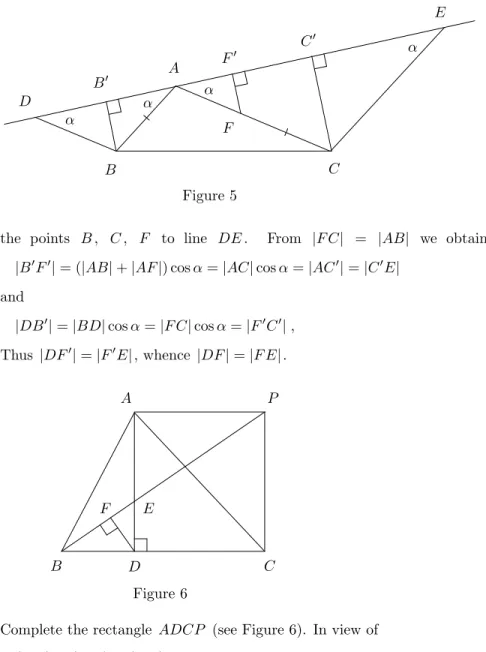
14. Since the lines BD and AC are parallel and since AD is the external bisector of 6 BAC , we have 6 BAD = 6 BDA ; denote their common size by α (see Figure 5). Also 6 CAE =6 CEA = α , implying |AB| = |BD|
and |AC| = |CE|. Let B0, C0, F0 be the feet of the perpendiculars from
Figure 5
B C
A F0
C0 B0
D
E
α F
α α
α
the points B , C , F to line DE . From |F C| = |AB| we obtain
|B0F0| = (|AB| + |AF |) cos α = |AC| cos α = |AC0| = |C0E|
and
|DB0| = |BD| cos α = |F C| cos α = |F0C0| , Thus |DF0| = |F0E|, whence |DF | = |F E|.
F
B D C
P A
E
Figure 6
15. Complete the rectangle ADCP (see Figure 6). In view of
|AE|
|ED| = |CD|
|DB| = |AP |
|DB| ,
the points B , E , P are collinear. Therefore 6 DF P = 90◦, and so F lies on the circumcircle of the rectangle ADCP with diameter AC ; hence
6 AF C = 90◦. 16. Answer: no.
Label the horizontal rows by integers from 1 to 13 . Assume that the tiling is possible, and let ai be the number of vertical tiles with their outer squares in rows i and i+3 . Then bi = ai+ ai−1+ ai−2+ ai−3 is the number of vertical tiles intersecting row i (here we assume aj = 0 if j 6 0 ). Since there are 13 squares in each row, and each horizontal tile covers four (i.e.
an even number) of these, then bi must be odd for all 1 6 i 6 13 except for b7, which must be even.
We now get that a1 = b1 is odd, a2 is even (since b2 = a2+ a1 is odd), and similarly a3 and a4 are even. Since b5= a5+ a4+ a3+ a2 is odd, then a5 must be odd. Continuing this way we find that a6 is even, a7 is odd (since b7 is even), a8 is odd, a9 is odd and a10 is even. Obviously ai= 0 for i > 10 , as no tile is allowed to extend beyond the edge of the board.
But then b13= a10 must be both even and odd, a contradiction.
Alternative solution. Colour the squares of the board black and white in the following pattern. In the first (top) row, let the two leftmost squares be black, the next two be white, the next two black, the next two white, and so on (at the right end there remains a single black square). In the second row, let the colouring be reciprocal to that of the first row (two white squares, two black squares, and so on). If the rows are labelled by 1 through 13 , let all the odd-indexed rows be coloured as the first row, and all the even-indexed ones as the second row (see Figure 7).
Note that there are more black squares than white squares in the board.
Each 4 × 1 tile, no matter how placed, covers two black squares and two white squares. Thus if a tiling leaves a single square uncovered, this square must be black. But the central square of the board is white. Hence such a tiling is impossible.
Another solution. Colour the squares in four colours as follows: colour all squares in the 1-st column green, all squares in the 2-nd column black, all squares in the 3-rd column white, all squares in the 4-th column red, all squares in the 5-th column green, all squares in the 6-th column black etc., leaving only the central square uncoloured (see Figure 8). Altogether we have 3 · 13 = 39 black squares and 3 · 13 − 1 = 38 white squares. Since
each 4 × 1 tile covers either one square of each colour or all four squares of the same colour, then the difference of the numbers of black and white squares must be divisible by 4 . Since 39 − 38 = 1 is not divisible by 4, the required tiling does not exist.
Figure 7
G B W R G B W R G B W R G
Figure 8
17. If k = 1 , it is obvious how to do the packing. Now assume k > 1 . There are not more than n objects of a certain colour — say, pink — and also not fewer than n objects of some other colour — say, grey. Pack all pink objects into one box; if there is space left, fill the box up with grey objects.
Then remove that box together with its contents; the problem gets reduced to an analogous one with k−1 boxes and k−1 colours. Assuming induc- tively that the task can be done in that case, we see that it can also be done for k boxes and colours. The general result follows by induction.
18. Answer: all integers n > 4 .
Direct search shows that there is no such set S for n = 1, 2, 3 . For n = 4 we can take S = {3, 5, 6, 7}. If, for a certain n > 4 we have a set S = {a1, a2, . . . , an} as needed, then the set S∗= {1, 2a1, 2a2, . . . , 2an} satisfies the requirements for n + 1 . Hence a set with the required proper- ties exists if and only if n > 4 .
19. We start with the following observation: In a match between two teams (not necessarily of equal sizes), there exists in one of the teams a player who won his games with at least half of the members of the other team.
Indeed: suppose there is no such player. If the teams consist of m and n members then the players of the first team jointly won less than m · n 2 games, and the players of the second team jointly won less than m · n 2 games — this is a contradiction since the total number of games played is mn , and in each game there must have been a winner.
Returning to the original problem (with two equal teams of size 1000 ), choose a player who won his games with at least half of the members of the other team — such a player exists, according to the observation above, and we shall call his team “first” and the other team “second” in the sequel.
Mark this player with a white hat and remove from further consideration all those players of the second team who lost their games to him. Applying the same observation to the first team (complete) and the second team truncated as explained above, we again find a player (in the first or in the second team) who won with at least half of the other team members. Mark him with a white hat, too, and remove the players who lost to him from further consideration.
We repeat this procedure until there are no players left in one of the teams;
say, in team Y . This means that the white-hatted players of team X constitute a group with the required property (every member of team Y has lost his game to at least one player from that group). Each time when a player of team X was receiving a white hat, the size of team Y was reduced at least by half; and since initially the size was a number less than 210, this could not happen more than ten times.
Hence the white-hatted group from team X consists of not more than ten players. If there are fewer than ten, round the group up to ten with any players.
20. Answer: 1 .
Let 1 6 g < h < i < j 6 n be fixed integers. Consider all n -digit numbers a = a1a2. . . an with all digits non-zero, such that ag= 1 , ah= 9 , ai= 9 , aj= 8 and this quadruple 1998 is the leftmost one in a ; that is,
al6= 1 if l < g ; al6= 9 if g < l < h ; al6= 9 if h < l < i ; al6= 8 if i < l < j .
There are kghij(n) = 8g−1· 8h−g−1· 8i−h−1· 8j−i−1· 9n−j such numbers a . Obviously, kghij(n) ≡ 1 (mod 8) for g = 1, h = 2, i = 3, j = 4, and kghij(n) ≡ 0 (mod 8) in all other cases. Since k(n) is obtained by sum- ming up the values of kghij(n) over all possible choicecs of g, h, i, j , the remainder we are looking for is 1 .