—53—
서 론
농어목(Order Perciformes) 자리돔과(Family Pomacentri- dae) 어류는 인도-태평양 해역을 포함한 모든 온대와 열대 및 아열대해역에 분포한다(Allen, 1991; Nakabo, 2002; Allen and Adrim, 2003; 김 등, 2005; Nelson, 2006). 자리돔과 어류 는 주로 산호서식지에서 군락을 이루고 살아가는 정착성 어류로, 놀래기과 어류(Family Labridae) 및 망둑어과 어류 (Family Gobiidae) 다음으로 다양한 종을 가지고 있어 생태 적 지위가 매우 큰 분류군이다(Wainwright and Bellwood, 2002; Frederich et al., 2008). 특히 성장에 따른 체색변이, 성 전환에 의한 체색변이, 산란기에 나타나는 혼인색, 환경 요
인에 따른 체색변이가 심한 분류군으로, 동종 내 집단 간, 암수 간 또는 개체 간 상당한 체색 차이와 다양성을 가진 다(Neal, 1993). 이처럼 유어기와 성어기의 체형 및 체색 변화가 심한 경우에는 성어기의 분류형질을 유어기에 적용 하기 어려우므로 서로 다른 종으로 오 동정할 가능성이 매 우 높다. 따라서 사육에 의한 자치어의 발달과정 연구나 초 기생활사 연구, 자치어기의 형태 연구 (Kingsford, 1984;
Potthoff et al., 1987; Murphy et al., 2007) 등 다양한 연구를 통해 새로운 분류형질을 찾거나, 최근에는 DNA를 이용한 분자 분석이 병행되어 형태 분석 결과를 검증하고 분류상 의 문제점을 보완하려는 노력이 증가하고 있다(Chang et al., 2005; 권과 김, 2010; 지 등, 2011; Milana et al., 2011;
Malakar et al., 2012). 본 연구는 2011년 9월과 2012년 7월 하계에 제주 서귀포에서 채집된 줄자돔속 치어 7개체를 대 상으로, 정확한 종 동정을 위한 형태 및 분자분석을 실시하
미토콘드리아 16S rRNA 염기서열 분석에 의해 밝혀진 동갈자돔 치어의 성장에 따른 체색변이
송영선∙김진구*
부경대학교 자원생물학과
Ontogenetic Color Variation of Abudefduf notatus (Pomacentridae: Perciformes) Revealed by 16S rRNA Sequences Analysisby Young Sun Song and Jin-Koo Kim*(Department of Marine Biology, Pukyong National Univer- sity, Busan 608-737, Korea)
ABSTRACT Seven individuals (16.1~~29.1 mm in length) which were estimated with fishes of genus Abudefduf were collected in Seogwipo, Jeju Island in the summer of 2011 and 2012. Among them, five individuals (20.8~~29.1 mm SL) are similar to Abudefduf notatus, based on morphological characters such as yellow transverse band on the body, one small black spot on the base of the pectoral fin, and yellow caudal fin. On the other hand, two individuals (16.1 mm, 17.0 mm SL) differ from them in several light transverse bands and transparent rays of all fins except for pelvic fin, and anterior transparent head with only one (16.1 mm). According to the results of molecular analyses of 578 base pairs of mtDNA 16S rRNA sequences, these individuals correspond to A. notatus adult, with a high bootstrap value of 95%
(genetic distance, d==0.002). Therefore, this study shows that the individuals more than 20.8 mm similar to adult body color but the 16.1 mm individual differs to that of adult. We confirm that this species changes to body color during their early life stages. This result regards as a survival strategy to protect themselves against their predator during their early life stages.
Key words : Abudefduf notatus, juvenile, genus Abudefduf, color variation, identification, Jeju Island, Korea
*Corresponding author: Jin-Koo Kim Tel: 82-51-629-5927, Fax: 82-51-629-5931, E-mail: [email protected]
http://www.fishkorea.or.kr
였으며, 본 종의 성어기와 유어기의 형태적 특징과 체색 변 화에 대해 자세히 고찰하였다.
재료 및 방법
2011년 9월과 2012년 7월에 제주도 서귀포시 숲섬 조수 웅덩이에서 뜰채로 줄자돔속 치어 7개체를 채집하여 탈색 을 방지하기 위하여 채집 즉시 RCL2 고정용액(Delfour, 2006)에 넣어 냉동 보관하였다. 본 연구에 사용된 표본은 부경대학교(Pukyong National University, PKU)에 등록 및 보관되어 있다. 외부형태는 입체해부현미경(Olympus SZX- 16. Japan) 하에서 관찰하였으며 Hubbs and Lagler (2004)을 따라 계수 및 몸의 각 부위를 0.1 mm 단위까지 측정하였다.
분자분석을 위해 Total DNA는 Chelex 100 resin (Bio-rad, USA)을 이용하여 오른쪽 눈에서 추출하였다. PCR은 미토 콘드리아 DNA 16S rRNA영역을 Ivanova et al. (2007)의 16Sar-5′ (5′-CGCCTGTTTATCAAAAACAT-3′)과 16Sbr- 3′ (5′-CCGGTCTGAACTCAGATCACGT-3′) primer로 증폭 시켰다. 10X PCR buffer 5μL, 2.5 mM dNTP 4 μL, 16Sar-5′
primer 1μL, 16Sbr-3′ primer 1 μL, FR taq polymerase 0.5 μL (Biomedic, Korea)를 섞은 혼합물에 total DNA 10μL를 첨 가한 후, 총 50μL가 될 때까지 3차 증류수를 넣고 Thermal cycler (Bio-rad MJ mini PTC-1148, USA)를 이용하여 다음 과 같은 조건에서 PCR을 수행하였다: Initial denaturation 95�C에서 5분; PCR reaction 35 cycles (denaturation 95�C에 서 1분, annealing 50�C에서 1분, extension 72�C에서 1분);
final extention 72�C에서 5분. 정제는 ExoSAP-IT (United States Biochemical Corporation, USA)를 이용하였다. 염기서 열은 ABA 3730XL sequencer (Applied Biosystems Inc., USA) 에서 ABA Bigdye terminator cycle sequencing ready reaction kit v3.1 (Applied Biosystems Inc., USA)를 이용하여 얻었다.
미토콘드리아 16S rRNA 염기서열의 정렬은 BioEdit version 7 (Hall, 1999)의 ClustalW (Thompson et al., 1994)를 이용하 였으며, 염기서열을 비교하기 위해 동갈자돔 치어에서 얻은 염기서열과 NCBI (National Center for Biotechnology Infor- mation)에 등록된 줄자돔속 어류 6종의 Database를 이용하 였다. 외집단으로는 농어목 전갱이과의 전갱이(Trachurus japonicus)를 함께 비교하였다: Abudefduf notatus (PKU 6320;
KF154016), Abudefduf sp. (PKU 6325; KF154017), Abudefduf vaigiensis (AY365120), Abudefduf sexfasciatus (JF457206), Abudefduf saxatilis (AY279673), Abudefduf bengalensis (FJ616397), Abudefduf sordidus (JF457210), Abudefduf notatus (FJ616400), Trachurus japonicus (PKU 6551; JQ1 78230). 유전적 거리는 Mega 5 (Tamura et al., 2011)의 Pair- wise distance를 Kimura-2-parameter모델(Kimura, 1980)로
계산하였다. Neighbor joining tree (NJ)는 Mega 5 (Tamura et al., 2011)를 이용하여 작성하였으며 bootstrap은 5000번 수 행하였다.
결 과
1. 관찰재료
PKU 6320 (체장 29.1 mm), PKU 6321 (체장 25.3 mm), PKU 6322 (체장 22.9 mm), PKU 6323 (체장 23.8 mm), PKU 6324 (체장 20.8 mm), PKU 6325 (체장 16.1 mm), 제주도 서 귀포시 숲섬, 2011. 09. 16, 뜰채로 채집; PKU 7590 (체장 17.0 mm), 제주도 서귀포시, 2012. 07. 10, 뜰채로 채집.
2. 형태동정
1) 기재
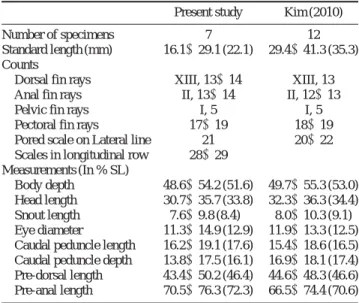
체장 16.1~29.1 mm의 7개체 모두 등지느러미 가시 13개, 줄기 13~14개, 뒷지느러미 가시 2개, 줄기 13~14개의 계 수 형질을 가진다(Table 1). 체장에 대한 체고, 두장, 문장, 안경, 미병장, 미병고, 등지느러미 앞까지의 거리의 비율도 7 개체 모두 유사한 값을 나타냈으나 체장에 대한 뒷지느러 미 앞까지의 거리의 비율은 16.1 mm 개체보다 29.1 mm 개 체에서 더 높았다(Fig. 1). 체고는 체장의 1/2보다 높으며 문장이 안경보다 짧고 아래턱보다 위턱이 더 돌출되어 있 다. 윗턱과 아래턱에 모두 이빨이 존재하고, 이빨은 삼첨두
형 ( )이며 그 끝이 다소 날카롭다. 눈의 앞쪽과 위쪽, 주
둥이, 아래턱 부근에 많은 감각공이 있으며 전새개골의 뒷
Table 1. Comparison of counts and measurements of Abudefduf notatus juveniles
Present study Kim (2010)
Number of specimens 7 12
Standard length (mm) 16.1~29.1 (22.1) 29.4~41.3 (35.3) Counts
Dorsal fin rays XIII, 13~14 XIII, 13
Anal fin rays II, 13~14 II, 12~13
Pelvic fin rays I, 5 I, 5
Pectoral fin rays 17~19 18~19
Pored scale on Lateral line 21 20~22
Scales in longitudinal row 28~29 -
Measurements (In % SL)
Body depth 48.6~54.2 (51.6) 49.7~55.3 (53.0) Head length 30.7~35.7 (33.8) 32.3~36.3 (34.4) Snout length 7.6~9.8 (8.4) 8.0~10.3 (9.1) Eye diameter 11.3~14.9 (12.9) 11.9~13.3 (12.5) Caudal peduncle length 16.2~19.1 (17.6) 15.4~18.6 (16.5) Caudal peduncle depth 13.8~17.5 (16.1) 16.9~18.1 (17.4) Pre-dorsal length 43.4~50.2 (46.4) 44.6~48.3 (46.6) Pre-anal length 70.5~76.3 (72.3) 66.5~74.4 (70.6) Parenthesis indicate average.
가장자리는 톱니가 없이 부드럽다. 측선 공 비늘은 아가미 뚜껑 위쪽부터 시작하여 등지느러미 5~6번째 연조까지 이 어지다 끊어지는 불완전한 상태이다. 등지느러미 기점은 가 슴지느러미 기점의 위쪽에서 시작되며 뒷지느러미 기저의 말단을 지나고 극조부와 연조부가 부드럽게 연결되어 있 다. 가슴지느러미는 뒷지느러미 기점을 지나지 않고 배지느
러미는 가슴지느러미기점보다 약간 뒤에 있다. 꼬리지느러 미는 가랑이형이다. 비교적 큰 빗비늘이 몸 전반을 덮고 있 으며, 새개부와 각 지느러미 기저의 일부에도 존재한 다(Fig. 2).
2) 체색
살아있을 때, 체장 20.8~29.1 mm 5개체는 몸이 전체적으 로 어두운 암갈색 바탕에 등지느러미 3~7번째 극조부에 걸쳐 항문부위를 향해 가로지르는 황색의 뚜렷한 가로줄무 늬를 가지며 주변에도 다소 불분명한 다열의 흰색 가로줄 무늬가 나타나고 가슴지느러미 기부에는 검은색의 반점 1 개가 있다. 입 주변부와 가슴지느러미 기저부, 등지느러미 극조부의 중간부분, 등∙배∙뒷∙꼬리지느러미 줄기는 황 색을 띤다(Fig. 2A). 그러나, 16.1~17.0 mm 2개체는 몸이 전체적으로 밝은 녹갈색을 띠며 등지느러미 극조부에 3열, 연조 시작부에 1열, 미병부에 1열 총 5열의 불분명하고 밝 은 가로줄무늬가 있다. 등지느러미 극조부에서 시작되는 줄 무늬는 복강부에서 희미해 지며, 복부는 밝다. 특히, 두부 앞 쪽과 꼬리∙뒷∙가슴지느러미, 등지느러미 연조부가 투명하 다(Fig. 2B).
RCL2 고정 후, 몸은 밝은 갈색을 띠며, 배는 희다. 등∙뒷 지느러미 연조부와 꼬리지느러미는 불투명한 흰색이고 각
0.0 10.0 20.0 30.0 40.0 50.0 60.0 70.0 80.0 90.0
10.0 15.0 20.0 25.0 30.0 35.0
% in SL
Standard length (mm)
Fig. 1. Relationships between standard length (SL) and proportional measurements of Abudefduf notatus. Body depth (diamond), Head length (rectangle), Snout length (triangle), Eye diameter (cross), Cau- dal peduncle length (star), Caudal peduncle depth (circle), Pre-dorsal length (plus sign), Pre-anal length (minus sign).
Fig. 2. Abudefduf notatus, PKU 6320, 29.1 mm SL (A-A′), PKU 6325, 16.1 mm SL (B-B′), collected from Jeju Island. Fresh specimen (A-B), Fixed specimen (A′-B′).
A A′
B B′
지느러미 기저는 검다. 가슴지느러미 기저 위쪽에 선명한 검은 색의 작은 점이 있다(Fig. 2A′, B′).
3. 분자 동정
다른 개체들과 체색 차이를 보이는 1개체(PKU 6325, 체 장 16.1 mm)의 정확한 종 동정을 위하여 미토콘드리아 16S rRNA 영역 578 base-pair를 분석하였다. 동갈자돔 성어의 체 색을 가진 치어 1개체(PKU 6320, 체장 29.1 mm)와 NCBI 에 등록된 줄자돔속 어류 6종과 비교 시, 검은줄꼬리돔(A.
sexfasciatus)과 유전적거리 (d)가 0.049, 해포리고기 (A.
vaigiensis)와는 d==0.043, 흑줄돔 (A. bengalensis)과는 d== 0.041, 줄자돔(A. sordidus)과는 d==0.022로 차이를 보였으 나, 동갈자돔 (A. notatus)과는 d==0.002로 99.8% 일치도를 보여 동갈자돔인 것으로 판단되었다. NJ tree에서는 줄자돔 속 치어가 동갈자돔 성어(FJ616400) 및 치어(PKU 6320)와 가장 가깝게 유집되었으며 높은 bootstrap값(95)으로 지지 되었고 줄자돔속 어류 6종은 크게 2개의 clade를 형성하였 는데, 그중 동갈자돔은 줄자돔(A. sordidus, JF457210)과 함 께 유집되었다(Fig. 3).
고 찰
본 연구는 우리나라에서 처음 발견된 동갈자돔 유어(체 장 16.1~29.1 mm)의 형태 및 체색변이에 대한 기재로, 계 수형질은 이미 정수에 도달한 상태였으며, 계측형질은 체장 에 대한 뒷지느러미 앞까지 거리의 백분율을 제외하면 성 장에 따른 변화가 없었다(Table 1; Fig. 1). 그러나, 체색은 성장에 따라 차이를 보였다. 체장 16.1 mm의 동갈자돔 치 어는 밝은 녹갈색의 몸을 가졌으며 두부의 앞쪽과 배지느 러미를 뺀 나머지 지느러미 연조부가 투명하였으나, 체장
20.8 mm 개체부터는 어두운 암갈색의 몸을 가지고 몸의 중 앙을 가로지르는 황색의 뚜렷한 가로줄무늬와 4열의 밝은 가로줄무늬가 나타났다. 그러나, 성어에서 관찰되는 새개골 상부에 1개의 뚜렷한 흑색 반점은 본 연구의 최대 크기인 29.1 mm 개체에서도 관찰되지 않았다. 이는 김(2010)의 연 구 결과와도 잘 일치하는 것이다. 이번 조사에서 동갈자돔 과 함께 채집된 줄자돔 치어도 역시 비슷한 크기에서 두부 의 앞쪽과 대부분의 연조부가 투명하여 흥미로웠다. 또한, 자리돔과의 Hypsypops rubicunda는 성어기에는 오렌지 색 을 띠지만 치어기에는 파란색 반점을 많이 가져 잘 구분된 다(Herald, 1961). 그 외 하스돔과 어류와 놀래기과 어류에 서도 성장에 따라 체색변화가 일어나는 것으로 알려져 있 다(Herald, 1961; Allen, 1991; Allen and Erdmann, 2012).
어류의 체색과 무늬 패턴은 종 동정에 중요한 분류형질 로 이용되지만, 많은 어류의 초기생활기에 나타나는 체색변 이는 분류학자들에게 많은 혼란을 초래하였다(Booth, 1990;
Neal, 1993). 성어와 유어의 체색 차이를 생태 기능적인 측 면에서 살펴본 Fricke (1980)와 Thresher (1984)는 정착성 어 류에서 나타나는 유어기 특유의 착색이 동종인 성어로부터 의 공격 가능성을 감소시키는 효과가 있다고 하였다. 또한, Fricke (1980)는 자리돔과 어류의 Pomacanthus imperator의 경우 유어 특유의 착색은 성어가 자신을 경쟁자로 인식하 지 못하도록 하는 데 도움을 준다고 하였다. 더욱이 자리돔 과 어류의 초기생활기에서 볼 수 있는 발생단계에 따른 체 색변이는 포식자로부터 자신을 방어하기 위한 전략에서 기 인한 것이다(Neal, 1993). 또한 Gittleman et al. (1980)은 치 어가 밝은 체색을 가질수록 성어의 치어에 대한 인지도를 둔화시키는 효과가 있다고 하였다. 이는 치어가 궁극적으로 성어의 영역 내에서 먹이활동을 하는 데 이용가능한 시간 을 증가시켜 준다(Neal, 1993). 또한, 체색을 이용한 포식자 에 대한 방어는 치어뿐 아니라 성어에서도 많이 볼 수 있 Fig. 3. Neighbor-joining tree showing the relationship between Abudefduf sp. and genus Abudefduf six species and Trachurus japonicus as one outgroup using mtDNA 16S rRNA sequences. Numbers at branches indicate bootstrap probabilities in 5000 bootstrap replications. Bar indicates genetic distance of 0.01.
다. 예를 들면, 참복과의 청복(Canthigaster rivulata)의 경우, 몸의 윤곽을 모호하게 하는 체색을 가짐으로써 주변환경과 유화되어 포식자가 인식하지 못하도록 하거나 (Tackett, 2002), 망둑어과의 Signigobius biocellatus는 등지느러미에 한 쌍의 눈처럼 생긴 무늬를 가져 게의 눈처럼 보이게끔 하므 로 포식자의 눈을 교란시키기도 한다 (Hoese and Allen, 1997; Tackett, 2002). 이는 나비고기과의 가시나비고기 (Chaetodon auriga)나 Chaetodon bennetti에서도 잘 나타난 다(Tackett, 2002). 체장 16.1~17.0 mm 크기의 동갈자돔 치 어에서 볼 수 있는 머리의 앞쪽과 특히 꼬리지느러미 연조 부가 투명한 것은 이들이 온전한 어류로 보이지 않게 할지 도 모른다. 그 결과 동갈자돔 치어는 포식자나 유해 요인으 로부터 눈에 잘 띄지 않거나, 먹이로 인식되지 않도록 하여 자신을 방어할 것이다.
요 약
2011년과 2012년 하계에 제주도 서귀포에서 줄자돔속 어류로 추정되는 치어 7개체(체장 16.1~29.1 mm)가 채집 되었다. 그중 5개체(체장 20.8~29.1 mm)는 몸 중앙에 황 색의 뚜렷한 가로줄무늬와 가슴지느러미 기저에 작은 검은 색 반점이 1개 있고 꼬리지느러미가 노란색을 띠는 점에서 동갈자돔(Abudefduf notatus)과 유사하였다. 그러나, 상대적 으로 크기가 작은 2개체(체장 16.1 mm, 17.0 mm)는 다열의 밝은 가로줄무늬가 있고 두부의 앞쪽과 배지느러미를 제외 한 모든 지느러미 연조부가 투명한 점에서 앞서 5개체와 차 이를 보였다. 미토콘드리아 16S rRNA 영역 578bp를 분석 한 결과, 본 개체는 동갈자돔 성어와 95% bootstrap 값으로 일치하였다(genetic distance, d==0.002). 따라서, 본 연구를 통해 동갈자돔 치어 중 20.8 mm 이상 개체는 성어와 유사 한 체색을 나타내었으나 그보다 작은 16.1 mm개체에서는 성어와 다른 체색을 보여 본 종은 어린 시기에 체색이 변 하는 것을 확인할 수 있었다. 이는 이들이 어린 시기에 포 식자로부터 자신을 방어하기 위한 생존전략으로 사료된다.
인 용 문 헌
권혁준∙김진구. 2010. 참서대과(Pisces: Cynoglossidae) 자어 2종 의 미토콘드리아DNA에 의한 형태동정의 타당성. 한국수 산과학회지, 43(5): 482-488.
김병직. 2010. 자리돔과. 대한민국 생물지[한국의 척추동물], 국립 생물자원관, 인천, pp. 56-79.
김익수∙최 윤∙이충렬∙이용주∙김병직∙김지현. 2005. 한국어 류대도감. 교학사, 615pp.
지환성∙이수정∙김진구. 2011. 날붕장어 (Echelus uropterus) 엽
상자어의 분자동정, 개체발생 및 진화학적 고찰. 한국어 류학회지, 23(3): 217-224.
Allen, G.R. 1991. Damselfishes of the world. Aquarium Systems Mentor, Ohio, USA. Mergus Publishers, Melle, Germany, 271pp.
Allen, G.R. and M. Adrim. 2003. Coral reef fishes of Indonesia. Zool.
Stud., 42(1): 1-72.
Allen, G.R. and M.V. Erdmann. 2012. Pomacentridae, In: Reef fishes of the East Indies. Vol. II. Tropical Reef Res., Perth Australia, pp. 561-630.
Booth, C.L. 1990. Evolutionary significance of ontogenetic colour change in animals. Biol. J. Linn. Soc., 40: 125-163.
Chang, C.H., Y.T. Shao and H.W. Kao. 2006. Molecular identifica- tion of two sibling species of Puntius in Taiwan. Zool. Stud., 45: 149-156.
Delfour, C., P. Roger, C. Bret, M.L. Berthe, P. Rochaix, N. Kalfa, P. Raynaud, F. Bibeau, T. Maudelonde and N. Boulle. 2006.
RCL2, a new fixative, preserves morphology and nucleic acid integrity in paraffin-embedded breast carcinoma and microdissected breast tumor Cells. J. Mol. Diagn., 8: 157- 169.
Frederich, B., A. Pilet, E. Parmentier and P. Vandewalle. 2008. Com- parative trophic morphology in eight species of damselfishes (Pomacentridae). J. Morphol., 269: 175-188.
Fricke, H.W. 1980. Juvenile-adult colour patterns and coexistence in the territorial coral reef fish Pomacanthus imperator. Mar.
Ecol., 1: 133-141.
Gittleman, J.L., P.H. Harvey and P.J. Greenwood. 1980. The evolu- tion of conspicuous coloration: some experiments in bad taste. Anim. Behav., 28: 897-899.
Hall, T.A. 1999. BioEdit: a user-friendly biological sequence align- ment editor and analysis program for windows 95/98/NT.
Nucleic Acids Symposium Series, 41: 95-98.
Herald, E.S. 1961. Living fishes of the world. Chanticleer Press.
Doubleday & Company, Inc., Garden City, N.Y., 304pp.
Hoese, D.F. and G.R. Allen. 1997. Signigobius biocellatus, a new genus and species of sand-dwelling coral reef Gobiid Fish from the Western Tropical Pacific. Japanese J. Ichthyol., 23: 199-207.
Hubbs, C.L. and K.F. Lagler. 2004. Fishes of the Great Lakes region.
Revised ed. Michigan Univ. Press, Ann Arbor., pp. 1-332.
Ivanova, N.V., T.S. Zemlak, R.H. Hanner and P.D.N. Hcbcrt. 2007.
Universal primer cocktails for fish DNA barcoding. Mol.
Ecol. Notes., 7: 544-548.
Kimura, M. 1980. A simple method for estimating evolutionary rate of base substitution through comparative studies of nucleo- tide sequences. J. Mol. Evol., 16: 111-120.
Kingsford, M.J. 1985. The demersal eggs and planktonic larvae of Chromis dispilus (Teleostei: Pomacentridae) in north-eastern New Zealand coastal waters. N.Z. J. Mar. Freshwater Res., 19: 429-438.
Malakar, A.K., W.S. Lakra, M. Goswami, M. Singh and R.M. Mishra.
2012. Molecular identification of three Ompok species using mitochondrial COI gene. Mitochondrial DNA, 23: 20-24.
Masuda, H., K. Amaoka, C. Araga, T. Uyeno and T. Yoshino. 1984.
The fishes of the Japanese Archipelago. Tokai Univ. Press, Tokyo, Text: i-xxii+1-437, Atlas: Pls. 1-370.
Milana, V., A. Fusari, A.R. Rossi and L. Sola. 2011. Molecular and morphological identification of an uncommon centrolophid fish. Central European J. Biol., 6: 440-445.
Murphy, B.F., J.M. Leis and K.D. Kavanagh. 2007. Larval develop- ment of the Ambon damselfish Pomacentrus amboinensis, with a summary of pomacentrid development. J. Fish Biol., 71: 569-584.
Nakabo, T. 2002. Fishes of Japan with pictorial keys to the species second edition. Tokai Univ., Tokyo, 1748pp.
Neal, T.J. 1993. A test of the function of juvenile color patterns in the pomacentrid fish Hypsypops rubicundus (Teleostei: Po- macentridae). Pacific Sci., 47: 240-247.
Nelson, J.S. 2006. Fishes of the world. 4thed. John Wiley and Sons, Inc., Hoboken, New Jersey, 601pp.
Potthoff, T., S. Kelley, V. Saksena, M. Moe and F. Young. 1987.
Description of larval and juvenile Yellowtail Damselfish,
Microspathodon Chrysurus, Pomacentridae, and their oste- ological development. Bulletin Mar. Sci., 40: 330-375.
Tackett, D.N. 2002. Reef Life. Natural history and behaviors of marine fishes and invertebrates. T. F. H. Publications, Inc., Neptune City, New Jersey, 227pp.
Tamura, K., D. Peterson, N. Peterson, G. Stecher, M. Nei and S.
Kumar. 2011. MEGA5: Molecualr evolutionary genetics analysis using maximum likelihood, evolutionary distance, and maximum parsimony methods. Mol. Biol. Evol., 28:
2731-2739.
Thompson, J.D., D.G. Higgins and T.J. Gibson. 1994. CLUSTAL W: Improving the sensitivity of progressive multiple sequ- ence alignment through sequence weighting, position speci- fic gap penalties and weight matrix choice. Nucleic Acids Res., 22: 4673-4680.
Thresher, R.E. 1984. Reproduction in reef fishes. T. F. H. Publica- tions, Inc., Neptune City, New Jersey, 399pp.
Wainwright, P.C. and D.R. Bellwood. 2002. Ecomorphology of feeding in coral reef fishes. In: Sale, P.F. (ed.), Coral Reef Fishes: Dynamics and Diversity in a Complex Ecosystem.
Academic Press, San Diego, pp. 33-57.