• 검색 결과가 없습니다.

Molecular diversity of endobacterial communities in edible part of King oyster mushroom (Pleurotus eryngii) based on 16S rRNA

N/A
N/A
Protected

Academic year: 2021

Share "Molecular diversity of endobacterial communities in edible part of King oyster mushroom (Pleurotus eryngii) based on 16S rRNA"

Copied!
8
0
0

로드 중.... (전체 텍스트 보기)

전체 글

(1)

보 문

Molecular diversity of endobacterial communities in edible part of King oyster mushroom (Pleurotus eryngii) based on 16S rRNA

Choung Kyu Lee

1

, Md. Azizul Haque

2

, Byoung Rock Choi

3

, Hee Yul Lee

2

, Chung Eun Hwang

2

, Min Ju Ahn

2

, and Kye Man Cho

2

*

1

Department of Forest Resources, Gyeongnam National University of Science and Technology, Jinju 660-758, Republic of Korea

2

Department of Food Science, Gyeongnam National University of Science and Technology, Jinju 660-758, Republic of Korea

3

Department of Future Farming, Sacheon Agricultural Development & Technology Center, Sacheon 664-951, Republic Korea

16S rRNA 기초 새송이 버섯(Pleurotus eryngii)의 식용가능 부위 내생세균 군집 다양성

이총규

1

・ 모하메드 아지줄 하크

2

・ 최병록

3

・ 이희율

2

・ 황정은

2

・ 안민주

2

・ 조계만

2

*

1

경남과학기술대학교 산림자원학과,

2

경남과학기술대학교 식품과학부,

3

사천시농업기술센터 미래농업과

(Received December 17, 2014; Accepted June 10, 2015)

ABSTRACT: The diversity of endobacteria in the edible part (cap and stipe) king oyster mushroom (Pleurotus eryngii) was investigated using 16S rRNA sequence analysis. The bacterial 16S rRNA libraries were constructed from the body cap (BC) and the body stipe (BS) of the king oyster mushroom. The twenty sequenced BC clones were divided into four groups and the largest group was affiliated with the Firmicutes (40% of clones). While, the twenty sequenced BS clones could be divided into six groups and the largest group was affiliated with the Actinobacteria (40% of clones). The predominant bacterial family from both the cap and stipe of the mushroom was corresponded with the Gram positive bacteria (62.5%).

Key words: Pleurotus eryngii, 16S rRNA gene, bacteria diversity, endobacteria, phylogenetic tree

*For correspondence. E-mail: [email protected];

Tel.: +82-55-751-3272; Fax: +82-55-751-3279

The edible king oyster mushroom (Pleurotus eryngii) is cultivated throughout the world and Pleurotus fungi as a group are linked to several agro-industrial activities of great economic importance, e.g., conversion of lignocellulosic residues to food and feed, biocontrol of plant diseases, degradation of noxious pollutants, and production of enzymes and medicinal compounds (Ruiz-Duenas and Martinez, 1996; Wasser and Weis, 1999;

Philippoussis et al., 2001; Wang and Ng, 2004; Kang and Cho, 2014).

Intracellular symbiosis is a widespread and biologically important phenomenon. Although host cells usually provide a suitable shelter and supply important material needs for

endosymbionts, the cytoplasm of a host cell may be considered to be a hostile environment for an invading organism (Morioka and Ishikawa, 1993; Mota et al., 2005). Thus endosymbionts must still overcome many difficulties to survive in the host.

Nevertheless, microorganisms can live in different tissues of healthy plants without causing symptoms of plant damage and give benefit to plants (Perotti, 1926; Gao et al., 2005; Hashiba and Narisawa, 2005). The root system of plants, in particular, is known to offer different microhabitats for microbial growth.

Bacterial endosymbiosis with fungi, both parasitic and mutualistic types, is characterized by the intracellular localization of the bacteria (Moran and Wernegreen, 2000).

Examples reported thus far are mainly for species belonging to

the phylum Glomeromycota (Schußler et al., 2001). Moreover,

(2)

except for the cyanobacteria colonizing Geosiphon pyriforme (Schußler and Kluge, 2000), known intra-fungal bacteria are nonculturable. Despite this difficulty, the bacterial nature of these endosymbionts has been confirmed using molecular methods. Previously, endobacteria (e.g. Burkholderia sp.) was identified from several species of endomycorrhizal fungi such as Gigaspora sp. and Scutellospora sp. (Bianciotto et al., 1996). Meanwhile, intracellular bacteria from wild types of Laccaria bicolor were detected using fluorescence in situ hybridization (FISH) in combination with confocal laser scanning microscopy (Bertaux et al., 2003, 2005). In fact, the bacterium was identified as Paenibacillus sp. by using a 16S rRNA-directed oligonucleotide probe (Bertaux et al., 2003).

While, Barbieri et al. (2000) identified bacteria belonging to Flexibacter-Cytophaga-Bacteroides (FCB) phylogroup of Bacteroidetes phylum from the cell wall of hyphae of Tuber borchii (ectomycorrhizal fungus) using FISH analyses. A molecular study aimed at surveying potential endobacteria within the mycelium of the ectomycorrhizal fungus Tuber borchii Vittad. revealed the presence of novel uncultured bacteria (Gazzanelli et al., 1999; Barbieri et al., 2000). In addition, the phylogenetic analysis placed the bacterial sequences in a single new rRNA branch in the Sphingobacterium subgroup of the Bacteroidetes phylum (Steyn et al., 1998;

Barbieri et al., 2002, 2005). Despite the above progress identifying fungal endosymbionts, little is known about the diversity and functions of bacterial populations living in the edible mushroom. Studies on the genetic and physiological diversity of the endomicrobial populations in edible mushrooms are important for understanding of their ecological role and for the development of biotechnological applications aimed at utilizing beneficial strains (Frey et al., 1997; Timonen et al., 1998).

The structure of mushroom have a stem (stipe), a cap (pileus), and gills (lamellae, sing. lamella) on the underside of the cap.

These gills produce microscopic spores that help the fungus spread across the ground or its occupant surface. The goal of this study is to examine the endobacterial community in edible part (cap and stipe) of king oyster mushroom using analysis of 16S rRNA sequences in a culture-independent manner. To date, this study first reveals the endobacterial community in edible part of king oyster mushroom.

Materials and Methods

Microbial strains and growth conditions

Escherichia coli DH5 and recombinant E. coli cells were cultured in LB containing ampicillin (50 µg/ml). The king oyster mushroom (P. eryngii) used in this study was kindly provided by the Laboratory of Mushroom, Gyeongnam Agricultural Research and Extension Services (GARES), Jinju, Republic of Korea.

Growth of mushroom

The king oyster mushroom is usually cultivated on a sawdust medium in a plastic bottle. Sawdust from poplar was used and rice bran (30%) was supplemented to promote mycelial growth.

The final moisture content of substrate materials was 65%.

Prepared and moisture-conditioned sawdust mixture was loaded into the bottle feeder. Bottles were sterilized at 121°C for 90 min. After the bottles were removed from the autoclave, they were cooled to 20°C in the cooling room. Inoculated bottles were hauled to an incubation room, where temperature and humidity were maintained at 22 to 24°C and 65 to 68%, respectively. When the substrate in the bottles was colonized, the bottles were transferred to a cultivation room for 20 days to obtain fruiting bodies. The formation of fruiting body was induced at low temperature (about 15°C) and high humidity (about 90 to 95%).

Total DNA extraction

The surface of mushroom was disinfected with 1% sodium hypochlorite for 10 min. The external fruiting body of mushroom was removed approximately 0.5 cm from the margin of fruiting body with sterile razor blades. The fruiting body tissue was triturated by pestle in sterile 10 mM phosphate buffer (pH 7.2). The triturate was subjected to DNA extraction using the DNAzol Extraction Kit (MRC Inc.). The mixture of the extracted DNA from the ten samples was used as template for PCR to amplify 16S rDNA.

Polymerase chain reaction

The PCR primers used to amplify 16S rDNA fragments were

the bacteria-specific primers, 5ʹ-CGGAGAGTTTGATCCTGG-

(3)

3 ʹ (forward) and 5ʹ-TACGGCTACCTTGTTACGAC-3ʹ (reverse) (Lane, 1991). Ribosomal DNAs were amplified by PCR using the extracted DNA, Super-Therm DNA polymerase (JMR), 1.5 mM MgCl

2

, 2 mM dNTP, and primers in a final volume of 50 µl.

Fifteen cycles (denaturation at 94°C for 30 sec, annealing at 50°C for 30 sec, and extension at 72°C for 1 min 30 sec) were followed by a final incubation at 72°C for 10 min. The anticipated product of approximately 1,500 bp was isolated after agarose gel electrophoresis of the amplified mixture using a gel extraction kit (NucleoGen).

Cloning and sequencing

PCR products were directly cloned into the pGEM-T Easy vector (Promega) and recombinant colonies were randomly (20 colonies) picked from approximately 40 colonies. The recombinant plasmids were extracted using plasmid DNA isolation kit (iNtRON). Samples for nucleotide sequencing were prepared by the dideoxy-chain termination method using the PRISM Ready Reaction Dye terminator/primer cycle sequencing kit (Perkin-Elmer Corp.). The samples were analyzed in both directions and two repeats with an automated DNA sequencer (model 3100; Applied Biosystems). Assembly of the nucleotide sequences was performed with the DNAMAN analysis system (Lynnon Biosoft).

Sequence analysis

All reference sequences were obtained from the GenBank and Ribosomal Database Project (RDP) databases (Maidak et al., 2000). The sequences were analyzed using the CHECK_

CHIMERA program (Maidak et al., 2000) to exclude sequences from chimeric rDNA clones. The similarity search against database entries was done using online BLAST search (Madden et al., 1996). Sequences were aligned using the multiple sequence alignment program CLUSTAL W versions 1.6 (Tompson et al., 1994). Phylogenetic analysis was performed using the neighbor-joining method (Saitou and Nei, 1997). Gaps and positions with ambiguities were excluded from the phylogenetic analysis. Bootstrap analysis was performed on data resampled 1,000 times using the DNAMAN analysis system (Lynnon Biosoft).

Nucleotide sequence accession numbers and nomenclature

The 16S rDNA gene sequences of endobacteria isolated from the king oyster mushroom have been deposited in the GenBank database under the accession numbers AY838556, AY838458- AY838495. The names of the 16S rDNA gene library from body cap (BC) and body stipe (BS) of mushroom begins with the letters BC and BS (e.g., BC1 for clone 1 of the cap library).

Results

Cloning and detection of bacterial rDNA

The PCR amplification from the total DNAs by the cap and the stipe samples of king oyster mushroom with the bacteria- specific primers produced a single band of approximately 1.5 kb. The products were purified from an agarose gel and cloned in E. coli DH5 in the pGEM-T Easy vector. Twenty clones were obtained from the body cap library (BC clones) and twenty from the body stipe library (BS clones).

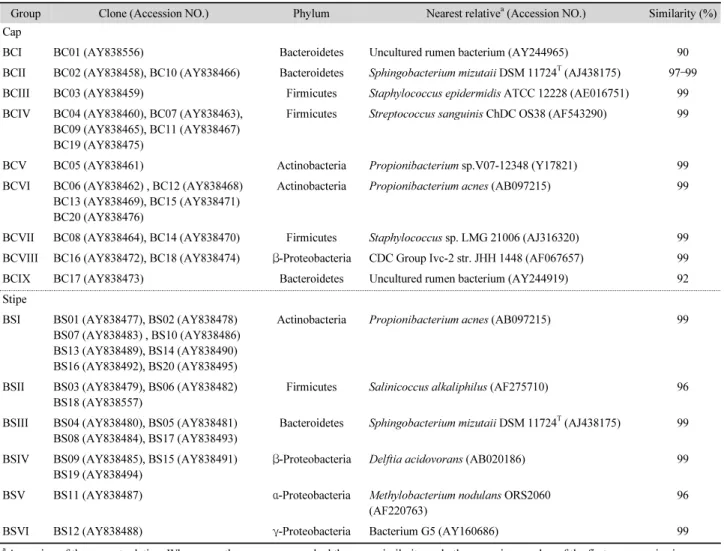
Similarity with database sequences

All clones from the two libraries were subjected to sequence analysis followed by online homology searches using two databases: GenBank which implements the BLAST algorithm, and the RDP database which implements the SIMILARITY_

RANK program (Table 1). Although there are no exact 16S

rDNA similarity limits for defining specific taxa such as genus

and species, in general, species definition requires sequence

similarities greater than 97%. Fourteen sequences (35%) from

the 40 clones in our libraries (6 from BC clones, 8 from BS

clones) can be identified as belonging to Actinobacteria. About

15% of the sequences have a similarity level with database

sequences in the range of 90–97% (Table 1). Twenty clones of

the BC library were analyzed for DNA similarity. Among them,

eighteen clones had the highest similarities with cultured

bacteria and two clones had the highest similarities to

uncultured rumen bacteria. Of the 20 clones of the BS library

that were analyzed, eight were highly similar to each other and

gave hits in the same similarity range (Table 1).

(4)

Table 1. Similarity value of 16S rDNA sequences retrieved from mushroom cap and stipe

Group Clone (Accession NO.) Phylum Nearest relative

a

(Accession NO.) Similarity (%)

Cap

BCI BC01 (AY838556) Bacteroidetes Uncultured rumen bacterium (AY244965) 90

BCII BC02 (AY838458), BC10 (AY838466) Bacteroidetes Sphingobacterium mizutaii DSM 11724

T

(AJ438175) 97 –99

BCIII BC03 (AY838459) Firmicutes Staphylococcus epidermidis ATCC 12228 (AE016751) 99

BCIV BC04 (AY838460), BC07 (AY838463), BC09 (AY838465), BC11 (AY838467) BC19 (AY838475)

Firmicutes Streptococcus sanguinis ChDC OS38 (AF543290) 99

BCV BC05 (AY838461) Actinobacteria Propionibacterium sp.V07-12348 (Y17821) 99

BCVI BC06 (AY838462) , BC12 (AY838468) BC13 (AY838469), BC15 (AY838471) BC20 (AY838476)

Actinobacteria Propionibacterium acnes (AB097215) 99

BCVII BC08 (AY838464), BC14 (AY838470) Firmicutes Staphylococcus sp. LMG 21006 (AJ316320) 99 BCVIII BC16 (AY838472), BC18 (AY838474) β-Proteobacteria CDC Group Ivc-2 str. JHH 1448 (AF067657) 99

BCIX BC17 (AY838473) Bacteroidetes Uncultured rumen bacterium (AY244919) 92

Stipe

BSI BS01 (AY838477), BS02 (AY838478) BS07 (AY838483) , BS10 (AY838486) BS13 (AY838489), BS14 (AY838490) BS16 (AY838492), BS20 (AY838495)

Actinobacteria Propionibacterium acnes (AB097215) 99

BSII BS03 (AY838479), BS06 (AY838482) BS18 (AY838557)

Firmicutes Salinicoccus alkaliphilus (AF275710) 96

BSIII BS04 (AY838480), BS05 (AY838481) BS08 (AY838484), BS17 (AY838493)

Bacteroidetes Sphingobacterium mizutaii DSM 11724

T

(AJ438175) 99

BSIV BS09 (AY838485), BS15 (AY838491) BS19 (AY838494)

β-Proteobacteria Delftia acidovorans (AB020186) 99

BSV BS11 (AY838487) α-Proteobacteria Methylobacterium nodulans ORS2060 (AF220763)

96

BSVI BS12 (AY838488) γ-Proteobacteria Bacterium G5 (AY160686) 99

a
Accession of the nearest relative. When more than one sequence had the same similarity, only the accession number of the first sequence is given.

Phylogenetic placement of sequences from the two libraries

The results of phylogenetic analysis of the BC library are shown in Fig. 1A. In this library, the majority of the sequences were placed within the Actinobacteria phylum. Two sequences, BCI and BCIX, were related to the typical rumen bacteria of the Bacteroidetes, which indicates the symbiotic relationship between this family and the host mushroom. The eight clones in the Firmicutes phylum were clustered with the Streptococcus and Staphylococcus.

The results of phylogenetic analysis of the BS library are shown in Fig. 1B. The majority of the sequences in this library belonged to the Actinobacteria phylum. Eight clones were clustered with the type strain of Propionibacterium acnes.

Discussion

Compared with other ecosystems, there have been very few

studies examined bacteria in mushroom. The relative lack of

information available on endobacteria in mushroom may be due

to difficulties in isolation, culture, or maintenance. We have

examined the bacterial diversity in the edible mushroom using

PCR-based 16S rRNA gene analysis. This culture-independent

approach offers the possibility of characterizing microbial

ecosystems independent of isolating, maintaining, and pro-

pagating bacteria under laboratory conditions. In fact, this study

examined the bacterial community in the Pleurotus eryngii by

analysis of bacterial 16S rDNA libraries constructed from the

body cap (BC) and body stipe (BS) of king oyster mushroom. A

total of twenty BC clones were divided into four groups and the

(5)

Fig. 1. Phylogenetic placement of 16S rRNA sequences from the fraction of BC (A) and BS (B) from king oyster mushroom. Numbers above each node are confidence levels (%) generated from 1,000 bootstrap trees. The scale bar is in fixed nucleotide substitutions per sequence position. Only bootstrap values of greater than 90% are shown. BC, body cap fraction of king oyster mushroom; and BS, body stipe fraction of king oyster mushroom.

Fig. 2. Bacterial distribution of the fraction of BC and BS. Numbers in square brackets give the total number of clones in that library. BC, body cap fraction of king oyster mushroom; and BS, body stipe fraction of king oyster mushroom.

largest group was affiliated with the Firmicutes phylum (40% of clones). On the other hand, a total of twenty BS clones were divided into six groups and the largest group was affiliated with the Actinobacteria phylum (40% of clones) (Fig. 2).

One striking characteristic of the PCR-retrieved sequences was that the majority of them showed high similarity with known bacterial isolates and could be placed within a specific genus and species. The number of hits with database entries is

shown in Table 1. The BS library had a high number of hits with isolates cultured from mushroom in comparison with the BC libraries (38% vs. ~8%). Interestingly, thirteen sequences of all forty clones were closely belonged to the P. acnes strains, while six sequences of all forty clones were corresponded with Sphingobacterium mitutaii. The predominance of sequences corresponded with Propionibacterium sp. and Sphingobacterium sp. suggests its role in the structure and function of the mushroom community. However, the current study did not coverage the functional role of these identified endobacteria in mushroom. Yet there is no available study shows these endobacterial functional relationships with these identified strains. Therefore, it is difficult to explain of any functional relationship of these endobacteria with mushroom. A possible reasonable explanation can be drawn that the identified endobacteria may play symbiotic role like endophytic bacteria in plants.

A second striking feature is that the majority of bacteria

identified in these libraries from mushroom are Actinobacteria

and Firmicutes (62.5%). Firmicutes were predominant in the

mushroom cap while Actinobacteria were predominant in the

stipe. In particular, the BCI and BCIX clones are similar to

(6)

uncultured rumen bacterium. The phylogenetic clustering of microorganism groups is a more useful guide for defining taxa than a specific similarity value (Fell et al., 2000). However, when the similarity values for a majority of sequences are too low to allocate them with a reasonable degree of confidence to particular taxa, then phylogenetic analysis be performed to clarify their taxonomic position (Paster et al., 1991).

A third feature is that the species distributions were different in the cap vs. the stipe. This suggests that these are likely to represent different microbial niches (Fig. 2). For example, the stipe samples contained sequences related to Salinicoccus alkaliphilus and Delfia acidovorans (sequences BSII and BSIV), but sequences related to neither were detected in the BC library. Two novel clones representing uncultured bacteria (BC01 and BC17) were found only in the cap samples.

Approximately half of the LGCGPB-related sequences were affiliated with the Propionibacterium sp. group in both cap and stipe isolates. Representatives of known bacteria were more abundant in the BC library. A clone similar to Staphylococcus epidermidis was present in the sequences from cap. This atypical sequence may result from transient microbial contamination of the environment.

Studies on the bacteria associated with the edible mushroom will shed light on the relative importance of the bacterial species as a significant partner in fungus symbiosis. In vivo investigations are needed to assess whether any of the strains identified in this work can be used as fungal helper bacteria, promoting the establishment of the symbiosis between bacteria and its mushroom. The functional roles of endobacteria in the fungi are not clear and are needed to be described. However, the relationship between fungi and bacteria is unlikely to be casual.

The trophic relationships between fungi and bacteria are likely to be complex. If these complex relationships are essential then it is necessary to ensure that all the components are present to stable infections of mushrooms with potential helper bacteria (Sbrana et al., 2002; Hall et al., 2003).

How do endobacteria differ from pathogens? Why does endomicrobial colonization not lead to disease? The status of the “endomicrobe” must be regulated at several well-evolved steps. With regard to the example of fungi-plant intracellular interactions, Schulz et al. (2002) hypothesized that the fungal endophyte-plant host interaction is characterized by a finely

tuned equilibrium between fungal virulence and plant defense.

If this balance is disturbed by either a decrease in plant defense or an increase in fungal virulence, diseases are developed. Also, endophytic penetration of the host plant was via the stomata and along the anticlinal epidermal cells; the pathogen, in contrast, was also able to penetrate directly through the cell wall.

Interestingly bacteria, in particular Pseudomonas sp., have also been isolated from tuber fruiting bodies (Frey-Klett et al., 2005), and are involved in the suppression of competing ectomycorrhizal fungi (Sbrana et al., 2000). Most interesting is the antimycotic activity of Pseudomonas sp. against fungal contaminants from ascocarps of T. borchii (Bedini et al., 1999;

Sbrana et al., 2000). Yet several bacteria have been reported playing role to mushroom included: Pseudomonas spp. (antibiotic producing), Burkoholderia gladioli pv. agaricicola (soft rots), Pseudomonas aeruginosa (mummy disease), Pseudomonas agarici (drippy gill disease), Pseudomonas gingerii (lighter discoloration on mushroom surfaces), and Ewingella americana (stipe necrosis). However, none of these bacteria are corresponded with those of endobacteria in the P. eryngii tested. It is probably occurred due to study on the sterile and healthy oyster mushroom in this study. Therefore, it is supposed that the endobacteria identified in this study may have friendly symbiotic relationship with the edible part of Pleurotus eryngii.

In this study, we revealed the diversity of endobacteria in

edible part of king oyster mushroom (Pleurotus eryngii) by

using 16S rRNA gene sequence analysis. In fact, we sampled

from two parts of the mushroom such as cap and stipe. As a

matter of fact, total 40 clones were identified and sequenced

from the cap and stipe of mushroom. Since the mushrooms cap

and stipe are used as foods, therefore, we focused the

endobacterial diversity of these edible parts in this study. More

endobacterial strains could be identified if we could analyze the

roots of the mushroom tested. In future, a study should be

conducted to reveal the whole diversity of endobacteria in the

king oyster mushroom. Moreover, the role of these intracellular

bacteria and their possible impact on the fugal symbiosis has to

be studied thoroughly. Future studies to determine the effects of

varying bacterial flora for the growth of the mushroom, and the

impact of environmental conditions such as pH, moisture, and

temperature on those effects will also be important.

(7)

적 요

세균 16S rRNA 유전자 특이 프라이머를 기초로 하여 중합 효소연쇄반응을 이용하여 Pleurotus eryngii (큰느타리 버섯) 의 내부에 존재하는 세균의 다양성을 조사하였다. 세균 16S rRNA의 라이브러리는 버섯 갓(BC, body cap)와 줄기(BS, body stipe) 로 구성하였다. BC 20 클론은 네 그룹으로 구별되 었고 가장 큰 그룹은 Firmicutes (클론의 40%) 있었다. 그러나, BS 20 클론은 여섯 그룹으로 나뉘어졌고 가장 큰 그룹은 Actinobacteria (클론의 40%) 있었다. 전체 버섯 내에 존재하 는 세균 그룹은 그람양성 세균(62.5%) 있었다.

Acknowledgements

This research was supported by Gyeongnam National University of Science and Technology Grant (2014).

References

Barbieri, E., Bertini, L., Rossi, I., Ceccaroli, P., Saltarelli, R., Guidi, C., Zambonelli, A., and Stocchi, V. 2005. New evidence for bacterial diversity in the ascoma of the ectomycorrhizal fungus Tuber borchii Vittad. FEMS Microbiol. Lett. 247, 23 –35.

Barbieri, E., Potenza, L., Rossi, I., Sisti, D., Giomaro, G., Rossetti, S., Beinfohr, C., and Stocchi, V. 2000. Phylogenetic characterisation and in situ detection of a Cytophaga-Flexibacter-Bacteroides phylogroup bacterium in Tuber borchii Vittad. ectomycorrhizal mycelium. Appl. Environ. Microbiol. 66, 5035–5042.

Barbieri, E., Riccioni, G., Pisano, A., Sisti, D., Zeppa, S., Agostini, D., and Stocchi, V. 2002. Competitive PCR for quantitation of a Cytophaga-Flexibacter-Bacteroides phylum bacterium associated with the Tuber borchii Vittad. mycelium. Appl. Environ.

Microbiol. 68, 6421 –6424.

Bedini, S., Bagnoli, G., Sbrana, C., Leporini, C., Tola, E., Dunne, C., Filippi, C., D’ Andrea, F., O’ Gara, F., and Nuti, M.P. 1999.

Pseudomonas isolated from within fruit bodies of Tuber borchi are capable of producing biological control or photostimulatory compounds in pure culture. Symbiosis 26, 223 –236.

Bertaux, J., Schmid, M., Prevost-Boure, N.C., Churin, J.L., Hartmann, A., Garbaye, J., and Frey-Klett, P. 2003. In situ identification of intracellular bacteria related to Paenibacillus spp. in the mycelium of the ectomycorrhizal fungus Laccaria bicolor S238N. Appl. Environ. Microbiol. 69, 4243 –4248.

Bertaux, J., Schmid, M., Hutzler, P., Hartmann, A., Garbaye, J., and Frey-Klett, P. 2005. Occurrence and distribution of endobacteria in the plant-associated mycelium of the ectomycorrhizal fungus

Laccaria bicolor S238N. Environ. Microbiol. 7, 1786 –1795.

Bianciotto, V., Bandi, C., Minerdi, D., Sironi, M., Tichy, H.V., and Bonfante, P. 1996. An obligately endosymbiotic mycorrhizal fungus itself harbors obligately intracellular bacteria. Appl.

Environ. Microbiol. 62, 3005 –3010.

Fell, J.W., Boekhout, T., Fonseca, A., Scorzetti, G., and Statzell- Tallman, A. 2000. Biodiversity and systematics of basidiomycetous yeasts as determined by large-subunit rDNA D1/D2 domain sequence analysis. Int. J. Syst. Evol. Microbiol. 50, 1351–1371.

Frey-Klett, P., Chavatte, M., Clausse, M.L., Courrier, S., Le Roux, C., Raaijmakers, J., Martinotti, M.G., Pierrat, J.C., and Garbaye, J.

2005. Ectomycorrhizal symbiosis affects functional diversity of rhizosphere fluorescent pseudomonads. New Phytol. 165, 317 – 328.

Frey, P., Frey-Klett, P., Garbaye, J., Berge, O., and Heulin, T. 1997.

Metabolic and genotypic fingerprinting of fluorescent pseu- domonads associated with the douglas fir Laccaria bicolor mycorrhizosphere. Appl. Environ. Microbiol. 63, 1852–1860.

Gao, X.X., Zhou, H., Xu, D.Y., Yu, C.H., Chen, Y.Q., and Qu, L.H.

2005. High diversity of endophytic fungi from the pharmaceutical plant, Heterosmilax japonica Kunth revealed by cultivation- independent approach. FEMS Microbiol. Lett. 249, 255 –266.

Gazzanelli, G., Malatesta, M., Pianetti, A., Baffone, W., Stocchi, V., and Citterio, B. 1999. Bacteria associated to fruit bodies of the ecto-mycorrhizal fungus Tuber borchii Vittad. Symbiosis 26, 211 – 219.

Hall, I.R., Yun, W., and Amicucci, A. 2003. Cultivation of edible ectomycorrhizal mushrooms. Trends Biotechnol. 21, 433 –438.

Hashiba, T. and Narisawa, K. 2005. The development and endophytic nature of the fungus Heteroconium chaetospira. FEMS Microbiol.

Lett. 252, 191 –196.

Kang, Y.M. and Cho, K.M. 2014. Identification of auxin from Pseudomonas sp. P7014 for the rapid growth of Pleurotus eryngii mycelium. Korean J. Microbiol. 50, 15 –21.

Lane, D.J. 1991. 16S/23S rRNA sequencing. Nucleic acids techniques in bacterial systematics, p. 115. In Stackebrandt, E. and Goodfellow, M. (eds.) John Wiley and Sons, Chicester, UK.

Madden, T.L., Tatusov, R.L., and Zhang, J. 1996. Applications of network BLAST server. Methods Enzymol. 266, 131 –141.

Maidak, B.L., Cole, J.R., Lilburn, T.G., Parker Jr., C.T., Saxman, P.R., Stredwick, J.M., Garrity, G.M., Li, B., Olsen, G.J., Pramanik, S., et al. 2000. The RDP (Ribosomal Database Project) continues.

Nucleic Acids Res. 28, 173 –174.

Moran, N.A. and Wernegreen, J.J. 2000. Life style evolution in symbiotic bacteria: insights from genomics. Trends Ecol. Evol.

15, 321 –326.

Morioka, M. and Ishikawa, H. 1993. Self-assembly of symbionin, a chaperonin of intracellular symbiont. J. Biochem. 114, 468 –472.

Mota, L.J., Sorg, I., and Cornelis, G.R. 2005. Type III secretion: The bacteria-eukaryotic cell express. FEMS Microbiol. Lett. 252, 1 –10.

Paster, B.J., Dewhirst, F.E., Weisburg, W.G., Tordoff, L.A., Fraser,

G.J., Hespell, R.B., Stanton, T.B., Zablen, L., Mandelco, L., and

(8)

Woese, C.R. 1991. Phylogenetic analysis of the spirochetes. J.

Bacteriol. 173, 6101 –6109.

Perotti, R. 1926. On the limits of biological enquiry in soil science.

Proc. Int. Soc. Soil Sci. 2, 146 –161.

Philippoussis, A., Zervakis, G., and Diamantopoulou, P. 2001.

Bioconversion of agricultural lignocellulosic wastes through the cultivation of the edible mushrooms Agrocybe aegerita, Volvariella volvacea and Pleurotus spp. World J. Microbiol.

Biotechnol. 17, 191–200.

Ruiz-Duenas, F.J. and Martinez, M.J. 1996. Enzymatic activities of Trametes versicolor and Pleurotus eryngii implicated in biocontrol of Fusarium oxysporum f. sp. lycopersici. Curr.

Microbiol. 32, 151 –155.

Saitou, N. and Nei, M. 1997. The neighbor-joining method: a new method for reconstructing phylogenetic trees. Mol. Biol. Evol. 4, 406–425.

Sbrana, C., Agnolucci, M., Bedini, S., Lepera, A., Toffanin, A., Giovannetti, M., and Nuti, M.P. 2002. Diversity of culturable bacterial populations associated to Tuber borchii ectomycorrhizas and their activity on T. borchii mycelial growth. FEMS Microbiol. Lett. 211, 195 –201.

Sbrana, C., Bagnoli, G., Bedini, S., Filippi, C., Giovannetti, M., and Nuti, M.P. 2000. Adhesion to hyphal matrix and antifungal activity of Pseudomonas strains isolated from Tuber borchii ascocarps. Can. J. Microbiol. 46, 259 –268.

Schußler, A. and Kluge, M. 2000. Geosiphon pyriforme, an endocy- tosymbiosis between fungus and cyanobacteria, and its meaning as a model system for AM research, p. 151. The mycota IX (ed.), In Hock, B. (ed.). Springer Verlag, Berlin, Germany.

Schußler, A., Schwarzott, D., and Walker, C. 2001. A new fungal phylum, the Glomeromycota: phylogeny and evolution. Mycol.

Res. 105, 1413 –1421.

Schulz, B., Boyle, C., Draeger, S., Rommert, A.K., and Krohn, K. 2002.

Endophytic fungi: a source of novel biologically active secondary metabolites. Mycol. Res. 106, 996 –1004.

Steyn, P.L., Segers, P., Vancanneyt, M., Sandra, P., Kersters, K., and Joubert, J.J. 1998. Classification of heparinolytic bacteria into a new genus, Pedobacter, comprising four species: Pedobacter heparinus comb. nov., Pedobacter piscium comb. nov., Pedobacter africanus sp. nov. and Pedobacter saltans sp. nov.

proposal of the family Sphingobacteriaceae fam. nov. Int. J. Syst.

Bacteriol. 48, 165 –177.

Timonen, S., Jorgensen, K.S., Haahtela, K., and Sen, R. 1998. Bacterial community structure at defined locations of Pinus sylvestris-Suillus bovinus and Pinus sylvestris-Paxillus involutus mycorrhizospheres in dry pine forest humus and nursery peat. Can. J. Microbiol. 44, 499–513.

Tompson, J.D., Higgins, D.G., and Gibson, T.J. 1994. CLUSTAL W:

improving the sensitivity of progressive multiple sequence alignment through sequence weighting, position-specific gap penalties and weight matrix choice. Nucleic Acids Res. 22, 4673 – 4680.

Wang, H. and Ng, T.B. 2004. Eryngin, a novel antifungal peptide from fruiting bodies of the edible mushroom Pleurotus eryngii.

Peptides 25, 1 –5.

Wasser, S.P. and Weis, A.L. 1999. Medicinal properties of substances

occurring in higher Basidiomycetes mushrooms: current pers-

pectives. Int. J. Med. Mushr. 1, 47–50.

수치

Table 1. Similarity value of 16S rDNA sequences retrieved from mushroom cap and stipe
Fig. 1. Phylogenetic placement of 16S rRNA sequences from the fraction of BC (A) and BS (B) from king oyster mushroom

참조

관련 문서

The 16S rRNA sequence analysis data in this study confirmed that order Nostocales and order Pleurocapsales cyanobacteria are monophyletic while orders

ABSTRACT  To develop a new cultivar of king oyster mushroom(Pleurotus eryngii), G09-21 as parental strain was selected by the method of Di-mon crossing between monokaryotic strain

Changes in weight loss and stem firmness of king oyster mushroom after 3, and 4 weeks storage at 0℃ and plus 3 days on the shelf at room temperature depend on 1 μL/L 1-MCP

16S rRNA Gene Sequence-based Microbial Diversity Analyses of the Geothermal Areas of Cisolok, Kamojang, and Likupang in Indonesia.. Seo, Myung-Ji 1,2 *, Jeong-Nyeo Kim 3 ,

Potential of consumer unit packaging was investigated for quality maintenance during export simulation in king oyster mushrooms (Pleurotus eryngii).. Mushrooms were harvested