Copyright ⓒ2009, The Microbiological Society of Korea
430
단 보
Vibrio 속 16S rRNA 유전자 염기서열의 이질성 분석
기장서 상명대학교 생명과학과
세균 16S rRNA 유전자 염기서열은 분자계통분류, 진화역사 규명, 미생물 검출 등 다양한 목적으로 이용되어 왔 다. 세균 제놈(genome)은 multiple rRNA 오페론을 갖고 있으며, 이들 유전자 염기서열은 일부 변이가 있는 것으 로 알려져 있다. 본 연구에서는 Vibrio 속의 16S rRNA 유전자 염기서열을 이용하여 세포 내 16S rRNA의 이질성 을 규명하였다. 분석은 GenBank 자료 중에서 제놈 염기서열 annotation이 완료된 V. cholerae, V. harveyi, V.
parahaemolyticus, V. splendidus, V. vulnificus를 이용하여 실시하였다. Vibrio 속은 1번 염색체에 7~10개의 16S rRNA 유전자 copy를 갖고 있으며, 이들의 세포 내 유전자 변이는 0.9% 이하 상이성(99.1%이상 DNA 상동성)을 보였다. 2번 염색체에서는 16S rRNA 유전자가 1개 이하로 존재하였다. 유전체내 16S rRNA 유전형은 최소 5개(V.
vulnificus #CMCP6)에서 최대 8개(V. parahaemolyticus #RIMD 2210633, V. harveyi #ATCC BAA-1116)로 조사되었 다. 본 결과는 Vibrio 속의 16S rRNA 유전자 염기서열이 높은 이질성을 갖는 것을 제시해 준다.
Key words □ 16S rRNA, heterogeneity, rrn operon, similarity, Vibrio
세균을 구분하기 위한 수단으로 16S rRNA 유전자 염기서열을 이용한다(11). 이들 유전자는 세균의 분자계통 분석, 진화관계 규 명, 생물다양성 분석, 병원균 검출 등 다양한 목적으로 응용되어 왔다(11, 15, 22, 26). 대부분의 세균은 multiple rRNA (rrn) 오페 론(operon)을 갖고 있으며, 제놈(genome) 안에 1~15개의 16S rRNA 유전자 copy를 갖고 있다(3). 대체로 유전체내(intragenomic) 16S rRNA 유전자의 염기서열은 같으나, 일부 copy에서 차이가 있 다. 이와 같이 세균 유전체내 16S rRNA 변이는 염기서열 기반 의 미생물 분류를 난해하게 할 수 있으며(3-5), 16S rRNA 유전 자와 메타게노믹스(metagenomics)를 이용한 미생물 다양성 연구 에서 미생물 상이 과도하게 측정될 수 있다(19, 26). 따라서 세 균 rrn 오페론에 존재하는16S rRNA 유전자 염기서열에 대한 정 확한 분석이 필요하다.
Vibrio Pacini, 1854 속은 그람 음성 및 호염성 간균으로 육상, 해양, 기수, 담수 등에 널리 분포한다(4). 지금까지 76종 이상이 기재되었으며(www.bacterio.cict.fr/number.html), 이들 중에는 사람 에게 치명적인 병원균으로 패혈증균(V. vulnificus), 급성 설사질환 균(V. cholerae), 장염균(V. parahaemolyticus)이 있다. 실제로 Vibrio 에 의한 각종 어패류 질병과 수산물 오염에 따른 피해사례 가 오랫동안 보고되어 왔다(6, 7, 14). Vibrio 속의 16S rRNA 염 기서열은 이들의 분자 계통 관계 규명, 병원성 Vibrio균(V.
cholerae, V. vulnificus, V. parahaemolyticus) 검출을 목적으로 다 양하게 이용되어 왔다(1, 2, 15, 22). 다른 세균과 같이 Vibrio 속
의 rrn 오페론은 multiple copy로 존재하고 있으며, 일반적으로 관찰된다(9, 25). Vibrio의 16S rRNA는 종간(interspecies)에 1~6% 의 염기변이가 있는 것으로 알려져 있다(8, 20). 최근에 Vibrio 의 개체 유전체내 16S rRNA 유전자 변이에 대하여, heteroduplex assay, 유전자 클로닝, southern blot 분석을 통해 이 질성(heterogeneity)이 규명되었으며(9, 12, 18), V.
parahaemolyticus #RIMD2210856 는 11개의 16S rRNA 유전자 copy (10 개는 1번 염색체, 1개는 2번 염색체에 존재)를 갖는 것 으로 보고되었다(12, 17). 하지만 Vibrio의 유전체내 16S rRNA 유전자 이질성에 대한 염기서열 수준의 분석 결과는 부족한 실 정이다. 따라서 본 연구에서는 Vibrio의 개체 내에 존재하는 16S rRNA 유전자 오페론과 염기서열의 이질성을 규명하고자 한다.
제놈 데이터 sampling 및 16S rRNA 분석
본 연구에서 Vibrio 속의 16S rRNA 염기서열은 GenBank에 등 록된 제놈 자료를 이용하였다. 현재까지 GenBank에 공개된 Vibrio 속의 제놈 연구 결과는 80개(V. cholerae 44개; V.
parahaemolyticus 7 개; V. mimicus 5개; V. harveyi 4개; V.
alginolyticus, V. splendidus, V. vulnificus 각 2개; V. coralliilyticus, V. fluvialis, V. furnissii, V. metschnikovii, V. orientalis, V. shilonii, V. tapetis 각 1개)로 파악되었다. 분석은 유전자 annotation이 완료 된 V. cholerae, V. harveyi, V. parahaemolyticus, V. splendidus, V.
vulnificus 를 대상으로 실시하였다(Table 1). 이들 5종의 Vibrio는 세포 안에 2개의 염색체(1번 염색체 3 Mb, 2번 염색체 2 Mb 내 외)를 갖고 있었다(25; Table 1).
Vibrio 의 제놈 정보로부터 16S rRNA 유전자 염기서열을 추출 하여 개체 내에 존재하는 16S rRNA 유전자 이질성을 조사하였
*To whom correspondence should be addressed.
Tel: 82-2-2287-5449, Fax: 82-2-2287-0700
E-mail: [email protected]
다. 유전체내 16S rRNA 유전자 염기서열을 비교하기 위하여, 추출한 16S rRNA 염기서열을 CLUSTAL W 1.8 (21)을 이용하 여 하나의 서열로 배열하였다. 이후 BioEdit 5.0.6 (10) 프로그램 을 이용하여, 각각의 염기서열 위치에 대한 엔트로피(entropy) 값 을 계산하였다. 또한 유전체내 16S rRNA 유전자 염기서열 상호 간에 DNA 상동성(similarity)값을 계산하여, 개체 내의 16S rRNA 유전자 상호간의 유사성을 분석하였다.
Vibrio 속 유전체내 16S rRNA copy 특성
본 연구에서 분석한 5종의 Vibrio에 대한 유전체 내 16S
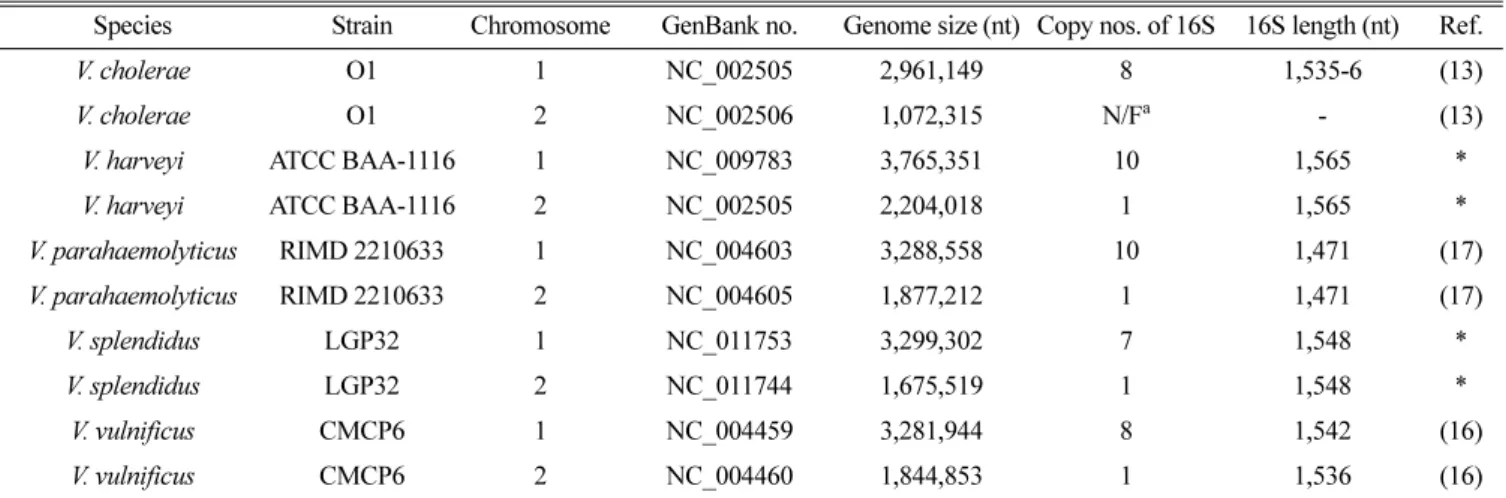
rRNA 유전자 copy개수와 염기서열 길이는 Table 1과 같다. V.
cholerae #O1 은 1번 염색체에 8개의 16S rRNA 유전자를 갖고 있으며, 길이는 1,535~1,536 bp로 1 bp 차이가 있다. 다른 Vibrio 는 1번 염색체에 16S rRNA 유전자를 대부분 갖고 있으며, 개수 는 7개 이상이다(V. harveyi 10개[총 11개], V. parahaemolyticus 10 개[총 11개], V. splendidus 7개[총 8개], V. vulnificus 8개[총 9개]).
유전체내 16S rRNA 염기서열 길이는 모두 동일하였다(예, V.
parahaemolyticus, 1,471 bp; V. harveyi, 1,565 bp). 또한 Vibrio의 세포 안의 1번, 2번 염색체에 코드화된(coding) 16S rRNA 유전 자간 염기서열의 뚜렷한 차이는 없었다. Vibrio 16S rRNA 이질 Table 1. Vibrio 16S rRNA sequence GenBank nos. used in this study
Species Strain Chromosome GenBank no. Genome size (nt) Copy nos. of 16S 16S length (nt) Ref.
V. cholerae O1 1 NC_002505 2,961,149 8 1,535-6 (13)
V. cholerae O1 2 NC_002506 1,072,315 N/F
a- (13)
V. harveyi ATCC BAA-1116 1 NC_009783 3,765,351 10 1,565 *
V. harveyi ATCC BAA-1116 2 NC_002505 2,204,018 1 1,565 *
V. parahaemolyticus RIMD 2210633 1 NC_004603 3,288,558 10 1,471 (17)
V. parahaemolyticus RIMD 2210633 2 NC_004605 1,877,212 1 1,471 (17)
V. splendidus LGP32 1 NC_011753 3,299,302 7 1,548 *
V. splendidus LGP32 2 NC_011744 1,675,519 1 1,548 *
V. vulnificus CMCP6 1 NC_004459 3,281,944 8 1,542 (16)
V. vulnificus CMCP6 2 NC_004460 1,844,853 1 1,536 (16)
a
Not found in genome sequence
* Direct GenBank submission
Fig. 1. Variability maps along the full length of 16S rRNAs found in individual Vibrio cells. Entropy scores were plotted along nucleotide positions
of each 16S rRNA gene, by calculating the amount of variability through a column in an alignment of the compared sequences.
성과 관련하여, Moreno 등(18)은 해양 생물에서 분리한 V.
parahaemolyticus 를 조사하여 종내(intraspecies)에 16S rRNA 유전 자 변이가 있다는 것을 보고하였다. 또한 같은 Vibrio 속의 종내 변이 및 copy 개수에 대한 연구로 Fegatella 등(9)은 V. harveyi 에 16S rRNA를 포함하는 rrn 오페론이 7~9개 있다고 보고하였 으며, Wolf와 Haygood (24)는 8~11개 있는 것으로 발표하였다.
이것은 본 연구 결과와 잘 일치하며, Vibrio 속은 종내 수준에서 16S rRNA 유전자 copy 개수에 차이가 있다는 것을 제시해 준다.
Vibrio 속 유전체내 16S rRNA 유전자 변이를 엔트로피 값을 이용하여 비교하였다(Fig. 1). V. cholerae #O1는 16S rRNA 180~900 번 염기 사이에 변이가 관찰되었으며, 다른 종들은 전혀 다른 위치에 변이가 있는 것으로 분석되었다. 염기서열 변이가 발생하는 위치는 종간에 뚜렷한 상관성이 없었다(P>0.05). 최근에 Harth 등(12)은 V. parahaemolyticus #RIMD2210856을 대상으로 16S rRNA 염기서열 이질성을 분석하였는데, 2차 구조 내에서 이 중나선을 갖는 16S rRNA 부위에 많은 변이가 있는 것으로 보고 하였다. 본 연구에서는 16S rRNA 유전자의 2차 구조와 연관된 V1-V9 지역(23)을 조사하였으나, 변이지역(variable region)과 보존 지역(conserved region)에서 모두 변이가 관찰 되었다.
Vibrio 유전체내 16S rRNA DNA 이질성
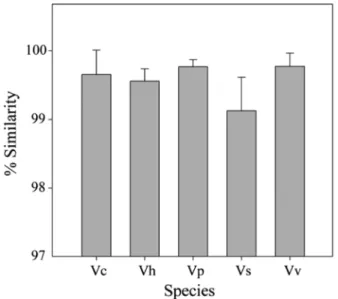
Vibrio 속의 유전체내 16S rRNA의 차이를 DNA 상동성을 이 용하여 분석하였다(Fig. 2). 개체 내의 16S rRNA 염기서열 상동 성은 V. cholerae 99.7% (SD=0.36, N=20), V. harveyi 99.6%
(SD=0.18, N=45), V. parahaemolyticus 99.8% (SD=0.10, N=55), V. splendidus 99.1% (SD=0.49, N=20), V. vulnificu 99.8%
(SD=0.19, N=36) 였다. Vibrio 속의 세포 내 16S rRNA 유전자는
대략 1% 이내의 염기서열 상이성(dissimilarity)을 갖고 있는 것으 로 판단된다. 이것은 최근에 Moreno 등(18)이 발표한 연구결과와 잘 일치하는데, V. cholerae, Helicobacter pylori, Ureaplasma urealyticum, Escherichia coli 의 유전체내 16S rRNA 변이가 0.6%
에서 최대 2%까지 있는 것으로 보고하였다(www.tigr.org, www.ncbi.nlm.nih.gov).
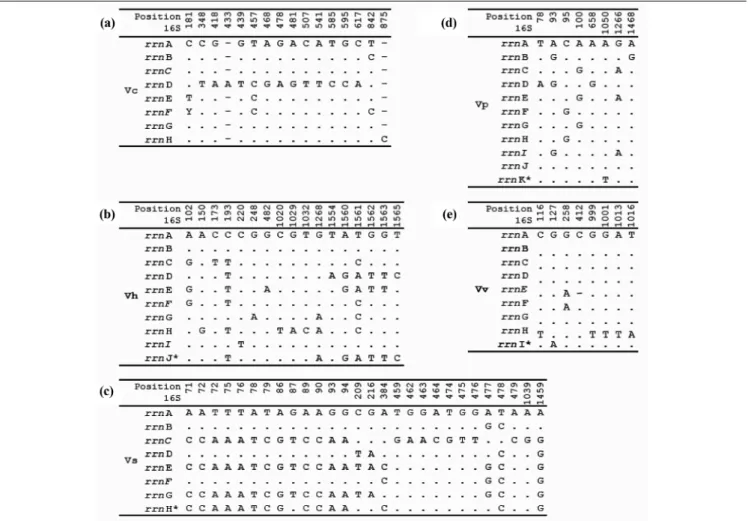
Table 2 는 5종의 Vibrio에서 발견된 유전체내 16S rRNA 염기 변이를 나타낸다. Vibrio 속은 1번 염색체에 7개 이상의 16S rRNA 유전자를 갖고, 2번 염색체에 1개 이내의 16S rRNA 유전 자가 존재한다(V. cholerae). 이들 염색체간에 16S rRNA 염기서 열의 뚜렷한 차이는 발견되지 않았다. 예를 들어, V. harveyi는 rrnD 와 rrnJ가 정확히 동일한 염기서열을 갖고 있으며, V.
splendidus 는 rrnC, rrnE, rrnH 유전자가 유사한 것으로 파악되었 다. 본 연구에서 분석한 5종의 Vibrio에서 유전체내 16S rRNA 유전형은 5개(V. vulnificu) 이상, 8개(V. parahaemolyticus, V.
harveyi) 까지 조사되었다.
세균 16S rRNA 유전자는 미생물 동정 및 생물 군집분석을 위해 효과적인 지표이다. 이것은 16S rRNA 유전자가 갖는 장점 ( 예, 모든 생물에 존재, 구조적으로 안정, 종간에 낮은 염기변이, GenBank 에 등록된 많은 데이터)으로 인해(11), 이들 유전자를 활 용한 분석 및 검출방법이 고안되고 있다. Vibrio 속의 계통 분석 및 병원균 검출을 위해 16S rRNA를 이용하고 있으나, 많은 연 구에서 16S rRNA 분석의 한계를 보고하여 왔다(11, 15). 본 연 구에서 Vibrio 속 제놈 데이터를 이용하여 유전체내 16S rRNA copy 개수와 이질성을 염기서열 수준에서 분석하였으며, Vbrio 속은 세포 안에 8개 이상 16S rRNA를 갖고 있으며 이들 유전 자 염기서열은 1% 정도 변이가 관찰 되었다. 본 결과는 Vibrio 속의 16S rRNA 유전자 염기서열이 높은 이질성을 갖는 것을 제시해 준다.
참고문헌
1. 김영진, 이선이, 조효진, 유선녕, 김철민, 최용락, 박병근, 안순철. 2007. Vibrio tapetis의 검출을 위한 PCR specific primer 의 제작. J. Life Sci. 17, 162-165.
2. 윤영준, 김도연, 이실한, 이우윤, 고영환, 김승곤, 김정완.
2000. 수입냉동 어패류에 오염되어 있는 Vibrio 속 세균의 분리 및 동정. J. Fd Hyg. Safety 15, 128-136.
3. Acinas, S.G., L.A. Marcelino, V. Klepac-Ceraj, and M.F. Polz.
2004. Divergence and redundancy of 16S rRNA sequences in genomes with multiple rrn operons. J. Bacteriol. 186, 2629-2635.
4. Case, R.J., Y. Boucher, I. Dahllöf, C. Holmström, W.F. Doolittle, and S. Kjelleberg. 2007. Use of 16S rRNA and rpoB genes as molecular markers for microbial ecology studies. Appl. Environ.
Microbiol. 73, 278-288.
5. Coenye, T. and P. Vandamme. 2003. Intragenomic heterogeneity between multiple 16S ribosomal RNA operons in sequenced bac- terial genomes. FEMS Microbiol. Lett. 228, 45-49.
6. Colwell, R.R. and W.M. Soira. 1992. The ecology of Vibrio chol- erae, pp. 1-36. In D. Barua and W.B.I. Greenough (eds.), Cholera, Plenum Press, NY, USA.
7. Diggles, B.K., J. Carson, P.M. Hine, R.W. Hickman, and M.J. Tait.
Fig. 2. DNA similarities of the 16S rRNA genes presented in single cells of five Vibrio. DNA similarities were calculated between each pair of the 16S rRNA gene copies. Each bar represents mean % similarity scores with standard deviations (Vc, N=20; Vh, N=45; Vp, N=55; Vs, N=20; Vv, N=36). Abbreviations: Vc, V. cholerae; Vh, V.
harvey; Vp, V. parahaemolyticus; Vs, V. splendidus; Vv, V. vulnificus.
2000. Vibrio species associated with mortalities in hatchery-reared turbot (Colistium nudipinnis) and brill (C. guntheri) in New Zealand. Aquaculture 183, 1-12.
8. Dorsch, M., D. Lane, and E. Stackebrandt. 1992. Towards a phy- logeny of the genus Vibrio based on 16S rRNA sequences. Int. J.
Syst. Bacteriol. 42, 58-63.
9. Fegatella, F., J. Lim, S. Kjelleberg, and R. Cavicchioli. 1998.
Implications of rRNA operon copy number and ribosome content in the marine oligotrophic ultramicrobacterium Sphingomonas sp.
strain RB2256. Appl. Environ. Microbiol. 64, 4433-4438.
10. Hall, T.A. 1999. BioEdit: a user-friendly biological sequence alignment editor and analysis program for Windows 95/98/NT.
Nucl. Acids Symp. Ser. 41, 95-98.
11. Harmsen, D. and H. Karch. 2004. 16S rDNA for diagnosing patho- gens: a living tree. ASM News 70, 19-24.
12. Harth, E., J. Romero, R. Torres, and R.T. Espejo. 2007. Intrage- nomic heterogeneity and intergenomic recombination among Vibrio parahaemolyticus 16S rRNA genes. Microbiology 153, 2640-2647.
13. Heidelberg, J.F., J.A. Eisen, W.C. Nelson, R.A. Clayton, M.L.
Gwinn, R.J. Dodson, D.H. Haft, E.K. Hickey, J.D. Peterson, L.A.
Umayam, S.R. Gill, K.E. Nelson, T.D. Read, H. Tettelin, D. Rich-
ardson, M.D. Ermolaeva, J. Vamathevan, S. Bass, H. Qin, I. Dra- goi, P. Sellers, L. McDonald, T. Utterback, R.D. Fleishmann, W.C.
Nierman, O. White, S.L. Salzberg, H.O. Smith, R.R. Colwell, J.J.
Mekalanos, J.C. Venter, and C.M Fraser. 2000. DNA sequence of both chromosomes of the cholera pathogen Vibrio cholerae.
Nature 406, 477-483.
14. Huq, A. and R.R. Colwell. 1995. Vibrios in the marine and estua- rine environments. J. Mar. Biotechnol. 3, 60-63.
15. Ki, J.S., R. Zhang, W. Zhang, Y.L. Huang, and P.Y. Qian. 2009.
Analysis of RNA polymerase beta subunit (rpoB) gene sequences for the discriminative power of marine Vibrio species. Microb.
Ecol. 58, 679-691.
16. Kim, Y.R., S.E. Lee, C.M. Kim, S.Y. Kim, E.K. Shin, D.H. Shin, S.S. Chung, H.E. Choy, A. Progulske-Fox, J.D. Hillman, M.
Handfield, and J.H. Rhee. 2003. Characterization and pathogenic significance of Vibrio vulnificus antigens preferentially expressed in septicemic patients. Infect. Immun. 71, 5461-5471.
17. Makino, K., K. Oshima, K. Kurokawa, K. Yokoyama, T. Uda, K.
Tagomori, Y. Iijima, M. Najima, M. Nakano, A. Yamashita, Y.
Kubota, S. Kimura, T. Yasunaga, T. Honda, H. Shinagawa, M.
Hattori, and T. Iida. 2003. Genome sequence of Vibrio para- haemolyticus: a pathogenic mechanism distinct from that of V.
Table 2. Variable positions in the complete sequences of the 16S rRNA genes from the studied Vibrio
Note: Positions of the sequences were numbered from the 16S rRNA of each species (Table 1). Dots indicate identity with nucleotides of the first
consensus one. Dashes indicate indel sites. “Y” was represented to “C” or “T”. Abbreviations: Vc, V. cholerae; Vh, V. harveyi; Vp, V. para-
haemolyticus; Vs, V. splendidus; Vv, V. vulnificus. * represents genes encoded on chromosome 2, the others chromosome 1.
cholerae. Lancet 361, 743-749.
18. Moreno, C., J. Romero, and R.T. Espejo. 2002. Polymorphism in repeated 16S rRNA genes is a common property of type strains and environmental isolates of the genus Vibrio. Microbiology 148, 1233-1239.
19. Pillidge, C.J., L.M. Sheehy, A. Shihata, Z.Y. Pu, M. Dobos, and I.B. Powell. 2009. Intragenomic 16S rRNA gene heterogeneity in Lactococcus lactis subsp. cremoris. Int. Dairy J. 19, 222-227.
20. Ruimy, R., V. Breittmayer, P. Elbaze, B. Lafay, O. Bouseemart, M.
Gauthier, and R. Christen. 1994. Phylogenetic analysis and assess- ment of the genera Vibrio, Photobacterium, Aeromonas, and Ple- siomonas deduced from small-subunit rRNA sequences. Int. J.
Syst. Bacteriol. 44, 416-426.
21. Thompson, J.D., D.G. Higgins, and T.J. Gibbson. 1997. Clustal X:
improving the sensitivity of progressive multiple sequence align- ment through sequence weighting, position specific gap penalties and weight matrix choice. Nucleic Acids Res. 22, 4673.
22. Thompson, J.R., M.A. Randa, L.A. Marcelino, A. Tomita-Mitch- ell, E. Lim, and M.F. Polz. 2004. Diversity and dynamics of a
North Atlantic coastal Vibrio community. Appl. Environ. Micro- biol. 70, 4103-4110.
23. Van de Peer, Y., S. Chapelle, and R. De Wachter. 1996. A quanti- tative map of nucleotide substitution rates in bacterial rRNA.
Nucleic Acids Res. 24, 3381- 3391.
24. Wolfe, C.J. and M.G. Haygood. 1993. Bioluminescent symbionts of the Caribbean flashlight fish (Kryptophanaron alfredi) have a single rRNA operon. Mol. Mar. Biol. Biotechnol. 2, 189-197.
25. Yamaichi, Y., T. Iida, K.S. Park, K. Yamamoto, and T. Honda.
1999. Physical and genetic map of the genome of Vibrio para- haemolyticus: presence of two chromosomes in Vibrio species.
Mol. Microbiol. 31, 1513-1521.
26. Zhang, W., J.S. Ki, and P.Y. Qian. 2008. Molecular microbial diversity of Victoria Harbor sediments: I. Bacterial community assessment based on four 16S rDNA clone libraries. Estuar. Coast.
Shelf. Sci. 76, 668-681.
(Received December 4, 2009/Accepted December 23, 2009)
ABSTRACT : Heterogeneity Analysis of the 16S rRNA Gene Sequences of the Genus Vibrio Jang-Seu Ki (Department of Life Science, Sangmyung University, Seoul 111-743, Republic of Korea)
Bacterial 16S rRNA gene sequences have been widely used for the studies on molecular phylogeny, evolutional history, and molecular detections. Bacterial genomes have multiple rRNA operons, of which gene sequences sometimes are variable. In the present study, heterogeneity of the Vibrio 16S rRNA gene sequences were inves- tigated. Vibrio 16S rRNA sequences were obtained from GenBank databases, considering the completion of gene annotation of Vibrio genome sequences. These included V. cholerae, V. harveyi, V. parahaemolyticus, V.
splendidus, and V. vulnificus. Chromosome 1 of the studied Vibrio had 7~10 copies of the 16S rRNA gene, and their intragenomic variations were less than 0.9% dissimilarity (more than 99.1% DNA similarity). Chro- mosome 2 had none or single 16S rRNA gene. Intragenomic 16S rRNA genotypes were detected at least 5 types (V. vulnificus #CMCP6) to 8 types (V. parahaemolyticus #RIMD 2210633, V. harveyi #ATCC BAA-1116).
These suggest that Vibrio has high heterogeneity of the 16S rRNA gene sequences.