Korean J Clin Microbiol Vol. 15, No. 4, December, 2012 http://dx.doi.org/10.5145/KJCM.2012.15.4.139
Haemophilus parainfluenzae Infective Endocarditis Confirmed by 16S rRNA Sequence Analysis from Culture Negative Tissue
Kyoung-Jin Park1, Kyung Sun Park1, Soo-Han Choi2, Yae-Jean Kim2, Chang-Seok Ki1, I-Seok Kang2, Nam Yong Lee1
Departments of 1Laboratory Medicine and Genetics, 2Pediatrics, Samsung Medical Center, Sungkyunkwan University School of Medicine, Seoul, Korea
Blood culture-negative infective endocarditis (CNE) can be a diagnostic dilemma. Herein, we report a case of CNE caused by Haemophilus parainfluenzae identified only via 16S rRNA sequence analysis di- rectly from valve tissue. A 17-year-old boy presented with high spiking fever for one month. Pansystolic murmur (Grade III) and vegetation (0.65×0.26 cm and 0.62×0.55 cm) on the anterior mitral valve leaflet via transesophageal echocardiogram suggested the diagnosis of infective endocarditis (IE). However, blood culture performed on admission was negative
even after 2 weeks of incubation. Gram stain and culture of a direct tissue specimen failed to identify causative microorganism, while 16S rRNA gene se- quences (548 bp) showed 100% identity with those of Haemophilus parainfluenzae (GenBank: FJ939586.1).
The 16S rRNA sequence analysis with a direct tis- sue specimen might be useful in cases of CNE.
(Korean J Clin Microbiol 2012;15:139-142)
Key Words: 16S rRNA, Haemophilus parainfluenzae, Infective endocarditis
Received 6 February, 2012, Revised 22 March, 2012 Accepted 4 April, 2012
Correspondence: Nam Yong Lee, Department of Laboratory Medicine and Genetics, Samsung Medical Center, Sungkyunkwan University School of Medicine, 50, Irwon-dong, Gangnam-gu, Seoul 135-710, Korea.
(Tel) 82-2-3410-2710, (Fax) 82-2-3410-2719, (E-mail) micro.lee@
samsung.com
139 INTRODUCTION
Traditionally, the diagnosis of infective endocarditis (IE) is mainly based on the clinical suspicion, conventional culture method, and echocardiography. Etiological diagnosis by culture method is very important to provide adequate treatment and fa- vorable clinical outcome. However, blood culture negative in- fective endocarditis (CNE) has been reported with a frequency of 2.5-31%, which is a diagnostic dilemma and results in de- layed treatments and high mortality [1,2]. The most common cause of CNE is antibiotic administration preceding blood cul- ture, which occurs in 45-60% of CNE [3-5]. Fastidious and slow-growing organism is also reported as another cause of CNE. In addition, other factors such as right sided endocarditis and cases with permanent pacemaker have been reported for the causes of CNE [2].
The HACEK group (Haemophilus spp., Aggregatibacter acti- nomycetemcomitans gen. nov., comb. nov., Cardiobacterium hominis, Eikenella corrodens, Kingella kingae) is classified as
one of the fastidious organism causing CNE [1,6]. Haemophilus parainfluenzae as one of the HACEK group constitutes part of normal flora of the oropharyngeal cavity. Thus, risk factors such as dental procedure, nasopharyngeal infection, tongue piercing, and the use of tongue scrapers seem to be needed for the devel- opment of IE by Haemophilus parainfluenzae [7-9]. Although it is a fastidious organism that requires V factor for growth, the mean incubation time for growth of HACEK group is 3-5 days except Actinobacillus actinomycetemcomitans, which requires up to 30 days for growth [10,11].
Herein, we present a case of CNE due to Haemophilus para- influenzae, which was identified only via sequencing of direct tissue specimen in a healthy boy without definitive predisposing factors.
CASE REPORT
A 17-year-old healthy boy was referred from other hospital with fever of unknown origin and weight loss (5 kg/month) for 1 month. He complained that fever was highly spiking and re- sponded to antipyretics. Chest tightness, dyspnea, and cough were added as new symptoms 1-2 days earlier than admission.
His medical history was not remarkable except the present
140
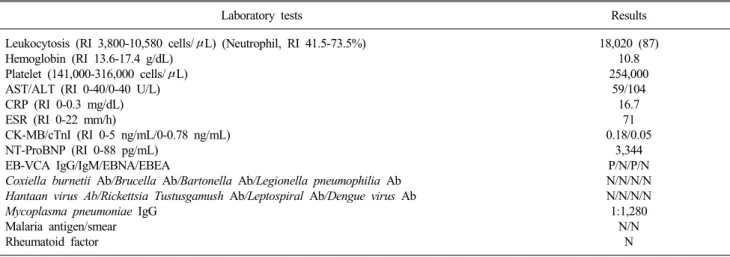
Korean J Clin Microbiol 2012;15(4):139-142Table 1. Laboratory findings
Laboratory tests Results
Leukocytosis (RI 3,800-10,580 cells/μL) (Neutrophil, RI 41.5-73.5%) Hemoglobin (RI 13.6-17.4 g/dL)
Platelet (141,000-316,000 cells/μL) AST/ALT (RI 0-40/0-40 U/L) CRP (RI 0-0.3 mg/dL) ESR (RI 0-22 mm/h)
CK-MB/cTnI (RI 0-5 ng/mL/0-0.78 ng/mL) NT-ProBNP (RI 0-88 pg/mL)
EB-VCA IgG/IgM/EBNA/EBEA
Coxiella burnetii Ab/Brucella Ab/Bartonella Ab/Legionella pneumophilia Ab Hantaan virus Ab/Rickettsia Tustusgamush Ab/Leptospiral Ab/Dengue virus Ab Mycoplasma pneumoniae IgG
Malaria antigen/smear Rheumatoid factor
18,020 (87) 10.8 254,000
59/104 16.7
71 0.18/0.05
3,344 P/N/P/N N/N/N/N N/N/N/N 1:1,280
N/N N
Abbreviations: RI, reference interval; AST, aspartate aminotransferase; ALT, alanine aminotransferase; CRP, C-reactive protein; ESR, erythrocyte sedimentation rate; CK-MB, creatine kinase MB fraction; cTnI, cardiac troponin I; NT-ProBNP, amino-terminal pro-brain natriuretic peptide;
EB-VCA, Epstein-Barr virus capsid antigen; Ig, Immunoglobulin; EBNA, Epstein-Barr virus nuclear antigen; EBEA, Epstein-Barr virus early antigen; Ab, antibody; N, negative; P, positive.
illness. On admission to hospital, he had blood pressure of 93/51 mmHg, heart rate of 123 beats per min, temperature of 39.2oC, and oxygen saturation of 97%. Physical examination re- vealed Grade III pansystolic murmur at lower left sternal border and mild splenomegaly. Chest X-ray showed that peribronchial marking in both lungs was increased with normal cardiac size, which was suggestive of viral pneumonia. Oxygen and empiri- cal antibiotics such as ampicillin-sulbactam and azithromycin were administrated. However, worsening of chest discomfort and bilateral pulmonary edema were developed along with per- sistent fever on day 2 after admission. A transthoracic echo- cardiography (TTE) showed severe mitral regurgitation (MR), chordal rupture of anterior mitral valve leaflet (AMVL), and left atrium dilation. IE was suspected and antibiotics were exchanged into combination of ampicillin, nafcillin, and gentamicin. Subse- quent transesophageal echocardiography (TEE) showed linear mobile mass like lesion on AMVL, which indicates the vegeta- tion. The sizes of the vegetation were 0.65×0.26 cm and 0.62×
0.55 cm.
Gram stain and 3 sets of cultures using the blood obtained on admission day showed no growth of microorganism even after 14 days of incubation in Bact/Alert 3D automated microbial de- tection system (bioMerieux, Inc, Durham, NC, USA). One day after that, 1 set of blood culture also was negative for the growth of microorganism. Other laboratory findings were de- scribed in Table 1. Delayed mitral valvuloplasty with artificial chordae formation was performed to save native valve on day
14 after admission. Ruptured chordaes were removed and fi- brous tissue on tip of separated chordae was collected to per- form the Gram stain and culture. Histologic sections of removed mitral valve demonstrated fibromyxoid valvulopathy and fibrin deposition with dystrophic calcification, which is suggestive of IE. However, no microorganisms were identified using Gram stain of mitral valve. In addition, Gram stain and culture of the chordae tissue showed no microorganism. We did not prepare wet smear in this case.
To identify the causative agent, genomic DNA was extracted from the direct chordae tissue using the MagNa Pure LC Total Nucleic Acid Isolation Kit (Roche, Mannheim, Germany).
Approximately 500 bp of 16S ribosomal RNA (rRNA) gene was amplified in an ABI 9700 Thermal Cycler (Applied Biosystems, Foster City, CA, USA). The polymerase chain reaction con- sisted of 1 cycle at 94oC for 5 min, followed by a 32 cylce am- plification (94oC for 30 sec, 60oC for 30 sec, and 72oC for 30 sec) and a final extension step at 72oC for 7 min. Standard 16S rRNA primer pairs were following sequences according to CLSI guideline; Forward primer, 4F:5’-TTG GAG AGT TTG ATC CTG GCT C-3’ and reverse primer, 534R: 5’- TAC CGC GGC TGC TGG CAC-3’ and forward primer 27F: 5’-AGA GTT TGA TCM TGG CTC AG-3’ and reverse primer 801R:
5’-CGGC GTG GAC TTC CAG GGT ATC T-3’ [11]. Direct sequencing was performed using the BigDye Terminator Cycle Sequencing Kit 3.1 (Applied Biosystems) on ABI prism 3730 Genetic analyzer (Applied Biosystems). Sequence analysis
Kyoung-Jin Park, et al. : Infective Endocarditis Confirmed by Sequence Analysis
141
showed that the 16S rRNA sequences of the isolate had 100%
homology (548/548 bp) with those of Haemophilus para- influenzae (GenBank accession number, FJ939586.1).
The patient had no more fever since the day 3 after admission.
Antibiotic treatment was done for 6 weeks and the patient had a full recovery without any complication. Follow-up echo- cardiography after 2 months showed minimal MR.
DISCUSSION
Fastidious organisms as causative organism constitute 5-15%
of IE and 50% of CNE [5]. CNE caused by fastidious organ- isms can be diagnosed mainly by serologic testing and molec- ular techniques. There are several organisms in this category; in- tracellular organisms (Coxiella burnetii and Chlamydia spp.), slow-growing bacteria (Bartonella spp., Brucella spp. and Leg- ionella spp.), and nutritionally deficient bacteria (Abiotrophia spp. Mycoplasma spp. and Haemophilus spp.) [5]. Our patient was also all negative for serologic tests of antibodies responding to Coxiella burnetii, Brucella, Bartonella, and Legionella pneu- mophilia. When traditional microbiological and serologic diag- nosis was not definitive, molecular method is the most powerful tool for etiologic diagnosis of CNE. According to one study, molecular approach showed a sensitivity of 72% and specificity of 100%, while the culture-based approach only showed a sensi- tivity of 26% and a specificity of 62% [12]. There are some sit- uations when sequencing of the 16S rRNA gene is useful in case of; 1) antibiotic treatment preceding blood culture, 2) fas- tidious pathogen that is difficult to grow by conventional culture method, 3) some pathogen such as Coxiella burnetii and Brucella spp. that give a significant biohazard.
Fewer than 80 cases of H. parainfluenzae endocarditis includ- ing 4 cases in Korea have been reported in the literature [13].
Typical clinical manifestations of H. parainfluenzae endocarditis are subacute endocarditis, predisposing factors of dental proce- dure, nasopharyngeal infection, tongue piercing, and preexisting cardiac abnormalities in the literature [11,14,15]. Also, septic embolization is well known complication of H. parainfluenzae endocarditis, because which they have a propensity to form fri- able and large vegetations [11]. Our patient showed only pro- longed fever and heart murmur without any other physical find- ings such as Roth’s spots, and Janeway’s lesions. In addition, he had no definite predisposing conditions except for probable res- piratory infection, which was supported by the increased Mycoplasma pneumoniae IgG titer on admission. It was not cer-
tain that Mycoplasma pneumoniae infection was occurred prior to H. parainfluenzae infection. Conventional culture method failed to identify the causative organism in spite of long in- cubation time of 2 weeks. Considering the HACEK organisms could be recovered within 3 days in improved blood culture sys- tem, negative results of culture in our case might be due to pre- vious antibiotic treated in other hospital during unknown period.
If antibiotics were administrated for short period, result of blood culture turned negative into positive. However, longer courses of incurative antibiotics lead to negative results of blood culture for several weeks [1].
In summary, we report the case of H. parainfluenzae endo- carditis diagnosed via only molecular technique with culture negative tissue specimen. Early awareness of causative organism leading to CNE is very important because empirical antibiotic therapy might not be effective and delayed diagnosis could re- sult in destruction of cardiac structure.
REFERENCES
1. Tunkel AR and Kaye D. Endocarditis with negative blood cultures.
N Engl J Med 1992;326:1215-7.
2. Houpikian P and Raoult D. Blood culture-negative endocarditis in a reference center: etiologic diagnosis of 348 cases. Medicine (Baltimore) 2005;84:162-73.
3. Lamas CC and Eykyn SJ. Blood culture negative endocarditis:
analysis of 63 cases presenting over 25 years. Heart 2003;89:258- 62.
4. Werner M, Andersson R, Olaison L, Hogevik H. A clinical study of culture-negative endocarditis. Medicine (Baltimore) 2003;82:
263-73.
5. Brouqui P and Raoult D. New insight into the diagnosis of fastidious bacterial endocarditis. FEMS Immunol Med Microbiol 2006;47:1-13.
6. Nørskov-Lauritsen N and Kilian M. Reclassification of Actinobacillus actinomycetemcomitans, Haemophilus aphrophilus, Haemophilus paraphrophilus and Haemophilus segnis as Aggregatibacter actino- mycetemcomitans gen. nov., comb. nov., Aggregatibacter aphro- philus comb. nov. and Aggregatibacter segnis comb. nov., and emended description of Aggregatibacter aphrophilus to include V factor-dependent and V factor-independent isolates. Int J Syst Evol Microbiol 2006;56:2135-46.
7. Choi D, Thermidor M, Cunha BA. Haemophilus parainfluenzae mitral prosthetic valve endocarditis in an intravenous drug abuser.
Heart Lung 2005;34:152-4.
8. Lynn DJ, Kane JG, Parker RH. Haemophilus parainfluenzae and influenzae endocarditis: a review of forty cases. Medicine (Baltimore) 1977;56:115-28.
9. Redmond AM, Meiklejohn C, Kidd TJ, Horvath R, Coulter C.
Endocarditis after use of tongue scraper. Emerg Infect Dis 2007;13:
1440-1.
10. Houpikian P and Raoult D. Diagnostic methods. Current best practices and guidelines for identification of difficult-to-culture pathogens in infective endocarditis. Cardiol Clin 2003;21:207-17.
142
Korean J Clin Microbiol 2012;15(4):139-142 11. Feder HM Jr, Roberts JC, Salazar JC, Leopold HB, Toro-SalazarO. HACEK endocarditis in infants and children: two cases and a literature review. Pediatr Infect Dis J 2003;22:557-62.
12. Voldstedlund M, Nørum Pedersen L, Baandrup U, Klaaborg KE, Fuursted K. Broad-range PCR and sequencing in routine diagnosis of infective endocarditis. APMIS 2008;116:190-8.
13. Kelesidis T, Kelesidis I, Lewinski MA, Humphries R. Establishing diagnosis of Haemophilus parainfluenzae as etiology of culture-
negative endocarditis using DNA sequence analysis on tissue spe- cimen. Am J Med 2011;124:e9-10.
14. Christou L, Economou G, Zikou AK, Saplaoura K, Argyropoulou MI, Tsianos EV. Acute Haemophilus parainfluenzae endocarditis: a case report. J Med Case Rep 2009;3:7494.
15. Brouqui P and Raoult D. Endocarditis due to rare and fastidious bacteria. Clin Microbiol Rev 2001;14:177-207.
=국문초록=
배양음성 조직에서 16S rRNA 유전자 염기서열 분석법을 시행하여 확진한
Haemophilus parainfluenzae
심내막염성균관대학교 의과대학 삼성서울병원 1진단검사의학과, 2소아과
박경진1, 박경선1, 최수한2, 김예진2, 기창석1, 강이석2, 이남용1
감염성 심내막염의 일부에서는 혈액배양이 음성으로(culture negative infective endocarditis, CNE) 진단이 어려울 수 있다.
저자들은 심장 판막 조직에서 직접 16S rRNA 염기서열 검사를 시행하여 진단한 Haemophilus parainfluenzae CNE 증례를 보고하고자 한다. 기저질환이 없던 17세 남자 환자가 1개월 된 발열을 주소로 내원하였다. 전수축기 심잡음 (Grade III)과 경식도 심초음파상 승모판막 전엽에서 관찰된 증식 (vegetation) (0.65×0.26 cm and 0.62×0.55 cm) 소견은 감염성 심내막염 진단을 시사하였다. 그러나 입원 시의 혈액검체를 이용한 배양 검사는 2주 이후에도 음성 소견을 보였다. 판막 조직을 이용한 배양검사 및 그람 염색은 음성이었으나, 16S rRNA 염기서열 검사(548 bp, 100% identity) 결과 Haemophilus para- influenzae (GenBank: FJ939586.1)가 원인균으로 진단되었다. 배양 음성 심내막염의 진단을 위하여 조직 검체에서 직접 시행하는 16S rRNA염기서열 분석법이 유용할 수도 있다. [대한임상미생물학회지 2012;15:139-142]
교신저자 : 이남용, 135-710, 서울시 강남구 일원동 50번지 성균관대학교 의과대학 삼성서울병원 진단검사의학과 Tel: 02-3410-2710, Fax: 02-3410-2719
E-mail: [email protected]