1. Introduction
1.1. Background and purpose of the study
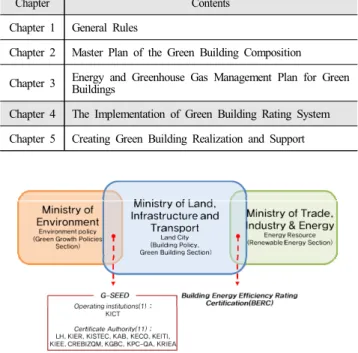
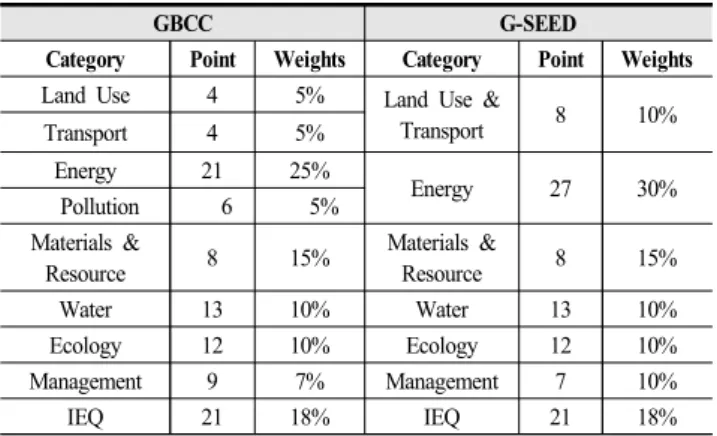
A new, globally competitive certification regime is being attempted, by integrating the GBCC system and the house performance certification system based on the existing Construction Act and the Housing Act in 2013. The new regime, given with a fancy brand name that goes G-SEED (Green Standard for Energy and Environmental Design,) however lacks any improvement of the environment certification criteria for offices, schools, or commercial facilities. The only difference it has is some new items for evaluating multi-unit houses for environmental certification in addition to what they already had in the existing housing performance certification regime. The issues regarding relevance of the domestic certification system and improvement of the criteria to ensure a practically valid set of standard have been pointed out and demanded for a long time. However, such voices have never been heard as the system has been revised repeatedly.
For this reason, the housing suppliers in Korea obtain LEED
pISSN 2288-968X, eISSN 2288-9698 http://dx.doi.org/10.12813/kieae.2015.15.1.013
certifications of the United States to increase the properties’ market values and promotional advantages. As of 2013, 95 buildings have been registered or filed for a registrations, indicating the LEED has firmly placed its roots in Korean market.
Recently, attempts have been made to obtain BREEAM certification, which is a green building certification regime in UK.
BRE, the operating agency of BREEAM system, provides customized certification systems in consideration of the culture and climatic characteristics of each country where possible candidate buildings are located. 1)
Even if the BRE provides a customized scheme for Korea, it is basically a necessity to analyze the differences between BREEAM and the domestic scheme (G-SEED.) Especially, due to the fact that LEED, GREEN STAR, or other systems have been developed based on BREEAM, the analysis on the background, purpose, evaluation items and the methods is an essential step to endow the
1) It is divided into the National Scheme Operators and BREEAM International Bespoke.
The National Scheme Operator is a nation wide system, which require one to two years for preparation. The BREEAM certification operation is commissioned by BRE Global. (EX:
BREEAMES, BREEAM SE, BREEAM NOR). On the other hand, the International Bespoke is composed of a simplified manual, which is intended for buildings in countries which failed to get the qualifications mentioned above. The manual is to be applied for each individual building, and the preparation time required ranges from two to three months.
KIEAE Journal
Korea Institute of Ecological Architecture and Environment 71
1)
Study for Improvement of Domestic System through Regulation based on Comparison of Green Building Certification System Analysis
- Focused on the G-SEED, BREEAM Hyun, Eun-Mi
*⋅ Kim, Yong-Sik
*** Dept. of Architecture Konkuk Univ. South Korea([email protected])
** Corresponding author, Dept. of Architecture Konkuk Univ. South Korea([email protected])
A B S T R A C T K E Y W O R D
The main purpose of the green buildings by reducing energy consumption and carbon footprint of the building society, global as to ensure the sustainability of the building and the environment. These regulations and schemes are used to activate the green buildings were made on the basis of the relevant laws and regulations. Mainly in the research for the improvement of the domestic institutional assessment items, the analysis of the legislation was fundamentally focused on Scoring the incomplete state. The analysis based on the laws and regulations of the institution is the way to know the purpose and direction of the respective certification. This study was performed in the following order to target the new commercial buildings. First, the analysis of the geungeobeop G-SEED and BREEAM. Second, we analyze the content and method of building energy performance in the certification system. As a result, Green Building Act is broad in relation to the composition of the contents are building for the activation energy green building and EPI is dealt with in an abstract and presented the applicability of such documentary content of insulation and airtightness, efficient machine. In contrast, the UK has been directly limit the carbon footprint of buildings in the Building Regulations Part L and evaluate them in BREEAM. This analysis of the ways to reduce substantially the energy for domestic green building regulations should be addressed through the feed.
ⓒ 2015 KIEAE Journal
Green Building Certification Criteia G-SEED
BREEAM
A C C E P TA N C E IN F O