JKSCI
The Performance Evaluation System for the Modern Pentathlon based on the Concept of Performance Analysis of Sport
*
Hyongjun Choi*, Doryung Han**
*Associate Professor, Dept. of Physical Education (Performance Analysis in Sport), Dankook University, Yongin, Korea
**Honorary principal professor, Major of Security secretary Studies Continuing Education Center, Kyonggi University, Seoul, Korea
[Abstract]
This study intended to develop the Performance Evaluation system for the modern pentathlon such as an Olympic sporting event. The performance evaluation index system for the modern pentathlon was developed by Microsoft Excel 2016 with Visual Basic for Application that it is able to be understandable for the practical field in sport. Consequently, the system for the performance evaluation index is able to be developed within the concept of performance analysis of sport such as a notational analysis of sport. And the performance indicators for the performance evaluation index were selected by the skills to make successful outcomes. Finally, the simulation with big data gathering by the developed system would be requested that systematic reviews on successful outcomes in other sporting events would be necessary.
▸Key words: Indexing, ratio of improved performances, performance analysis of sport, Performance Evaluation system
[요 약]
본 연구는 올림픽 정식 종목 중 하나인 근대 5종 경기의 경기력 평가 시스템을 개발하는데 주된 목적을 두었다. 근대5종을 위한 경기력 평가 지표 시스템을 위하여 마이크로소프트사 엑셀 2016 을 VBA와 함께 사용하였으며, 현장 적용을 고려하여 개발하였다. 결론적으로 경기력 평가 지표를
위한 시스템은 스포츠부호화분석 이론의 적용으로 구현이 가능하였으며 , 경기력 평가 지표 시스
템에 사용되는 분석인자는 성공적인 운동수행 기술에 기초하여 선정하였다. 마지막으로 향후 개 발된 시스템을 활용한 빅데이터의 시뮬레이션이 요구되며, 타 스포츠종목의 성공적인 운동수행 결과를 토대로 한 체계적인 고찰이 필요하다고 사료된다 .
▸주제어: 인덱싱, 경기력 향상 비율, 스포츠경기분석, 경기력 평가 시스템
∙First Author: Hyongjun Choi, Corresponding Author: Doryung Han
*Hyongjun Choi ([email protected]), Dept. of Physical Education (Performance Analysis in Sport), Dankook University
**Doryung Han ([email protected]), Major of Security secretary Studies Continuing Education Center, Kyonggi University
∙Received: 2020. 09. 14, Revised: 2020. 09. 22, Accepted: 2020. 09. 23.
Copyright ⓒ 2020 The Korea Society of Computer and Information http://www.ksci.re.kr pISSN:1598-849X | eISSN:2383-9945
I. Introduction
Computer science has been developed and affected to different domains such as economy, social science, accounts, or sport science. Among different domains against the computer science, the quotation or application of computer science into a particular area in academic has not been immediately expended in sport science. The main reason of slow application from the concept of computer science to practical field in sports was that main contents in sport science have been not easily accessible. In terms of convergences, it would be very important precondition that the contents of linkage between difference domains or principles would be understandable [1]. Current research relevant to the sport science and computer science shown that there would be greater expectations when the environment of convergence between both domains [2]. Obviously, the convergent research between both domains, such as computer science and sport science have to consider many attempts in order to understand and to develop potential environment of convergence.
Therefore, this study is willing to suggest how to understand between the computer science and the sport science with the development process of performance evaluation for the modern pentathlon such as a fundamental event in Olympic Games.
II. Preliminaries
1. The modern pentathlon
The modern pentathlon is a sport event that Pierre Coubertin who suggested the modern Olympic Games create the modern pentathlon [3]. The modern pentathlon includes 5 different sports’
events such as swimming, fencing, horse riding, running and shooting. 5 different events indicate that in era of ancient the solders should have abilities of running, throwing the javelin, throwing a stone, wrestling with enemies and escaping from the
enemies in the era of ancient. The ancient events have quoted to the modern abilities for solders such as riding a horse (horse riding), shooting enemies(shooting), competing with enemies(fencing), escaping toward to river(swimming) and escaping on the ground(running). Thus, the modern pentathlon as a sport events request multi-sporting abilities such as strength, speed, and endurance. Recently, a major change of rules in the modern pentathlon was in a combination between running and shooting that athletes would be required the concentration during high intensity of performance. It assumed that the rule change could affect the performance levels and strategies during a competition [4]. Thus, to analysis of match contents in the modern pentathlon would be worthy that it could be a comprehensive research when the result of performance analysis of sport would be applied in the practice efficiently.
2. Performance Analysis of sport
Performance analysis of sport is able to gather
the performance analysis with objective
perspectives based on the notational analysis of
sport[5]. The notational analysis of sport is willing
to notate every single event during the
performances in sport such as passes, dribbles and
shootings in soccer. In order words, the events
would be the factors or variables relating to
successful outcomes. The definition of successful
outcomes would be in subjective perspectives, but
the concept of performance analysis of sport keens
to guide the objective way to observe performances
[6]. The objective observation is the most important
to the field of sports that it could be great effects
to athletes’ training. Hughes and Franks(2004) have
proven that the subjective observation was not
suitable to be used in coaching process because of
ineffectiveness of data uses [7]. Thus, the
subjective observation should be reduced, and the
objective observation should be increased in the
process of analysis in sport according to the
concept of coaching process [8]. The needs of
performance analysis of sport with the objective
observation [9] has been already suggested within
the routine of coaching process that continuous research on the evidence of the needs of performance analysis of sport. Fig 1 is shown the needs of objective observation in the routine of coaching process.
Fig. 1. A simple schematic diagram representing the coaching process (Hughes& Franks, 1997, p. 7).
However, the objective observation is notable to be efficient that the system design and development should be also concerned as much as the concept of objective observation has been greater value of the main concept of performance analysis of sport.
3. System for performance evaluation in sports As the development of ICT technology comes into the field of sport, the application of ICT technology has been applied for the system design of performance analysis of sport as well as Digital pad [10], Concept keyboard [11], and wearable devices [12]. The evaluation of performances in sport is used to determine the data with statistical approaches such as individual evaluation for tennis player [13], team performance in soccer world cup [14], individual evaluation for swimmers [15].
Previous researches based on the statistical approaches in order to analyze the performance within the evaluation of individual performance or team performance, but it is only the theoretical perspectives and not the practical aspects.
Therefore, recent researches are willing to bring the performance analysis of sport from theory to practice in the field of sport science [16]. Technical evaluation on the system developed has been usually concerned in the computer science area, however, it has been depending on the technical
report in the area of performance analysis of sport.
The accuracy of data collection has been considered in the field of performance analysis of sport that the tracking information system using the GPS(Global Positioning System) technology has even concerned [17]–[20].
III. The System of Performance Evaluation for the Modern Pentathlon
1. Performance Indicators
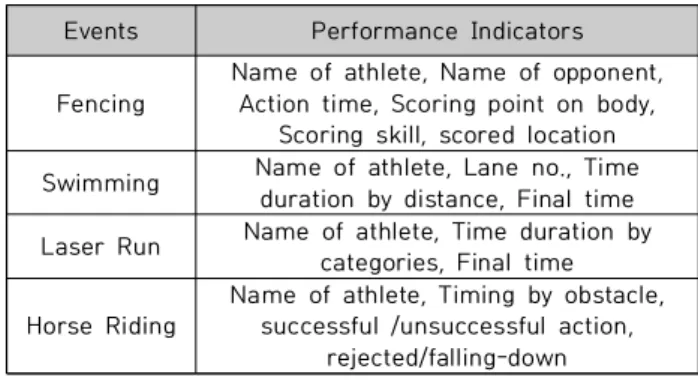
Performance Indicators which are main variables to analyze the performances have selected within the official regulation of the modern pentathlon.
Table 1 is shown that the performance indicators were separated in each sport event such as fencing, swimming, laser run and horse riding.
Events Performance Indicators
Fencing
Name of athlete, Name of opponent, Action time, Scoring point on body,
Scoring skill, scored location Swimming Name of athlete, Lane no., Time
duration by distance, Final time Laser Run Name of athlete, Time duration by
categories, Final time
Horse Riding
Name of athlete, Timing by obstacle, successful /unsuccessful action,
rejected/falling-down Table 1. Performance Indicators in each event
2. System Design and data processing
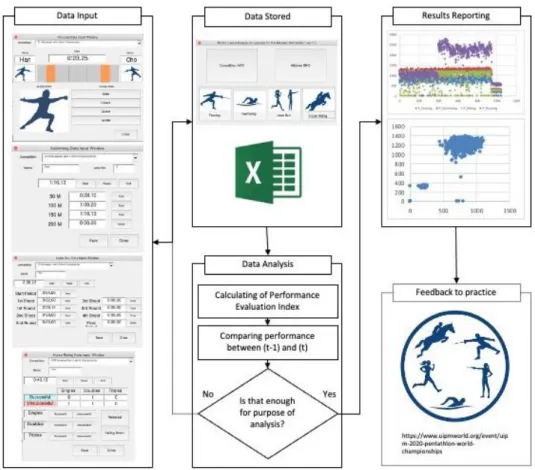
The system design was to consider the feedback
to practice of the field of the modern pentathlon
that it included data input, data storage, data
analysis, results reporting and feedback as above
Fig 2. For the data input, the system was developed
by Microsoft Excel 2016 with Visual Basic for
Application (VBA). The reason of selection for
programming as Excel with VBA was for catholicity
in the practical field of sports that easier database
for the practice would be the Excel. All sport
events such as fencing, swimming, laser run and
horse riding, were concerned within conveniency of
data collection that it would be necessary to
Fig. 2. Flow chart of system design and data processing
consider data collection time, easy data input, and training of data collectors. Particularly, in data input for fencing, the data of 2 athletes who have a match in fencing event were collected at same time that timing of point scored, location of point scored, scored body part, and skills (attacking and defending) were collected by orders. In data input for the swimming, only 1 athlete’s data was collected that a stop-watch were designed for record timing by distance categories (every 50 m).
The time data was also importantly collected in an event of laser run that collected data was based on the distance categories and the data was collected by a second. For data input for the horse riding, the results of riding obstacles (i. e. single, double and triple obstacles) after the performances were separately collected within the outcomes of performance such as successful/ unsuccessful, rejected by horse, or falling down from a horse. All concepts of system design were considered that an advanced analysis of performance evaluation was
required even though the official data has not been provided. After the data input done, all data was stored into excel worksheets in order to apply the performance evaluation index on stored data.
Within the stage of data analysis, firstly, the performance evaluation index was calculated on each sporting event and combined into total performance evaluation index. Secondly, the performances were compared with performance evaluation index between previous competition (t-1) and current competition (t). After the data analysis done, all performance indicators were visualized on the report sheets and were ready to feedback to the practical field of modern pentathlon.
3. Modelling for the Performance Evaluation Index
The evaluation of performances was commonly
utilized with statistical approaches [21]-[23]. The
percentile was easily used to determine the
categories of performance as well as advanced
statistics used [24]. However, previous studies relevant to the development of evaluation index were concentrated to team sports such as volleyball, baseball, soccer and rugby, but not an individual sport event. In other words, the performance evaluation index for the modern pentathlon would be differently developed.
Thus, the modelling of the performance evaluation index in this study was concerned within the improvement of individual performances between previous and current competition.
Equation 1 is indicated performance evaluation index for Fencing where PFW is frequence of winners in previous competition(t-1), PTM is total number of fencing matches in previous competition(t-1), CFW is frequence of winners in current competition(t), and CTM is total number of fencing matches in current competition(t).
f or
Equation 1. Performance Evaluation Index for fencing
Equation 2 is for performance evaluation index for swimming where WRP
smindicates for “World Record in Previous competition for swimming”, PRP
smfor “Personal Record in Previous competition for swimming”, WRC
smfor “World Record in Current competition for swimming”, and PRC
smfor
“Personal Record in Current competition for swimming”.
f or
Equation 2. Performance Evaluation Index for swimming
Equation 3 is about the performance evaluation index for laser run where WRP
lrindicates for
“World Record in Previous competition for laser run”, PRP
lrfor “Personal Record in Previous competition for laser run”, WRC
lrfor “World Record in Current competition for laser run”, and
PRC
lrfor “Personal Record in Current competition for laser run”.
f or
Equation 3. Performance Evaluation Index for laser run
Equation 4 is shown the performance evaluation index for horse riding where ODP is for
“frequencies of Obstacle Dropped in Previous competition”, FDP is for “frequencies of Falling Down from horse in Previous competition”, ODC is for “frequencies of Obstacle Dropped in Current competition”, and FDC is for “frequencies of Falling Down from horse in Current competition”.
for
—
—
Equation 4. Performance Evaluation Index for horse riding
IV. Conclusion
This study was intended to develop the performance evaluation index system for the modern pentathlon. As a part of introduction mentioned that the convergence between computer science and sport science would guide to provide efficiencies of application from the concept of computer science to the field of sports’ practice.
The development of the performance evaluation index system was concerned within the perspectives of sports’ practice that the layout of data input in the system was designed for convenience.
According to the results of this study, potential
guides are found as following conclusions in order
to concern the development of performance
evaluation index system for other sports. According
to the results of this study, potential guides are
found as following conclusions in order to concern
the development of performance evaluation index
system for other sports.
1) The system for the performance evaluation index is able to be developed within the concept of performance analysis of sport such as a notational analysis of sport.
2) The performance indicators for the performance evaluation index were selected by the skills to make successful outcomes.
3) The simulation with big data gathering by the developed system would be requested that systematic reviews on successful outcomes in each sporting event would be necessary.
Consequently, the prospect of the convergence between computer science and sport science is brightly potential, so that further researches on the convergence based on the contents from sport science would be worthy for both domains in academical perspectives.
REFERENCES
[1] E. McLaughlin and P. O’Donoghue, “The reliability of time-motion analysis using the CAPTAIN system,” in PASS.COM;
performance analysis, sport science and computers, 2001, pp. 63–
68.
[2] H. Choi, “The Current Status of Sports Big Data Analysis Researches in Korea,” Korean J. Meas. Eval. Phys. Educ. Sport Sci., vol. 22, no. 2, pp. 63–69, 2020, doi:10.21797/ksme.2020.
22.2.006.
[3] D.R. Han and J.H. Kim, “A study on the Exploration on the Organic Harmonies of Modern Pentathlon,” Korean J.Sport, vol.
15, no. 2, pp. 519–530, 2020.
[4] D.R. Han, “A Study on the Ancient Greek Physical Education Spirit,” J. Korea Soc. Comput. Inf., vol. 22,no. 4, pp. 99–105, 2017.
[5] M. Hughes and I. M. Franks, “Notational Analysis of Sport”.
London: E & FN SPON, 1997.
[6] I. M. Franks and G. Miller, “Eyewitness testimony in sport”, J.
Sport Behav., vol. 9, pp. 39–45, 1986.
[7] H. J. Choi, M. Hughes, and P. O’Donoghue, “Ergonomics Issues and Human-Computer interaction in sport: A case study evaluation of a match analysis system for basketball,” in Symposium Proceedings 6th IACSS, 2007, pp. 31–35.
[8] M. Hughes and I. M. Franks, “Notational Analysis of Sport”;
Second Edition. London: Routledge, 2004.
[9] P. Potrac, C. Brewer, R. Jones, K. Armour, and J. Hoff, “Toward an holistic understanding of the coaching process,” Quest, vol. 52, no. 2, pp. 186–199, 2000, doi:10.1080/00336297.2000.10491709.
[10] I. M. Franks, “The science of match analysis,” in Science and Soccer, T. Reilly, Ed. London: E. & F.N. Spon, 1996, pp. 363–
375.
[11] J. Williams, “The development of a real-time data capture application for rugby union,” in World Congress of Performance Analysis of Sport VI, 2004, pp. 253–261.
[12] J. C. Barbero-Álvarez, M. Gómez López, V. Barbero Álvarez, J. Granda, and C. Castagna, “Heart rate and activity profile for young female soccer players,” J. Hum. Sport Exerc., vol. 3,no.
2, pp. 1–11, 2008.
[13] S. J. Hong, “The Development of Record Factor Norm for Evaluation Tennis Players,” Korean J. Meas. Eval. Phys. Educ.
Sport Sci., vol. 12, no. 3, pp. 77–89, 2010.
[14] H. Choi, “The Investigation of team performance analysis based on the 2002, 2006 football worldcup data,” Korean J. Meas. Eval.
Phys. Educ. Sport Sci., vol. 11, no. 2, pp. 41–51, 2009.
[15] M. J. Yang and H. Choi, “Comparison of game contents in 100m swimming competition : With the focus of the 98th National Sports Festival,” Korean J. Sport. Sci., vol. 28, no. 6, pp. 1173–
1186, 2019, doi: 10.35159/kjss.2019.12.28.6.1173.
[16] H. Choi, “Evaluation of key-strokes on the basketball game analysis software,” Korean J. Meas. Eval. Phys. Educ. Sport Sci., vol. 15, no. 3, pp. 27–34, 2013, doi:10.21797/ksme.2013.15.3 .003.
[17] M. Stockl and S. Morgan, “Visualization and Analysis of Spatial Characteristics of Attacks in Field Hockey,” Int. J. Perform. Anal.
Sport, vol. 13, no. 1, pp. 160–178, 2013.
[18] V. Di Salvo, A. Collins, B. McNeill, and M. Cardinale,
“Validation of Prozone : A new video-based performance analysis system,” Int. J. Perform. Anal. Sport, 2006.
[19] E. J. Walker, A. J. McAinch, A. Sweeting, and R. J. Aughey,
“Inertial sensors to estimate the energy expenditure of team-sport athletes,” J. Sci. Med. Sport, vol. 19, no. 2,pp. 177–181, 2016, doi: 10.1016/j.jsams.2015.01.013.
[20] M. Buchheit, A. Allen, T. K. Poon, M. Modonutti, W. Gregson, and V. Di Salvo, “Integrating different tracking systems in football: multiple camera semi-automatic system, local position measurement and GPS technologies,” J. Sports Sci., vol. 32, no.
20, pp. 1844–1857,Dec. 2014, doi: 10.1080/02640414.2014.94 2687.
[21] M. A. Dixon and G. B. Cunningham, “Data Aggregation in Multi level Analysis: A Review of Conceptual and Statistical Issues,”
Meas. Phys. Educ. Exerc. Sci., vol. 10, no. 2, pp. 85–107, 2006.
[22] S. S. Blackman and J. W. Casey, “Development of a Rating System for All Tennis Players,” Oper. Res., vol. 28, no. 3,pp.
489–502, 1980.
[23] F. M. Ávila-Moreno, L. J. Chirosa-Ríos, A. Ureña-Espá, D.
Lozano-Jarque, and D. Ulloa-Díaz, “Evaluation of tactical performance in invasion team sports: a systematic review,”
International Journal of Performance Analysis in Sport, vol. 18, no. 2. 2018, doi:10.1080/24748668.2018.1460054.
[24] H. J. Eom, “A mathematical analysis of team performance in volleyball,” Can. J. Sport. Sci., vol. 13, pp. 55–65, 1988.
Authors
Dr. Hyongjun Choi recieved the BS.c., Ph.D.
degrees in Performance Analysis of Sport from University of Wales(UK), in 2005 and 2008. He is interested in Performance Analysis of Sport, Match analysis in sport, Artificial Intelligence and computer science in sport, Dankook University.
Dr. Doryung Han, received his Ph.D. in Physical Education Philosophy from Korea National Sport University. He also majored in physical education ethics in the graduate school master's course. He majored in physical education in the undergraduate course of the same university. He majored in physical education in the undergraduate course of the same university. He is teaching Major of Security Secretary Studies continuing Education Center Kyonggi University.