ISSN 2234-3806 • eISSN 2234-3814
http://dx.doi.org/10.3343/alm.2012.32.6.413
Clonal Spread of Carbapenem Non-susceptible
Acinetobacter baumannii in an Intensive Care Unit in a Teaching Hospital in China
Qiao Zhong, M.D., Weidong Xu, M.D., Yuanjian Wu, M.D., and Hongxing Xu, M.D.
Department of Laboratory Medicine, Suzhou Municipal Hospital Affiliated Nanjing Medical University, Suzhou, China Background: This study was aimed to investigate the genetic diversity and antibiotic resis- tance profile of the nosocomial infection agent Acinetobacter baumannii from a medical intensive care unit (ICU) in a teaching hospital in Suzhou, China.
Methods: The genetic relationship among A. baumannii isolates in an ICU was investigat- ed using multilocus sequence typing (MLST). The antibiotic resistance pattern was deter- mined by performing an antibiotic susceptible test, which included an agar dilution meth- od and an E-test method. Resistant determinants, e.g., carbapenemase genes, metallo-β- lactamases, and class 1 integron, were analyzed by specific PCR and DNA sequencing.
Results: In the present study, 33 non-duplicate isolates were identified as 5 existing se- quence types (STs) (ST92, ST75, ST112, ST145, and ST345) and 1 new sequence type STn, which has a G-A mutation at nt268 on ropD40 of ST251. These results reveal limited diversity in carbapenem non-susceptible A. baumannii (CNSAb) isolates in our ICU, which are comprised of only 2 distinct STs, with ST92 and ST75 clustering into a clonal complex (CC) 92. Most CNSAb isolates (94.4%, 17/18) harbored the OXA-23 gene, while no carbapenem-susceptible A. baumannii (CSAb) isolates harbored it. In addition, 66.7% (22/33) isolates were positive for class 1 integrase, and gene cassette analysis showed there are 3 gene arrays among them, i.e., aacA4-catB8-aadA1 (77.3%, 17/22), aacA4 (22.7%, 5/22), and aacC1-orfX-orfX’-aadA1 (4.5%, 1/22).
Conclusions: When all these data are combined, the antibiotic resistance and wide distri- bution of CNSAb isolates in our ICU are probably caused by expansion of the CC92 clone.
Key Words: MLST, Molecular epidemiology, Acinetobacter baumannii
Received: June 13, 2012 Revision received: July 2, 2012 Accepted: September 16, 2012 Corresponding author: Qiao Zhong Department of Laboratory Medicine, Suzhou Municipal Hospital Affiliated Nanjing Medical University, 26 Daoqian Street, Suzhou, Jiangsu 215002, China
Tel: +86-512-62362312 Fax: +86-512-62362317
E-mail: [email protected]
© The Korean Society for Laboratory Medicine.
This is an Open Access article distributed under the terms of the Creative Commons Attribution Non-Commercial License (http://creativecom- mons.org/licenses/by-nc/3.0) which permits unrestricted non-commercial use, distribution, and reproduction in any medium, provided the original work is properly cited.
INTRODUCTION
Acinetobacter baumannii is an opportunistic human pathogen associated with an increasing incidence of nosocomial infec- tions, including bacteremia, urinary tract infections, and ventila- tor-associated pneumonia [1-3]. Most A. baumannii isolates have a multidrug resistant phenotype (MDRAb) with an increas- ing prevalence in the intensive care unit (ICU) [2, 4]. Although carbapenem is a common clinical choice to treat MDRAb infec-
tions, the resistance rate has increased dramatically over the past decade. Carbapenem resistance is caused by the produc- tion of carbapenemases, including class D β-lactamases (OXA- type carbapenemases) and class B metallo-β-lactamases (MBLs) as previously described [5-8]. The OXA-type carbapenemases are comprised of 4 kinds of genes: blaOXA-23-like, blaOXA-24-like, blaOXA- 58-like, and an intrinsic blaOXA-51-like type as previously reported [9, 10]. In addition, ISAba1, an insertion sequence (IS), was found in A. baumannii isolates, which can enhance the expression of
OXA-type carbapenemase genes and mobilize these genes among the strains [11].
Integron is a widely studied vehicle for gene capture, which is highly related to antibiotic resistant gene dissemination [12, 13].
Among MDRAb isolates, the class 1 integron is commonly de- tected, which infers a high association with carbapenem resis- tance. The integron structure contains an integrase, followed by an attI site for the integration of cassettes and the recognition of integrase, and a promoter to drive its expression. It can appear on a plasmid or chromosome, and can be classified into differ- ent types (class 1, class 2, and class 3 integron) on the basis of their integrases. The most classical integron, class 1 integron, has 2 conserved terminal sequences. Therefore, the primer set (5’-conserved sequence [CS] and 3’-CS), which targets 2 termi- nal sequences in the integron, is commonly used for integron cassette analysis.
Multi locus sequence typing (MLST) is an unambiguous typ- ing method for identifying accurate and portable nucleotide se- quences of internal fragments of multiple housekeeping genes.
Recently, some studies [14-16] revealed that the clonal complex (CC) 92 in the carbapenem non-susceptible A. baumannii (CNSAb) isolate has a worldwide dissemination. The ST92 A.
baumannii isolate is the largest clone and is predicted to be the founder of this clonal complex. Molecular epidemiological sur- veillance not only provides a better understanding of nosocomial infections in certain hospitals, but also provides a chance to un- derstand the route of global dissemination. However, the genetic diversity and molecular characteristics of A. baumannii in our region remain unclear. Therefore, in order to better understand the epidemiological characteristics of A. baumannii in the ICU and the relationship of carbapenem resistance with integrons, in this study, we performed MLST typing and a molecular inves- tigation of antibiotic resistance determinants in A. baumannii isolates collected in our medical ICU.
METHODS
1. Bacterial strains and antimicrobial susceptibility test In total, 33 non-duplicated clinical A. baumannii isolates were collected by standard isolation methods between January and December 2009 in our medical ICU. All isolates were identified by conventional methods and further identified by 16S-23S rRNA gene spacer region analysis as described previously [17].
All of these isolates were stored at -80°C in brain-heart infusion broth containing 50% (v/v) glycerol before inclusion in this study.
Antimicrobial susceptibility of isolates to cefepime, ceftazi- dime, piperacillin, amikacin, gentamicin, ciprofloxacin, ampicil- lin/sulbactam, and piperacillin/tazobactam were determined by using the disc diffusion method. The minimum inhibitory con- centrations (MICs) of imipenem and meropenem were deter- mined by using the agar dilution method, and that of colistin was determined by using the E-test (AB bioMérieux, Marcy- l’Etoile, France). Escherichia coli ATCC 25922 and Pseudomo- nas aeruginosa ATCC 27853 were used as reference strains for the antimicrobial susceptibility test. The results were interpreted according to the manufacturer’s instructions and CLSI guide- lines [18].
2. Carbapenemase genes and class 1 integron analysis Genomic DNA from A. baumannii was extracted using a ge- nomic DNA extraction Kit (Qiagen, Valencia, CA, USA) following the manufacturer’s instructions. MBL-producing isolates were screened using the imipenem-EDTA double-disk synergy test [19]. Metallo-β-lactamase (IPM4)-producing A. baumannii was used as a positive control. The genes encoding carbapene- mases blaIMP-type, blaVIM-type, blaSIM-1, blaOXA-23-like, blaOXA-24-like, blaOXA- 58-like, and blaOXA-51-like were analyzed by PCR using primers as de- scribed previously [5-8]. The location of blaOXA-23-like and blaOXA-51- like with an insert element (ISAba1) was screened by PCR [11].
Integron analysis was conducted by using PCR with the class 1 integrase (int1 gene) as the targeting gene, as previously de- scribed [12]. Gene cassettes in class 1 integrase-positive iso- lates were performed by amplifying the sequence from the 5’-CS to the 3’-CS region [12]. The PCR products were purified and sequenced, either directly by using the PCR product, or by cloning into a pGEM®-T vector (Promega, Madison, WI, USA).
All sequencing reactions were performed using an ABI prism sequencer 3730 (Applied Biosystems, Foster City, CA, USA), and the sequence data were analyzed by using BLAST at the NCBI website (http://www.ncbi.nlm.nih.gov).
3. MLST
MLST was performed on A. baumannii as described by Bartual et al. [20]. Briefly, 7 housekeeping genes, i.e., gltA, gyrB, gdhB, recA, cpn60, gpi, and rpoD, were amplified, followed by se- quencing on the ABI prism sequencer 3730 (Applied Biosys- tems). The sequences of these 7 housekeeping genes were an- alyzed using the Pubmlst database (http://pubmlst.org/abau- mannii/). The sequence type (ST) was designated according to the allelic profiles in the database. The eBURST algorithm (ver- sion 3; http://eburst.mlst.net/) was used to assign STs to CCs
and to assess the genetic relationship with definition of the groups sharing alleles at ≥6 of 7 loci [21]. The CC comprises a founding ST as a common ancestor and several other closely related STs descending from the predicted founding genotype.
4. Statistical analysis
Resistance rates for each antibiotic were compared between CNSAb and carbapenem-susceptible A. baumannii (CSAb), ST92-CNSAb and ST92-CSAb, and the int1-positive group and int1-negative group, using Fisher’s exact test. A P value <0.05 was considered as significant difference.
RESULTS
1. Characteristics of A. baumannii isolates
In this study, 33 non-duplicate A. baumannii isolates were iso- lated from patients hospitalized in our medical ICU. All of these isolates were confirmed by 16S-23S rRNA internal spacer analy- sis as previously described [17]. Among these isolates (26 from lower respiratory tract, 4 from urinary tract, and 2 from blood, and 1 from pus), 54.5% (18/33) isolates were resistant to either imipenem, meropenem, or both. The resistance rate of colistin was 3% (1/33), which coincides with the observation that colis- tin is the most effective antibiotic to treat A. baumannii infec- tions in our area. From a nationwide surveillance conducted during 2007, the resistance rates of imipenem and meropenem in China were calculated to be 40% and 35%, respectively [22].
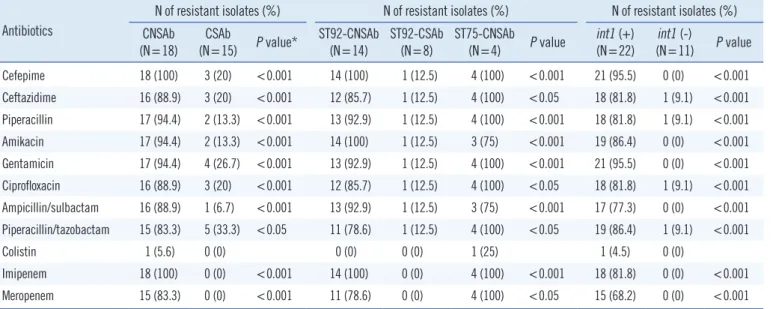
Table 1. Antibiotic resistance rates for Acinetobacter baumannii in this study Antibiotics
N of resistant isolates (%) N of resistant isolates (%) N of resistant isolates (%) CNSAb
(N=18) CSAb
(N=15) P value* ST92-CNSAb
(N=14) ST92-CSAb
(N=8) ST75-CNSAb
(N=4) P value int1 (+)
(N=22) int1 (-)
(N=11) P value
Cefepime 18 (100) 3 (20) <0.001 14 (100) 1 (12.5) 4 (100) <0.001 21 (95.5) 0 (0) <0.001
Ceftazidime 16 (88.9) 3 (20) <0.001 12 (85.7) 1 (12.5) 4 (100) <0.05 18 (81.8) 1 (9.1) <0.001 Piperacillin 17 (94.4) 2 (13.3) <0.001 13 (92.9) 1 (12.5) 4 (100) <0.001 18 (81.8) 1 (9.1) <0.001 Amikacin 17 (94.4) 2 (13.3) <0.001 14 (100) 1 (12.5) 3 (75) <0.001 19 (86.4) 0 (0) <0.001 Gentamicin 17 (94.4) 4 (26.7) <0.001 13 (92.9) 1 (12.5) 4 (100) <0.001 21 (95.5) 0 (0) <0.001 Ciprofloxacin 16 (88.9) 3 (20) <0.001 12 (85.7) 1 (12.5) 4 (100) <0.05 18 (81.8) 1 (9.1) <0.001 Ampicillin/sulbactam 16 (88.9) 1 (6.7) <0.001 13 (92.9) 1 (12.5) 3 (75) <0.001 17 (77.3) 0 (0) <0.001 Piperacillin/tazobactam 15 (83.3) 5 (33.3) <0.05 11 (78.6) 1 (12.5) 4 (100) <0.05 19 (86.4) 1 (9.1) <0.001
Colistin 1 (5.6) 0 (0) 0 (0) 0 (0) 1 (25) 1 (4.5) 0 (0)
Imipenem 18 (100) 0 (0) <0.001 14 (100) 0 (0) 4 (100) <0.001 18 (81.8) 0 (0) <0.001
Meropenem 15 (83.3) 0 (0) <0.001 11 (78.6) 0 (0) 4 (100) <0.05 15 (68.2) 0 (0) <0.001
*P value represent the difference in antibiotic resistance rates between ST92-CNSAb and ST92-CSAb.
Abbreviations: CNSAb, carbapenemase non-susceptible Acinetobacter baumannii; CSAb, carbapenemase susceptible Acinetobacter baumannii; ST, se- quence type; int1, class 1 integrase.
However, from a new surveillance report generated in 2010, the prevalence of CNSAb isolates was dramatically increased to 80% [23]. Therefore, the CNSAb isolate is becoming a major concern as a nosocomial infection in China.
2. MLST and clonal relationship of A. baumannii isolates According to the MLST, 33 A. baumannii isolates can be grouped into 5 existing STs (ST92, 1-3-3-2-2-7-3; ST75, 1-3-3-2-2-11-3; ST112, 1-12-56-36-4-61-26; ST145, 21-35-2-28-1-52-4; ST345, 46-12-110-1-16-141-50) and 1 new ST, which has a G-A mutation at nt268 on the rpoD40 loci of ST251(32-48-54-35-1-11-40) (Table 1). All CNSAb isolates comprised of ST92 and ST75 only, accounting for 77.8% (14/18) and 22.2% (4/18), respectively.
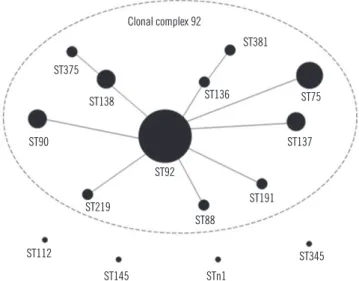
Clonal relation analysis showed that both ST92 and ST75 be- long to the CC92, which is a globally disseminated CC for A.
baumannii (Fig. 1). This result suggests that CC92 is the major clone that spreads in the ICU of our hospital. eBURST analysis [21] showed that ST92 is the founder of CC92. Previous studies [14, 15, 24] showed that several STs exist, e.g., ST75, ST88, ST90, ST136, ST137, and ST138, which are SLVs of the founder ST92. However, we still found other types, e.g., ST381 and ST375, which are double locus variants (DLVs) of ST92.
3. Genetic determinants in CNSAb isolates
No blaIMP-type, blaVIM-type, blaSIM-1, blaOXA-24-like, and blaOXA-58-like genes were observed among these isolates, and no MBLs producing these isolates were detected by the EDTA double-disk synergy
test. Most (94.4%, 17/18) ST92-CNSAb isolates harbor the bla- OXA-23 gene, as shown in Table 2. Interestingly, there was 1 ST92-CSAb isolate that could be detected as being positive for the blaOXA-23 gene. However, ISAba1 blaOXA-23 gene mapping showed that no ISAba1 gene could be detected in this isolate.
Therefore, this result confirmed the importance of the ISAba1 gene in A. baumannii isolates, which exhibit the carbapenem resistance phenotype. ISAba1 was detected in most (88.2%, 15/17) blaOXA-23-positive isolates, which are located upstream of blaOXA-23. The blaOXA-51-like gene was detected in all isolates in this study, which is consistent with the blaOXA-51-like gene as an intrin- sic carbapenemase. However, there were no ISAba1 genes lo- cated with the blaOXA-51-like gene as determined by PCR mapping in CSAb isolates. All blaOXA-51-like genes were confirmed as blaOXA-66
genes by sequencing of CNSAb isolates.
Integron analysis revealed that all CNSAb isolates have a class 1 integrase (Table 2). When comparing the antibiotic resis- tance profiles (Table 1), most antibiotics showed resistance rates that were much higher in the int1-positive isolates than in the negative ones. Integron gene cassette analysis showed that there were 3 distinct antibiotic gene arrays, i.e., aacA4-catB8- aadA1 (77.3%, 17/22; Genebank accession no. EU340419), aacA4 (22.7%, 5/22; Genebank accession no. EU523056), and aacC1-orfX-orfX’-aadA1 (4.5%, 1/22; Genebank accession no.
AY307113). Functional analysis showed that these genes were only associated with aminoglycoside and chloramphenicol resis- tance, which are not related to carbapenem resistance. It seems that carbapenem-resistant genes might not be transmitted via integron structures in our area.
DISCUSSION
In this study, we analyzed the molecular typing and characteris- Fig. 1. Population structure of Acinetobacter baumannii in this
study and an existing isolate in China, represented by an eBURST algorithm. A circle represents an ST, and its size corresponds to the number of isolates. The broken line indicates clonal complex (CC) 92. ST112, ST145, ST345, and STn1 are the singletons in this study. ST represents sequence type, i.e. ST92, 1-3-3-2-2-7-3, ST75, 1-3-3-2-2-11-3, ST112, 1-12-56-36-4-61-26, ST145, 21-35-2-28- 1-52-4, ST345, 46-12-110-1-16-141-50, and STn1, representing a new sequence type with a G-A mutation at nt268 on the rpoD40 loci of ST251(32-48-54-35-1-11-40); CC represents clonal complex.
Clonal complex 92
ST381
ST136 ST75
ST375 ST138
ST90
ST92
ST88
ST191 ST137
ST345 STn1
ST145 ST112
ST219
Table 2. Distribution, allelic profiles, MIC ranges of IPM and MEM and antibiotic resistance determinants of the isolates ST* Allelic profiles† Isolates N of
isolates
N of IPM-resistant isolates (MIC range [mg/L])
N of MEM-resistant
isolates (MIC range [mg/L])
N of blaOXA-23
-positive isolates
N of blaOXA-51-like
-positive isolates
N of int1-positive
isolates
CC
92 1-3-3-2-2-7-3
c4, c6, c8, c10, c11, c12, c20, c21, c22,
c23, c27, c30, c32, c33 14 14/14 (32-128) 10/14 (32-128) 14 14 14 92
92 1-3-3-2-2-7-3 c5, c13, c16, c24, c25,
c26, c29, c31 8 0/8 0/8 1 8 1 92
75 1-3-3-2-2-11-3 c7, c9, c17, c19 4 4/4 (64-128) 4/4 (32-128) 3 4 4 92
112 1-12-56-36-4-61-26 c2, c18, c28 3 0/3 0/3 0 3 1 singleton
145 21-35-2-28-1-52-4 c1, c15 2 0/2 0/2 0 2 1 singleton
345 46-12-110-1-16-141-50 c3 1 0/1 0/1 0 1 1 singleton
n 32-48-54-35-1-11-40 (nt268G-A) c14 1 0/1 0/1 0 1 0 singleton
*ST represents sequence type, and the novel unassigned STs were designated STn; †Allelic profiles represent 7 loci in the order of gltA, gyrB, gdhB, recA, cpn60, gpi, and rpoD.
Abbreviations: IPM, imipenem; MEM, meropenem; int1, class 1 integrase; CC, clonal complex (assigned based on eBURST analysis).
tics of A. baumannii isolates in our ICU. From the MLST result, the predominant clone is ST92 in CNSAb isolates in our hospi- tal, and this observation is also consistent with previous studies [14-16, 25], which revealed that ST92 has spread worldwide.
However, limited diversity was observed in CNSAb isolates in our ICU, while there was a higher diversity in CSAb isolates. In- terestingly, there were still 8 CSAb isolates being assigned as ST92, but none of the CSAb isolates belonged to ST75. This characteristic indicates that these 2 types might exhibit differ- ences in clinical outcomes or have antibiotic resistance pat- terns. Although there were no significant differences in antibiotic resistance rates for the ST92 and ST75 CNSAb isolates, they still exhibited slight differences on their MIC ranges. As shown in Table 2, all ST92 CNSAb isolates were resistant to imipenem, with MICs ranging from 32-128 mg/L; most of them (71.4%, 10/14) were also resistant to meropenem with the same MIC range. However, the MIC of the imipenem-resistant ST75 iso- lates ranged from 64 to 128 mg/L, which is a more narrow resis- tance profile than that of ST92 (Table 2). However, there was no difference in the MIC range of meropenem for these 2 types.
These results indicate that ST75 might have a more severe imi- penem resistance range than ST92.
Genetic analysis showed that ST75 is the single locus variant (SLV) of ST92, which differs in its gpi loci. While ST92 isolates show moderate carbapenem resistance rates, all ST75 types are resistant to carbapenem with a higher MIC range. Therefore, we hypothesized that mutations of the gpi loci in ST92, e.g., ST75, might benefit its survival when encountering carbapenem selec- tion. In contrast, in our collection, there were some ST92-type CSAb isolates, but none was ST75, which also inferred that ST75 CNSAb isolates might represent a severe epidemic marker in nosocomial infections in our area. Moreover, a study by He et al. [15] showed that more ST138-CNSAb isolates are associated with ST92 in western China, which could give rise to the inter- esting assumption that the composition of CNSAb STs could ex- hibit geographic differences. These differences might be caused by different antibiotic usage habits, which may influence the evolution direction of ST92. Therefore, ST75 accompanied by ST92 might be the epidemical feature in eastern China.
In this study, we observed more diversity in CSAb isolates (5 ST types) than in CNSAb isolates (only 2 ST types). Interestingly, we observed some of CSAb isolates is ST92-CSAb type, and this type strain is the majority component in the epidemic CNSAb clonal CC92. While the other 4 STs, including ST112, ST145, ST345, and STn are singleton in the A. baumannii population, which shows no relation with epidemic strain CC92. As is
known, natural selection is the major force that shapes the pop- ulation structure of microbial communities in certain environ- ments. A higher diversity in CSAb isolates might be due to fewer encounters with natural selection forces, e.g., antibiotics. Antibi- otic resistance profiles showed that most antibiotics caused more resistance in the ST92-CNSAb group than in the ST92- CSAb group (Table 1). However, ST92-CSAb strains could po- tentially be a source of CNSAb strains, having acquired carbap- enem resistance. Therefore, ST92-CSAb strains should be con- sidered as important along with CNSAb isolates for future noso- comial infection control.
Genetic determinants analysis shows MBLs are not the major resistant determinants in CNSAb isolates in our hosptial, which is consistent with previous study [26]. However, in some distinct areas of China, the MBL plays a more important role than the OXA-type carbapenemase in CNSAb [27]. This implies that a geographical characteristic plays an important role in CNSAb isolates formation, and it could be due to different antibiotic us- age in distinct areas. Integron analysis shows a high prevalence of this gene capture machinery. Although in this study, we only recovered 3 type of class 1 integron cassette, there still shows integron is highly associated with antibiotic resistance. However, there are some limitations in this integron cassette analysis method, e.g., some gene cassettes failed to be recovered due to the lack of a conserved terminal [28]. However, there are several studies [29, 30] showing that there are multiple gene cassettes that contain the OXA gene in A. baumannii isolates. This might indicate that transmission of the carbapenemase resistant gene might be mediated by a very complex mechanism. Notably, whole genome sequencing of MDRAbs [31-34] revealed a cor- relation between carbapenem resistance and the integron com- ponent. Most MDRAb strains harbor an antibiotic resistance is- land (AbaR) in their genome, which provides great potential for antibiotic resistance. Moreover, in the present study, we ob- served that these gene cassettes are shared among these strains and other species from the integron database [29], which provides a clue for the transmission of integrons among inner- and interspecies. Interestingly, several environmental iso- lates in our ICU possessed a class 1 integrase from a previous collection, while 1 isolate was detected with an empty gene cas- sette (data not shown). Similarly, there is a recent report that shows 1 environmental isolate of P. aeruginosa with an empty cassette [35]. This empty cassette potentially represents a reser- voir with an increased capacity to adapt to the environment.
In conclusion, we found that there are 2 predominant distinct clones (ST92 and ST75) of CNSAb isolates, which clustered to
CC92 in our medical ICU. ST92-A. baumannii is considered to be the clone with a worldwide dissemination, while ST75 could be another major clone accompanying the CNSAb isolates in our region. Moreover, the ST75 clone might act as a severe epi- demic marker in the carbapenem-resistant A. baumannii iso- lates in our area. Therefore, CC92-CNSAb plays an important role in causing nosocomial infections in our medical ICU and thus, should be investigated as part of hospital infection control in the future.
Authors’ Disclosures of Potential Conflicts of Interest
No potential conflicts of interest relevant to this article were re- ported.
Acknowledgement
The authors thank Peinan Wu and other colleagues for recover- ing and identifying the A. baumannii isolates. This study was supported by the grant from the Nature & Science project in Suzhou (SYSD2010136).
REFERENCES
1. Joly-Guillou ML. Clinical impact and pathogenicity of Acinetobacter. Clin Microbiol Infect 2005;11:868-73.
2. Abbo A, Navon-Venezia S, Hammer-Muntz O, Krichali T, Siegman-Igra Y, Carmeli Y. Multidrug-resistant Acinetobacter baumannii. Emerg Infect Dis 2005;11:22-9.
3. Piazza O, Iasiello A, PapaIanni C, De Robertis E, Servillo G, Rossano F, et al. Incidence of antimicrobial-resistant ventilator associated pneumo- nia: an eighteen-month survey. Panminerva Med 2005;47:265-7. 4. Wu CJ, Lee HC, Lee NY, Shih HI, Ko NY, Wang LR, et al. Predominance
of Gram-negative bacilli and increasing antimicrobial resistance in noso- comial bloodstream infections at a university hospital in southern Taiwan, 1996-2003. J Microbiol Immunol Infect 2006;39:135-43.
5. Jeon BC, Jeong SH, Bae IK, Kwon SB, Lee K, Young D, et al. Investiga- tion of a nosocomial outbreak of imipenem-resistant Acinetobacter bau- mannii producing the OXA-23 beta-lactamase in korea. J Clin Microbiol 2005;43:2241-5.
6. Lee K, Yum JH, Yong D, Lee HM, Kim HD, Docquier JD, et al. Novel acquired metallo-beta-lactamase gene, bla(SIM-1), in a class 1 integron from Acinetobacter baumannii clinical isolates from Korea. Antimicrob Agents Chemother 2005;49:4485-91.
7. Poirel L, Marque S, Heritier C, Segonds C, Chabanon G, Nordmann P.
OXA-58, a novel class D {beta}-lactamase involved in resistance to car- bapenems in Acinetobacter baumannii. Antimicrob Agents Chemother 2005;49:202-8.
8. Turton JF, Ward ME, Woodford N, Kaufmann ME, Pike R, Livermore DM, et al. The role of ISAba1 in expression of OXA carbapenemase genes in Acinetobacter baumannii. FEMS Microbiol Lett 2006;258:72-7.
9. Brown S, Young HK, Amyes SG. Characterisation of OXA-51, a novel class D carbapenemase found in genetically unrelated clinical strains of Acinetobacter baumannii from Argentina. Clin Microbiol Infect 2005;11: 15-23.
10. Merkier AK and Centron D. Bla(OXA-51)-type beta-lactamase genes are ubiquitous and vary within a strain in Acinetobacter baumannii. Int J Antimicrob Agents 2006;28:110-3.
11. Zhou H, Pi BR, Yang Q, Yu YS, Chen YG, Li LJ, et al. Dissemination of imipenem-resistant Acinetobacter baumannii strains carrying the ISA- ba1 blaOXA-23 genes in a Chinese hospital. J Med Microbiol 2007;56: 1076-80.
12. White PA, McIver CJ, Rawlinson WD. Integrons and gene cassettes in the enterobacteriaceae. Antimicrob Agents Chemother 2001;45:2658- 61.
13. Gu B, Tong M, Zhao W, Liu G, Ning M, Pan S. Prevalence and charac- terization of class I integrons among Pseudomonas aeruginosa and Aci- netobacter baumannii isolates from patients in Nanjing, China. J Clin Microbiol 2007;45:241-3.
14. Fu Y, Zhou J, Zhou H, Yang Q, Wei Z, Yu Y, et al. Wide dissemination of OXA-23-producing carbapenem-resistant Acinetobacter baumannii clonal complex 22 in multiple cities of China. J Antimicrob Chemother 2010;65:644-50.
15. He C, Xie Y, Zhang L, Kang M, Tao C, Chen Z, et al. Increasing imipen- em resistance and dissemination of the ISAba1-associated blaOXA-23 gene among Acinetobacter baumannii isolates in an intensive care unit.
J Med Microbiol 2011;60:337-41.
16. Adams-Haduch JM, Onuoha EO, Bogdanovich T, Tian GB, Marschall J, Urban CM, et al. Molecular epidemiology of carbapenem-nonsuscepti- ble Acinetobacter baumannii in the United States. J Clin Microbiol 2011; 49:3849-54.
17. Chang HC, Wei YF, Dijkshoorn L, Vaneechoutte M, Tang CT, Chang TC.
Species-level identification of isolates of the Acinetobacter calcoaceti- cus-Acinetobacter baumannii complex by sequence analysis of the 16S-23S rRNA gene spacer region. J Clin Microbiol 2005;43:1632-9. 18. Clinical and Laboratory Standards Institute. Performance standards for
antimicrobial disk and dilution susceptibility tests for bacteria isolated from animals, 3rd ed., approved standard M31–A3. CLSI, Wayne, PA:
Clinical and Laboratory Standards Institute, 2008.
19. Lee K, Lim YS, Yong D, Yum JH, Chong Y. Evaluation of the Hodge test and the imipenem-EDTA double-disk synergy test for differentiating metallo-beta-lactamase-producing isolates of Pseudomonas spp. and Acinetobacter spp. J Clin Microbiol 2003;41:4623-9.
20. Bartual SG, Seifert H, Hippler C, Luzon MA, Wisplinghoff H, Rodriguez- Valera F. Development of a multilocus sequence typing scheme for characterization of clinical isolates of Acinetobacter baumannii. J Clin Microbiol 2005;43:4382-90.
21. Feil EJ, Li BC, Aanensen DM, Hanage WP, Spratt BG. eBURST: infer- ring patterns of evolutionary descent among clusters of related bacterial genotypes from multilocus sequence typing data. J Bacteriol 2004;186: 1518-30.
22. Wang F, Zhu D, Hu F, Ruan F, Ni Y, Sun J, et al. CHINET 2007 Surveil- lance of bacterial resistance in China (Chinese). Zhongguo Gan Ran Yu Hua Liao Za Zhi 2008;8:325-34.
23. Zhang L, Yang W, Xiao M, Xu Y, Zheng B, Lü Y. Mohnarin annual report 2010: surveillance of antimicrobial resistance in bacteria isolated from intensive care units (Chinese). Zhonghua Yi Yuan Gan Ran Xue Za Zhi 2012;28:330-5.
24. Zhang JP, Zhu W, Chu YZ, Tian SF, Chen BY. Molecular epidemiological study of multi-drug resistant Acinetobacter baumannii (Chinese). Zhon- ghua Nei Ke Za Zhi 2010;49:657-61.
25. Grosso F, Carvalho KR, Quinteira S, Ramos A, Carvalho-Assef AP, Asensi
MD, et al. OXA-23-producing Acinetobacter baumannii: a new hotspot of diversity in Rio de Janeiro? J Antimicrob Chemother 2011;66:62-5. 26. Wang H, Guo P, Sun H, Yang Q, Chen M, Xu Y, et al. Molecular epide-
miology of clinical isolates of carbapenem-resistant Acinetobacter spp.
from Chinese hospitals. Antimicrob Agents Chemother 2007;51:4022-8. 27. Lei J, Yuan L, Li H, Zeng X. Study of metallo-β-lactamase of Carbapen-
ems-resistant Acinetobacter baumanii (Chinese). Xian Dai Zhong Xi Yi Jie He Za Zhi 2009;27:3280-1.
28. Dawes FE, Kuzevski A, Bettelheim KA, Hornitzky MA, Djordjevic SP, Walker MJ. Distribution of class 1 integrons with IS26-mediated dele- tions in their 3’-conserved segments in Escherichia coli of human and animal origin. PLoS One 2010;5:e12754.
29. Moura A, Soares M, Pereira C, Leitao N, Henriques I, Correia A. INTE- GRALL: a database and search engine for integrons, integrases and gene cassettes. Bioinformatics 2009;25:1096-8.
30. Xu X, Kong F, Cheng X, Yan B, Du X, Gai J, et al. Integron gene cassettes in Acinetobacter spp. strains from South China. Int J Antimicrob Agents
2008;32:441-5.
31. Hornsey M, Loman N, Wareham DW, Ellington MJ, Pallen MJ, Turton JF, et al. Whole-genome comparison of two Acinetobacter baumannii isolates from a single patient, where resistance developed during tigecy- cline therapy. J Antimicrob Chemother 2011;66:1499-503.
32. Fournier PE, Vallenet D, Barbe V, Audic S, Ogata H, Poirel L, et al. Com- parative genomics of multidrug resistance in Acinetobacter baumannii.
PLoS Genet 2006;2:e7.
33. Zhou H, Zhang T, Yu D, Pi B, Yang Q, Zhou J, et al. Genomic analysis of the multidrug-resistant Acinetobacter baumannii strain MDR-ZJ06 widely spread in China. Antimicrob Agents Chemother 2011;55:4506-12. 34. Krizova L, Dijkshoorn L, Nemec A. Diversity and evolution of AbaR ge- nomic resistance islands in Acinetobacter baumannii strains of Europe- an clone I. Antimicrob Agents Chemother 2011;55:3201-6.
35. Ruiz-Martinez L, Lopez-Jimenez L, Fuste E, Vinuesa T, Martinez JP, Vi- nas M. Class 1 integrons in environmental and clinical isolates of Pseu- domonas aeruginosa. Int J Antimicrob Agents 2011;38:398-402.