ISSN 2234-3806 • eISSN 2234-3814
http://dx.doi.org/10.3343/alm.2014.34.1.20
Rates of Fecal Transmission of Extended-Spectrum β-Lactamase-Producing and Carbapenem-Resistant Enterobacteriaceae Among Patients in Intensive Care
Units in Korea
Jayoung Kim, M.D.1, Ji Young Lee, Ph.D.2, Sang Il Kim, M.D.3, Wonkeun Song, M.D.4, Jae-Seok Kim, M.D.4, Seungwon Jung, M.D.4, Jin Kyung Yu, M.S.5, Kang Gyun Park, M.T.5, and Yeon-Joon Park, M.D.5
Department of Laboratory Medicine1, College of Medicine, The Catholic University of Korea, Daejeon St. Mary’s Hospital, Daejeon; Department of Infection Control2, Seoul St. Mary’s Hospital, Seoul; Division of Infectious Disease3, Department of Internal Medicine, College of Medicine, The Catholic University of Korea, Seoul; Department of Laboratory Medicine4, Hallym University College of Medicine, Seoul; Department of Laboratory Medicine5, College of Medicine, The Catholic University of Korea, Seoul St. Mary’s Hospital, Seoul, Korea
Background: We investigated the rates of fecal transmission of extended-spectrum β-lactamase (ESBL)-producing Enterobacteriaceae (ESBL-E) and carbapenem-resistant Enterobacteriaceae (CRE) among patients admitted to intensive care units (ICUs).
Methods: From June to August 2012, rectal cultures were acquired from all patients at ICU admission. For patients not carrying ESBL-E or CRE at admission, follow-up cultures were performed to detect acquisition. A chromogenic assay was used to screen for ESBL-E and CRE. Bacterial species identification and antibiotic susceptibility tests were performed using the Vitek 2 system (bioMérieux, France). ESBL genotypes were determined by PCR, and clonal relatedness of the isolates was assessed by pulsed-field gel electrophoresis.
Results: Out of 347 ICU admissions, 98 patients were found to be carriers of ESBL-E (28.2%, 98/347). Follow-up cultures were acquired from 91 of the patients who tested negative for ESBL-E at admission; the acquisition rate in this group was 12.1% (11/91), although none was a nosocomial transmission. For CRE, the prevalence of fecal carriage was 0.3% (1/347), and the acquisition rate was 2.9% (4/140). None of the CRE isolates were carbapenemase-producers.
Conclusions: The high prevalence of ESBL-E carriage on admission (28.2%), coupled with rare nosocomial transmission and the very low carriage rate of CRE (0.3%), challenge the routine use of active surveillance in non-epidemic settings. Nevertheless, passive sur- veillance measures, such as rapid and accurate screening of clinical specimens, will be critical for controlling the spread of CRE.
Key Words: Rectal swab, Colonization, Transmission, ESBL-E, CRE, CTX-M
Received: May 6, 2013
Revision received: August 12, 2013 Accepted: October 17, 2013
Corresponding author: Yeon-Joon Park Department of Laboratory Medicine, College of Medicine, The Catholic University of Korea, Seoul St. Mary’s Hospital, 222 Banpo-daero, Seocho-gu, Seoul 137-701, Korea
Tel: +82-2-2258-1640 Fax: +82-2-2258-1719 E-mail: [email protected]
© The Korean Society for Laboratory Medicine This is an Open Access article distributed under the terms of the Creative Commons Attribution Non-Commercial License (http://creativecom- mons.org/licenses/by-nc/3.0) which permits unrestricted non-commercial use, distribution, and reproduction in any medium, provided the original work is properly cited.
INTRODUCTION
Infections with extended-spectrum β-lactamase (ESBL)-produc- ing Enterobacteriaceae (ESBL-E) were first reported during the
late 1980s [1]. Since then, the prevalence of infection with ESBL-E, notably Escherichia coli and Klebsiella pneumoniae, has increased dramatically [2, 3]. Infections caused by ESBL-E are associated with improper use of antibiotics and/or lengthy
hospital stays. ESBL-E infections are also linked to increased mortality, largely due to delays in receiving effective therapy. The increasing use of carbapenems for empirical therapy of hospital- acquired sepsis has led to a rapid international dissemination of carbapenemase-producing Enterobacteriaceae (CPE), notably K. pneumoniae [4, 5].
Prior colonization is a known risk factor for ESBL-E infections [6]. The reported prevalence rate of ESBL-E varies, depending on the region and the patient population studied. In Korea, the prevalence rate of ESBL-E in clinical specimens was reported to be 12% for E. coli and 20-30% for K. pneumoniae [7, 8]. These rates are relatively higher than those reported for the Asia-Pa- cific region (27.7%), Latin America (23.3%), Europe (18.8%), the Middle East/Africa (16.2%), and North America (7.4%), but much lower than those reported for India ( ≥80%) and China ( ≥60%) [9, 10]. As for ESBL-E colonization in intensive care units (ICU) patients, rates varied from 2% to as high as 49%
[11, 12]. Reports of carbapenem-resistant Enterobacteriaceae (CRE) have emerged during the past decade and are increasing rapidly. On the basis of the data from the Centers for Disease Control and Prevention (CDC) on bacterial species that cause healthcare-associated infections, 8% of Klebsiella species were resistant to carbapenems in 2007, a much higher figure than that seen in 2000 (<1%) [13]. In Pakistan, as many as 18.3%
of patients attending a military hospital had fecal carriage of CPE; all the isolates were found to produce the New Delhi metallo-β-lactamase-1 (NDM-1) enzyme [14]. In Korea, there have also been reports of CPE, such as Citrobacter freundii and Serratia marcescens producing the VIM-2 enzyme, K. pneu- moniae producing Klebsiella pneumoniae carbapenemase (KPC), and one outbreak cluster of K. pneumoniae that pro- duced the NDM-1 enzyme [10].
In this study, we investigated the frequency of fecal carriage and acquisition rate of ESBL-E and CRE among patients admit- ted to ICU. In addition, we examined the molecular characteris- tics of the isolates. To our knowledge, this is the first study on CRE colonization rate in patients admitted to ICU in Korea.
METHODS
1. Study patientsAfter ethical clearance by the Institutional Review Board of the Catholic Medical Center, all patients admitted to the ICU of three teaching hospitals from June to August 2012 were included in the study. Rectal swabs were acquired at admission and there- after at weekly intervals, or at the time of discharge. Carriers
were defined as patients found to be colonized with ESBL-E or CRE at admission. To determine acquisition rates, follow-up cul- tures were performed for original non-carriers at weekly intervals until hospital discharge. The acquisition rate was defined as the number of patients who were not colonized at admission but became colonized afterwards, divided by the number of patients not colonized at admission.
2. Microbiological studies
A single rectal swab specimen was collected from each patient.
To detect the presence of ESBL-E, specimens were inoculated onto ChromID ESBL agar (bioMérieux, Marcy l’Etoile, France) containing 4 mg/L cefpodoxime, according to CLSI guidelines [15]. ESBL confirmatory tests were performed as described pre- viously [16]. For CRE screening, specimens were inoculated onto KPC agar containing 1 mg/L imipenem (Rosco Diagnos- tica, Taastrup, Denmark) [17]. Isolates from colonies grown on the selective medium were identified to the species level and tested for antimicrobial susceptibility using the Vitek 2 system (bioMérieux). For isolates showing decreased susceptibility to imipenem or meropenem, a modified Hodge/cloverleaf test and carbapenemase confirmation test using the Rosco kit (Rosco Diagnostica) were conducted as previously described [18]. Min- imum inhibitory concentrations (MICs) for ertapenem, imipe- nem and meropenem were determined by the broth dilution method, the E test (bioMérieux), or the disk diffusion methods, according to CLSI guidelines [15]. CRE was defined as isolates showing decreased susceptibility to ertapenem, imipenem, and/
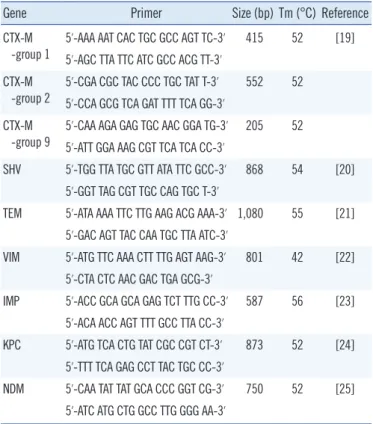
or meropenem irrespective of carbapenemase production. PCR assays were used for preliminary characterization of ESBLs present. Previously described PCR conditions and group-spe- cific primers were used in this study (Table 1). For all isolates of a given family, clonal relatedness was determined using pulsed- field gel electrophoresis (PFGE) analysis. Briefly, after digestion with XbaI (New England Biolabs, Frankfurt, Germany), DNA fragments were separated on 1.2% agarose gels in a 0.5× TBE (Tris-borate-EDTA) buffer, using a CHEF Mapper apparatus (Bio-Rad Lab., Hercules, CA, USA). The conditions were as fol- lows: 14°C, 6 V/cm, pulses of 10-40 sec, and a run time of 22 hr with a ramping factor of -1.357. Genetic similarities were as- sessed by the unweighted pair-group method using arithmetic averages (UPGMA), with the band position tolerance set at 1.8%. Tenover’s criteria were used to determine whether iso- lates represented the same clone [26]. PFGE patterns were an- alyzed with the Finger-Printing II software (Bio-Rad Lab.), and were considered to be clonally related if they had a similarity co-
efficient greater than 80%.
3. Statistical analysis
Statistical analysis was performed using SPSS software (version 14.0, SPSS Inc., Chicago, IL, USA). We used Student’s t-test to
compare proportions, and Fisher’s exact test when appropriate.
P value equal to or less than 0.05 was considered statistically significant.
RESULTS
1. Fecal carriage and acquisition rate of ESBL-E and CRE When 347 patients admitted to the ICU were taken for the re- search, the ESBL-E carriage rate was 28.2% (98/347). Of the 249 non-carriers, follow-up rectal swabs were obtained for only 91 patients, resulting in an ESBL-E acquisition rate of 12.1%
(11/91). The carriage rate of CRE was very low (0.3%, 1/347), and the acquisition rate was 2.9% (4/140). Of the 98 patients carrying ESBL-E, no patient concurrently carried CRE, although 2 patients acquired CRE afterwards.
2. Bacterial species identification, distribution of resistance genotypes, and clonality analysis of ESBL-E and CRE isolates
The bacterial species identified from isolates and the distribution of ESBL genotypes are shown in Table 2. E. coli and K. pneu- moniae were the two most common species found among the 115 ESBL-E isolates from the carriage group (82 and 24 iso- lates, respectively). Of these, 76 E. coli isolates (92.7%) and 15 K. pneumoniae isolates (62.5%) harbored CTX-M type ESBLs;
overall, CTX-M-9 was the most common genotype (54/115). For E. coli, CTX-M-9 was the most common type (65.9%, 54/82) whereas the CTX-M-1 type was the most common (62.5%, Table 1. PCR primers used in this study
Gene Primer Size (bp) Tm (°C) Reference CTX-M
-group 1
5’-AAA AAT CAC TGC GCC AGT TC-3’ 415 52 [19]
5’-AGC TTA TTC ATC GCC ACG TT-3’
CTX-M -group 2
5’-CGA CGC TAC CCC TGC TAT T-3’ 552 52 5’-CCA GCG TCA GAT TTT TCA GG-3’
CTX-M -group 9
5’-CAA AGA GAG TGC AAC GGA TG-3’ 205 52 5’-ATT GGA AAG CGT TCA TCA CC-3’
SHV 5’-TGG TTA TGC GTT ATA TTC GCC-3’ 868 54 [20]
5’-GGT TAG CGT TGC CAG TGC T-3’
TEM 5’-ATA AAA TTC TTG AAG ACG AAA-3’ 1,080 55 [21]
5’-GAC AGT TAC CAA TGC TTA ATC-3’
VIM 5’-ATG TTC AAA CTT TTG AGT AAG-3’ 801 42 [22]
5’-CTA CTC AAC GAC TGA GCG-3’
IMP 5’-ACC GCA GCA GAG TCT TTG CC-3’ 587 56 [23]
5’-ACA ACC AGT TTT GCC TTA CC-3’
KPC 5’-ATG TCA CTG TAT CGC CGT CT-3’ 873 52 [24]
5’-TTT TCA GAG CCT TAC TGC CC-3’
NDM 5’-CAA TAT TAT GCA CCC GGT CG-3’ 750 52 [25]
5’-ATC ATG CTG GCC TTG GGG AA-3’
Abbreviation: Tm, melting temperature.
Table 2. Comparison of the extended-spectrum β-lactamase types found in the ESBL-E carriage group and the acquisition group
Status Pathogens N of isolates (%) N of isolates (by type)
CTX-M-1 CTX-M-2 CTX-M-9 CTX-M-1,9 SHV ND
ESBL carriage group (N=115) E. coli 82 (71.3) 22 52 2 1 5
K. pneumoniae 24 (20.9) 14 1 8 1
E. cloacae 4 (3.5) 1 1 1 1
C. freundii 3 (2.6) 2 1
P. vulgaris 1 (0.9) 1
M. morganii 1 (0.9) 1
Total 115 39 1 54 3 10 8
ESBL acquisition group (N=12) E. coli 6 (50.0) 3 2 1
K. pneumoniae 3 (25.0) 3
E. cloacae 2 (16.7) 1 1
C. freundii 1 (8.3) 1
Total 12 8 2 1 1
Abbreviations: ND, not identified; ESBL, extended-spectrum β-lactamase; ESBL-E, extended-spectrum β-lactamase-producing Enterobacteriaceae.
15/24) for K. pneumoniae. PFGE analysis of the 82 E. coli and 24 K. pneumoniae isolates from the carriage group revealed 71 and 16 pulsotypes, respectively. Of the 12 cases who acquired ESBL-E (6 Escherichia coli, 3 K. pneumoniae, 3 Enterobacter cloacae, and 1 C. freundii), all isolates except one (E. cloacae) had CTX-M type genes. Overall, CTX-M-1 was the most com- mon genotype (8/11). Only two CTX-M-9-producing E. coli iso- lates had pulsotypes closely related to isolates from the carriage group (2.2%, 2/91). However, nosocomial transmission is un- likely to account for either of these, since the carrier and acqui- sition cases were from different ICU, and were admitted at dif- ferent times.
For CRE, only one patient carried CRE (E. coli) at admission.
4 patients acquired CRE after admission (1 Escherichia coli, 2 K.
pneumoniae, and 1 Enterobacter cloacae), although none of the isolates were carbapenemase-producing.
DISCUSSION
The ESBL-E carriage rate in our study was high (28.2%, 98/347), although lower than in a recent Korean study, which reported a rate of 42.5% in ICU patients and 20.3% even in healthy per- sons [27]. These rates were higher than those in a 2012 report from France (15%) as well as one from Israel (8%) [28, 29]. The acquisition rate in our study was 12.1% (11/91), similar to that in the report from France (13%) and lower than that in the report from Israel (21%) [28, 29]. In the carriage group, CTX-M-9 was the most prevalent ESBL type, whereas CTX-M-1 was more prev- alent in the acquisition group, particularly for E. coli isolates (E.coli-only CTX-M-1/carriage group vs. CTX-M-1/acquisition group, 22/82 vs. 3/6). There have been no reports suggesting that CTX-M-1 genes might be more effectively transferred be- tween bacterial strains. However, given that the pandemic clone E. coli O25b:H4-ST131 has also been found to carry CTX-M-1- type genes (CTX-M-15) [30, 31], further research is needed to determine whether there are characteristics of plasmids harbor- ing CTX-M-1-type genes that favor plasmid stability or transmis- sion. In our study, the clonality of ESBL-E was low, and nosoco- mial transmission of resistant clones was not detected. Our find- ings are in line with a recent study involving 133 patients who were hospitalized in the same room as an ESBL-E carrier or in- fected person for more than 24 hr (4.3 days on average); this study found only two cases of clone transmission (1.5%) [32].
Although we identified 4-5 clones within one hospital that were not found in patient groups from other hospitals (data not shown), given that the transmission of ESBL-producing organ-
isms can occur among family and other persons who share food or bathrooms [33], it is difficult to determine whether these clones were acquired from the local community or spread within the hospital.
Ideally, infection control for ESBL-producing strains would be achieved through active surveillance and infection control in high-risk patients, such as those in the ICU [34]. However, since both the carriage rate and the likelihood of dissemination in the local community are high, active surveillance of ESBL-E is not cost-effective, and the use of strict contact precautions for infected patients might be more appropriate.
For CRE, the carriage rate was very low (0.3%, 1/346) and the acquisition rate was 2.9% (4/140); no CPE were found in our study. However, data from the Korea Centers for Disease Control and Prevention indicate that an increasing number of hospitals are reporting the incidence of KPC- or NDM-producing strains [10, 35]. There have also been reports of horizontal transfer of KPC resistance genes between species [36, 37], no- tably one outbreak that involved 6 species of KPC producers (K.
oxytoca, K. pneumoniae, Escherichia coli, Enterobacter cloacae, Enterobacter asburiae, and C. freundii) [37]. A recent Korean study found that a hospital where a case of NDM-1-producing K. pneumoniae was identified subsequently continued to detect the presence of NDM-1 in other bacterial species (S. marces- cens and C. freundii) [38].
In conclusion, our data indicate a high fecal carriage rate for ESBL-E, but low clonality and a very low acquisition rate. Our findings suggest that in a non-epidemic setting, systematic de- tection of ESBL-E in ICU patients is not cost-effective, and that stringent contact precaution for infected patients might be ade- quate. For CRE, the fecal carriage rate was low, and no cases of CPE were found. However, given the recent emergence of CPE in several Korean hospitals and the potential for horizontal trans- fer of resistance genes, it will be critical to control the spread of CRE while the frequencies are still low. This will require rapid and accurate testing of carbapenem-resistant isolates from clini- cal specimens, as well as the adoption of appropriate infection control procedures, if carbapenemase-producing isolates are found. In addition, the incidence of CRE should be monitored continuously. If CRE incidence increases, more aggressive man- agement, such as active surveillance of high-risk patients (those with a history of travel to high-risk countries, a history of contact with immigrants from high-risk countries, or those transferred from hospitals with an occurrence of carbapenemase-producing strains), will be necessary.
Authors’ Disclosures of Potential Conflicts of Interest
No potential conflicts of interest relevant to this article were re- ported.
Acknowledgements
This study was supported by a grant from Korea Centers for Dis- ease Control and Prevention in 2012 (2012 E4400200).
REFERENCES
1. Kliebe C, Nies BA, Meyer JF, Tolxdorff-Neutzling RM, Wiedemann B.
Evolution of plasmid-coded resistance to broad-spectrum cephalospo- rins. Antimicrob Agents Chemother 1985;28:302-7.
2. Drieux L, Brossier F, Duquesnoy O, Aubry A, Robert J, Sougakoff W, et al. Increase in hospital-acquired bloodstream infections caused by ex- tended spectrum beta-lactamase-producing Escherichia coli in a large French teaching hospital. Eur J Clin Microbiol Infect Dis 2009;28:491-8.
3. European Centre for Disease Prevention and Control. Antimicrobial re- sistance surveillance in Europe 2010. Annual report of the European antimicrobial resistance surveillance network (EARS-Net). http://ecdc.
europa.eu/en/publications/Publications/1111_SUR_AMR_data.pdf. pdf (Updated on Nov 2011).
4. Munoz-Price LS, De La Cuesta C, Adams S, Wyckoff M, Cleary T, Mc- Curdy SP, et al. Successful eradication of a monoclonal strain of Klebsi- ella pneumoniae during a K. pneumoniae carbapenemase-producing K.
pneumoniae outbreak in a surgical intensive care unit in Miami, Florida.
Infect Control Hosp Epidemiol 2010;31:1074-7.
5. Karah N, Haldorsen B, Hermansen NO, Tveten Y, Ragnhildstveit E, Skutlaberg DH, et al. Emergence of OXA-carbapenemase- and 16S rRNA methylase-producing international clones of Acinetobacter bau- mannii in Norway. J Med Microbiol 2011;60:515-21.
6. Troché G, Joly LM, Guibert M, Zazzo JF. Detection and treatment of anti- biotic-resistant bacterial carriage in a surgical intensive care unit: a 6-yr prospective survey. Infect Control Hosp Epidemiol 2005;26:161-5.
7. Ko KS, Lee MY, Song JH, Lee H, Jung DS, Jung SI, et al. Prevalence and characterization of extended-spectrum beta-lactamase-producing Enterobacteriaceae isolated in Korean hospitals. Diagn Microbiol Infect Dis 2008;61:453-9.
8. Song W, Lee H, Lee K, Jeong SH, Bae IK, Kim JS, et al. CTX-M-14 and CTX-M-15 enzymes are the dominant type of extended-spectrum beta- lactamase in clinical isolates of Escherichia coli from Korea. J Med Mi- crobiol 2009;58:261-6.
9. Hoban DJ, Nicolle LE, Hawser S, Bouchillon S, Badal R. Antimicrobial susceptibility of global inpatient urinary tract isolates of Escherichia coli:
results from the Study for Monitoring Antimicrobial Resistance Trends (SMART) program: 2009-2010. Diagn Microbiol Infect Dis 2011;70:
507-11.
10. Livermore DM. Current epidemiology and growing resistance of gram- negative pathogens. Korean J Intern Med 2012;27:128-42.
11. Thouverez M, Talon D, Bertrand X. Control of Enterobacteriaceae pro- ducing extended-spectrum beta-lactamase in intensive care units: rec- tal screening may not be needed in non-epidemic situations. Infect Control Hosp Epidemiol 2004;25:838-41.
12. Azim A, Dwivedi M, Rao PB, Baronia AK, Singh RK, Prasad KN, et al.
Epidemiology of bacterial colonization at intensive care unit admission with emphasis on extended-spectrum beta-lactamase- and metallo-be- ta-lactamase-producing Gram-negative bacteria--an Indian experience.
J Med Microbiol 2010;59:955-60.
13. Centers for Disease Control and Prevention (CDC). Guidance for control of infections with carbapenem-resistant or carbapenemase-producing Enterobacteriaceae in acute care facilities. MMWR Morb Mortal Wkly Rep 2009;58:256-60.
14. Day KM, Ali S, Mirza IA, Sidjabat HE, Silvey A, Lanyon CV, et al. Preva- lence and molecular characterization of Enterobacteriaceae producing NDM-1 carbapenemase at a military hospital in Pakistan and evaluation of two chromogenic media. Diagn Microbiol Infect Dis 2013;75:187-91.
15. Clinical and Laboratory Standards Institute. Performance standards for antimicrobial susceptibility testing. Twenty-second Informational supple- ment, M100-S22. Wayne, PA: Clinical and Laboratory Standards Insti- tute, 2012.
16. Song W, Jeong SH, Kim JS, Kim HS, Shin DH, Roh KH, et al. Use of bo- ronic acid disk methods to detect the combined expression of plasmid- mediated AmpC β-lactamases and extended-spectrum β-lactamases in clinical isolates of Klebsiella spp., Salmonella spp., and Proteus mirabi- lis. Diagn Microbiol Infect Dis 2007;57:315-8.
17. Perry JD, Naqvi SH, Mirza IA, Alizai SA, Hussain A, Ghirardi S, et al.
Prevalence of faecal carriage of Enterobacteriaceae with NDM-1 car- bapenemase at military hospitals in Pakistan, and evaluation of two chromogenic media. J Antimicrob Chemother 2011;66:2288–94.
18. Anderson KF, Lonsway DR, Rasheed JK, Biddle J, Jensen B, McDougal LK, et al. Evaluation of methods to identify the Klebsiella pneumoniae carbapenemase in Enterobacteriaceae. J Clin Microbiol 2007;45:2723-5.
19. Woodford N, Fagan EJ, Ellington MJ. Multiplex PCR for rapid detection of genes encoding CTX-M extended-spectrum β-lactamases. J Antimi- crob Chemother 2006;57:154-5.
20. Kim J, Kwon Y, Pai H, Kim JW, Cho DT. Survey of Klebsiella pneumoni- ae strains producing extended-spectrum beta-lactamases: prevalence of SHV-12 and SHV-2a in Korea. J Clin Microbiol 1998;36:1446-9.
21. Lee K, Yong D, Yum JH, Kim HH, Chong Y. Diversity of TEM-52 extend- ed-spectrum beta-lactamase-producing non-typhoidal Salmonella iso- lates in Korea. J Antimicrob Chemother. 2003;52:493-6.
22. Poirel L, Lambert T, Türkoglü S, Ronco E, Gaillard J, Nordmann P.
Characterization of Class 1 integrons from Pseudomonas aeruginosa that contain the bla (VIM-2) carbapenem-hydrolyzing beta-lactamase gene and of two novel aminoglycoside resistance gene cassettes. Anti- microb Agents Chemother 2001;45:546-52.
23. Arakawa Y, Shibata N, Shibayama K, Kurokawa H, Yagi T, Fujiwara H, et al. Convenient test for screening metallo-beta-lactamase-producing gram-negative bacteria by using thiol compounds. J Clin Microbiol 2000;
38:40-3.
24. Bradford PA, Bratu S, Urban C, Visalli M, Mariano N, Landman D, et al.
Emergence of carbapenem-resistant Klebsiella species possessing the class A carbapenem-hydrolyzing KPC-2 and inhibitor-resistant TEM-30 β-lactamases in New York City. Clin Infect Dis 2004;39:55-60.
25. Yong D, Toleman MA, Giske CG, Cho HS, Sundman K, Lee K, et al.
Characterization of a new metallo-β-lactamase gene, bla (NDM-1), and a novel erythromycin esterase gene carried on a unique genetic struc- ture in Klebsiella pneumoniae sequence type 14 form India. Antimicrob Agents Chemother 2009;53:5046-54.
26. Tenover FC, Arbeit RD, Goering RV, Mickelsen PA, Murray BE, Persing DH, et al. Interpreting chromosomal DNA restriction patterns produced by pulsed-field gel electrophoresis: criteria for bacterial strain typing. J Clin Microbiol 1995;33:2233-9.
27. Ko YJ, Moon HW, Hur M, Park CM, Cho SE, Yun YM. Fecal carriage of extended-spectrum β-lactamase-producing Enterobacteriaceae in Ko- rean community and hospital settings. Infection 2013;41:9-13.
28. Razazi K, DErde LP, Verachten M, Legrand P, Lesprit P, Brun-Buisson C.
Clinical impact and risk factors for colonization with extended-spectrum β-lactamase-producing bacteria in the intensive care unit. Intensive Care Med 2012;38:1769-78.
29. Friedmann R, Raveh D, Zartzer E, Rudensky B, Broide E, Attias D, et al. Prospective evaluation of colonization with extended-spectrum β-lactamase (ESBL)-producing enterobacteriaceae among patients at hospital admission and of subsequent colonization with ESBL-produc- ing enterobacteriaceae among patients during hospitalization. Infect Control Hosp Epidemiol 2009;30:534-42.
30. Coque TM, Novais A, Carattoli A, Poirel L, Pitout J, Peixe L, et al. Dis- semination of clonality related Escherichia coli strains expressing ex- tended-spectrum β-lactamase CTX-M-15. Emerg Infect Dis 2008;14:
195-200.
31. Nicolas-Chanoine MH, Blanco J, Leflon-Guibout V, Demarty R, Alonso MP, Caniça MM, et al. Intercontinental emergence of Escherichia coli clone O25:H4-ST131 producing CTX-M-15. J Antimicrob Chemother 2008;61:273-81.
32. Tschudin-Sutter S, Frei R, Dangel M, Stranden A, Widmer AF. Rate of transmission of extended-spectrum β-lactamase-producing enterobac- teriaceae without contact isolation. Clin Infect Dis 2012;55:1505-11.
33. Rodríguez-Baño J, López-Cerero L, Navarro MD, Diaz de Alba P, Pas- cual A. Faecal carriage of extended-spectrum β-lactamase-producing Escherichia coli: prevalence, risk factors and molecular epidemiology. J Antimicrob Chemother 2008;62:1142-9.
34. Goddard S and Muller MP. The efficacy of infection control interventions in reducing the incidence of extended-spectrum β-lactamase-producing Enterobacteriaceae in the nonoutbreak setting: a systematic review. Am J Infect Control 2011;39:599-601.
35. Korea Centers for Disease Control & Prevention. 2011 Epidemiological report. http://www.cdc.go.kr/CDC/info/CdcKrInfo0206.jsp?menuIds=
HOME001-NU0004NU0026-MNU0031&fid=73&q_type=&q_value=
&cid=20100&pageNum= (Updated on Jun 2013).
36. Goren MG, Carmeli Y, Schwaber MJ, Chmelnitsky I, Schechner V, Na- von-Venezia S. Transfer of carbapenem-resistant plasmid from Klebsiel- la pneumoniae ST258 to Escherichia coli in patient. Emerg Infect Dis 2010;16:1014-7.
37. Mathers AJ, Cox HL, Kitchel B, Bonatti H, Brassinga AK, Carroll J, et al.
Molecular dissection of an outbreak of carbapenem-resistant entero- bacteriaceae reveals Intergenus KPC carbapenemase transmission through a promiscuous plasmid. MBio 2011;2:e00204-11.
38. Kim SY, Shin J, Shin SY, Ko KS. Characteristics of carbapenem-resistant Enterobacteriaceae isolates from Korea. Diagn Microbiol Infect Dis 2013;
76:486-90.