COMPARISON OF OPERATIVE TECHNIQUES BETWEEN FEMALE AND MALE DENTISTS IN CLASS 2 AND CLASS 5 RESIN COMPOSITE RESTORATIONS
Juhea Chang1, Hae-Young Kim2, Ho-Hyun Son3*
1Clinic for Peoples with Disabilities, Seoul National University Dental Hospital, Seoul, Korea
2Department of Dental Hygiene, College of Medical Science, Eulji University, Seongnam, Kyounggi, Korea
3Department of Conservative Dentistry and Dental Research Institute, School of Dentistry, Seoul National University, Seoul, Korea
This study aimed to assess whether the gender of the dental practitioner affects operative techniques in class 2 and class 5 resin composite restorations. In 2008, a nationwide survey was given to Korean den- tists. Total 12,193 e-mails were distributed, 2,632 were opened by recipients, and 840 responses were col- lected. Of the respondents, 78.9% were male and 21.1% were female. The gender distribution in the age groups between respondents and the total population did not differ (p > 0.05). A chi-square test was used to compare technical differences between female and male dentists. A multiple logistic regression analysis was performed to assess the association between gender and operative techniques in resin composite restoration. For class 2 resin composite restoration, female dentists were 1.87 times more likely than male dentists to do multiple incremental fillings (four layers or more) and 2.72 times more likely than males to spend 30 minutes or more for the treatment (p < 0.05). For class 5 resin composite restoration, female dentists were 2.69 times more likely than their male counterparts to use a cavity base or liner, 1.83 times more likely to do multiple incremental fillings (four layers or more) and 1.63 times more likely to spend 20 minutes or more for the procedure (p < 0.05). The gender factor was influential to individual operative techniques in restorative treatment. [J Kor Acad Cons Dent 35(2):116-124, 2010]
Key words: Survey, Gender difference, Operative technique, Female dentist, Class 2 resin, Class 5 resin -Received 2010.2.1., revised 2010.3.10., accepted 2010.3.11.-
Ⅰ. Introduction
As the numbers of women entering the health pro- fessions increase, the gender composition of dentists has been drastically changing.1) This trend is similar in Asian countries where the traditional role of women has changed dramatically in terms of career development. In 2006, females comprised of 23.0% of the dentist in South Korea and 24.2% of the dentists in Japan.2,3) Although female dentists outnumbered
their male counterparts in some countries, female practitioners still exhibited various gender specific patterns in practice type (public vs. private sector), patient group, employment status, working time, etc.4-9) Furthermore, several specified studies based on dental work models have mentioned a gender dif- ference in terms of occupational relationships, profes- sional attitudes, academic contributions, treatment decisions, etc.4,5,7,8,10-13) However, it has been rarely studied on gender difference related to dental opera- tion per se. One study showed that female dentists reportedly applied topical anesthesia more often than male dentists before needle injection.6) Regarding operative procedures, it is challenging to extract rele- vant variables for differentiating the individual per- formances of multiple practitioners. For example, ABSTRACT
*Corresponding Author: Ho-Hyun Son
Department of Conservative Dentistry and Dental Research Institute, School of Dentistry, Seoul National University, Seoul, South Korea 28-2 Yeongeon-Dong, Jongro-Ku, Seoul, 110-749, South Korea.
Tel: 82-2-2072-2652 Fax: 82-2-2072-3859 E-mail: [email protected]
restorative treatment, which comprises the major part of a dentist’s workload, may be divided into several procedural steps, including cavity prepara- tion, base or liner placement, filling with restorative materials, etc.14) These individual steps may vary based on scientific knowledge, clinical experience, and different maneuver. The operative procedures may be further influenced by practitioners’degree of attentiveness, caring, and other personal characteris- tics.7) We selected direct resin composite restoration for a representative operative model and chose rele- vant variables for specification. The aim of this study was to assess whether there is an independent effect of gender difference in direct resin composite restora- tion under consideration of background confounding factors of practitioners which might affect.
Ⅱ. Methods 1. Sample design
The nationwide survey was projected to all dentists whose contact information was enlisted in the Korean Dental Association. A total of 12,193 dentists (from the 22,663 licensed dentists in Korea as of January in 2008) had registered their e-mail addresses in the membership list and received the questionnaire by e- mail. Among them 2632 respondents were confirmed to have opened the e-mail, and 1,177 clicked the link to the questionnaire to give answers. Within a period of three weeks, 840 responses were received, accounting for 31.9 % of the opened e-mails. The respondent group was analyzed in detail and described elsewhere.15,16)
2. Questionnaire
The questionnaire was comprised of three parts.
The first part contained questions regarding the demographic characteristics of the operator. The sec- ond part concerned class 2 resin composite restora- tion, and the mesioocclusal cavity of the upper sec- ond premolar was given as an example for precision.
The third part was about class 5 resin composite restoration. An exemplary clinical photo of a noncari- ous cervical lesion was provided to ensure under-
standing of the case (Figure 1). Each part was sub- divided into the following items.
Part I: Characteristics of dentists
�Year of license acquisition
�Gender
�Practice type (private/ hospital based/ public)
�Practice location (urban/ rural)
�Practice size (number of employees)
�Specialty training (none/ conservative dentistry/
other specialty)
Part II: Class 2 resin composite restoration
�Rubber dam usage
�Preferred matrix type
�Number of incremental layers
�Length of operation time
�Primary challenge in operative technique Part III: Class 5 resin composite restoration
�Base or liner application
�Number of incremental layers
�Length of operation time
�Primary postoperative complication 3. Statistical analyses
The general characteristics of female and male den- tist respondents are presented as a frequency and percentage. For the bivariate evaluation of the tech- nical differences between females and males, a chi- Figure 1. Exemplary case of noncarious cervical lesion in class 5 resin composite restoration.
square test was used for comparison. To assess the multivariate association between gender and opera- tive techniques in class 2 and class 5 composite restorations, a multiple logistic regression analysis was used. The independent direct effects by a gender factor were analyzed after adjustment for other vari- ables showing statistically significant gender differ- ences: year of dental license acquisition, practice type, practice location, practice size, and specialty training. Those dependent variables were dichotomized and used as indicators of the operator’s technical variation. Statistical significance was set at p < 0.05. The statistical package SAS 9.13 (SAS Institute Inc., Cary, NC, USA) was used for the analysis.
Ⅲ. Results 1. Characteristics of dentists
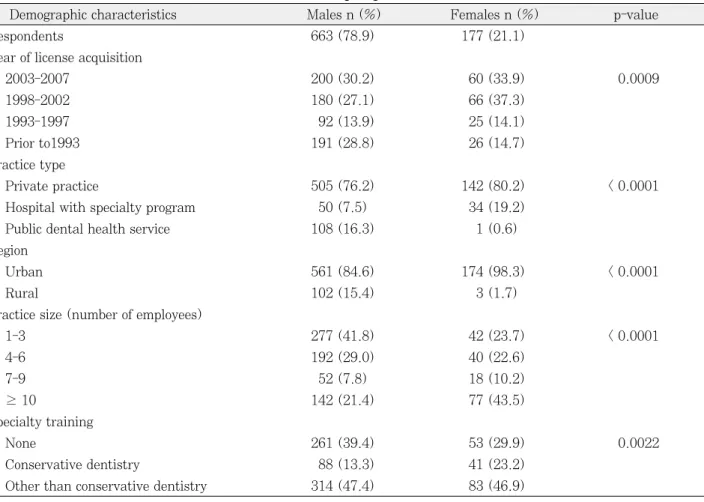
Table 1 presents the gender comparisons of back-
ground information of the respondents. They were 78.9% male and 21.1% female. Several statistically significant differences were identified between males and females. More male dentists were included in the older age group who had acquired their licenses before 1992 (males 28.8%; females 14.7%). The gender distribution in the age groups between respondents and the total population did not differ (p
> 0.05) (data not shown). Because three years of ser- vice at either military bases or in community health centers is mandatory for new male graduates in Korea, 16.3% of male dentists worked for public den- tal health service. Additionally, 15.4 % of male den- tists were located in rural areas where the public health services were largely based. Male dentists were more likely to work in small practices with one to three employees (males 41.8%; females 23.7%).
Female dentists were more often worked in large practices with more than 10 employees (males 21.4%; females 43.5%). Female dentists were also
Table 1.Distributions of male vs. female dentists according to general characteristics
Demographic characteristics Males n (%) Females n (%) p-value
Respondents 663 (78.9) 177 (21.1)
Year of license acquisition
2003-2007 200 (30.2) 60 (33.9) 0.0009
1998-2002 180 (27.1) 66 (37.3)
1993-1997 92 (13.9) 25 (14.1)
Prior to1993 191 (28.8) 26 (14.7)
Practice type
Private practice 505 (76.2) 142 (80.2) < 0.0001
Hospital with specialty program 50 (7.5) 34 (19.2)
Public dental health service 108 (16.3) 1 (0.6)
Region
Urban 561 (84.6) 174 (98.3) < 0.0001
Rural 102 (15.4) 3 (1.7)
Practice size (number of employees)
1-3 277 (41.8) 42 (23.7) < 0.0001
4-6 192 (29.0) 40 (22.6)
7-9 52 (7.8) 18 (10.2)
≥ 10 142 (21.4) 77 (43.5)
Specialty training
None 261 (39.4) 53 (29.9) 0.0022
Conservative dentistry 88 (13.3) 41 (23.2)
Other than conservative dentistry 314 (47.4) 83 (46.9)
more likely to have completed or to currently be in a specialty program of conservative dentistry (males 13.3%; females 23.2%).
2. Operative techniques in class 2 composite restoration
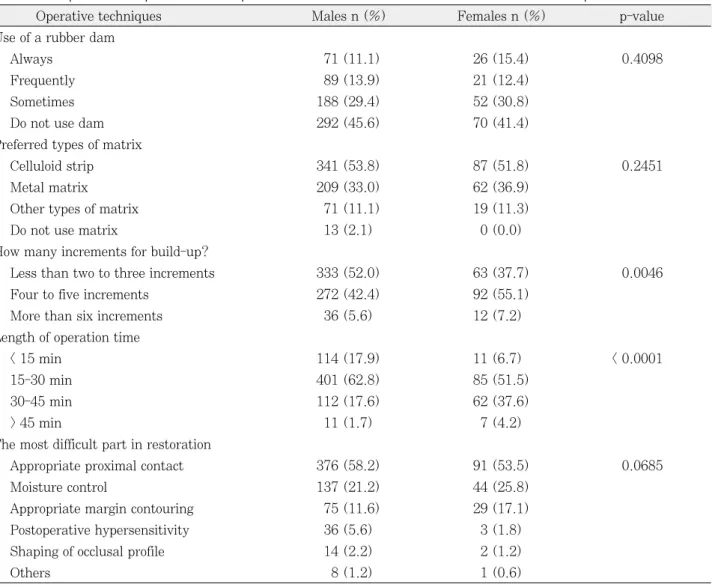
Table 2 presents the results of a gender comparison of the operative techniques in class 2 resin composite restoration. There were no differences between male and female dentists regarding the frequency of rub- ber dam usage and the preferred type of matrix. For the number of increments, 52.0% of male dentists performed incremental filling with two to three lay- ers, while 55.1% of females did the same procedure by the placement of four to five layers. For the length
of treatment time, 19.3% of males spent more than 30 minutes on the procedure, while 41.8 % of females fit in the same category. For the most chal- lenging point in class 2 resin composite restoration, there was no difference between males and females (p > 0.05). Adequate proximal contact was chosen most frequently, followed by moisture control and margin contouring. The technical variables indicating gender difference remained significant in the multiple logistic regression analysis, implying that this gender difference can not be completely explained by the confounding effects of age, practice type, practice location, practice size, and specialty training. The multivariate associations between operative tech- niques and gender are listed in Table 4. Female den- tists were 1.87 times more likely than males to per-
Table 2.Comparison of operative techniques between male and female dentists in class 2 composite restoration
Operative techniques Males n (%) Females n (%) p-value
Use of a rubber dam
Always 71 (11.1) 26 (15.4) 0.4098
Frequently 89 (13.9) 21 (12.4)
Sometimes 188 (29.4) 52 (30.8)
Do not use dam 292 (45.6) 70 (41.4)
Preferred types of matrix
Celluloid strip 341 (53.8) 87 (51.8) 0.2451
Metal matrix 209 (33.0) 62 (36.9)
Other types of matrix 71 (11.1) 19 (11.3)
Do not use matrix 13 (2.1) 0 (0.0)
How many increments for build-up?
Less than two to three increments 333 (52.0) 63 (37.7) 0.0046
Four to five increments 272 (42.4) 92 (55.1)
More than six increments 36 (5.6) 12 (7.2)
Length of operation time
< 15 min 114 (17.9) 11 (6.7) < 0.0001
15-30 min 401 (62.8) 85 (51.5)
30-45 min 112 (17.6) 62 (37.6)
> 45 min 11 (1.7) 7 (4.2)
The most difficult part in restoration
Appropriate proximal contact 376 (58.2) 91 (53.5) 0.0685
Moisture control 137 (21.2) 44 (25.8)
Appropriate margin contouring 75 (11.6) 29 (17.1)
Postoperative hypersensitivity 36 (5.6) 3 (1.8)
Shaping of occlusal profile 14 (2.2) 2 (1.2)
Others 8 (1.2) 1 (0.6)
form multiple incremental filling (4 layers or more) under adjustment for other related factors.
Additionally, female dentists were 2.72 times more likely than males to spend 30 minutes or more on the treatment procedure.
3. Operative techniques in class 5 composite restoration
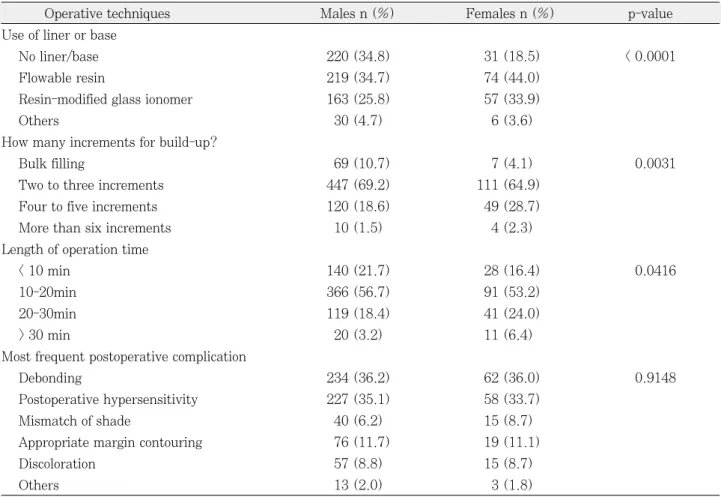
For the case of a noncarious cervical lesion present- ed with a clinical photo (Figure 1), 34.8 % of male dentists replied that they would not use a base or liner, while only 18.5% of females gave the same answer (Table 3). Flowable resin was most frequent- ly chosen as the base material, followed by resin- modified glass ionomer (RMGI). We found that 21.1% of male dentists performed multiple incremen- tal filling (four to five layers or more), while 30.4% of
female dentists used the same technique.
Additionally, 21.6% of male dentists spent more than 20 minutes on the restoration, while 31% of female dentists spent the same length of time. The primary postoperative complication of class 5 resin composite restoration was debonding for both male and female dentists, followed by postoperative sensitivity. This clinical outcome was not different between both groups (p > 0.05). Multiple logistic regression analy- sis exhibited the gender difference in operative proce- dures after adjustment for other related factors (Table 4). Female dentists were 2.69 times more likely than their male counterparts to use a cavity base or liner. And female dentists were also 1.83 times more likely than male dentists to do multiple incremental filling (4 layers or more) and 1.63 times more likely to spend 20 minutes or more per proce- dure.
Table 3.Comparison of operative techniques between male and female dentists in class 5 composite restoration
Operative techniques Males n (%) Females n (%) p-value
Use of liner or base
No liner/base 220 (34.8) 31 (18.5) < 0.0001
Flowable resin 219 (34.7) 74 (44.0)
Resin-modified glass ionomer 163 (25.8) 57 (33.9)
Others 30 (4.7) 6 (3.6)
How many increments for build-up?
Bulk filling 69 (10.7) 7 (4.1) 0.0031
Two to three increments 447 (69.2) 111 (64.9)
Four to five increments 120 (18.6) 49 (28.7)
More than six increments 10 (1.5) 4 (2.3)
Length of operation time
< 10 min 140 (21.7) 28 (16.4) 0.0416
10-20min 366 (56.7) 91 (53.2)
20-30min 119 (18.4) 41 (24.0)
> 30 min 20 (3.2) 11 (6.4)
Most frequent postoperative complication
Debonding 234 (36.2) 62 (36.0) 0.9148
Postoperative hypersensitivity 227 (35.1) 58 (33.7)
Mismatch of shade 40 (6.2) 15 (8.7)
Appropriate margin contouring 76 (11.7) 19 (11.1)
Discoloration 57 (8.8) 15 (8.7)
Others 13 (2.0) 3 (1.8)
Ⅳ. Discussion
This study was based on the data acquired by a nationwide survey to investigate gender differences in operative dentistry with a specific focus on direct resin composite restoration. The survey was conduct- ed using an electronically delivered questionnaire.
The subject line of the e-mail was “A survey on esthetic bonded restoration,”and the e-mail asked for participation in the linked survey. After reading a brief introduction on the survey, the recipients were able to click the icon labeled “Participation”and then proceed to the questionnaire. An electronically deliv- ered survey has the advantages of a rapid response rate, improved ease of data collection and minimal cost when compared to traditional paper surveys sent via mail.17)However, the major drawback of an elec- tronically delivered survey is the low response rates, which is partially due to incorrect, inactive or nonex- istent e-mail addresses. In our study, information was received from 840 respondents, representing 71.4% of those who clicked to participate in the sur- vey, 31.9% of those who viewed the e-mail, but only 6.9% of the total number of dentists who were sent the e-mail. There were a large proportion of true non-respondents who have actually received the e- mail but deleted it without opening it or chose not to participate in the survey. Previous studies on the effect of the non-response group noted that low response rates to health studies do not necessarily result in a high non-response bias.18,19)In this study,
more dentists in the younger age group were included in the respondent group. Additionally, more female dentists belonged to the younger age group.
However, the age and gender distributions were not significantly different between the respondents and the overall Korean dentist population (p > 0.05). The vast majority of dentists were in private practice (female, 80.2%; male, 76.2%). Relatively more female respondents (53.7%) than male respondents (29.2%) were working in a large practice which had seven employees or more. In our questionnaire, the ownership of a practice was not determined; howev- er, it may be related to that female dentists were less likely than male dentists to own the practice as shown in other studies.6-8) Instead, female dentists were more likely to be employed in a large practice with several dental staff. Relatively more female den- tists were currently finishing or had completed a spe- cialty program in conservative dentistry. This fact reflected the current trend in Korea of a growing enrollment by female graduates in the specialty of conservative dentistry.
For class 2 resin composite restoration, we chose a distoocclusal cavity of an upper second premolar for the exemplary case, which may not be an esthetically critical area. Considering that the primary selection of material would not be direct resin composite for some respondents, we posed the question: “If you were to restore the distoocclusal cavity of the upper second premolar with resin composite, how often would you use a rubber dam?”There was no signifi- Table 4.Association of gender and operative techniques in class 2 and class 5 composite restorations after adjust- ment for other related factors
Operative techniques Females vs. males
Odds ratio* (95% CI) p-value
Class 2 restoration
Increments of four times or more 1.87 (1.24-2.71) 0.0009
Time expenditure of 30 min or longer 2.72 (1.82-4.06) < 0.0001 Class 5 restoration
Use of liner/base 2.69 (1.71-4.25) < 0.0001
Increments of four times or more 1.83 (1.21-2,76) 0.0042
Time expenditure of 20 min or longer 1.63 (1.07-2.43) 0.0232
* Adjusted for age, practice type, practice location, practice size, and specialty training.
cant difference between male and female dentists in the frequency of rubber dam usage: 15.4% of female and 11.1% of male dentists always used a rubber dam, while more than 40% of both groups did not use a rubber dam in such a case. However, field iso- lation still seemed to be a concern, since moisture control was chosen as the most challenging part of the procedure by many respondents (females, 25.9%;
males, 21.2%). Proximal contact formation was the most frequently chosen answer by both groups. A clear plastic matrix was the more preferred matrix type compared to a metal matrix; but a question concerning how to place the strip was not included in the questionnaire.
It is well known that polymerization shrinkage stress of resin composite is influenced by the configu- ration factor of a cavity, and incremental build up has been broadly recommended in resin composite restoration.20) Additionally, incremental layering can increase the polymerization degree of the resin com- posite placed in a deep cavity preparation. Generally, it is recommended that the resin composite should be cured in increments no greater than 2 mm in thick- ness.21) However, cavity filling in very small incre- ments may not be desirable due to increased chair time and inclusion of porosity between the layers. It is interesting to note that female dentists tend to split the layers into smaller increments in both class 2 and class 5 restorations. Female dentists were also more likely than male dentists to take a longer time for the restoration procedure. Furthermore, this gen- der-specific operative pattern was clearly reflected in base or liner applications of class 5 restorations.
44.0% and 33.9% of female dentists would use flow- able resin and RMGI, respectively, for the base or liner of a moderately deep V-shaped non carious lesion given as an example (Figure 1), while 34.7%
and 25.8% of males gave the same answers, respec- tively. Flowable resin can provide a stress-relief function to compensate for polymerization shrinkage stress of the overlying resin composite and improve internal adaptation by wetting the cavity wall.22) However, the elastic bonding capacity of flowable resin was shown to be offset by its inherently high shrinkage rate.23,24) Resin-modified glass ionomer cement may be another option for a lining material
with a preferable dentin bonding capacity. However, no clarified consensus exists on the efficacy of base or liner application prior to resin composite restoration, since many conflicting results have been induced from in vitro and in vivo experiments with regards to postoperative sensitivity, microleakage, bonding durability, etc.25-28)Therefore, a practitioner’s inclina- tion to use a base or liner may be related not only to evidence-based knowledge but also individual prefer- ence. Only a few studies have been performed on gender differences in dental procedures, but their findings were that operative procedures reflected gender-specific patterns. In a survey of Canadian dentists, women were more likely than men to prac- tice recommended infection control procedures, such as wearing gloves, a mask, and protective eyewear, and being vaccinated against the hepatitis B virus.29) In a Swedish report, female dentists reported that 0.8 more of their weekly working hours were used for prosthodontic treatment compared to their male counterparts.4)
In spite of the dissimilarity in operative techniques between male and female dentists, postoperative sensitivity and debonding were chosen as the major concerns after class 5 resin composite restorations for both groups. There are several procedural steps related to postoperative complications and bonding failure such as cavity preparation, dentin and enamel bonding, resin composite placement, polymerizing light irradiation, etc. For the bonding procedure, it would be even more complicated to select clinically specific variables because of the diversity of adhesive agents and their usage.15) It is the same with the irradiating source, since various light-curing units require different irradiation times and intensities.
However, more extended questions on other parts of operative procedure will derive additional valuable information on the association of gender and dental practice. Also, unbiased, well stratified sampling methods are crucial in a surveyed study, which were not properly applied in this study. Despite the limi- tations of this study, a gender difference was identi- fied in several aspects of operative procedures involved in direct resin composite restoration. Future study covering other areas of dental practice will help identify the inherent characteristics of male and
female clinical performance.
Ⅴ. Conclusions
This study revealed differences between male and female practitioners regarding operative procedures of direct resin composite restoration. Female dentists were more likely than males to use a base or liner prior to resin composite placement, to apply resin composite in smaller increments, and to spend a longer time for the restoration procedure.
References
1. Murray JJ. Better opportunities for women dentists: a review of the contribution of women dentists to the workforce. Br Dent J 192(4):191-196, 2002.
2. http://blog.korea.kr/app/log/nsodmd/40223475.
3. http://www.jda.or.jp/en/index.html#intro.
4. Kronstrom M, Palmqvist S, Soderfeldt B, Carlsson GE.
Dentist-related factors influencing the amount of prosthodontic treatment provided. Community Dent Oral Epidemiol 28(3):185-194, 2000.
5. Hjalmers K, Soderfeldt B, Axtelius B. Moral values and career: factors shaping the image of healthy work for female dentists. Acta Odontol Scand 64(5):255- 261, 2006.
6. Rasmussen JK, Frederiksen JA, Hallonsten AL, Poulsen S. Danish dentists’knowledge, attitudes and management of procedural dental pain in children:
association with demographic characteristics, structur- al factors, perceived stress during the administration of local analgesia and their tolerance towards pain. Int J Paediatr Dent 15(3):159-168, 2005.
7. Kunzel C, Sadowsky D. Assessing HIV-related atti- tudes and orientations of male and female general den- tists. J Am Dent Assoc 126(7):862-871, 1995.
8. Atchison KA, Bibb CA, Lefever KH, Mito RS, Lin S, Engelhardt R. Gender differences in career and prac- tice patterns of PGD-trained dentists. J Dent Educ 66(12):1358-1367, 2002.
9. Spencer AJ, Lewis JM. The practice of dentistry by male and female dentists. Community Dent Oral Epidemiol 16(4):202-207, 1988.
10. Berthelsen H, Hjalmers K, Soderfeldt B. Perceived social support in relation to work among Danish gener- al dental practitioners in private practices. Eur J Oral Sci 116(2):157-163, 2008.
11. Bruers JJ, Felling AJ, Truin GJ, van’t Hof MA, van Rossum GM. Patient orientation and professional ori- entation of Dutch dentists. Community Dent Oral Epidemiol 32(2):115-124, 2004.
12. Palotie U, Vehkalahti MM. Finnish dentists’percep- tions of the longevity of direct dental restorations. Acta Odontol Scand 67(1):44-49, 2009.
13. Kronstrom M, Palmqvist S, Soderfeldt B. Prosthodontic decision making among general dentists in Sweden.
III: The choice between fixed partial dentures and sin- gle implants. Int J Prosthodont 13(1):34-40, 2000.
14. Hickel R, Roulet JF, Bayne S, Heintze SD, Mjor IA, Peters M, et al. Recommendations for conducting con- trolled clinical studies of dental restorative materials.
Clin Oral Investig 11(1):5-33, 2007.
15. Chang J, Kim HY, Cho BH, Lee IB, Son HH.
Information resources and material selection in bonded restorations among korean dentists. J Adhes Dent 11(6):439-446, 2009.
16. 신동호, 박세은, 양인석, 장주혜, 이인복, 조병훈, 손호현. 2급 와동 수복시 한국치과의사들의 복합레진 사용 실태 연구. 대한 치과보존학회지 34(2):8, 2009.
17. Rosenstiel SF, Land MF, Rashid RG. Dentists’molar restoration choices and longevity: a web-based survey.
J Prosthet Dent 91(4):363-367, 2004.
18. McCarthy GM, MacDonald JK. Nonresponse bias in a national study of dentists’infection control practices and attitudes related to HIV. Community Dent Oral Epidemiol 25(4):319-323, 1997.
19. McFarlane E, Olmsted MG, Murphy J, Hill CA.
Nonresponse bias in a mail survey of physicians. Eval Health Prof 30(2):170-185, 2007.
20. Park J, Chang J, Ferracane J, Lee IB. How should composite be layered to reduce shrinkage stress: incre- mental or bulk filling? Dent Mater 24(11):1501-1505, 2008.
21. Summitt JB RJ, Hilton TJ, Schwartz RS. dos Santos J.
Fundamentals of Operative Dentistry. Quintessence books, 2006.
22. Li Q, Jepsen S, Albers HK, Eberhard J. Flowable materials as an intermediate layer could improve the marginal and internal adaptation of composite restora- tions in Class-V-cavities. Dent Mater 22(3):250-257, 2006.
23. Awliya WY, El-Sahn AM. Leakage pathway of Class V cavities restored with different flowable resin composite restorations. Oper Dent 33(1):31-36, 2008.
24. Cadenaro M, Marchesi G, Antoniolli F, Davidson C, De Stefano Dorigo E, Breschi L. Flowability of composites is no guarantee for contraction stress reduction. Dent Mater, 2009.
25. Unemori M, Matsuya Y, Akashi A, Goto Y, Akamine A.
Composite resin restoration and postoperative sensitiv- ity: clinical follow-up in an undergraduate program. J Dent 29(1):7-13, 2001.
26. Sidhu SK, Henderson LJ. In vitro marginal leakage of cervical composite restorations lined with a light-cured glass ionomer. Oper Dent 17(1):7-12, 1992.
27. Ernst CP, Canbek K, Aksogan K, Willershausen B.
Two-year clinical performance of a packable posterior composite with and without a flowable composite liner.
Clin Oral Investig 7(3):129-134, 2003.
28. Pongprueksa P, Kuphasuk W, Senawongse P. Effect of elastic cavity wall and occlusal loading on microleakage and dentin bond strength. Oper Dent 32(5):466-475, 2007.
29. McCarthy GM, MacDonald JK. Gender differences in characteristics, infection control practices, knowledge and attitudes related to HIV among Ontario dentists.
Community Dent Oral Epidemiol 24(6):412-415, 1996.
국문초록
2급/ 5급 와동 복합레진 수복 술식에 대한 남녀 치과 의사의 비교
장주혜1∙김혜영2∙손호현3*
1서울대학교 치과병원 장애인구강진료실, 2을지대학교 의과대학 치위생학과,
3서울대학교 치과대학 치과보존학교실
본 연구에서는 복합 레진을 이용한 2급/5급 와동의 직접수복에 있어서 치과의사의 성별에 따른 술식의 차이를 비교하였다.
2008년 대한치과의사협회에 등록된 치과의사 12,193명을 대상으로 이 메일을 통한 설문조사를 실시하였다. 이 메일 수신이 확인된 2,632명 중 840명이 응답하였으며 응답자의 남녀 비율은(남 78.9%, 여 21.1%) 전체 치과의사의 남녀 비율과 유의한 차이를 보이지 않았다(p > 0.05). Chi-square test 와 multiple logistic regression analysis 를 이용하여 남녀간 술식의 차 이를 검증하였다. 2급 와동 수복에서 여자치과의사는 4회 이상의 적층 분할 수복을 하는 경향이 남자치과의사에 비해 1.87배 높았으며, 술식 당 30분 이상 소요하는 경향은 2.72배 높았다(p < 0.05). 5급 와동 수복에서 여자치과의사는 베이스를 사용하 는 경향이 1.83배 높았으며, 술식 당 20분 이상 소요하는 경향은 1.63배 높았다(p < 0.05). 본 설문조사에 따르면 남녀 성별 에 따라 복합 레진 수복 술식의 차이가 존재하는 것으로 나타났다.
주요단어: 설문조사, 성별, 수복 술식, 남녀 치과의사, 복합 레진 수복