• 검색 결과가 없습니다.

IEG 환경지질연구정보센터

N/A
N/A
Protected

Academic year: 2021

Share "IEG 환경지질연구정보센터"

Copied!
4
0
0

로드 중.... (전체 텍스트 보기)

전체 글

(1)

PERFORMANCE OF COMS SNOW AND SEA ICE DETECTION ALGORITHM

Jung-Rim Lee, Chu-Yong Chung, Myoung-Hwan Ahn and Mi-Lim Ou

Global Environment System Research Laboratory, National Institute of Meteorological Research, KMA [email protected]

ABSTRACT:

The purpose of this study is to develop snow and sea ice detection algorithm in Communication, Ocean and Meteorological Satellite (COMS) meteorological data processing system. Since COMS has only five channels, it is not affordable to use microwave or shortwave infrared data which are effective and generally used for snow detection. In order to estimate snow and sea ice coverage, combinations between available channel data(mostly visible and 3.7 ㎛) are applied to the algorithm based on threshold method. As a result, the COMS snow and sea ice detection algorithm shows reliable performance compared to MODIS products with channel limitation. Specifically, there is partial underestimation over the complicated vegetation area and overestimation over the area of high level clouds such as cirrus. Some corrections are performed by using water vapor and infrared channels to remove cloud contamination and by applying NDVI to detect more snow pixels for the underestimated area.

KEY WORDS: Snow and Sea Ice Detection, Visible, 3.7 ㎛, Normalized Difference vegetable Index(NDVI)

1. INTRODUCTION

The high albedo of snow and sea ice affects on the interaction between surface and atmosphere (Walsh et al., 1985). Also, snow and sea ice influence human activities and industries. For instance, snow is very important in water resources management, and sea ice is a main problem for oil drilling. Moreover, frequency of Asian dust can be predicted better with snow information in the forecasting model (Kurosaki et al., 2004).

Observation of snow and sea ice is hardly performed at surface observation sites because snow and sea ice exist mostly on high latitude regions or mountainous area.

Also, point observation is not proper for snow cover and sea ice extent because of its high spatial variation. For these reasons, global observation using satellite has been executing over 40 years instead of in-situ observation.

Satellite has multiple choices of observation from visible to microwave spectral ranges (Armstrong et al., 2001). First, microwave data are not only for snow cover and sea ice concentration but also for depth and water equivalent, but the contamination and spatial resolution limit the accuracy. Second, visible data has higher spatial resolution and easy to distinguish snow and sea ice from the surface using the reflectivity difference. Then, near- infrared data shows high reflectance for water clouds, medium reflectance for ice clouds, and very low reflectance for snow cover. However, the method using optical sensors such as visible and infrared data has an unsolvable problem. Because of its characteristic not to penetrate clouds, it is impossible to get surface

information from these sensors. At NOAA/NESDIS, daily snow and sea ice map, Interactive Multi-sensor Snow and Ice Mapping System (IMS), is estimated by combining surface observation data, optical sensor data (AVHRR), and microwave data (SSM/I) as well.

In this study, MTSAT-1R data which is a geostationary satellite, and has similar sensors with COMS are used. In order to detect snow and sea ice coverage, we first utilized visible reflectance and the channel difference between near-infrared and infrared data. Then, channel difference between 10.8 ㎛ and water vapour has been adopted for correcting desert area and decreasing cloud effect. NDVI data are used for under- detected pixels over forest area. Also, we apply Sea Surface Temperature (SST) threshold to this algorithm for sea ice detection. In order to minimize the cloud shaded pixels, daily composite has been carried out using the temporal observation data during the daytime.

2. METHODS AND ALGORITHM 2.1 Methods

MTSAT-1R satellite has five channels: visible(0.65

㎛), short wave infrared(3.7 ㎛), water vapour(6.7 ㎛)

and two infrared channels(10.8 ㎛ and 12 ㎛). From

visible channel, snow and sea ice areas are discriminated

with snow-free land and open sea water over the clear

sky. When cloud pixels and snow pixels are mixed, it is

not possible to classify between snow and cloud pixels

because cloud also have high reflectivity in visible. In

(2)

2.2

order to distinguish snow and sea ice pixels with cloud, near-infrared channel data are used. Fig. 1 shows spectral reflectance for different surface types. Thick line at the picture represents the spectral reflectance of snow, and it shows higher reflectance in visible and lower reflectance in near-infrared. On the contrary, clouds that have same characteristic with snow in visible have higher reflectance in near-infrared. This difference makes it possible to distinguish snow and cloud pixels. For snow detection, 1.6 ㎛ channel data is generally used, and other algorithm which is not affordable to use this channel calculate the reflectance from short wave infrared in many ways (Allen et al., 1990). Short wave infrared channel measures both the emitted thermal radiation and the reflected component of the solar radiation in the daytime. As a simple method to extract the reflected component from this, we subtracted infrared (10.8 ㎛) from short wave infrared (3.7 ㎛). The Dual Channel Difference (DCD) can be expressed as (1).

DCD = SWIR (3.7) – IR (10.8) (1)

The result of the simple calculation is showed at Fig.

2(b). At the Fig. 2(a), A and B represent snow and cloud area respectively, and both area shows high reflectance.

Unlike visible image, the DCD image (Fig. 2(b)) shows that snow area (A) has low value, and cloud area (B) has high value in DCD image, so snow area can be distinguished from cloud area using DCD.

(a) (b)

Figure 2. (a) Visible and (b) DCD images at 0333 UTC 1 January, 2007

Algorithm

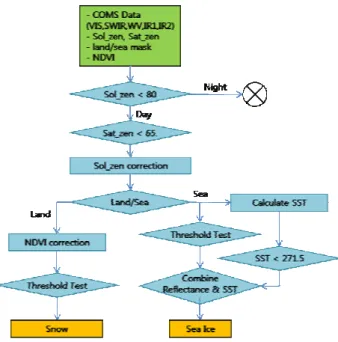
Fig. 3 shows the flow chart of this algorithm. We use all of the 5 channel data, zenith angles and monthly averaged NDVI data which are AVHRR products. Since this algorithm basically uses reflectance, it operates only in daytime. Then, each algorithm for snow and sea ice is applied to land and sea respectively.

Figure 1. Spectral reflectance for different land surface cover types (Romanov et al., 2000)

Solar zenith angle correction: Reflectance changes according to solar zenith angle. Solar zenith angle varies with location, and has a daily and seasonal variation. In order to apply visible data for this algorithm, normalization has performed using solar zenith angle, and which can be written as (2).

Figure 3. COMS snow and sea ice detection algorithm.

Mod_alb ≈ alb/Cos(θ

0

) (2)

where θ

0

= solar zenith angle alb = visible reflectance

After this correction, the daily variation has been obviously decreased, and we could use the same threshold value for all regions and time.

NDVI correction: Where dense forests mask underlying

snow, visible reflectance decrease, so the algorithm

underestimates the snow area. In order to correct this

limitation, we adopted normalized difference vegetation

index (NDVI). NDVI is an alternative measure of

vegetation amount, and an NDVI value of zero means no

green vegetation and close to 1 indicates the highest

possible density of green leaves. Before correction, we

assumed that if NDVI is greater than 0.5, there wouldn’t

be snow. The value of 0.5 is from the analysis of

relationship between snow and NDVI with climatology

data. The correction can be expressed as (3)

(3)

Where NDVI < 0.5

Mod_alb = Mod_alb × (NDVI + 1) (3)

Sea surface temperature: For sea ice extent, sea ice surface temperature (IST) is usually used together to remove cloud contamination. However, we had many limitations to derive IST with COMS, which are such as high satellite zenith angle and difficulties of obtaining the in-situ observed data. Therefore, we adopted SST instead of IST. For calculation of SST, split window method is used. Then, sea ice pixels are detected only when SST is lower than 271.5K (Hall, 2004; Burns, 1992).

SST = a×Tb (10.8) + b×DT

+ c×(secθ -1)×DT + d (4)

where DT = Tb (10.8)-Tb (12) θ = satellite zenith angle

Cloud contamination and desert effects: Desert can be detected as snow because of its high albedo. Also, at the edge of high level cloud, it can be detected as snow since they show high visible reflectivity and low near-infrared reflectivity. In order to correct these effects, we adopted threshold method using the channel difference between infrared (10.8 ㎛) and water vapour(6.7 ㎛). 15 and 35 are introduced for removing high level cloud and for correcting desert with high surface temperature respectively. It can be written as (5)

15 < IR (10.8) – WV (6.7) < 35 (5)

3. APPLICATION AND RESULTS

Snow and sea ice detection has been estimated using MTSAT-1R data during the winter in 2007. This algorithm basically uses visible and short wave infrared reflectivity, and some corrections using other channels in MTSAT-1R data are performed. The biggest problem in this algorithm is cloud contamination and underestimation over forest region. In order to reduce cloud contamination, threshold methods and SST were

introduced, and NDVI correction has been carried out.

With those corrections, performance of the algorithm has been improved, and especially NDVI correction is very effective. Fig. 4(a) is NDVI distribution, and green represent higher value than blue. Fig. b) and c) represent snow cover maps before and after NDVI correction respectively on January 4 in 2007. Before the correction, the snow pixels sparsely exist over the forest area from North Korea to Russia along the Pacific Ocean, and the underestimation near Vladivostok is notably presented.

After the correction(c), this area is expressed well as

snow pixels.

(a) (b)

(c) (d)

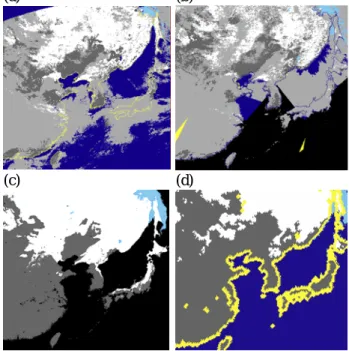
Figure 5. Snow cover and sea ice extent maps (a) estimated by current algorithm, (b) MODIS, (c) NOAA/NESDIS and (d) SSM/I snow and sea ice products on January 2, 2007. (White, light blue, light gray, dark gray and dark blue represent snow, sea ice, cloud, snow-free land and open sea water respectively)

For validation, MODIS snow cover and sea ice extent, NISE (Near real-time Ice and Snow Extent) from SSM/I and IMS (Interactive Multi-sensor Snow and Ice Mapping System) from NOAA/NESDIS are used. Fig. 5 represent the snow and sea ice coverage maps, a) MTSAT-1R, b) MODIS, c) IMS, d) NISE, on January 2 in 2007. Overall, snow and sea ice maps using optical sensors, MTSAT-1R and MODIS, shows similar patterns.

Also, MODIS which has less observation frequency compare to MTSAT-1R shows more pixels shaded by cloud. IMS which is estimated by combination of various kinds of data including surface observation, polar satellite and geostationary satellite data from NOAA/NESDIS(c) presents more snow and sea ice coverage over the map.

Otherwise, NISE using SSM/I exhibit serious underestimation especially in Japan. Usually, there is snow cover along the west side of Japan in winter, but NISE snow cover map (Figure 5(d)) doesn’t detect snow even though SSM/I is a microwave sensor which isn’t

(a) (b) (c)

Figure 4. (a) NDVI, and snow cover maps (b) before

more correction and (c) after NDVI correction on January

4, 2007.

(4)

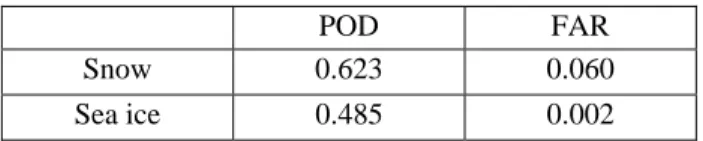
affected by cloud. We calculate probability of detection (POD) and false alarm rate (FAR) with MODIS products for January in 2007 (Table 1). Mean POD for snow detection during this period is 0.623, and sea ice showed worse performance. FAR is very low in both snow and sea ice.

Table 1. Statistics between MTSAT-1R and MODIS snow and sea ice in January 2007.

POD FAR

Snow 0.623 0.060

Sea ice 0.485 0.002

4. CONCLUSIONS

Snow and sea ice detection algorithm using satellite data mainly use Microwave and optical channels.

Microwave channels are effective over clouds, but optical channels such as visible and infrared do not have the ability to penetrate clouds, and can be used only in daytime. In this paper, snow and sea ice detection algorithm for COMS satellite and the application results are presented. However, this algorithm is unusable to obtain surface information under cloud because COMS satellite has only optical sensors. In order to minimize the cloud shading pixels, every scene observed during the daytime has been composited for the day. And the results show that this algorithm represents surface characteristics more than MODIS products. Corrections for cloud contamination and forest area have been performed, and the result shows that the NDVI correction is outstandingly effective. In validation, the scores of POD and FAR with MODIS snow cover showed 0.625 and 0.060 respectively. The accuracy of this algorithm is acceptable even though many limitations exist for 5- channel data. We currently examine the use of other calculation method for extracting reflectance portion from short wave infrared. In the future, this calculation method will be applied for this algorithm, and threshold tests for sea ice detection will be done.

References from Journals:

Allen, R. C., P. A. Durkee, and C. H. Wash, 1990:

Snow/cloud discrimination with multispectral satellite measurements. J. Appl. Meteor., 29, 994-1004.

Armstrong, R. L., M. J. Brodzik, 2001: Recent Northern Hemisphere Snow Extent: A Comparison of Data Derived from Visible and Microwave Satellite Sensors, Geophys. Res. Lett., 28, 19, 3673-3676.

Burns, Barbara A., 1992: Methods for Digital Analysis of AVHRR Sea Ice Images. IEEE Trans. Geosci. Remote Sens., 30, 589-602.

Hall, Dorothy K., 2004: Sea Ice surface Temperature Product From MODIS. IEEE Trans. Geosci. Remote Sens., 42, 1076-1087.

Kurosaki, Y. and M. Mikami, 2004: Effect of snow cover on threshold wind velocity of dust outbreak, Geophys.

Res. Lett., 31, L03106, doi:10.1029/2003GL018632.

Romanov P., G. Gutman, and C. Ivan, 2000: Automated Monitoring of snow cover over North America with Multispectral Satellite Data, J. of Appl. Meteor., 39, 1866-1880.

Walsh, J. E., W. H. Jasperson, and B. Ross, 1985:

Influences of snow cover and soil moisture on monthly air temperature. Mon. Wea. Rev., 113, 756-768.

Acknowledgements

This study is implemented as a part of “Development of Meteorological Data Processing System of Communication, Ocean and Meteorological Satellite”

project.

수치

Fig. 3 shows the flow chart of this algorithm. We use  all of the 5 channel data, zenith angles and monthly  averaged NDVI data which are AVHRR products
Figure 5. Snow cover and sea ice extent maps (a)  estimated by current algorithm, (b) MODIS, (c)  NOAA/NESDIS and (d) SSM/I snow and sea ice  products on January 2, 2007
Table 1. Statistics between MTSAT-1R and MODIS  snow and sea ice in January 2007.

참조

관련 문서

For estimating the biomass from multi-angle spectrum observation data, it is require that we should develop the BRF simulator for calculating Bi-directional reflectance for any

The model consists of the extinction coefficients and geo-referenced GIS data, thus the outputs including the near real-time Δ AOT vertical profile mapping and

In future, forest cover density mapping with object oriented classification method using QuickBird satellite data can be tried for entire India, so that not only the accuracy

Three processing strategies of seismic refraction data are tested in terms of velocity and depth profiles or struc- tures for mapping of geological discontinuities:

The proposed system is composed of Location Data Interface, Moving Objects Engine, and Web/Mobile Presentation Interface.. We utilized the concept of Web Map Server, that is

This technique will be possible to transmit of the geographic information effectively such as position data, attitude data, and image data acquired by Mobile Mapping Systems in

For this proposal, many mapping rules from GML application schema to spatial database schema were defined as well as suitable XML storage approaches for GML data ware selected.

This study was carried out to investigate the possibility of biotop mapping using high resolution satellite remote sensing data together with field data and eventually,