• 검색 결과가 없습니다.

IEG 환경지질연구정보센터

N/A
N/A
Protected

Academic year: 2021

Share "IEG 환경지질연구정보센터"

Copied!
4
0
0

로드 중.... (전체 텍스트 보기)

전체 글

(1)

Scale height를 이용한 대기 에어러솔 연직분포와 GIS에서의 응용

(Aerosol vertical profile by scaling height and its linkage with GIS technique)

Man Sing Wong

1

, 이권호

2

, 김영준

3

1

Dept. of Land Surveying and Geo-Informatics/The Hong Kong Polytechnic University,

2

Earth System Science Interdisciplinary Center/University of Maryland,

3

광주과학기술원 환경공학과/환경모니터링 신기술 연구센터

1. Introduction

The aerosol vertical profile data are traditionally obtained from the Lidar which measures the atmospheric particles and molecules along the line of sight.

These data can help on describing the complete profile of aerosol vertical structure, but the high cost of the instrument and complicated installation prohibits its widespread use. This study attempts to derive the scaling height and extinction coefficient

profile based on the

sunphotometer measurements and surface visibility data from the meteorology stations. The modeled extinction coefficient profiles were validated with the MPLNET Lidar data.

The aims of this study are to test the applicability for (i).

modeling the atmospheric vertical profiles using sunphotometer data

and visibility data, (ii). validating the modeled data with MPLNET measurements, and (iii).

displaying the resulting extinction coefficient and AOT with GIS and virtual reality model.

2. Methodology

A study area was selected in Taipei with the co-located AERONET and MPLNET station.

The AERONET level 1.5 data was made use in this study. The cloud-screening and temporary co-matching data (with MPLNET) was undertaken, where only matched data (within 30 minutes) were selected for the analysis. A total of 164 matched data were found in Taipei between year 2006 and 2007.

Additionally, the surface visibility

data was acquired from the

World Meteorology Observation

(WMO) for those matched data.

(2)

The scaling height is a measure of decreases of atmosphere aerosol over a distance and the integrated extinction coefficient over a vertical column of unit cross section is known as aerosol optical depth or optical thickness (Qiu et al., 2005). The extinction coefficient can be derived from the scaling height and AOT can be derived from the extinction coefficient. The rationale of the model is first estimating the scaling height by equation 1:

³

ſ

á ć

ÐíÖÎÏî ¯ ƇƑ à ň

Ƌ

Þ×íÒÒłƋß ʼn

ſ

Þ×íÒÒłƋß

(1)

where Z

a

is the scaling height, Ɏ

a

is AOT, Vis is surface visibility, ɍ

m

is the surface-level molecular extinction coefficient. The equation 1 is comprised with equation 2 and 3.

ň

ſ

ÞƘ á ×ß á ć ¯ ƇƑ ÐíÖÎÏ

à ň

Ƌ

(2)

ň

ſ

ÞƘ ß á ň

ſ

ÞƘ á ×ß _ ¸ËÃÞà ƘîƘ

ſ

ß (3)

where z is the height, ň

ſ

ÞƘ ß is the aerosol extinction coefficient at the surface level. With the implementation of equation 1 with AERONET level 1.5 AOT data

and WMO surface visibility data, the scaling height Z

a

can be calculated. The assumption made in the model is the background stratospheric aerosol is negligible, comparing with the tropospheric aerosol.

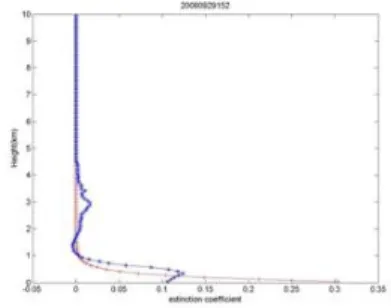
3. Aerosol vertical profiles It is not surprising that good agreement was observed between modeled extinction coefficient profiles and MPLNET data. Fig.

1 illustrates the four days modeled aerosol profiles and the profiles measured from MPLNET.

The modeled exponent profiles were fitted well with the MPLNET measurements. Figure 2 shows the average values of 164 data and the absolute standard error between modeled data and MPLNET is 0.0216km

-1

. The standard errors of two profiles

Fig. 1. Aerosol extinction coefficient

profiles from the model and MPLNET

on .

(3)

(drawn in red and blue lines) were also displayed in Figure 2.

Because of the limited data, only 164 data were available from year 2006 to 2007, monthly and seasonally analysis cannot be further analyzed. With respect, more analysis and the other study sites will be studied in the near future.

Fig. 2. Averaged aerosol extinction coefficient profiles from model and MPLNET.

There are two major limitations of this method. Since the model assumes the aerosol profile is in exponential transformation where it is not exactly true in the real atmosphere. The cloud layer, heavy dust aerosol loading and biomass burning induce the second or third peaks in the profile. Thus, the model only works well in the non-dust and non-cloud atmospheric conditions.

The MPLNET has its native drawback on measuring the atmosphere below 0.8km. The large uncertainty on the nearrange signal is due to the minimum range of return signal and the instrument field of view, thus, the overlapping problem is always presented under 0.8km atmosphere.

4. Linkage in GIS platform GIS platform provides the integration of modeled data of scaling height and extinction coefficients with the spatial geo-referenced data eg. buildings and Digital Elevation Model (DEM). This study is the first ever study by linking the derived atmospheric extinction coefficient and AOT values in different elevation layers to GIS platform, this made the possibility for three dimensional visualization and near real-time AOT vertical profile mapping for Hong Kong.

The derivation of extinction

coefficients and scaling heights

were formulated from the

matched data and as the input in

GIS platform. As well, the spatial

geo-referenced GIS data including

the building vectors and elevation

contours were processed in the

platform and later as the other

(4)

input for modeling. The model consists of the extinction coefficients and geo-referenced GIS data, thus the outputs including the near real-time Δ AOT vertical profile mapping and 3-dimensional virtual reality model as shown in Fig. 3. The scale of the model was set to 1:5000. This permits interactive visualization of extinction coefficient and Δ AOT over the whole city.

Fig. 3. 3D model with extinction coefficient values from ground level to 300m.

4. Summary

The study presented a state-of-the-art technique for modeling the atmospheric vertical profile using AERONET level 1.5 AOT and surface visibility data.

The assumption of exponent-type aerosol profile inside the tropospheric layer is adopted in the modeling. The results were found to have a good agreement by validating with MPLNET Lidar measurements. General

comment has been made that the model is best-fit and accurate in non-cloud and non-dust atmospheric condition, where further improvement is needed and will be modified in the near future. The derived extinction coefficients and AOT values at different atmospheric heights were fully linked in GIS platform.

It shows the possibility and applicability for depicting the AOT contents through the near-real time vertical profile mapping and 3-dimensional virtual reality model. Thesehelp on analyzing the AOT contents at the near surface elevations which may have a close relationship with urban pollutants and water vapour contents.

Acknowledgements

이 연구는 한국항공우주연구원의 위탁 연구과제 지원으로 수행되었습니다 .

References

Qiu, J., Zong, X.M., and Zhang, X.Y.

(2005), A study of the scaling

height of the tropospheric

aerosol and its extinction

coefficient profile, Journal of

Aerosol Science, 36, 361-371

수치

Fig.  1.  Aerosol  extinction  coefficient  profiles  from  the  model  and  MPLNET  on  .

참조

관련 문서

Modern Physics for Scientists and Engineers International Edition,

Five days later, on 15 January 1975, the Portuguese government signed an agreement with the MPLA, FNLA and UNITA providing for Angola to receive its independence on 11

Usefulness of co-treatment with immunomodulators in patients with inflammatory bowel disease treated with scheduled infliximab maintenance therapy.. Oussalah A, Chevaux JB, Fay

Inclusion and Inclusiveness: Shared Vision of Youth for Local, National, and Global Village Inclusion at large stands for embracing populations with disabilities and

웹 표준을 지원하는 플랫폼에서 큰 수정없이 실행 가능함 패키징을 통해 다양한 기기를 위한 앱을 작성할 수 있음 네이티브 앱과

It is impossible to change the voltage across a capacitor by a finite amount in zero time, for this requires an infinite current through the capacitor.. (A capacitor resists

If the volume of the system is increased at constant temperature, there should be no change in internal energy: since temperature remains constant, the kinetic

Continued to the entropy cycle and energy balance with entropy changes. Reversible cycle consisting of two isothermal branches, AB and CD, and two isentropic branches,