1. Introduction
Change of ocean with abnormal climate contributes the increase of SL and SST, the change of ocean surface circulation and the variation of sea level. SL and SST are the fundamental index for oceanography and climatology. In order to predict to change of ocean, it is necessary to monitor and predict the oceans in the long time by satellite data.
Several studies (Carnes, 1990), Cheney (1982) have found that SL derived from altimeter and subsurface temperature are highly correlated. The correlation between SL and SST is 0.6 (Nerem, 1997). Coupled Pattern Analysis (CPA) between global SL and SST presented annual cycle accounts for nearly all (95.3%) of the covariance. The spatial and temporal coefficients of the primary mode of a nonseasonal
CPA are correlated with ENSO events (Eric, 1999).
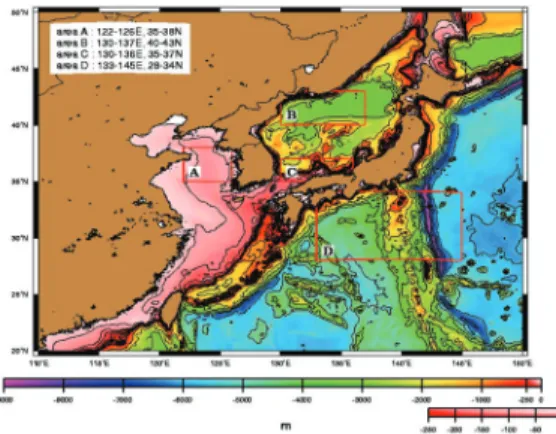
Here, we estimated characteristics on the variations and the correlations of SL and SST, and examined Empirical Orthogonal Function (EOF) analysis in the North East Asian Seas(Fig. 1).
2. Data and Method
Map of Sea Level Anomaly (MSLA) altimeter data have been generated for over 5.4 years, from October 1992 to May 1998, using AVISO GDR-M products for Topex / Poseidon (T/P), cycles 3 to 210.
MSLA was corrected for instrumental errors, environmental perturbations, ocean wave influence, tide influence. CSR3.0 tidal model and ECMWF dry troposhperic and inverse barometer corrections are
Variations of Sea Level and Sea Surface Temperature in Korean Seas by Topex/Poseidon and NOAA
Hong-Joo Yoon, Heung-Soon Kang, and Han-Keun Cho
†Department of Satellite Information Sciences, Pukyung National University
Abstract : Altimeter (Topex/Poseidon) and AVHRR (NOAA) data were used to study the variations and correlations of Sea Level (SL) and Sea Surface Temperature (SST) in the North East Asian Seas from November 1993 to May 1998. This region is influenced simultaneously to continental and oceanic climate as the border of the East Sea (Japan Sea). SL and SST have increased gradually every year because the global warming, and presented usually a strong annual variations in Kuroshio extension region with the influence of bottom topography.
Key Words : EOF Analysis, Sea Level, Sea Surface Temperature.
Korean Journal of Remote Sensing, Vol.23, No.1, 2007, pp.59~63
Received 16 January 2007; Accepted 24 February 2007.
†