• 검색 결과가 없습니다.

IEG 환경지질연구정보센터

N/A
N/A
Protected

Academic year: 2021

Share "IEG 환경지질연구정보센터"

Copied!
6
0
0

로드 중.... (전체 텍스트 보기)

전체 글

(1)

Feasibility Study of Climatological Variability Monitoring Using OSMI and EOS Data

Hyo-Suk Lim

1

, Jeongyeon Kim

2

1

Korea Aerospace Research Institute, Daejeon, Korea

2

Department of Oceanography, Chungnam National University, Daejeon, Korea E-mail : [email protected]

ABSTRACT

Dramatic changes in the patterns of satellite-derived pigment concentrations, sea-level height anomaly, sea surface temperature anomaly, and zonal wind anomaly are observed during the 1997-1998 El Nino. By some measures, the 1997-1998 El Nino was the strongest of the 20

th

century. A very strong El Nino developed during 1997 and matured late in the year. A dramatic recovery occurred in mid-1998 and led to a La Nina conditions. The largest spatial extent of the phytoplankton bloom was followed recovery from El Nino over the equatorial Pacific. The evolution towards a warm episode (El Nino) continued in the equatorial Pacific from March 2002 and further development toward mature El Nino conditions may be possible in late 2002. The OSMI (Ocean Scanning Multispectral Imager) data can be used for detection of dramatic changes in the patterns of pigment concentration during next El Nino.

Key Word : El Nino, Climatological Variability, OSMI, EOS

1. INTRODUCTION

El Nino may be characterized as one of the most dramatic examples of a large amplitude, interannual response of the ocean to atmospheric forcing. The 1997-1998 El Nino is the best documented and strongest event of its kind to date.

Chavez et al. (1999) investigated dramatic biological and chemical response of the equatorial Pacific ocean to the 1997-1998 El Nino. It was possible to capture the dramatic event because of in situ sensors on moorings, regular ship visits to service the moorings, and remote sensing of ocean variables. Takayabu et al. (1999) examined the reason which is resulted in abrupt termination of the 1997-1998 El Nino. According to the research, in spite of no previous observations of the Madden-Julian oscillation (MJO) that triggered the termination of El Nino events, MJO may be the possible reason for the abrupt termination.

In this paper, 1997-1998 El Nino was investigated with EOS and TAO data. It is also examined whether the global distribution of chlorophyll by OSMI can be used for detection of El Nino.

2. ANALYSIS OF THE 1997-1998 El-Nino CASE

Since the observation of an El-Nino during 1997 – 1998, it has been classified as the greatest large-scale

developed El-Nino. Through the analysis of meteorological and oceanic data (SST, sea level height, ocean color, wind

(2)

field) investigation into the 1997 – 1998 El-Nino was carried out. Not only was satellite data acquired for analysis, but also TAO data. Mooring was set up for the measurement of meteorological/oceanic variables of the Equatorial Ocean (shown in Fig. 1), which was observed during 1985 and 1994 by international collaboration and consequently acquiring TAO data. The data is very useful for El-Nino, La Nina, Global Climate Observing System (GCOS) and Global Ocean Observing System (GOOS).

Fig. 1 TOA set up locations

The average of ocean variables of the equator areas ranging between 2

0

S – 2

0

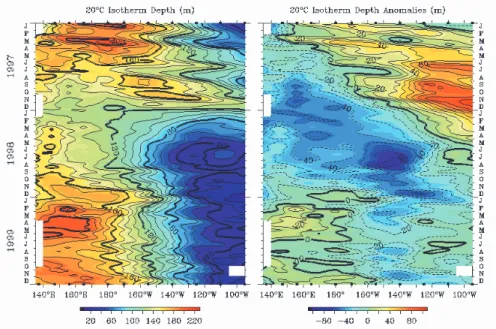
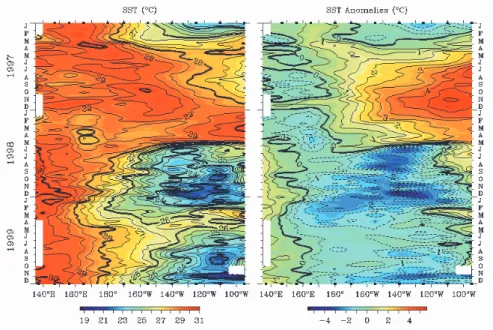
N were obtained from TAO data, which were observed from January 1997 to December 1999. Fig.4 displays the 20

0

C isotherm depth anomalies. During the 1997 – 1998 El-Nino occurring and maturing period, the 20

0

C isotherm depth of the East Pacific Ocean deepened, but contrary to this, the 20

0

C isotherm depth of La-Nina (observed during 1998 to 1999), which lowered, can be understood by observing Fig. 2. The average of the identical area was obtained using the same method and as a result the distribution of the sea surface temperature and anomaly presented in Fig. 3 was derived. During the occurrence and maturing period of an El-Nino from 1997 – 1998 (East Pacific Ocean), the sea surface temperature rose over 4

0

C. But La Nina reacted oppositely. During the period of observation of La-Nina from 1998 to 1999, the sea surface temperature declination was observed.

Fig. 2 20

0

C isotherm depth and anormalies distribution of the observation/averages

observed from TAO between 2

0

S – 2

0

N.

(3)

Fig. 3 Sea surface temperature and anomaly distribution of the observations/averages observed from TAO between 2

0

S – 2

0

N.

Other than the data observed from TOA, sea level height, SSTA, ocean color, and wind field of January, July and December (1998) were examined. Fig. 4 shows NCEP SSTA –in January 1998, an El-Nino matured, in July an El-Nino was breaking down, and then in December an La-Nina began to appear.

Fig. 4 Sea surface temperature anomaly observed in January, July, and December of 1998.

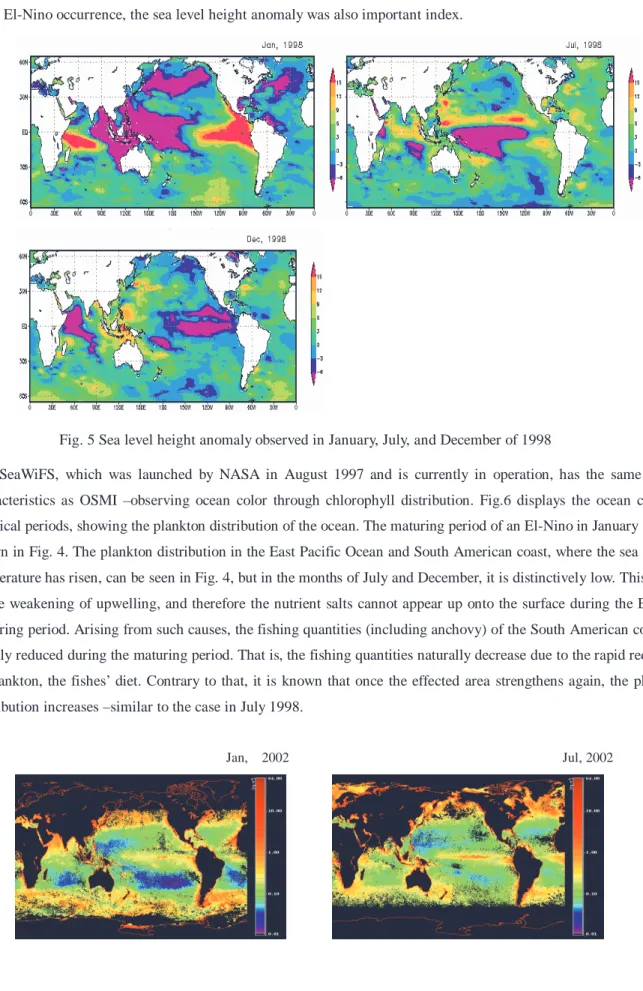
The sea level height anomaly observed by TOPEX-POSEIDON is used as a index of an El-Nino occurrence

together with SSTA. Fig. 5 displays the sea level height anomaly during identical periods of January 1998, which was

the occurrence and maturing period of an El-Nino. The sea surface temperature anomaly appears higher in the East

Pacific Ocean and the sharp rise in the sea level height anomaly can be seen. In reality, the El-Nino ended in July as the

rise in the sea level height anomaly in the East Pacific Ocean ceased. By looking at Fig. 4, an La-Nina began to

develop in December, and by looking at Fig. 5, the heavy declination of sea level anomalies were observed. The time

(4)

series of the rise in sea surface temperature and sea level height referring to before and after an occurrence, that is, what variables are leading, are not analyzed in this study. Such research into the change of ocean variables in relation to an El-Nino and believe that there is value in its analyzing. Before the application of the 1992 TOPEX POSEIDON, sea surface temperature anomaly was the principle data that informed of an El-Nino occurrence, but during the 1997 – 1998 El-Nino occurrence, the sea level height anomaly was also important index.

Fig. 5 Sea level height anomaly observed in January, July, and December of 1998

SeaWiFS, which was launched by NASA in August 1997 and is currently in operation, has the same sensor characteristics as OSMI –observing ocean color through chlorophyll distribution. Fig.6 displays the ocean color of identical periods, showing the plankton distribution of the ocean. The maturing period of an El-Nino in January 1998 is shown in Fig. 4. The plankton distribution in the East Pacific Ocean and South American coast, where the sea surface temperature has risen, can be seen in Fig. 4, but in the months of July and December, it is distinctively low. This is due to the weakening of upwelling, and therefore the nutrient salts cannot appear up onto the surface during the El-Nino maturing period. Arising from such causes, the fishing quantities (including anchovy) of the South American coast are rapidly reduced during the maturing period. That is, the fishing quantities naturally decrease due to the rapid reduction in plankton, the fishes’ diet. Contrary to that, it is known that once the effected area strengthens again, the plankton distribution increases –similar to the case in July 1998.

Jan, 2002 Jul, 2002

(5)

Dec, 2002

Fig. 6 Plankton distribution observed in January, July, and December of 1998.

Monthly mean of global plankton distribution for April, May, and June 2002 were processed in KARI ground station (Figures not shown). Because of 20 % duty cycle, global map is not like monthly mean map of SeaWiFS. There are many missing data over the global area. In spite, it is possible to know the trend of monthly mean of Plankton distribution. If El Nino occurred year of 2002 or 2003, better global map over the Equatorial Pacific can be made when mission planning is properly prepared. Therefore, it is optimistic to monitor the El Nino using OMSI data.

When an El-Nino occurs, not only are the already examined Equatorial Pacific Ocean’s sea surface temperature, sea level height, and chlorophyll distribution seen, but also different to normal periods such as wind field. Among the NCEP reanalysis data, the anomalies of the east-westerly winds were examined (Fig. 7). During the maturing of an El- Nino in January 1998, westerly winds were strengthening at the East Pacific Ocean equator, and in July, during the declining period, it was weakening. But it is known that the easterly winds once again strengthen in December.

Fig. 7 East-westerly winds anormalies observed in January, July, and December of 1998.

(6)

3. CONCLUSIONS

Using EOS and TAO data, dramatic changes in the patterns of satellite-derived pigment concentrations, sea-level height anomaly, sea surface temperature anomaly, and zonal wind anomaly are observed during the 1997-1998 El Nino, the strongest of the 20

th

century. The evolution towards a warm episode (El Nino) continued in the equatorial Pacific from March 2002 and further development toward mature El Nino conditions may be possible in late 2002 and Early 2003. The OSMI data can be used for detection of dramatic changes in the patterns of pigment concentration during next El Nino.

ACKNOWLEDGEMENTS

This work was supported by grant R04-2001-000-00128-0 from the Basic Research Program of the Korea Science and Engineering Foundation.

REFERENCES

Chavez, E. P., P. G. Strutton, G. E. Friederich, R. A. Feely, G. C. Feldman, D. G. Foley, and M. J. McPhaden, 1999, Biological and chemical response of the equatorial Pacific ocean to the 1997-1998 El Nino, Science, 286:2126-2131.

Takayabu, Y. N., T. Iguchi, M. Kachi, A. Shibata, and H. Kanzawa, 1999, Abrupt termination of the 1997-1998 El Nino

in response to a Madden-Julian oscillation, Nature, 402(6759): 279-282.

수치

Fig. 2 20 0 C isotherm depth and anormalies distribution of the observation/averages          observed from TAO between 2 0 S – 2 0 N
Fig. 3 Sea surface temperature and anomaly distribution of the observations/averages observed    from TAO between 2 0 S – 2 0 N
Fig. 5 Sea level height anomaly observed in January, July, and December of 1998
Fig. 7 East-westerly winds anormalies observed in January, July, and December of 1998

참조

관련 문서

월강수량 (monthly total) 평년편차 (anomaly from normal) 최근10년평균편차 (anomaly from 10yr mean)..

월강수량 (monthly total) 평년편차 (anomaly from normal) 최근10년평균편차 (anomaly from 10yr mean)..

월강수량 (monthly total) 평년편차 (anomaly from normal) 최근10년평균편차 (anomaly from 10yr mean).

월강수량 (monthly total) 평년편차 (anomaly from normal) 최근10년평균편차 (anomaly from 10yr mean).

월강수량 (monthly total) 평년편차 (anomaly from normal) 최근10년평균편차 (anomaly from 10yr mean)..

월강수량 (monthly total) 평년편차 (anomaly from normal) 최근10년평균편차 (anomaly from 10yr mean).

월강수량 (monthly total) 평년편차 (anomaly from normal) 최근10년평균편차 (anomaly from 10yr mean).

연강수량 (annual total) 평년편차 (anomaly from normal) 최근10년평균편차 (anomaly from 10yr mean).