Study on the Valuation Method for Redeveloped Area of Industrial Heritage
Li Sun1,2, Young-Hwan Pan3*
1Ph.D. Course, Dept. of Experience Design, TED, Kookmin University
2Lecturer, Jiangsu University of Technology, Artistic Design
3Professor, Dept. of Experience Design, TED, Kookmin University
산업 유산 재생지역에 대한 가치 평가 방법에 대한 연구
쑨리1,2, 반영환3*
1국민대학교 테크노디자인전문대학원 경험디자인학과 박사과정
2강소이공대학교 디자인예술학 강사
3국민대학교 테크노디자인전문대학원 경험디자인학과 교수
Abstract Objective evaluation of the resources of industrial heritage regeneration area is an important prerequisite for design and improvement. The purpose of the study is to comprehensively evaluate the value of the industrial heritage regeneration area. This study identifies the method (model), combining the qualitative factor and quantitative factor. (1) Establish an evaluation system (AHP Hierarchy) based on the resources of regeneration area; (2) Choose an evaluation way based on the type of resource; (3) Calculate the value and total value of various resources in the area. The research is a case study of Canal 5 resort. It expounds the using process of the method and gets the rank and total value of each type of resource in this area, the factors influencing the value (mainly concerned with income), etc. The conclusion is that the value of the reclaimed land should be composed of both the use value and the non-use value; the same factor has different influence on different resources; different factors influence one resource to different extents.
Key Words : Industrial Heritage, Valuation, Contingent Valuation Method (CVM), AHP, Canal 5 요 약 산업유산 재생 지역의 자원 가치를 객관적으로 평가하는 것은 디자인 개선과 서비스 혁신의 중요한 전제 조건이 다. 본 연구에서는 산업유산 재생 지역의 자원 가치를 전반적으로 평가하기 위해 정성적, 정량적 방법을 결합한 가치 평가 방법(모형)을 제시하였다. (1)재생 지역의 자원에 따른 평가체계 수립(AHP 계층); (2)자원 유형에 따른 평가 코스 선택(cvm 또는 사용가치); (3)해당 지역의 각 자원의 가치와 총 가치의 계산. 본 연구에서는 운하 5호 사례에 적용하여 다음과 같은 결과를 얻었다. 해당 지역의 다양한 자원의 가치 순위 및 총 가치; 가치에 영향을 주는 요인은 다양하지만 주로 소득과 관련되는 것으로 나타났다. 나아가 결론은 다음과 같다. 재생지역의 가치는 사용가치와 비사용가치를 함께 구성해야 하며, 동일 요소가 서로 다른 자원의 가치에 미치는 영향이 다르다. 또한 요소별로 동일한 자원에 미치는 영향의 크기가 다르다.
주제어 : 산업유산, 가치평가, Contingent Valuation Method(CVM), AHP, 운하5호
*This paper has been conducted with the support of the "Design Engineering Postgraduate Schools" program, a R&D project initiated by the Ministry of Trade, Industry and Energy of the Republic of Korea. (N0001436) and 19SYB-146.
*Corresponding Author : Young-Hwan Pan([email protected]) Received December 11, 2019
Accepted February 20, 2020 Revised February 3, 2020 Published February 28, 2020
1. Introduction 1.1 Research background
Industrial heritage reuse is an approach for urban regeneration, which can avoid the waste of resources, spaces and lands, and can promote the conservation of industrial heritage and the inheritance of culture. In the last century, most factories and industrial buildings were abandoned, idled or demolished. Guided by successful cases in developed countries, many areas have gradually laid emphasis on the industrial heritage regeneration. Since the 1960s, many traditional industrial parks in Europe have been successfully transformed into tourist attractions (Hospers,
2002)[1], such as Ruhr in Germany. In 2003, the International Committee for the Conservation of the Industrial Heritage(TICCIH) elucidated the definition and value of industrial heritage and the importance of identifying(2003), documenting and studying industrial heritage in the Nizhny Tagil Charter[2].
As of 2018, about 6% of industrial heritage has been included in the World Heritage List[3], and the number of charters to preserve industrial heritage around the world has soared. Since the 1980s, China has gradually begun to lay emphasis on the regeneration and conservation of industrial heritage. According to relevant papers and reports, the regeneration of industrial heritage has a history of more than 50 years.
Some industrial heritage has been regenerated and entered a new life cycle. At present, many developed countries have valuated and appraised the industrial heritage sites in their long-term development practices, and have formed relatively consummated and scientific management approaches for industrial heritage[4]. Fuying Liu et al. adopted the Dempster–Shafer theory to assess the value of industrial heritage. AHP has been widely applied in many fields, and scholars believe that the combination of AHP and the
Delphi method is the basis for identifying the value of industrial heritage[5]. Countries such as the United Kingdom and the United States have passed legal documents that affirm the reliability and significance of measuring non-use value on the decision-making with CVM[6]. Considering the special correlation between industrial heritage and social value, industrial heritage should be considered a non-market product[7].
Ventura used the Conditional Valuation Method (CVM) to valuate industrial heritage, while Tan Chao used the CVM to assess the non-use value of industrial heritage[8]. CVM has been localized for the valuation of industrial heritage[9].
It is of paramount importance to study the value of industrial heritage regeneration area, which is an epitome of urban development in a specific period[10]. In general, there are considerable records of the culture, protection, and development of industrial heritage in some literature[11], but research focusing on the value of resources in industrial heritage regeneration area remains scarce (mainly focusing on the value of the heritage itself, its economic value, etc.)(Google scholar,2018). In terms of the valuation of industrial heritage, the number of quantitative research methods is increasing. With the introduction of quantitative methods, AHP has been commonly used. This method is widely applicable and highly accepted, but its subjectivity in the step of weight assignment cannot be[12]. The Contingent Valuation Method (CVM) has been widely applied to various tourism resources and the valuation of industrial heritage, but its application is generally limited to overall resources and overall non-use value (Weihua Cui,2014). On this basis, the study combines CVM and the hierarchical framework of AHP to comprehensively evaluate the industrial heritage regeneration area.
1.2 Research purpose
Objective evaluation of the resources of industrial heritage regeneration area is an important prerequisite for design and improvement. The direct purpose of this paper is to provide a method and model for the valuation of industrial heritage regeneration area. The method is combined with non-use value and economic value.
The indirect goal is to provide a reference for redesign and to enhance the reuse value of the industrial heritage through value evaluation.
This study can also serve as a model for areas in the mid or late stage of industrialization.
Taking Canal 5 as an example to explain the process and method of value evaluation.
Providing an important reference for design research, tourism innovation and design improvement.The indirect goal is to provide a reference for redesign and to enhance the reuse value of the industrial heritage through service innovation.
2. Related theoretical research 2.1 Analytic Hierarchy process(AHP)
The Analytic Hierarchy Process, abbreviated as AHP, was proposed in the early 1970s by American operations researcher and professor at the University of Pittsburgh, Saaty. The evaluation system has enjoyed high recognition and adaptability. According to the characteristics of research objects, the hierarchical method of AHP is employed to decompose complex problems into corresponding levels, forming a multi-level structural model through analysis[13].
2.2 Contingent valuation method(CVM)
CVM, i.e. the Contingent Valuation Method created by American scholars, is also called the Willingness Survey Method. It is widely applied in the evaluation of various tourism resources and
is the most important and common method applied to the valuation of non-market value. It is divided into two assessment methods, namely the willingness to retain the payment
(Willingness to Pay. WTP); the willingness to abandon the valuated object and accept compensation(Willingness to Accept, WTA).
Based on the domestic and foreign case studies and the property right issue concerning industrial heritage, Professor Cui suggested using WTP since it is more suitable for the valuation of industrial heritage[6]. Therefore, this study relies on individuals’ opinions and uses WTP values as the evaluation standard for the value of Canal 5 resources. According to the principle, the total willingness to pay for the sample resources can be estimated by multiplying the average willingness to pay for the sample with the relevant groups. The formula is shown as follow s:
··· (1) A(WTP) is people's willingness to pay for "the resources of the industrial heritage regeneration area ", ni is the number of people willing to pay in the total number of respondents, N is the total number of respondents, and M is the total number of annual reception of the sample land.(2017 canal 5 good tourism area statistical yearbook)[14,15].
2.3 Questionnaire survey
Questionnaire was used and random sampling was taken. For details, please refer to 4.2 questionnaire[16].
3. Method and model research 3.1 Use-value assessment model
The current mainstream valuation methods for industrial heritage regeneration area mainly
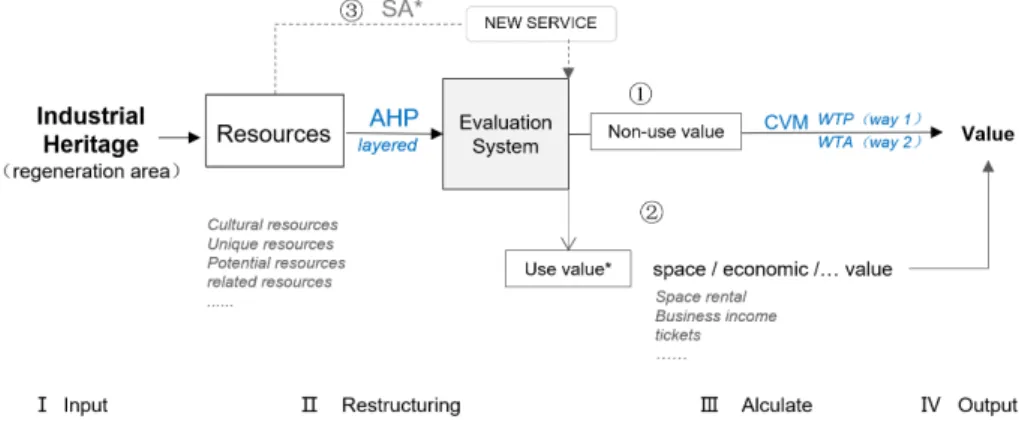
Fig. 2. Valuation model for regenerated area of industrial heritage focus on economic value, rent, value of the
heritage itself, etc. After analysis, an overview of the current mainstream valuation models is shown in Fig.1. (2019, Google scholar).
Fig. 1. General valuation approach
3.2 CVM-based valuation method and model 3.2.1 Valuation method research
The non-use value of industrial heritage accounts for a large proportion of its total value due to the inherent characteristics of industrial heritage(Cui Weihua,2010).Neglecting non-use value may lead to serious deviations during valuation.(S. V. Ciriacy-Wantrup,1947). Considering that heritage is associated with social value and should therefore regard as a non-market product, Wantrup applies Contingent Valuation Method (CVM) to evaluate it.
Therefore, taking emotional value into account, this study introduces CVM to assess the value, classifies the resources after regeneration combining the AHP hierarchical theory, and then uses a resource evaluation method that integrates both qualitative and quantitative factors to improve valuation accuracy.
According to the research background and
existing problems, the valuation method proposed is elucidated as follows: (1) Identify all the resources (including potential resources) in the regenerated area through field investigation, literature review, and expert consultation. (2) Based on the AHP hierarchical theory, establish a system for resource evaluation and clarify evaluation indicators. (3) Based on CVM, design a reasonable questionnaire, conduct a questionnaire survey to obtain the valuation data of conditional value; use the data to calculate the value of WTP, the value of each resource, and the value of total resources.
3.2.2 Establish value evaluation model
The valuation model for regenerated area of industrial heritage based on CVM and the hierarchical method of AHP is shown in Fig. 2 below.
I. Enter the data of industrial heritage. Enter the background and relevant information of the industrial heritage.
II. Establish a resource reconstruction and evaluation system. Deconstruct the resources in the regenerated area, classify the resources and establish a valuation system (obtain the hierarchy according to the level of AHP).
III. Assessment and calculation. The WTP / WTA figures are calculated based on CVM to
assess indicators in each layer.
IV. Output the value. Calculate the value of the industrial heritage regeneration area.
Usually, Process ① applies to the non-use value of the industrial heritage regeneration area, such as transformed into museum, art district, etc.,
Process ② applies to use value of the industrial heritage regeneration area, such as ticket fees, rent, industrial economy, etc. When the regeneration area is inclined to sole "space regeneration", such as transformed into hotels, warehouses, creative industrial parks, etc.; the process ② is mainly evaluation approach.
In addition, process ③ is used to estimate the heritage area to be developed, and the value of the area is obtained through Hypothetical Markets (assuming that something is retained and what new services are provided), CVM and research.
Generally, the content of industrial heritage after regeneration is complex, and its value requires comprehensive evaluation of multiple process.
4. Research results and application 4.1 Sample area selection
The sample area selected in this paper is Canal 5 Creativity Campus(N31°47′25.14″ ,E119°55′52.2 9″), an AAA-class tourist resort in Changzhou, Jiangsu Province, China (hereinafter referred to as Canal5)[17]. Canal5 is near the bank of the Grand Canal. It is a “Creative Art Block”
transformed from industrial heritage (including the former Fifth Wool Textile Factory and Marine Instrument Factory in the 1930s-1980s).
The original positioning of the sample area includes cultural heritage, industrial heritage, and creative industries. This is a national industrial heritage regeneration area. The government announces its annual economic income.
Abundant resources after regeneration, including industrial heritage memorial hall, pure business, service industry and educational sites, can cover the three evaluation routes of the model, which are more suitable for the regeneration area with a single resource. The recycled resources are mostly similar to canal 5 or part thereof[18].
Fig. 3. Photo of the Canal No.5
However, after more than a decade of development, some problems have arisen, such as the decline in the proportion of culture and heritage utilization. The local management cannot fully utilize its value, neglect the value of the heritage, and the valuation of heritage mostly relies on rent and industrial income. The functions of regeneration area include tourism, commerce, exhibition, office, and catering, which has industrial economy, rent and non-use value, etc. This type of regeneration has a high proportion and it must be evaluated by comprehensive Process ① and ②.
4.2 Questionnaire survey
The questionnaire survey is based on random sampling. Surveys were conducted among respondents (visitors and citizens) through online or face-to-face interviews (The questionnaire content did not involve invasion of personal privacy. And the purpose of the survey, its content and the technical terms in the questionnaire have been properly explained prior to distribution in order to guide the respondents to express their true thoughts). From March 2019 to June 2019, 350 questionnaires were distributed to local citizens and visitors, and 327 were recovered, with a recovery rate of 93.4%, as Table 1.
Target Layer
(A) Criteria Layer
(B) Elements Layer
(C) Representative of Elements
(e)
Overall resources (A)
Industrial heritage resources
(b1)
Industrial heritage buildings and structures (c1)
Industrial civilization, history and culture (c2)
Nautical instruments, textiles, comb factories, wharves, constructions, objects related to industrial production, etc.
Historical Celebrities, Historical background, Comb culture, Textile civilization, Canal culture memorial, Industrial Civilization display, Industrial commercial archives Museum
Resources conserved
(b2)
Art resources (c3)
Education resources (c4)
Art Gallery, Exhibition Hall, Painting Memorial Hall,
Open-air exhibitions
Theme Library, Growth Experience Library, Creative art crafts, art studios, Painting studios, Craft studios, and other training studios
Comprehensive resources
(b3)
Catering (c5) Leisure and entertainment (c6)
Business office (c7*)
Restaurants, Cafes, Tea, Barbecue, etc.
Bars, Restaurants, Theatres, KTVs, etc.
Company(Decoration, Design, etc),Shop(Clothing Store, Wedding Photography, Plant Store, etc.), Warehouse, youth hostel, etc.
Table 2. Canal 5 tourism resource classification and indicator table Number of
questionnaires distributed
Number of questionnaires
collected
Number of uncollected
questionnaires Recovery rate
350 329 21 94%
Table 1. Questionnaire distribution and collection
The questionnaire is divided into 4 parts:
(1) Respondents' knowledge of the area.
(2) Willingness to pay. First, the respondents are asked whether they are willing to pay for enjoying a certain service. The payment ranges from 0 RMB to 500 RMB per year.
(0RMB, 5RMB, 10RMB, 20RMB... a total of 16 options)
(3) Personal information of the respondents including usual residence, occupation, gender, age, income, education level, etc.
This information is analyzed as factor affecting the conclusion.
4.3 Resource system based on the hierarchy of AHP theory
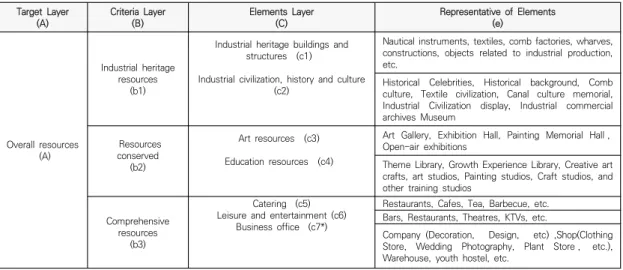
Based on the resource classification method in AHP(Hierarchy theory), expert interviews and literature research, this paper conducts a hierarchical analysis on the tourism resources of Canal 5. The total resources A are divided into 3 items in Layer B and 7 items in Layer C, and the
representative elements (solutions) of each item are provided.
As can be seen from Table 2, there are three items in the criteria layer(B), namely the industrial heritage resources (b1), conserved resources (b2), and comprehensive resources(b3).
Among them, industrial heritage resources(b1) contain two subitems, namely, the industrial heritage buildings and structures (c1) as well as historical and cultural resources (c2). The
“representative elements” are the specific content of Layer C, and they are also the existing solution. For example, the resources of art exhibition (c3) include art museums, exhibition halls, painting school museums, and open-air exhibitions. In addition, the value of the business office resources(*c7) needs to be analyzed based on industry income at the later stage (refer to the valuation process ② in the model).
4.4 CVM-based resource evaluation and calculation
The 329 questionnaires include 321 valid questionnaires (8 invalid questionnaires have been removed). According to the statistics of willingness to pay, 219 people are willing to pay for the permanent conservation of Canal 5,
Resource
Type A (WTP)
Million RMB/year Resource
Type A (WTP)
Million RMB/year Resource
Type A (WTP)
Million RMB/year
Overall
resources 196.2
Industrial heritage resources
(b1) 77.08
Industrial heritage buildings and structures
(c1) 40.06
Industrial civilization, history and culture
(c2) 37.02
Conserved resources
(b2) 63.36 Art resources (c3) 30.66
Education resources (c4) 32.7
Comprehensive resources
(b3) 55.76
Catering (c5) 21.01
Leisure and entertainment (c6) 20.14
Business office (c7) 14.61
Table 3. The A (WTP) value of each resource in the regenerated area
IV DV
Income Age Knowledge Area Gender
A p t A p t A p t A p t A p t Industrial heritage buildings and
structures (c1) 39.698 *** 4.527 -14.237 -1.724 10.015 * 1.324 0.435 0.055 -7.108 –1.047 Industrial civilization, history and
culture (c2) 28.923 *** 3.714 -19.232 -2.622 5.752 0.856 -3.315 -0.471 -2.440 -0.405 Art resources(c3) 15.916 1.786 -8.845 -1.054 12.791 1.664 9.156 1.136 1.267 0.184 Education resources(c4) 16.478 * 1.957 -16.734 * -2.110 3.764 0.518 4.670 0.613 -3.684 -0.565 Catering (c5) 33.682 *** 4.652 2.236 0.328 15.673 2.510 8.355 1.276 -14.465 –1.292 Leisure and entertainment (c6) 25.695 *** 3.843 -1.377 -0.219 10.068 1.746 7.257 1.200 0.984 0.190 Business office (c7) 17.114 ** 2.995 2.346 0.436 8.390 1.702 -2.658 –0.514 -4.431 -1.002 Table 4. Regression analysis between individual attributes and willingness to pay (WTP)
accounting for 68.22% of the total sample. The number of people who are unwilling to pay is 102, accounting for 31.89% of the total sample.
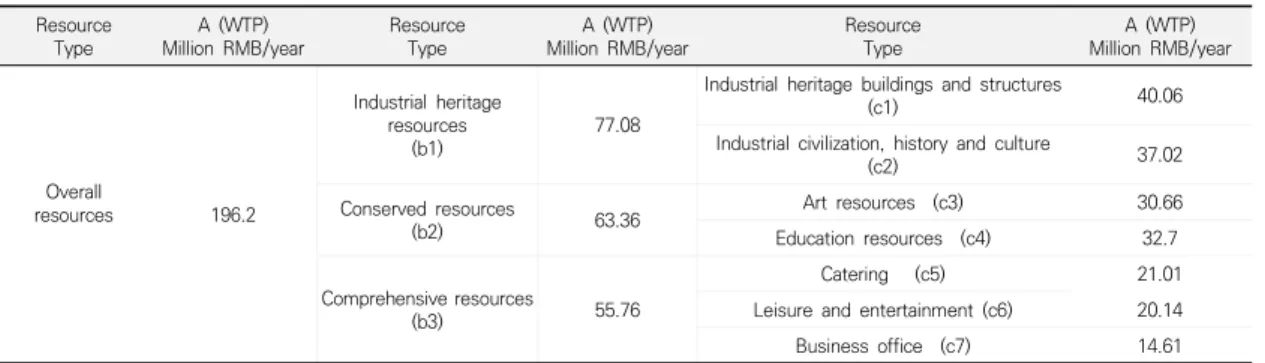
The maximum payment is 500 RMB/year, and the minimum payment is 5 RMB/year. According to the theory in 2.1, the T (WTP) value of various resources and overall resources is calculated as shown in Table 3.
The total resource non-use value of Canal 5 is 196.2 million RMB/year. Among them, the ranking in the second layer (Layer B) by estimated resource value is as follows: industrial heritage resources > conserved resources >
comprehensive resources. In the third layer(C), the resources value of Industrial heritage buildings and structures (c1, 40.06) is higher than that of Historical and cultural, and the estimated value of Education resources is higher than that of Art resources. Among the 7 items, Business office resources have the lowest estimated value
(c7,14.61).
4.5 The A (WTP) value of resource in the redeveloped area
The results show that in the second resource layer, tourists have a relatively strong willingness to pay for the industrial heritage resources. In the third layer, people have a relatively higher recognition for Industrial heritage buildings and structures(c1), Historical and cultural resources(c2), Education resources(c4)and Art resources(c3) compared with that of others. The respondents have the lowest recognition for Business office resources (c7). The main reason is that commerce has little correlation with residents' daily lives. Most citizens are reluctant to pay for the replacement of cultural and leisure resources by business activities. But C7 resources still have economic value. For example, the revenue of
Canal 5 in 2017 reached 61.47 million RMB[12].
According to the model used in this paper, the value should be included in Process 2, resulting in a total value of about 2,576,700 RMB for the area as a supplement to the former total value.
4.6 Analysis of factors influencing WTP The factors affecting the value(WTP)are identified through regression analysis, where the independent variable is the individual attributes of the respondents, and the dependent variable is the WTP value of each of the 7 items of resources.
Finally, SPSS software was used for regression analysis. Regression coefficient A, significance (0.01<P<0.05 means significant difference, denoted as **) and statistical value T were filled in table 4.
The larger the regression coefficient, the greater the influence of independent variables on dependent variables. Table-based data analysis from Table 4., Respondents have different WTP for different resources.
1. The regression coefficient A in table 4 shows that among the seven items of resources (C1-C7), “income” and “knowledge” have a positive impact on the willingness to pay; the willingness to pay for these types of services increases with income.
2. The data (10.015* 1.324) indicate that the regression coefficient A shows that the willingness of respondents to pay for industrial heritage increases with their knowledge of the heritage
3. Among the 7 items of resources, the WTP value of industrial heritage was more influenced by income (C1,39.689) than in the other 6 items.
The ranking of willingness to pay by income’s influence is as follows: C1 > C5 > C2 > C6 > C7
> C4 > C3.
4. The willingness of the respondents to pay for art resources (C3,15.916) is the least affected by income.
5. Among the indicators related to education resources (C4,16.478), the willingness to pay is more affected by age than by income, but the difference is negligible. The data show that the younger the respondents, the greater their support for education.
6. Other individual attributes (age, area, gender, knowledge) has little impact on willingness to pay; It can be seen from the p value in table 4.
4.7 Application summary and deviation analysis First, according to the model proposed in this paper, the total value of resources in the sample area (2,576,700 RMB), the value of different resources, and the ranking of resources by value can be obtained. Second, the total estimated value is higher than the actual income in the sample area, indicating that Canal 5 has regeneration value. However, the reality is quite different from residents’ expectations. According to the survey, income from the reuse of art and cultural heritage accounts for less than 3%. The local management focuses on income while neglecting non-use value, and adopts biased valuation, leading to intensified commercialization and rapid value loss in industrial heritage and culture.
The ability to pay is an important factor affecting the WTP for resources. Other individual attributes (location, gender, age) is not a major factor affecting the value of industrial heritage for the resources in this survey.
Deviation analysis from Table 4.:
(1) as for art, income is not the most important factor affecting willingness to pay.(Art resources c3, p=0.105,no significant). Further analysis shows that people's WTP of art is also influenced by personal artistic accomplishment, education level, hobbies etc.
(2) The date(-16.734 * -2.110) indicates that the younger the age, the higher the willingness to pay for education. Further analysis shows that there are many college students in the sample,
who generally pay more for education.
(3) The date (10.015 * ,1.324) indicates that the knowledge of industrial heritage is also an important factor affecting WTP of industrial heritage and structures. The more you know, the more you're willing to pay.
5. Conclusions
The research shows that the resource value of the industrial heritage regeneration area is not only economic income, This study provides a method and model for the valuation of industrial heritage regeneration area(three kinds of process).
The value of this method is the combination of objectivity and supervisor; (1)after objective layering according to AHP, combined with CVM method;
This method can also avoid the subjectivity (weighting process) of using AHP alone and other issues when AHP is solely applied. (2) The calculation based on stratification, classification, and different valuation processes can not only measure the value of the regenerated area but also horizontally compare the value of different types of resources (WTP) as well as measure factors that affect the value. (3) The application of the method is described in detail based on the sample area, and the value of Canal 5 and the factors affecting the valuation have been measured for the first time. The study can serve as a reference for resource valuation for other regenerated areas.
Renewable resources change over time (cyclical booms and busts); the ratio of the non-use value to the use value of a resource can indicate the direction of redevelopment (protective or substitutive). How to establish the standard of this proportion and give the development suggestion is worthy of further study, which is of guiding significance to the service innovation design.
REFERENCES
[1] G. J. Hospers. (2002). Industrial Heritage Tourism and Regional Restructuring in the European Union. Academic Journal of European Planning Studies, 10(3), 397-404.
DOI : 10.1080/09654310220121112
[2] TICCIH. (2003, July). The Nizhny Tagil Charter for the Industrial Heritage Russian, in Proceeding of the CHARTER. European Route of Industrial Heritage [Online]. https://www.erih.net/
[3] Mechtild Rossler. (2017,October). Modern heritage and the World Heritage Convention. Newsletter of World Heritage, 85, 8-17.
[4] H. R Lee. (2019). Brief Analysis on the Experience of Activation and Utilization of Industrial Heritage in World Cultural Heritage. Journal of Low Carbon Economy, 8(1), 1-7.
DOI:10.12677/JLCE.2019.81001
[5] F. Y. Liu, Q. Zhao & Y. L Yang. (2018). An approach to assess the value of industrial heritage based on Dempster – Shafer theory. Journal of Cultural Heritage, 32(July–August), 210-220.
DOI:10.1016/j.culher.2018.01.011
[6] W. H. Cui & J. H. Xie. (2014). Value evaluation of liaoning industrial heritage-improvement based on CVM localization. Journal of Dongbei University of Finance and Economics, 2014(4), 39-46.
DOI:CNKI:SUN:DBCD.0.2014-04-007
[7] S. V. Ciriacy-Wantrup.(1947). Capital returns from soil conservation practices. American Journal of Agricultural Economics, 29(4), 1181-1196.
DOI : 10.2307/1232747
[8] C. Tan. (2009). Application of CVM method to evaluate the non-use value of industrial heritage: a case study of Beijing coking plant site. Journal of Inner Mongolia normal university (Chinese version of natural science), 38(3), 323-328.
DOI:10.3969/j. issn.1001-8735.2009.03.021.
[9] W. H. Cui & F. F. Lin.(2010). Evaluation on the value of cultural heritage resources: limitations of CVM and some improvements. Journal of Resources science, 32(10), 1993-1998.
[10] G. W. Liu, Z. Zhao & Z. J. Xie. (2018). Research on the realization path of industrial heritage value from the perspective of urban renewal. Journal of Architectural economics. 39(12), 94-98.
DOI:10.14181/j.cnki.1002-851x.201812093
[11] J. M. Chen & S. B. Xu. (2018). A preliminary study on the economic value evaluation of industrial heritage cultural capital after reconstruction. Journal of Architecture and culture, 6(8), 41-43.
DOI : 10.3969/j.issn.1672-4909.2018.10.007
[12] K. Li, W. Shen, Z. S. Huang & M. Cheng. (2018).
Tourism resources evaluation of traditional karst settlements based on AHP and CVM-a case study of
qingyan ancient town in guiyang city. Journal of mountain agricultural biology, 37(01), 50-55.
DOI : 10.12677/JLCE.2019.81001
[13] M. J. Kang, Y. J. Kim, D. Y. Jo, H. J. Kim & M. S. Kim.
(2011). A Study on the Design Decision-Making Supporting System Based on AHP. Journal of Advanced Materials Research. 204-210, 911-914.
DOI : 10.4028/www.scientific.net/AMR. 204-210.911 [14] Chang zhou statistical yearbook committee. (2018.
Sep. 17) Changzhou Tourism Statistics. Statistical yearbook sharing platform.
[15] M. N. Lee et al. (2012). The Current Status &
Application of Contingent Value Method in China.
Journal of Sustainable Development, 2(2), 74-79.
DOI:10.12677 / sd.2012.22012
[16] Y. Lee. (2001). The Technology of Questionnaire Design in the Contingent Valuation Method. Journal of Environ Protec. 2001(6), 25-27.
DOI:10.16803/j.cnki.issn.1004-6216.2001.06.011 [17] Anon. (2010-2016). A picture of Canal 5. Baidu
picture [Online]. zhttp://image.baidu.com.
[18] S. Z. Cheng, Y. Lei & C. Shen. (2017). Research on R egeneration Mode of British Industry Heritage Form the Perspective of Tourism. Academic Journal of Industrial Construction, 47(9), 49-53.
DOI : 10.13204/j.gyjz201709011
쑨 리(Li Sun) [정회원]
· 2012년 12월 : 우한이공대학교 인터 랙션디자인학과 (석사)
· 2014년 2월 ~ 현재 : 강소이공대학교 디지털미디어 (강사)
․ 2018년 2월 ~ 현재 : 국국민대학교 테 크노디자인전문대학원 경험디자인학과 (박사과정)
․ 관심분야 : 서비스디자인, 도시재생
․ E-Mail : [email protected]
반 영 환(Young-Hwan Pan) [정회원]
· 1991년 2월 : 한국과학기술원 산업공 학과(공학사)
· 1993년 2월 : 한국과학기술원 인간공 학 (공학석사)
· 1999년 8월 : 한국과학기술원 인간공 학(공학박사),삼성전자 DTV UX 책 임
· 2006년 9월 ~ 현재 : 국민대학교 테크노디자인전문대학원 인터랙션디자인(교수)
· 관심분야 : 인터랙션디자인, 서비스디자인,사용자 경험(UX)
· E-Mail : [email protected]