DOI: http://dx.doi.org/10.4313/JKEM.2014.27.11.718 ISSN 1226-7945 (Print), 2288-3258 (Online)
Simple 프로세스로 제조된 TiO
2
페이스트를 이용한 염료감응 태양전지의 전기화학적 특성Xing Guan Zhao
1, 박주영
1, 구할본
1,a1 전남대학교 전기공학과
Electrochemical Properties of Dye-sensitized Solar Cells Using TiO 2 Paste Prepared by Simple Process
Xing Guan Zhao
1, Ju-Young Park
1, and Hal-Bon Gu
1,a1 Department of Electrical Engineering, Chonnam National University, Gwangju 500-757, Korea (Received September 5, 2014; Revised October 15, 2014; Accepted October 23, 2014)
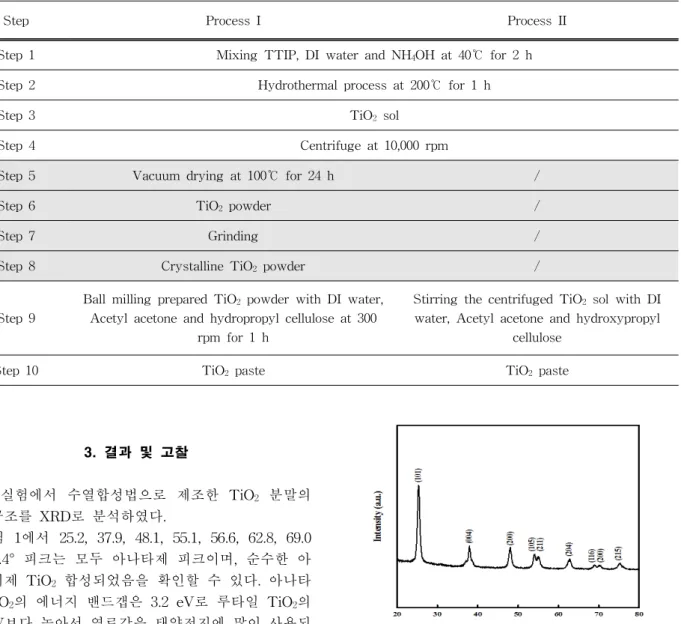
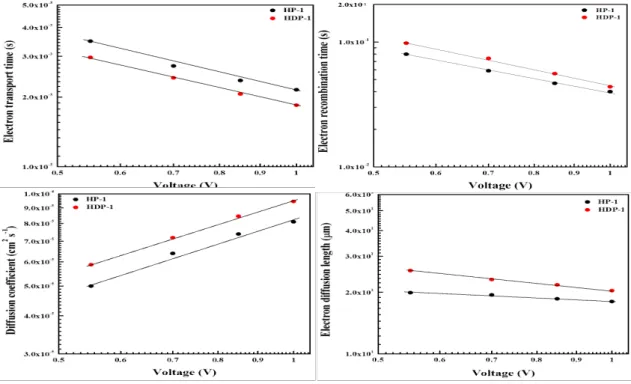
Abstract: In this work, in order to manufacture the photoelectrode of dye-sensitized solar cells, the different anatase TiO2 paste was prepared by simple route using hydrothermal method. In comparison with the traditional preparing process, the hydrothermally synthesized TiO2 gel was used to make paste directly. Thus, the making process was simplified and the solar conversion efficiency was improved. In comparison with 5.34% solar energy efficiency of HP-1 photoelectrode, the 6.23% efficiency of HDP-1 electrode was improved by 16.67%. This is because hydrothermally synthesized TiO2 gel was used to make paste directly, the dispersibility between TiO2 particles was improved and get the smoother network, leading to the charge transport ability of the electron generated in dye molecular was improved.
Further, HDP-2 photoelectrode delivered the best results with Voc (open circuit voltage), Jsc (short circuit current density) FF (fill factor) and η(solar conversion efficiency) were 0.695 V, 15.81 mA cm-2, 61.48% and 6.80%, respectively. In comparison with 5.34% of HP-1 photoelectrode, it was improved by 27.34%.
Keywords: Dye-sensitized solar cells, Hydrothermal method, Simple process
1. 서 론
염료감응 태양전지 (
dye-sensitized solar cells, DSSCs)는 1991년 O’regan과 Grätzel에 의해 7%의 에
a. Corresponding author; [email protected]
Copyright ©2014 KIEEME. All rights reserved.This is an Open-Access article distributed under the terms of the Creative Commons Attribution Non-Commercial License (http://creativecommons.org/licenses/by-nc/3.0) which permits unrestricted non-commercial use, distribution, and reproduction in any medium, provided the original work is properly cited.