• 검색 결과가 없습니다.

Subcutaneous Sacrococcygeal Myxopapillary Ependymoma in Asian Female:A Case Report

N/A
N/A
Protected

Academic year: 2021

Share "Subcutaneous Sacrococcygeal Myxopapillary Ependymoma in Asian Female:A Case Report"

Copied!
3
0
0

로드 중.... (전체 텍스트 보기)

전체 글

(1)

Case Report J Clin Med Res • 2011;4(1):61-63

Elmer ress

Articles © The authors | Journal compilation © J Clin Med Res and Elmer Press™ | www.jocmr.org

Subcutaneous Sacrococcygeal Myxopapillary Ependymoma in Asian Female:A Case Report

Kyung-Jae Lee a, b , Byung-Woo Min a , Hyuk-Jun Seo a , Chul-Hyun Cho a

Abstract

Subcutaneous sacrococcygeal myxopapillary ependymoma is ex- tremely rare tumor that has a tendency to develop in children and adolescents. There have been several case reports and sporadic re- ports in the literature. However, no case has been reported in an Asian patient, to the best of our knowledge. We describe a 25-year- old Asian female patient with a subcutaneous sacrococcygeal myxopapillary ependymoma that had been clinically diagnosed as a pilonidal cyst. The tumor was treated successfully by surgical ex- cision and the patient is doing well without evidence of local recur- rence or distant metastasis at 2 years after surgery.

Keywords: Myxopapillary ependymoma; Subcutaneous; Sacro- coccygeal

Introduction

Ependymomas are slowly growing glial cancers of the central nervous system that account for over 60% of spinal tumors of glial origin [1]. However, they rarely occur outside of the central nervous system known as extraspinal ependymomas.

The majority of the extraspinal ependymomas occur in the sacrococcygeal subcutaneous tissue or the presacral regions [2-7]. Although the incidences of ependymoma do not differ with respect to race [8], no case of subcutaneous sacrococ- cygeal myxopapillary ependymoma has been reported in an Asian patient. We present a case of an ependymoma arising from the sacrococcygeal subcutaneous tissue in a 25-year- old Asian female.

Case Report

A previously healthy 25-year-old-Asian woman was referred for evaluation of an enlarging, painless, subcutaneous mass located intergluteal fold. It was clinically diagnosed as a pi- lonidal cyst by previous examiner. She could remember that a mass had been present in this region for 2 years. During the 2-year period the mass had slowly increased in size from less than 0.5 cm to over 2.5 cm in diameter. During the past few months, the mass had become tender and sometimes making it uncomfortable to sit down. There was no history of urinary or faecal problems. Physical examination revealed a 2 × 3 cm sized, solid, mildly tender, mobile mass over the coccyx.

It was well circumscribed proximally but not in distally on palpation. Neurological examination was normal.

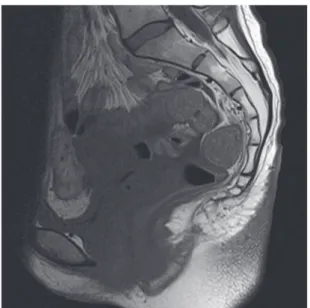
Magnetic resonance imaging (MRI) revealed a 6 ×3 cm well-circumscribed subcutaneous mass located over the coc- cyx. This tumor was comprised of two ovoid mass and there was no direct invasion to the coccyx (Fig. 1). Ultrasonogra- phy (USG)-guided needle biopsy was performed and micro- scopic examination showed a myxopapillary ependymoma.

Computed tomography (CT) scanning of the thorax and ab- domen demonstrated no evidence of lung or liver metasta- ses. Isotope bone scanning revealed no evidence of skeletal metastases.

The mass was completely excised. Intraoperatively, the lesion was seen near the tip of the coccyx and well-cir- cumscribed. It was composed of two ovoid but contiguous masses, the larger 3.0 × 2.5 × 1.5 cm, and the smaller 1.2

×1.0 ×0.8 cm (Fig. 2). The histology of the specimens again confirmed a myxopapillary ependymoma (Fig. 3). Her post- operative course was uneventful and no adjuvant therapy

Manuscript accepted for publication December 5, 2011

a

Department of Orthopaedic Surgery, College of Medicine, Keimyung University, Daegu, Korea

b

Corresponding author: Kyung-Jae Lee, Department of Orthopaedic Surgery, Dongsan Medical Center, College of Medicine, Keimyung University, 194 Dongsan-dong, Joong-Gu, Daegu, Korea.

Email: [email protected] doi:10.4021/jocmr678w

61 62

(2)

J Clin Med Res • 2011;4(1):61-63 Lee et al

Articles © The authors | Journal compilation © J Clin Med Res and Elmer Press™ | www.jocmr.org

was offered.

During 2 years of follow-up no local recurrence or me- tastasis were detected, with chest radiography and abdomi- no-pelvic MRI (Fig. 4).

Discussion

Because ependymal cells may be found within the coccygeal ligament as well as in heterotopic position and thus ependy- momas may rarely occur in extraspinal locations. Extraspi- nal ependymomas may be found in four general situations:

metastatic extension from a primary central nervous system neoplasm; direct extension into the soft tissue of the sacro- coccygeal area from primary ependymoma of the spinal

cord, filium terminale, or cauda equina; primary tumor of the skin and subcutaneous tissue without any demonstrable con- nection with the spinal cord; and primary presacral, pelvic, or abdominal tumor [5, 9]. Our case would correspond to the third situation of this classification.

Since the original description of an extraspinal ependy- moma by Mallory in 1902 [4], there have been several case reports and sporadic reports in the literature [2, 3, 5-7]. With the review of literature, subcutaneous sacrococcygeal myxo- papillary ependymomas are usually presented as a slow- growing mass in the intergluteal fold and often mistaken for a pilonidal cyst or other benign mass. The differential diagnosis includes pilonidal disease, teratoma, lipoma, chor- doma, myxoid chondrocarcinoma, metastatic mucoid carci- noma and metastatic carcinoid [7]. Our patient also clinically

Figure 1. MR image shows the well circumscribed mass near the coccyx. The tumor was lobulated with low signal T1- weighted (A) and high signal T2-weighted image (B).

Figure 2. Photograph of sectioned gross specimen shows a dark red to brown soft tissue tumor which composed of two

ovoid mass. Figure 3. Photomicrograph demonstrates a columnar cells sur-

rounding vascular cores. (H & E, × 200)

61 62

(3)

J Clin Med Res • 2011;4(1):61-63 Subcutaneous Sacrococcygeal Myxopapillary Ependymoma

Articles © The authors | Journal compilation © J Clin Med Res and Elmer Press™ | www.jocmr.org

diagnosed as a pilonical cyst.

The most important treatment for cure lies with com- plete surgical excision at the initial operation if possible.

Coccygectomy and adjuvant radiotherapy may be needed if the tumor is attached to coccyx, in case of incomplete exci- sion, or metastatic cases [2, 7]. Long-term and close follow- up should be needed, because these tumors may recur locally or become metastatic. Sonneland et al. [9] reported that the extrameningeal ependymomas tend to metastasize more fre- quently than their intrameningeal counterparts which origi- nate in the cauda. Also Helwig and Stern [5] reported four (17%) of 23 patients developed metastases and two of the metastasized patient died from progressive pulmonary and pleural metastasis. The best chance of survival of any patient with this type of tumor is achieved by complete excision at the time of the first operation [10].

We report a case of a subcutaneous sacrococcygeal myxopapillary ependymoma in an Asian female. To our knowledge, there has been no previous report of a case in an

Asian patient. Although very rare, extraspinal myxopapillary ependymomas must be considered in the differential diagno- sis of postsacral mass lesion. And postoperatively, long-term follow-up should be needed for evaluation of metastasis.

References

1. Russell DS, Rubinstein LJ. Pathology of tumors of the nervous system (4th ed). Baltimore: Williams and Wilkins, 1977.

2. Johnson JM, Jessurun J, Leonard A. Sacrococcygeal ep- endymoma: case report and review of the literature. J Pediatr Surg. 1999;34(9):1405-1407.

3. Morantz RA, Kepes JJ, Batnitzky S, Masterson BJ. Ex- traspinal ependymomas. Report of three cases. J Neuro- surg. 1979;51(3):383-391.

4. Mallory FB. Three Gliomata of ependymal Origin; Two in the Fourth Ventricle, One subcutaneous over the Coc- cyx. J Med Res. 1902;8(1):1-10 11.

5. Helwig EB, Stern JB. Subcutaneous sacrococcygeal myxopapillary ependymoma. A clinicopathologic study of 32 cases. Am J Clin Pathol. 1984;81(2):156-161.

6. Kramer GW, Rutten E, Sloof J. Subcutaneous sacrococ- cygeal ependymoma with inguinal lymph node metasta- sis. Case report. J Neurosurg. 1988;68(3):474-477.

7. Lynch J, Kelly N, Fitzpatrick B, Regan P. A sacrococ- cygeal extraspinal ependymoma in a 67-year-old man: a case report and review of the literature. Br J Plast Surg.

2002;55(1):80-82.

8. McGuire CS, Sainani KL, Fisher PG. Incidence patterns for ependymoma: a surveillance, epidemiology, and end results study. J Neurosurg. 2009;110(4):725-729.

9. Sonneland PR, Scheithauer BW, Onofrio BM. Myxopap- illary ependymoma. A clinicopathologic and immunocy- tochemical study of 77 cases. Cancer. 1985;56(4):883- 10. Miralbell R, Louis DN, O’Keeffe D, Rosenberg AE, Suit 893.

HD. Metastatic ependymoma of the sacrum. Cancer.

1990;65(10):2353-2355.

Figure 4. MR image taken 2 years after operation shows no local recurrence.

63

수치

Figure 1. MR image shows the well circumscribed mass near the coccyx. The tumor was lobulated with low signal T1- T1-weighted (A) and high signal T2-T1-weighted image (B).
Figure 4. MR image taken 2 years after operation shows no  local recurrence.

참조

관련 문서

The eruption of East Asian financial crisis in 1997 has aroused heated debate on the re-evaluation of past economic achievements of East Asian countries

This course is designed to provide students with claim adjustment practice in case of damage to property of the other party or damage to the own vehicle due to

Should a module be used with any of the absolute maximum ratings exceeded, the characteristics of the module may not be recovered, or in an extreme case, the module

(in case of partially miscible and form a low-boiling azeotrope).

(A) Interestingly, this has often been the case with English animal expressions.. As you may have observed, they make irregular twists and turns in their

• If the earbuds do not connect to a mobile device, the connection pop-up window does not appear, or your mobile device cannot find the earbuds, store them in the charging

1 John Owen, Justification by Faith Alone, in The Works of John Owen, ed. John Bolt, trans. Scott Clark, "Do This and Live: Christ's Active Obedience as the

- Through its energy development and supply, Russia has tried to join dynamic Northeast Asian economy in order to boost the depressed economies of East