Print ISSN: 2288-4637 / Online ISSN 2288-4645 doi:10.13106/jafeb.2021.vol8.no3.0479
The Impact of Shariah Supervisory Board and Shariah Audit Committee on Corporate Social Responsibility Adoption
at Islamic Banks in Bangladesh
K. M. Anwarul ISLAM 1 , Mohammad Shamsus SADEKIN 2 , Md. Tahidur RAHMAN 3 , Md. Ariful Haque CHOWDHURY 4
Received: November 20, 2020 Revised: January 26, 2021 Accepted: February 03, 2021
Abstract
Although corporate social responsibility (CSR) is an extensively studied topic, its determinants in the field of Islamic banking are scarce.
In Bangladesh, CSR plays a vital role in gaining customer loyalty and confidence. Therefore, this research aims to identify and analyze the influence of the Shariah Supervisory Board (SSB) and the Shariah Audit Committee (SAC) on CSR adoption in Islamic banks in Bangladesh. The study population is managers and second managers of 160 Islamic bank branches of different commercial banks in Dhaka, Bangladesh. The sampling technique used is convenience sampling where the first available primary data source was used for the research without additional requirements. The study developed a survey questionnaire from examining previous related studies in Islamic banking and CSR context. The final sample size in this research was n = 309, indicating the survey response rate was about 97%. The study used SPSS 23.0 software to interpret the statistical findings, and the findings revealed that support from the SSB and the presence of a strong and effective SAC has a strong correlation with CSR adoption and significantly influence CSR adoption in Islamic banks in Bangladesh. Finally, the study proposes several significant and crucial policy guidelines for Islamic bank branches to adopt CSR activities.
Keywords: Corporate Social Responsibility Adoption, Islamic Banks, Bangladesh, Shariah Supervisory Board, Shariah Audit Committee JEL Classification Code: A13, G21, G28
and significance. It has been the subject of considerable debate, commentary, theory-building, and research.
On the CSR front, the 1980s produced fewer new definitions of the concept, more empirical research, and the rise and popularity of alternative themes (Carroll &
Shabana, 2010). CSR is a self-regulating business model that helps a company be socially accountable—to itself, its stakeholders, and the public. By practicing CSR, companies can be conscious of the kind of impact they are having on all aspects of society, including economic, social, and environmental (Auliyah & Basuki, 2021). CSR programs provide an opportunity for businesses to positively engage with communities across all levels of society. CSR not only benefits communities. It also provides businesses with new and varied opportunities and can often be of mutual benefit for both businesses and the community (Isa & Reast, 2014). According to Windsor (2001), CSR can be defined as “the obligations of businessmen to pursue those policies, to make those decisions, or to follow those lines of action which are desirable in terms of the objectives and values of our society” (p. 227).
1. Introduction
Over the decades, the concept of corporate social responsibility (CSR) has continued to grow in importance
1
First Author and Corresponding Author. [1] Associate Professor, Department of Business Administration, The Millennium University, Dhaka, Bangladesh [2] Ph.D. Candidate, Faculty of Business and Accountancy, University of Selangor, Malaysia [Postal Address: 5, Momenbagh Road, Dhaka-1217, Bangladesh]
Email: [email protected]
2
Associate Professor, Department of Humanities, Chittagong University of Engineering & Technology, Chittagong, Bangladesh.
Email: [email protected]
3
Associate Professor, Department of Business Administration, Bangladesh Army International University of Science and Technology, Cumilla, Bangladesh. Email: [email protected]
4
Assistant Professor, Department of Business Administration, Bangladesh Army International University of Science and Technology, Cumilla, Bangladesh. Email: [email protected]
© Copyright: The Author(s)
This is an Open Access article distributed under the terms of the Creative Commons Attribution
Non-Commercial License (https://creativecommons.org/licenses/by-nc/4.0/) which permits
unrestricted non-commercial use, distribution, and reproduction in any medium, provided the
original work is properly cited.
Many corporate organizations in developed countries have seen the importance of responsible behavior towards society and the impact of CSR activities on customers, employees, investors, the environment, stakeholders, and business sustainability (Darusa et al., 2015). It is recommended that business firms, which are operating in Muslim countries, need to integrate their CSR activities with Islamic principles to gain more trust and confidence from Muslim customers (Bukhari et al., 2020). Research indicates CSR in Islamic banking emphasizes ethical values and social responsibility and is based on the principles of shariah law. As such, Islamic banks should incorporate CSR in business policy to enhance customer loyalty by portraying a positive image of the bank (Abdullahi et al., 2019).
Studies point out that the organizational implementation of CSR activities will lead to increased brand image, customer contentment, business performance, and goodwill of the business. More than ever before, companies engage in CSR initiatives to make a positive contribution to society or support their strategic goals (Skarmeas & Leonidou, 2013).
A company’s action towards CSR is considered an important determinant of corporate effectiveness and competitiveness (Yoon et al., 2006). In particular, companies may reap long term benefits of enhanced corporate reputation, improved relationships between the corporation and the local communities, differentiation, customer loyalty, increased worker motivation, quality workforce retention, and higher profitability by committing themselves to CSR practices (Smith, 2007). Hence, the adoption of CSR activities at the organizational level would bring out various benefits for the organization and it is crucial to examine what factors might influence the CSR adoption at the organizational level.
In recent years, Bangladesh has been performing excellently in several economic parameters to emerge as a developing and powerful economy, which is followed by a rising per capital income and gross domestic production (Akhter et al., 2020a; Rahaman et al., 2020). In a major leap forward, Bangladesh has become eligible to graduate to a developing country from a least developed one as it has met all the three criteria (per capita gross national income (GNI), human assets, and economic vulnerability to external shocks) (Hossain et al., 2019) for the first time for getting out of the UN’s Least Developed Countries (LDC) bloc. Bangladesh reached the lower middle-income country status in 2015. In 2018, Bangladesh fulfilled all three eligibility criteria for graduation from the LDC list for the first time and is on track for graduation in 2024 (Akhter et al., 2020b).
The service and manufacturing sectors in Bangladesh are a huge contributor to the country’s economic growth.
Graduating from LDC status is a sign that a country’s per capita gross national income, human assets, and resilience
to economic and environmental shocks are robust enough to enable sustainable development (Islam et al., 2020;
Jahan et al., 2020). The fast and stable growth of Islamic banks in the world financial system during the last few decades indicate the inherent strength of Islamic banking as a challenging alternative to the interest-based capitalistic financial system. The Islamic finance industry has expanded rapidly over the past decade, growing at 10–12% annually (Alam et al., 2020).
In tandem with the global rapid expansion of Islamic banking, Bangladesh has experienced phenomenal growth in Islamic banking following strong public demand for the system. Since its inception in 1983, the Islamic banking industry has recorded robust performance and the industry now accounted for more than twenty percent market share of the entire banking industry in Bangladesh Still, academic literature is very scarce in determining what might influence the CSR adoption at Islamic branch banking level.
As Muslim customers are increasing day by day and their demands for Islamic banking services are also soaring up at the same time, it is critical to identify what factors influence CSR adoption of branches at Islamic banks. And, since SSB and SAC have become an indispensable part of Islamic banks, therefore this study aims at finding the influence of the SSB and SAC on CSR adoption in Islamic bank branches in Bangladesh.
2. Literature Review and Hypotheses 2.1. Shariah Supervisory Board and Corporate
Social Responsibility Adoption
Shariah principles are the foundation for the practice of Islamic finance through the observance of the tenets, conditions, and principles espoused by Shariah. Each Islamic bank has a SSB, which consists of Shariah members who look after the bank’s accounting and financial aspects from the Islamic viewpoint (Neifar et al., 2020; Ajili & Bouri, 2018). SSB is the internal corporate governance tool through which Islamic banking activities are monitored in the light of Islamic principles (Rafay
& Farid, 2018; Quttainah et al., 2013). SSB ensures corporate transparency and accountability within the Islamic banking system (Mollah & Zaman, 2015; Grassa, 2013). The SSB is entrusted with the duty of directing, reviewing, and supervising the activities of the Islamic financial institution (Bukhari et al., 2020; Nomran et al., 2018). Members of the SSB actively participate in the board meetings with the higher management committee of an Islamic bank to make sure the Shariah compliance at every level of banking operation (Grassa, 2015; Raman &
Bukair, 2013). In carrying out its activities, the Shariah
board needs a clear framework and structure to ensure its independence and effectiveness (Maali et al., 2006). Shariah governance is considered a unique kind of governance in financial architecture, as it is concerned with the religious aspects of the overall activities of Islamic financial institutions as compared to the conventional concept of corporate governance (Islam & Bhuiyan, 2019; Alnasser &
Muhammed, 2012). The members of SSB have a critical influence on Islamic banking operations by appointing an auditor at the branch banking level. Hence, it is to be assumed that getting necessary and sufficient support from the SSB would stimulate the CSR adoption at the Islamic branch banking level. Thus, it is supposed that
H1: Support from Shariah Supervisory Board will influence the Corporate Social Responsibility adoption in Islamic bank branches.
2.2. Shariah Audit Committee and Corporate Social Responsibility Adoption
The presence of a strong and effective SAC is a prerequisite for the Islamic banking system to ensure Shariah compliance, adequate CSR disclosure, and to promote accountability and transparency of the Islamic banking activities (Puad et al., 2019). The primary purpose of an audit committee is to provide oversight of the financial reporting process, the audit process, the bank’s system of internal controls, and compliance with laws and regulations (Pucheta‐Martínez & De Fuentes, 2007).The presence of a strong and effective SAC is an important element for the Islamic banking system as the presence of an audit committee contributes to financial risk for smooth Islamic banking operation (Khalid et al., 2017).
An effective internal audit function provides independent assurance to the board of directors and senior management on the quality and effectiveness of a bank’s internal control, risk management, and governance systems and processes, thereby helping the board and senior management protect their organization and its reputation (Khan et al., 2013).
Previous studies have found that an effective audit committee has an influence on CSR disclosure in Islamic banks (Ridwan & Mayapada, 2020; Bastina & Bernawati, 2019; Katmon et al., 2019). Therefore, it can be assumed that the presence of an effective and strong SAC can influence the CSR adoption at the branch banking level.
Hence, it is supposed that
H2: The presence of a strong and effective Shariah audit committee will influence the Corporate Social Responsibility adoption inIslamic bank branches.
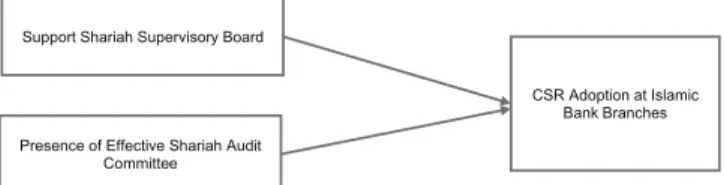
Based on the hypotheses, the following study model is proposed (figure 1):
3. Methodology
In Bangladesh, each commercial bank has its own branch banking facility. The study adopted a convenience method for sampling. Convenience sampling is a specific type of non- probability sampling method that relies on data collection from population members who are conveniently available to participate in the study. Therefore, based on the convenience sampling method, the study has chosen 160 Islamic bank branches of forty different commercial banks which are specifically known and famous for providing seamless and effective Islamic Shariah-based banking services in Dhaka, Bangladesh. Dhaka city was chosen as this is the capital city and Islamic banking hub in Bangladesh. It is also believed that the sample of 160 Islamic bank branches would produce generalizable results. Generalizability is applied by researchers in an academic setting. It can be defined as the extension of research findings and conclusions from a study conducted on a sample population to the population at large. A total of 320 survey questionnaires, with the request application to act as the study respondent, were sent to each bank branch through the postal service. The survey questionnaire was formulated based on prior research. In Bangladesh’s banking industry, each branch is jointly headed by a manager and a second manager and they are considered as having complete knowledge about Islamic banking and CSR activities.
The researchers of this study perceived that managers and second managers would have sufficient knowledge of the variables which may influence CSR adoption in Islamic bank branches. Thus, the study considered the managers and second managers of each Islamic bank branch as the study sample. Therefore, the study sent mail invitations with a research questionnaire to the managers and second managers of each Islamic bank branch. The mail invitation containeda survey questionnaire and application letter which described the importance and essence of this research study in regard to the Islamic banking industry for making the questionnaire more understandable and easy to the study respondents. Also, several emails and phone calls were made to each study respondent for producing more response rate for this research. In return, 309 responses were finally received from managers and second managers, and all of these 309 responses were realized as usable for this study. Therefore, the survey response rate was 97% (n = 309) and all responses were fully completed.
Support Shariah Supervisory Board
Presence of Effective Shariah Audit Committee
CSR Adoption at Islamic Bank Branches
Figure 1: Proposed Study Model
Source: Author’s Own
The Likert scale is a type of psychometric response scale in which respondents specify their level of agreement to a statement typically in five points: (1) Strongly disagree;
(2) Disagree; (3) Neither agree nor disagree; (4) Agree;
(5) Strongly agree.The study used a five-point Likert scale (Likert, 1931) questionnaire to gather study data from the respondents, where “1” was marked as fully dissatisfied with the given statement based question and “5” was marked as fully satisfied. The study has undertaken SPSS 23.0 for performing statistical analysis (i.e. hypotheses testing) and also confirmed the internal consistency and validity of each instrument. Cronbach’s alpha is a measure of internal consistency, that is, how closely related a set of items are as a group. It is considered to be a measure of scale reliability.
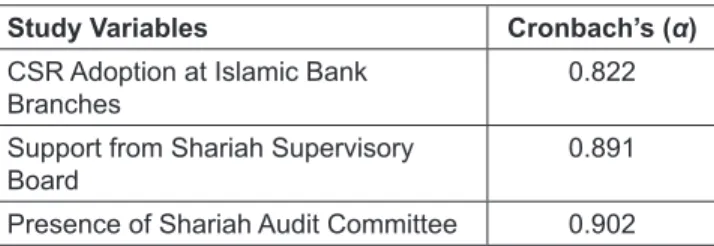
Cronbach alpha values of 0.7 or higher indicate acceptable internal consistency (Pallant, 2000; Hair et al., 2010). All the study variables were found to be reliable (Table 1);
since the alpha (α) value of each variable is more than 0.8 which is considered as good reliability for each variable (Taber, 2018).
4. Results and Discussion
Table 2 reveals the basic demographic profile (age, gender, education, designation, and work experience) of the respondents. Table 2 shows that 281 (91%) Islamic bank managers (including both managers and second managers) were male and only 28 (9%) were female. In terms of age distribution, 175 Islamic bank managers (including both managers and second managers) were aged between 26 years to 35 years (57%), 103 Islamic bank managers were aged between 36 years to 45 years (33%), and 31 Islamic bank managers were above 45 years of age (10%). According to academic achievement, almost 84% (n = 258) of the Islamic bank managers (including both managers and second managers) had completed their master’s degree, while almost 5% (n = 15) had completed their doctoral degree and around 12% (n = 36) of them completed their bachelor’s degree. According to the professional designation, 211 Islamic branch bank managers (68%) and 98 second managers (32%) of Islamic bank branches took part in this study. In terms of Islamic banking experience, 56 Islamic bank managers (including
both managers and second managers) (18%) had 1 to 3 years of Islamic banking experience, 89 Islamic bank managers (29%) had 4 to 6 years of Islamic banking experience, 141 Islamic bank managers (46%) had 7 to 10 years of Islamic banking experience and 23 Islamic bank managers (7%) had more than 10 years of Islamic banking experience.
The correlation evaluation outcomes showed that the relationship between CSR intention and the determinants was satisfactory (Table 3). The highest correlation was found between CSR adoption in Islamic bank branches and Support from SSB (r = 0.517). A significant and considerable correlation was found between the presence of the SAC and CSR adoption in Islamic bank branches (r = 0.508).
Regression analysis is a data analysis technique that examines relationships between variables. The techniques allow survey researchers to answer questions about associations between different variables of interest.
Regression analysis was applied to measure the impact of four predictive variables on CSR intention. The Durbin Watson (DW) statistic is a test for autocorrelation in the residuals from a statistical regression analysis. Values from 0 to less than 2 indicate positive autocorrelation.The Durbin-Watson test shows a proper value of 1.996, which is acceptable (Durbin & Watson,1950).
Table 1: Reliability Measurement of the Study Variables
Study Variables Cronbach’s (α)
CSR Adoption at Islamic Bank
Branches 0.822
Support from Shariah Supervisory
Board 0.891
Presence of Shariah Audit Committee 0.902
Table 2: Description of the Respondents Basic Demographic Profile
Description Frequency Percentage
Gender
Male 281 90.9
Female 28 9.1
Age
26 to 35 years 175 56.6
36 to 45 years 103 33.4
More than 46 years 31 10.0
Position at Islamic Bank Branch
Manager 211 68.3
Second Manager 98 31.7
Academic Qualification
PhD 15 4.8
Master/Master Equivalent
Degree 258 83.5
Bachelor Degree 36 11.7
Islamic Banking Experience
1–3 years 56 18.2
4–6 years 89 28.8
7–10 years 141 45.6
More than 10 years 23 7.4
(n = 309)
Table 3: Correlations among Associated Variables
Correlations CSR Adoption at
Islamic Bank Branch
Support from Shariah Supervisory
Board
Presence of Shariah Audit
Committee
CSR Adoption at Islamic Bank Branches 1
Support from Shariah Supervisory Board 0.517
**1
Presence of Shariah Audit Committee 0.431
**0.508
**1
** Correlation is significant at the 0.01 level (2-tailed). n = 309.
Table 4: Regression Analysis
R
2Change F change β value t-value p-value Tolerance VIF Decision Support from Shariah
Supervisory Board 0.388 50.789 0.279 5.365 0.004* 0.668 1.782 Accepted
Presence of Shariah Audit
Committee 0.323 4.964 0.000** 0.452 1.629 Accepted
[n = 309; **p < 0.01; *p < 0.05].
Durbin Watson Value: 1.996.
Dependent Variable: CSR adoption at an Islamic bank.
Figure 2: Regression Results of the Study Model Source: Author’s Own
β= 0.279*
Support Shariah Supervisory Board
Presence of Effective Shariah Audit Committee
CSR Adoption at Islamic Bank
Branches
β= 0.323** R2=0.388