17 DOI: 10.4196/kjpp.2011.15.1.17
ABBREVIATIONS: 5-HT3A, 5-hydroxytryptamine 3A; ACh, acetylcho- line; Que, quercetin.
Received December 27, 2010, Revised January 17, 2011, Accepted January 18, 2011
Corresponding to: Seung-Yeol Nah, Department of Physiology, College of Veterinary Medicine and Bio/Molecular Informatics Center, Konkuk University, 1, Hwayang-dong, Gwangjin-gu, Seoul 143-701, Korea. (Tel) 82-2-450-4154, (Fax) 82-2-450-3037, (E-mail) [email protected]
*These authors contributed equally to this work.
Quercetin Inhibits α3β4 Nicotinic Acetylcholine Receptor-Mediated Ion Currents Expressed in Xenopus Oocytes
Byung-Hwan Lee*, Sung-Hee Hwang*, Sun-Hye Choi*, Tae-Joon Shin, Jiyeon Kang, Sang-Mok Lee, and Seung-Yeol Nah
Department of Physiology, College of Veterinary Medicine and Bio/Molecular Informatics Center, Konkuk University, Seoul 143-701, Korea
Quercetin mainly exists in the skin of colored fruits and vegetables as one of flavonoids. Recent studies show that quercetin, like other flavonoids, has diverse pharmacological actions. However, relatively little is known about quercetin effects in the regulations of ligand-gated ion channels. In the previous reports, we have shown that quercetin regulates subsets of homomeric ligand-gated ion channels such as glycine, 5-HT3A and α 7 nicotinic acetylcholine receptors. In the present study, we examined quercetin effects on heteromeric neuronal α 3β 4 nicotinic acetylcholine receptor channel activity expressed in Xenopus oocytes after injection of cRNA encoding bovine neuronal α 3 and β 4 subunits. Treatment with acetylcholine elicited an inward peak current (IACh) in oocytes expressing α3β 4 nicotinic acetylcholine receptor. Co-treatment with quercetin and acetylcholine inhibited IACh
in oocytes expressing α 3β 4 nicotinic acetylcholine receptors. The inhibition of IACh by quercetin was reversible and concentration-dependent. The half-inhibitory concentration (IC50) of quercetin was 14.9±
0.8 μM in oocytes expressing α 3β4 nicotinic acetylcholine receptor. The inhibition of IACh by quercetin was voltage-independent and non-competitive. These results indicate that quercetin might regulate α3β 4 nicotinic acetylcholine receptor and this regulation might be one of the pharmacological actions of quercetin in nervous systems.
Key Words: Flavonoids, Quercetin, α3β4 nicotinic acetylcholine receptor, Xenopus oocyte
INTRODUCTION
Nicotinic acetylcholine receptors are members of the Cys-loop family of ligand-gated ion channels [1]. Currently, sixteen different nicotinic acetylcholine receptor subunits are known [2]. Muscle form of nicotinic acetylcholine re- ceptor consists of α1β1γε. Activation of muscle form of nicotinic acetylcholine receptor initiates muscle contraction by inducing depolarization of neuromuscular junctions.
Neuronal forms of nicotinic acetylcholine receptor consist of α (α2-7, α9, α10) and β (β2-4) and their activations are mainly involved in rapid synaptic transmissions in cen- tral and peripheral nervous systems [2]. Neuronal nicotinic acetylcholine receptor contain α2-6 subunits that are usu- ally expressed as heteropentamers in combination with β 2-4 subunits [3-6]. For example, the α3 and β4 subunits can form heteromeric receptors [7]. Although many nic- otinic acetylcholine receptor subunits are expressed in the central and peripheral nervous systems, the distributions
of α3β4 nicotinic acetylcholine receptor are mainly re- stricted to several tissues such as adrenal chromaffin cells [8,9]. The α3β4 nicotinic acetylcholine receptors play an important role for release of catecholamine releases [10].
Skin of colored fruits and vegetables contains a variety of flavonoids and quercetin is one of representative fla- vonoids (Fig. 1A) [11]. Quercetin exhibits multiple pharma- cological activities in nervous and non-nervous systems [12-16]. However, the underlying cellular mechanisms of quercetin actions are relatively unknown, especially with regards to possible regulation of receptors or ionic channels involved in synaptic transmissions. Recently, we demon- strated that quercetin differentially regulates subsets of nicotinic acetylcholine receptor such as homomeric glycine, 5-HT3A, α7 and α9α10 nicotinic acetylcholine receptors [17-20]. In the present study, we examined the effects of quercetin on heteromeric α3β4 nicotine acetylcholine re- ceptor channel activity and report here that quercetin in- hibits heteromeric α3β4 nicotine acetylcholine receptor channel activity with voltage-independent and non-com- petitive manner. These results indicate that quercetin might play a role for the regulation of nicotinic acetylcho- line receptor channel activities.
Fig. 1. Chemical structure of quercetin (A) and effect of quercetin (Que) in oocytes expressing α3β4 nicotinic acetylcholine receptors.
Quercetin itself had no effect on IACh in oocytes expressing α3β4 nicotinic acetylcholine receptors (B).
METHODS Materials
Bovine α3 and β4 nicotine acetylcholine receptor sub- unit cDNAs were kindly provided by Dr. S. Sala (Universi- dad Miguel Hernández-Consejo Superior de Investigaciones Cientificas, Spain). Quercetin (Fig. 1A) and all other re- agents were purchased from Sigma-Aldrich (St. Louis, MO, USA).
Preparation of Xenopus laevis oocytes and microinjec- tion
X. laevis frogs were purchased from Xenopus I (Ann Arbour, MI, USA). Animal care and handling were in ac- cordance with the highest standards of Konkuk university guidelines. To isolate oocytes, frogs were anesthetised with an aerated solution of 3-amino benzoic acid ethyl ester, and the ovarian follicles were removed. The oocytes were sepa- rated with collagenase followed by agitation for 2 h in a Ca2+-free medium containing 82.5 mM NaCl, 2 mM KCl, 1 mM MgCl2, 5 mM HEPES, 2.5 mM sodium pyruvate, 100 units/ml penicillin, and 100 μg/ml streptomycin. Stage V-VI oocytes were collected and stored in a ND96 medium (96 mM NaCl, 2 mM KCl, 1 mM MgCl2, 1.8 mM CaCl2, and 5 mM HEPES, pH 7.5) supplemented with 50 μg/ml genta- micin. The solution containing the oocytes was maintained at 18oC with continuous gentle shaking and was replaced daily. Electrophysiological experiments were performed three to five days after oocyte isolation. For α3β4 nicotine acetylcholine receptor experiments, α3 and β4 nicotine acetylcholine receptor subunit-encoding cRNAs (40 nl) were co-injected into the animal or vegetal pole of each oocyte 1 day after isolation using a 10-μl microdispenser (VWR Scientific, West Chester, PA, USA) fitted with a tapered glass pipette tip (15∼20 μm in diameter) [19].
Data recording
A custom-made Plexiglas net chamber was used for two-electrode voltage-clamp recordings, as previously re- ported [19]. A single oocyte was constantly superfused with a recording solution (96 mM NaCl, 2 mM KCl, 1.8 mM CaCl2, and 10 mM HEPES, pH 7.5) in the absence or pres- ence of glutamate or quercetin during recording. The micro- electrodes were filled with 3 M KCl and had a resistance of 0.2∼0.7 MΩ. Two-electrode voltage-clamp recordings were obtained at room temperature using an Oocyte Clamp (OC-725C, Warner Instrument) and were digitised using Digidata 1,200 A (Molecular Devices, Sunnyvale, CA, USA).
Stimulation and data acquisition were controlled using pClamp 8 software (Molecular Devices). For most electro- physiological data, the oocytes were clamped at a holding potential of −80 mV. For current and voltage (I-V) relation- ship, voltage ramps were applied from −100 to +60 mV for 300-ms. In the different membrane-holding potential ex- periments, the oocytes were clamped at the indicated hold- ing potentials. Linear leak and capacitance currents were corrected by means of the leak subtraction procedure.
Data analysis
To obtain the concentration-response curve for the effect of quercetin on the inward peak IACh mediated by the α3β4 nicotinic acetylcholine receptor, the IACh peak was plotted at different concentrations of quercetin. Origin software (OriginLab Corp., Northampton, MA, USA) was used to fit the plot to the Hill equation: I/Imax=1/[1+(IC50/[A])nH], where Imax was maximal current obtained from each ED50
value of acetylcholine in wild-type receptors, IC50 was the concentration of quercetin required to decrease the re- sponse by 50%, [A] was the concentration of quercetin, and nH was the Hill coefficient. All values were presented as mean±S.E.M. The differences between the means of control and treatment data were determined using the unpaired Student’s t-test. A value of p<0.05 was considered to be statistically significant.
RESULTS
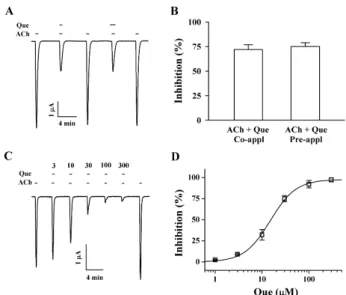
Effect of quercetin on IACh in oocytes expressing hetero- meric α3β4 nicotinic acetylcholine receptors The addition of acetylcholine to the bathing solution in- duced a large inward current in oocytes injected with α3β 4 nicotinic acetylcholine receptor, indicating that this nic- otinic acetylcholine receptor was functionally expressed in this system (Fig. 1B). Quercetin itself had no effect in oo- cytes expressing α3β4 nicotinic acetylcholine receptors at a holding potential of −80 mV (Fig. 1B). But co- and pre- treatment with quercetin and acetylcholine inhibited IACh
in oocytes expressing α3β4 nicotinic acetylcholine re- ceptors (Fig. 2A and B, n=9 from three different frogs). The inhibition of IACh by quercetin in oocytes expressing α3β4 nicotinic acetylcholine receptors was reversible with a neg- ligible desensitization (Fig. 2A). Thus, these results suggest the possibility that quercetin regulates α3β4 nicotinic ace- tylcholine receptor channel activity, although quercetin it- self had no effect on α3β4 nicotinic acetylcholine receptor channel activity.
Fig. 2. Effect of quercetin (Que) on IACh in oocytes expressing α3β4 nicotinic acetylcholine receptors. (A) Acetylcholine (ACh, 100 μM) was first applied and then acetylcholine was co- or pre-applied with quercetin (Que, 30 μM). Thus, co- and pre-application of quercetin with acetylcholine inhibited IACh. The resting membrane potential of oocytes was about −35 mV and oocytes were voltage-clamped at a holding potential of −80 mV prior to drug application. Traces are representative of six separate oocytes from three different frogs.
(B) Co- or pre-application of quercetin did not affect differently on IACh. (C) IACh in oocytes expressing α3β4 nicotinic acetylcholine receptors was elicited at −80 mV holding potential with indicated time in the presence of 100 μM acetylcholine and then the indicated concentration of quercetin was co-applied with acetylcholine. (D)
% Inhibition by quercetin of IACh was calculated from the average of the peak inward current elicited by acetylcholine alone before quercetin and the peak inward current elicited by acetylcholine alone after co-application of quercetin with acetylcholine. The continuous line shows the curve fitted according to the equation.
y/ymax=[Quercetin]/[Quercetin]+K1/2), where ymax, the maximum inhibition (97.8±1.7%, mean±S.E.M.) and K1/2 is the concentration for half-maximum inhibition (14.9±0.8 μM, mean±S.E.M.), and [Quercetin] is the concentration of quercetin. Each point represents the mean±S.E.M. (n=9∼12 from three different frogs).
Fig. 3. Current-voltage relationship and voltage-independent inhibition by quercetin. (A) Current-voltage relationships of IACh
inhibition by quercetin (Que) in α3β4 nicotinic acetylcholine receptors. Representative current-voltage relationships were obtained using voltage ramps of −100 to +60 mV for 300 ms at a holding potential of −80 mV. Voltage steps were applied before and after application of 100 μM acetylcholine in the absence or presence of 20 μM quercetin. (B) Voltage-independent inhibition of IACh in the α3β4 nicotinic acetylcholine receptors by quercetin.
Inset; the values were obtained from the receptors in the absence or presence of 20 μM quercetin at the indicated membrane holding potentials.
Concentration-dependent effect of quercetin on IACh in oocytes expressing α3β4 nicotinic acetylcholine receptor Since pre-treatment of quercetin did not induce further inhibition on IACh in oocytes expressing α3β4 nicotinic ace- tylcholine receptor compared to co-treatment, in next ex- periments we examined quercetin effects on IACh after co-treatment of quercetin with acetylcholine. In concen- tration-response experiments, co-treatment of quercetin with acetylcholine inhibited IACh in a concentration-depend- ent manner in oocytes expressing α3β4 nicotinic ace- tylcholine receptor (Fig. 2C). The IC50 of IACh was 14.9±0.8 μM in oocytes expressing α3β4 nicotinic acetylcholine re- ceptors (n=9∼12 from three different frogs) (Fig. 2D).
Current-voltage relationship and voltage-independent inhibition in oocytes expressing α3β4 nicotinic acetyl- choline receptors by quercetin
As shown in Fig. 3, the current-voltage relationship in- duced by acetylcholine with voltage steps from −100 to
+60 mV showed a slight rectification at positive potentials in oocytes expressing α3β4 nicotinic acetylcholine recep- tor. The reversal potential of α3β4 nicotinic acetylcholine receptors was Vr=−11.2±2.4 mV (means±S.E.M., n=6 from three different frogs). Co-treatment with quercetin and ace- tylcholine did not modify the reversal potential of α3β4 nicotinic acetylcholine receptor with a reduction of IACh (n=
6 from three different frogs). The inhibitory effect of querce- tin on IACh in oocytes expressing α3β4 nicotinic acetylcho- line receptors was independent of the membrane holding potential (Fig. 3B). Thus, quercetin inhibited IACh by 65.4±
4.1, 65.7±1.7, 66.8±5.7, and 65.8±2.8% at −120, −90, −60, and −30 mV membrane holding potential in oocytes ex- pressing α3β4 nicotinic acetylcholine receptor, re- spectively (Fig. 3B; n=9∼12, from three different frogs).
Noncompetitive inhibition of α3β4 nicotinic acetyl- choline receptors by quercetin
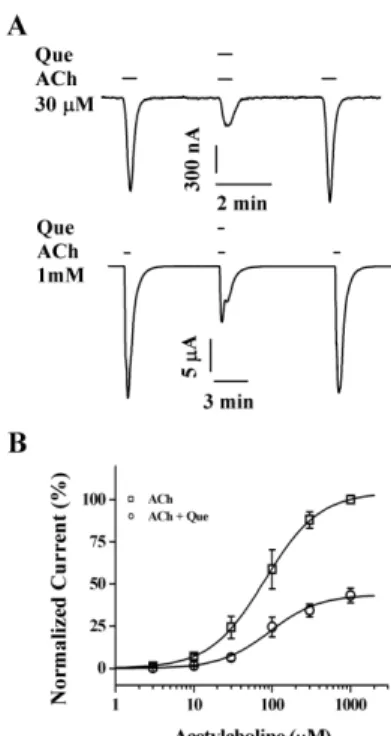
To study further the mechanism by which quercetin in- hibits IACh in oocytes expressing α3β4 nicotinic acetylcho- line receptors, we analyzed the effect of 20 μM quercetin on IACh evoked by different acetylcholine concentrations in oocytes expressing α3β4 nicotinic acetylcholine receptors (Fig. 4). Co-application of quercetin with different concen-
Fig. 4. Concentration-dependent effects of acetylcholine on quercetin-mediated inhibition of IACh. (A) The representative traces were obtained from α3β4 nicotinic acetylcholine receptors ex- pressed in oocytes. IACh of the upper and lower panels were elicited from concentration of 30 μM ACh and 1 mM ACh at a holding potential of −80 mV, respectively. (B) Concentration-response relationships for ACh in the α3β4 nicotinic acetylcholine receptors treated with ACh (3∼1,000 μM) alone or with ACh plus co-application of 20 μM quercetin. The IACh of oocytes expressing the α3β4 nicotinic acetylcholine receptors was measured using the indicated concentration of ACh in the absence (□) or presence (○) of 20 μM quercetin (Que). Oocytes were exposed to ACh alone or to ACh with quercetin. Oocytes were voltage-clamped at a holding potential of −80 mV. Each point represents the mean±
S.E.M. (n=9∼12/group).
trations of acetylcholine did not shift the dose-response curve of acetylcholine to the right (ED50, from 81.5 ±2.3 to 91.2±6.5 μM and Hill coefficient, from 1.25 to 1.37) in oo- cytes expressing α3β4 nicotinic acetylcholine receptors, indicating that quercetin regulates α3β4 nicotinic ace- tylcholine receptor channel activity with non-competitive manner (n=9∼12 from three different frogs) (Fig. 4).
DISCUSSION
In the present study, we demonstrated that (1) co- or pre-treatment with quercetin and acetylcholine inhibited IACh in oocytes expressing bovine α3β4 nicotine acetylcho- line receptor in reversible and concentration-dependent manner, (2) the inhibition of IACh by quercetin occurred in a non-competitive and voltage-independent manner in oo- cytes expressing α3β4 nicotinic acetylcholine receptors, indicating that quercetin could be associated with the in- hibitory regulator on IACh in oocytes expressing α3β4 nic- otinic acetylcholine receptors (Fig. 3 and 4).
From the present results, however, it is unclear precisely how quercetin acts to inhibit IACh in oocytes expressing α3
β4 nicotinic acetylcholine receptor. One possible mecha- nism is that quercetin may act as open channel blocker of α3β4 nicotinic acetylcholine receptors but this may be not the case because the inhibitory effect of quercetin on IACh
in oocytes expressing α3β4 nicotinic acetylcholine re- ceptors was not voltage-dependent (Fig. 3). It is known that open channel blockers such as local anesthetics or hexame- thonium are strongly voltage dependent, due to the charge that they carry in the transmembrane electrical field [21-23].
Another possibility is that quercetin may work as a com- petitive inhibitor by inhibiting acetylcholine binding to its binding site(s) in α3β4 nicotinic acetylcholine receptors.
In competition experiments, we observed that the presence of quercetin did not shift the concentration of acetylcholine in oocytes expressing α3β4 nicotinic acetylcholine re- ceptors without changing the Hill coefficient (Fig. 4). Thus, the non-competitive modulation of α3β4 nicotinic ace- tylcholine receptor channel activity by quercetin shows that quercetin might have different binding or interaction site(s) as a non-competitive inhibitor at α3β4 nicotinic acetylcho- line receptors.
The third and last possibility is that quercetin might have its binding sites for the regulation of α3β4 nicotinic acetylcholine receptor. In previous reports, we have demon- strated that the regulatory effects of quercetin on homo- meric glycine, 5-HT3 and α7 nicotinic acetylcholine re- ceptor channel activities were attenuated or abolished after site-directed mutations of amino acid residues of pre-trans- membrane domain of glycine and 5-HT3 receptor or Ca2+- binding sites of α7 nicotinic acetylcholine receptor [17-19].
Based on present results and previous reports, it is likely that quercetin achieves its effect through direct interactions with α3β4 nicotinic acetylcholine receptors. However, there might be some difficulties to construct mutant α3β4 nicotinic acetylcholine receptors to confirm quercetin bind- ing sites compared to the previous homomeric ligand-gated ion channels, since α3β4 nicotinic acetylcholine receptors consist of heteromeric α and β subunits, In future, further investigations will be required to identify quercetin binding site(s) on α3β4 nicotinic acetylcholine receptors.
Since subsets of nicotinic acetylcholine receptor channels play an important role for fast synaptic transmissions in postsynaptic sites, there are several reports on the regu- lations of nicotinic acetylcholine receptor channel activity using natural compounds such as flavonoids and poly- phenol. Grønlien et al showed that genistein, one of fla- vonoids, inhibits α7 nicotinic acetylcholine receptor chan- nel activity in oocytes expressing α7 nicotinic acetylcholine receptor [24]. Zhang et al showed that nobiletin, one of fla- vones inhibited catecholamine release by acetylcholine, whereas nobiletin stimulate catecholamine release via acti- vation of Ca2+ channels or Na+/Ca2+ exchangers [25]. In addition, Shinohara et al demonstrated that resveratrol, one of grape polyphenol exhibited a profound effect by in- hibiting on α3β4 nicotinic acetylcholine receptor and poly- phenols of Rubus coreanum also inhibited catecholamine re- lease from adrenal medulla [26,27]. On the other hand, in the previous studies we found that quercetin enhanced α7 nicotinic acetylcholine receptor channel activity with ex- tracellular Ca2+-independent manner, whereas quercetin inhibited α9α10 nicotinic acetylcholine receptor channel activity. In the present study, we found that quercetin in- hibited IACh in oocytes expressing α3β4 nicotinic ace- tylcholine receptors. Taking together of previous reports
and present results, these results indicate that quercetin might be a differential regulator of nicotinic acetylcholine receptors.
On the other hand, the previous reports have shown that various agents such as serotonin, strychnine, Ca2+ channel blockers, polyamines, steroids such as progesterone and hy- drocortisone, ethanol, and metal ion like Zn2+, regulate muscle or neuronal nicotinic acetylcholine receptors ex- pressed in Xenopus oocytes [28-35]. Interestingly, the mech- anism (i.e., voltage dependence or competition with ace- tylcholine for binding site) by which these substances regu- late nicotinic acetylcholine receptors depend on the receptor subunit composition. The previous and present studies showed that quercetin inhibited heteromeric α3β4 and α9α10 nicotinic acetylcholine receptor channel activities, whereas quercetin enhanced homomeric α7 nicotinic ace- tylcholine receptors. These results show the possibility that the differential effects of quercetin on subset of nicotinic acetylcholine receptor might be also due to different re- ceptor subunit composition. In addition, since these nic- otinic acetylcholine receptors may play an important role in modulating the neurotransmitter release or neuronal cell excitability induced by acetylcholine in pre-synaptic or post-synaptic site(s), quercetin-mediated differential regu- lations of subsets of nicotinic acetylcholine receptor channel activity might contribute to a diverse range of neuro- pharmacological effects of quercetin [12,13].
In summary, we found that quercetin inhibited IACh in oocytes expressing bovine neuronal α3β4 nicotinic ace- tylcholine receptors. Since α3β4 nicotinic acetylcholine re- ceptors are closely involved in neurotransmitter release in adrenal chromaffin cells, these inhibitory effects of querce- tin on IACh in oocytes expressing bovine neuronal α3β4 nicotinic acetylcholine receptor might provide the single cel- lular basis for one of mechanisms for the pharmacological effects of quercetin.
ACKNOWLEDGEMENTS
This work was supported by the Basic Science Research Program through the National Research Foundation of Korea (NRF), funded by the Ministry of Education, Science and Technology (R01-2008-000-10448-0). Support was also provided by the Priority Research Centers Program through the National Research Foundation of Korea (NRF), funded by the Ministry of Education, Science and Technology (2009-0093824), and by BK21 to S.Y. Nah.
REFERENCES
1. Jensen ML, Schousboe A, Ahring PK. Charge selectivity of the Cys-loop family of ligand-gated ion channels. J Neurochem.
2005;92:217-225.
2. Dani JA, Bertrand D. Nicotinic acetylcholine receptors and nicotinic cholinergic mechanisms of the central nervous system.
Annu Rev Pharmacol Toxicol. 2007;47:699-729.
3. Boulter J, Evans K, Goldman D, Martin G, Treco D, Heinemann S, Patrick J. Isolation of a cDNA clone coding for a possible neural nicotinic acetylcholine receptor alpha-subunit. Nature.
1986;319:368-374.
4. Boulter J, Connolly J, Deneris E, Goldman D, Heinemann S, Patrick J. Functional expression of two neuronal nicotinic acetylcholine receptors from cDNA clones identifies a gene family. Proc Natl Acad Sci U S A. 1987;84:7763-7767.
5. Karlin A. Emerging structure of the nicotinic acetylcholine receptors. Nat Rev Neurosci. 2002;3:102-114.
6. Gotti C, Clementi F. Neuronal nicotinic receptors: from struc- ture to pathology. Prog Neurobiol. 2004;74:363-396.
7. Boorman JP, Groot-Kormelink PJ, Sivilotti LG. Stoichiometry of human recombinant neuronal nicotinic receptors containing the b3 subunit expressed in Xenopus oocytes. J Physiol. 2000;
529:565-577.
8. Free RB, McKay SB, Boyd RT, McKay DB. Evidence for constitutive expression of bovine adrenal a3beta4* nicotinic acetylcholine receptors. Ann N Y Acad Sci. 2002;971:145-147.
9. Di Angelantonio S, Matteoni C, Fabbretti E, Nistri A. Molecular biology and electrophysiology of neuronal nicotinic receptors of rat chromaffin cells. Eur J Neurosci. 2003;17:2313-2322.
10. Campos-Caro A, Smillie FI, Domínguez del Toro E, Rovira JC, Vicente-Agulló F, Chapuli J, Juíz JM, Sala S, Sala F, Ballesta JJ, Criado M. Neuronal nicotinic acetylcholine receptors on bovine chromaffin cells: cloning, expression, and genomic organization of receptor subunits. J Neurochem. 1997;68:488- 11. Havsteen BH. The biochemistry and medical significance of the 497.
flavonoids. Pharmacol Ther. 2002;96:67-202.
12. Speroni E, Minghetti A. Neuropharmacological activity of extracts from Passiflora incarnata. Planta Med. 1988;54:488- 491.
13. Picq M, Cheav SL, Prigent AF. Effect of two flavonoid com- pounds on central nervous system. Analgesic activity. Life Sci.
1991;49:1979-1988.
14. Kandaswami C, Middleton E Jr. Free radical scavenging and antioxidant activity of plant flavonoids. Adv Exp Med Biol.
1994;366:351-376.
15. Oyama Y, Fuchs PA, Katayama N, Noda K. Myricetin and quercetin, the flavonoid constituents of Ginkgo biloba extract, greatly reduce oxidative metabolism in both resting and Ca(2
+)-loaded brain neurons. Brain Res. 1994;635:125-129.
16. Harborne JB, Williams CA. Advances in flavonoid research since 1992. Phytochemistry. 2000;55:481-504.
17. Lee BH, Jeong SM, Lee JH, Kim JH, Yoon IS, Lee JH, Choi SH, Lee SM, Chang CG, Kim HC, Han Y, Paik HD, Kim Y, Nah SY. Quercetin inhibits the 5-hydroxytryptamine type 3 receptor-mediated ion current by interacting with pre-trans- membrane domain I. Mol Cells. 2005;20:69-73.
18. Lee BH, Lee JH, Yoon IS, Lee JH, Choi SH, Pyo MK, Jeong SM, Choi WS, Shin TJ, Lee SM, Rhim H, Park YS, Han YS, Paik HD, Cho SG, Kim CH, Lim YH, Nah SY. Human glycine alpha1 receptor inhibition by quercetin is abolished or inversed by alpha267 mutations in transmembrane domain 2. Brain Res.
2007;1161:1-10.
19. Lee BH, Choi SH, Shin TJ, Pyo MK, Hwang SH, Kim BR, Lee SM, Lee JH, Kim HC, Park HY, Rhim H, Nah SY. Quercetin enhances human α7 nicotinic acetylcholine receptor-mediated ion current through interactions with Ca2+ binding sites. Mol Cells. 2010;30:245-253.
20. Lee BH, Choi SH, Shin TJ, Pyo MK, Hwang SH, Lee SM, Paik HD, Kim HC, Nah SY. Effects of quercetin on α9α10 nicotinic acetylcholine receptor-mediated ion currents. Eur J Pharmacol.
2011;650:79-85.
21. Sine SM, Taylor P. Local anesthetics and histrionicotoxin are allosteric inhibitors of the acetylcholine receptor. Studies of clonal muscle cells. J Biol Chem. 1982;257:8106-8114.
22. Heidmann T, Oswald RE, Changeux JP. Multiple sites of action for noncompetitive blockers on acetylcholine receptor rich membrane fragments from torpedo marmorata. Biochemistry.
1983;22:3112-3127.
23. Arias HR. Luminal and non-luminal non-competitive inhibitor binding sites on the nicotinic acetylcholine receptor. Mol Membr Biol. 1996;13:1-17.
24. Grønlien JH, Ween H, Thorin-Hagene K, Cassar S, Li J, Briggs CA, Gopalakrishnan M, Malysz J. Importance of M2-M3 loop in governing properties of genistein at the α7 nicotinic acetylcholine receptor inferred from α7/5-HT3A chimera. Eur J Pharmacol. 2010;647:37-47.
25. Zhang H, Toyohira Y, Ueno S, Shinohara Y, Itoh H, Furuno Y, Yamakuni T, Tsutsui M, Takahashi K, Yanagihara N. Dual effects of nobiletin, a citrus polymethoxy flavone, on catechola- mine secretion in cultured bovine adrenal medullary cells. J Neurochem. 2010;114:1030-1038.
26. Shinohara Y, Toyohira Y, Ueno S, Liu M, Tsutsui M, Yanagihara N. Effects of resveratrol, a grape polyphenol, on catecholamine secretion and synthesis in cultured bovine adrenal medullary cells. Biochem Pharmacol. 2007;74:1608- 1618.
27. Yu BS, Na DM, Kang MY, Lim DY. Polyphenols of Rubus coreanum inhibit catecholamine secretion from the perfused adrenal medulla of SHRs. Korean J Physiol Pharmacol. 2009;
13:517-526.
28. García-Colunga J, Miledi R. Effects of serotonergic agents on neuronal nicotinic acetylcholine receptors. Proc Natl Acad Sci U S A. 1995;92:2919-2923.
29. García-Colunga J, Miledi R. Modulation of nicotinic acetyl- choline receptors by strychnine. Proc Natl Acad Sci U S A.
1999;96:4113-4118.
30. Herrero CJ, García-Palomero E, Pintado AJ, García AG, Montiel C. Differential blockade of rat alpha3beta4 and alpha7
neuronal nicotinic receptors by omega-conotoxin MVIIC, omega-conotoxin GVIA and diltiazem. Br J Pharmacol. 1999;
127:1375-1387.
31. Haghighi AP, Cooper E. A molecular link between inward rectification and calcium permeability of neuronal nicotinic acetylcholine alpha3beta4 and alpha4beta2 receptors. J Neurosci. 2000;20:529-541.
32. Valera S, Ballivet M, Bertrand D. Progesterone modulates a neuronal nicotinic acetylcholine receptor. Proc Natl Acad Sci U S A. 1992;89:9949-9953.
33. Kindler CH, Verotta D, Gray AT, Gropper MA, Yost CS.
Additive inhibition of nicotinic acetylcholine receptors by corticosteroids and the neuromuscular blocking drug vecuro- nium. Anesthesiology. 2000;92:821-832.
34. Cardoso RA, Brozowski SJ, Chavez-Noriega LE, Harpold M, Valenzuela CF, Harris RA. Effects of ethanol on recombinant human neuronal nicotinic acetylcholine receptors expressed in Xenopus oocytes. J Pharmacol Exp Ther. 1999;289:774-780.
35. Palma E, Maggi L, Miledi R, Eusebi F. Effects of Zn2+ on wild and mutant neuronal alpha7 nicotinic receptors. Proc Natl Acad Sci U S A. 1998;95:10246-10250.