• 검색 결과가 없습니다.

Effect of Sasa quelpaertensis Nakai Extracts and its Constituent p-coumaric Acid on the Apoptosis of Human Cancer Cell Lines

N/A
N/A
Protected

Academic year: 2022

Share "Effect of Sasa quelpaertensis Nakai Extracts and its Constituent p-coumaric Acid on the Apoptosis of Human Cancer Cell Lines"

Copied!
5
0
0

로드 중.... (전체 텍스트 보기)

전체 글

(1)

https://doi.org/10.20307/nps.2018.24.4.293

293

Effect of Sasa quelpaertensis Nakai Extracts and its Constituent p-coumaric Acid on the Apoptosis of Human Cancer Cell Lines

Mi Gyeong Jang

2

, Hee Chul Ko

1

, and Se Jae Kim

1,2,

*

1

Jeju Sasa Industry Development Agency, Jeju National University, 102 Jejudaehakno, Jeju-si Special Self-Governing Province 63243, Korea

2

Department of Biology, Jeju National University, 102 Jejudaehakno, Jeju-si Special Self-Governing Province, 63243, Korea

Abstract – Sasa quelpaertensis Nakai leaves contain a mixture of polysaccharides, amino acids, and polyphenols, which mediate various biological activities. For efficient utilization of its leaf, we reported the preparation procedure for phytochemical-rich extract (PRE) using the leaf residue, which was by-product of hot water extraction. This study was undertaken to evaluate the effects of PRE and its major constituent, p-coumaric acid,on the growth of several human cancer cell lines (MKN-74, MKN-45, SNU-1, SNU-16, and HL-60). The ethyl acetate fraction of PRE and p-coumaric acid significantly inhibited the proliferation of MKN-74 and HL-60 cells, respectively, and induced cell apoptosis, down-regulated Bcl-2 and poly (ADP-ribose) polymerase levels, and up- regulated those of Bax and caspase-3. These results show the potential utility of S. quelpaertensis Nakai leaves in cancer prevention.

Keywords – Apoptosis, p-coumaric acid, phytochemicals, Sasa quelpaertensis Nakai

Introduction

Cancer is one of the leading causes of death worldwide.

The incidence and mortality rates of cancer have increased steadily due to both inherited and environ- mental causes, e.g., adoption of a Westernized diet.

1

Gastric cancer is the second leading cause of cancer death in both sexes worldwide (approximately 738,000 deaths in 2008; 9.7% of all cancer deaths), and the highest incidence rates are seen in Eastern Asia, Eastern Europe, and South America.

2

Surgery and chemotherapy are the main treatments for gastric cancer; however, adverse reactions can occur with both. To reduce side effects, research on anticancer agents in natural substances that have been proven safe has been ongoing.

3

In recent years, cancer cell apoptosis has been researched as a potential therapeutic target,

4

and natural products are becoming an increasingly important option for inducing apoptosis.

5

Apoptosis is a selective process of physiological cell deletion that regulates the balance between cell prolifera- tion and cell death. Failure of apoptosis is considered to

contribute to the development of human malignancies.

6

Recent studies have shown the benefits of cancer chemotherapeutics and their pharmacological effects in part by triggering apoptotic cell death; as such, the induction of apoptosis in cancer cells has become a target in cancer treatment.

7

Sasa quelpaertensis Nakai is an endemic dwarf bamboo which is distributed Mt. Halla of Jeju Island, Republic of Korea. Its leaf extract has been reported to possess several health-promoting properties, including anti-inflammatory, anticancer, and anti-obesity activities.

8,9,10

S. quelpaertensis Nakai also protects against gamma radiation-induced damage in mice.

11

We previously reported that the phytochemical-rich extract (PRE), which was prepared using a by-product of hot water extract of S.

quelpaertensis Nakai leaves, had high anti-oxidant and anti-inflammatory properties.

12

PRE is a mixture of polysaccharides, amino acids, and polyphenols, including p-coumaric acid and tricin known for their anti- inflammatory and anti-obesity effects.

13-14

However, the effects of PRE and p-coumaric on human cancer cells, and the underlying molecular mechanisms of action, are not yet completely understood. In this study, we investigated the effects of the ethyl acetate fraction of PRE (EPRE) and p-coumaric on the proliferation of several human cancer cell types.

*Author for correspondence

Department of Biology, Jeju National University, 102 Jejudaehakno, Jeju-si Special Self-Governing Province, 63243, Korea

Tel: +82-64-754-3529; E-mail: [email protected]

(2)

acid were purchased from Sigma Chemical Co. (St.

Louis, MO, USA). p-coumaric acid was dissolved in dimethyl sulfoxide (DMSO) to make a 200-mM solution.

All other reagents were purchased from Sigma Chemical Co., unless otherwise stated.

Cell culture – Human gastric cancer cells (MKN-74, MKN-45, SNU-1, SNU-16) and acute leukemia (HL-60) were obtained from the Korean Cell Line Bank (KCLB;

Seoul, Korea). The cells were cultured in RPMI-1640 medium (Gibco) supplemented with 10% FBS and antibiotics (penicillin, 100 U/mL; Gibco). Cells cultures were maintained at 37

o

C in a humidified atmosphere of 5% CO

2

. Cells in the exponential growth phase were used throughout the experiments.

Cell viability assay – Cell viability was determined using MTT assay. Briefly, the cells were plated in 96-well plates at 2.0 × 10

5

~ 3.0 × 10

5

cells/mL, incubated overnight, treated with different concentrations of PRE and p- coumaric acid, and then incubated for an additional 72 hr.

Each well was supplemented with 50 µL of MTT and incubated for 4 hr at 37

o

C. The formazan crystals that formed were subsequently dissolved in 150 µL of DMSO, and the optical density of the resultant reaction solution was read at 540 nm using a microplate reader (Bio-Tek, Winooski, VT, USA).

Measurement of apoptosis – Cells were harvested and fixed with ice-cold 70% ethanol for 30 min.The fixed cells were stained with 5 µL of PI at room temperature in the dark for 30 min. Apoptotic cells were counted using a flow cytometer (FACS Calibur; Becton Dickinson, Franklin Lakes, NJ, USA).

Western blot analysis – Cells were washed with ice- cold PBS, collected, and centrifuged. The resulting cell pellets were resuspended in lysis buffer [1 × RIPA; 1 mM phenylmethylsulfonyl fluoride, 1 mM Na

3

VO

4

, 1 mM NaF, 1 µg/mL aprotinin, 1 µg/mL pepstatin, and 1 µg/mL leupeptin (Upstate Biotechnology, Temecula, CA, USA)]

and incubated on ice for 1 hr. Cell debris was then removed

peroxidase-conjugated secondary antibody. Immunodetection was carried out using enhanced chemiluminescence (ECL) Western blotting detection reagent (Cyanagen, Bologna, Italy).

Statistical analysis – All qualitative data are repre- sentative of at least three independent experiments. Values are expressed as means ± standard deviation (SD). One- way analysis of variance (ANOVA) was used for multiple comparisons. Treatment effects were analyzed using Duncan’s multiple range test, performed with SPSS software (ver. 12.0; SPSS Inc., Chicago, IL, USA).

Differences were considered statistically significant at p < 0.05.

Result and discussion

In this study, we evaluated the cell growth inhibition activity of PRE fractions and p-coumaric acid using four human gastric cancer cell lines (MKN-74, MKN-45, SNU-16, and SNU-1 cell) and acute leukemia cell line (HL-60 cell). Hexane, chloroform, ethylacetate and butanol fractions of PRE inhibited the proliferation of these cells to differing extents (Fig. 1). Among the fractions, chloroform fractions of PRE (CPRE) and ethylacetate fractions of PRE (EPRE) showed a significant inhibitory effect on the proliferation of MKN-74 cells. Because CPRE showed cytotoxic effects on a normal cell line (Hs68 cells; data not shown), we used EPRE in subsequent experiment. As shown in Fig. 1A, EPRE (100 µg/mL) exhibited the anti-proliferative effects against various cancer cell lines in the order of MKN-74 cells (81%) > SNU-16 cells (80%) > HL-60 cells (60%) >

MKN-45 cells (51%) > SNU-1 cells (30%).

p-Coumaric acid is the most abundant phytochemical

(44.10 mg/g) in PRE,

12

thus the bioavailability of p-

coumaric acid may be relatively higher comparing other

constituents within body fluid. Recent study have

suggested that a 1,500 µM concentration of p-coumaric

(3)

acid is within a physiological range in the colon after consumption of plant extracts.

15

On the basis of this report, we used 2,000 µM of p-coumaric acid as the highest concentration in the present study. As shown in Fig. 1.B, p-coumaric acid (2,000 µM) effectively inhibited the growth of HL-60 cells without cytotoxicity. Also, it inhibited the proliferation of gastric cancer cell lines in the order of HL-60 cells (88%) >SNU-16 cells (48%) >

SNU-1 cells (40%) > MKN-74 cells (25%) > MKN-45 cells (21%) (Fig. 1.B).

It has been reported that the extract of S. quelpaertensis Nakai leaves and p-coumaric acid induced apoptosis in human colon cancer cells, as well as in human leukemia cells.

16,9

Consistent with previous studies, our results

demonstrated that EPRE and p-coumaric acid effectively inhibited the growth of human gastric cancer cells (MKN- 74 cells) and human leukemia cells (HL-60 cells), respectively. p-Coumaric acid showed anti-cancer activity at relatively higher concentration comparing to EPRE, suggesting that p-coumaric acid is not a major active compound. Therefore, it is suggested that potent anticancer activity of EPRE is exerted through the additive and synergistic actions of various phenolic compounds, such as p-coumaric acid, chlorogenic acid, orientin, vitexin, and tricin.

17

Induction of apoptosis by EPRE and p-coumaric acid was evaluated using flow cytometry by measuring the amount of sub-G1 DNA. EPRE and p-coumaric acid Fig. 1. Growth-inhibiting effects of phytochemical-rich extract (PRE) fraction (A) and p-coumaric acid (B) on the several human cancer cell lines. Data are means ± standard deviation (SD) of three independent experiments. ***p < 0.001, **p < 0.01, and *p < 0.05 compared to the untreated group.

Fig. 2. Apoptosis inducing effects of ethyl acetate fraction of PRE (EPRE) (A) and p-coumaric acid (B) in HL-60 cells. Data (means ±

SD of triplicate determinations) are representative of at least three independent experiments. ***p < 0.001 compared to the untreated

group. (A) PRE, (B) p-coumaric acid.

(4)

induced apoptosis in HL-60 cells (Fig. 2). In the control group, the sub-G1 DNA content was 4.37%, compared with 52.36% with a concentration of 200 µg/mL EPRE and 54.37% with 2,000 µM of p-coumaric acid, revealing that G1 arrest, which is an indicator of apoptosis, increased with increasing concentrations of EPRE and p- coumaric acid. Therefore, it was confirmed that the cell growth inhibitory activity by EPRE and p-coumaric acid was due to the apoptosis rather than by cell necrosis.

Apoptosis can be activated through two major pathways:

the mitochondria-dependent pathway and the death receptor-dependent pathway. In the mitochondria-dependent signaling pathway, the Bcl-2 family plays an important role in pro- and anti-apoptosis signaling. The Bcl-2 family includes both pro-apoptotic (Bax, Bad, and Bak) and anti- apoptotic members (Bcl-2).

18

Bcl-2 is among the best- known apoptosis-suppressing gene products,

19

and Bax is a prototype apoptosis-promoting gene product.

20

Regulation of the expression of Bcl-2 family members on the mitochondria is followed by activation of caspase-3 and caspase-9, and cleavage of PARP.

21

Caspase-3 is one of the key executioners of apoptosis, being cleaved by numerous proteins including nuclear enzyme PARP.

22

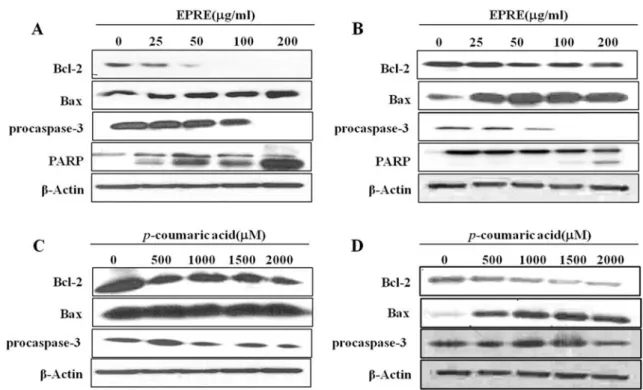
To elucidate the molecular mechanism underlying apoptosis by EPRE and p-coumaric acid, we assessed the expression of Bax, Bcl-2, procapspase-3, and PARP in MKN-74 cells and HL-60 cells. As shown in Figure 3,

EPRE and p-coumaric acid significantly decreased the expression of Bcl-2, procaspase-3 and PARP and increased the expression of Bax in a dose-dependent manner. These data suggest that the apoptosis induced by EPRE and p- coumaric acid also involves caspase-3-mediated mechanisms.

In summary, we demonstrated that EPRE and p- coumaric acid effectively inhibit the proliferation of MKN-74 cells and HL-60 cells by inducing apoptosis.

The relative expression levels of pro- and anti-apoptotic proteins are key factors in the inhibitory effects of EPRE and p-coumaric acid. Further studies on the anticancer properties of EPRE and p-coumaric acid could further reveal the potential of S. quelpaertensis leaves in cancer prevention.

Acknowledgment

This research was supported by Business for Cooperative R&D between Industry, Academy, and Research Institute funded Korea Small and Medium Business Administration in 2016 (grant number C0394780).

References

(1) Doll, R. Cancer Res. 1992, 52, 2024S-2029S.

(2) Jemal, A.; Bray, F.; Center. M. M.; Ferlay, J.; Ward, E.; Forman, D.

CA Cancer J. Clin. 2011, 61, 69-90.

(3) Kim, E. J.; Part, H.; Lim, S. S.; Kim, J. S.; Shin, H. K.; Yoon, J. H.

Fig. 3. Effects of ethyl acetate fraction of PRE (EPRE) and p-coumaric acid on the expression of apoptosis-related proteins in MKN-74

cells (A, C) and HL-60 cells (B, D).

(5)

Korean J. Food Sci. Technol. 2008, 40, 207-214.

(4) Fulda, S.; Debatin, K. M. Curr. Cancer Drug Targets. 2004, 7, 569- 576.

(5) Ji, Y. B.; Qu, Z. Y.; Zou. X. Exp. Toxicol. Pathol. 2011, 63, 69-78.

(6) Shinkai, K.; Akedo, H.; Mukai, M.; Imamura, F.; Isoai, A.;

Kobayashi, M.; Kitagawa, I. Jpn. J. Cancer Res. 1996, 87, 357-362.

(7) Ahmad, N.; Feyes, D. K.; Nieminen, A. L.; Agarwal, R.; Mukhtar H. J. Natl. Cancer Inst. 1997, 89, 1881-1886.

(8) Hwang, J. H.; Choi, S. Y.; Ko, H. C.; Jang, M. G.; Jin, Y. J.; Kang, S.

I.; Park, J. G.; Chung, W. S.; Kim, S. J. Food Sci. Biotechnol. 2007, 16, 728-733.

(9) Jang, M. G.; Park, S. Y.; Lee, S. R.; Choi, S. Y.; Hwang, J. H.; Ko, H. C.; Park, J. G.; Chung, W. S.; Kim, S. J. Food Sci. Biotechnol. 2008, 17, 188-190.

(10) Kim, M.; Kim, Y. S.; Kim, K. M.; Ko, H. C.; Kim, S. J.; Kim, J.

H.; Kim, Y. Integr. Cancer Ther. 2014, 13, 529-540.

(11) Kim, A.; Bing, S. J.; Cho, J.; Herath, K.; Ahn, G.; Park, E.; Kim, M. J.; Kim, D. S.; Kim, J. S.; Lee, N. H.; Jee, Y. J. Prev. Vet. Med. 2015, 39, 169-174.

(12) Lee, J. Y.; Ko, H. C.; Jang, M. G.; Kim, S. J. J. Life Sci. 2016, 26, 1330-1335.

(13) Kang, S. W.; Kang, S. I.; Shin, H. S.; Yoon, S. A.; Kim, J. H.; Ko, H. C.; Kim, S. J. Food Chem. Toxicol. 2013, 59, 380-385.

(14) Kim, A.; Bing, S. J.; Cho, J.; Herath, K.; Ahn, G.; Park, E.; Kim, M. J.; Kim, D. S.; Kim, J. S.; Lee, N. H.; Jee, Y. J. Prev. Vet. Med. 2016, 39, 169-174.

(15) Janicke, B.; Onning, G.; Oredsson, S. M. J. Agric. Food Chem.

2005, 53, 6658-6665.

(16) Jaganathan, S. K.; Supriyanto, E.; Mandal, M. World J.

Gastroenterol. 2013, 19, 7726-7734.

(17) Liu, M. H.; Ko, C. H.; Ma, N.; Tan, P. W.; Fu, W. M.; He, J. Y. J.

Funct. Foods 2016, 22, 533-546.

(18) Hunt, A.; Evan, G. Science 2001, 293, 1784-1785.

(19) Burlacu, A. J. Cell. Mol. Med. 2003, 7, 249-257.

(20) Kuwana, T.; Mackey, M. R.; Perkins, G.; Ellisman, M. H.;

Latterich, M.; Schneiter, R.; Green, D. R.; Newmeyer, D. D. Cell 2002, 111, 331-342.

(21) Green, D. R.; Reed, J. C. Science 1998, 281, 1309-1312.

(22) Fernandes-Alnemri, T.; Litwack, G.; Alnemri, E. S. J. Biol. Chem.

1994, 269, 30761-30764.

Received May 31, 2018

Revised July 17, 2018

Accepted July 17, 2018

수치

Fig. 2. Apoptosis inducing effects of ethyl acetate fraction of PRE (EPRE) (A) and p-coumaric acid (B) in HL-60 cells
Fig. 3. Effects of ethyl acetate fraction of PRE (EPRE) and p-coumaric acid on the expression of apoptosis-related proteins in MKN-74 cells (A, C) and HL-60 cells (B, D).

참조

관련 문서

Antiproliferative Effects of Caesalpinia sappan Extract on Human Epithelial Cell Line HaCaT and Cancer Cell Lines.. Man-Deuk Han † and

This study was performed to confirm the anticancer mechanism of various fractions of Ailanthus altissima on A549 human lung cancer cell cells.. Materials

To begin the series of in vitro and in vivo anti-diabetic studies, we evaluated cell viability of pancreatic beta cell lines to figure it out toxicity of the extract. The leaves

Cell viability was determined by MTT assay after treatment with 0, 50, 100 and 200 μg/ml of water extract or ethanol extract for 24 hr in human colon cancer cells [15] (A), MTT

The thyroid cancer cell lines, TPC-1, FTC-133, NPA, FRO, and ARO, displayed growth inhibition in response to genistein, resveratrol, quercetin.. We further demonstrated that

Juniperus chinensis extract induces apoptosis via reaction oxygen species (ROS) generation in human pancreatic cancer cell lines.. Boram Go 1,3 · Song-I Han 2 · Jungwhoi Lee 2

Results: Na-4-PB inhibited cell proliferation in a dose and time dependent manner in all 5 thyroid cancer cell lines.. By performing flowcytometry in the FTC-133 and TPC-1 cell

Objectives : The purpose of this study was to identify antiproliferative effects of Salviae miltiorrhizae Radix(SM) extracts against cancer cell lines.. Methods : We used 2