Antiproliferation and Redifferentiation in Thyroid Cancer Cell Lines by Polyphenol Phytochemicals
Thyroid carcinogenesis is accompanied by loss of thyroid-specific functions and refractory to radioiodine and thyroid stimulating hormone (TSH) suppression therapy. Redifferentiating agents have been shown to inhibit tumor growth and improve the response to conventional therapy. Polyphenol phytochemicals (PPs) in fruits and vegetables have been reported to inhibit cancer initiation, promotion, progression and induce redifferentiation in selected types. In this study we examined PPs induce redifferentiation in thyroid cancer cell lines.
We investigated the effects of genistein, resveratrol, quercetin, kaempferol, and resorcinol on the F9 embryonal carcinoma cell differentiation model. The thyroid cancer cell lines, TPC-1, FTC-133, NPA, FRO, and ARO, displayed growth inhibition in response to genistein, resveratrol, quercetin. We further demonstrated that genistein decreased the dedifferention marker CD97 in NPA cells and resveratrol decreased CD97 in FTC-133, NPA, FRO cells and quercetin decreased CD97 in all cell lines. We observed increased expression of differentiation marker NIS in FTC-133 cells in response to genistein, and resveratrol but no change in NPA, FRO, ARO cells. Quercetin increased or induced NIS in FTC-133, NPA, FRO cells. These findings suggest that PPs may provide a useful therapeutic intervention in thyroid cancer redifferentiation therapy.
Key Words: Thyroid Neoplasms; F9 Embryonal Carcinoma Cell; Redifferentiation;
Polyphenols; Phytochemical; CD97; Sodium-Iodine Symporter Hee Joon Kang1, Yeo-Kyu Youn2,
Mi-Kyoung Hong3 and Lee Su Kim3
1Department of Surgery, Hangang Sacred Heart Hospital, Hallym University College of Medicine, Seoul; 2Department of Surgery, Seoul National University Hospital, Seoul National University College of Medicine, Seoul; 3Department of Breast and Endocrine Surgery, Hallym Sacred Heart Hospital, Hallym University College of Medicine, Anyang, Korea
Received: 24 February 2011 Accepted: 6 April 2011 Address for Correspondence:
Lee Su Kim, MD
Department of Breast and Endocrine Surgery, Hallym Sacred Heart Hospital, 170 Gwanpyong-ro, Dongan-gu, Anyang 431-896, Korea
Tel: +82.31-380-5930, Fax: +82.31-384-0208 E-mail: [email protected]
The investigation was supported from a grant from the Korea Research Foundation (KRF-2004-041-E00239).
DOI: 10.3346/jkms.2011.26.7.893 • J Korean Med Sci 2011; 26: 893-899 Oncology & Hematology
INTRODUCTION
Differentiated thyroid cancers (DTC) maintain thyroid specific functions even with regional metastasis, respond to surgical treat- ment, radioiodine therapy and TSH suppression therapy. How- ever, poorly differentiated (PDTC) or anaplastic thyroid cancers (ATC) do not respond to conventional therapy, leading to poor outcome (1). During the dedifferentiation process, the cancer loses thyroid-specific gene expression, including the ability to absorb radioiodine and to express the TSH receptor; as such ra- dioiodine therapy or thyroid stimulating hormone (TSH) sup- pressive therapy is not effective in PDTC/ATC. Dedifferentiated cancers display more rapid growth properties and are refractory to chemotherapy, external beam radiation therapy, and show poor outcomes in comparison with differentiated cancers.
Redifferentiation therapy is defined as a treatment to inhibit tumor growth and regain thyroid-specific functions in PDTC and ATC as a mean of increasing the response to conventional therapy (2). The goals of such therapy are to regain the expres- sion of differentiation markers, including the sodium iodine symporter (NIS), and to reduce levels of the dedifferentiation marker CD97. Plasma membrane expression of NIS in thyroid
follicular cells is necessary to absorb iodine into the cell and, as such thyroid cancers with reduced NIS expression display im- paired iodine uptake (3). CD97 is a dedifferentiation marker that is increased during cancer progression and metastasis, and is reduced by redifferentiating agent such as retinoid acid (RA) in partially dedifferentiated thyroid cancer cells (4).
Currently available redifferentiating agents include RA, his- tone deacetylase inhibitors (HDAC inhibitors), and peroxisome proliferator activated receptor gamma (PPARγ) agonist. Their effectiveness in dedifferentiated cancers and patient tolerability have been variable (1, 2, 5-7). Thus, this is a reason why more effective and better tolerated agents are needed.
The polyphenol phytochemicals (PPs) such as quercetin, res- veratrol, genistein, and kaempferol (8-11), are present in fruits and vegetables, and inhibit cancer initiation, promotion and pro- gression in vivo and in vitro. Moreover these compounds have been reported to induce redifferentiation in specific cancer types (12-14).
The F9 mouse embryonal carcinoma cell model (F9 cells) is frequently used to evaluate cellular morphological and molec- ular differentiation changes following drug and hormone treat- ment. The time duration of the growth cycle is very short and no
self differentiation is evident; however, drugs including RA have been demonstrated to induce differentiation after 72 hr of treat- ment. The primitive endoderm-like structure is formed with the expression of laminin B1, collagen type IV, and tissue plasmino- gen activator (tPA), followed by growth inhibition (15).
In the present study, we tried to demonstrate that some PPs have the ability to induce antiproliferation and redifferentiation in thyroid cancer cell lines using the F9 embryonal carcinoma cell differentiation model.
MATERIALS AND METHODS Cell lines and culture
F9 embryonal cancer, cells were cultured in DMEM (Sigma, St Louis, MO, USA) with 20% fetal bovine serum (FBS). TPC-1 (pap- illary thyroid cancer cell line) and FTC-133 (follicular thyroid cancer cell line), cells were cultured in DMEM with 10% FBS.
NPA (poorly differentiated papillary thyroid cancer cell line), FRO (undifferentiated/anaplastic thyroid cancer cell line), and ARO (undifferentiated/anaplastic thyroid cancer cell line) cells were cultured in RPMI1640 (Sigma) with 10% FBS.
Reagents
Polyphenol phytochemical (resveratrol, genistein, quercetin, kaempferol, resorcinol (Sigma, Fig. 1) were dissolved in dimeth- ylsulfoxide (DMSO; Sigma) at appropriate concentrations prior to dilution in tissue-culture medium such that the final concen- tration of DMSO not exceed 0.1% (v/v). Each reagent was as- sessed for a concentrations-dependent effect in F9 and thyroid cancer cells. In F9 cells, 0.2 μM ATRA (all-trans-retinoic acid;
Sigma) was used as a positive control.
Cell proliferation and growth inhibition
Cell proliferation and growth inhibition was measured by colo- rimetric dimethyl-thiazol-diphenyltetrazolium bromide (MTT) proliferation assays.
RT-PCR and semi quantitative analysis
At 72 hr after the administration of reagents, RT-PCR was per- formed for laminin B1, collagen type IV, and tissue plasminogen activator (tPA) mRNA in F9 cell. To assess thyroid cancer redif- ferentiation, RT-PCR was performed for NIS, CD97 mRNA; 36B4
mRNA was assessed as a housekeeping gene. RNA extraction and complementary DNA preparation were performed by con- ventional methods. The primers for each gene were designed and PCRs performed according to the following conditions (anneal- ing temperature/cycles). 36B4: forward 5´-CAGCTCTGGAGA- AACTGCTG-3´, reverse 5´-GTGTACTCAGTCTCCACAGA-3´
(49°C/25 cycles); laminin B1: forward 5´-TGAATTCTCACTG- CAGACATGGTGAAG-3´, reverse 5´-ATGGATCCCTCACTTAT- GTCCTTAAGGA-3´ (48°C/30 cycles); collagen type IV: forward 5´-ATGAATTCTCAGCGTCTGGCTTCTGCT-3´, reverse: 5´-AT- GGATCCGTTGCATCCTGGGATACCTG-3´ (62°C/30 cycles); tPA forward 5´-TTGGGCAGAACATACAGGGTGGTC-3´, reverse 5´- CTGGCATGCATCGTGGAGGTCTT-3´ (62°C/30 cycles); NIS for- ward 5´-GCCCTCATCCTGAACCAAGTG-3´, reverse 5´-TGATC- CGGGAGTGGTTCTG-3´ (50°C/30 cycles); CD97 forward 5´-TC- CTGCCGGCAGCTCCAACC-3´, reverse 5´-GGCAGCGGCAG- CTGTATGAAC-3´ (58°C/30 cycles). PCR was conducted for the indicated number of cycles with denaturation at 95°C for 60 sec, annealing at the temperatures indicated for 60 sec, and exten- sion at 72°C for 20 sec. Each RT-PCR experiment from F9 cell and thyroid cancer cells was performed in triplicate.
In thyroid cancer cell experiments, the PCR results were ana- lyzed by semi quantitative methods using the Total Lab TL100 program (Nonlinear Dynamics Ltd., Newcastle, UK) compen- sated by comparing the 36B4 density of each PCR.
Statistical analyses
Statistical analyses were performed using the SPSS software (ver.
12.0 for Windows SPSS, Chicago, IL, USA). All MTT assays were performed in triplicate and mean value were compared using Student’s t-test and one-way ANOVA. A P value < 0.05 was con- sidered to indicate statistical significance.
RESULTS
F9 cell proliferation assays
We initially assessed the effects of resorcinol, genistein, resvera- trol, kaempferol and quercetin on F9 cell proliferation at con- centrations of 1, 10, 50, and 100 μM respectively. Fig. 2 shows that resorcinol did not inhibit growth at concentrations below 100 μM, while genistein, resveratrol, kaempferol and quercetin all inhibited cellular growth in a dose dependent manner. Fol-
Quercetin Kaempferol Resorcinol Genistein Resveratrol
Fig. 1. Structure of polyphenol phytochemicals and resorcinol.
lowing the administration of each agent, MTT assays were per- formed at 24, 48, 72, 96, and 120 hr. Fig. 3 demonstrates that F9 cell growth was increased in a time-dependent manner in con- trol cells (DMSO only), while quercetin, resveratrol and genis- tein inhibited cell growth up to 120 hr (P < 0.05). Kaempferol did not affect F9 cell growth.
We thus selected quercetin, resveratrol and genistein for fur- ther experiments.
Quantification of F9 cell differentiation markers by RT-PCR Genistein, resveratrol and quercetin at concentration of 10 μM and ATRA (positive control) at a concentration of 0.2 μM were
administered to F9 cells in culture. After 72 hr, RT-PCR was per- formed for laminin B1, tPA and collagen type IV mRNA. Fig. 4 demonstrates that genistein, resveratrol and quercetin increased the levels of these differentiation markers compared with the DMSO-alone negative control.
Thyroid cancer cell proliferation assays
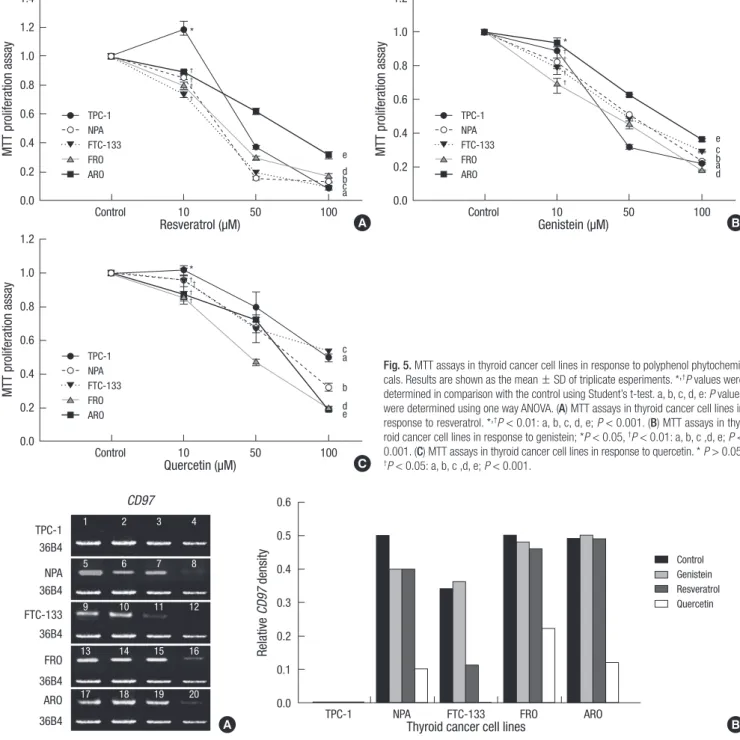
Fig. 5 demonstrates that when genistein and quercetin were ad- ministered for 72 hr, the growth of TPC-1, NPA, FTC-133, FRO, and ARO cells was inhibited in a dose-dependent manner (P <
0.05). Resveratrol inhibited the growth of these cells from 10 μM excluding TPC-1 cells that displayed increased levels of growth.
TPC-1 proliferation was, however, inhibited at resveratrol con- centrations of 50 μM or more.
MTT proliferation assay
Quercetin (µM)
P = 0.138 P < 0.001
Control 1 10 50 100
1.0 0.8 0.6 0.4 0.2 0.0
E
MTT proliferation assay
Resorcinol (µM)
P = 0.01
Control 1 10 50 100
1.0 0.8 0.6 0.4 0.2 0.0
A
MTT proliferation assay
Kaempferol (µM)
P = 0.002
Control 1 10 50 100
1.0 0.8 0.6 0.4 0.2 0.0
D
MTT proliferation assay
Genistein (µM)
P = 0.06
Control 1 10 50 100
1.0 0.8 0.6 0.4 0.2 0.0
B
MTT proliferation assay
Resveratrol (µM)
P < 0.001 P = 0.059
Control 1 10 50 100
1.0 0.8 0.6 0.4 0.2 0.0
C
Fig. 2. F9 cell MTT assays in the presence of each polyphenol phytochemicals. Results are the mean ± SD of triplicate experiments. P values were determined by comparison with the control samples using Stu- dent’s t- test. (A) F9 cell MTT assays in the presence of resorcinol, (B) F9 cell MTT assays in the presence of genistein, (C) F9 cell MTT assays in the presence of resveratrol, (D) F9 cell MTT assays in the presence of kaempferol, (E) F9 cell MTT assays in the presence of quercetin.
MTT proliferation assay
24 48 Hour72 96 120
1.0
0.8
0.6
0.4
0.2
0.0
Control Kaempferol Quercetin Resorcinol Resveratrol Genistein
Fig. 3. F9 cell MTT assays in the presence of each polyphenol (10 µM). Results are the mean ± SD of triplicate experiments. P values were determined by comparison with the control samples using Student’s t-test. *P = 0.001; †P < 0.001; ‡P = 0.001;
§P < 0.001.
*
†
‡
§
Fig. 4. F9 cell differentiation marker expression in the presence of ATRA and the poly- phenol phytochemicals. Representative results are shown. 1, DMSO; 2, ATRA 0.2 µM;
3, Genistein 10 µM; Resveratrol 10 µM; Quercetin 10 µM.
36B4
Laminin B1
tPA
Collagen type IV
1
1
1
2
2
2
3
3
3 4
4
4 5
5
5
Assessment the expression of thyroid cancer differentiation markers by RT-PCR
RT-PCR for CD97 and NIS mRNA was performed following 72 hr of treatment for TPC-1 cells: genistein (100 μM), resveratrol (50 μM), quercetin (100 μM), for NPA cells: genistein (20 μM), resveratrol (50 μM), qeurcetin (100 μM), for FTC-133 cells: ge- nistein (20 μM), resveratrol (20 μM), quercetin (20 μM), for FRO cells: genistein (50 μM), resveratrol (50 μM), quercetin (20 μM),
MTT proliferation assayMTT proliferation assay MTT proliferation assay
1.4 1.2 1.0 0.8 0.6 0.4 0.2 0.0
1.2 1.0 0.8 0.6 0.4 0.2 0.0
1.2 1.0 0.8 0.6 0.4 0.2 0.0 Resveratrol (µM)
Quercetin (µM)
Genistein (µM)
Control 10 50 100
Control 10 50 100
Control 10 50 100
TPC-1
* *
*
†
††
†
†
TPC-1
TPC-1 NPA
NPA
NPA FTC-133
FTC-133
FTC-133 FRO
FRO
FRO ARO
ARO
ARO e
e
e d
d b d
b
b c
c
c
a
a
a
A
A B
C
B
†
†
†
†
†
†
†
Fig. 5. MTT assays in thyroid cancer cell lines in response to polyphenol phytochemi- cals. Results are shown as the mean ± SD of triplicate esperiments. *,†P values were determined in comparison with the control using Student’s t-test. a, b, c, d, e: P values were determined using one way ANOVA. (A) MTT assays in thyroid cancer cell lines in response to resveratrol. *,†P < 0.01: a, b, c, d, e; P < 0.001. (B) MTT assays in thy- roid cancer cell lines in response to genistein; *P < 0.05, †P < 0.01: a, b, c ,d, e; P <
0.001. (C) MTT assays in thyroid cancer cell lines in response to quercetin. * P > 0.05,
†P < 0.05: a, b, c ,d, e; P < 0.001.
TPC-1 1
5
9
13
17 2
6
10
14
18 3
7
11
15
19 4
8
12
16
20
CD97
NPA
FTC-133
FRO
ARO 36B4
36B4
36B4
36B4
36B4
Relative CD97 density
0.6 0.5 0.4 0.3 0.2 0.1 0.0
Control Genistein Resveratrol Quercetin
Thyroid cancer cell lines
TPC-1 NPA FTC-133 FRO ARO
Fig. 6. RT-PCR for CD97 mRNA in thyroid cancer cell lines. (A) RT-PCR for CD97 mRNA levels in thyroid cancer cell lines following genistein, resveratrol or quercetin treatment (1, Control; 2, Genistein 100 µM; 3, Resveratrol 50 µM; 4, Quercetin 100 µM; 5, Control; 6, Genistein 20 µM; 7, Resveratrol 50 µM; 8, Quercetin 100 µM; 9, Control; 10, Ge- nistien 20 µM; 11, Resveratrol 20 µM; 12, Quercetin 20 µM; 13, Control; 14, Genistein 50 µM; 15, Resveratrol 50 µM; 16, Quercetin 20 µM; 17, Control; 18, Genistein 50 µM;
19, Resveratrol 20 µM; 20, Quercetin 20 µM). (B) Relative CD97 density in thyroid cancer cell lines following genistein, resveratrol or quercetin treatment. Results are normal- ized to the relative density of 36B4.
for ARO cells: genistein (50 μM), resveratrol (20 μM), quercetin (20 μM). In contrast to the other cell lines under investigation, TPC-1 cells did not express the dediffenetiation marker CD97.
We observed a decrease in CD97 expression following genistein treatment in NPA cells. Resveratrol decreased CD97 in FTC-133, NPA and marginally decreased CD97 in FRO cells, while qurce- tin decreased CD97 levels in FTC-133, NPA, FRO, and ARO cells.
Expression of CD97 in TPC-1 cells was unaffected by the pres-
A B
ence of any of the PPs (Fig. 6). NIS was expressed in TPC-1 and FTC-133 cells. While the levels of NIS were unchanged in the presence of genistein, resveratrol and quercetin in TPC-1 cells, all three compounds increased NIS levels in FTC-133 cells. Ge- nistein and resveratrol both failed to induce in NPA, FRO or ARO cells. Qurcetin did not induce NIS in ARO cells but did induce NIS in dedifferentiated/anaplastic NPA and FRO cells (Fig. 7).
DISCUSSION
RA, HDAC inhibitor, and PPARγ agonists are effective rediffer- entiation therapies in partially dedifferentiated thyroid cancers, but are ineffective undifferentiated/anaplastic cancers and dis- play high patient toxicity or effectiveness only in vitro. Polyphe- nol phytochemicals have been reported to inhibit cancer initia- tion, promotion and progression in vivo or in vitro and more- over have been reported to induce redifferentiation in specific cancer types (12-14). We present the first report that identifies the ability of PPs to promote tumor growth inhibition in both partially dedifferentiated cancer and dedifferentiated/anaplas- tic cancers.
We demonstrated that genistein (rich in soybeans), resvera- trol (rich in grapes), quercetin (rich in onions) inhibit the tumor growth of TPC-1, FTC-133, NPA, FRO, and ARO cell lines. The mechanism of the growth inhibition of genistein, resveratrol and quercetin is thought to involve the inhibition of epidermal growth factor (EGF), NF-κB, cyclin D and protein tyrosine kinase, all of which increase tumor promotion, progression, and inreases cas- pase which can induce apoptosis (16-18). They have been test- ed in normal and cancer cultured cells, and shown that these compounds induced apoptosis in cultured cancer cells but not in their normal counterparts up to 100 μM, so these effects were not by general toxicity (19). Other studies have suggested that
PPs act as phytoestrogens and inhibit the estrogen-dependent growth of estrogen receptor (ER) - positive cancer cells (20) and specific cancer cells (NPA, FRO) that express ER (11). We ob- served increased TPC-1 cell growth in response to low dose res- veratrol (10 μM), most likely caused by its phytoestrogenic ef- fects, stimulating the estrogen receptor α (ERα) and inhibitory estrogen receptor β (ERβ). The dose of resveratrol displays bipha- sic effects in MCF-7 breast cancer cells and low dose are thought to affect growth stimulation (21). However, no report has de- scribed the expression of ER in TPC-1 cells.
CD97 is a representative dedifferentiation marker in thyroid cancers that is stimulated by EGF, and can be inhibited genis- tein, resveratrol and quercetin (16), consistent with their effects on cancer cell observed in our study.
The dedifferentiation process is accompanied by both genet- ic mutations and epigenetic changes. During dedifferentiation process, a loss of NIS gene expression occurs, caused by hyper- methylation of the NIS gene; this is recovered by demethylating agent 5-azacytidine (22). Additionally, NIS expression is induc- ed by TSH mediated by TSH receptor (TSHR). Dedifferentiated thyroid cancers are accompanied by a loss of the TSHR gene promoter hypermethylation and is restored by 5-azacytidine (23). DNA methylation is mediated by DNA methyltransferases (DNMT) and numerous cancers including thyroid cancers, have been reported to have stimulated hypermethylation (22, 23). In this study, genistein, resveratrol and quercetin all incresed NIS expression in FTC-133 cells while quercetin also incresed NIS expression in dedifferentiated/anaplastic NPA and FRO cells.
Quercetin has been reported to reverse DNA hypermethylation in a dose-dependent manner in other cancers (24). Genistein has been reported to reverse retinoic acid receptor β (RARβ) pro- moter hypermethylation and increase RARβ in prostate and esophageal cancers (25). There is no report regarding the effects
TPC-1 1
5
9
13
17 2
6
10
14
18 3
7
11
15
19 4
8
12
16
20
NIS
NPA
FTC-133
FRO
ARO 36B4
36B4
36B4
36B4
36B4
Relative NIS density
0.6 0.5 0.4 0.3 0.2 0.1 0.0
Control Genistein Resveratrol Quercetin
Thyroid cancer cell lines
TPC-1 NPA FTC-133 FRO ARO
Fig. 7. RT-PCR for NIS mRNA in thyroid cancer cell lines. (A) RT-PCR for NIS mRNA in thyroid cancer cell lines following genistein, resveratrol or quercetin treatment (1, Control;
2, Genistein 100 µM; 3, Resveratrol 50 µM; 4, Quercetin 100 µM; 5, Control; 6, Genistein 20 µM; 7, Resveratrol 50 µM; 8, Quercetin 100 µM; 9, Control; 10, Genistien 20 µM;
11, Resveratrol 20 µM; 12, Quercetin 20 µM; 13, Control; 14, Genistein 50 µM; 15, Resveratrol 50 µM; 16, Quercetin 20 µM; 17, Control; 18, Genistein 50 µM; 19, Resvera- trol 20 µM; 20, Quercetin 20 µM). (B) Relative NIS density in thyroid cancer cell lines following genistein, resveratrol or quercetin treatment. Results are normalizd to the relative density of 36B4.
of resveratrol in relation to DNA methylation; however, most of PPs are substrates of catechol O-methyltransferase (COMT) and are converted to S-adenosyl-L-homocysteine (SAH) by COMT, an antagonist of DMNT (24). Additionally, resveratrol has been reported to increase the transcription of PPARγ, which can in- duce thyroid cancer redifferentiation (26). RA acts through bind- ing with RARβ and has been reported to restore NIS expression in FTC-133 (27), but not in NPA, FRO or ARO cells. Additionaly RA does not inhibit growth of FRO and ARO cells that have lost RARβ (28), which occurs as a result of promoter hypermethyl- ation in numerous thyroid cancer cell lines (29). Thus, PPs that inhibit RARβ hypermethylation, when administered in combi- nation with low-dose RA, may be effective in thyroid cancers that are refractory to RA therapy. Serum concentrations of PPs typically do not exceed 10 μM in humans, a concentration that is both antiproliferative and induces redifferentiative in vitro.
The tissue concentration levels of these compounds can increase 1-10 fold following dietary supplementation (30).
In conclusion these findings suggest that genistein, resvera- trol and quercetin may be effective for thyroid cancer rediffer- entiation therapy, including of undifferentiated/anaplastic can- cers. Further investigations are required to increase the tissue concentrations of these polyphenol phytochemicals in thyroid cancer patients and to assess their effectiveness in patients with dedifferentiated thyroid cancers.
ACKNOWLEDGMENTS
We thank the senior investigator Drs. Kuk Jin Choe, Bo Youn Cho, Sung-Eun Jung and Do-Joon Park for their help throughout the study.
RFFERENCES
1. Park JW, Clark OH. Redifferentiation therapy for thyroid cancer. Surg Clin North Am 2004; 84: 921-43.
2. Schmutzler C, Koehrle J. Innovative strategies for treatment of thyroid cancer. Eur J Endocrinol 2000; 143: 15-24.
3. Lazar V, Bidart JM, Caillou B, Mahé C, Lacroix L, Fletti S, Schlumberger M. Expression of the Na+/I- symporter gene in human thyroid tumors: a comparison study with other thyroid specific genes. J Clin Endocrinol Metab 1999; 84: 3228-34.
4. Hoang-Vu C, Bull K, Schwarz I, Krause G, Schmutzler C, Aust G, Köhrle J, Dralle H. Regulation of CD97 protein in thyroid carcinoma. J Clin En- docrinol Metab 1999; 84: 1104-9.
5. Shen WI, Chung WY. Treatment of thyroid cancer with histone deacety- lase inhibitor and peroxisome proliferater-activated receptor-γ agonists.
Thyroid 2005; 15: 594-9.
6. Zarnegar R, Brunaud L, Kanauchi H, Wong M, Fung M, Ginzinger D, Duh QA, Clark OH. Increasing the effectiveness of radioactive iodine ther- apy in the treatment of thyroid cancer using Trichostatin A, a histone deacetylase inhibitor. Surgery 2002; 132: 984-90.
7. Park JC, Ryu DH, Park JW, Clark OH. Redifferentiation effects of trogli- tazone in human thyroid cancer cell lines. J Korean Surg Soc 2004; 67:
93-9.
8. Chen YC, Shen SC, Chow JM, Ko CH, Tseng SW. Flavone inhibition of tumor growth via apoptosis in vitro and in vivo. Int J Oncol 2004; 25:
661-70.
9. Choi JA, Kim JY, Lee JY, Kang CM, Kwon HJ, Yoo YD, Kim TW, Lee TS, Lee SJ. Induction of cell cycle arrest and apotosis in human breast cancer cells by quercetin. Int J Oncol 2001; 19: 837-44.
10. Lambert JD, Hong J, Yang GY, Liao J, Yang CS. Inhibition of carcinogene- sis by polyphenols: evidence from laboratory investigations. Am J Clin Nutr 2005; 81(1 Suppl): 284S-91S.
11. Yin F, Giuliano AE, Van Herle AJ. Growth inhibitory effects of flavonoids in human thyroid cancer cell line. Thyroid 1999; 9: 369-76.
12. Asou H, Koshizuka K, Kyo T, Takata N, Kamada N, Koeffier HP. Resvera- trol, a natural product derived from grapes, is a new inducer of differen- tiation in human myeloid leukemias. Int J Hematol 2002; 75: 528-33.
13. Dihal AA, Woutersen RA, van Ommen B, Rietjens IM, Stierum RH. Mod- ulatory effects of quercetin on proliferation and differentiation of the hu- man colorectal cell line Caco-2. Cancer Lett 2006; 238: 248-59.
14. Nakamura Y, Chang CC, Mori T, Sato K, Ohtsuki K, Upham BL, Trosko JE. Augmentation of diffentiation and gap junction function by kaemp- ferol in partially differentiated colon cancer cells. Carcinogenesis 2005;
26: 665-71.
15. Alonso A, Breuer B, Steuer B, Fisher J. The F9-EC line as a model for the analysis of differentiation. Int J Dev Biol 1991; 35: 389-97.
16. Aggarwal BB, Shishodia S. Molecular targets of dietary agents for preven- tion and therapy of cancer. Biochem Pharmacol 2006; 71: 1397-421.
17. Gulati N, Laudet B, Zohravian VM, Murali R, Jhanwa-Uniyal M. The an- tiproliferative effect of quercetin in cancer cells is mediated via inhibition of the PI3K-Akt/PKB pathway. Anticancer Res 2006; 26: 1177-81.
18. Mertens-Talcott SU, Bomser JA, Romero C, Talcott ST, Percival SS. Ellag- ic acid potentiates the effect of quercerin on p21waf1/cip1, p53, and MAP- kinase without affecting intracellular generation of reactive oxygen spe- cies in vitro. J Nutr 2005; 135: 609-14.
19. Ramos S. Effect of dietary flavonoids on apoptotic pathways related to cancer chemoprevention. J Nutr Biochem 2007; 18: 427-42.
20. Folman Y, Pope GS. The interaction in the immature mouse of potent oes- trogens with coumestrol, genistein and other utero-vaginotrophic com- pounds of low potency. J Endocrinol 1966; 34: 215-25.
21. Harris DM, Besselink E, Henning SM, Go VL, Heber D. Phytoestrogens induce differential estrogen receptor alph- or beta mediated response in transfected breast cancer cells. Exp Biol Med (Maywood) 2005; 230: 558-68.
22. Venkataraman GM, Yatin M, Marcinek R, Ain KB. Restoration of iodine uptake in dedifferentiated thyroid carcinoma: relatioship to human Na+/
I- symporter gene methylation status. J Clin Endocrinol Metab 1999; 84:
2449-57.
23. Das PM, Singal R. DNA methyation and cancer. J Clin Oncol 2004; 22:
4632-42.
24. Lee WJ, Shim JY, Zhu BT. Mechanism for the inhibiton of DNA methyl- transferases by tea catechins and bioflavonoids. Mol Pharmacol 2005;
68: 1018-30.
25. Fang MZ, Wang Y, Ai N, Hou AZ, Sun Y, Lu H, Welsh W, Yang CS. Tea polyphenol (−)-epigallocatechin-3-gallate inhibits DNA methyltransfer- ase and reactivates methylation-silenced genes in cancer cell lines. Can-
cer Res 2003; 63: 7563-70.
26. Ulrich S, Loitsch SM, Rau O, von Knethen A, Brüne B, Schubert-Zsilavecz M, Stein JM. Peroxisome proliferator-activated receptor gamma as a mo- lecular target of resveratrol-induced modulation of polyamine metabo- lism. Cancer Res 2006; 66: 7348-54.
27. Schmutzler C, Köehrle J. Retinoic acid redifferentiation therapy for thy- roid cancer. Thyroid 2000; 10: 393-406.
28. Elisei R, Vivaldi A, Agate L, Ciampi R, Monlinaro E, Piampiani P, Romei C, Favaiana P, Basolo F, Miccoli P, Capodano A, Collecchi P, Pacini F, Pinchera A. All-trans-Retinoic acid treatment inhibits the growth of reti-
noic acid receptor β messenger ribonucleic acid expressing thyroid can- cer cell lines but does not reinduce the expression of thyroid-specific genes.
J Clin Endocrinol Metab 2005; 90: 2403-11.
29. Hoque MO, Rosenbaum E, Westra WH, Xing M, Ladenson P, Zeiger MA, Sidransky D, Umbricht CB. Quantitative assessment of promoter meth- ylation profiles in thyroid neoplasm. J Clin Endocrinol Metab 2005; 90:
4011-8.
30. Gardner CD, Jenny B, Liu JP, Feldman D, Franke AA, Brooks JD. Prostate soy isoflavone concentrations exceed serum levels after dietary supple- mentation. Prostate 2009; 69: 719-26.
AUTHOR SUMMARY
Antiproliferation and Redifferentiation in Thyroid Cancer Cell Lines by Polyphenol Phytochemicals
Hee Joon Kang, Yeo-Kyu Youn, Mi-Kyoung Hong and Lee Su Kim
This study assessed the ability of polyphenol phytochemicals (PPs) as a redifferentiatiion therapy in thyroid cancer cells. Using F9 cell differentiation model for the selection of effective PPs, we demonstrated that genistein, resveratrol, quercetin were effective.
In five kinds of thyroid cancer cell lines, we further demonstrated that the PPs not only decrease the dedifferention markers, but also increase the expression of differentiation marker. These findings suggest that the PPs investigated in this study might be considered for the redfferentiation therapy of thyroid cancer.