www.earticle.net
야자박과 팜박의 첨가 수준이 거세한우의 발육 및 도체특성에 미치는 영향
박병기1# ․ 안준상2# ․ 박중국3 ․ 김영수1 ․ 송금석1 ․ 임환4 ․ 최욱진4 ․ 서진교1 ․ 권응기2 ․ 신종서4*
농협사료1, 국립축산과학원 한우연구소2, 농협축산연구원3, 강원대학교 동물생명과학대학4
Effect of Supplementation Levels of Copra and Palm Meal on Growth Performance and Carcass Characteristics of Hanwoo Steers
Byung-Ki Park1#, Jun-Sang Ahn2#, Joong-Kook Park3, Young-Soo Kim1, Kum-Seuk Song1, Hwan Lim4, Wook-Jin Choi4, Jin-Kyo Seo1, Eung-GI Kwon2 and Jong-Suh Shin4*
1Nonghyup Feed Co. LTD., Seoul 05398, Korea
2Hanwoo Research Institute, National Institute of Animal Science, Pyeongchang 25340, Korea
3Nonghyup Livestock Research Center, Ansung 17558, Korea
4College of Animal Life Sciences, Kangwon National University, Chuncheon 24341, Korea
ABSTRACT1)
This study was conducted to investigate whether dietary levels of copra and palm meals affect the growth performance, carcass characteristics, and meat properties of Hanwoo steers. Eighty-one Hanwoo steers were randomly assigned to one of three dietary groups: T1 (conventional level of palm and copra meals), T2 (20%
copra meal and 15% palm meal), and T3 (30% copra meal and 20% palm meal). During the growing and early fattening periods, the average daily gains and formula feed intakes of T2 and T3 were higher than that of T1; however, those differences were not statistically significant. The dietary levels of copra and palm meals did not affect carcass weight, back fat thickness, and rib-eye areas. Marbling scores and meat quality grades were lower in T3 than in T1 and T2; however, those differences were not statistically significant. Meat color, fat color, texture, and maturity were similar among the treatment groups. In addition, dietary levels of copra and palm meals did not affect the chemical and fatty acid composition oflongissimus dorsi muscles in Hanwoo steers. Thus, the present results indicate that high supplementation levels of copra and palm meals do not negatively affect the growth performance, carcass characteristics, and meat properties of Hanwoo steers.
(Key word: Copra meal, Palm meal, Growth performance, Carcass characteristics)
* Corresponding author: Jong-Suh Shin, College of Animal Life Sciences, Kangwon National University, Chuncheon 24341, Korea. Tel:
+82-33-250-8628, E-mail: [email protected]
# These authors contributed equally.
This is an Open Access article distributed under the terms of the Creative Commons Attribution Non-Commercial License (http://creativecommons.org/licenses/by-nc-nd/3.0/deed.ko), which permits unrestricted non-commercial use, distribution, and reproduction in any medium, provided the original work is properly cited. The moral rights of the named author(s) have been asserted.
Ⅰ. 서론
한우 사육과정에서 생산비는 가축 구입비 다음으로 높은 비중을 차지하고 있으며, 생산비 중에서도 사료비는 농가
의 가장 큰 부담으로 작용하고 있다(MAFRA, 2017). 배합 사료를 이용하는 농가의 입장에서는 가격이 저렴한 원료의 사용 확대를 통해 사료비를 경감시킬 수 있는 방안의 모색 이 필요하다. 특히, 야자박과 팜박처럼 상대적으로 가격이
[Provider:earticle] Download by IP 118.70.52.165 at Monday, December 20, 2021 7:50 PM
www.earticle.net
저렴한 단백질 원료를 효율적으로 이용할 필요성이 있지 만(Jaworski et al., 2014), 원가절감을 위해 이들 단백질 원 료들의 배합비율을 높이기 위해서는 영양적 균형, 기호성, 증체량, 도체등급 및 육질특성에 미치는 영향에 대한 검토 를 통해 한우의 생산성에 영향을 미치지 않는 범위에서 이 들 원료를 최대한으로 사용하는 것이 중요하다.
야자박은 야자의 핵육을 건조시켜 기름을 추출하고 남 는 부산물로써 조단백질 함량이 약 21∼24% 정도이며, 조 단백질 함량은 옥수수글루텐보다는 낮고 밀기울보다는 높 으며, 단백질의 품질은 옥수수글루텐에 비해서는 양호한 편이지만, 대두박에 비해서는 낮은 것으로 보고된 바 있다 (Han, 1994). 또한 야자박은 lysine과 methionine의 이용효 율이 각각 78 및 94% 정도이며, 면실박과 같은 단백질 원 료에 비해 소장에서 아미노산의 이용효율이 상대적으로 높은 것으로 평가되고 있다(Hvelplund and Hesselholt, 1987). 염소의 경우에는 야자박을 75%까지 배합사료에 첨 가해도 성장과 체형의 변화가 없을 뿐만 아니라 건물, 유 기물과 단백질 및 TDN의 소화율이 오히려 증가되었다고 보고되었다(Aregheore, 2006). 또한 Hennessy 등(1989)은 헤어퍼드 거세우에서 조사료의 품질이 좋지 않을 경우 두 당 500g/일의 야자박 급여로 증체량이 개선되어 야자박을 적절히 활용할 경우 생산성 향상에 도움이 될 수 있다고 보고하였다.
Palm kernel cake으로 알려진 팜박(palm meal)은 팜유 를 분리하는 방법(압착, 추출 등)에 따라 일부 영양소 함량 의 차이가 있다(Ezieshi and Olomu, 2007). 예를 들어 팜박 의 경우 조단백질의 함량은 16.0∼21.3%까지 다양하며, 적 은 양의 lysine, methionine, histidine 및 threonine을 함유 하고 있는 것으로 보고되었다(Olomu, 1995). 팜박의 조섬 유 함량은 6.7∼17.5%(Olomu, 1995; Yeong, 1980), 조지방 함량은 0.80∼10.33%(Yeong et al., 1981), NFE 함량은 38.7
∼63.5%(Olomu, 1995; Yeong et al., 1981) 및 조회분 함량 은 4.30% 정도로 영양소 함량의 차이가 팜유의 추출 방법 에 따라 차이가 있는 것으로 보고되고 있다. 특히 조지방 의 함량은 팜유의 추출 방법 혹은 추출 용매 종류에 따라 크게 차이가 나는 것으로 보고된 바 있다(Yeong et al., 1981).
팜박은 대부분의 가축에서 이용이 가능한 원료사료이며, Zahari와 Alimon(2004)은 비육우의 경우 50∼80%, 젖소의 경우에는 30∼50%, 양의 경우에는 30%까지 팜박의 사용이 가능하다고 보고하였다. 또한 말레이시아에서 비육우를 대 상으로 수행된 연구에서는 팜박 80%, 건초 17.5%, 석회석 1.5% 및 미량광물질 1.0% 급여로 증체효과가 개선되었으
며(Chin, 2001), 이러한 연구결과를 바탕으로 펠렛, 큐브 혹 은 TMR의 원료로 다양하게 활용되고 있는 것으로 보고되 었다.
따라서 본 연구는 야자박과 팜박의 첨가 비율이 거세한 우의 성장단계별 사료섭취량, 증체량, 도체특성 및 육질특 성에 미치는 영향을 검토하여 경제성 있는 야자박과 팜박 의 첨가수준을 규명하고자 실시하였다.
Ⅱ. 재료 및 방법
1. 공시동물, 시험구배치 및 사양관리
본 연구는 경기도 안성 소재의 목장에서 사육중인 거세 한우 81두(육성기: 27두, 비육전기: 27두 및 비육후기 : 27 두)를 공시하여 6개월(180일) 동안 실시하였다. 본 연구에 공시된 육성기 거세한우의 평균 체중은 237.30±17.45㎏
(8.49±0.95개월), 비육전기 거세한우는411.85±24.87㎏
(14.98±1.91개월) 및 비육후기 거세한우는 637.60±26.43㎏
(26.98±1.50개월) 이었다.
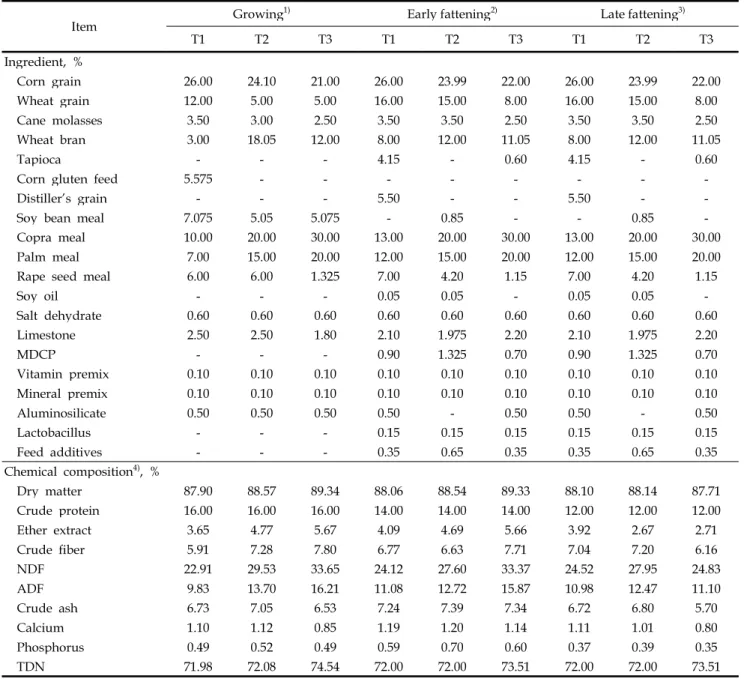
시험구 배치는 사육단계별로 체중을 고려하여 임의배치 배 치하였으며, 각 성장단계별 한우 거세우 27두는 N사의 관행 적인 수준의 팜박 및 야자박 첨가구(T1구), 야자박 20% 및 팜 박 15% 첨가구(T2구) 및 야자박 30% 및 팜박 20% 첨가구 (T3구)의 3처리로 배치하였다. 본 연구에 사용된 성장단계 및 처리구별 배합사료의 배합비 및 영양소 함량은 Table 1 과 같다.
시험축들은 pen(5×10m) 당 3두씩 소규모 군사로 수용하 여 사육하였으며, 배합사료는 pen을 기준으로 설치된 사조 에 급여하였고(07:30, 13:00 및 18:00), 볏짚(건물 90.18%, 조 단백질 3.65%, 조지방 1.02%, 조섬유 34.19%, NDF 70.21%, ADF 38.13%, 조회분 10.58%, 칼슘 0.09% 및 인 0.05%)은 육성기, 비육전기 및 비육후기 동안 두당 건물 기준으로 각각 2.71, 2.71 및 0.96㎏을 급여하였다. 깔짚은 왕겨, 톱밥 및 마사토를 혼용하여 우상 약 20㎝의 두께로 깔아주었고, 급수는 워터컵을 설치하여 항상 자유롭게 이용할 수 있도 록 하였다. 기타 사양관리는 시험목장의 관행에 준하여 실 시하였다.
2. 조사항목 및 분석방법
체중은 모든 공시축들을 대상으로 시험개시, 3개월 경과
[Provider:earticle] Download by IP 118.70.52.165 at Monday, December 20, 2021 7:50 PM
www.earticle.net
Table 1. Ingredients and chemical composition of the experimental diets for the growing period of Hanwoo steers
Item Growing1) Early fattening2) Late fattening3)
T1 T2 T3 T1 T2 T3 T1 T2 T3
Ingredient, %
Corn grain 26.00 24.10 21.00 26.00 23.99 22.00 26.00 23.99 22.00
Wheat grain 12.00 5.00 5.00 16.00 15.00 8.00 16.00 15.00 8.00
Cane molasses 3.50 3.00 2.50 3.50 3.50 2.50 3.50 3.50 2.50
Wheat bran 3.00 18.05 12.00 8.00 12.00 11.05 8.00 12.00 11.05
Tapioca - - - 4.15 - 0.60 4.15 - 0.60
Corn gluten feed 5.575 - - - - - - - -
Distiller's grain - - - 5.50 - - 5.50 - -
Soy bean meal 7.075 5.05 5.075 - 0.85 - - 0.85 -
Copra meal 10.00 20.00 30.00 13.00 20.00 30.00 13.00 20.00 30.00
Palm meal 7.00 15.00 20.00 12.00 15.00 20.00 12.00 15.00 20.00
Rape seed meal 6.00 6.00 1.325 7.00 4.20 1.15 7.00 4.20 1.15
Soy oil - - - 0.05 0.05 - 0.05 0.05 -
Salt dehydrate 0.60 0.60 0.60 0.60 0.60 0.60 0.60 0.60 0.60
Limestone 2.50 2.50 1.80 2.10 1.975 2.20 2.10 1.975 2.20
MDCP - - - 0.90 1.325 0.70 0.90 1.325 0.70
Vitamin premix 0.10 0.10 0.10 0.10 0.10 0.10 0.10 0.10 0.10
Mineral premix 0.10 0.10 0.10 0.10 0.10 0.10 0.10 0.10 0.10
Aluminosilicate 0.50 0.50 0.50 0.50 - 0.50 0.50 - 0.50
Lactobacillus - - - 0.15 0.15 0.15 0.15 0.15 0.15
Feed additives - - - 0.35 0.65 0.35 0.35 0.65 0.35
Chemical composition4), %
Dry matter 87.90 88.57 89.34 88.06 88.54 89.33 88.10 88.14 87.71
Crude protein 16.00 16.00 16.00 14.00 14.00 14.00 12.00 12.00 12.00
Ether extract 3.65 4.77 5.67 4.09 4.69 5.66 3.92 2.67 2.71
Crude fiber 5.91 7.28 7.80 6.77 6.63 7.71 7.04 7.20 6.16
NDF 22.91 29.53 33.65 24.12 27.60 33.37 24.52 27.95 24.83
ADF 9.83 13.70 16.21 11.08 12.72 15.87 10.98 12.47 11.10
Crude ash 6.73 7.05 6.53 7.24 7.39 7.34 6.72 6.80 5.70
Calcium 1.10 1.12 0.85 1.19 1.20 1.14 1.11 1.01 0.80
Phosphorus 0.49 0.52 0.49 0.59 0.70 0.60 0.37 0.39 0.35
TDN 71.98 72.08 74.54 72.00 72.00 73.51 72.00 72.00 73.51
1)T1: Formula feed supplemented with copra meal 10% and palm meal 7%; T2: Formula feed supplemented with copra meal 20% and palm meal 15%; T3: Formula feed supplemented with copra meal 30% and palm meal 20%.
2),3)T1: Formula feed supplemented with copra meal 13% and palm meal 12%; T2: Formula feed supplemented with copra meal 20%
and palm meal 15%; T3: Formula feed supplemented with copra meal 30% and palm meal 20%.
4)Estimated values by feed formula program.
NDF, neutral detergent fiber; ADF, acid detergent fiber; TDN, total digestible nutrients.
시 및 시험종료시에 우형기를 이용하여 측정하였다(오전 10시). 사료섭취량 조사는 매일 pen 단위로 실시하였으며, 사료 급여량과 잔량의 차이를 이용하여 사료섭취량을 계 산하였다. 사료요구율은 일당증체량과 사료섭취량을 이용 하여 산출하였다.
비육후기 거세한우 27두는 사양시험 종료 후 도축장으
로 출하하여 소도체등급판정기준에 따라 축산물등급판정 사가 도체등급을 평가하였다. 도체의 등급은 육질 및 육량 등급으로 구분하여 판정하였는데, 육질등급은 근내지방도, 육색, 지방색, 조직감 및 성숙도에 따라 1++, 1+, 1, 2 및 3등 급으로 판정하였으며, 육량등급은 도체중량, 등지방두께 및 배최장근단면적을 종합하여 A, B 및 C등급으로 판정하였다.
[Provider:earticle] Download by IP 118.70.52.165 at Monday, December 20, 2021 7:50 PM
www.earticle.net
등심의 일반 화학성분은 AOAC(1995) 방법에 준하여 수 분, 조지방 및 조단백질 함량을 측정하였다. 등심의 지방산 조성 분석을 위해 Folch 등(1957)의 방법에 의해 추출한 지 질을 AOAC (1995)의 방법에 따라 fatty acid methyl ester 화 시킨 후 gas chromatography(Agilent 6890N, Agilent Technologies Co., USA)를 이용하여 분석하였으며, 각각의 fatty acid methyl ester standard(Sigma-Aldrich Co., ST., Louis, MO, USA)의 retention time과 비교하여 지방산 함 량을 정량 하였다.
3. 통계 분석
본 연구에서 얻어진 결과들은 PC-SAS Package 9.1.3 (2005)을 이용하여 분석을 실시하였다. 각 조사항목에 대한
처리간의 차이는 다음과 같은 일반 선형모델을 적용하여 분석하였으며, 그룹 간 평균 성적은 Least significant difference(LSD) 검정으로 비교하였다.
Yij = μ + TRTi +eij
Yij = 측정치, μ = overall mean, TRTi=i 번 째 처리의 효과, eij = 임의오차
Ⅲ. 결과 및 고찰
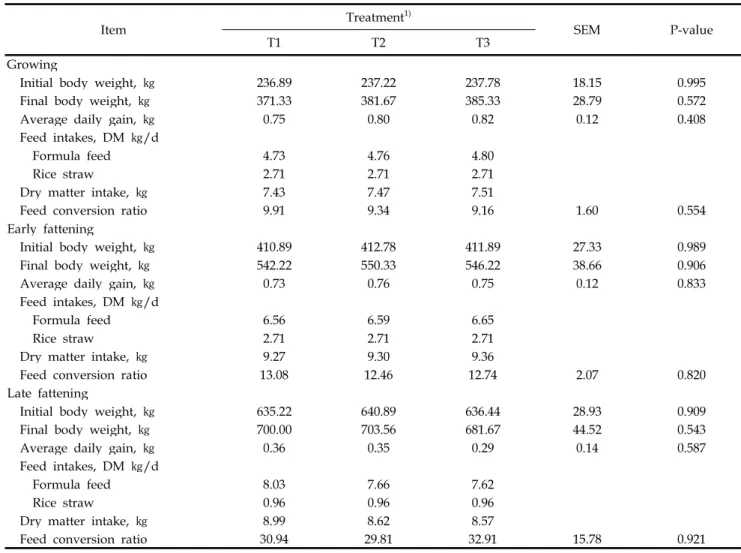
야자박 및 팜박의 첨가수준이 거세한우의 성장단계별 발육, 사료섭취량 및 사료요구율 변화에 미치는 영향은 Table 2와 같다.
Table 2. Effect of copra meal and palm meal supplementation on growth performance of Hanwoo steers
Item Treatment1)
SEM P-value
T1 T2 T3
Growing
Initial body weight, ㎏ 236.89 237.22 237.78 18.15 0.995
Final body weight, ㎏ 371.33 381.67 385.33 28.79 0.572
Average daily gain, ㎏ 0.75 0.80 0.82 0.12 0.408
Feed intakes, DM ㎏/d
Formula feed 4.73 4.76 4.80
Rice straw 2.71 2.71 2.71
Dry matter intake, ㎏ 7.43 7.47 7.51
Feed conversion ratio 9.91 9.34 9.16 1.60 0.554
Early fattening
Initial body weight, ㎏ 410.89 412.78 411.89 27.33 0.989
Final body weight, ㎏ 542.22 550.33 546.22 38.66 0.906
Average daily gain, ㎏ 0.73 0.76 0.75 0.12 0.833
Feed intakes, DM ㎏/d
Formula feed 6.56 6.59 6.65
Rice straw 2.71 2.71 2.71
Dry matter intake, ㎏ 9.27 9.30 9.36
Feed conversion ratio 13.08 12.46 12.74 2.07 0.820
Late fattening
Initial body weight, ㎏ 635.22 640.89 636.44 28.93 0.909
Final body weight, ㎏ 700.00 703.56 681.67 44.52 0.543
Average daily gain, ㎏ 0.36 0.35 0.29 0.14 0.587
Feed intakes, DM ㎏/d
Formula feed 8.03 7.66 7.62
Rice straw 0.96 0.96 0.96
Dry matter intake, ㎏ 8.99 8.62 8.57
Feed conversion ratio 30.94 29.81 32.91 15.78 0.921
1)T1, supplementation percent of copra meal were 10 (growing) or 13% (early and late fattening), and supplementation percent of palm meal were 7% (growing) or 12% (early and late fattening); T2, supplementation percent of copra and palm meal were 20 and 15% for the whole period; T3, supplementation percent of copra and palm meal were 30 and 20% for the whole period.
[Provider:earticle] Download by IP 118.70.52.165 at Monday, December 20, 2021 7:50 PM
www.earticle.net
T1구, T2구 및 T3구의 육성기 시험개시 평균체중은 각각 236.89, 237.22 및 237.78㎏이었으며, 시험종료시 평균체중 은 각각 371.33 381.67 및 385.33㎏으로 나타났다. T1구, T2 구 및 T3구의 일당증체량은 각각 0.75, 0.80 및 0.82㎏으로 나타나 T1구에 비해 T2구 및 T3구에서 일당증체량이 개선 되는 경향을 보였지만, 통계적인 유의차이는 없었다. 육성 기 T1구, T2구 및 T3구의 배합사료 섭취량은 각각 4.73, 4.76 및 4.80㎏이었으며, 볏짚 섭취량은 처리에 관계없이 원물기준으로 3㎏(건물 기준 2.71㎏)을 급여하였기 때문에 처리간의 차이는 없었다. 또한 육성기 T1구, T2구 및 T3구 의 사료요구율은 각각 9.91, 9.34 및 9.16으로 나타나 T1구 에 비해 T2구 및 T3구의 사료요구율이 개선되는 경향을 보였으나, 통계적인 유의성은 없었다.
T1구, T2구 및 T3구의 비육전기 시험개시 평균체중은 각 각 410.89, 412.78 및 411.89㎏이었으며, 시험종료시 평균체 중은 각각 542.22, 550.33 및 546.22㎏으로 나타났다. T1구, T2구 및 T3구의의 일당증체량은 각각 0.73, 0.76 및 0.75㎏
으로 나타나 T1구에 비해 T2구 및 T3구에서 일당증체량이 개선되는 경향을 보였지만, 통계적인 유의차이는 없었다.
육성기 T1구, T2구 및 T3구의 배합사료 섭취량은 각각 6.56, 6.59 및 6.65㎏이었으며, 비육전기 T1구, T2구 및 T3 구의 사료요구율은 각각 13.08, 12.46 및 12.74으로 나타나 T1구에 비해 T2구 및 T3구의 사료요구율이 개선되는 경향 을 보였으나, 통계적인 유의성은 없었다.
T1구, T2구 및 T3구의 비육후기 시험개시 평균체중은 각 각 635.22, 640.89 및 636.44㎏이었으며, 시험종료시 평균체 중은 각각 700.00, 703.56 및 681.67㎏으로 나타났다. T1구, T2구 및 T3구의 일당증체량은 각각 0.36, 0.35 및 029㎏으 로 나타났다. 비육후기 T1구, T2구 및 T3구의 배합사료 섭 취량은 각각 8.03, 7.66 및 7.62㎏이었으며, 비육전기 T1구, T2구 및 T3구의 사료요구율은 각각 30.94, 29.81 및 32.91로 나타나 T3구의 사료요구율이 높아지는 경향을 보였으나, 통계적인 유의성은 없었다.
본 연구에서 육성기 및 비육전기에 야자박과 팜박의 첨 가수준을 높였음에도 불구하고 사료섭취량에 대한 부의 영향 없이 거세한우의 일당증체량이 증가되는 경향을 보 였던 결과는 육성기 브라만 교잡우 120두(평균 체중 282
㎏)에서 팜박의 첨가(30, 43, 55, 60 및 72%)로 일당증체량, 건물섭취량 및 사료요구율이 개선되었다는 Osman과 Mohd(2000)의 연구결과와 유사한 경향을 보였던 것으로 판단된다. 또한 Hennessy 등(1989)은 헤어퍼드 종 거세우 에서 조사료의 품질이 좋지 않을 경우 일일 500g의 야자박
급여로 증체 및 사료이용성이 개선되었다고 본 연구와 유 사한 결과를 보고하였다. 염소를 대상으로 한 연구에서도 배합사료에 야자박을 75%까지 첨가하였음에도 불구하고 건물, 유기물, 조단백질 및 TDN 소화율이 증가되어 생산 성이 개선되었다고 보고한 바 있다(Aregheore, 2006). 이외 에도 야자박(Hennessy et al., 1989)과 팜박(Abdullah and Hutagalung, 1988; Shibata and Osman, 1988; Zahari and Alimon, 2004)의 첨가가 비육우의 증체 및 사료이용성에 미치는 부의 영향이 없었다는 이전의 연구결과도 본 연구 의 결과를 뒷받침해주고 있으며, 야자박의 첨가에 따른 증 체량 및 사료이용성 개선 효과는 다른 단백질 원료에 비해 상대적으로 소장에서 lysine 및 methionine의 이용효율(78 및 94%)이 높은 것과 연관이 있는 것으로 판단된다 (Hvelplund and Hesselholt, 1987).
그러나 육성기 및 비육전기 거세한우의 경우 시험초기 기존 배합사료 급여구(T1구)에 비해 T2구 및 T3구에서 1주 일 정도 사료섭취 속도가 느린 현상이 발생되었지만, 일일 사료섭취량의 차이는 없었는데, 이는 야자박과 팜박의 증 량 사용에 따른 일시적인 기호성 변화에 영향이 있는 것으 로 판단된다. 따라서 본 연구의 결과에서 육성기 및 비육 전기 동안에는 배합사료에 야자박과 팜박의 첨가수준을 높여도 기호성과 발육성적에는 별다른 문제없이 사용가능 하지만, 비육후기에는 T3구(야자박 30% 및 팜박 20%)에서 일당증체량 및 배합사료 섭취량 감소 현상을 감안했을 때 야자박과 팜박의 첨가수준은 거세한우의 성장단계별로 조 절이 필요한 것으로 판단된다.
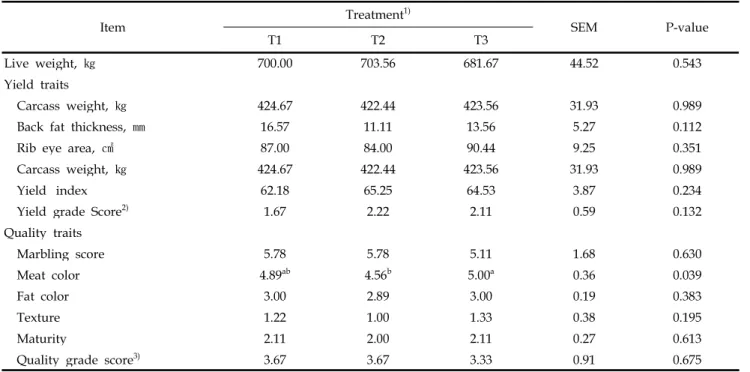
야자박 및 팜박의 첨가수준이 비육후기 거세한우의 도 체특성에 미치는 영향은 Table 3과 같다.
T1구, T2구 및 T3구의 도체중은 각각 424.67, 422.44 및 423.56㎏으로 처리간 도체중의 차이는 없었으며, 등지방두 께는 T1구에 비해 T2구 및 T3구에서 얇은 경향을 보였고, 배최장근단면적은 T2구에 비해 T1구 및 T3구에서 넓은 경 향을 보였지만, 통계적인 유의차이는 인정되지 않았다. 육 량지수 및 육량등급 출현율은 T1구에 비해 T2구 및 T3구에 서 증가되는 경향을 보였으나, 통계적인 유의성은 없었다.
근내지방도 및 육질등급은 T1구 및 T2구에 비해 T3구에 서 낮아지는 경향을 보였으나, 육색은 T3구에서 T1구 및 T2구에서 증가되는 경향을 보였다. 지방색, 조직감 및 성 숙도의 처리간 차이는 없었다.
본 연구의 결과에서 야자박 및 팜박의 첨가수준 상향 조 정은 육량등급 향상에 긍정적인 영향을 미치는 것으로 나 타났는데, T2구(야자박 20% 및 팜박 15%)구에서는 등지방,
[Provider:earticle] Download by IP 118.70.52.165 at Monday, December 20, 2021 7:50 PM
www.earticle.net
Table 3. Effect of copra and palm meal supplementation on carcass characteristics of Hanwoo steers
Item Treatment1)
SEM P-value
T1 T2 T3
Live weight, ㎏ 700.00 703.56 681.67 44.52 0.543
Yield traits
Carcass weight, ㎏ 424.67 422.44 423.56 31.93 0.989
Back fat thickness, ㎜ 16.57 11.11 13.56 5.27 0.112
Rib eye area, ㎠ 87.00 84.00 90.44 9.25 0.351
Carcass weight, ㎏ 424.67 422.44 423.56 31.93 0.989
Yield index 62.18 65.25 64.53 3.87 0.234
Yield grade Score2) 1.67 2.22 2.11 0.59 0.132
Quality traits
Marbling score 5.78 5.78 5.11 1.68 0.630
Meat color 4.89ab 4.56b 5.00a 0.36 0.039
Fat color 3.00 2.89 3.00 0.19 0.383
Texture 1.22 1.00 1.33 0.38 0.195
Maturity 2.11 2.00 2.11 0.27 0.613
Quality grade score3) 3.67 3.67 3.33 0.91 0.675
a,bMeans with a row with different superscript differ (p<0.05).
1)T1, supplementation percent of copra meal were 10 (growing) or 13% (early and late fattening), and supplementation percent of palm meal were 7% (growing) or 12% (early and late fattening); T2, supplementation percent of copra and palm meal were 20 and 15% for the whole period; T3, supplementation percent of copra and palm meal were 30 and 20% for the whole period.
2)Yield grade score: 3=A grade, 2=B grade and 1=C grade (high score means better quality).
3)Quality grade score: 5=1++grade, 4=1+grade, 3=1 grade, 2=2 grade, 1=3 grade (high score means better quality).
두께의 감소, T3구(야자박 30% 및 팜박 20%)의 경우에는 배최장근단면적의 증가로 육량등급이 개선되는 경향을 보 였던 것으로 판단된다. 또한 본 연구결과에서 야자박과 팜 박의 첨가수준 상향 조정에 따른 등지방두께의 감소(T2구 및 T3구)는 비육후기 배합사료 섭취량 감소(Table 2)와도 연관이 있는 것으로 생각되는데, Carsten 등(1991)은 앵거 스 교잡종 거세우에서 영양소 공급량이 증가될수록 등지 방두께가 두꺼워진다고 하여 본 연구에서 사료섭취량이 적었던 야자박 및 팜박 첨가수준 상향 조정구(T2구 및 T3 구)에서 등지방두께가 얇았던 결과를 뒷받침해주고 있는 것으로 판단된다.
야자박과 팜박의 첨가수준이 가장 높았던 처리구(T3구) 에서 근내지방도 및 육질등급이 낮아지는 경향을 보였는 데, 이는 사료섭취량 감소에 따른 영양소 공급량 감소에 일부 원인이 있는 것으로 생각되며, 영양소 공급량이 감소 될수록 도체의 근내지방도가 감소되었다는 이전의 연구결 과(Bodine and Purvis, 2003; Ferrel et al., 1978; Jeong et al., 2005)와 유사한 경향을 보인 것으로 판단된다.
일반적으로 육색은 생후월령(Barton-Gade et al., 1988),
보상성장 여부(Hornick et al., 1998), 일당증체량(Itoh et al., 1989), 온도 및 음수를 통한 철분 공급량 등의 다양한 요인이 영향을 미치는 것으로 보고되어 왔다. 처리에 관계 없이 거세한우의 평균적인 수준인 No. 4-5 범위로 나타났 지만, 야자박과 팜박의 첨가수준이 가장 높았던 처리구(T3 구)에서 육색이 짙어지는 결과를 보였는데, 생후월령, 사육 환경 등의 차이가 없었음에도 불구하고 일정수준 이상의 야자박 및 팜박의 첨가는 일부 육색을 어둡게 할 가능성도 있는 것으로 판단된다.
야자박 및 팜박의 첨가수준이 등심의 일반성분 및 지방 산 조성에 미치는 영향은 Table 4와 같다.
야자박 및 팜박의 첨가수준이 거세한우 등심의 수분, 조단백질, 조지방 및 회분 함량에 미치는 영향은 없었으며, 처리간 개별 지방산, 포화지방산 및 불포화지방산 조성은 유사한 결과를 보였다.
본 연구에서는 야자박 및 팜박의 첨가수준에 관계없이 배합사료의 조단백질 함량만을 동일한 수준으로 조정하였 기 때문에 처리간 조지방 및 에너지 함량의 차이가 일부 있었음에도 불구하고 등심의 조지방 함량의 차이는 없었
[Provider:earticle] Download by IP 118.70.52.165 at Monday, December 20, 2021 7:50 PM
www.earticle.net
Table 4. Effect of copra and palm meal supplementation on chemical and fatty acid composition in longissimus dorsi muscle of Hanwoo steers
Item Treatment1)
SEM P-value
T1 T2 T3
Chemical composition, %
Moisture 70.49 70.33 70.34 0.91 0.727
Crude Protein 21.54 20.94 21.66 0.04 0.615
Ether extract 9.25 9.32 9.54 1.13 0.887
Ash 1.02 1.04 1.01 0.04 0.791
Fatty acid composition, %
Lauric acid (C12:0) 1.03 1.02 1.02 0.12 0.14
Myristic acid (C14:0) 3.15 3.24 3.25 0.10 0.35
Myristoleic acid (C14:1) 0.91 0.89 0.92 0.10 0.28
Palmitic acid (C16:0) 26.45 26.24 26.13 2.12 0.91
Palmitoleic acid (C16:1) 4.24 4.18 4.15 0.54 0.94
Stearic acid (C18:0) 11.26 11.67 11.52 2.09 0.84
Oleic acid (C18:1) 50.21 50.00 50.20 0.91 0.91
Linoleic acid (C18:2) 2.08 2.01 2.05 0.28 0.99
Linolenic acid (C18:3) 0.15 0.16 0.14 0.14 0.97
Arachidic acid (C20:0) 0.10 0.10 0.11 0.11 0.64
Eicosenoic acid (C20:1) 0.11 0.13 0.11 0.11 0.59
Others 0.31 0.36 0.40 0.05 0.64
Total SFA 41.99 42.27 42.03 0.53 0.61
Total UFA 57.70 57.37 57.57 0.67 0.97
UFA/SFA 1.37 1.36 1.37 0.64 0.90
1)T1, supplementation percent of copra meal were 10 (growing) or 13% (early and late fattening), and supplementation percent of palm meal were 7% (growing) or 12% (early and late fattening); T2, supplementation percent of copra and palm meal were 20 and 15% for the whole period; T3, supplementation percent of copra and palm meal were 30 and 20% for the whole period.
SFA, saturated fatty acid; UFA, Unsaturated fatty acid.
는데, 사료의 조지방 및 에너지 함량의 차이가 등심의 조 지방 함량에 미치는 영향은 없었다는 이전의 연구결과 (Rule et al., 1994; Wistuba et al., 2006)와 유사한 경향을 보였던 것으로 판단된다. 또한 Jeong 등(2010, 2009)은 급 여사료의 에너지와 조단백질 함량이 증가될수록 등심의 조지방 함량이 증가되었다고 보고한 바 있는데, 본 연구에 서는 배합사료의 조단백질 함량이 동일한 조건에서 약간 의 에너지 함량 차이가 등심의 조단백질 및 조지방 함량에 영향을 미치지는 않는 것으로 판단된다.
일반적으로 등심의 지방산 조성은 유전, 사료의 영양소 함량, 사양관리 조건, 출하월령 및 비육 등의 요인에 따라 달라질 수 있는데(Choi et al., 2008), Jeong 등(2010)은 조 단백질 및 에너지 급여수준별 사양시험에서 31.4개월령에
출하된 거세한우 등심의 개별, 포화 및 불포화 지방산 조 성의 차이가 없었다고 본 연구와 유사한 결과를 보고한 바 있다. 한편 이전의 연구결과(Song et al., 1998; Jeong et al., 2010; Choi et al., 2008)에서 에너지와 단백질의 비율에 따 라 등심의 지방산 조성이 변동될 수 있다고 보고한 바 있 는데, 본 연구에서는 배합사료의 조단백질 함량이 차이가 없었고, 처리간 에너지와 조단백질 비율의 차이가 크지 않 았기 때문에 처리간 등심의 지방산 조성의 차이가 없었던 것으로 판단된다.
따라서 본 연구의 결과에서 야자박과 팜박의 첨가수준 이 육성기 및 비육전기 거세한우의 증체량 및 사료섭취량 에 미치는 영향은 없었으며, 도체특성 및 육질특성에 미치 는 영향은 적었지만, 야자박 30% 및 팜박 20% 첨가로 비
[Provider:earticle] Download by IP 118.70.52.165 at Monday, December 20, 2021 7:50 PM
www.earticle.net
육후기 사료섭취량, 일당증체량, 근내지방도 및 육질등급 이 약간 낮아지는 경향을 보였기 때문에 비육후기에는 야 자박과 팜박의 첨가비율을 너무 높지 않게 유지할 필요가 있는 것으로 판단된다. 즉, 본 연구의 결과에서 육성기와 비육전기에는 전체 사료 중에서 야자박과 팜박을 합쳐서 50% 정도까지 사용가능하지만, 비육후기에는 야자박과 팜 박을 35% 수준에서 사용하는 것이 바람직 할 것으로 판단 된다. 그러나 본 연구에서는 육성기, 비육전기 및 비육후기 공시축을 따로 선발해서 사양시험이 진행된 관계로 육성 기부터 출하시까지 연속적으로 야자박과 팜박의 첨가수준 이 증체량, 사료섭취량 및 도체특성에 미치는 영향에 대한 추가적인 연구가 필요할 것으로 판단된다.
Ⅳ. 요약
본 연구는 야자박과 팜박의 첨가수준이 거세한우의 사 양성적 및 도체특성에 미치는 영향을 조사하기 위해 거세 한우 81두(육성기: 27두, 비육전기: 27두 및 비육후기: 27 두)를 공시하여 6개월 동안 실시하였다. 시험구 배치는 관 행적인 수준의 야자박 및 팜박 첨가구(T1구), 야자박 20%와 팜박 15% 첨가구(T2구) 및 야자박 30%와 팜박 20% 첨가 구(T3구)의 3처리로 배치하였다. 육성기 및 비육전기 일당 증체량 및 사료섭취량은 T1구에 비해 T2구 및 T3구에서 높은 경향을 보였지만, 통계적인 유의차이는 없었다. 야자 박 및 팜박의 첨가수준의 거세한우의 도체중, 등지방두께 및 배최장근단면적에 미치는 영향은 없었다. 근내지방도와 육질등급은 T1구 및 T2구에 비해 T3구에서 낮은 경향을 보였지만, 통계적인 유의차이는 없었다. 처리간 육색, 지방 색, 조직감 및 성숙도는 유사한 수준이었다. 야자박과 팜박 의 첨가수준이 등심의 조단백질, 조지방 및 지방산 조성에 미치는 영향은 없었다. 따라서 본 연구에서 야자박과 팜박 의 첨가수준 증가가 거세한우의 산육성적, 도체특성 및 육 질특성에 미치는 부의 영향은 없는 것으로 판단된다.
사사
본 연구과제는 2015년 농림축산식품 농생명산업기술개 발사업(과제번호: 315022-3)과 강원대학교 전임교원 기본연 구비 지원사업(과제번호 C1009768-01-01,120131308)의 지 원으로 수행되었습니다.
Ⅴ. 참고문헌
1. AOAC. 1995. Official Methods of Analysis, 15th ed.
Association of official analytical chemists, Washington, DC, 269 USA.
2. Aregheore, E. M. 2006. Utilization of concentrate supplements containing varying levels of copra cake (Cocos nucifera) by growing goats fed a basal diet of napier grass (Pennisetum purpureum). Small Rum.
Res. 64(1):87-93.
3. Abdullah, N. and Hutagalung, R. I. 1988. Rumen fermentation, urease activity and performance of cattle given palm kernel cake-based diet. Anim. Feed Sci.
Technol. 20:79-86.
4. Barton-Gade, P. A., Cross, H. R., Jones, J. M. and Winger, R. J. 1988. Factors affecting sensory properties of meat. In: Meat Science, Milk Science and Technology. Cross, H. R. and Overby, A. J. (eds.). Vol.
C. In Series: World Animal Production.
Neimann-Sørensen, A. and Tribe, D. E. (Series eds.).
Elsevier Science Publishers, Amsterdam, Netherlands.
pp. 141-171.
5. Bodine, T. N. and Purvis, H. T. 2003. Effects of supplemental energy and/or degradable intake protein on performance, grazing behavior, intake, digestibility, and fecal and blood indices by beef steers grazed on dormant native tallgrass prairie. J.
Anim. Sci. 81:304-321.
6. Bremmer, D. F., Ruppert, L. D., Clark, J. H. and Drackley, J. K. 1998. Effects of chain length and unsaturation of fatty acid mixtures infused into the abomasum of lactating dairy cows. J. Dairy Sci.
81:176-188.
7. Carsten, G. E., Johnson, D. E., Ellenberger, M. A. and J. D. Tatum. 1991. Physical and chemical components of the empty body during compensatory growth in beef steers. J. Anim. Sci. 69:3251-3315.
8. Chalupa, W., Rickabaugh, B., Kronfeld, D. S. and Sklan, D. 1984. Rumen fermentation in vitro as influenced by long chain fatty acids. J. Dairy Sci.
67:1439-1444.
9. Chin, F. Y. 2001. Palm Kernel Cake (PKC) as a
[Provider:earticle] Download by IP 118.70.52.165 at Monday, December 20, 2021 7:50 PM
www.earticle.net
Supplement for fattening and dairy cattle in Malaysia.
In: Moog, F.A., S.G. Reynolds, K. Maaruf, Forage Development in Southeast Asia:Strategies and Impacts.
Proc. 7th Meeting of the Regional Working Group on Grazing and Feed Resources, FAO-University of Sam Rapulangi, Manado, Indonesia.
10. Choi, C. B., Shin, H. Y., Lee, S. O., Kim, S. I., Jung, K. K., Choi, C. W., Baek, K. H., Lunt, D. K. and Smith, S. B. 2008. Comparison of cholesterol contents and fatty acid composition in M. longissimus of Hanwoo, Angus and Wagyu crossbred steers. J.
Anim. Sci. Technol. 50(4):519~526.
11. Ezieshi, E. V. and Olomu, J. M. 2007. Nutritional evaluation of palm kernel meal types: 1. Proximate composition and metabolizable energy values. Afric.
J. Biotechnol. 6: 2484-2486.
12. Fernandez, X., Monin, G., Culioli, J., Legrand, I. and Quilichini, Y. 1996. Effect of duration of feed withdrawal and transportation time on muscle characteristics and quality in Friesian-Holstein calves.
J. Anim. Sci. 74:1576-1659.
13. Ferrell, C. L., Kohlmeier, R. H., Crouse, J. D. and Glimp, H. 1978. Influence of dietary energy, protein and biological type of steer upon rate of gain and carcass characteristics. J. Anim. Sci. 46:255-270 14. Folch, J., Less, M. and Sloestanley, G. H. 1957. A
simple method for the isolation of purification of total lipids from animal tissues. J. Bio. Chem.
226:497-509.
15. Han I. K. 1994. Feed Resources Handbook, Korean Society of Animal Nutrition and Feedstuffs. Korea Feed Ingredients Association. Korea.
16. Hennessy, D. W., Kempton, T. J. and Williamson, P.
J. 1989. Copra meal as a supplement to cattle offered a low quality native pasture hay. Asian-Australas. J.
Anim. Sci. 2:77-84.
17. Hornick, J. L., Van Eenaeme, C., Clinquart, A., Diez, M. and Istasse, L. 1998. Different periods of feed restriction before compensatory growth in Belgian Blue bulls: I. Animal performance, nitrogen balance, meat characteristics, and fat composition. J. Anim.
Sci. 76:249-308.
18. Hvelplund, T. and Hesselholt, M. 1987. Digestibility of individual amino acids in rumen microbial protein and undegraded dietary protein in the small intestine of sheep. Acta Agric. Scandv. 37:469-477.
19. Itoh, M., Arihara, K., Kondo, Y., Matsumoto, T., Tarumi, K., Tabata, T. and Ikeda, N. 1989. Analysis of influencing factors on meat color evaluation of fattening Holstein steers. Jap. J. Zootech. Sci.
60:321-329.
20. Jaworski, N. W., Shoulders, J. Gonzalez-Vega, J. C.
and Stein, H. H. 2014. Effects of using copra meal, palm kernel expellers, or palm kernel meal in diets for weanling pigs. PAS. 30:243-251.
21. Jeong, J., Hwang, J. M., Seong, N. I., Kim, J. B., Hwang, I. K. and Kim, Y. C. 2009. Effects of supplemented PROSOL® as an emulsifier on growth performance and carcass characteristics in Hanwoo steers of final fattening period. J. Anim. Sci. Technol.
51(5):395-406.
22. Jeong, J., Seong, N. I., Hwang, I. K., Lee, S. B., Yu, M. S., Nam, I. S. and Lee, M. I. 2010. Effects of level of CP and TDN in the concentrate supplement on growth performances and carcass characteristics in Hanwoo steers during final fattening period. J. Anim.
Sci. Technol. 52(4):305~312.
23. MAFRA. 2017. Agriculture food and rural affairs statistics yearbook. Ministry of Agriculture, Food and Rural Affairs. Korea.
24. Oldick, B. S., Staples, C. R., Thatcher, W. W. and Gyawu, P. 1997. Abomasal infusion of glucose and fat-effect on digestion, production, and ovarian and uterine functions of cows. J. Dairy Sci. 80:1315-1343.
25. Olomu, J. M. 1995. Monogastric Animal Nutrition- Principle and Practices. Jachem Publication, Benin, Nigeria. pp. 234-284.
26. Osman, A. and Mohd, S. H. I. 2000. Growth Performance of Steers Fed By-Products of the Oil Palm Industry. Asian-Australas. J. Anim. Sci. 13(7) Suppl. A:331-332.
27. Rule, D. C., Busboom, J. R. and Kercher, C. J. 1994.
Effect of dietary canola on fatty acid composition of bovine adipose tissue, muscle, kidney, and liver. J.
[Provider:earticle] Download by IP 118.70.52.165 at Monday, December 20, 2021 7:50 PM
www.earticle.net
Anim. Sci. 72:2735-2779.
28. SAS. 2005. PC-SAS package. SAS User's guide ; statistic. SAS institute Inc., Cary. NC. USA.
29. Shibata, M. and Osman, A. H. 1988. Feeding value of oil palm by-products. 1. Nutrient intake and physiological responses of Kedah-kelantan cattle. Jpn.
Agric. Res. Q. 22:77-84.
30. Song, M. K., Kim, N. S., Chung, C. S., Choi, Y. I., Won, Y. S. Chung, J. K. and Choi, S. H. 1998. Effect of feeding level of concentrates on growth performance and fatty acid composition of adipose tissues at various locations in Hanwoo Bulls. J.
Anim. Sci. Technol. 40:488-498.
31. Wistuba, T. J., Kegley, E. B. and Apple, J. K. 2006.
Influence of fish oil in finishing diets on growth performance, carcass characteristics, and sensory evaluation of cattle. J. Anim. Sci. 84:902-911.
32. Yeong, S. W. 1980. The nutritive value of palm oil by-products for poultry. Proceedings of 1st AAAP Animal Science Congress. Abstract No. 45:17.
33. Zahari, M. W. and Alimon, A. R. 2004. Use of palm kernel cake and oil palm by-product in compound feed. Palm Oil Developments No. 40:5-9.
(Received 31 January 2018, Revised 14 June 2018, Accepted 19 June 2018)
[Provider:earticle] Download by IP 118.70.52.165 at Monday, December 20, 2021 7:50 PM