• 검색 결과가 없습니다.

Genetic variation in populations of the Korean endemic Eranthis byunsanensis (Ranunculaceae)

N/A
N/A
Protected

Academic year: 2021

Share "Genetic variation in populations of the Korean endemic Eranthis byunsanensis (Ranunculaceae)"

Copied!
7
0
0

로드 중.... (전체 텍스트 보기)

전체 글

(1)

http://dx.doi.org/10.11110/kjpt.2012.42.4.253 Plant Taxonomy

Genetic variation in populations of the Korean endemic Eranthis byunsanensis (Ranunculaceae)

Soonku So

1

, Byongsoon Lee

2

and Ki-Ryong Park*

Department of Science Education, Kyungnam University, Changwon 631-701, Korea

1

Department of Biological Sciences, Chonbuk National University, Jeonju 561-756, Korea

2

Department of Health Science, Jeonju University, Jeonju 560-759, Korea (Received 6 September 2012; Revised 5 November 2012; Accepted 3 December 2012)

한국 특산식물 변산바람꽃(Eranthis byunsanensis)의 유전적 변이

소순구1·이병순2·박기룡*
경남대학교 과학교육과,

1

전북대학교 자연과학대학 생명과학과,

2

전주대학교 보건관리학과

ABSTRACT: The genetic variation in populations of Eranthis byunsanensis, an endemic and rare species of Korea, was studied using starch gel electrophoresis. All five known populations were sampled for allozyme electrophoresis of nine enzymes coded by 10 loci. The overall genetic variation of E. byunsanensis population was shown to be considerably high within the populations (A = 2.4, P = 90.0, H

E

= 0.311). A positive F

IS

value of E. byunsanensis indicated an overall deficiency of heterozygotes, and a low F

ST

value (0.131) showed little differentiation among populations. The high genetic variation, less genetic differentiation among populations, and a significant amount of heterozygote deficiency propose the hypothesis that they have an experience of recent isolation and fragmentation of their habitat. Thus, the rate of gene flow has been drastically reduced, and the rate of inbreeding in E. byunsanensis populations has increased. Current habitats in Mai-san and Naro-do are vulnerable due to their small population size and the levels of anthropogenic activity in the region constantly threatening survival of this species. Because of the high genetic variation and low levels of differentiation among populations in E. byunsanensis, it is not issue which populations have a priority for protection, but we may concern the plan to maintain population continuously and diminish the rate of inbreeding.

Keywords: Eranthis byunsanensis, genetic variation, conservation

적 요: 한국특산식물이며 희귀식물인 변산바람꽃(Eranthis byunsanensis)의 보전을 위해 5개 자생지 집단을 대상으로 9개의 allozyme marker를 이용하여 유전적 다양성과 구조를 분석하였다. 변산바람꽃 집단의 대립 유전자의 수(A)는 2.4개, 다형적 유전좌위의 비율(P)은 90.0%, 이형접합자의 평균 기대치(H

E

) 는 0.311을 나타 내어 분포 역이 넓은 특산식물과 유사하거나 다소 높은 수준의 유전적 다양도를 유지하는 것으로 나타났다.

유전적 구조분석 결과 집단간 F

IS

는 양의 값을 나타내었고 집단간 유전적 분화도는 낮은 결과(0.131)를 보였다.

집단간 높은 유전적 변이, 낮은 유전적 분화, 이형접합자의 결여양상은 이 종이 최근 고립되어 서식지의 단 편화를 경험했을 가능성을 제시하며 유전적 확산을 막아 집단의 근친교배율이 증가한 것으로 판단된다. 현 재 마이산과 나로도 자생지는 집단의 작은 크기와 종의 생존을 위협하는 인간활동에 의해 매우 취약한 상태 이다. 따라서 유전적 변이가 다소 높고 분화가 적은 변산바람꽃 집단의 합리적 보전을 위해서는 특정한 집단 에 대한 보전의 우선권을 설정하는 것 보다 전체 집단을 지속적으로 유지하고 근친교배율을 낮추기 위한 노 력이 요구된다.

*Author for correspondence: [email protected] http://www.pltaxa.or.kr

Copyright © 2012 the Korean Society of Plant Taxonomists

(2)

주요어: 변산바람꽃, 유전적 변이, 보전

Most rare and endemic plants with small populations are maintained by low levels of genetic variation, which are heavily impacted by changes within the genetic structure, whether it be genetic drift, the founder effect or inbreeding depression (Hamrick and Godt, 1989; Ellstrand and Elam, 1993; Neale et al., 2008). The lack of genetic variability within such species can lead to population extinctions. To be precise, small and fragmented populations are a major cause of extinction for rare species (Neel and Ellstrand, 2001). Knowledge of the genetic variation and structure of such rare species is, therefore, needed to establish suitable guidelines for conservation and restoration strategies. Sampling efforts which capture the maximum genetic variation of target species are essential for the long- term success of conservation (Hamrick et al., 1991).

However, some rare species have been reported to have a high genetic variation compared to widespread congeners, and it can be difficult to establish that species with a limited geographic range have low genetic diversity (Gitzendanner and Soltis, 2000; Park, 2004; Neale et al., 2008). The high genetic diversity of some rare species can usually be explained by the unique histories, which may include recent origin from a widespread ancestor, multiple or refugia origins, or a high contemporary gene flow (Park, 2004; Neale et al., 2008).

The genus Eranthis Salisb. consists of 8-9 species in the family Ranunculaceae, and is widely distributed in temperate zones of Europe and East Asia (Park et al., 2007). Among the species of Eranthis E. stellata Maxim., E. byunsanensis B. Y.

Sun and E. pungdoensis B. U. Oh are reported to occur in the Korean peninsula (Wang et al., 2001; Oh and Ji, 2009). Out of the three, E. byunsanensis, is endemic to Korea and was described as a new species by Sun et al. (1993). Only five populations of E. byunsanensis have been reported until now, and it is listed as a “LC; Least Concerned” species in the Rare Plant Data Book of Korea (Korea Forest Service, 2008).

Morphologically, E. byunsanensis is distinctly different from the related species E. pinnatifida, which is endemic to Japan, in having funnel shaped petals with nectary around the margin, entire lobes of involucre, and glabrous peduncle.

This study examines genetic diversity within and among populations of Korean endemic E. byunsanensis using starch gel electrophoresis, and provides basic guidelines for future conservation plans of this species.

Materials and Methods

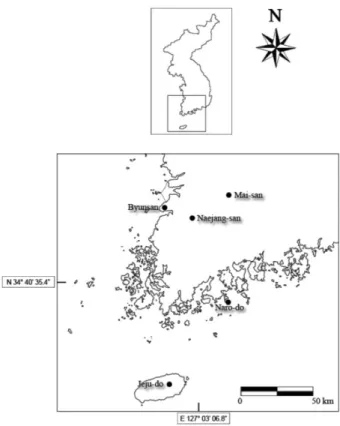
On average, we obtained samples from 16 individual plants

from each of the five known populations of E. byunsanensis in Korea for isozyme study (Fig. 1; Table 1) which were found mainly in shady places along streams and on mountain slopes.

For running the starch gel electrophoresis, samples were pulverized and ground in porcelain dish using extracting buffer containing 0.1 M tris-HCl, pH 7.5, 1 mM EDTA (tetrasodium salt), 10 mM MgCl, 10 mM KCl, 14 mM 2-mercaptoethanol, and 5-10 mg/mL solid polyvinylpyrrolidone (Gottlieb, 1981).

Chromatography paper wicks approximately 15 mm long and 3 −4 mm wide were dipped into each sample solution, and were frozen at −60

o

C prior to the electrophoresis.

Each sample was then processed through electrophoresis with 13% starch gel using two buffer systems. An electrode buffer of 0.065 M L-histidine and 0.007 M citric acid, adjusted to pH 6.5 with NaOH was diluted by 1:3 ratio for System I.

Another electrode buffer of 0.18 tris, 0.1M Boric acid, and 0.004M EDTA, pH 8.6, also diluted according to 1:3 ratio was used for System II. The whole process of electrophoresis was carried out under 4

o

C. Gel systems were run at 40 mA for about 5 hours. Enzyme-activity staining and agarose overlays generally followed the protocols of Soltis et al. (1983). Loci and

Fig. 1. The geographical distribution of E. byunsanensis

populations in Korea.

(3)

alleles were numbered sequentially and lettered alphabetically beginning with the most anodal form. A total of nine enzymes were assayed by using Systems I and II; glyceraldehydes- 3-phosphate dehydrogenase (GA3PD), 6-phosphogluconate dehydrogenase (6PGD), malate dehydrogenase (MDH), aldolase (ALD) and shikimate dehydrogenase (SKDH) were assayed with System I, while malic enzyme (ME), phosphoglucose isomerase (PGI), phosphoglucomutase (PGM) and alcohol dehydrogenase (ADH) were resolved with System II.

The mean number of alleles per locus (A), percentage of polymorphic loci (P), average observed heterozygosity (H

O

), and mean expected heterozygosity (H

E

) of ca. 16 samples from each group were studied by using the BIOSYS-1 program (Swofford and Selander, 1981). Also, to study the population differentiation, Wright’s F-statistics were calculated. It includes F

IS

, an index of inbreeding, F

IT

, the overall inbreeding coefficient, and F

ST

, a measure of the genetic differentiation among subpopulations (Wright, 1965). Fixation indices (F) were calculated, and a chi-square test was conducted to test for significant deviations from the Hardy-Weinberg expectation. A UPGMA tree was produced by Nei’s genetic identity values using BIOSYS-1 program.

Results

Of the 10 enzymes evaluated, PGI and 6PGD were consistently resolved and scored for 2 interpretable loci (PGI-1 and PGI- 2; 6PGD-1 and 6PGD-2) while only one locus was interpreted in the remaining loci. All loci were polymorphic among five populations of E. byunsanensis inhabiting in Korean peninsula;

PGI-2

a

was unique to population 4 (Naejang-san). The remaining populations had no unique allele (Table 2).

All populations had 90% of polymorphic loci. The mean number of alleles per locus ranged from 2.1 to 2.6 with the lowest in population 1 (Naro-do) and the highest in population 2 and 3 (Mai-san and Byunsan). The mean heterozygosity expected by the Hardy-Weinberg equilibrium ranged from 0.217 to 0.430 and averaged 0.311. The mean heterozygosity observed ranged from 0.043 to 0.176 and averaged 0.122. All populations showed a lower observed heterozygosity than expected by the Hardy-Weinberg equilibrium (Table 3). This clearly indicated a severe heterozygote deficit.

Observed genotype proportions were compared to those expected by the Hardy-Weinberg equilibrium by calculating the fixation index (F) for each polymorphic locus in each Table 1. Collection sites for five populations of E. byunsanensis.

Population Location Number of individuals sampled

1 Naro-do Naro-do, Goheung-gun , Korea 16

2 Mai-san Mai-san, Jinan-gun, Korea 16

3 Byunsan Byunsan, Buan-gun, Korea 16

4 Naejang-san Naejang-san, Jeongeup-si, Korea 16

5 Jeju-do Jeju-do, Korea 16

Table 2. Summary allele-frequency data for ten polymorphic loci among five populations of E. byunsanensis in Korea.

Locus Naro-do Mai-san Byunsan Naejang-san Jeju-do

ADH-2

a 0.357 0.133 0.438 0.000 0.000

b 0.643 0.467 0.563 0.938 1.000

c 0.000 0.400 0.000 0.063 0.000

GA3PD

a 0.000 0.333 0.063 0.000 0.125

b 0.938 0.333 0.938 0.938 0.875

c 0.063 0.333 0.000 0.063 0.000

PGI-1

a 0.000 0.063 0.036 0.031 0.033

b 0.857 .0.656 0.714 0.875 0.667

c 0.107 0.250 0.214 0.094 0.300

d 0.036 0.031 0.036 0.000 0.000

(4)

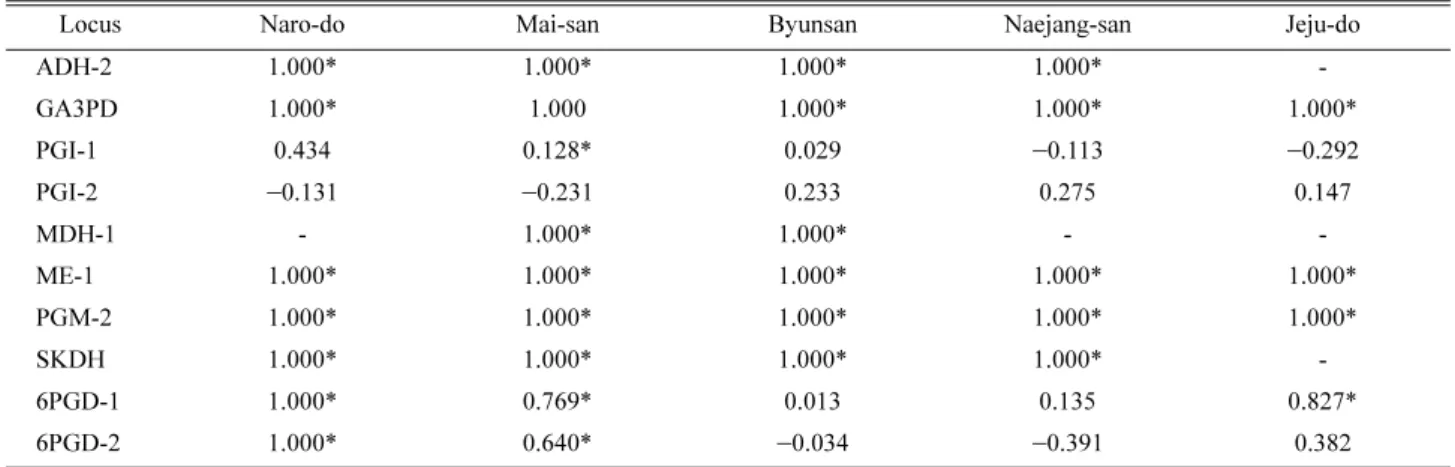
population. The statistical difference of the F value from 0 was then calculated by using the chi-square test (Table 5). Of the 45 valid tests, 15 loci showed accordance to Hardy-Weinberg proportions, while most of the remaining loci were significantly different from the Hardy-Weinberg equilibrium and the value of F exceeded 0, indicating heterozygote deficiency.

The mean F

IS

and F

IT

value of all ten loci of E. byunsanensis studied were 0.675 and 0.696, which indicated an overall Table 2. Continued.

Locus Naro-do Mai-san Byunsan Naejang-san Jeju-do

PGI-2

a 0.000 0.000 0.000 0.031 0.000

b 0.036 0.188 0.321 0.406 0.036

c 0.857 0.813 0.571 0.563 0.607

d 0.107 0.000 0.107 0.000 0.357

MDH-1

a 0.000 0.313 0.063 0.000 0.000

b 1.000 0.688 0.938 1.000 1.000

ME-1

a 0.250 0.250 0.000 0.063 0.000

b 0.750 0.750 0.938 0.875 0.813

c 0.000 0.000 0.063 0.063 0.188

PGM-2

a 0.000 0.000 0.063 0.063 0.067

b 0.938 0.867 0.813 0.500 0.867

c 0.063 0.133 0.125 0.438 0.067

SKDH

a 0.083 0.333 0.063 0.308 0.000

b 0.917 0.667 0.938 0.692 1.000

6PGD1

a 0.071 0.071 0.125 0.125 0.156

b 0.929 0.827 0.719 0.656 0.786

c 0.000 0.107 0.156 0.219 0.063

6PGD2

a 0.133 0.063 0.233 0.000 0.156

b 0.867 0.906 0.700 0.719 0.750

c 0.000 0.031 0.067 0.281 0.094

Table 3. Mean sample size per locus (N), mean number of alleles per locus (A), percentage of polymorphic loci (P), mean observed heterozygosity (H

O

), and mean expected heterozygosity (H

E

) in five populations of E. byunsanensis in Korea.

Population N A P H

O

H

E

1 Naro-do 14.7 2.1 90.0 0.043 0.217 2 Mai-san 13.6 2.6 100.0 0.095 0.430 3 Byunsan 15.5 2.6 100.0 0.176 0.328 4 Naejang-san 15.7 2.4 90.0 0.162 0.320 5 Jeju-do 15.1 2.2 70.0 0.134 0.258

Mean 14.9 2.4 90.0 0.122 0.311

Table 4. Summary of F-statistics at 10 loci from five populations of E. byunsanensis. F

IS

, an index of inbreeding, F

IT

, the overall inbreeding coefficient, and F

ST

, a measure of the genetic differentiation among populations.

Locus F

IS

F

IT

F

ST

ADH-2 1.000 1.000 0.232

GA3PD 1.000 1.000 0.259

PGI-1 0.014 0.054 0.041

PGI-2 0.114 0.216 0.115

MDH-1 1.000 1.000 0.212

ME-1 1.000 1.000 0.076

PGM-2 1.000 1.000 0.131

SKDH 1.000 1.000 0.140

6PGD1 0.424 0.448 0.042

6PGD2 0.194 0.246 0.064

Mean 0.675 0.696 0.131

(5)

deficiency of heterozygotes compared to that expected based on the Hardy-Weinberg equilibrium. The mean F

ST

value of ten loci of E. byunsanensis was 0.131, which was slightly low, indicating moderate differentiation among populations (Table 4). Thus, 87% of the genetic diversity of this species is common to all populations.

The Nei’s unbiased genetic identity (Nei, 1978) indicated that five populations studied were close to each other in pairwise comparison. The genetic identity values ranged from 0.895, for the comparison between population 2 (Mai-san) and 4, (Naejang-san) to 0.984, for the comparison between population 1 (Naro-do) and 3 (Byunsan) (Table 6). There was also no significant relationship between geographical distance and genetic identity, as determined by the Nei's (1978). The UPGMA phenogram shows that the Byunsan population is clustered to the Naro-do population, as well as the Jeju-do population (Fig. 2).

Discussion

High genetic variation in Eranthis byunsanensis: Comparing widespread congeners, rare and endemic species usually have low genetic variation due to their limited geographic range

(Hamrick and Godt, 1989; Ellstrand and Elam, 1993).

However, in our study of the genetic variation within five populations of E. byunsanensis, we found an unusually high genetic diversity compared to those of previously reported Korean endemic species such as Scrophularia takesimensis (Park et al., 2010), Cotoneaster wilsonii (Park et al., 2009) for which overall genetic variation was very low and genetic polymorphism was rarely found among the population. Using isozyme data, similar cases of high genetic variation were reported in Korean endemic Euphorbia fauriei (Park, 2004), Hemerocallis hakuunensis (Kang and Chung, 1997) and Hosta Table 5. Value of the fixation index F for polymorphic loci in populations of E. byunsanensis. Consistency with the Hardy-Weinberg equilibrium, i.e., statistical difference of fixation indices from 0, was evaluated using chi-square analysis and is indicated via asterisks:

*P < 0.005.

Locus Naro-do Mai-san Byunsan Naejang-san Jeju-do

ADH-2 1.000* 1.000* 1.000* 1.000* -

GA3PD 1.000* 1.000 1.000* 1.000* 1.000*

PGI-1 0.434 0.128* 0.029 − 0.1130.292

PGI-2 − 0.1310.231 0.233 0.275 0.147

MDH-1 - 1.000* 1.000* - -

ME-1 1.000* 1.000* 1.000* 1.000* 1.000*

PGM-2 1.000* 1.000* 1.000* 1.000* 1.000*

SKDH 1.000* 1.000* 1.000* 1.000* -

6PGD-1 1.000* 0.769* 0.013 0.135 0.827*

6PGD-2 1.000* 0.640* − 0.0340.391 0.382

Table 6. Mean values for Nei’s (1978) unbiased genetic identity coefficient for the pair-wise comparisons of five populations of E.

byunsanensis in Korea.

Population 1 2 3 4 5

1 Naro-do -

2 Mai-san 0.944 -

3 Byunsan 0.984 0.922 -

4 Naejang-san 0.933 0.895 0.953 -

5 Jeju-do 0.968 0.906 0.971 0.946 -

Fig. 2. UPGMA phenogram derived from Nei’s genetic identity of

five populations of E. byunsanensis in Korea.

(6)

minor (Chung, 1994). In addition to isozyme data, Lee et al.

(2012) reported high genetic variation of E. byunsanensis on the basis of nrDNA ITS and cpDNA sequences.

Historical factors might provide one possible explanation for the high genetic variation and low levels of genetic differentiation detected in E. byunsanensis. It is likely that these populations were connected for a significant amount of time, and later isolated from one another by human interventions.

Earlier it was known to occur only in Byunsan area but lately found in some isolated localities in Korea including Jeju, Jeonnam and Gyungnam to Gyeonggi and Gangwon. The high genetic identity among populations as well as the lack of unique alleles within the population suggests that it may have originated recently, and has not had enough time to accumulate unique alleles locally. Only the Naejang-san population of E.

byunsanensis has a unique allele of PGI-2.

The levels and patterns of genetic diversity documented in E. byunsanensis allow us to make inferences about the demographic history of the species. The high percentage values of polymorphic loci and number of alleles per locus suggest that E. byunsanensis did not experience severe or long-lasting population bottlenecks sufficient to cause a loss of genetic diversity (Neel and Ellstrand, 2001). The lack of genetic differentiation among populations supports the hypothesis that they have recently undergone a substantial degree of gene flow.

The positive values of F statistics in E. byunsanensis indicated a significant amount of heterozygote deficiency, and supported the recent isolation of populations rather than intensive gene flow among populations. Thus, the recent population fragmentation should prevent the gene flow, and promote the rate of inbreeding in E. byunsanensis populations.

Conservation implication for E. byunsanensis populations:

On the base of isozyme analysis, the level and patterns of genetic diversity of E. byunsanensis are not typical patterns of a rare endemic plant species, revealing very low genetic variation within populations and high genetic differentiation among populations. However, they have considerable genetic variation at all loci, and showed less genetic differentiation than typical endemic plants. Besides, this species indicated an overall deficiency of heterozygotes by presumable fragmentation of habitats and following inbreeding depression. In this case conservation efforts should be focused on maintaining large and continuous populations in order to maintain high genetic variation, and to prevent the loss of heterozygotes via inbreeding events (Neel and Ellstrand, 2001). In order to protect existing populations, we also suggest the establishment of new subpopulations with seeds or seedlings from ex situ collections, and to amend the fragmentation of populations. For example,

a new subpopulation could be settled between the original habitats so that the gap between them would be diminished.

Although E. byunsanensis populations are found in areas of moderate vegetation, they are discontinuous and isolated, and mainly have small population sizes. Besides, individuals of E.

byunsanensis are collected frequently from the wild due to the beauty of the flowers as well as the rarity of the species, and thus, the protection of existing sites is urgently needed.

The habitats of population 3 (Byunsan) and 4 (Naejang-san) are found inside National Parks of Korea, which are protected by law, and these groups show a stable vegetation pattern in spite of their small population size. Moreover, the habitats of Jeju-do is in the Sangumburi crater, which is found in the only World Natural Heritage site in Korea, Jeju-do, and is also protected by law. This shows that sustainable efforts to conserve E. byunsanensis habitats are being conducted steadily.

Unfortunately, the habitats of Naro-do and Mai-san do not fall under any legal protection, which is urgently required for their conservation. Population 2 (Mai-san) is a famous tourist destination due to the proximity of Tapsa Temple and its 80 stone pagodas, and hence, experiencing a high level of threat from the large volume of human traffic in the area. In the Mai- san population, E. byunsanensis is only distributed on the southern side of the mountain slope and is extremely vulnerable due to the presence of a trail course installed around the population. Furthermore, the expansion of E. byunsanensis population is limited by the presence of Eunsusa Temple located beneath the habitat, and thus, there is need for effective Ex situ conservation plans for this population. Because of the high genetic variation and low levels of differentiation among populations of E. byunsanensis, it is not important as to which populations are protected, rather all populations must be protected and suitable efforts can be made to diminish the rate of inbreeding.

Acknowledgement

We thank two anonymous reviewers who provided valuable comments on the manuscript. This work was supported by Kyungnam University Research Fund, 2012.

Literature Cited

Chung, M. G. 1994. Genetic variation and population structure in Korean endemic species: III. Hosta minor (Liliaceae). Journal of Plant Research 107: 307-383.

Ellstrand, N. C. and D. R. Elam. 1993. Population genetic conse-

quences of small population size: Implications for plant conser-

(7)

vation. Annual Review of Ecology, Evolution, and Systematics 24: 217-242.

Gitzendanner, M. A. and P. S. Soltis. 2000. Pattern of genetic vari- ation in rare and widespread plant congeners. American Jour- nal of Botany 87: 783-792.

Gottlieb, L. D. 1981. Electrophoretic evidence and plant popula- tions. Progress in Phytochemistry 7: 1-46.

Hamrick, J. L and M. J. W. Godt. 1989. Allozyme diversity in plant species. In Plant Population Genetics, Breeding and Genetic Resources. Brown A. D. H., M. T. Clegg, A. L.

Kahler, and B. S. Weir. (eds.), Sinauer, Sunderland, Pp. 43-63.

Hamrick, J. L., M. J. W. Godt, D. A. Murawski and M. D. Love- less. 1991. Correlations between species traits and allozyme diversity: Implications for conservation biology. In Genetics and Conservation of Rare Plants. Falk D. A. and K. E. Hols- inger. (eds.), Oxford Univ. Press, New York, Pp. 76-86.

Kang, S. S. and M. G. Chung. 1997. Genetic variation and popu- lation structure in Korean endemic species: IV. Hemerocallis hakuunensis (Liliaceae). Journal of Plant Research 110: 209- 217.

Korea Forest Service. 2008. Rare plants data book in Korea. Korea National Arboretum, Pocheon. Pp. 225.

Lee, C. S., S. H. Yeau and N. S. Lee. 2012. Taxonomic status and genetic variation of Korean endemic plants, Eranthis byunsan- ensis and Eranthis pungdoensis (Ranunculaceae) based on nrDNA ITS and cpDNA Sequences. Journal of Plant Biology 55: 165-177.

Neale, J. M. R., T. A. Ranker and S. K. Collinge. 2008. Conser- vation of rare species with island-like distributions: a case study of Lasthenia conjugens (Asteraceae) using population genetic structure and the distribution of rare markers. Plant Species Biology 23: 97-110.

Neel, M. C. and N. C. Ellstrand. 2001. Patterns of allozyme diver- sity in the threatened plant Erigeron parishii (Asteraceae).

American Journal of Botany 88: 810-818.

Nei, M. 1978. Estimation of average heterozygosity and genetic distance from a small number of individuals. Genetics 89:

583-590.

Oh, B. U., S. J. Ji. 2009. Eranthis pungdoensis B.U. Oh: a new species of Eranthis (Ranunculaceae) from Korea. Korean Journal of Plant Taxonomy 39: 86-88. (in Korean)

Park, C. W., S. H. Yeau, C. S. Chang, H. W. Lee and B. Y. Sun.

2007. Ranunculaceae. In The Genera of Vascular Plants of Korea. Flora of Editorial committee (eds.) Academy Publish- ing Co, Seoul. Pp. 165-205.

Park, J., M. Kim and K.-R. Park. 2010. Genetic variation in endan- gered Scrophularia takesimensis (Scrophulariaceae) from Ulleung island. Botanical Studies 51: 371-376.

Park, J., J. Lee, S. So and M. Kim. 2009. Genetic variation and conservation of the endangered species Cotoneaster wilsonii (Rosaceae) from Ulleung island. Korean Journal of Plant Tax- onomy 39: 125-129.

Park, K.-R. 2004. Comparisons of allozyme variation of narrow endemic and widespread species of Far East Euphorbia (Euphorbiaceae). Botanical Bulletin of Academia Sinica 45:

221-228.

Soltis, D. E., C. H. Haufler, D. C. Darrow and G. J. Gastony. 1983.

Starch gel electrophoresis of ferns: a compilation of grind buffers, gel and electrode buffers, and staining schedules.

American Fern Journal 73: 9-27.

Sun, B. Y., C. H. Kim and T. J. Kim. 1993. A new species of Eranthis (Ranunculaceae) from Korea: E. byunsanensis.

Korean Journal of Plant Taxonomy 23: 21-26. (in Korean) Swofford, D. L. and R. B. Selander. 1981. BIOSYS-1: a FOR-

TRAN program for the comprehensive analysis of electro- phoretic data in population genetics and systematics. Journal of Heredity 72: 281-283.

Wang, W. D. Fu, L. Li, B. Bartholomew, A. R. Brach, B. E. Dut- ton, M. G. Gilbert, Y. Kadota, O. R. Robinson, M. Tamura, M.

J. Warnock, Z. Guanghua and S. N. Ziman. 2001. Ranuncu- laceae. In Flora of China, Vol. 6. Wu, Z., P. H. Raven and D.

Hong (eds.), Science Press, Beijing and Missouri Botanical Garden Press, St. Louis. Pp. 133-438.

Wright, S. 1965. The interpretation of population structure by F-

statistics with special regard to systems of mating. Evolution

19: 395-420.

수치

Fig. 1. The geographical distribution of E. byunsanensis populations in Korea.
Table 2. Summary allele-frequency data for ten polymorphic loci among five populations of E
Table 3. Mean sample size per locus (N), mean number of alleles per locus (A), percentage of polymorphic loci (P), mean observed heterozygosity (H O ), and mean expected heterozygosity (H E ) in five populations of  E
Table 6. Mean values for Nei’s (1978) unbiased genetic identity coefficient for the pair-wise comparisons of five populations of E.

참조

관련 문서

Abstract: Fourteen Acer pseudosieboldianum populations in South Korea were used to estimate genetic diversity, genetic differentiation and genetic relationships using seven

several questions about Fraxinus chiisanensis popula- tions: 1) What proportion of the species’ genetic varia- tion was preserved within local populations? 2) How were

Genetic differentiation between populations of swimming crab Portunus trituberculatus along the coastal waters of the East China Sea. Short tandem repeats and

The level of genetic variation and relationships in three native Korean goat populations (Dangjin, Jangsu, and Tongyeong) as well as the populations of a farm were analyzed, based on

Characteristics of Leaf Morphology and Genetic Variation of the Rare Woody Plant, Berchemia

In recent reviews of allozyme data in Korean native Euphorbia species, high levels of genetic diversity within and among populations were maintained in most species (Park,

ABSTRACT: We investigated the genetic diversity of an endemic rare species, Forsythia ovata Nakai by exam- ining 93 ISSR amplicons in 84 individuals distributed

Seasonal genetic variation of Plutella xylostella in different geographical populations assessed with three RAPD markers: Andong (‘AD1-AD3’), Guri (‘GR’),