유전다양성 복원을 위한 지리산 구상나무 아집단의 유전변이
안지영
1
⋅임효인2
*⋅하현우1
⋅한진규2
⋅한심희1
1
국립산림과학원 산림유전자원과,2
국립산림과학원 연구기획과Genetic Variation of Korean Fir Sub-Populations in Mt. Jiri for the Restoration of Genetic Diversity
Ji Young Ahn
1
, Hyo-In Lim2
*, Hyun-Woo Ha1
, Jingyu Han2
and Sim-Hee Han1
1
Division of Forest Genetic Resources, National Institute of Forest Science, Suwon 16631, Korea2
Division of Research Planing and Coordination, National Institute of Forest Science, Seoul 02455, Korea요 약: 구상나무(Abies koreana)의 유전다양성 복원 전략 수립을 위해 지리산의 반야봉, 벽소령, 천왕봉 아집단들에 대 한 유전다양성과 아집단 간 유전분화율을 추정하였다. 아집단 평균 유전다양성은 대립유전자수(A)가 7.8개, 평균 유효 대립유전자수(A
e
)가 4.9개, 이형접합도 관찰치(Ho
)가 0.578, 이형접합도 기대치(He
)가 0.672이었다. 3개 아집단들의 평균 유전다양성(He
=0.672)은 지리산 집단 수준의 유전다양성(He
=0.778)과 구상나무 종 수준의 유전다양성(He
=0.759)보다 낮 았으나, 전나무 속 타 수종들과 비교하면 높은 것으로 나타났다. 아집단 간 유전분화율은 F-통계분석(FST
)에서 0.014였 고, AMOVA 분석(ΦST
)에서 0.004로 나타났다. 베이지안 군집분석에서 지리산 내 아집단 간 유전분화가 거의 없는 것으 로 나타났다. 그러므로 3개 지역으로부터 모수들을 충분히 선정하여 종자를 채취한다면, 유전적으로 다양한 복원재료를 확보할 수 있을 것으로 생각된다.Abstract: To provide a ecological restoration strategy considering genetic diversity of Abies koreana in Mt. Jiri, the genetic diversity and the genetic differentiation among sub-populations such as Banyabong, Byeoksoryeong, and Cheonwangbong were investigated. The average number of alleles (A) was 7.8, the average number of effective alleles (A
e
) was 4.9, observed heterozygosity (Ho
) was 0.578, and expected heterozygosity (He
) was 0.672, respectively. The level of genetic diversity within sub-populations (He
=0.672) was lower than those of both population (He
=0.778) and species (He
=0.759) level. However, the level of genetic diversity was high compared those of Genus Abies. Genetic differentiation was 0.014 from F-statistics (FST
) and was 0.004 from AMOVA analysis (ΦST
). There was no almost genetic differentiation among sub-populations in Mt. Jiri from bayesian clustering. Therefore, If the seeds are sampled sufficiently by selecting the parameters from three sub-populations, it is possible that we could obtain genetically appropriate materials for ecological restoration.Key words: Abies koreana, microsatellite markers, genetic differentiation, AMOVA, seed source
서 론
1)
고산 및 아고산 지역에 분포하는 종들은 낮은 온도, 강 한 바람, 건조한 토양 등 열악한 환경 요인에 의해 영향 을 받는다(Lim et al., 2006). 열악한 환경조건은 자생지의 쇠퇴를 야기하고 그로 인해 집단의 크기가 작아지면서
* Corresponding author E-mail: [email protected] ORCID
Ji Young Ahn http://orcid.org/0000-0002-8598-2474
유전적 부동이나 근친교배영향으로 유전다양성이 감소 한다(Tang et al., 2008). 장기적인 관점에서 집단의 유전 다양성 감소는 환경변화에 대한 적응력을 감소시키고 종 자생산량이 감소하거나 치수 발생이 적어지면서 집단이 쇠퇴로 이어지게 된다(Broadhurst and Boshier, 2014).
구상나무(Abies koreana)는 우리나라 중·남부 아고산지 역에 분포하는 특산수종으로서 한라산, 지리산 지역에 대 규모로 분포하며 덕유산, 가야산, 금원산, 영축산 등에서 소규모 개체들이 분포하는 것으로 보고된다(Yang et al., 2015). 구상나무의 쇠퇴현상은 1980년대부터 관찰되었는
J OURNAL OF K OREAN F OREST S OCIETY ISSN0445-4650(Print), ISSN2289-0904(Online) http://e-journal.kfs21.or.kr
417
Figure 1. Location of three sub-populations of Abies koreana in Mt. Jiri.
(A=Banyabong, B=Byeoksoryeong, C=Chunwangbong).
데, 비교적 큰 집단을 형성하고 있는 지리산, 한라산에서 대규모 고사현상이 보고되었다(Kim et al., 2011). 이에 따 라 국제자연보존연맹(IUCN: International Union for Conservation of Nature and Natural Resource)에서는 구상 나무를 멸종위기종(EN, Endangered)으로 분류하였다. 구 상나무 집단의 쇠퇴 원인으로는 겨울철 기온 상승과 생장 에 필요한 수분공급의 불균형 때문으로 추정하였다(Koo et al., 2001). 최근 종 분포모델(SDM: Species distribution model)을 이용한 한라산 구상나무의 기후변화에 대한 잠 재능력을 평가한 결과, 온도와 건조스트레스에 민감한 것 으로 나타나 기존 연구결과와 일치하는 것으로 나타났다 (Koo et al., 2017). 기후변화에 따른 지속적인 기온상승은 구상나무 집단의 생장에 부정적인 영향을 미칠 것으로 예 상되며 구상나무 집단의 안정적인 유지·보존을 위해서는 기후변화의 적응성을 높일 수 있는 적절한 보존 대책 마 련이 시급한 상황이다(KNA, 2014).
환경변화에 대한 적응성을 높이고 유전자원의 지속적 인 보존을 위해 자생지 고유의 유전특성을 고려할 필요 가 있다(Mckay, 2005). 산림유전자원의 보존과 지속적인 이용을 위해 훼손되거나 교란된 산림을 복원할 때는 미 래 환경 조건에서 잘 적응할 수 있게 유전적으로 적절한 복원재료를 이용해야 한다(NIFOS, 2016). 특히 유전적으 로 이질적인 외부 유전자원을 이용하기 보다는 자생지 고유의 유전특성과 다양한 유전자형을 가지는 유전자원 을 활용하는 것이 중요하다(Bischoff et al., 2010). 이를 위해 복원유전학분야에서는 Microsatellite와 같은 분자
마커를 이용하여 자생지 또는 종자공급원이나 복원이 이 루어진 집단에 대한 유전다양성 평가에 이용하고 있다 (Ritchie and Krauss, 2012). 본 연구는 쇠퇴하고 있는 지리 산 구상나무를 보존하고 유전다양성을 유지 시킬 수 있는 복원개체 선정을 위해 Microsatellite 마커를 이용하여 지 리산 내 3개 아집단들의 유전변이 특성을 알아보았다.
재료 및 방법
1. 공시 재료
지리산 내 구상나무 분포지역 중 반야봉(1,732 m), 벽 소령(1,340 m), 천왕봉(1,915 m) 등 3개 지역을 연구 대 상지로 선정하였다(Figure 1). 지역 당 30개체에서 침엽 을 채취하였고, 개체목의 위치는 GPS를 이용하여 측정 하였다. 침엽 채취 시 개체 간 50 m 이상 거리를 두어 유전적으로 가까운 개체가 선발되는 것을 최소화하였다.
침엽에서 Genomic DNA 추출은 NucleoSpin Plant II (Macherey-Nagel, Düren, Germany)를 사용하여 제조사가 제공하는 매뉴얼에 따라 수행하였다.
2. Microsatellite 마커 분석
Abies nordmanniana 수종에서 개발된 NFF7, NFH15 (Hansen et al., 2005), Abies alba 수종에서 개발된 SF50, SF83(Cremer et al., 2006)과 Aat04, Aat05, Aat12, Aat15, Aag02 (Postolache et al., 2013)로 명명된 9개의 Microsatellite 마커 분석용 프라이머를 이용하였다. DNA 증폭을 위한
Sub-population N A A
e
Ho
He
FBanyabong 30 8.0 5.0 0.557 0.674 0.149
Byeoksoryeong 30 7.9 5.2 0.634 0.689 0.041
Cheonwangbong 30 7.6 4.5 0.532 0.651 0.129
Mean 7.8 4.9 0.578 0.672 0.106
N: Number of samples, A: number of alleles, A
e
: number of effective alleles, Ho
: observed heterozygosity, He
: expected heterozygosity, F: Fixation IndexTable 1. Genetic diversity of three sub-populations of Abies koreana in Mt. Jiri.
PCR 반응용액은 SF50, SF83을 제외하고 나머지 프라이 머들에 대해 25µl당 20 ng Template DNA, 1×reaction buffer, 0.2 μM primer mix, 0.2 mM dNTPs, 2.5 mM MgCl
2
, 2.5 unit Taq DNA polymerase (RBC Bioscience, New Taipei, Taiwan)가 포함되도록 하였다. SF50, SF83 프라이머들에 대해서는 11 µl당 14 ng Template DNA, 1×reaction buffer, 0.2 μM Primer mix, 0.1 mM dNTP mix, 1 mM MgCl2
, 0.04 μM M13(-19) FAM/HEX dye-labeled primer, 1unit Taq DNA polymerase (RBC Bioscience, New Taipei, Taiwan)가 포함되도록 하였다. PCR 증폭은 PTC- 0240 DNA Engine Tetrad®
2 Peltier Thermal Cycler (BIO-RAD, Hercules, CA)를 이용하였다. 증폭산물의 분 획은 Prism 3730xl Genetic Analyzer (Life Technology)를 이용하되, 증폭산물 크기 결정을 위해 Gene ScanTM
-500 Rox size standard (Applied Byosystems, Foster City, USA)를 사용하였다. 증폭산물 분석은 GeneMapper 5.0 analysis software (Applied Byosystems, Foster City, USA) 를 이용하였으며 증폭산물 크기를 기준으로 대립유전자 를 확인하고 유전자형을 결정하였다.3. 통계 분석
Microsatellite 마커에서 null allele (non-amplified allele) 에 의한 genotyping error를 검증하기 위해 Micro-Checker 프로그램을 사용하였다(Oosterhout et al., 2004). GeneAlEx 6.41 프로그램(Peakall and Smouse, 2006)으로 3개의 아 집단 별 평균 유효대립유전자 수(A
e
), 다형적 유전자좌 비율(%P), 이형접합도 관찰치(Ho
), 이형접합도 기대치 (He
), 고정지수(F)를 구하였다. 유전분화율을 알아보기 위해 Wright의 F 통계량(FIT
, FIS
, FST
)을 구하였으며, 아 집단 간 유전변이량의 차이를 알아보기 위해 AMOVA (Analysis of Molecular Variance)를 수행하였다. 개체들 의 유전자 할당 양상을 알아보기 위해 베이즈 군집분석 을 STRUCTURE v2.3 프로그램(Pritchard et al., 2000)으 로 수행하였다. 군집 수 K(K=1-4)값에 대한 확률값 Pr(X|K)을 구하되 20회 반복을 실시하고 STRUCTURE HARVESTER 프로그램(Earl and von Holdt, 2012)을 이용하여 최적군집수를 구하였다. CLUMPPv1.1.2 프로그 램(Jakobsson and Rosenberg, 2007)으로 permutation하여 재배열하고 DISTRUCT v1.1 소프트웨어(Rosenberg, 2004)를 이용하여 도식화하였다.
결과 및 고찰
평균 유전다양성은 관찰된 대립유전자 수(A)가 7.8개, 유효 대립유전자 수(A
e
)가 4.9개, 이형접합도 관찰치(Ho
) 가 0.578, 이형접합도 기대치(He
)가 0.672이었다(Table 1).평균 고정지수(F)는 0.106이었다. 아집단 간 유전다양성을 비교했을 때, 벽소령(A=7.9, A
e
=5.2, Ho
=0.634, He
=0.689), 반야봉(A=8.0, Ae
=5.0, Ho
=0.557, He
=0.674), 천왕봉(A=7.6, Ae
=4.5, Ho
=0.532, He
=0.651) 순으로 나타났다. 아집단 내 근친교배정도를 나타내는 고정지수(F)는 평균 0.106으로 3개 아집단 모두에서 Hardy-Weinberg 평형상태보다 이 형접합체가 감소한 것으로 나타났다.지리산 내 반야봉, 벽소령, 천왕봉 3개 지역의 평균 유 전다양성(H
e
=0.672)은 Kwak 등(2017)이 보고한 지리산 집단의 유전다양성(He
=0.778) 및 구상나무 종 수준의 유 전다양성(He
=0.759)보다 낮았다. 그러나 Abies chensiensis (He
= 0.734; Wang et al., 2014), Abies fargesii (He
=0.743;Wang et al., 2014), Abies ziyuanensis (H
e
=0.337, Tang et al., 2008), Abies fraseri (He
=0.442; Potter et al., 2008), Abies cilicica (He
=0.595; Awad et al., 2014)들과 비교했을 때 비교적 높은 수준으로 나타났다. Nybom(2004)이 정리 한 결과에서 구상나무와 유사한 생태적 특성을 가지는 다 년생(He
=0.680), 타가교배(He
=0.650), 바람에 의해 종자가 비산(He
=0.610)하는 종들의 평균보다 높은 수준이었다.우리나라 아고산지역에 자생하고 있는 침엽수들은 빙 하기 때 집단이 확장했다가 기온이 상승하면서 고도가 낮은 집단들은 점차 소멸되었고 고도가 높은 지역 집단 들만 잔존한 것으로 알려져 있다(Kong, 1998). 이러한 집단 생성과정이 우리나라 아고산 침엽수들의 유전다 양성에 영향을 준 것으로 기존 연구에서 보고된 바 있다 (Moriguchi et al., 2009; Lee et al., 2008; Hong et al.,
2011). 가문비나무의 유전다양성(H
e
=0.503; Moriguchi et al., 2009)은 본 연구결과인 지리산 구상나무(He
=0.672) 및 구상나무 전체 유전다양성(He
=0.778; Kwak et al., 2017)보다 낮은 것으로 나타났다. 그리고 중국, 일본, 러 시아 집단들보다 우리나라 집단의 유전다양성이 낮은 것 으로 나타났다. 분비나무의 유전다양성은 다른 침엽수종 들과 비교한 결과, 유전다양성이 낮은 것으로 나타났다 (Lee et al., 2008). 그리고 동일한 전나무 속에 속하는 구 상나무보다 유전다양성이 낮은 것으로 나타났다(Hong et al., 2011). 보고에 따르면 가문비나무와 분비나무의 유전 다양성이 낮은 원인으로 급격한 유효 집단 크기 감소보 다는 개체들의 쇠퇴가 진행되면서 개화결실의 약화로 후 대림 생성이 약해진 결과 나타난 집단 크기 감소에 의한 유전적부동을 하나의 원인으로 추정하였다. 그리고 개체 들의 감소가 진행된 결과, 남겨진 개체들 간 교배가 이루어 지면서 근친교배가 증가했기 때문으로 보았다. 지리산은 육지에서 가장 큰 구상나무 집단이지만 기후변화로 개체들 이 빠른 속도로 쇠퇴하면서 분포면적이 262 ha(1981년)에 서 216 ha(2007년)로 18% 감소하였다(Kim and Lee, 2013).앞으로도 지리산 구상나무의 쇠퇴현상이 지속된다면 가 문비나무와 분비나무와 같이 집단크기 감소로 인한 유전 적 부동을 배제할 수 없을 것으로 생각된다. 그리고 본 연구에서 아집단 별 나타난 고정지수 값(F)을 살펴보면, 반야봉(F=0.149)과 천왕봉(F=0.129) 지역이 비교적 높은
것으로 나타나고 있어 근친교배에 의해 점차 유전다양성 이 낮아질 가능성이 높을 것으로 생각된다.
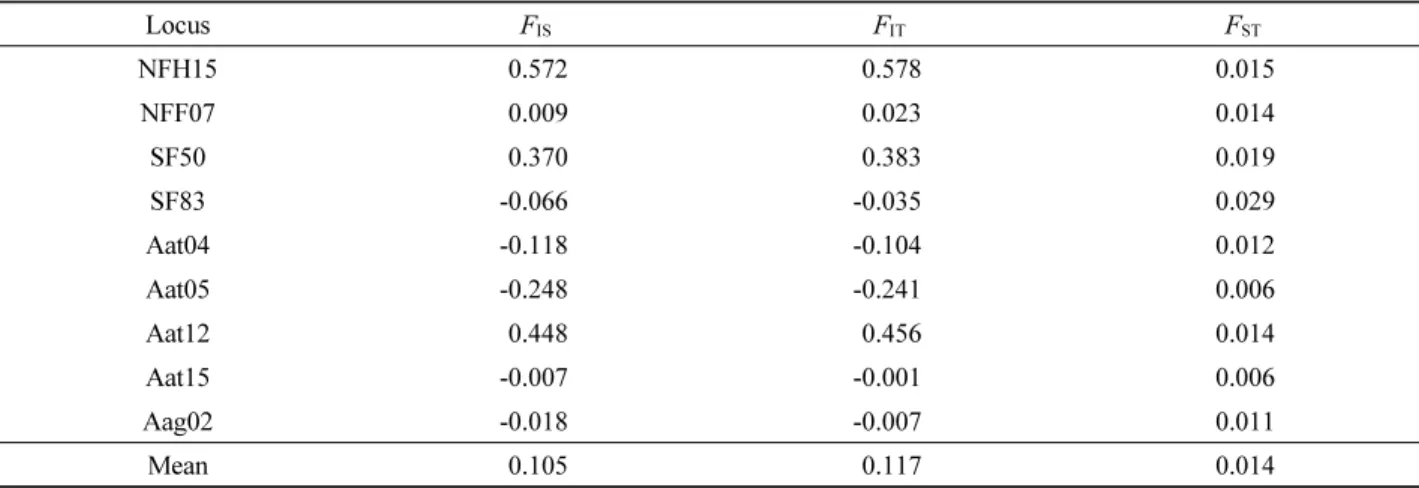
Wright의 F통계량에 의한 3개 아집단 간 유전분화율 (F
ST
)은 0.014로 나타났으며(Table 2), 분산분석을 수행한 결과에서는 전체 유전변이량의 0.4%(ΦST
=0.004)가 아집 단 간 차이로 나타났다(Table 3).지리산 구상나무 집단 내 3개 아집단 간 유전분화율 (F
ST
=0.014, ΦST
=0.004)은 구상나무 집단 간 유전분화율 (FST
=0.053; Hong et al., 2011, ΦST
=0.039; Kwak et al., 2017)보다 적은 것으로 나타났다. 동일 지역 내 아집단 간 유전분화는 매우 적은 것으로 보고되고 있다. 지리산 내 자생하고 있는 가문비나무(FST
=0.008; Moriguchi et al., 2009)도 유전분화가 적게 이루어진 것으로 나타났고 알프스 산맥에 분포하는 Larix decidua (GST
=0.012; Nardin et al., 2015, FST
=0.016, ΦST
=0.005; King et al., 2013)와 Picea abies (FST
=0.013, ΦST
=0.008; King et al., 2013)도 유전분화가 매우 적게 이루어진 것으로 나타났다. 비록 동일 집단 내에서 지리적 위치나 고도가 다르지만 바람 에 의해 화분과 종자 비산이 이루어지는 수종이기 때문 에 아집단들 간 유전자교류가 이루어지고 있기 때문으로 추정하였다. 또한 높은 고도에 위치하고 있어 상승기류가 만들어낸 공기의 흐름으로 화분의 이동거리가 유전분화 효과를 상쇄시키는데 큰 역할을 하는 것으로도 보았다 (King et al., 2013). 베이즈 군집분석에서 Pritchard 등(2000)Locus F
IS
FIT
FST
NFH15 0.572 0.578 0.015
NFF07 0.009 0.023 0.014
SF50 0.370 0.383 0.019
SF83 -0.066 -0.035 0.029
Aat04 -0.118 -0.104 0.012
Aat05 -0.248 -0.241 0.006
Aat12 0.448 0.456 0.014
Aat15 -0.007 -0.001 0.006
Aag02 -0.018 -0.007 0.011
Mean 0.105 0.117 0.014
Table 2. Wright's F statistics for nine microsatellite loci in three sub-populations of Abies koreana in Mt. Jiri.
Source of variation d.f. Sum of squares
Variance components
Percentage of
variation (%) Φ
ST
Among sub–populations 2 15.922 0.026 0.4 0.004 (P=0.273)
Within individuals 87 623.567 7.167 99.6
Total 89 639.489 7.194 100.0
Table 3. Analysis of molecular variance (AMOVA) results of three sub-populations of Abies koreana.
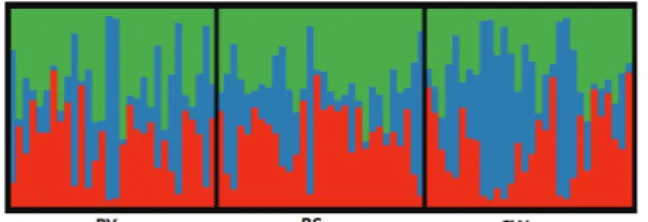
Figure 2. Bayesian clustering analysis of sub-populations of Abies koreana in Mt. Jiri the visualization with proportions of each cluster at the individuals from K=3, respectively. BY:
Banyabong, BS: Byeoksoryeong, CW: Chunwangbong.
방법으로 추정한 최적군집수(K)가 1이었고 Evanno 등 (2005) 방법으로 추정한 최적군집수가 3이었다. K=3일 때, 개체들에 대한 군집분석 결과를 보면, 각각의 개체들 은 군집수에 따라 구분되지 않았다(Figure 2).
따라서 Pritchard 방법에 의해 추정된 최적군집수 1이 적정한 것으로 판단되었다. 지리산은 440.485 ㎦로 여러 개의 봉우리들이 능선으로 이어져 있으며, 구상나무는 해발고도 1,200 m에서 1,900 m까지 연속적으로 자생지 들이 이어져 있다(Kim and Lee, 2013). 그러나 자생지 내 에서 개체단위로 고사가 진행되고 있어 밀도가 점차 감 소하고 있다. 따라서 지리산 구상나무 아집단 간 적은 유 전분화결과는 지리산 자생지가 연속적으로 이어져 있고 풍매하여 유전자교류가 지속적으로 이루어지고 있기 때 문으로 생각된다. 그러나 개체들의 쇠퇴가 지속된다면 파편화에 따른 아집단 간 유전분화도 점차 나타날 가능 성도 배제할 수 없을 것으로 생각된다.
본 연구는 지리산 구상나무의 유전다양성을 유지할 수 있는 복원전략 수립을 위해 수행되었다. 유전적으로 안 정적이고 변화하는 환경에 대한 적응성을 높일 수 있는 복원을 위해서는 적절한 종자 수급대상지로부터 유전자 형 다양성을 확보하는 것이 중요하다(Bischoff et al., 2010) Centrolobium tomentosum의 경우, 자연집단과 복 원지 간 유전다양성을 비교한 결과, 복원지 2개 지역의 유전다양성은 자연집단과 유사한 것으로 나타났다(Sujii et al., 2017). 이러한 결과는 유전다양성이 높은 지역의 모수들로부터 많은 수의 종자를 확보한 것과 복원대상지 역 뿐 아니라 다른 지역의 종자들을 확보하여 대립유전 자의 다양성을 높였기 때문으로 기술하였다. 그리고 복 원지 내 근친교배를 낮추고 지속적으로 유전다양성을 높 이기 위한 유효집단을 충분히 확보하기 위해 주변 집단 들에서 충분한 화분공급이 이루어질 수 있게 관리가 필 요하다고 보고하였다. Populus nigra L.의 경우 하천복원 전략을 수립하기 위해 11개지역 17개 자연집단에 대한 유전다양성과 유전구조를 알아보았다(Smulders et al., 2008). 종자에 의한 유성증식과 자연적 또는 인위적 원인
으로 가지가 잘려져 주변에 정착하는 형태의 무성증식이 유전구조 형성에 영향을 주고 있는 것으로 추정하였다.
따라서 유전다양성이 높은 종자 수급지를 충분히 확보하 고 홍수나 인간에 의한 교란 등을 고려하여 복원지를 선 정할 필요가 있다고 하였다. Banksia attenuata의 경우 복 원지의 유전다양성을 분석한 결과, 자연집단과 유사하거 나 더 높은 유전다양성이 나타났는데, 유전적 차이는 자 연집단과 비교했을 때 매우 적은 수준인 것으로 나타났 다(Ritchie and Krauss, 2012). 이러한 결과는 자생지에서 생성된 종자로부터 파생된 실생묘를 이용했기 때문으로 판단하였다. 따라서 지리산 구상나무를 보존하고 유전다 양성을 유지하기 위한 복원을 위해서 자생지의 다양한 모수로부터 복원재료를 확보하는 것이 필요하다고 생각 된다. 본 연구에서 지리산 내 3개 아집단들의 유전다양성 이 비교적 높고 아집단 간 유전적 차이는 거의 나타나지 않았다. 그러므로 3개 지역으로부터 모수들을 충분히 선 정하여 종자를 채취한다면, 유전적으로 다양한 복원재료 를 확보할 수 있을 것으로 생각된다.
결 론
지리산 구상나무의 유전다양성 복원전략 수립을 위해 지리산 3개 아집단(반야봉, 벽소령, 천왕봉)의 유전다양 성과 유전분화율을 알아보았다. 3개 아집단의 평균 유전 다양성은 기존에 보고된 지리산 집단과 구상나무의 유전 다양성 수준과 유사하였고 전나무속 타 수종들에 비해 높은 것으로 나타났다. 지리산 내 구상나무 자생지는 연 속적으로 이어져 있고 풍매하는 특성으로 아집단 간 유 전분화는 거의 이루어지지 않은 것으로 생각된다. 그러 나 개체들의 고사로 집단 내 파편화가 이루어진다면 아 집단 간 유전분화가 나타날 가능성도 배제할 수 없다. 유 전다양성 복원을 위해서는 자생지 내에서 다양한 모수로 부터 복원재료를 확보하는 것이 중요하다. 본 연구에서 지리산 내 3개 아집단의 유전다양성이 비교적 높은 수준 이었고 아집단 간에는 유전분화가 거의 이루어지지 않은 것으로 나타났다. 그러므로 3개 지역으로부터 모수들을 충분히 선정하여 종자를 채취한다면, 유전적으로 다양한 복원재료를 확보할 수 있을 것으로 생각된다.
References
Awad, L., Fady, B., Khater, C., Roig, A. and Cheddadi, R.
2014. Genetic structure and diversity of the endangered fir tree of Lebanon (Abies cilicica Carr.): implications for conservation. PLoS ONE 9(2): e90086.
Bischoff, A., Steinger, T. and Müller-Schärer, H. 2010. The importance of plant provenance and genotypic diversity of seed material used for ecological restoration. Restoration Ecology 18: 338-348.
Broadhurst, L. and Boshier, D. 2014. Seed provenance for restoration and management: conserving evolutionary potential and utility. pp. 27-37. In : Bozzano, M., Jalonen, R., Thomas, E., Boshier, D., Gallo, L., Stepehn, C., Bordacs, S., Smith, P. and Loo, J. (Ed.). Genetic considerations in ecosystem restoration using native tree species. Food and Agriculture Organization of the United Nations. Rome, Italy.
Cremer, E., Liepelt, S., Sebastiani. F., Buonamici, A., Michalczyk, I.M., Ziegenhagen, B. and Vendramin, G.G.
2006. Identification and characterization of nuclear microsatellite loci in Abies alba Mill. Molecular Ecology Notes 6: 374-376.
Earl, D.A. and vonHoldt, B.M. 2012. STRUCTURE HARVETER: a website and program for visualizing STRUCTURE output and implementing the Evanno method. Conservation Genetic Resources 4: 359-361.
Evanno, G., Reanaut, S. and Goudet, J. 2005. Detecting the number of clusters of individuals using the software STRUCTURE: a simulation study. Molecular Ecology 14:
2611-2620.
Hansen, O.K., Vendramin, G.G., Sebastiani, F. and Edwards, K.J. 2005. Development of microsatellite markers in Abies nordmanniana(Stev.) Spach and cross-species amplification in the Abies genus. Molecular Ecology Notes 5: 784-787.
Hong, Y.P., Ahn, J.Y., Kim, Y.M., Yang, B.H. and Song, J.H.
2011. Genetic Variation of nSSR Markers in Natural Populations of Abies koreana and Abies nephrolepis in South Korea. Journal of Korean Forest Society 100(4):
577-584.
Jakobsson, M. and Rosenberg, N.A. 2007. CLUMPP: a cluster matching and permutation program with label switching and multimodality in analysis of population structure.
Bioinformatics 23(14): 1801-1806.
Kim, M.S. and Lee, H.C. 2013. A study on changes and distributions of Korean Fir in sub-alpine zone. Journal of the Korean Society of Environmental Restoration Technology 16(5): 49-57.
Kim, Y.S., Chang, C.S., Kim, C.S. and Gardner, M. 2011. Abies koreana. The IUCN Red List of Threatened Species 2011:
e.T31244A9618913.
King, G.M., Gugerli, F., Fonti, P. and Frank, D.C. 2013. Tree growth response aling an elevational gradient: climate or genetics? Oecologia 173: 1587-1600.
Kong, W.S. 1998. The Alpine and subalpine Geoecology of
the Korean Peninsula. Korean Journal of Ecology 21(4):
383-387.
Koo, K.A., Park, W.K. and Kong, W.S. 2001.
Dendrochronological Analysis of Abies koreana W. at Mt.
Halla, Korea: Effects of Climate Change on the Growths.
Korean Journal of Ecology 24(5): 281-288.
Koo, K.A., Kong, W.S., Park, S.U., Lee, J.H., Kim, J.U. and Jung, H.C. 2017. Sensitivity of Korean fir (Abies koreana Wils.), a threatened climate relict species, to increasing temperature at an island subalpine area. Ecological Modelling 353: 5-16.
KOREA NATIONAL ARBORETUM (KNA). 2014. Forest of Korea (I) Conservation of Korean fir (Abies koreana) in a changing environment. pp. 85-86.
Kwak, M.H., Hong, J.K., Park, J.H., Lee, B.Y., Suh, M.H.
and Kim, C.S. 2017. Genetic assessment of Abies koreana (Pinaceae) the endangered Korean fir and conservation implications. Conservation Genetics
DOI 10. 1007/s10592-017-0968-0
Lee, S.W., Yang, B.H., Han, S.D., Song, J.H. and Lee, J.J.
2008. Genetic variation in natural populations of Abies nephrolepis Max. in South Korea. Annual Forest Science.
65(302): 1-7.
Lim, J.H., Woo, S.Y., Kwon, M.J., Chun, J.H. and Shin, J.H.
2006. Photosynthetic capacity and water use efficiency under different temperature regimes on healthy and declining korean fir in Mt. Halla. Journal of Korean Forestry Society. 95(6): 705-710.
Mckay, J.K., Christian, C.E., Harrison, S. and Rice, K.J. 2005.
How local is local? a review of practical and conceptual issues in the genetics of restoration. Restoration Ecology 13(3): 432-440.
Moriguchi, Y., Kang, K.S., Lee, K.Y., Lee, S.W. and Kim Y.Y. 2009. Genetic variation of Picea jezoensis populations in South Korea revealed by chloroplast, mitochondirial and nuclear DNA markers. Journal of Plant Research 122:
153-160.
Nardin, M., Musch, B., Rousselle, Y., Guérin, V., Sanchez, L., Jean-Pierre, R., Gerber, S., Marin, S., Pâques, L.E. and Philippe, R. 2015. Genetic differentiation of european larch along an altitudinal gradient in the French Alps. Annals of Forest Science DOI 10.1007/s13595-015-0483-8.
National Institute of Forest Science (NIFOS). 2016. Global plan of action for the conservation, sustainable use and development of forest genetic resources. National Institute of Forest Science. Suwon, Republic of Korea. pp. 54.
Nybom, H. 2004. Comparison of different nuclear DNA markers for estimating intraspecific genetic diversity in Plants. Molecular Ecology 13: 1143-1155.
Oosterhout, C.V., Hutchinson, W.F., Wills, P.M. and Shiply, P. 2004. MICRO-CHECKER: software for identifying and correcting genotyping errors in microsatellite data. Molecular Ecology Notes 4: 535-538.
Peakall, R. and Smouse, P.E. 2006. GENEALEX 6: genetic analysis in Excel. population genetic software for teaching and research. Molecular Ecology Notes 6: 288-295.
Postolache, D., Leonarduzzi, C., Piotti, A., Spanu, I., Roig, A., fady, B., Roschanski, A., Liepelt, S. and Vendramin, G.G. 2013. Transcriptome versus genomic microsatellite markers: highly informative multiplexes for genotyping Abies alba Mill. and Congeneric Species. Plant Molecular Biology Report DOI 10.1007/s11105-013-0688-7.
Potter, K.M., Frampton, J., Josserand, S.A. and Nelson, C.D.
2008. Genetic variation and population structure in Fraser fir (Abies fraseri): a microsatellite assessment of young trees. Canadian Journal of Forest Research 38: 2128-2137.
Pritchard, J.K., Stephens, M. and Donnelly, P. 2000. Inference of population structure using multilocus genotype data.
Genetics 155: 945-959.
Ritchie, A.L. and Krauss, S.L. 2012. A genetic assessment of eclolgical restoration success in Banksia attenuata.
Restoration Ecology 20(4): 441-449.
Rosenberg, N.A. 2004. DISTRUCT: a program for the graphical display of population structure. Molecular Ecology Notes 4: 137-138.
Smulders, M.J.M., Cottrell, J.E., Lefèvre, F., Schoot, J., Arens, P., Vosman, B., Tabbener, H.E., Grassi, F., Fossati, T., Castiglione, S., Krestufek, V., Flucj, S., Burg, K., Vornam,
B., Pohl, A., Gebhardt, K., Alba, N., Agúndez, D., Maestro, C., Notivol, E., Volosyanchuk, R., Pospíškova, M., Bordács, S., Bovenschen, J., Dam, B.C., Koelewijn, H.P., Halfmaerten, D., Ivens, B., Slycken,J., Vanden Broeck, A., Storme, V.
and Boerjan, W. 2008. Structure of the genetic diversity in black poplar (Populus nigra L.) populations across European river systems: Consequences for conservation and restoration. Forest Ecology and Management 255:
1388-1399.
Sujii, P.S., Schwarcz, K.D., Grando, C., Silvestre, E.A., Mori, G.M., Brancalion, P.H.S. and Zucchi, M.I. 2017. Recovery of genetic diversity levels of a neotropical tree in atlantic forest restoration plantations. Biological Conservation 211:
110-116.
Tang, S., Dai, W., Li, M., Zhang, Y., Geng, Y., Wang, L.
and Zhong, Y. 2008. Genetic diversity of relictual and endangered plant Abies ziyuanensis (Pinaceae) revealed by AFLP and SSR markers. Genetica 133: 21-30.
Wang, X., Zhang, Q.W., Liufu, Y.Q., Lu, Y.B., Zhan, T. and Tang, S.Q. 2014. Comparative analysis of genetic diversity and population genetic structure in Abies chensiensis and Abies fargesii inferred from microsatellite markers.
Biochemical Systematics and Ecology 55: 351-357.
Yang, J.C., Yi, D.K., Joo, M.J. and Choi, K. 2015.
Phylogeographic study of Abies koreana and Abies nephrolepis in Korea based on mitochondrial DNA. Korean Journal of Plant Taxonomy 45(3): 254-261.
(Received: October 13, 2017; Accepted: October 27, 2017)