531
F
ORESTS
OCIETYA Preliminary Population Genetic Study of an Overlooked Endemic ash, Fraxinus chiisanensis in Korea
Using Allozyme Variation
Heung Soo Lee
1, Chin-Sung Chang
1, Hui Kim
2*and Do Yeol Choi
112Department of Forest Sciences and The Arboretum, Seoul National University, Seoul, 151-921, Department of Medicinal Plants Resources, Mokpo National University, Muan 534-729, Korea
Abstracts :
We used enzyme electrophoresis to evaluate genetic diversity in five populations of endemic ash,
Fraxinus chiisanensisin Korea. Of 15 putative allozyme loci examined 26.7% were polymorphic and expected heterozygosity for the species was low (0.082). Within the range, population were highly differentiated (
FST=0.356) and little genetic variation was explained by geography. The pattern of distribution of variation showed low genetic variation within populations and pronounced divergence among populations, which was consistent with the prediction for the effects of limited gene flow and local genetic erosion. Although the frequencies of male plants were dominant ranging from 79.3% to 89.4%, most mating events seems to be inevitable mating between relatives in small populations based on heterozygote deficiency of this species.
Small effective population size and the limited dispersal contributed to the low rates of gene flow within as well as between populations.
Key words :androdioecy, endemic species, forest fragmentation,
Fraxinus chiisanensis,
genetic diversity, isolationIntroduction
Fraxinus chiisanensis
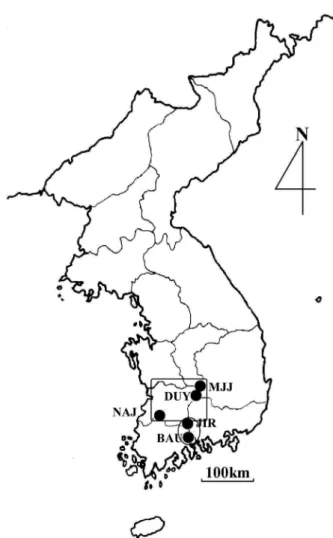
Nakai (Oleaceae) is an endan- gered and endemic tree species, found in deciduous for- est areas of southwestern Korea (Figure 1). This species is categorized as endangered in the IUCN redlisting study in Korea (unpublished data) due to limited number of populations and restricted areas (Table 1). Morpho- logically,
F. chiisanensisis clearly distinguished from related taxa by the presence of panicle from leafless lat- eral bud of previous year, apetalous flower, persistent calyx, and brownish naked bud (Min
et al.2001; Chang
et al., 2002). Based on the results of nuclear ribosomal DNA ITS (Wallender and Albert, 2000), foliar fla- vonoids (Min
et al., 2001; Chang
et al., 2002), and mor- phology (Chang
et al., 2002),
F. chiisanensisis included into subgen.
Fraxinus, sect.
Melioides, which is mainly distributed in North America. This species seems to be a highly primitive species within the section as indicated by no petal and androdioecious flower with calyx.
F.chiisanensis
has no related extant species within the sec- tion in eastern Asia (Chang
et al., 2002).
F. chiisanensis
is morphologically androdioecious, but it remains unknown whether it is functionally androdi- oecious. This species is presumed to be pollinated by wind, because it is inferred that most apetalous taxa of
Fraxinusare wind pollinated based on the results of other studies (Wallender, 2001; Dommee
et al., 1999;
Ishida and Hiura, 1998; Ishida and Hiura, 2002). The germination percent of seeds is ca. 50-60% and decreases rapidly to 15% after two years under laboratory condi- tions (unpublished data). In general, germination per- cents of
F. rhynchophyllaand
F. mandshuricarange from 20 to 50% (Oh
et al., 1991; Chung
et al., 1984).
Therefore, it is assumed that germinations occur at sim- ilar rates within the genus.
Decline in genetic variation due to recent population bottlenecks in wind pollinated species is of great concern to conservation biologists (Hedrick and Miller, 1992;
Lacy, 1997; Matocq and Villablanca, 2001), because it is expected to have destructive effects since such reduc- tions are generally accompanied by inbreeding (Lacy, 1997). In addition, many narrowly endemic taxa persist for long periods in small, naturally isolated populations (Ellstrand and Elam, 1993; Holsinger, 1993; Wolf
et al., 2000). Especially genetic impoverishment is expected to increase the risk of local extinction in these small pop-
*Corresponding author E-mail: [email protected]
ulations (Hanski and Gilpin, 1991). Diminished genetic variation between populations reduces the opportunity for adaptive responses to geographically varying local conditions. The utility of the variation depends upon its likely importance for current and future adaptation, and therefore its contribution to the viability of populations (Sherwin and Moritz, 2000).
This study was conducted to elucidate population genetic structure underlying its reproductive and genetic diver- sity, which helped provide insight into conservation of this taxon. We used protein electrophoresis to address
several questions about
Fraxinus chiisanensispopula- tions: 1) What proportion of the species’ genetic varia- tion was preserved within local populations? 2) How were genetic relationships among populations affected by androdioecy on breeding pattern in natural popula- tion?
Materials and Methods 1. Field sampling
Distribution of the species is reasonably well known as five restricted localities in Korea (Figure 1), with pop- ulations ranging in size from <100 individuals in Mt.
Nae-jang-san to > 10,000 individuals in the largest pop- ulations, Mts. Ji-ri-san and Min-Ju-Ji-san. Because all populations are located in mountain stream side as one of dominant species in the forest, we could easily esti- mate population size, and male frequency (Table 1).
For the allozyme analyses, branch samples with buds and young leaves randomly were collected from five known populations, Mt. Ji-ri-san (JIR, 50), Mt. Duk-yu- san (DUY, 50), Mt. Min-ju-ji-san (MJJ, 50), Mt. Baek- un-san (BAU, 50), and Mt. Nae-jang-san (NAJ, 29) in mid April of 2001 and 2002 (Figure 1). Sampled trees were widely spaced more than 50 m in order to avoid colleting closely related individuals.
2. Laboratory analyses
Leaves were transported on ice to the laboratory, where they were refrigerated at 4°C. For the extraction of enzymes, leaves were cut into 3 cm
2pieces and ground with extracting buffer (Wendel and Weeden, 1989) using ceramic mortars and pestles. The homoge- nized extracts were absorbed into filter paper (Whatman 3 mm, 4 mm
×10 mm), frozen at -70°C, and electro- phoresed for 4-6 h on four gel and buffer systems using 12% starch gels (Conkle
et al., 1982; Wendel and Weeden, 1989). The following enzyme systems were assayed in all individuals in all populations: aspartate aminotransferase (AAP), acid phosphatase (ACP), cata- lase (CAT), glutamine dehydrogenase (GDH), isocitrate dehydrogenase (IDH), leucine amino peptidase (LAP), malate dehydrogenase (MDH), malic enzyme (ME), mena- Table 1. Occupation size, population size, and male frequency in five populations of
F. chiisanensis.
Populations Occupation size No of
Individuals Male tree/ha Hermaphrodite Male frequency
Mt. Ji-ri-san (JIR) > 100 ha > 10,000 42 5 89.4%
Mt. Baek-un-san (BAU) < 1 ha < 500 ---
a--- ---
Mt. Min-ju-ji-san (MJJ) < 10 ha < 5,000 34 6 85.0%
Mt. Nae-jang-san (NAJ) < 1 ha < 100 --- --- ---
Mt. Duk-yu-san (DUY) > 30 ha > 5,000 23 6 79.3%
a
All individuals are juvenile.
Figure 1. Locations of five populations of
F. chiisanensisin Korea from which samples were collected for
electrophoretic analysis.
dione reductase (MNR), phosphoglucoisomerase (PGI), phosphoglucomutase (PGM), 6-phosphogluconate dehy- drogenase (6PGD), and shikimate dehydrogenase (SKDH).
Enzymes were visualized using staining methods detailed by Wendel and Weeden (1989). Most staining recipes were modifications of the widely used assays presented in ear- lier manual (Conkle
et al., 1982; Soltis
et al., 1983).
Loci were considered putative because no genetic anal- yses have been performed on this species. The patterns observed, however, were typical of the same enzyme systems studied in other species and were consistent with the expected banding patterns of those species for which formal analyses have been carried out (Wendel and Weeden, 1989; Kepart, 1990).
3. Statistical analyses
Allele frequencies for each locus in each populations and genetic structure of the entire set of populations were analyzed using BIOSYS-1 (Swofford and Selander, 1981). The following standard measures of genetic vari- ation were calculated at the species level: number of alleles per locus (
A), percent of polymorphic loci (
P), and observed (
Ho) and expected (
He) heterozygosity. A goodness-of-fit test of genotypic frequencies to Hardy- Weinberg equilibrium was performed on each variable locus. Population structure was analyzed using Weir and Cockerham’s (1984)
F-statistics by Genepop (Raymond and Rousset, 1995), where
FITrepresents the overall inbreeding coefficient, and
FISand
FST, the levels of inbreeding due to nonrandom mating within populations and population subdivision, respectively. Interpopulation gene flow was estimated by the equation,
Nm=(1
− FST)/
4
FST(Wright, 1951). A dendrogram based on the genetic sim- ilarity was created using UPGMA (unweighted pair group method). Genetic divergence among populations was estimated by calculating Nei’s genetic distance (
D) for all pairs of populations (Nei, 1973). Nei’s genetic distance measure ranges from 0 for population with identical allele frequencies, infinity for populations with no alleles in common, to unity for populations with identical allele frequencies. Analyses of covariance and correlation were performed to examine the relationship
between population and occupation sizes, and the vari- ous measures of genetic variation.
Results
Genetic diversity: The 13 enzyme systems examined resulted in the interpretation of 15 putative loci, of which, four (
Ps= 26.7%) were polymorphic across the range of
F. chiisanensis. At the population level, poly- morphism was 22.7% (
Pp) on average (Table 2). Values of
Ppranged from 13.3% (DUY) to 26.7% (BAU and JIR). Only four loci (ACP-1, LAP-1, MNR-2 and CAT- 1) were polymorphic in at least one population. The mean numbers of alleles per polymorphic locus were 2.50 and 2.00 at the species and population levels, respectively. Including the 11 monomorphic loci, the average numbers of alleles per locus were 1.33 and 1.27 at the species (
As) and population levels (
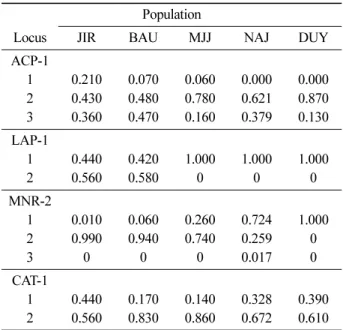
Ap), respec- tively. One of the 20 alleles (MNR-2c), which occurred at a low frequency (< 0.02), was unique to a single pop- ulation (=NAJ, private alleles; Table 3). Expected het- erozygosity (=
He) for the species was somewhat low
Table 2. Genetic variability at four polymorphic loci and mean identity values for five populations of
F. chiisanensis. Abbreviations:
N, number of individuals sampled;
P, percent polymorphic loci;
A, mean number of allele per locus;
H0, observed heterozygosity;
He, expected heterozygosity.
Populations N A P H0 He
Mt. Ji-ri-san (JIR) 50 1.3 26.7 0.650 0.111
Mt. Baek-un-san (BAU), 50 1.3 26.7 0.510 0.097
Mt. Min-ju-ji-san (MJJ) 50 1.3 20.0 0.045 0.067
Mt. Nae-jang-san (NAJ) 29 1.3 20.0 0.041 0.090
Mt. Duk-yu-san (DUY) 50 1.1 13.3 0.019 0.047
Mean 45.8 1.26 21.3 0.253 0.0.82
Table 3. Allele frequencies of polymorphic loci in
F. chiisa-nensis
.
Population
Locus JIR BAU MJJ NAJ DUY
ACP-1
1 0.210 0.070 0.060 0.000 0.000
2 0.430 0.480 0.780 0.621 0.870
3 0.360 0.470 0.160 0.379 0.130
LAP-1
1 0.440 0.420 1.000 1.000 1.000
2 0.560 0.580 0 0 0
MNR-2
1 0.010 0.060 0.260 0.724 1.000
2 0.990 0.940 0.740 0.259 0
3 0 0 0 0.017 0
CAT-1
1 0.440 0.170 0.140 0.328 0.390
2 0.560 0.830 0.860 0.672 0.610
(0.082) (Table 2). When compared with other sites, lev- els of genetic diversity (
A, P,and
He) were high in JIR and BAU.
Population size and sex ratio: Among the extent popu- lations, the frequency of flowering on males and hermaph- rodites from three populations in 2004 were observed and summarized in Table 1. Only less than 20% of hermaph- rodites were observed whereas the frequencies of male plants were dominant ranging from 79.3% to 89.4%. This data indicated a significant deviation from 1:1 in the fre- quencies of the male vs. hermaphrodite.
Distribution of genetic variability among populations:
More than 31.4% of the genetic variation in our sample could be attributed to variation among populations (
FST=0.356).
FIT, which reflected inbreeding within popula- tions (for five populations) and population structuring, indicated an overall deficiency of heterozygotes at all four polymorphic loci. The inbreeding coefficient,
FIS(0.457), for four polymorphic loci were positive (Table 4), reflecting that observed levels of heterozygosity within populations (
HS) were lower than would have been expected if each plant were the product of random sexual reproduction (Wright, 1965). This, of course, is unlikely, given the known ability of this species, due to the outcrossing system. The values of
FISare indicative of inbreeding within populations. Although all estimates were not significant at 95% confidence level, the high values of
FITand
FST(Table 4) indicate low levels of gene flow among populations (Hamrick and Godt, 1989). Indirect estimates of gene flow indicated low lev- els of migration among
F. chiisanensispopulations.
Application of Wright's (1951) model gave an estimate of
Nm=0.57. This estimates of
Nm<1 suggested that gene flow between populations was inadequate to counter the effects of genetic drift in local populations.
A UPGMA dendrogram illustrating genetic relationships among populations (Figure 2) reflected straightforward spa- tial configuration of populations. Mean genetic identity (
I) among pairs of populations, on the other hand, was gener- ally high (mean=0.958; SD=0.027), suggesting that small number of alleles contributed significantly to the among- population genetic variation. Results revealed, among all
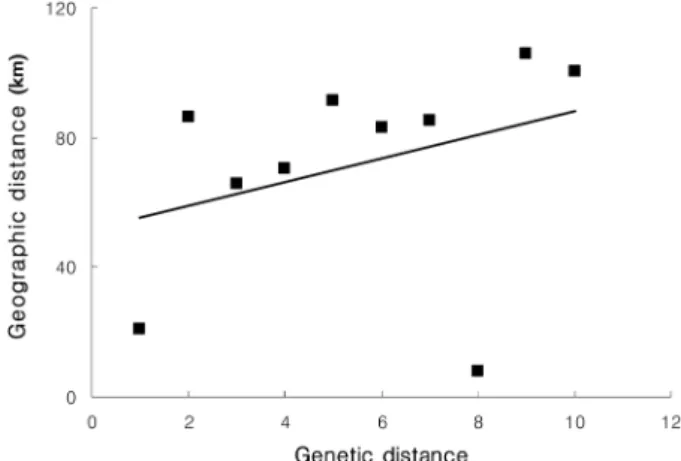
pairs of populations, genetic distances between populations were not associated with geographic distances (
rs=0.147, p<0.001) (Figure 3, Table 5).
Two UPGMA clustering solutions were identified. The first group included population from southern popula- tions (JIR and BAU). The second group comprised three populations, two from large and small populations (DUY, NAJ) and one from a large one (MJJ). Significant regional variation was found in two parameters exam- ined. Populations in southern mountains had signifi- cantly more polymorphic loci (
P=26.7%) than those in northern mountains (
P=17.8%). Expected heterozygosity also exhibited regional variation. The more amount of genetic diversity was found in southern (0.104) followed by northern mountains (0.068).
Table 4.
F-statistics were estimated as in Weir and Cockerham (1984) to calculate overall inbreeding coefficient,
FISthe levels of inbreeding due to nonrandom mating within populations, and
FSTdue to population subdivision.
Locus No. of alleles FIS FIT FST
ACP-1 3 0.390 0.462 0.118
LAP-1 2 0.639 0.811 0.476
MNR-2 3 0.321 0.796 0.699
CAT-1 2 0.493 0.532 0.077
Mean 2.5 0.457 0.650 0.356
Figure 2. A UPGMA phenogram of Nei’s genetic identity coefficient for five
F. chiisanensispopulations sampled.
Table 5. Nei’s (1978) genetic distance (lower triangle) and geographic distances (km, upper triangle) among five populations of
F. chiisanensis.Population JIR BAU MJJ DUY NAJ
JIR --- 20.8 86.3 65.9 70.4
BAU .006 --- 91.3 83.3 85.4
MJJ .040 .033 --- 7.9 106.0
DUY .075 .081 .036 --- 100.4
NAJ .123 .133 .085 .009 ---
Figure 3. Plot of the genetic distance against geographic
distance for all pairs of populations.
Discussion
Low genetic diversity and population differentiation:
In general, endemic and rare taxa often have signifi- cantly lower genetic variability (Hamrick and Godt, 1989) and higher rates of self-pollination and inbreeding (Inoue and Kawahara, 1990; Linhart and Premoli, 1993).
Given its endemism and history of fragmentation,
F. chi-isanensis
supports the general rule of lower genetic vari- ability in rare taxa. Species-level
Hefor
F. chiisanensiswas lower than means reported by Hamrick and Godt (1989) in 81 endemic (0.096) and 101 narrowly distrib- uted (0.137) taxa. The distribution pattern of allozyme variation in
F. chiisanensisincluded low genetic varia- tion within populations and pronounced divergence among populations, consistent with the prediction for the effects of limited gene flow among small populations that have been separated for a long time.
Genetic diversity and current population sizes indi- cated that size of JIR and DUY populations of
F. chi-isanensis
was substantially larger than today. The low correlation between geographic and genetic distances might be explained through the result of genetic drift (Figure 3). It is possible that some of these cases of low genetic diversity are due to recent demographic crashes (Matocq and Villablanca, 2001) in some populations. In this case, small effective size of populations would have increased genetic drift and led to the loss of allelic diver- sity with random fixation of alleles (Gaudeul
et al,2000). Probably due to local extinctions and/or bottle- necks, this species might have been squeezed out of many areas and finally restricted to isolated stands at current five populations. Especially NAJ and BAU pop- ulations have been severely threatened. Until 70’s timber harvest had been common on this area, but we have not assessed the extent of damage, if any, to the
F. chiisan- ensis. Patterns of low genetic diversity on these two sites could be interpreted as reflecting a recent reduction in diversity, or a historical lack of diversity. Habitat destruction were obvious, reduced effective populations size also had caused detrimental effects on the demography, because we could not find any flowering adults but only juvenile suckers at these stands.
The results shown in Table 5 demonstrate that there is strong differentiation between the studied populations and their respective complements. Decreasing population size and stronger isolation from larger populations to marginal populations go along with loss of genetic vari- ability (genetic drift) and increasing genetic distance.
This would also agree with the results from Höltken
etal.
(2003) and Þvingila
et al.(2005). This is corrobo- rated by the summarizing analysis of
FST, particularly in comparison with the results obtained from studies of
Heuertz
et al.(2001) on ash in Bulgaria (
FST=0.087) and Höltken
et al.(2003) on ash in South Finland (
FST= 0.123). Our
FSTestimate (
FST=0.356) tends to indicate higher degrees of average.
F. chiisanensis
appeared to consist of two geographi- cally isolated groups. The possible scenario for the present occurrence was that these two groups might have served as sources for the colonization of regions inde- pendently. Some populations may be old centers, and other could have been originated through dispersal.
Breeding system and high inbreeding coefficient:
Breeding system has been shown to be one of the most important factors of life history in explaining the distri- bution of allozyme variation within and among popula- tions (Hamrick and Godt, 1996). Androdioecy is a rare breeding system in which male plants coexist with her- maphrodite plants (Ishida and Hiura, 2002). All androdioe- cious species show variations in male frequency among populations, and self-compatibility (Akimoto
et al., 1999; Ishida and Hiura, 2002). It is generally known that the frequencies of males were consistently lower than those of hermaphrodite in most androdioecious popula- tions, but a common feature in the androdioecious
Frax-inus
species was high male frequencies. For example,
F.ornus
and
F. longicuspis, males were either as frequent as or more frequent than hermaphrodite (Pannell, 2002).
With wind pollination, the concentration of pollen grains decreases rapidly with distance from the plant, making outcrossing unlikely (Allison, 1990).
Several previous studies on the mating system of
Fraxinus
(Dommée
et al., 1999; Ishida and Hiura, 2002) showed that outcrossing rate of
Fraxinusincreased with the number of male frequency and hermaphrodites pro- duced viable pollen in dehiscent anthers and viable seeds as self-compatibility, although hermaphrodites function as females under natural conditions, and that populations function as a dioecious species (Charlesworth, 1984;
Pannell, 2002). Partially self-fertilized hermaphroditic species under low male frequency is known as a facul- tative selfing phenomenon. Ishida and Hiura (2002) Table 6. Fixation indices (
F) for four polymorphic loci within the population level. Chi-square tests were used to determine if fixation indices were different from an expected values (
F=0).
Locus Population
JIR BAU MJJ NAJ DUY
ACP-1
-0.376 0.324* 0.2270.707** 0.381*
LAP-1
-0.675** 0.589** ---a--- --- MNR-2 -0.010 0.291 0.272 0.409* ---
CAT-1
-0.188 0.646** 0.502* 0.452* 0.706**a
Populations that were monomorphic for a particular locus are
indicated with a dash; *<0.05; **<0.01Legends of figures
insisted that these androdioecious species appeared to have a density-dependent outcrossing rate. In our study high male frequency data of
F. chiisanensisshowed asymmetric sex ratio in natural population (Table 1). In spite of high male frequency, however,
F. chiisanensisshowed high inbreeding coefficient. Decline in local abundances and positive fixation indices found in these populations suggested, in time, negative consequences of isolation and small size became apparent in the remnant populations (Table 6). Forest fragmentation have reduced the size and increased the spatial isolation of plant pop- ulation. Therefore, this might result in a severe increase of unequal sex-ratio within the population.
Heterozygote deficiency:
Heuertz
et al.(2001)’s spa- tial genetic structure analyses showed that estimated neighborhood size of
F. excelsiorin Bulgaria ranged from 38 to 126 individual trees. That is, most mating events become sib-mating over time, unless significant gene flow by pollen or seeds increases local gene pools.
Heterozygote deficiency of
F. chiisanensismight be due to inevitable mating between relatives in small popula- tions. The deficiency of heterozygotes led to partially higher estimates of
FISfor some populations, which could be explained by a high rate of inbreeding, restricted seed and moderate pollen dispersal (Heuretz
et al., 2003) or Wahlund effect due to fine scale genetic structuring (Hebel
et al., 2006). As a first reason for the excess of homozygotes, we can expect inbreeding, due to isolated nature of
F. chiisanensisand the limited gene flow. The most current populations may have been characterized as small effective population size, and also limited potential for dispersal of
F. chiisanensiswas likely to contribute to the low rates of gene flow within as well as between populations. The relatively low genetic diversity and het- erozygote deficiency documented for
F. chiisanensisare most likely a result of habitat fragmentation (Young
etal.
, 1996). The forest areas necessary for the survival of this species have been destroyed and disturbed by anthropogenic activity during the past century. As a result, the numbers and sizes of extant
F. chiisanensispopulations have decreased greatly, which in turn has led to the loss of genetic diversity and alteration of popu- lation genetic structure (Ellstand and Elam, 1993). Over- all, the low allozyme diversity documented for this species is likely a result of habitat fragmentation fol- lowed by genetic drift and limited gene flow among small populations.
Conclusion
To avoid the harmful effects of inbreeding, conserva- tion management could aim at maintaining or re-estab- lishing high tree density within large populations prior to
severe fragmentation. We may have to manage popula- tion size instead of gene diversity (Sherwin and Moritz, 2000) for this species. In conclusion, because of limited flowering individuals at the shrinking populations
,pollen transfer between related trees within the populations seemed to be common in
F. chiisanensis. Further pop- ulation genetic analysis combined with ongoing repro- ductive biology studies will be expected to provide valuable additional data to augment the present conclu- sions.
Acknowledgements
The authors thank W.K. Min for field assistance. This research was supported by the grant for Reform of Uni- versity Education under the BK21 project (The sustain- able management and environment friendly use of forest resources of Seoul National University) and
‘Forest Sci- ence & Technology Projects (Project No. S210707L1010)’
provided by Korea Forest Service.
Literature Cited
1. Akimoto, J., Fukuhara, T. and Kikuzawa, K. 1999. Sex ratio and genetic variation in functionally androdioe- cious species,
Schizonpepon bryoniaefolius(Cucurbita- ceae). Amer. J. Bot. 86: 880-886.
2. Allison, T.D. 1990. Pollen production and plant density affect pollination and seed production in
Taxus canadensis. Ecology 71: 516-522.
3. Chang, C.S., Min, W.K. and Jeon, J.I. 2002. Species relationships of
Fraxinus chiisanensisNakai and sub- sect.
Melioidesof sect.
Fraxinus.- as revealed by mor- phometics and flavonoids. J. Korean Pl. Taxon. 32: 55- 76 (in Korean).
4. Charlesworth, D. 1984. Androdioecy and the evolution of dioecy. Biol. J. Linn. Soc. 22: 333-348.
5. Chung, S.H., Kim, J.W. and Lee, G.S. 1984. A study on the seed germination and seedling density of
Fraxinus mandshuricain nursery. J. Korean Forest. Soc. 63: 9- 11 (in Korean).
6. Conkle, M.T., Hodgskii, P.D., Nunnally, L.B. and Hunter, S.C. 1982. Starch gel electrophoresis of conifer seeds: a laboratory manual. General Technical Report PSW-64. U.S.D.A. Forest Service Pacific Southwest and Range Experiment Station.
7. Dommee, B., Geslot, A., Thompson, J.D., Reille, M.
and Denelle, N. 1999. Androdioecy in the entomophil- ous tree
Fraxinus ornus(Oleaceae). New Phytol. 143:
419-426.
8. Ellstrand, N.C. and Elam, D.R. 1993. Population genetic
consequences of small population size: implications for
plant conservation. Annual Rev. Ecol. Syst. 24: 217-
242.
9. Gaudeul, M., Taberlet, P. and Till-Bottraud, I. 2000.
Genetic diversity in an endangered alpine plant,
Eryn- gium alpinumL. (Apiaceae), inferred from amplified fragment length polymorphism markers. Molecular Ecology 9: 1625-1637.
10. Hamrick, J.L. and Godt, M.J.W. 1989. Allozyme diver- sity in plant species. pp. 43-63. In: Brown, A.H.D., Clegg, M.T., Kahler, A.L. and Weir, B.S. (Ed.), Plant Population Genetics, Breeding, and Genetic resources.
Sinauer, Sunderland, MA.
11. Hamrick, J.L. and Godt, M.J.W. 1996. Conservation genetics of endemic plant species. pp. 81-304. In: Avise, J.C. and Hamrick, J.L. (Ed.), Conservation Genetics.
Chapman and Halll, New York.
12. Hanski, I.A. and Gilpin, M.E. 1991. Metapopulation Biology: Ecology, Genetics, and Evolution. Academic Press, San Diego.
13. Hebel, I., Haas, R. and Dounavi, A. 2006. Genetic vari- ation of common ash (
Fraxinus excelsiorL.) popula- tions from provenance regions in southern Germany by using nuclear and chloroplast microsatellites. Silvae Genetica 55: 38-44.
14. Hedrick, P.W. and Miller, P.S. 1992. Conservation genetics: techniques and fundamentals. Ecol. Applic. 2:
30-46.
15. Heuertz, M., Hausman, J.F., Tsvetkov, I., Frascaria- Lacoste, N. and Vekemans, X. 2001. Assessment of genetic structure within and among Bulgarian popula- tions of the common ash (
Fraxinus excelsiorL.).
Molecular Ecology 10: 1615-1623.
16. Heuertz, M., Vekemans, X., Hausman, J.F., Palada, M.
and Hardy, O.J. 2003. Estimating seed vs. pollen dis- persal from spatial genetic structure in the common ash. Molecular Ecology 12: 2483-2495.
17. Holsinger, K.E. 1993. The evolutionary dynamics of fragmented plant populations. pp. 198-216. In: Kareiva, P.M., Kingsolver, J.G. and Huey, R.B. (Ed.), Biotic Interactions and Global Change. Sinauer, Sunderland, 18. Höltken, A.M., Tähtinen, J. and Pappinen, A. 2003. Effects MA.
of discontinuous marginal habitats on the genetic struc- ture of common ash (
Fraxinus excelsiorL.) Silvae Genetica 52: 206-212.
19. Inoue, K. and Kawahara, T. 1990. Allozyme differen- tiation and genetic structure in island and mainland Japanese populations of
Campanula punctata(Cam- panulaceae). Amer. J. Bot. 77: 1440-1448.
20. Ishida, K. and Hiura, T. 1998. Pollen fertility and flow- ering phenology in an androdioecious tree,
Fraxinus lanuginose(Oleaceae), in Hokkaido, Japan. Int. J. Pl.
Sci. 159: 941-947.
21. Ishida, K. and Hiura, T. 2002. Mating system and pop- ulation genetic structure of an androdioecious tree,
Fraxinus lanuginoseKoidz. (Oleaceae) in northern
Japan. Heredity 88: 296-301.
22. Karron, J.D. 1991. Patterns of genetic variation and breeding systems in rare plant species. pp. 87-98. In:
Falk, D.A. and Holsinger, K.E. (Ed.), Genetics and Conservation of Rare Plants. Oxford University Press, New York.
23. Kepart, S. 1990. Starch electrophoresis of plant isozymes:
a comparative analysis of techniques. Amer. J. Bot. 77:
693-712.
24. Lacy, R.C. 1997. Importance of genetic variation to the viability of mammalian population. J. Mammal. 78:
320-335.
25. Linhart, Y.B. and Premoli, A.C. 1993. Genetic variation in
Aletes acaulisand its relative, the narrow endemic
A.humilis
(Apiaceae). Amer. J. Bot. 80: 598-605.
26. Matocq, M.D. and Villablanca, F.X. 2001. Low genetic diversity in an endangered species: recent or historic pattern? Biol. Conservation 98: 61-68.
27. Min, W.K., Jeon, J.I. and Chang, C.S. 2001. A taxo- nomic reconsideration of
Fraxinus chiisanensis(Ole- aceae) in Korea. J. Korean Forest. Soc. 90: 266-276 (in Korean).
28. Nei, M. 1973. Analysis of gene diversity in subdivided populations. Proceeding of the National Academy of Sciences, USA 70: 3321-3323.
29. Oh, M.Y., Oh, J.S., Lee, M.B. and Sung, J.H. 1991.
Characteristics of seed germination and seedling growth of broad-leaved species. Res. Rep. Inst. Forest Genet. 42:
1-9 (in Korean).
30. Pannell, J.R. 2002. The evolution and maintenance of androdioecy. Annual Rev. Ecol. Syst. 33: 397-425.
31. Raymond, M. and Rousset, F. 1995. GENEPOP (ver- sion 1.2): population genetics software for exact tests and ecumenicism. J. Heredity 86: 248-249.
32. Sherwin, W.B. and Moritz, C. 2000. Managing and monitoring genetic erosion. pp. 9-34. In: Brown, A.H.D., Clegg, M.T., Kahler, A.L. and Weir, B.S. (Ed.), Genet- ics, Demography and the Conservation of Fragmented Populations. Cambridge University Press, Cambridge, 33. Soltis, D.E., Haupler, C.H., Darrow, D.C. and Gastony, UK.
G.J. 1983. Starch gel electrophoresis of ferns: a com- pilation of grinding buffers, gel and electrode buffers, and staining schedules. Amer. Fern J. 73: 9-27.
34. Swofford, D.E. and Selander, R.B. 1981. BIOSYS-1: a FORTRAN program for the comprehensive analysis of electrophoretic data in population genetics and system- atics. J. Heredity 72: 281-283.
35. Þvingila, D., Verbylaitë, R., Baliuckas, V., Pliûra, A.
and Kuusienë, S. 2005. Genetic diversity (RAPD) in natural Lithuanian populations of common ash (
Frax- inus excelsiorL.). Biologija. 3: 46-53.
36. Wallander, E. and Albert, V.A. 2000. Phylogeny and
classification of Oleaceae based on
rps16and
trnL-Fsequence data. Amer. J. Bot. 87: 1827-1841.
37. Wallender, E. 2001. Evolution of pollination and breed- ing systems in
Fraxinus(Oleaceae), and a new classi- fication. In: Wallender, E. (Ed.), Evolution of Wind- pollination in
Fraxinus(Oleaceae). Ph. D. thesis. Göte- borg University, Göteborg.
38. Weir, B.S. and Cockerham, C.C. 1984. Estimating
F- statistics for the analysis of population structure. Evo- lution 38: 1358-1370.
39. Wendel, J.F. and Weeden, N.F. 1989. Visualization and interpretation plant isozymes. pp. 5-45. In: D.E. Soltis and Soltis, P.S. (Ed.), Isozyme in Plant Biology. Dioscorides Press, Oregon.
40. Wolf, A.T., Harrison, S.P. and Hamrick, J.L. 2000.
Influence of habitat patchiness on genetic diversity and spatial structure of a serpentine endemic plant. Conser- vation Biology 14: 452-463.
41. Wright, S. 1951. The genetic structure of populations.
Annals of Eugenics 15: 324-354.
42. Wright, S. 1965. The interpretation of population struc- ture by
F-statistics with special regard to systems of mating. Evolution 15: 395-420.
43. Young, A., Boyle, T. and Brown, T. 1996. The popu- lation genetic consequences of habitat fragmentation for plants. Trends Ecol. Evol. 11: 413-418.
(Received February 19, 2009; Accepted October 9, 2009)