희귀수종 먹넌출 엽의 형태적 특성과 유전변이
송정호, 임효인1*, 장경환1, 한진규1
국립산림과학원 산림유전자원부 특용자원연구과, 1국립산림과학원 산림유전자원부 산림유전자원과
Characteristics of Leaf Morphology and Genetic Variation of the Rare Woody Plant, Berchemia racemosa var. magna
Jeong-Ho Song, Hyo-In Lim1*, Kyung-Hwan Jang1 and Jingyu Han1 Division of Special-purpose Trees, Department of Forest Genetic Resources,
Korea Forest Research Institute, Suwon 441-847, Korea
1Division of Forest Genetic Resources, Department of Forest Genetic Resources, Korea Forest Research Institute, Suwon 441-847, Korea
Abstract - This study was conducted to investigate the morphological characteristics of leaf and the genetic diversity of Berchemia racemosa var. magna which is only found in Anmyeon Island of South Korea. ANOVA test showed that there were significant differences among individuals within population in all 10 leaf characteristics. Average characteristics of 39 individuals were 11.8 cm in leaf length, 7.1 cm in leaf width, 1.67 in leaf index, 5.4 cm in upper 1/3 width, 6.2 cm in lower 1/3 width, 3.6 cm in petiole length, 0.19 mm in leaf thickness, 11.5 ea. in number of veins (left), 11.4 ea. in number of veins (right) and 61.7 cm2 in leaf area, respectively. Except for leaf thickness (18.8%), petiole length (21.7%) and leaf area (22.0%), the coefficients of variation of most leaf characteristics were relatively low (<15.0%). A total of 50 bands was generated from 8 selected I-SSR primers. The estimates of genetic variation were 1.719 in effective number of alleles (Ae), 26.0% in proportion of polymorphic bands (P), 0.410 in expected heterozygosity (He) and 0.598 in Shannon’s diversity index (S.I.), respectively. In spite of the small number and the limited distribution, the B. racemosa var. magna population in Anmyeon Island showed high genetic diversity.
Key words - Anmyeon Island, ANOVA, Coefficients of variation, I-SSR primers, Shannon’s diversity index
*교신저자(E-mail) :[email protected]
서 언
망개나무속(Berchemia Neck., Rhmnaceae)은 열매가 핵과 이고 그 안에 1개의 종자가 있는 것이 특징이며 전 세계적으로 약 32종이 동아시아와 동남아시아를 중심으로 분포한다(Chen and Carsten, 2007). 국내에는 망개나무, 먹넌출, 청사조 등 3 종이 분포하고 있는데, 그 중 먹넌출(Berchemia racemosa var.
magna Makino)은 낙엽활엽의 덩굴성 식물로 길이 10 m 이상 자라며 지리적으로 우리나라와 일본에 분포한다(Lee, 2003;
KNA, 2008).
먹넌출의 줄기는 어릴 때 녹색이나 오래되면 흑녹색으로 변 하며, 잎은 호생하고 난형으로 길이 8~13 cm, 나비 4.5~7.0 cm
이다. 잎맥은 5~11쌍이고 맥 위에 갈색털이 있으며, 엽병길이 는 1~2 cm 정도이다. 꽃은 양성화이며, 열매는 타원형의 핵과 로 가을에 붉은 빛이 돌며 흑색으로 익는다. 건조에는 약하나 비 옥 적윤한 곳에서 번성한다. 철망, 울타리, 스크린에 올려서 갖 가지 형상으로 키우면 아름다우며 가을에 결실하는 주홍색 열 매는 더욱 가치가 있다(Lee, 2003; KNA, 2008).
먹넌출은 국내에서 충남 안면도의 소나무 숲에서만 자생하고 있어 산림보호법 제18조의2에 따라 특별산림보호대상종으로 지 정․관리되고 있으며, 국가단위에서는 취약종(VU/Vulnerable) 으로 평가되어 있다. 최근 기후변화에 따른 서식지 환경 악화로 인해 소멸 위험성이 매우 높아 먹넌출 보존을 위한 현지 내·외 보전 대책이 요구되고 있다(KNA, 2008). 최근에는 먹넌출에 대 한 학술적 연구 가치뿐만 아니라 추출물에서 약리성분 및 항산 화, 미백 기능이 입증되어 유용한 식물자원으로서의 가치를 인
Original Research Article
Fig. 1. Natural population of Berchemia racemosa var. magna.
Fig. 2. Diagram of the B. racemosa var. magna leaf showing the characteristics measured.
정받고 있다(Wang et al., 2006; Ji et al., 2012).
국제적으로는 생물다양성협약(CBD)의 지구식물보전전략 (GSPC)에서 알려진 위협종의 최소 75%를 현지외 보전토록 요 구하고 있다(UNEP, 2010). 일반적으로 국소환경 조건에 민감 한 희귀수종은 급작스런 환경변화에 적응력이 떨어지기 때문에 기후변화로 인한 지구온난화에 더욱 심각한 영향을 받을 수 있 다(Pearman et al., 2007). 특히, 유전다양성의 유지는 대상 종 의 생존과 보존을 위해서 매우 중요하며, 임목의 경우 한 장소에 서 오랫동안 생존하며 다양한 환경변화에 대하여 적응해야 되 기 때문에 유전다양성의 확보는 생존과 진화를 위해서 필수적 이다(Jump et al., 2008; KNA, 2008). 안면도 먹넌출 집단은 분 포면적이 매우 제한적이고 개체수가 현재 50여 본으로 많지 않 기 때문에 점진적으로 유전적 부동의 영향을 받을 가능성이 매 우 높다(송정호, 2009).
먹넌출 집단의 적극적인 보존을 위해서는 현 자생지의 지속 적인 모니터링(Moon et al., 2012)과 집단의 유전적 구성이나 형질 변이에 대한 연구가 필수적이다(Song et al., 2000; Kim et al., 2005). 엽의 형태적 특성은 환경의 영향뿐만 아니라 유전 적 특성에 의해서 결정되는데(Tsukaya, 2005), 먹넌출의 근연 종인 망개나무를 포함하여 음나무, 노각나무 등 보존가치가 높 은 수종의 집단특성을 파악하는데 활용하고 있다(Ahn et al., 2002; .Kim et al., 2005; Song et al., 2008). I-SSR 표지자 분 석은 SSR (Simple sequence repeat)을 이용하여 다형성을 탐색하 는 방법으로서 개체간 변이를 파악하는데 효과적이며(Zietkiewicz et al., 1994), 만리화, 눈잣나무, 줄댕강나무 등 희귀·멸종 위기 식물의 유전적 다양성을 연구하는데 자주 사용되고 있다(Jeong et al., 2007; Kim et al., 2009; Song et al., 2012).
따라서 본 연구는 우리나라에서는 안면도에만 분포하는 희 귀소멸위기 수종인 먹넌출 생명자원의 보존전략 수립을 위해 엽의 형태적 특성 변이와 I-SSR 표지자 분석을 이용한 유전적 특성을 밝히는데 있다.
재료 및 방법
엽의 형태적 특성 분석
공시재료는 충청남도 태안군 안면읍 승언리 해발 53 m의 소 나무 숲에 분포하는 먹넌출 천연집단을 대상으로 하였으며 (Fig. 1), 2012년 10월 엽 특성 조사와 유전변이 분석을 위한 시 료를 채취하였다. 먹넌출은 소나무(Pinus densiflora Siebold &
Zucc.), 때죽나무(Styrax japonicus Siebold & Zucc.), 말오줌
때(Euscaphis japonica (Thunb.) Kanitz), 나도밤나무(Meliosma myriantha Siebold & Zucc.), 초피나무(Zanthoxylum piperitum (L.) DC.) 등과 함께 서식하고 있었다. 먹넌출의 평균 근원경은 3.7 cm였으며, 1.5 cm의 가장 작은 개체부터 6.5 cm의 가장 큰 개체까지 다양한 크기로 분포하고 있었다.
채취된 시료는 형태적 특성 조사를 위해 개체목별로 10개의 성엽을 임의로 선발하여 전체 39개체 390개 엽을 대상으로 조사 하였다. 엽의 형태적 특성은 엽신장, 엽폭(상⅓, ½, 하⅓), 엽지
Table 1. Average values and coefficient variation (C.V.) for 10 leaf characteristics of B. racemosa var. magna
Lz W L/W UW LW P T VL VR LA
Mean 11.8 7.1 1.67 5.4 6.2 3.6 0.19 11.5 11.4 61.7
Range 8.8∼17.5 4.9∼10.3 1.0∼2.0 3.2∼7.8 4.1∼9.4 1.8∼6.8 0.11∼0.33 8.0∼14.0 7.0∼13.0 32.5∼121.2
C.V.y 11.4 12.1 8.2 13.7 14.1 21.7 18.8 8.5 7.8 22.0
zCodes for the morphological traits are given in Fig. 2.
yCoefficient variation (%).
Table 2. Analysis of variance (ANOVA) for leaf characteristics in B. racemosa var. magna
Source of variance Lz W L/W UW LW P T VL VR LA
Among Individuals 10.16*y 4.34* 0.067* 3.73* 5.06* 3.66* 0.005* 2.82* 1.92* 1094.4*
zCodes for the morphological traits are given in Fig. 2.
yAsterisk indicates a significant difference at p < 0.001 level.
수(길이/폭), 엽병길이, 엽두께, 엽맥수(좌측), 엽맥수(우측) 및 엽면적을 각각 조사하였다(Fig. 2). 엽의 길이 및 폭 특성은 버니 어캘리퍼스를 이용하였으며, 엽면적은 엽면적 측정기(LI-3100, LI-COR Inc., USA)를 이용하여 측정하였다.
유전변이 분석
채취된 먹넌출의 유엽은 유전변이 분석을 위해 DNeasy Plant Mini Kit (Qiagen)를 이용하여 DNA를 분리 ND-1000 Spectro- photometer (Nano-Drop Technologies, Wilmington, DE, USA) 를 이용하여 정량하였다. 추출한 먹넌출의 DNA는 국립산림과 학원(KFRI) 산림유전자원과 유전자은행(DNA-bank)에 보관 하였다. Polymerase chain reaction (PCR)은 주형 DNA 6 ng, 10X buffer, 1 mM dNTP, 0.025% BSA 각각 1.5 ul, 2 mM MgCl2 1.2 ul, 1.5 uM ISSR primer 3.75 ul, Promega Flexi GoTaq (Promega Corp., Madison, WI) 0.6 U 및 증류수가 포함된 총 15 ul의 반응액을 95℃에서 5분 동안 1차 해리한 후, 해리 95℃
1분, annealing 50~54℃ 1분, extension 72℃ 2분으로 구성된 반응을 30회 반복한 후 최종적으로 72℃에서 10분간 extension 하여 수행하였다(Applied Biosystems Gene Amp. PCR system 9700). ISSR primer는 UBC primer Set #9 (University of British Columbia, Canada) 46개를 사용하였으며, 이 가운데 재현성이 우수하고 다형성을 보이는 8개의 primer (UBC primer; #825,
#830, #841, #842, #847, #851, #857, #859)를 사용하였다. PCR 증폭산물은 1×TBE buffer를 사용하여 2% agarose gel에서 2시 간 30분 전기영동 하였고, ethidium bromide로 정색하여 UV trans-illuminator상에서 사진을 찍고 증폭산물의 존재 유무
를 판정하였다. DNA size marker를 기준으로 특정 크기(bp)를 지니는 증폭산물의 유무에 따라 ‘1’과 ‘0’으로 코딩하여 자료행 렬로 전환하였다(Wolfe, 2005).
자료분석
분산분석(ANOVA)을 통해 측정형질의 개체간 변이를 분석 하였고 각 형질의 변이정도를 파악하고자 변이계수 값을 비교하 였으며, 모든 통계분석은 SAS 프로그램(ver. 8.01; SAS Institute Inc., 1999)또한 I-SSR PCR에 의해 생성된 다형성 증폭산물을 바탕으로 POPGENE 1.32 프로그램(Yeh et al., 1997)을 이용하 여 유효대립유전자의 수(Kimura and Cow, 1964), 다형적 유전 좌의 비율, Shannon의 다양성지수(Lewontin, 1972) 등 유전적 다양성을 구하였다.
결과 및 고찰
엽의 형태적 특성
먹넌출 엽의 평균특성은 엽신장 11.8 cm, 최대엽폭 7.1 cm, 엽지수 1.67, 상1/3폭 5.4 cm, 하1/3폭 6.2 cm, 엽병길이 3.6 cm, 엽두께 0.19 mm, 엽맥수(좌) 11.5개, 엽맥수(우) 11.4개, 엽면적 61.7 cm2로 나타났다. 변이계수 값은 엽두께, 엽병길이, 엽면적 이 각각 18.8%, 21.7%, 22.0%로 높게 나타났으며, 나머지 특성 들에서는 15% 이내의 비교적 낮은 변이를 나타냈다(Table 1). 본 연구 결과는 Lee (2003)에 의해 보고된 엽신장 8~13 cm와 최대 엽폭 4.5~7.0 cm와는 유사한 경향을 나타냈으며, 엽맥수도 평 균 11.4~11.5개로 원기재문(Makino, 1892)과 Koidzumi (1916)
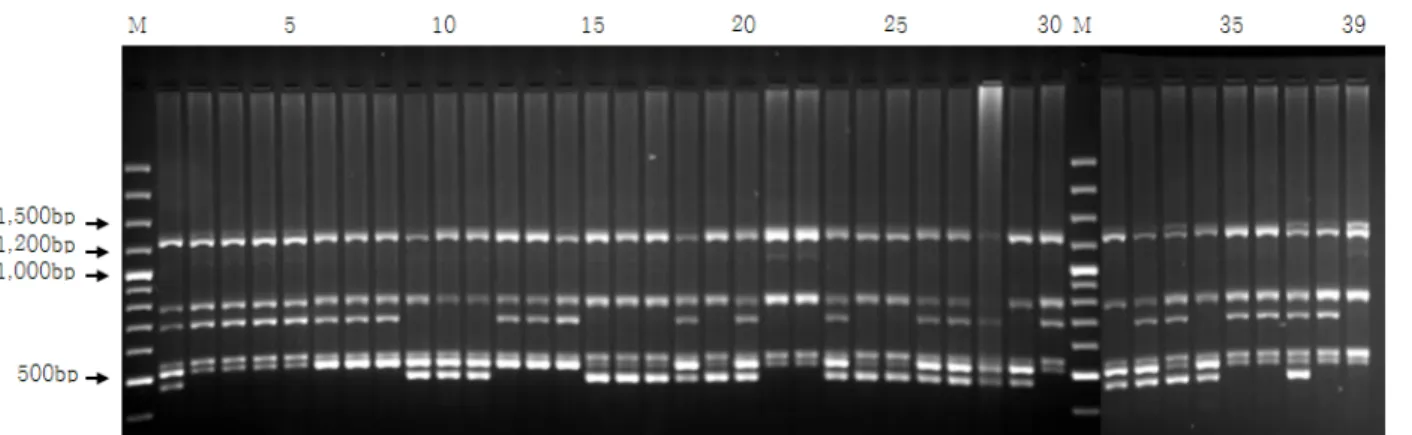
Fig. 3. Example of I-SSR profiles, amplified by UBC primer #840. “M” denotes DNA size marker of 100bp ladder.
Table 3. The genetic diversity estimates of a B. racemosa var. magna population based on 13 I-SSR polymorphic amplicons
Aez Py (%) Hex S.I.w
1.719 (0.197)v 26.0 0.410 (0.076) 0.598 (0.086)
zEffective number of alleles.
yThe percentage of polymorphic loci.
xExpected heterozygosity.
wShannon’s diversity index.
vStandard deviation.
가 언급한 10~15개와 유사한 경향을 나타냈다. 특히, 먹넌출 엽 의 형태적 특성에 대한 모든 형질들은 개체들 간에 통계적인 유 의성이 인정되어 개체간에 변이가 많은 형질들로 나타났다 (Table 2). Chen and Carsten (2007)에 의하면 기본종인 청사조 (B. racemosa var. racemosa)는 엽신장 4∼9 cm, 엽폭 2∼5 cm, 엽병길이 1∼2 cm로 보고된 바 있어 본 연구 수종인인 먹넌출에 비해 다소 작은 수종간 차이를 나타내었다.
엽의 유전변이 특성
먹넌출의 유전변이 분석에 사용된 8개의 I-SSR primer에서 총 50개의 증폭산물이 관찰되었으며, 다형적 증폭산물은 13개 를 얻을 수 있었다(Fig. 3). 증폭된 다형적 유전자좌를 토대로 계산된 유전변이량은 유효대립유전자의 수(Ae)가 1.719개, 다 형적 유전자좌의 비율(P )이 26.0%, 이형접합도의 기대치(He) 는 0.410, Shannon의 다양성지수(S.I.)는 0.598로 나타났다 (Table 3). 기존의 I-SSR 표지자를 이용한 연구에서 Shannon 의 다양성지수는 소나무 0.450 (Hong et al., 2004), 눈잣나무 0.567 (Song et al., 2012), 복분자딸기 0.576 (Kang et al., 2003)로 나타났는데, 본 연구결과 먹넌출은 0.598로서 타 수종 들에 비해 높은 값을 나타냈다. 일반적으로 식물종이 가지는 유 전다양성은 지리적 분포특성과 교배양식 및 번식방법의 영향을
많이 받는다(Hamrick et al., 1992). 안면도 먹넌출 집단이 제한 된 지역에 분포하며 개체수가 적음에도 불구하고 높은 유전다 양성을 유지하고 있는 것은 종자에 의한 유성번식뿐만 아니라 Beon and Kim (2008)이 근연종인 청사조에서 관찰한 바와 같이 줄기에 의한 무성번식을 겸하는 수종 특성으로 이러한 결과는 제한적으로 분포하는 올리브나무(Baali-Cherif and Besnard, 2005), 눈잣나무(Song et al., 2012), 시로미(Choi et al., 2004) 의 경우에서도 보고된 바 있다.
본 연구 결과 국내 안면도 먹넌출 집단은 유전다양성이 비교 적 높은 수종으로 분석되었으나 좁은 지역에 제한적으로 분포 하고 있고 개체수도 많지 않으며 개화가 편중되어 나타나기 때 문에 유전적 부동의 영향을 받을 가능성이 매우 큰 것으로 판단 된다. 집단의 크기가 작은 경우 유전적인 영향뿐만 아니라 환경 과 집단 개체수의 급진적인 변화에 따른 멸절의 위협이 높다 (Shaffer, 1981; Lynch et al., 1995). 따라서 현재 먹넌출 집단 의 유전다양성을 유지할 수 있도록 현지내 보존 전략이 필요하 며, 보존전략 수립을 위한 유전적 공간구조 구명을 통한 표본추 출 전략 등 합리적인 기준을 마련하는 일이 수행되어야 한다. 또 한 삽목 증식법(Song et al., 2011)과 더불어 종자를 통한 증식법 개발과 시설저장 등 현지외보존 전략도 병행하여 수립되어야 할 것이다.
적 요
우리나라에서 안면도에만 분포하는 먹넌출 집단의 생명자원 보존을 위하여 엽의 형태적 특성과 I-SSR 표지자를 이용한 유 전변이를 조사하였다. 10가지 엽특성에 대한 ANOVA 분석결과 모든 특성에서 개체 간에 통계적인 유의성이 인정되었다. 조사 된 39개체의 평균특성은 엽신장 11.8 cm, 최대엽폭 7.1 cm, 엽 지수 1.67, 상1/3폭 5.4 cm, 하1/3폭 6.2 cm, 엽병길이 3.6 cm, 엽두께 0.19 mm, 엽맥수(좌) 11.5개, 엽맥수(우) 11.4개, 엽면적 61.7 cm2로 나타났다. 변이계수 값은 엽두께, 엽병길이, 엽면적 이 각각 18.8%, 21.7%, 22.0%로 높게 나타났으며, 나머지 특성 들에서는 15% 이내의 비교적 낮은 변이를 나타냈다. 선발된 8개 I-SSR Primer에서 총 50개의 증폭산물을 얻었으며, 유효대립 유전자의 수 1.719개, 다형적 유전자좌의 비율 26.0%, 이형접합 도의 기대치 0.410 및 Shannon의 다양성지수 0.598로 각각 나 타났다. 안면도 먹넌출 집단은 제한된 지역에 분포하며 개체수 가 적음에도 불구하고 높은 유전다양성을 유지하는 것으로 나 타났다.
인용문헌
Ahn, Y.S., S.H. Kim, H.K. Jung, Y.S. Jang, Y.C. Choi and K.I.
Oh. 2002. The variation of leaf characters among natural populations of Kalopanax septemlobus Koidz. Jour. Korean For. Soc. 91(6):755-764.
Baali-Cherif, D. and G. Besnard. 2005. High genetic diversity and clonal growth in relict populations of Olea europaea subsp. laperrinei (Oleaceae) from Hoggar, Algeria. Ann.
Bot. London 96(5):823-830.
Beon, M.S. and Y.H. Kim. 2008. Vegetation structure and population dynamics of Berchemia racemosa habits. Kor. J.
Env. Eco. 22(6):679-690 (in Korean).
Chen, T.L. and S. Carsten. 2007. Berchemia. In Wu, Z.Y., P.H.
Raven and D.Y. Hong (eds.), Flora of China, Vol. 12, Science Press, Beijing and Missouri Botanical Garden Press, St. Louis, USA. pp. 124-130.
Choi, H.S., K.N. Hong, J.M. Chung, B.Y. Kang and W.W. Kim.
2004. Genetic diversity and spatial genetic structure of Empetrum nigrum var. japonicum in Mt. Halla, South Korea. Jour.
Korean For. Soc. 93(3):175-180 (in Korean).
Hamrick, J.L. M.J.W. Godt and S.L. Sherman-Broyles. 1992.
Factors influencing levels of genetic diversity in woody
plant species. New Forests 6(1):95-124.
Hong, Y.P., H.Y. Kwon, K.S. Kim, K.N. Hong and Y.Y. Kim.
2004. Discordance between geographical distribution and genetic relationship among populations of Japanese red pine in Korea revealed by analysis of I-SSR markers. Silvae Genet. 53(3):89-92.
Jeong, J.H., K.S. Kim, C.H. Lee and Z.S. Kim. 2007. Genetic diversity and spatial structure in populations of Abelia tyaihyoni. Jour. Korean For. Soc. 96(6):667-675 (in Korean).
Ji, D.H., Y.T. Kim, K.N. Kang, Y.Y. Lee and S.H. Cho. 2012. A composition comprising extract of Berchemia racemosa var.
magna having antioxidant and whitening effect. Korea Intellectual Property Rights 10-2011-0083528 (in Korean).
Jump, A.S., R. Marchant and J. Penuelas. 2008. Environmental change and the option value of genetic diversity. Trends Plant Sci. 14(1):51-58.
Kang, B.Y., K.N. Hong, J.M. Chung and Y.P. Hong. 2003.
Spatial genetic structure of Korean black raspberry (Rubus coreanus) at Mt. Chiak using I-SSR markers. Jour. Korean For. Soc. 92(6):558-566 (in Korean).
Kim, S.Y., Y.D. Kim, J.S. Kim, B.H. Yang, S.H. Kim and B.C.
Lee. 2009. Genetic diversity of Forsythia ovata Nakai (Oleaceae) based on inter-simple sequence repeats (ISSR). Korean J. Pl.
Taxon 39(1):48-54 (in Korean).
Kim, Y.J., K.C. Kim, B.S. Lee, G.Y. Lee, K.J. Cho, J.T. Kang and T.D. Kim. 2005. The variation of leaf characteristics in 6 natural populations of Stewartia koreana Nakai. Jour. Korean For. Soc. 94(6):446-452 (in Korean).
Kimura, M. and J.F. Crow. 1964. The number of alleles that can be maintained in a finite population. Genetics 49(4):725-738.
KNA (Korea National Arboretum). 2008. Rare Plants Data Book in Korea. GEOBOOK, Seoul, Korea. p. 186 (in Korean).
Koidzumi, G. 1916. Decades plantarum novarum vel minus cognitarum. Bot. Mag. Tokyo 30:325-326.
Lee, T.B. 2003. Coloured Flora of Korea. Hyangmoonsa Publishing Co., Seoul, Korea. p. 716.
Lewontin, R.C. 1972. The apportionment of human diversity.
Evol. Biol. 6:381-398.
Lynch, M., J. Conery and R. Burger. 1995. Mutation accumulation and the extinction of small populations. Am. Nat. 146(4):489-518.
Makino, T. 1892. Notes on Japanese plants ⅩⅥ. Bot. Mag.
Tokyo 6:169-170 (in Japanese).
Moon, A.R., H.J. Kim, J.M. Park, S.H. Kang and C.G. Jang.
2012. The study for the flora of 6 islands area in the western sea of Chungnam province. Korean J. Plant Res. 25(1):105-122
(in Korean).
Pearman, P., A. Guisan., O. Broenninmann and C.F. Randin.
2007. Niche dynamics in space and time. Trends in Ecology and Evolution 23(3):149-158.
SAS Institute Inc. 1999. SAS/STAT user’s guide, version 8.01.
SAS Institute Inc., Cary, North Carolina, USA.
Shaffer, M.L. 1981. Minimum population sizes for species conservation. BioScience 31(2):31-134.
Song, J.H., M.H. Park, H.K. Moon, S.U. Han and J.S. Yi. 2000.
The variation of leaf form of natural populations of Quercus variabilis in Korea. Jour. Korean For. Soc. 89(5):666-676 (in Korean).
Song, J.H., J.J. Lee, K.S. Kang and S.D. Hur. 2008. The variation of leaf form of rare endemic Berchemia berchemiaefolia populations. Jour. Korean For. Soc. 97(4):431-436.
Song, J.H., K.H. Jang, B.H. Yang and H.I. Lim. 2011. Propagation method of natural monument Berchemia racemosa var.
magna Makino using hardwood cutting. Korea Intellectual Property Rights 10-2011-0026543 (in Korean).
Song, J.H., H.I. Lim, K.N. Hong, K.H. Jang and Y.P. Hong.
2012. Genetic diversity and spatial genetic structure of dwarf stone pine in Daecheongbong Area, Mt. Seorak. Korean J.
Plant Res. 25(4):407-415 (in Korean).
Tsukaya, H. 2005. Leaf shape: genetic controls and environmental factors. Int. J. Dev. Biol. 49(5/6):547-555.
UNEP. 2010. Conference of Parties to the Convention on Biological Diversity. Decision X/17. Consolidated update of the Global Strategy for Plant Conservation 2011-2020. <http://www.
cbd.int/gspc/intro.shtml> (2013. 4. 5).
Wang, Y.F., J.X. Cao, T. Efferth, G.F. Lai and S.D. Luo. 2006.
Cytotoxic and new tetralone derivatives from Berchemia floribunda (Wall.) Brongn. Chem. Biodivers. 3(6):646-653.
Wolfe, A.D. 2005. ISSR techniques for evolutionary biology.
Methods Enzymol. 395: 134-144.
Yeh, F.C., R.C. Yang, T.B.J. Boyle, Z.H. Ye and J.X. Mao.
1997. POPGENE, the user-friendly shareware for population genetic analysis. Molecular Biology and Biotechnology Centre, University of Alberta. Edmonton, Canada.
Zietkiewicz, E., A. Rafalski and D. Labuda. 1994. Genome fingerprinting by simple sequence repeat (SSR)-anchored polymerase chain reaction amplification. Genomics 20(2):176-183.
송정호. 2009. 희귀 및 멸종위기수종 먹넌출의 유전자원 보존. 월 간산림 5월. pp. 88-89.
(Received 11 April 2013 ; Revised 12 August 2013 ; Accepted 16 October 2013)