• 검색 결과가 없습니다.

Effectiveness and Safety of Zotarolimus-Eluting Stent (Resolute™ Integrity) in Patients with Diffuse Long Coronary Artery Disease

N/A
N/A
Protected

Academic year: 2021

Share "Effectiveness and Safety of Zotarolimus-Eluting Stent (Resolute™ Integrity) in Patients with Diffuse Long Coronary Artery Disease"

Copied!
12
0
0

로드 중.... (전체 텍스트 보기)

전체 글

(1)

709 https://e-kcj.org

ABSTRACT

Background and Objectives: Diffuse long coronary artery disease (DLCAD) still has unfavorable clinical outcomes after successful percutaneous coronary intervention (PCI).

Therefore, we aimed to evaluate the effectiveness and safety of Resolute™ zotarolimus- eluting stent (R-ZES; Resolute™ Integrity) for patients with DLCAD.

Methods: From December 2011 to December 2014, 1,011 patients who underwent PCI using R-ZES for CAD with longer than 25 mm lesion were prospectively enrolled from 21 hospitals in Korea. We assessed the clinical outcome of major adverse cardiac events (MACE) defined

Original Article

Keun-Ho Park , MD 1 , Youngkeun Ahn , MD, PhD 2 , Young-Youp Koh, MD 1 , Young-Jae Ki , MD 1 , Sung Soo Kim , MD 1 , Hyun Kuk Kim , MD 1 ,

Dong-Hyun Choi , MD 1 , Young Joon Hong , MD 2 , Jin-Yong Hwang , MD 3 , Do Hoi Kim, MD 4 , Jay Young Rhew , MD 5 , Jae Kean Ryu, MD 6 ,

Jong-Seon Park , MD 7 , Tae Ho Park , MD 8 , Tae Hyun Yang , MD 9 , Seok Kyu Oh , MD 10 , Bong Ryeol Lee, MD 11 , Seung-Uk Lee, MD 12 , Sang Gon Lee, MD 13 , Kook Jin Chun, MD 14 , Jang-Hyun Cho, MD 15 , Kwang Soo Cha, MD 16 , Jei Keon Chae , MD 17 , Seung-Ho Hur , MD 18 , Sun Ho Hwang, MD 19 , Hun-Sik Park , MD 20 , and Doo-Il Kim, MD 21

1

Division of Cardiology, Department of Internal Medicine, Chosun University Hospital, Gwangju, Korea

2

Division of Cardiology, Department of Internal Medicine, Chonnam National University Hospital, Chonnam National University Medical School, Gwangju, Korea

3

Division of Cardiology, Department of Internal Medicine, Gyeongsang National University Hospital, Jinju, Korea

4

Division of Cardiology, Department of Internal Medicine, Soonchunhyang University Hospital Gumi, Gumi, Korea

5

Division of Cardiology, Presbyterian Medical Center, Jeonju, Korea

6

Division of Cardiology, Department of Internal Medicine, Daegu Catholic University Medical Center, Daegu, Korea

7

Division of Cardiology, Department of Internal Medicine, Yeungnam University Medical Center, Daegu, Korea

8

Division of Cardiology, Department of Internal Medicine, Dong-A University Hospital, Busan, Korea

9

Division of Cardiology, Department of Internal Medicine, Inje University Busan Paik Hospital, Busan, Korea

10

Division of Cardiology, Department of Internal Medicine, Wonkwang University Hospital, Iksan, Korea

11

Division of Cardiology, Daegu Fatima Hospital, Daegu, Korea

12

Division of Cardiology, Kwangju Christian Hospital, Gwangju, Korea

13

Division of Cardiology, Department of Internal Medicine, Ulsan University Hospital, Ulsan, Korea

14

Division of Cardiology, Department of Internal Medicine, Pusan National University Yangsan Hospital, Yangsan, Korea

15

Division of Cardiology, St. Carollo Hospital, Suncheon, Korea

16

Division of Cardiology, Department of Internal Medicine, Pusan National University Hospital, Busan, Korea

17

Division of Cardiology, Department of Internal Medicine, Chonbuk National University Hospital, Jeonju, Korea

18

Division of Cardiology, Department of Internal Medicine, Keimyung University Dongsan Hospital, Daegu, Korea

19

Division of Cardiology, Gwangju Veterans Hospital, Gwangju, Korea

20

DivIsion of Cardiology, Department of Internal Medicine, Kyungpook National University Hospital, Daegu, Korea

21

Division of Cardiology, Department of Internal Medicine, Inje University Haeundae Paik Hospital, Busan, Korea

Effectiveness and Safety of

Zotarolimus-Eluting Stent (Resolute™

Integrity) in Patients with Diffuse Long Coronary Artery Disease

Received: Jan 6, 2019 Revised: Mar 13, 2019 Accepted: Apr 10, 2019 Correspondence to Youngkeun Ahn, MD, PhD

Division of Cardiology, Department of Internal Medicine, Cardiovascular Center, Chonnam National University Hospital, Chonnam National University Medical School, 42, Jebong-ro, Dong-gu, Gwangju 61469, Korea.

E-mail: [email protected]

Copyright © 2019. The Korean Society of Cardiology

This is an Open Access article distributed under the terms of the Creative Commons Attribution Non-Commercial License (https://

creativecommons.org/licenses/by-nc/4.0) which permits unrestricted noncommercial use, distribution, and reproduction in any medium, provided the original work is properly cited.

ORCID iDs Keun-Ho Park

https://orcid.org/0000-0002-2303-4954 Youngkeun Ahn

https://orcid.org/0000-0003-2022-9366 Young-Jae Ki

https://orcid.org/0000-0003-2499-3433 Sung Soo Kim

https://orcid.org/0000-0002-5190-227X Hyun Kuk Kim

https://orcid.org/0000-0002-4554-041X Dong-Hyun Choi

https://orcid.org/0000-0003-0334-9809 Young Joon Hong

https://orcid.org/0000-0003-0192-8161 Jin-Yong Hwang

https://orcid.org/0000-0002-6632-7239

(2)

Jae Kean Ryu

https://orcid.org/0000-0002-4064-3276 Jong-Seon Park

https://orcid.org/0000-0001-5242-2756 Tae Ho Park

https://orcid.org/0000-0002-9968-8276 Tae Hyun Yang

https://orcid.org/0000-0002-2214-4393 Seok Kyu Oh

https://orcid.org/0000-0001-7545-0143 Jei Keon Chae

https://orcid.org/0000-0001-5783-7950 Seung-Ho Hur

https://orcid.org/0000-0002-3895-1915 Hun-Sik Park

https://orcid.org/0000-0001-7138-1494 Funding

This study was supported by Medtronic.

Conflict of Interest

The authors have no financial conflicts of interest.

Author Contributions

Conceptualization: Hong YJ; Data curation:

Hwang JY, Kim DH, Rhew JY, Ryu JK, Park JS, Park TH, Yang TH, Oh SK, Lee BR, Lee SU, Lee SG, Chun KJ, Cho JH, Cha KS, Chae JK, Hur SH, Hwang SH, Park HS, Kim DI; Formal analysis: Koh YY, Ki YJ, Kim SS, Kim HK, Choi DH; Writing - original draft: Park KH; Writing - review & editing: Ahn Y.

as the composite of cardiac death, non-fatal myocardial infarction (MI), and clinically-driven target vessel revascularization at 12 months.

Results: Mean age was 63.8±10.8 years, 701 (69.3%) patients were male, 572 (87.0%) patients had hypertension, 339 (33.8%) patients had diabetes, 549 (54.3%) patients diagnosed with acute MI and 545 (53.9%) patients had multi-vessel disease (MVD). A total of 1,697 stents were implanted into a total of 1,472 lesions. The mean diameter was 3.07±0.38 mm and the length was 28.27±6.97 mm. Multiple overlapping stents were performed in 205 (13.8%) lesions. A 12-month clinical follow-up was available in 1,004 patients (99.3%).

The incidences of MACE and definite stent thrombosis at 12-month were 3.0% and 0.3% respectively. On multivariate Cox-regression analysis, multiple overlapping stents implantation, previous congestive heart failure, MVD, and age ≥75 years were independent predictors of one-year MACE.

Conclusions: Our study shows that R-ZES has an excellent 1-year clinical outcome in Korean patients with DLCAD.

Keywords: Drug-eluting stents; Coronary artery disease; Treatment outcome

INTRODUCTION

With the gradual development of new drug-eluting stent (DES) and medical treatments in patients with coronary artery disease (CAD), there have been significant improvements in restenosis and clinical outcomes after stent implantation. However, high restenosis rate and poor prognosis are still reported in patients with diffuse long coronary artery disease (DLCAD) in the era of DES as well as in the era of bare metal stent (BMS).

1)-3)

The Resolute™ zotarolimus-eluting stent (R-ZES; Resolute™ Integrity; Medtronic Inc., Santa Rosa, CA, USA) is a zotarolimus-eluting system with Integrity™ cobalt alloy stent platform that further enhances the flexibility and deliverability of the stent in complex lesions by incorporation of a continuous sinusoidal design and with a new BioLinx™ polymer that allows a slower drug elution, therefore, might be expected to improve clinical outcomes compared to other DES. Some available data have shown the clinical efficacy and safety of R-ZES for treatment of CAD.

4)-7)

However, there have been a little data for the effectiveness and safety of R-ZES (Resolute™

Integrity) in patients with DLCAD. Therefore, the purpose of this study is to determine the effectiveness and safety of R-ZES in patients with DLCAD, a particularly long lesion ≥25 mm.

METHODS

Study design and patient population

We designed a multicenter, prospective, and observational study to assess the clinical outcomes in patients with DLCAD who underwent successful PCI using R-ZES (mainly Resolute™

Integrity) from 21 large-volume percutaneous coronary intervention (PCI) centers in Korea.

The selection and exclusion criteria of the subjects were as follows. The inclusion criteria

for our study were at least 18 years old patients with CAD, those eligible for PCI with lesions

suitable for R-ZES implantation, presence of one or more de novo stenosis ≥70% in a native

R-ZES in Long Coronary Artery Disease

(3)

coronary artery from 2.25 to 4.0 mm in diameter with more than 25mm length that can be covered with one or multiple stents with no limitation to the number of treated lesions or number of treated vessels. In principle, we initially implanted Resolute™ Integrity in all patients and allowed limited use of other stents only if Resolute™ Integrity was not available for additional stenting.

The exclusion criteria were patents with previous other type of DES or BMS implantation in target vessel, chronic renal failure (serum creatinine >2.0 mg/dL), severe hepatic impairment (serum alanine and aspartate aminotransferase ≥3 times the upper limit of normal),

hypersensitivity or contraindication to antiplatelet agents, active bleeding or significant risk of bleeding or life expectancy <12 months. We had also excluded the patients with cardiogenic shock, left main disease (≥50% stenosis), and saphenous vein graft lesion.

The baseline data including clinical, procedural, and lesional characteristics and in-hospital medications were obtained by electronic medical record reviews. Patients were followed at 1, 6, and 12 months after index procedure. The clinical outcome data were collected by a specialized study coordinator at each center using web-based electronic case report form. The outcome data of the patients who had not been followed-up were confirmed by telephone interviews. The study protocol was approved by the local Institutional Review Board. The approval number was 2011-184 of Chonnam National University Hospital, and all patients provided written informed consent for participation before or after PCI.

Procedure and post-intervention medications

PCI with R-ZES was performed in a routine manner without limitation on the use of single or multiple overlapping stent technique. The appropriate length and diameter of the R-ZES ensuring complete coverage of the lesion was chosen by the operator's visual estimate.

The vascular access, pre-dilatation or post-dilatation, use of intravascular ultrasound (IVUS) and peri-procedural anti-thrombotic therapies were freely determined based on the patient status according to the clinical decision of operators in each institutes. Anti-platelet agents were administered to all patients prior to the intervention, with aspirin 300 mg and clopidogrel 300–600 mg, prasugrel 60 mg or ticagrelor 180 mg. After the intervention, the patients received aspirin 100 mg once daily indefinitely and clopidogrel 75 mg once daily, prasugrel 5–10 mg once daily or ticagrelor 90 mg twice daily for at least 1 year. Other medical treatments were also administered based on the standard treatment regimen for patients with CAD in a non-restrictive manner.

Study end-points

The primary end-point was the occurrence of a major adverse cardiac events (MACE), defined as the composite of cardiac death, non-fatal myocardial infarction (MI), definite stent thrombosis (ST), and clinically-driven target vessel revascularization (TVR) at 12-month follow-up. The secondary endpoints included cerebrovascular accident (CVA), clinically-driven target lesion revascularization (TLR), the need for rehospitalization due to recurrent ischemia, and the Thrombolysis In Myocardial Infarction (TIMI) defined major or minor bleeding at 12-month follow-up. MI was defined as the third universal definition of myocardial infarction. A nonfatal myocardial infarction was defined as a MI event requiring hospitalization unrelated to death, however, periprocedural MI was excluded in this study.

Clinically-driven TVR was defined as revascularization performed on the treated lesion or vessel of a patient who complained of clinical symptoms such as chest pain that had increased in frequency, duration, or intensity.

711

https://e-kcj.org https://doi.org/10.4070/kcj.2019.0018

(4)

Statistical analyses

Categorical variables were expressed as frequencies and percentages, and continuous variables as mean±standard deviation. Cumulative incidence of clinical events was calculated using the Kaplan-Meier method. Cox regression analysis was used to identify the factors affecting the occurrence of MACE following the implantation of R-ZES. Only variables with a p value <0.1 in the univariate analysis were included in the multivariate model. Sub-group analyses were performed based on the several clinical statuses of patients. All statistical tests were 2-tailed, and a p value <0.05 was considered statistically significant. All the statistical analyses were performed using SPSS (Statistical Package for Social Science, SPSS Inc., Chicago, IL, USA) for Windows, version 24.0.

RESULTS

Baseline characteristics

From December 2011 to December 2014, we prospectively recruited 1,034 patients who underwent PCI using R-ZES for CAD with long lesion (≥25 mm) from 21 hospitals in Korea.

Of these, a total of 1,011 patients were analyzed, except for 23 patients with inadequate registration or withdrawal of permission.

Baseline clinical, procedural, and lesional characteristics are presented in Table 1. The mean age was 63.8±10.8 years. Of them, 701 (69.3%) patients were male, 572 (56.6%) patients had hypertension, 339 (33.5%) patients had diabetes mellitus (DM), 10 (1.0%) patents had previous congestive heart failure, and 549 (54.3%) patients presented with acute myocardial infarction (AMI).

R-ZES in Long Coronary Artery Disease

Table 1. Baseline clinical, angiographic, and procedural characteristics and in-hospital medications

Variables Values (%)

Variables of patients Patients (n=1,011)

Age (years) 63.75±10.82

Age ≥75 years 169 (16.7)

Male sex 701 (69.3)

Hypertension 572 (56.6)

Diabetes mellitus/Insulin-dependent 339 (33.5)/13 (1.3)

Dyslipidemia 344 (34.6)

Current smoker 284 (28.5)

Chronic renal failure 9 (0.9)

Previous cerebrovascular accident 60 (6.0)

Peripheral artery disease 14 (1.4)

Family history of coronary artery disease 30 (3.0)

Previous percutaneous coronary intervention 51 (5.1)

Previous coronary artery bypass graft surgery 4 (0.4)

Previous MI 24 (2.4)

Previous congestive heart failure 10 (1.0)

Left ventricular ejection fraction (%) 58.74±11.35

Body mass index (kg/m

2

) 24.68±3.55

Clinical presentation

ST elevation MI 142 (14.0)

Non-ST elevation MI 407 (40.3)

Angina or silent ischemia 462 (45.7)

Unfractionated heparin 510 (50.4)

Low molecular weight heparin 155 (15.3)

Glycoprotein IIb/IIIa inhibitor 15 (1.5)

In-hospital medications

Aspirin 989 (99.3)

(continued to the next page)

(5)

713 https://e-kcj.org https://doi.org/10.4070/kcj.2019.0018

Variables Values (%)

Clopiodgrel 859 (86.7)

Prasugrel 52 (5.1)

Ticagrelor 47 (4.6)

Cilostazol 137 (13.6)

Beta-blockers 747 (75.7)

Angiotensin converting enzyme inhibitors 372 (37.8)

Angiotensin II receptor blockers 366 (37.1)

Calcium channel blockers 206 (20.4)

Statin 903 (91.4)

Oral hypoglycemic agents 214 (21.7)

Target vessel

Left anterior descending artery 550 (54.4)

Left circumflex artery 138 (13.6)

Right coronary artery 320 (31.7)

Left main 3 (0.3)

Involved vessel number

Single vessel 466 (46.1)

Two vessels 336 (33.2)

Three vessels 209 (20.7)

Vascular access

Transradial approach 620 (61.3)

Transfemoral approach 391 (38.7)

Use of intravascular ultrasound 378 (37.4)

Variables of lesions Lesions (n=1,472)

Treated vessel

Left anterior descending artery 716 (48.6)

Left circumflex artery 285 (19.4)

Right coronary artery 464 (31.5)

Left main 7 (0.5)

Lesion preparation before stenting

Balloon dilatation 1,248 (84.8)

Cutting balloon dilatation 1 (0.1)

Thrombectomy 44 (3.0)

Use of intravascular ultrasound 522 (36.1)

Post-dilatation after stenting 470 (31.9%)

Pre-PCI TIMI antegrade flow 0 to 2 708 (48.4)

Post-PCI TIMI antegrade flow 2 or 3 1,445 (98.2)

Type of stent 1,697 (100.0)

Resolute™ Integrity 1,542 (90.9)

Endeavor Resolute™ 144 (8.5)

Xience™/Promus™ 6 (0.4)/3 (0.2)

Biomatrix™ 1 (0.06)

Bare metal stents 1 (0.06)

Technique of stent implantation

Single 1,282

Multiple overlapping 205

Two overlapping stents 200

Three overlapping stents 5

Number of stents per patient 1.64±0.84

Stent diameter per lesion, mm 3.07±0.38

Stent length per lesion, mm 28.27±6.97

Restenotic lesion 3 (0.2)

Chronic total occlusion 54 (3.7)

Moderate to severe tortuosity 137 (9.3)

Moderate to severe calcification 211 (14.4)

Bifurcation lesion 133 (9.2)

ACC/AHA classification B2/C lesion 1,303 (88.6)

The data are presented as number (%) or mean±standard deviation.

ACC/AHA = American College of Cardiology/American Heart Association; MI = myocardial infarction;

PCI = percutaneous coronary intervention; ST = stent thrombosis; TIMI = thrombolysis in myocardial infarction.

Table 1. (Continued) Baseline clinical, angiographic, and procedural characteristics and in-hospital medications

(6)

A total of 1,697 stents (Resolute™ Integrity: 90.9%) were implanted in 1,472 lesions and mean diameter of stent was 3.07±0.38 mm and mean stent length was 28.27±6.97 mm. The target lesion was common in the left anterior descending artery (54.4%) and patients with multi-vessel disease (MVD) accounted for 53.9%. A chronic total occlusion was present in 54 (3.7%) lesions and bifurcation lesion in 133 (9.2%) lesions. Post-dilatations were performed in 369 patients (470 lesions) and IVUS in 378 patients (522 lesions). A single long stent implantation was performed in most lesions, however, 2 overlapping stents were performed in 200 lesions and 3 overlapping stents in 5 lesions.

Clinical outcomes

A 12-month clinical follow-up was available in 1,004 patients (99.3%). The cumulative incidences of clinical events during follow-up are summarized in Table 2.

During the 12-month period, definite ST occurred in only 3 patients, including 1 with acute ST at 1 day and 2 with late ST at 70 and 322 days on dual antiplatelet treatments. The incidences of cumulative TVR and MACE at 12-month were 1.7% and 3.0% respectively.

On multivariate Cox-regression analysis, multiple overlapping stents implantation, previous congestive heart failure, MVD and patients with age ≥75 years were independent predictors of 1-year MACE (hazard ratio [HR], 3.879, 95% confidence interval [CI],1.779–8.459; HR, 8.071, 95% CI, 1.307–49.855; HR, 5.248, 95% CI, 1.557–17.689; and HR, 2.489, 95% CI,1.097–5.648, respectively) (Table 3).

Subgroup analysis

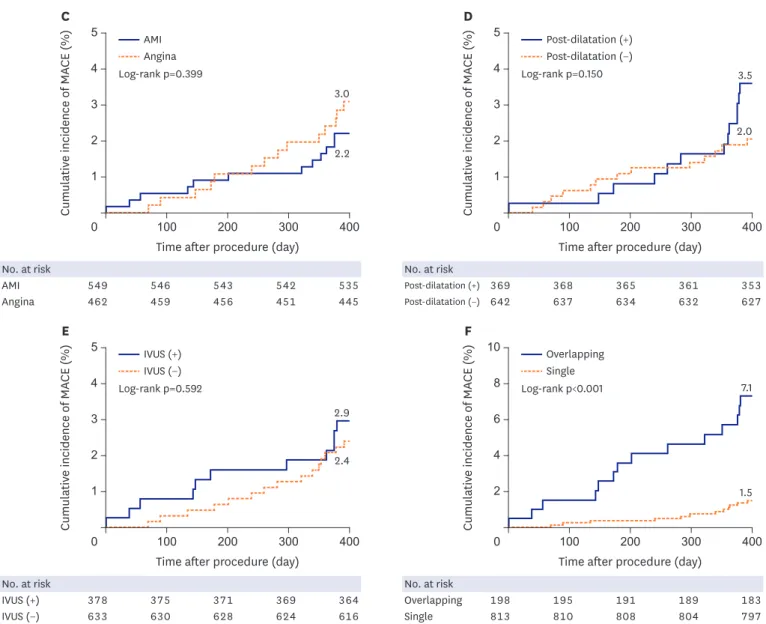
Subgroup analyses were performed according to parameters of gender, DM, presentation with AMI, post-dilatation after stenting or not, use of IVUS, and multiple overlapping stents implantation. Kaplan-Meier cumulative event curves showed no statistically significant differences in the incidence of MACE between males and females (2.4% vs. 2.9%, p=0.660), between patients with and without DM (3.9% vs. 1.9%, p=0.067), between those who presented with AMI and angina (2.2% vs. 3.0%, p=0.399), between patients with and without post-dilatation (3.5% vs. 2.0%, p=0.150), and between patients with IVUS and no IVUS (2.9% vs. 2.4%, p=0.592), however, significantly different between single stent and multiple overlapping stents implantation (1.5% vs. 7.1%, p<0.001) (Figure 1).

R-ZES in Long Coronary Artery Disease

Table 2. Cumulative incidence of clinical events at 12-month

Clinical events 12-month cumulative clinical events (n=1,004)

Cardiac death 5 (0.5)

Non-fatal MI 8 (0.8)

Stent thrombosis, definite 3 (0.3)

Cerebrovascular accident 9 (0.9)

Repeat revascularization, clinically-driven 36 (3.6)

Target lesion revascularization 17 (1.7)

Target vessel revascularization 19 (1.9)

Non-target lesion revascularization 19 (1.9)

Bleeding complication 12 (1.2)

TIMI major 5 (0.5)

TIMI minor 7 (0.7)

Rehospitalization 68 (6.8)

MACE 30 (3.0)

The data are presented as number (%).

MACE = major adverse cardiac events; MI = myocardial infarction; TIMI = thrombosis in myocardial infarction.

(7)

DISCUSSION

This is a first study to assess 1-year clinical outcomes in patients with DLCAD receiving R-ZES (mainly Resolute™ Integrity) from a large-scale, prospective, and real world-registry in Korea. A total of 1,011 patients with 1,472 lesions were enrolled and analyzed. In our results, the incidence of TVR and MACE were relatively low and that of definite ST was rare at 12-month follow up. Therefore, our study demonstrated that R-ZES has an excellent 1-year clinical outcome in Korean patients with DLCAD.

715 https://e-kcj.org https://doi.org/10.4070/kcj.2019.0018

Table 3. Independent predictors of 12-month major adverse cardiovascular events

Variable Univariate analysis Multivariate Cox regression analysis

HR (95% CI) p value HR (95% CI) p value

Multiple overlapping vs. single stenting 5.079 (2.311–11.163) <0.001 3.879 (1.779 – 8.459) 0.001

Previous CHF 9.990 (2.014–49.556) 0.026 8.071 (1.307–49.855) 0.003

Multi-vessel disease 6.800 (2.029–22.795) <0.001 5.248 (1.557–17.689) 0.007

Age ≥75 years 3.247 (1.447–7.285) 0.003 2.489 (1.097–5.648) 0.029

Diabetes mellitus 2.021 (0.927–4.410) 0.072 1.570 (0.717–3.436) 0.259

Previous MI 3.598 (0.800–16.178) 0.075 1.398 (0.223–8.779) 0.721

Chronic total occlusion 2.546 (0.739–8.778) 0.125 - -

Statin 1.921 (0.717–5.142) 0.187 - -

TFI vs. TRI 1.606 (0.737–3.501) 0.230 - -

Potent P2Y12 inhibitors 1.646 (0.556–4.873) 0.364 - -

Diagnosed with MI 0.715 (0.327–1.562) 0.398 - -

Hypertension 0.748 (0.343–1.630) 0.463 - -

LVEF <50% 1.416 (0.547–3.667) 0.472 - -

Current smoker 1.432 (0.591–3.046) 0.481 - -

Dyslipidemia 0.730 (0.302–1.766) 0.484 - -

Beta-blocker 1.222 (0.549–2.722) 0.623 - -

Male sex 1.203 (0.530–2.729) 0.658 - -

Previous CVA 1.306 (0.301–5.662) 0.720 - -

Calcium channel blocker 0.865 (0.322–2.323) 0.774 - -

ACEi or ARB 0.949 (0.431–2.088) 0.896 - -

ACEi = angiotensin converting enzyme inhibitor; ARB = angiotensin II receptor blocker; CHF = congestive heart failure; CI = confidence interval; CVA = cerebrovascular accident; HR = hazard ratio; LVEF = left ventricular ejection fraction; MI = myocardial infarction; TFI = trans-femoral intervention; TRI = trans-radial intervention.

No. at risk

Male 701 697 692 688 681

Female 310 308 307 305 299

No. at risk

AMI 549 546 543 542 535

Angina 462 459 456 451 445

No. at risk

IVUS (+) 378 375 371 369 364

IVUS (−) 633 630 628 624 616

No. at risk

DM (+) 339 336 330 328 323

DM (−) 672 669 669 665 657

No. at risk

Post-dilatation (+) 369 368 365 361 353

Post-dilatation (−) 642 637 634 632 627

No. at risk

Overlapping 198 195 191 189 183

Single 813 810 808 804 797

Cumulativ e incidence of MA CE (%)

0

B

Time after procedure (day) A

0 400

Cumulativ e incidence of MA CE (%)

5

300 200

100

DM (+) DM (−)

Time after procedure (day) Log-rank p=0.660

2.4 2.9

3.9

1 .9 Log-rank p=0.067

Male Female 4

3

2

1

400 5

300 200

100 4

3

2

1

Cumulativ e incidence of MA CE (%)

0

D

Time after procedure (day) C

0 400

Cumulativ e incidence of MA CE (%)

5

300 200

100

Post-dilatation (+) Post-dilatation (−)

Time after procedure (day) Log-rank p=0.399

2.2 3.0

3.5

2.0 Log-rank p=0.150

AMI Angina 4

3

2

1

400 5

300 200

100 4

3

2

1

Cumulativ e incidence of MA CE (%)

0

F

Time after procedure (day) E

0 400

Cumulativ e incidence of MA CE (%)

5

300 200

100

Overlapping Single

Time after procedure (day) Log-rank p=0.592

2.4 2.9

7.1

1.5 Log-rank p<0.001

IVUS (+) IVUS (−) 4

3

2

1

400 10

300 200

100 8

6

4

2

Figure 1. Kaplan-Meier survival curves for MACE among subgroups. Cumulative incidences of MACE according to (A) sex, (B) the presence of DM, (C) presentation with AMI, (D) performance of post-dilatation, (E) use of IVUS, and (F) the presence of multiple overlapping stents implantation.

AMI = acute myocardial infarction; DM = diabetes mellitus; IVUS = intravascular ultrasound MACE = major adverse cardiac events. (continued to the next page)

(8)

The R-ZES has been reported to have excellent long-term efficacy and safety outcomes in various studies. The RESOLUTE Global Clinical Trial Program included 7,618 patients treated with R-ZES reported that the 5-year cumulative incidence of target lesion failure (TLF defined as a composite of cardiac death, MI or clinically-driven TLR) was 13.4% and definite or probable ST was 1.2%.

8)

These excellent results are comparable to those of other second-generation DES. The data of RESOLUTE-Korea registry showed that the TLF of R-ZES was 2.9% at l-year follow-up and similar with that of everolimus-eluting stent (EES).

9)

R-ZES had lower incidences of TLR and ST, and showed comparable one-year safety and efficacy compared with EES. A report from the RESOLUTE All-Comer Trial demonstrated similar safety and efficacy between R-ZES and EES throughout 4 years. The rates of TLF (15.2% vs. 14.6%, p=0.68), clinically-indicated TLR (7.0% vs. 6.5%, p=0.62), and definite/probable ST (2.3% vs. 1.6%, p=0.23) were similar with the R-ZES and EES at 4 year.

10)

R-ZES in Long Coronary Artery Disease No. at risk

Male 701 697 692 688 681

Female 310 308 307 305 299

No. at risk

AMI 549 546 543 542 535

Angina 462 459 456 451 445

No. at risk

IVUS (+) 378 375 371 369 364

IVUS (−) 633 630 628 624 616

No. at risk

DM (+) 339 336 330 328 323

DM (−) 672 669 669 665 657

No. at risk

Post-dilatation (+) 369 368 365 361 353

Post-dilatation (−) 642 637 634 632 627

No. at risk

Overlapping 198 195 191 189 183

Single 813 810 808 804 797

Cumulativ e incidence of MA CE (%)

0

B

Time after procedure (day) A

0 400

Cumulativ e incidence of MA CE (%)

5

300 200

100

DM (+) DM (−)

Time after procedure (day) Log-rank p=0.660

2.4 2.9

3.9

1 .9 Log-rank p=0.067

Male Female 4

3

2

1

400 5

300 200

100 4

3

2

1

Cumulativ e incidence of MA CE (%)

0

D

Time after procedure (day) C

0 400

Cumulativ e incidence of MA CE (%)

5

300 200

100

Post-dilatation (+) Post-dilatation (−)

Time after procedure (day) Log-rank p=0.399

2.2 3.0

3.5

2.0 Log-rank p=0.150

AMI Angina 4

3

2

1

400 5

300 200

100 4

3

2

1

Cumulativ e incidence of MA CE (%)

0

F

Time after procedure (day) E

0 400

Cumulativ e incidence of MA CE (%)

5

300 200

100

Overlapping Single

Time after procedure (day) Log-rank p=0.592

2.4 2.9

7.1

1.5 Log-rank p<0.001

IVUS (+) IVUS (−) 4

3

2

1

400 10

300 200

100 8

6

4

2

Figure 1. (Continued) Kaplan-Meier survival curves for MACE among subgroups. Cumulative incidences of MACE according to (A) sex, (B) the presence of DM, (C) presentation with AMI, (D) performance of post-dilatation, (E) use of IVUS, and (F) the presence of multiple overlapping stents implantation.

AMI = acute myocardial infarction; DM = diabetes mellitus; IVUS = intravascular ultrasound MACE = major adverse cardiac events.

(9)

Compared with the biodegradable polymer biolimus-eluting stent (BES), the durable- polymer R-ZES also had similar in 3-year safety and efficacy clinical outcomes, including ST.

MACE occurred in 8.6% assigned to the durable-polymer R-ZES and in 9.6% assigned to the biodegradable-polymer BES (p=0.36). TLR (5.4% vs. 5.5%) and definite very late ST (0.4% vs.

0.7%) did not differ significantly between the 2 groups.

11)

Recently, novel biodegradable polymer stents with thinner strut, flexible designs and refined coatings have been available compared to the early biodegradable polymer stent. The thin strut durable polymer R-ZES were also non-inferior to very thin strut biodegradable polymer everolimus-eluting (Synergy™, Boston Scientific, Natick, MA, USA) or sirolimus-eluting stents (SES; Orsiro, Biotronik, Bulach, Switzerland) in treating complex all-comers with a high proportion of patients with acute coronary syndromes. The incidence of target vessel failure (TVF) was about 5% in all 3 groups at 12-month follow-up.

12)

The length of coronary artery lesion or stent has been well-known as predictors of restenosis and poor clinical outcomes after PCI in the first-generation DES era as well as in the BMS

era.

2)13)14)

However, some data have reported that the second-generation DES, especially such

as R-ZES, is relatively safe and effective for diffuse long lesions.

In the RESOLUTE 38-mm sub-study, the 38-mm length of the R-ZES had a low rate of TLF (5.4%) and ST (0.9%).

15)

Prospective study to evaluate safety and efficacy of Zotarolimus Eluting Stent (PSEZES) trial reported that the incidence of TLF was 6.36% and binary restenosis was 7.5% in R-ZES for patients with long coronary artery lesions (>20 mm).

16)

LONG-DES IV trial showed that R-ZES implantation had similar angiographic and clinical outcomes as compared with the first-generation SES implantation for patients with de novo long CAD.

17)

However, other study presented that R-ZES had a superior long-term safety than SES, with a similar clinical efficacy for treating long coronary lesions at 3-year follow-up. The cumulative TLR rate was similar between 2 groups (4.6% vs. 4.6%, p=0.911), however, the occurrence of target lesion-related definite ST was significantly lower in R-ZES than in SES (0.0% vs. 2.0%, p=0.028).

18)

A study comparing between R-ZES (Resolute™ Integrity) and X-EES (Xience Xpedition™) used single stent length of more than 30 mm for long CAD showed no significant between- group differences in the rate of adverse clinical events. The incidence of TLF was 5% in R-ZES and 4% in X-EES groups (HR, 1.25, 95% CI, 0.86–5.6; p=0.19).

19)

While most studies on R-ZES for DLCAD were small-scale studies, our study seems to be more meaningful because it is a relatively large-scale and prospective study. Our study reported that the incidence of MACE was 3.0% and that of definite ST was 0.3% at 12-month follow-up. In our study, the incidence of MACE appeared to be comparable or somewhat lower compared with that in other studies for DLCAD. We have not performed routine follow- up angiography and any stress test, but have evaluated only the clinically-driven TVR during follow-up periods. That is why we could not actually evaluate the binary stenosis or a silent ischemia. Therefore, it is possible that our results were assessed lower than actual. However, most of all (99.3%) have clearly completed a 12-month clinical follow-up in our study. In conclusion, as with other studies, R-ZES was actually safe and effective in our study. The good clinical outcomes of R-ZES did not differ according to gender, the presence of DM, and the diagnosis of AMI.

717

https://e-kcj.org https://doi.org/10.4070/kcj.2019.0018

(10)

Also, post-dilatation or use of IVUS could not affect the clinical outcomes of patients with DLCAD in our study. These procedures were performed by the choice of the operator and were more likely to be used in more complex lesions, so selection bias could not be ruled out.

Therefore, a large randomized trial should be needed to assess the impact of post-dilatation or IVUS for patients with DLCAD.

However, multiple overlapping stents implantation was different from single stent implantation in clinical outcomes and was still a predictor of MACE in patients with DLCAD. DES overlap has been well-known to be associated with impaired angiographic and long-term clinical outcome, including death or periprocedural MI.

20)-22)

However, the second-generation DES overlap seems to be much better than the first-generation DES overlap. The porcine model study showed that BES appears to be reliable on the inflammatory response at overlapping segments as well as non-overlapping segments.

23)

One retrospective study reported that the stent overlap with EES versus the first-generation DES was associated with lower rates of MACE and ST.

24)

The study for full metal jacket with ZES for DLCAD showed that the incidence of MACE and clinically-driven TLR were 11.7% and 5.0% at 3 year follow-up.

25)

Despite improvements in the second-generation DES era, DES overlap was still associated with high incidence of TVF and poor clinical outcomes. Therefore, we should make efforts to improve the clinical outcomes in patients with multiple overlapping DES for DLCAD.

Our study has several limitations. First, our study was not a randomized, comparative trial but based on a prospective, observational registry, even though our study enrolled a relatively large number of patients. Therefore, we could not evaluate the effect of R-ZES compared with that of other second-generation DES in patients with DLCAD. In addition, selection bias was hardly avoidable in the post hoc sub-group analysis of our study. Second, we could not evaluate quantitative angiographic outcomes, but only evaluated clinical outcomes. Therefore, we could not evaluate the angiographic pattern of in-stent restenosis between overlapping and non- overlapping segments of R-ZES. Third, Resolute™ integrity was used over 90% in our study.

However, with additional stenting, other DES or BMS was inevitably used at around 0.6%.

Nevertheless, other DES or BMS had nothing to do with the clinical outcomes.

In conclusion, our study shows that R-ZES implantation was safe and effective at 1-year follow-up in Korean patients with DLCAD. These effectiveness and safety of R-ZES were consistent for patients with DLCAD, regardless of gender, the presence of DM, and presented with AMI. However, it still seems to be necessary to improve the clinical outcome of multiple overlapping R-ZES in patients with DLCAD.

ACKNOWLEDGEMENTS

This study was funded by Medtronic. We thank Eo Jin Lee (Department of Cardiology, Chonnam National University Hospital) for technical assistance.

REFERENCES

1. Kastrati A, Schömig A, Elezi S, et al. Predictive factors of restenosis after coronary stent placement. J Am Coll Cardiol 1997;30:1428-36.

PUBMED | CROSSREF

R-ZES in Long Coronary Artery Disease

(11)

2. Kobayashi Y, De Gregorio J, Kobayashi N, et al. Stented segment length as an independent predictor of restenosis. J Am Coll Cardiol 1999;34:651-9.

PUBMED | CROSSREF

3. Claessen BE, Smits PC, Kereiakes DJ, et al. Impact of lesion length and vessel size on clinical outcomes after percutaneous coronary intervention with everolimus- versus paclitaxel-eluting stents pooled analysis from the SPIRIT (Clinical Evaluation of the XIENCE V Everolimus Eluting Coronary Stent System) and COMPARE (Second-generation everolimus-eluting and paclitaxel-eluting stents in real-life practice) Randomized Trials. JACC Cardiovasc Interv 2011;4:1209-15.

PUBMED | CROSSREF

4. Banerjee S. The resolute™ integrity zotarolimus-eluting stent in coronary artery disease: a review. Cardiol Ther 2013;2:17-25.

PUBMED | CROSSREF

5. Yeung AC, Leon MB, Jain A, et al. Clinical evaluation of the Resolute zotarolimus-eluting coronary stent system in the treatment of de novo lesions in native coronary arteries: the RESOLUTE US clinical trial. J Am Coll Cardiol 2011;57:1778-83.

PUBMED | CROSSREF

6. Qiao S, Chen L, Chen S, Wang W, Zhu G. One-year outcomes from an all-comers chinese population of patients implanted with the resolute zotarolimus-eluting stent. Am J Cardiol 2014;113:613-20.

PUBMED | CROSSREF

7. Richardt G, Leschke M, Abdel-Wahab M, et al. Clinical outcomes of the Resolute zotarolimus-eluting stent in patients with in-stent restenosis: 2-year results from a pooled analysis. JACC Cardiovasc Interv 2013;6:905-13.

PUBMED | CROSSREF

8. Yeh RW, Silber S, Chen L, et al. 5-year safety and efficacy of resolute zotarolimus-eluting stent: the RESOLUTE Global Clinical Trial Program. JACC Cardiovasc Interv 2017;10:247-54.

PUBMED | CROSSREF

9. Park KW, Lee JM, Kang SH, et al. Safety and efficacy of second-generation everolimus-eluting Xience V stents versus zotarolimus-eluting resolute stents in real-world practice: patient-related and stent-related outcomes from the multicenter prospective EXCELLENT and RESOLUTE-Korea registries. J Am Coll Cardiol 2013;61:536-44.

PUBMED | CROSSREF

10. Taniwaki M, Stefanini GG, Silber S, et al. 4-year clinical outcomes and predictors of repeat revascularization in patients treated with new-generation drug-eluting stents: a report from the RESOLUTE All-Comers trial (A Randomized Comparison of a Zotarolimus-Eluting Stent With an Everolimus-Eluting Stent for Percutaneous Coronary Intervention). J Am Coll Cardiol 2014;63:1617-25.

PUBMED | CROSSREF

11. Raungaard B, Christiansen EH, Bøtker HE, et al. Comparison of durable-polymer zotarolimus-eluting and biodegradable-polymer biolimus-eluting coronary stents in patients with coronary artery disease: 3-year clinical outcomes in the Randomized SORT OUT VI Trial. JACC Cardiovasc Interv 2017;10:255-64.

PUBMED | CROSSREF

12. von Birgelen C, Kok MM, van der Heijden LC, et al. Very thin strut biodegradable polymer everolimus- eluting and sirolimus-eluting stents versus durable polymer zotarolimus-eluting stents in allcomers with coronary artery disease (BIO-RESORT): a three-arm, randomised, non-inferiority trial. Lancet 2016;388:2607-17.

PUBMED | CROSSREF

13. Kastrati A, Elezi S, Dirschinger J, Hadamitzky M, Neumann FJ, Schömig A. Influence of lesion length on restenosis after coronary stent placement. Am J Cardiol 1999;83:1617-22.

PUBMED | CROSSREF

14. Choi IJ, Koh YS, Lim S, et al. Impact of the stent length on long-term clinical outcomes following newer- generation drug-eluting stent implantation. Am J Cardiol 2014;113:457-64.

PUBMED | CROSSREF

15. Lee M, Hiremath S, Zambahari R, et al. One-year outcomes of percutaneous coronary intervention with the 38-mm Resolute zotarolimus-eluting stent. Am J Cardiol 2013;112:1335-41.

PUBMED | CROSSREF

16. Bahuleyan CG, Krishna Kumar VV, Babu S. Prospective study to evaluate safety and efficacy of Zotarolimus Eluting Stent (PSEZES) in patients with long coronary artery lesions. Indian Heart J 2015;67:233-8.

PUBMED | CROSSREF

17. Ahn JM, Park DW, Kim YH, et al. Comparison of resolute zotarolimus-eluting stents and sirolimus- eluting stents in patients with de novo long coronary artery lesions: a randomized LONG-DES IV trial. Circ Cardiovasc Interv 2012;5:633-40.

PUBMED | CROSSREF

719

https://e-kcj.org https://doi.org/10.4070/kcj.2019.0018

(12)

18. Im E, Kim BK, Ko YG, et al. Comparison of 3-year clinical outcomes between Resolute™ zotarolimus- and sirolimus-eluting stents for long coronary artery stenosis. J Interv Cardiol 2013;26:378-83.

PUBMED | CROSSREF

19. Patra S, Chakraborty RN, Pande A, et al. Zotarolimus-eluting Resolute Integrity versus everolimus-eluting Xience Xpedition stents in the management of very long (>30mm) de novo coronary artery stenosis.

Cardiovasc Revasc Med 2017;18:160-4.

PUBMED | CROSSREF

20. Kereiakes DJ, Wang H, Popma JJ, et al. Periprocedural and late consequences of overlapping Cypher sirolimus-eluting stents: pooled analysis of five clinical trials. J Am Coll Cardiol 2006;48:21-31.

PUBMED | CROSSREF

21. Dawkins KD, Grube E, Guagliumi G, et al. Safety and efficacy of multiple, overlapping polymer-based paclitaxel-eluting stents. EuroIntervention 2007;3:213-21.

PUBMED | CROSSREF

22. Räber L, Jüni P, Löffel L, et al. Impact of stent overlap on angiographic and long-term clinical outcome in patients undergoing drug-eluting stent implantation. J Am Coll Cardiol 2010;55:1178-88.

PUBMED | CROSSREF

23. Park KH, Jeong MH, Kim JM, et al. The impact of triple anti-platelet therapy for endothelialization and inflammatory response at overlapping bioabsorbable polymer coated drug-eluting stents in a porcine coronary model. Int J Cardiol 2013;168:1853-8.

PUBMED | CROSSREF

24. Kitabata H, Loh JP, Pendyala LK, et al. Safety and efficacy outcomes of overlapping second-generation everolimus-eluting stents versus first-generation drug-eluting stents. Am J Cardiol 2013;112:1093-8.

PUBMED | CROSSREF

25. Durante A, Foglia Manzillo G, Burzotta F, et al. Long term follow-up of “full metal jacket” of de novo coronary lesions with new generation zotarolimus-eluting stents. Int J Cardiol 2016;221:1008-12.

PUBMED | CROSSREF

R-ZES in Long Coronary Artery Disease

수치

Table 1. Baseline clinical, angiographic, and procedural characteristics and in-hospital medications
Table 1. (Continued) Baseline clinical, angiographic, and procedural characteristics and in-hospital medications
Table 2. Cumulative incidence of clinical events at 12-month
Table 3. Independent predictors of 12-month major adverse cardiovascular events
+2

참조

관련 문서

Randomized comparison of sirolimus-eluting stent versus standard stent for percutaneous coronary revascularization in diabetic patients: The diabetes and sirolimus-eluting stent

This analysis of the Genoss DES™ prospective registry presents the safety and efficacy of the Genoss DES™ stent in real-world practice. The primary findings are as follows: 1) the

The use of biocompatible DP-everolimus-eluting stents (EES) or BP-biolimus-eluting stents (BES) was associated with superior safety and efficacy outcomes compared with

Drug-Eluting Stent Used to Treat a Case of Recurrent Right Coronary Artery In-Stent Restenoses often Accompanied by Acute Inferior Wall Myocardial Infarction Si-Hoon Park, M.D.1,

Comparison of coronary artery bypass surgery with percutaneous coronary intervention with drug-eluting stents for unprotected left main coronary artery disease..

3VD, 3 vessel disease; PES, paclitaxel-eluting stent; BEST, Bypass Surgery and Everolimus-Eluting Stent Implantation in the Treatment of Patients with Multivessel

Biodegradable polymer drug-eluting stents reduce the risk of stent thrombosis at 4 years in patients undergoing per- cutaneous coronary intervention: a pooled analysis of

In a study of pooled angiographic evaluation of the PERSEUS (Prospective Evaluation in a Randomized Trial of the Safety and Efficacy of the Use of the TAXUS