© 2017 The Korean Ophthalmological Society
This is an Open Access article distributed under the terms of the Creative Commons Attribution Non-Commercial License (http://creativecommons.org/licenses /by-nc/3.0/) which permits unrestricted non-commercial use, distribution, and reproduction in any medium, provided the original work is properly cited.
Original Article
Comparison of Long-term Surgical Outcomes of Two-muscle Surgery in Basic-type Intermittent Exotropia: Bilateral versus Unilateral
Seung Pil Bang
1, Soon Young Cho
2, Se Youp Lee
11
Department of Ophthalmology, Keimyung University Dongsan Medical Center, Keimyung University School of Medicine, Daegu, Korea
2
Department of Ophthalmology, Dongguk University Gyeongju Hospital, Dongguk University College of Medicine, Gyeongju, Korea
Purpose: To compare long-term surgical outcomes after bilateral lateral rectus recession (BLR) and unilateral lateral rectus recession-medial rectus resection (RR) for the treatment of basic-type intermittent exotropia.
Methods: Consecutive patients who underwent BLR or RR for treatment of intermittent exotropia between 1999 and 2010 and underwent ≥5 years of follow-up were recruited for this study. Surgical outcomes were grouped according to postoperative angle of deviation: overcorrection (esophoria/tropia >8 prism diopters [∆]), success (esophoria/tropia ≤8∆ to exophoria/tropia ≤8∆), and undercorrection/recurrence (exophoria/tropia >8∆). Out- comes were compared between the BLR group and the RR group at postoperative week 1, months 1 and 6, and years 1, 2, 3, 4, and 5.
Results: Of 99 patients, 37 underwent BLR and 62 underwent RR. At postoperative month 6 (97.3% vs. 82.3%, p = 0.045) and year 1 (91.9% vs. 74.2%, p = 0.040), the surgical success rates in the BLR group were signifi- cantly higher than in the RR group. Recurrence of exophoria/tropia most commonly occurred between 2 and 3 years after surgery in the BLR group, but continuous recurrences were found in the RR group. At postopera- tive year 5, the surgical success rate was 54.1% in the BLR group and 41.9% in the RR group ( p = 0.403). The reoperation rate was 24.3% in the BLR group and 33.9% in the RR group (p = 0.317).
Conclusions: Surgical outcomes 5 years after surgery for intermittent exotropia were comparable between the BLR and RR groups. The surgical success rate and the reoperation rate were not significantly different be- tween the BLR and RR groups.
Key Words: Exotropia, Operation, Strabismus
Intermittent exotropia (IXT) is the most frequent form of strabismus in childhood, representing well over half of all cases of exotropia [1]. On the basis of distance-near an- gle disparity, IXT subtypes are classified as basic, the most common subtype, followed by pseudo-divergence excess, convergence insufficiency, and true divergence excess [2].
Management for IXT consists of orthoptic exercises, part- time occlusion regimes, minus lenses or prisms, and sur- gery [3]. At present, surgery is the main approach used to achieve redundant ocular alignment and binocular single
Received: June 27, 2016 Accepted: August 19, 2016
Corresponding Author: Se Youp Lee, MD, PhD. Department of Ophthal- mology, Keimyung University Dongsan Medical Center, Keimyung Uni- versity School of Medicine, #56 Dalseong-ro, Jung-gu, Daegu 41931, Korea.
Tel: 82-53-250-7304, Fax: 82-53-250-7705, E-mail: [email protected]
A summary of this paper was presented as a narration at the 113th annual
meeting of the Korean Ophthalmology Society in Gwangju, Korea from
April 11 to 12, 2015.
vision. Surgical correction can produce satisfactory out- comes in the early postoperative stages; however, in order to produce consistent orthophoria, more than one operation is often required [4]. There is some controversy regarding the optimal surgical method. The two main methods are bilateral lateral rectus recession (BLR) and unilateral later- al rectus recession-medial rectus resection (RR).
The success rate of BLR varies from 41% to 83% [5-23], whereas that of RR varies from 32.3% to 85.1% [12-24].
According to findings from long-term follow-up compara- tive studies, Choi et al. [21] reported that final outcomes were better in the BLR group after a mean of 3.8 years of follow-up (success, 58.2% vs. 27.4%). On the other hand, Ekdawi et al. [20] found that BLR and RR were similarly effective over a mean of 8 years of follow-up (success, 56%
vs. 58%). The study by Choi et al. [21] was limited by a rel- atively short minimum follow-up period of 2 years; in the study by Ekdawi et al. [20], IXT was not classified by spe- cific type.
In this study, a retrospective review was performed to compare long-term surgical outcomes after BLR and RR for the treatment of basic-type IXT among four different types, with a follow-up period of 5 years.
Materials and Methods
Patients who underwent either BLR or RR for treatment of basic-type IXT between 1999 and 2010 at Keimyung University Dongsan Medical Center were enrolled in this study. Consecutive patients were included in the study co- hort if they were followed for more than 5 years postoper- atively. Basic-type IXT was defined as a distance deviation within 10 prism diopters (∆) of the near deviation.
Patients who had other types of IXT, A or V pattern, dissociated vertical deviation, oblique muscle overaction or underaction, paralytic or restrictive exotropia, a history of prior strabismus surgery, simultaneous vertical and/or oblique muscle surgery, vertical transposition of horizontal muscles during IXT surgery, severe amblyopia or anisometropia, other ocular abnormalities or surgeries, and systemic anomalies such as neurologic disorders or devel- opmental delays were excluded.
The medical records of patients were reviewed retro- spectively and adjusted for sex, age of deviation onset, pre- operative spherical equivalent as measured by cycloplegic
refraction, preoperative angle of deviation at distant/near, age at the time of surgery, and duration from deviation on- set to surgery. The angle of deviation was measured with the prism and alternate cover testing with accommodative targets for fixation both at distance (5 m) and near (33 cm), with appropriate spectacle correction when required. Ste- reoacuity was measured with a Titmus one test (Stereo Optical Co., Chicago, IL, USA) at near (33 cm).
All surgeries were performed by one of the authors (SYL) under general anesthesia. Surgical dose was based on the formula recommended by Wright [25]. The selec- tion of surgical procedure was made by the operating sur- geon, who had no preference for BLR or RR in the treat- ment of basic-type IXT.
Deviations at postoperative week 1, months 1 and 6, and years 1, 2, 3, 4, and 5 were assessed. The mean deviations at each postoperative time point were calculated, including the angle in patients who underwent additional operations.
Surgical outcomes were divided into three categories:
overcorrection (esophoria/tropia >8∆), success (esophoria/
tropia ≤8∆ to exophoria/tropia ≤8∆), and undercorrection/
recurrence (exophoria/tropia >8∆) according to postopera- tive angle of deviation at distance. History of reoperation and duration from surgery to recurrence were also ana- lyzed. Reoperation for recurrent exotropia was performed when patients had poor fusional control, by which an in- crease in the manifest phase of exotropia was noticed fre- quently by parents and clinicians.
An independent t-test or Fisher exact test was used for comparison of patient demographic data, preoperative and postoperative deviation angles, and stereoacuity values be- tween the groups. Pearson’s chi-square test or Fisher exact test was used for comparison of surgical outcomes at each postoperative time period and reoperation rate at postoper- ative year 5. Kaplan-Meier survival analysis and log-rank test were used for comparison of the recurrence rate. A lo- gistic regression test was used for examination of the influ- ence of surgical procedures on recurrence rate. Probability values <0.05 were considered statistically significant. SPSS for Windows ver. 22.0 (IBM Corp., Armonk, NY, USA) was used for all analyses.
Results
A total of 99 patients were included in this study. Thir-
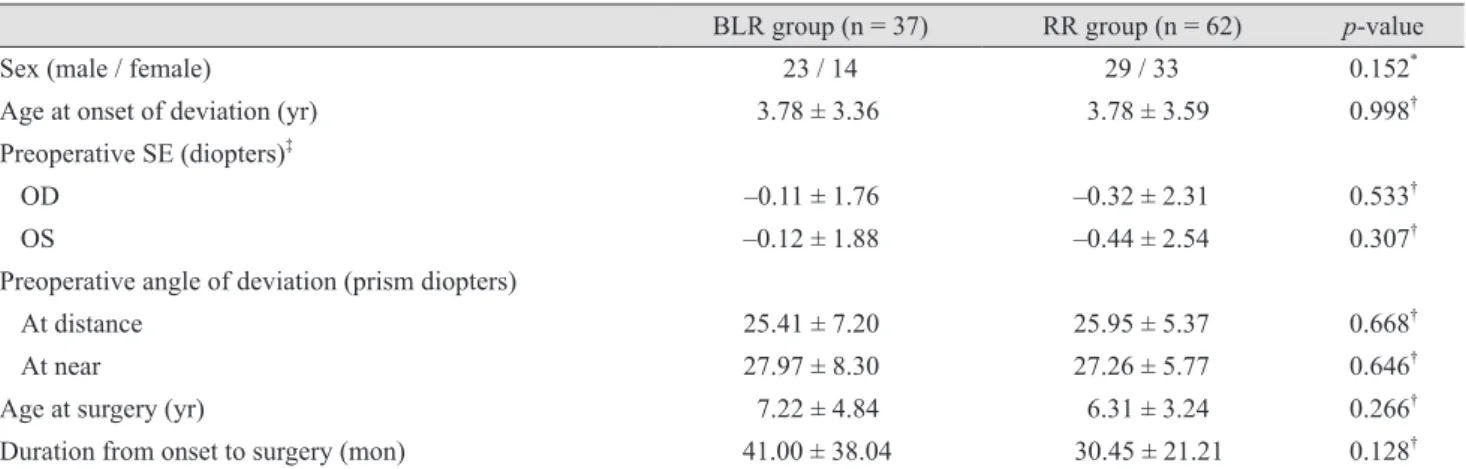
ty-seven patients, comprising 23 boys and 14 girls, under- went BLR, and 62 patients, comprising 29 boys and 33 girls, underwent RR. No statistically significant differenc- es were found between groups regarding gender (p = 0.152, Fisher exact test). Moreover, no statistically significant dif- ferences in mean age of deviation onset, preoperative re- fractive error, preoperative angle of deviation, mean age at surgery, or mean duration from onset of deviation to sur- gery were observed between the groups (p > 0.05 for all comparisons, independent t-test) (Table 1).
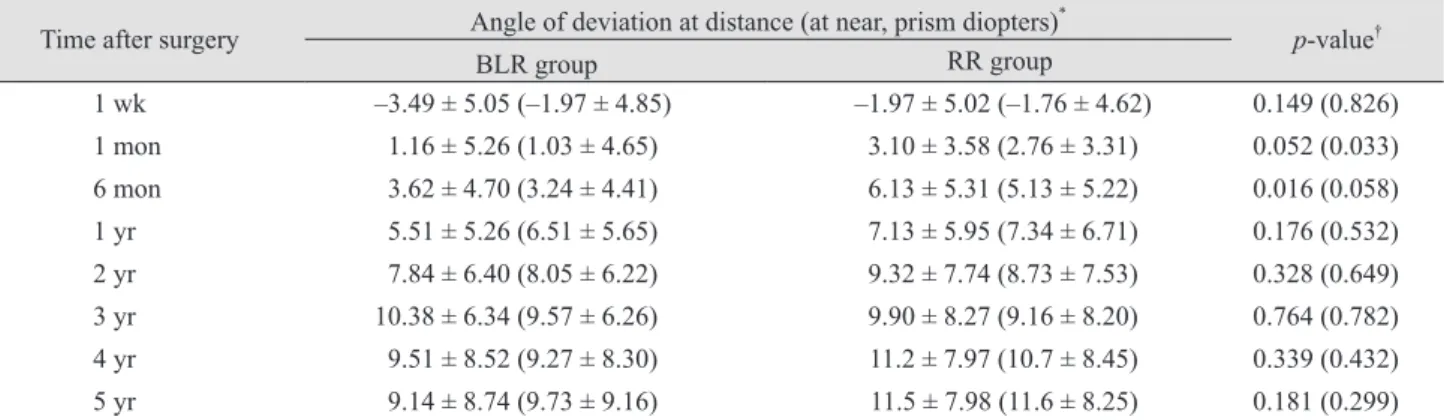
Mean postoperative deviation at distant and near fixation showed esodeviation, but did not differ between the groups at postoperative week 1. However, at postoperative month 1, near deviation was significantly more exotropic in the RR group than in the BLR group (p = 0.033, independent t-test) (Fig. 1A). At postoperative month 6, deviation at dis- tance was significantly more exotropic in the RR group than in the BLR group (p = 0.016, independent t-test) (Fig.
1B). At longer follow-up periods, deviations at distant and near fixation tended to be more exotropic in the RR group, but the differences were not statistically significant. An exception to this trend was noted at postoperative year 3 (Table 2).
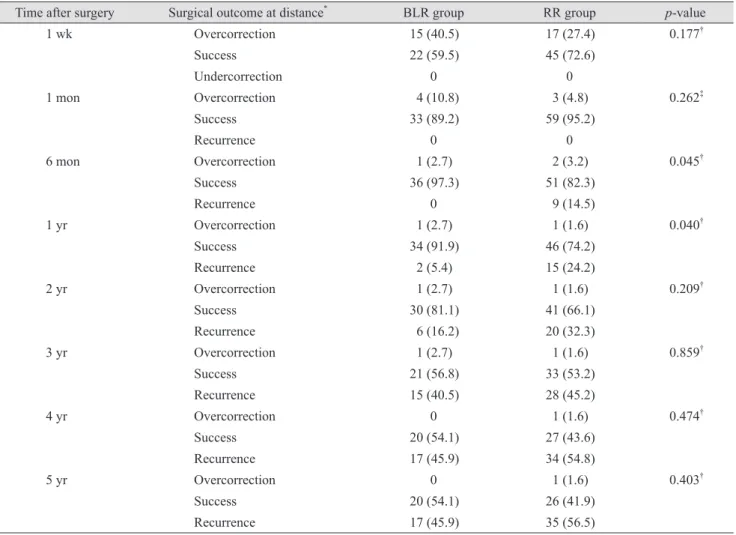
Analysis of the surgical results at each postoperative time point demonstrated that overcorrection decreased and the rate of recurrence increased in both groups over time.
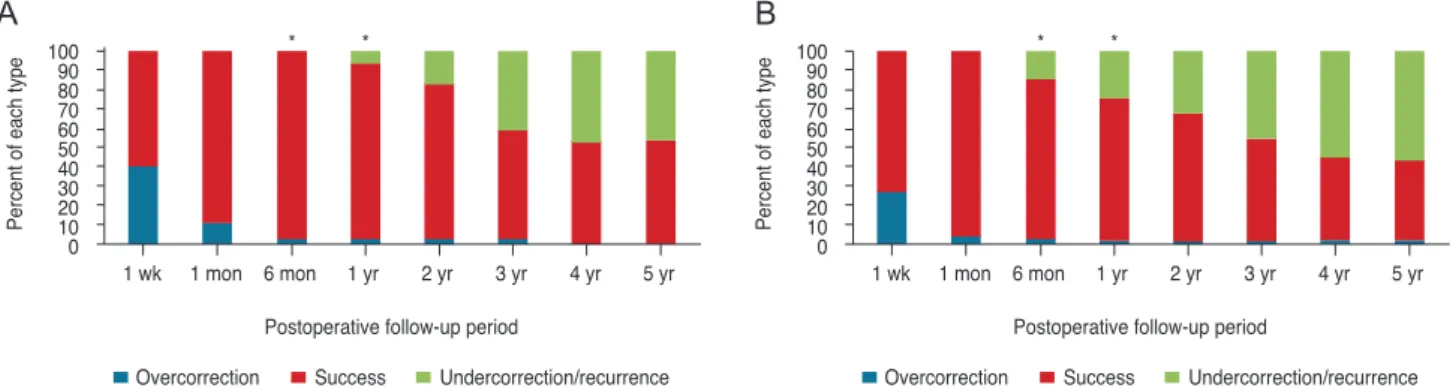
Surgical outcomes at postoperative month 6 (36 / 37 [ 97.3%] vs. 51 / 62 [82.3%], p = 0.045; Pearson’s chi-square
test) and year 1 (34 / 37 [91.9%] vs. 46 / 62 [74.2%], p = 0.040; Pearson’s chi-square test) were statistically more successful in the BLR group than in the RR group (Table 3, Fig. 2A and 2B). The postoperative year 5 success rate of the first procedure was not significantly different be- tween the BLR and RR groups (20 / 37 [54.1%] vs. 26 / 62 [ 41.9%], p = 0.403; Pearson’s chi-square test) (Table 4).
At postoperative year 5, recurrence was seen in 17 of 37 patients (45.9%) in the BLR group and 35 of 62 patients (56.5%) in the RR group (Table 3). The mean recurrence time from surgery was 27.18 ± 8.58 months in the 17 pa- tients of the BLR group and 32.29 ± 16.55 months in the 35 patients of the RR group, which was not a significant dif- ference (p = 0.149, independent t-test). Recurrence of exo- phoria/tropia most commonly occurred between 2 and 3 years after surgery in the BLR group, but within 6 months in the RR group. There were continuous recurrences with a second peak between 2 and 3 years after surgery in the RR group (Fig. 3).
Kaplan-Meier survival analysis for recurrence of exo- phoria/tropia showed no statistically significant difference in the cumulative probability of survival between the groups (p = 0.531, log-rank test). The median survival time from recurrence was 55 months in the BLR group and 52 months in the RR group. The mean survival time from re- currence was 44.92 ± 2.85 months in the BLR group and 44.36 ± 2.34 months in the RR group (Fig. 4).
Logistic regression analysis demonstrated that age at de-
Table 1. Patient characteristics
BLR group (n = 37) RR group (n = 62) p-value
Sex (male / female) 23 / 14 29 / 33 0.152
*Age at onset of deviation (yr) 3.78 ± 3.36 3.78 ± 3.59 0.998
†Preoperative SE (diopters)
‡OD –0.11 ± 1.76 –0.32 ± 2.31 0.533
†OS –0.12 ± 1.88 –0.44 ± 2.54 0.307
†Preoperative angle of deviation (prism diopters)
At distance 25.41 ± 7.20 25.95 ± 5.37 0.668
†At near 27.97 ± 8.30 27.26 ± 5.77 0.646
†Age at surgery (yr) 7.22 ± 4.84 6.31 ± 3.24 0.266
†Duration from onset to surgery (mon) 41.00 ± 38.04 30.45 ± 21.21 0.128
†Values are presented as mean ± standard deviation.
BLR = bilateral lateral rectus muscle recession; RR = unilateral lateral rectus recession-medial rectus resection; SE = spherical equiva- lent; OD = right eye; OS = left eye.
*
Statistics by Fisher exact test;
†Statistics by independent t-test;
‡Preoperative spherical equivalent measured by cycloplegic refraction.
viation onset was the only factor associated with recur- rence (p = 0.044), suggesting that recurrence can be ex- pected in patients who are younger at the time of deviation onset. Gender (p = 0.835), surgical method (p = 0.500), age at surgery (p = 0.530), duration from deviation onset to surgery (p = 0.763), preoperative angle of deviation at dis- tant fixation (p = 0.125), and postoperative angle of devia- tion at distant fixation 1 week after surgery (p = 0.406) were not significantly associated with recurrence.
Nine of 37 patients (24.3%) in the BLR group and 21 of 62 patients (33.9%) in the RR group underwent reoperation for a recurrence of exotropia, which are not significantly different rates (p = 0.317, Pearson’s chi-square test) (Table 4). The mean duration between the first and second sur- gery was 48.11 ± 9.48 months in the nine patients of the
BLR group and 51.38 ± 10.03 months in the 21 patients of the RR group (p = 0.413, independent t-test).
Preoperative and postoperative stereoacuity values by Titmus test showed no statistically significant difference between the two groups (p = 0.203 and p = 0.796, indepen- dent t-test) (Table 5).
Discussion
Various studies comparing long-term surgical outcomes between BLR and RR for treatment of IXT have been re- ported. Maruo et al. [15] reported that, in 666 patients, BLR produced better outcomes at a 4-year follow-up (66.7% vs. 32.8%), but those authors did not present the Table 2. Postoperative angles of deviation for distant and near fixation in the BLR group and the RR group treated for basic-type intermittent exotropia
Time after surgery Angle of deviation at distance (at near, prism diopters)
*p-value
†BLR group RR group
1 wk –3.49 ± 5.05 (–1.97 ± 4.85) –1.97 ± 5.02 (–1.76 ± 4.62) 0.149 (0.826)
1 mon 1.16 ± 5.26 (1.03 ± 4.65) 3.10 ± 3.58 (2.76 ± 3.31) 0.052 (0.033)
6 mon 3.62 ± 4.70 (3.24 ± 4.41) 6.13 ± 5.31 (5.13 ± 5.22) 0.016 (0.058)
1 yr 5.51 ± 5.26 (6.51 ± 5.65) 7.13 ± 5.95 (7.34 ± 6.71) 0.176 (0.532)
2 yr 7.84 ± 6.40 (8.05 ± 6.22) 9.32 ± 7.74 (8.73 ± 7.53) 0.328 (0.649)
3 yr 10.38 ± 6.34 (9.57 ± 6.26) 9.90 ± 8.27 (9.16 ± 8.20) 0.764 (0.782)
4 yr 9.51 ± 8.52 (9.27 ± 8.30) 11.2 ± 7.97 (10.7 ± 8.45) 0.339 (0.432)
5 yr 9.14 ± 8.74 (9.73 ± 9.16) 11.5 ± 7.98 (11.6 ± 8.25) 0.181 (0.299)
Values are presented as mean ± standard deviation. The positive numbers represent exodeviation, and the negative numbers represent esodeviation.
BLR = bilateral lateral rectus muscle recession; RR = unilateral lateral rectus recession-medial rectus resection.
*
The mean deviations at each postoperative time point were calculated, including the angles in patients who underwent further opera- tions;
†Statistics by independent t-test.
Fig. 1. Mean angles of deviation at each postoperative time point in the bilateral lateral rectus recession (BLR) group and the unilateral lateral rectus recession-medial rectus resection (RR) group treated for basic-type intermittent exotropia. (A) The mean angle of deviation at distant fixation was more exotropic in the RR group than in the BLR group through the entire follow-up period, except for postoper- ative year 3. (B) The mean deviation at near fixation was also more exotropic in the RR group than in the BLR group through the entire follow-up period, except postoperative year 3.
*p < 0.05 by independent t-test.
A B
BLR group RR group 1 wk 1 mon 6 mon 1 yr 2 yr 3 yr 4 yr 5 yr Angle of deviation (prism diopters)
Postoperative follow-up period 14 12
10 8 6 4 2 0 –2 –4 –6
*
* BLR group
RR group 1 wk 1 mon 6 mon 1 yr 2 yr 3 yr 4 yr 5 yr Angle of deviation (prism diopters)
Postoperative follow-up period 14 12
10 8
6 4
2 0
–2 –4
outcomes at each postoperative time before 4 years and in- cluded other types of IXT other than the basic-type. Few studies have compared the long-term surgical outcomes of these two procedures to treat basic IXT. Choi et al. [21] con- cluded that surgical outcomes at 2 years were not different;
however, at a mean follow-up period of 44.2 months in the BLR and 47.8 months in the RR group, final outcomes were better in the BLR group. In our study, surgical out- comes at 5 years, which is much longer than the average follow-up period investigated by Choi et al. [21], were not significantly different between the BLR and RR groups.
When assessing mean deviations at each postoperative time point, RR showed more exotropic deviation during
the entire follow-up period at distant and near fixation, ex- cept at postoperative year 3. In the study by Choi et al. [21], patients who underwent BLR showed more exotropic devi- ation until postoperative month 1, and those who under- went RR showed more exotropic deviation after postoper- ative month 6. The difference between our findings and those of Choi et al. [21] at postoperative year 3 shows that BLR patients exhibited more exotropic drift than do RR patients around postoperative year 3 in our study.
In concordance with Choi et al. [21], the first peak of re- currence occurred within 6 months, and the second peak occurred between postoperative years 2 and 3 in the RR group. Between 2 and 3 years after surgery, the BLR group
Table 3. Postoperative surgical outcomes at distant fixation in the BLR group and the RR group treated for basic-type intermit- tent exotropia
Time after surgery Surgical outcome at distance
*BLR group RR group p-value
1 wk Overcorrection 15 (40.5) 17 (27.4) 0.177
†Success 22 (59.5) 45 (72.6)
Undercorrection 0 0
1 mon Overcorrection 4 (10.8) 3 (4.8) 0.262
‡Success 33 (89.2) 59 (95.2)
Recurrence 0 0
6 mon Overcorrection 1 (2.7) 2 (3.2) 0.045
†Success 36 (97.3) 51 (82.3)
Recurrence 0 9 (14.5)
1 yr Overcorrection 1 (2.7) 1 (1.6) 0.040
†Success 34 (91.9) 46 (74.2)
Recurrence 2 (5.4) 15 (24.2)
2 yr Overcorrection 1 (2.7) 1 (1.6) 0.209
†Success 30 (81.1) 41 (66.1)
Recurrence 6 (16.2) 20 (32.3)
3 yr Overcorrection 1 (2.7) 1 (1.6) 0.859
†Success 21 (56.8) 33 (53.2)
Recurrence 15 (40.5) 28 (45.2)
4 yr Overcorrection 0 1 (1.6) 0.474
†Success 20 (54.1) 27 (43.6)
Recurrence 17 (45.9) 34 (54.8)
5 yr Overcorrection 0 1 (1.6) 0.403
†Success 20 (54.1) 26 (41.9)
Recurrence 17 (45.9) 35 (56.5)
Values are presented as number (%).
BLR = bilateral lateral rectus muscle recession; RR = unilateral lateral rectus recession-medial rectus resection; ∆ = prism diopters.
*
Overcorrection = esophoria/tropia >8∆ at a distance; success = esophoria/tropia ≤8∆ to exophoria/tropia ≤8∆ at a distance; undercor-
rection/recurrence = exophoria/tropia >8∆ at a distance. All patients who underwent reoperation for a recurrence of exotropia were also
included in “Recurrence” category;
†Statistics by Pearson’s chi-square test;
‡Statistics by Fisher exact test.
also showed the first peak, which was larger than the sec- ond peak of the RR group; in this period, the rate of recur- rence in the BLR group was higher than that in the RR group.
By analyzing mean deviations and recurrence rates at each postoperative time point, we found that the lack of significant difference in postoperative year 5 success rate
Fig. 2. The proportions of each surgical outcome type at distant fixation for each postoperative time point in the bilateral lateral rectus recession (BLR) group (A) and in the unilateral lateral rectus recession-medial rectus resection (RR) group (B) for basic-type intermit- tent exotropia. Surgical outcomes at postoperative month 6 (p = 0.045) and year 1 (p = 0.040) differed significantly between the groups, demonstrating a higher success rate in the BLR group than in the RR group.
*p < 0.05 by Pearson’s chi-square test.
A B
Percent of each type
Postoperative follow-up period 100 90
80 70 60 50 40 30 20 10
0 1 wk 1 mon 6 mon
*
1 yr
*
2 yr 3 yr 4 yr 5 yr
Overcorrection Success Undercorrection/recurrence
Percent of each type
Postoperative follow-up period 100 90
80 70 60 50 40 30 20 10
0 1 wk 1 mon 6 mon
*
1 yr
*
2 yr 3 yr 4 yr 5 yr
Overcorrection Success Undercorrection/recurrence
Table 4. Success rates and reoperation rates in the BLR group and RR group treated for basic-type intermittent exotropia at post- operative year 5
BLR group (n = 37) RR group (n = 62) p-value
*Success rate (%) 54.1 41.9 0.403
Reoperation rate (%) 24.3 33.9 0.317
BLR = bilateral lateral rectus muscle recession; RR = unilateral lateral rectus recession-medial rectus resection.
*
Statistics by Pearson’s chi-square test.
Percent of recurred patients
Time after surgery (yr) 30
25 20 15 10 5
0 ≤0.5 0.5–1 1–2 2–3 3–4 4–5
BLR group RR group
Fig. 3. The percentages of recurrence at distant fixation for each postoperative time point in the bilateral lateral rectus recession (BLR) group and the unilateral lateral rectus recession-medial rectus resection (RR) group for basic-type intermittent exotropia.
Analysis showed that recurrence was most common between postoperative years 2 and 3 in the BLR group, whereas it was most common within 6 months postoperatively in the RR group with continuous recurrences after surgery.
Cumulative probability of survival
Time to recurrence after initial surgery (mon) BLR group
RR group 1.0
0.8
0.6
0.4
0.2
0.0
0 10 20 30 40 50 60
Fig. 4. Kaplan-Meier survival analysis for recurrence of exo-
phoria/tropia more than 8 prism diopters in the bilateral lateral
rectus recession (BLR) group and the unilateral lateral rectus re-
cession-medial rectus resection (RR) group for basic-type inter-
mittent exotropia. The analysis showed no statistically significant
difference in the cumulative probability of survival between the
between the two procedures could be explained by the more exotropic deviation showed by the RR during all fol- low-up periods, but BLR showed more exotropic drift 2 and 3 years after surgery. In other words, the lack of sig- nificant differences in postoperative year 5 surgical out- comes may be attributable to the differences in recurrence rate over time.
The Kaplan-Meier survival curve showed continuous re- currence over time until about 40 months after surgery in both groups. Cumulative recurrence was more prominent in the RR group within 26 months after surgery, but in the BLR group between 26 and 47 months after surgery. The curve also showed no recurrence 40 months after surgery in the RR group. These findings may also be attributable to the difference in recurrence rate over time, as men- tioned above. Even though it did not reach statistical sig- nificance, the somewhat higher recurrence rate observed in the RR group at postoperative year 5 indicates that a longer follow-up period than that used in the current study could reveal a statistically significant difference in final outcomes between the two procedures.
In this study, the immediate postoperative angle of devi- ation was more esotropic in the BLR group than in the RR group, as shown in Table 2 and Fig. 1. There is a possibility that the duration of surgery might affect surgical outcome.
No statistically significant difference in immediate postop- erative angle of deviation was observed between the groups, but the difference might influence the recurrence rate observed. On the other hand, the mean deviations at each postoperative time point were calculated including the angles in patients who underwent further operations, as shown in Table 2 and Fig. 1. We expected more patients receiving secondary operation in the RR group to show smaller mean deviations at each postoperative follow-up.
Contrary to our expectation, however, larger mean devia- tions at each postoperative visit were observed in the RR
group, indicating more recurrences in the RR group than in the BLR group.
Classic theory suggests that surgery for the treatment of IXT should be based on distance/near differences [6].
Burian and Spivey [26] recommended RR as the preferred surgical procedure for basic-type IXT based on the theory that RR would affect distance and near deviation equally, whereas BLR would affect distance deviation more than near deviation. In this study, however, both procedures af- fected both the distance and near deviation, so no differ- ence was observed between postoperative deviation angle in distance and near fixation (Table 2).
Recently, some studies have shown that patients who underwent RR obtained better alignment than did those who underwent BLR at postoperative year 1, but RR was more likely to produce exodeviation over time [18]. As me- dial RR results in the original tethering effect, it may lead to success in the short term, but persistent strain on the re- sected medial rectus can give rise to muscle stretching;
thus, the tethering effect decreases over time. In this study, no difference was found in the orthophoria rates between the groups at postoperative year 1.
In previous studies, the age of deviation onset had no ef- fect on the recurrence of IXT. In contrast, in our study, the age at deviation onset was the only prognostic factor for the recurrence of IXT. Recently, Lim et al. [27] reported the prognostic factors for recurrence after RR procedures in patients with IXT, one of which was age of deviation onset. However, no explanation of the relevance of onset age to recurrence of IXT was presented in that study. More- over, in another study by the same group [28], they report- ed the prognostic factors for recurrence after BLR proce- dures in patients with IXT, and onset age of deviation was not significantly predictive of IXT recurrence. Therefore, further evaluation of the predictive value of onset age with respect to deviation is necessary.
Table 5. Stereoacuity values of the BLR group and the RR group treated for basic-type intermittent exotropia
BLR group (n = 37) RR group (n = 62) p-value
*Stereoacuity (second of arc)
†Preoperative 192.11 ± 240.34 114.21 ± 137.24 0.203
Postoperative
‡75.38 ± 37.12 72.88 ± 41.37 0.796
Values are presented as mean ± standard deviation.
BLR = bilateral lateral rectus muscle recession; RR = unilateral lateral rectus recession-medial rectus resection.
*