© 2020 The Korean Ophthalmological Society
This is an Open Access article distributed under the terms of the Creative Commons Attribution Non-Commercial License (http://creativecommons.org/licenses /by-nc/3.0/) which permits unrestricted non-commercial use, distribution, and reproduction in any medium, provided the original work is properly cited.
Original Article
Consecutive esotropia (ET) is a persisting or variable es- odeviation after surgery to correct exotropia. The preva- lence of such surgical overcorrection in patients with exo- deviation ranges from 6% to 20% [1,2]. Risk factors for consecutive ET include lateral incomitancy [3], high ac- Purpose: To evaluate the clinical features and prognosis of a delayed-onset consecutive esotropia (ET) after
surgical correction of intermittent exotropia.
Methods: Thirty-four patients who developed consecutive ET after primary bilateral lateral rectus recession for the surgical correction of intermittent exotropia were evaluated retrospectively and were divided into two groups: delayed-onset consecutive ET group and the continuous consecutive ET group. Patients who devel- oped esodeviation after once recovering to orthotropia within 1 month after the operation were included in the delayed-onset consecutive ET group, and patients with continuous esodeviation after the operation were included in the continuous consecutive ET group. We evaluated preoperative and postoperative angle of devi- ation, suppression, stereopsis, and follow up periods between the two groups and compared re-operation and success following non-surgical treatment between the continuous consecutive ET group and the delayed-on- set consecutive ET group.
Results: Among 34 patients with consecutive ET, 27 patients (79.4%) were included in the delayed-onset consecutive ET group, and seven patients (23.3%) were included in the continuous group. Success rate of non-surgical treatment was not statistically significant between two groups (p = 0.55), but it was higher in the delayed-onset group with 37.5%, and 25% of patients in continuous group were successfully recovered to straight alignment. Duration of orthotropia in delayed-onset group was 7.4 ± 6.0 months (range, 2–29 months).
Age, sex, preoperative refractive error, preoperative exodeviation, suppression, and near steroacuity were not statistically significant between two groups (p > 0.05, all). In the delayed-onset group, three patients (11.1%) underwent re-operation, while three patients (42.9%) in continuous consecutive ET group underwent re-oper- ation (p = 0.048).
Conclusions: Re-operation rate of delayed-onset consecutive ET after surgical correction of intermittent exo- tropia was lower than that of continuous consecutive ET.
Key Words: Bilateral lateral rectus muscle recession, Consecutive esotropia, Intermittent exotropia
Received: August 22, 2019 Final revision: October 14, 2019 Accepted: November 7, 2019
Corresponding Author: Seung-Hyun Kim, MD, PhD. Department of Ophthalmology, Korea University Anam Hospital, 73 Goryeodae-ro, Seongbuk-gu, Seoul 02841, Korea. Tel: 82-2-920-5520, Fax: 82-2-924- 6820, E-mail: [email protected]
Clinical Manifestations of Delayed-onset Consecutive Esotropia after Surgical Correction of Intermittent Exotropia
Daniel Jinhag Baik, Suk-Gyu Ha, Seung-Hyun Kim
Department of Ophthalmology, Korea University College of Medicine, Seoul, Korea
commodative convergence to accommodation ratio [4,5], age at surgery [6], and excessive lateral rectus muscle re- cession. As persisting consecutive ET may cause loss of binocular vision, diplopia, amblyopia, and suppression, several non-surgical treatments, such as optical correction, patching, and prism glasses, can be considered [7]. These conservative treatments of consecutive ET cases generally show a good clinical response [8]. If esodeviation of more than 10 prism diopters (PD) continues for more than six months, surgical management should be considered [7,9,10]
Initial overcorrection is the target of surgical treatment of intermittent exotropia [11]. Comitant consecutive ET with small deviation usually improves spontaneously with- in one month, but even after recovering to orthotropia, there are some cases that develop esodeviation again. We defined reoccurring esodeviation as delayed-onset consec- utive ET. Despite numerous studies that have investigated consecutive ET cases, delayed-onset consecutive ET has not been reported to our knowledge.
The purpose of this study was to evaluate the clinical features and prognosis of a delayed-onset consecutive ET case after surgical correction of intermittent exotropia.
Materials and Methods
The institutional review board of Korea University Med- ical Center approved this study (2019AN0176), and we ad- hered to the te nets of the Declaration of Helsinki. Written informed consent was waived due to the retrospective na- ture of the study.
A retrospective review was conducted of the clinical re- cords of patients with angle of esodeviation greater than 4 PD at two weeks following bilateral lateral rectus (BLR) muscle recession for treatment of intermittent exotropia between September 2014 and February 2018. Patients with history of strabismus surgery, ocular trauma, neurologic deficits, and ocular disease other than anisometropia, am- blyopia, and strabismus were excluded from the study.
Patients with consecutive ET were divided into two groups: a delayed-onset consecutive ET group and a con- tinuous consecutive ET group. Patients with persisting es- odeviation of more than 4 PD throughout the follow-up pe- riod after surgery despite non-surgical treatment were included in the continuous consecutive ET group, while those who re-developed esodeviation of more than 4 PD
after obtaining orthophoria at one month after initial post- operative overcorrection for surgical correction of inter- mittent exotropia were included in the delayed-onset group.
At the initial visit, all patients underwent best-corrected visual acuity and manifest refraction (Auto refractor RKF1, Canon, Japan), measurement of near and distant angles of exodeviation, ocular motor test, and the suppres- sion test. The angle of deviation (PD) was determined us- ing the prism and alternative cover test at both short (33 cm) and long (6 m) distances. The suppression was mea- sured at distance fixation using a vectrogram (Vectograph- ic Projector Test; Reneau, France). All measurements were obtained by an experienced pediatric ophthalmologist (SHK).
All patients underwent BLR muscle recession as the ini- tial surgery for treatment of intermittent exotropia. BLR recession was performed on stable exodeviation, which was defined as exodeviation that exceeded 25 PD. All sur- geries were carried out by one experienced pediatric oph- thalmologist (SHK). Surgical correction amount was con- sidered using standard tables [4].
Non-surgical treatment for consecutive ET before con- sidering surgical treatment consisted of part-time patching and prism glasses therapy. Alternate full-time patching was applied to all patients from postoperative day one for treatment of surgical overcorrection. Patients with esode- viation of more than 4 PD or who complained of diplopia despite alternate full-time patching were treated with prism glasses. These conservative management strategies were applied in both groups. Surgery for consecutive ET was performed on patients who persisted more than 10 PD of esodeviation for a minimum of six months, who had suppression in one eye, who had diplopia, and cases that did not achieve fine stereopsis.
Age at exotropia surgery, sex, visual acuity, spherical equivalent, preoperative and postoperative angles of devia- tion, suppression, stereopsis, and follow-up periods were compared between the two groups.
Statistical analysis was performed using the IBM SPSS Statistics ver. 24.0 (IBM Corp., Armonk, NY, USA). The clinical characteristics of the two groups were compared using the Mann-Whitney U-test and Pearson chi-square tests. A p-value <0.05 was considered statistically signifi- cant.
Results
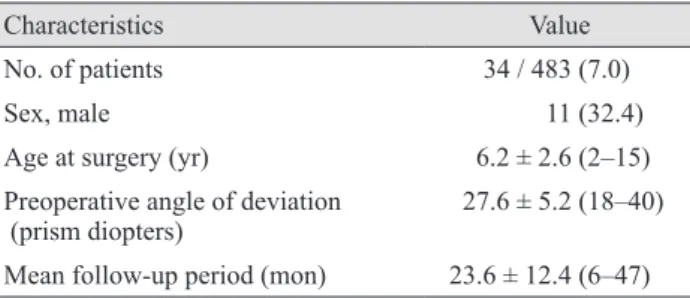
Among 483 patients who underwent BLR recession for surgical treatment of intermittent exotropia during the study period, 34 (7.0%) were diagnosed with consecutive ET (Table 1). Eleven patients (32.4%) were male; the mean age at surgery was 6.2 ± 2.6 years (range, 2–15 years), while the average preoperative exodeviation was 27.6 ± 5.2 PD (range, 18 –40 PD). The mean follow-up period was 23.6 ± 12.4 months (range, 6–47 months).
Twenty-seven patients were in the delayed-onset consec- utive ET group, and 7 patients were in the continuous con- secutive ET group. Baseline characteristics of age at oper- ation, sex, spherical equivalent, suppression, preoperative angle of exodeviation, and surgical amount were compara- ble between the two groups (Table 2).
In the delayed-onset consecutive ET group, 37.5% of the patients recovered to orthotropia, compared to 25% of pa- tients in the continuous consecutive ET group. The re-op- eration rate of consecutive ET patients was 11.1% in the delayed-onset group, and 42.9% of patients in the continu- ous group underwent reoperation for ET (p = 0.048).
There were no statistically significant differences in postoperative angle of deviation at postoperative day one or six months (p = 0.10 and p = 0.08, respectively), but the amount of distant exodeviation at one month postopera- tively was 0.1 ± 0.4 PD (range, 0–2 PD) in the delayed-on- set group and 5.1 ± 2.3 PD (range, 4–10 PD) in the continu- ous group (p < 0.01). The amount of distant deviation at one year postoperatively was 4.3 ± 4.5 PD (range, 0–18 PD) in the delayed-onset group and 12.0 ± 16.0 PD (range, 0–40 PD) in the continuous group (p = 0.04) (Table 3).
Discussion
Previous studies have reported the incidence of consecu- tive ET to range from 6% [12] to 15% [13]. Our study showed that 7% of intermittent exotropia patients who un- derwent BLR recession developed consecutive ET. The in- crease in medial rectus muscle tone after BLR recession may play a role in development of consecutive ET following BLR recession, but there is no consensus on the pathogenic mechanism [14,15]. Known risk factors for consecutive ET Table 1. Patient data
Characteristics Value
No. of patients 34 / 483 (7.0)
Sex, male 11 (32.4)
Age at surgery (yr) 6.2 ± 2.6 (2–15)
Preoperative angle of deviation
(prism diopters) 27.6 ± 5.2 (18–40)
Mean follow-up period (mon) 23.6 ± 12.4 (6–47) Values are presented as number (%) or mean ± standard deviation (range).
Table 2. Comparison of surgical results
Delayed onset (n = 27) Continuous (n = 7) p-value
Age at surgery (yr) 6.2 ± 2.6 (2–15) 6.4 ± 2.6 (3–10) 0.51*
Sex, male 9 (33.3) 2 (28.6) 0.81*
Refraction, CR (D) -1.02 ± 1.92 -0.79 ± 1.52 0.54*
Suppression (%) 85.7 100 0.29*
Preoperative angle of deviation (PD) Distant 28.1 ± 5.2 25.7 ± 5.4
0.64*
Near 28.3 ± 5.5 25.7 ± 5.4
Amount of surgery (mm) Right 6.1 (5–7) 5.4 (5–6)
0.10*
Left 5.9 (4–7) 5.8 (4.5–7)
Consecutive esotropia onset (mon) 7.4 ± 6.0 (2–29) 0.6 ± 0.5 (0–1) <0.01*
Recovery after non-surgical treatment 9 (37.5) 1 (25.0) 0.55*
Reoperation 3 (11.1) 3 (42.9) 0.048†
Values are presented as mean ± standard deviation (range), number (%), or mean ± standard deviation unless otherwise indicated.
CR = cycloplegic refraction; D = diopters; PD = prism diopters.
*Pearson chi-square test; †Mann-Whitney U-test.
are high accommodative convergence/accommodation ratio [4,5], lateral incomitancy [3], and age at surgery [6]; a previous study showed that larger esodeviation at postop- erative one month was more likely to proceed to secondary surgery [16].
Recently, we have noticed an increase in patients who develop esodeviation after surgery, even after recovering to orthotropia. We defined this type of consecutive ET cas- es as delayed-onset consecutive ET. The cause of this in- crease is unknown, but an increase of “near work” in the current generation during the unstable postoperative peri- od within several early months after surgery may have played a role [17].
In this study, patients with continuous consecutive ET were compared to patients who experienced delayed devel- opment of esodeviation after recovering to orthotropia within one month of BLR recession. As fewer patients with delayed-onset ET required a second operation and re- sponded well to conservative treatment, the prognosis of delayed-onset consecutive ET was more favorable com- pared to that of continuous consecutive ET. A larger per- centage of patients with continuous consecutive ET failed conservative treatment, such as part-time patching and prism glasses, and had to undergo a second procedure. The mechanism that causes this difference in prognosis is not fully understood, but recovery to orthotropia may be a factor in prognosis of consecutive ET.
The limitations of this study are its retrospective design, non-randomized and uncontrolled structure, and small number of cases.
The re-operation rate of delayed-onset consecutive ET
after surgical correction of intermittent exotropia was low- er than the re-operation rate of persistent consecutive ET.
Conflict of Interest
No potential conflict of interest relevant to this article was reported.
References
1. Burian HM, Spivey BE. The surgical management of exo- deviations. Am J Ophthalmol 1965;59:603-20.
2. Hardesty HH, Boynton JR, Keenan JP. Treatment of inter- mittent exotropia. Arch Ophthalmol 1978;96:268-74.
3. Jang JH, Park JM, Lee SJ. Factors predisposing to consecu- tive esotropia after surgery to correct intermittent exotrop- ia. Graefes Arch Clin Exp Ophthalmol 2012;250:1485-90.
4. Raab EL, Parks MM. Recession of the lateral recti. Early and late postoperative alignments. Arch Ophthalmol 1969;82:203-8.
5. Edelman PM, Brown MH, Murphree AL, Wright KW.
Consecutive esodeviation…then what?. Am Orthopt J 1988;38:111-6.
6. Keech RV, Stewart SA. The surgical overcorrection of in- termittent exotropia. J Pediatr Ophthalmol Strabismus 1990;27:218-20.
7. von Noorden GK. Binocular vision and ocular motility. 6th ed. St. Louis: Mosby; 2002. p. 371-2.
8. Choi YJ, Kim DH. Clinical course of consecutive esotropia Table 3. Comparison of postoperative esodeviation
Delayed onset (n = 27) Continuous (n = 7) p-value Postoperative angle of deviation (PD) 1 day Distant 6.9 ± 1.6 8.3 ± 7.7
0.10*
Near 7.0 ± 1.8 2.4 ± 2.1
1 mon Distant 0.1 ± 0.4 5.1 ± 2.3
<0.01*
Near 0.0 ± 0.0 5.1 ± 2.5
6 mon Distant 4.25 ± 5.0 8.0 ± 5.8
0.08*
Near 4.3 ± 4.9 8.0 ± 5.8
1 yr Distant 4.3 ± 4.5 12.0 ± 16.0
0.04*
Near 4.3 ± 4.6 12.0 ± 16.0
Values are presented as mean ± standard deviation.
PD = prism diopter.
*Pearson chi-square test.
after surgery to correct recurrent intermittent exotropia. J Korean Ophthalmol Soc 2016;57:1625-30.
9. Hardesty HH. Treatment of overcorrected intermittent exo- tropia. Am J Ophthalmol 1968;66:80-6.
10. Elsas FJ. Consecutive esotropia. Am Orthopt J 1992;42:94- 97.
11. Santiago AP, Ing MR, Kushner BJ, et al. Intermittent exo- tropia. In: Rosenbaum A, Santiago AP, editors. Clinical strabismus management: principles and surgical tech- niques. Philadelphia: Saunders; 1999. p. 163-75.
12. Richard JM, Parks MM. Intermittent exotropia. Surgical re- sults in different age groups. Ophthalmology 1983;90:1172-7.
13. Pratt-Johnson JA, Barlow JM, Tillson G. Early surgery in intermittent exotropia. Am J Ophthalmol 1977;84:689-94.
14. Lee TE, Kim SH. Accommodative and tonic convergence and anatomical contracture in partially accommodative and non-accommodative esotropia. Ophthalmic Physiol Opt 2012;32:535-8.
15. Cho YA, Kim SH. Role of the equator in the early overcor- rection of intermittent exotropia. J Pediatr Ophthalmol Strabismus 2009;46:30-4.
16. Choi YM, Lee JY, Jung JH, et al. Risk factors predicting the need for additional surgery in consecutive esotropia. J Pediatr Ophthalmol Strabismus 2013;50:335-9.
17. Lee JY, Ko SJ, Baek SU. Survival analysis following early surgical success in intermittent exotropia surgery. Int J Ophthalmol 2014;7:528-33.