© 2018 The Korean Ophthalmological Society
This is an Open Access article distributed under the terms of the Creative Commons Attribution Non-Commercial License (http://creativecommons.org/licenses /by-nc/3.0/) which permits unrestricted non-commercial use, distribution, and reproduction in any medium, provided the original work is properly cited.
Original Article
Intermittent exotropia has been categorized into the fol- lowing types: basic, divergence excess, pseudodivergence
excess, and convergence insufficiency. The pseudodiver- gence excess type has been subclassified into tenacious proximal fusion (TPF) and high accommodative conver- gence/accommodation ratio (AC/A) types [1]. Patients with an initial distance deviation that exceeds the near deviation by 10 prism diopters (PD), but with a near deviation angle similar to the distance deviation angle after 1 hour of mon- ocular occlusion have been defined as having TPF [2]. TPF has been reported to occur in patients who have a slow-to -dissipate fusional vergence that can be suspended with pro-
Received: February 20, 2018 Accepted: May 17, 2018
Corresponding Author: Soo Jung Lee, MD, PhD. Department of Ophthal- mology, Haeundae Paik Hospital, Inje University College of Medicine,
#875 Haeun-daero, Haeundae-gu, Busan 48108, Korea. Tel: 82-51-797- 2311, Fax: 82-51-797-2314, E-mail: [email protected]
This study was presented as poster at the 118th annual meeting of the Ko- rean ophthalmological Society in Busan, Korea, November 3-5, 2017.
Comparison of Binocular Function and Surgical Outcomes of Tenacious Proximal Fusion and High Accommodative Convergence/
Accommodation Ratio Types of Intermittent Exotropia
Jun Woo Park, Soo Jung Lee
Department of Ophthalmology, Haeundae Paik Hospital, Inje University College of Medicine, Busan, Korea
Purpose: To compare the characteristics and surgical outcomes in patients with tenacious proximal fusion (TPF) and high accommodative convergence/accommodation ratio (AC/A) types of intermittent exotropia.
Methods: This study retrospectively enrolled 40 patients with intermittent exotropia, 23 with TPF and 17 with high AC/A. Binocular function was evaluated by Worth’s 4-dot test. Patients underwent lateral rectus reces- sion, and surgical outcomes were compared. Surgical success was defined as less than ±10 prism diopters (PD) at 12 months postoperatively.
Results: The proportion of diplopia at near, evaluated by Worth’s 4-dot test, was significantly higher in patients with high AC/A than in those with TPF (35.3% vs. 4.3%, p = 0.029). The mean preoperative angles of deviation in TPF and high AC/A types were 28.3 ± 4.4 and 28.8 ± 4.5 PD at distances, and 14.7 ± 4.2 and 15.1 ± 4.1 PD at near. Twelve months after surgery, the mean angles of deviation in TPF and high AC/A types were 2.9 ± 9.8 and 1.2 ± 9.6 PD, respectively, at distance and 1.7 ± 7.7 and -1.3 ± 11.3 PD at near. The surgical success rates were similar in the TPF and high AC/A types (74.0% vs. 64.7%). Five (21.7%) patients with TPF and 2 (11.8%) with high AC/A type experienced recurrence, with consecutive esotropia occurring in 1 (4.3%) patient with TPF and 4 (23.5%) patients with high AC/A.
Conclusions: The proportion of diplopia at near was higher in patients with high AC/A type than in those with TPF intermittent exotropia. However, the surgical success rates were not significantly different between the types.
Key Words: Exotropia, High accommodative convergence/accommodation ratio, Lateral rectus recession, Pseudodivergence excess, Tenacious proximal fusion
longed occlusion [2]. Patients with high AC/A type can be identified by an increase in near deviation measured through +2.50 diopters (D) or +3.00 D spherical lenses [3,4].
This subclassification is complicated; however, several studies have reported that the prognosis of patients differed between the two types. Specifically, patients with TPF show good surgical outcomes, whereas patients with high AC/A type have poorer results, with most experiencing consecutive esotropia after lateral rectus recession [1,5,6].
To our knowledge, no previous studies have directly compared the features and surgical outcomes of patients with TPF and high AC/A types of intermittent exotropia.
This study compared groups of these patients.
Materials and Methods
This study retrospectively analyzed all patients with TPF or high AC/A intermittent exotropia who underwent bilat- eral lateral rectus recession between January 2011 and Jan- uary 2017 and were followed up for more than 12 months.
Patients with a distance deviation angle exceeding the near deviation angle by more than 10 PD, but who experienced a reduction in the difference between distance and near devi- ation angles to less than 10 PD after monocular occlusion for 1 hour were classified with TPF type intermittent exo- tropia. High AC/A ratio type was defined as an exodevia- tion in which the near exodeviation increased to within 10 PD of the distance exodeviation after prolonged monocular occlusion and the use of +3.00 D sph lenses at near. High AC/A ratios greater than 7 : 1 were confirmed by the lens gradient method [7]. The present study was approved by the institutional review board of Haeundae Paik Hospital (HPIRB 2017-07-620-001), and adhered to the tenets of the Declaration of Helsinki. Informed consent was waived due to the retrospective nature of the study.
Patients with other types of strabismus, including para- lytic or restrictive strabismus; amblyopia or other ocular disease; a history of ocular surgery, including prior strabis- mus surgery; nystagmus; congenital anomaly; neurologic abnormality; or chromosomal or systemic disease were ex- cluded. Visual acuity was measured after correction of re- fractive error. Preoperative stereopsis was evaluated using Titmus stereo tests (Stereo Optical, Chicago, IL, USA), and binocular function was evaluated using Worth's 4-dot tests (flashlight type; Mag Instrument, Ontario, CA, USA), with
the latter performed at near (33 cm) and distance (6 m) while wearing red/green glasses in a dark room. Worth's 4-dot tests were designed to display 4 apertures approxi- mately 6 mm in diameter, with all dots spaced equidistant- ly on a 34 mm diameter circle. The 4 dots transmitted red light at the 12 o’clock position, green light at the 3 and 9 o’clock positions, and white light at the 6 o’clock position;
interpretable responses were fusion, suppression, and dip- lopia.
After the cover-uncover test, an alternate prism cover test was performed using an accommodative target at 33 cm near and 6 m distance. The near deviation angle was measured again in all patients after monocular occlusion for 1 hour. Subsequently, a +3.00 D spherical lens was placed in front of the eye, and the deviation angle at near was measured while blocking fusional convergence. All surgeries were performed under general anesthesia by one of the authors (SJL). The surgical dose of bilateral lateral rectus recession was determined by Park's method based on distance and large near deviation angles following mon- ocular occlusion tests in patients with TPF and with +3.00 D spherical lens tests in patients with high AC/A ratio, which were the largest deviation angles before the surgery.
Deviation angles were measured on postoperative day 1 and after 1 and 12 months. Positive values indicated exode- viation, and negative values indicated esodeviation. Surgi- cal success was defined as distance and near deviation an- gles <±10 PD after 12 months and no complaints of diplopia. Recurrence was defined as exotropia ≥10 PD at distance or near, and consecutive esotropia was defined as esotropia ≥10 PD at distance or near. All statistical analyses were performed using PASW Statistics ver. 18.0 (SPSS Inc., Chicago, IL, USA). Comparisons were determined by the chi-square test, Mann Whitney U-test, and Pearson correla- tion, as appropriate. A p-value <0.05 was considered statis- tically significant.
Results
Twenty-three patients, consisting of 11 male and 12 fe- male, were classified as TPF type intermittent exotropia, and 17 patients, 6 male and 11 female, were classified as high AC/A type. Mean age at surgery of TPF and high AC/A types were different (p = 0.027); however, gender distribu- tion, preoperative corrected visual acuity, follow-up period,
mean Titmus stereoacuities, and number of patients with stereoacuities ≤100 sec arc (Table 1) were not statistically significantly different between the two groups.
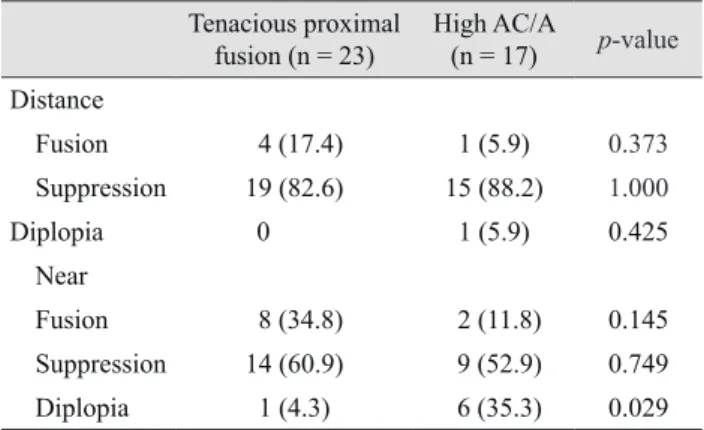
Worth’s 4-dot tests at distance showed no significant dif- ferences in the proportion of patients with fusion, suppres- sion, and diplopia responses between the groups (Table 2).
At near, the proportion of patients with diplopia was sig- nificantly higher in the high AC/A group than in the TPF group (p = 0.029). The proportions of patients with fusion and suppression were higher in the TPF group, but these differences were not statistically significant.
There were no significant differences in angle of devia- tion preoperatively or at 12 months postoperatively be- tween patients with and without diplopia responses at near on the Worth 4-dot test in both groups (TPF group, p = 0.147 and 0.129; high AC/A group, p = 0.239 and 0.210). In addition, there was no significant relationship between sur- gical success rate and diplopia response at near on the Worth 4-dot test in both groups (TPF group, p = 0.261;
high AC/A group, p = 0.600).
Mean preoperative deviation angles of patients with TPF type and high AC/A type intermittent exotropia were 28.3
± 4.4 and 28.8±4.5 PD, respectively, at distance (p = 0.787) and 14.7 ± 4.2 and 15.1 ± 4.1 PD at near before monocular occlusion tests or before +3.00 D spherical lens tests (p = 0.829). Differences of distance-near deviation angle were 13.6 ± 3.2 and 13.6 ± 3.4 PD in the TPF and high AC/A groups, respectively (p = 0.808) (Table 3). Mean preopera- tive deviation angle at near was 30.6 ± 6.1 PD after monoc- ular occlusion tests in the TPF group and 32.9 ± 4.0 PD after
+3.00 D spherical lens tests in the high AC/A group (p = 0.173). At 12 months after surgery, the mean deviation an- gles in the TPF and high AC/A groups were 2.9 ± 9.8 and 1.2 ± 9.6 PD, respectively, at distance (p = 0.680) and 1.7 ± 7.7 and -1.3 ± 11.3 PD at near (p = 0.705).
Surgical success after 12 months was observed in 17 (74.0%) of 23 patients with TPF and 11 (64.7%) of 17 pa- tients with high AC/A intermittent exotropia (p = 0.728) (Table 4). Five patients in the TPF group and 2 in the high AC/A group experienced recurrence (p = 0.677), with 1 and 4, respectively, experiencing consecutive esotropia (p = 0.144). Of the patients who experienced recurrence, 4 in the TPF group and 1 in the high AC/A group changed to basic type intermittent exotropia, and the rest were unchanged.
Table 1. Basic characteristics of patients with intermittent exotropia Tenacious proximal fusion
(n = 23) High AC/A
(n = 17) p-value
Age (yr) 7.5 ± 1.9 (4–11) 6.2 ± 1.0 (5–9) 0.027*
Sex (male : female) 11 : 12 6 : 11 0.525
BCVA of right eye (decimal) 1.0 ± 0.1 1.0 ± 0.0 0.685
BCVA of left eye (decimal) 1.0 ± 0.1 1.0 ± 0.0 0.914
Follow-up (mon) 30.0 ± 13.0 (12–63) 30.8 ± 14.6 (12–68) 0.871
Titmus (sec arc) 85.2 ± 71.6 (40–400) 70.6 ± 41.2 (40–200) 0.342
≤100 22 16
1.000
>100 1 1
Values are presented as mean ± standard deviation (range), number, or mean ± standard deviation.
AC/A = accommodative convergence/accommodation ratio; BCVA = best-corrected visual acuity.
*Statistically significant value.
Table 2. Patient responses on the Worth 4-dot test at distance and at near
Tenacious proximal
fusion (n = 23) High AC/A
(n = 17) p-value Distance
Fusion 4 (17.4) 1 (5.9) 0.373
Suppression 19 (82.6) 15 (88.2) 1.000
Diplopia 0 1 (5.9) 0.425
Near
Fusion 8 (34.8) 2 (11.8) 0.145
Suppression 14 (60.9) 9 (52.9) 0.749
Diplopia 1 (4.3) 6 (35.3) 0.029
Values are presented as number (%).
AC/A = accommodative convergence/accommodation ratio.
Discussion
Pseudodivergence excess has been subclassified into TPF and high AC/A ratio types [1]. A smaller near deviation an- gle may be due to greater fusional stimulus to near target or to accommodative convergence by a larger and brighter image on the retina, which results from a closer target [8].
Prolonged monocular occlusion and use of plus spherical lenses at near have been found to affect different conver- gence mechanisms [9], with monocular occlusion suspend-
ing fusional convergence (TPF type) and plus spherical lenses relaxing accommodative convergence (high AC/A ratio type). A comparison of binocular function in patients with basic and pseudodivergence excess types of intermit- tent exotropia found that all patients with pseudodiver- gence excess type showed fusion responses on Worth’s 4-dot tests at near [10].
In our study, the binocular function of patients with TPF and high AC/A types, as evaluated by Worth’s 4-dot test, did not differ at distance. However, the proportion of pa- tients with diplopia at near was significantly higher in pa- tients with high AC/A type than in those with TPF type in- termittent exotropia. Only objects that formed in the fovea of the fixating eye form on non-corresponding retinal points at a small deviation angle. Peripheral objects form on the corresponding retinal points and are located in Pa- num’s fusional area. Thus, peripheral fusion can exist even in the absence of central fusion, and interruption in this peripheral fusion may result in a diplopia response.
Light is a poor accommodative target because fine detail is not required and accommodation is not necessary to see Table 3. Preoperative and postoperative mean angles of deviation in patients with tenacious proximal fusion or high AC/A inter- mittent exotropia
Tenacious proximal fusion
(n = 23) High AC/A
(n = 17) p-value
Preoperative (PD)
Distance 28.3 ± 4.4 (20 to 35) 28.8 ± 4.5 (20 to 40) 0.787
Near* 14.7 ± 4.2 (8 to 20) 15.1 ± 4.1 (6 to 25) 0.829
Distance-near 13.6 ± 3.2 (11 to 23) 13.6 ± 3.4 (11 to 25) 0.808
Near† 30.6 ± 6.1 (18 to 40) 32.9 ± 4.0 (25 to 40) 0.173
Postoperative (PD) 1 Day
Distance -5.1 ± 8.6 (-30 to 8) -6.4 ± 6.6 (-20 to 0) 0.470
Near -3.7 ± 7.8 (-30 to 12) -4.7 ± 5.9 (-16 to 2) 0.524
1 Month
Distance 0.8 ± 3.9 (-6 to 12) 0.2 ± 6.2 (-14 to 18) 0.459
Near -1.6 ± 4.3 (-14 to 4) -3.8 ± 5.8 (-16 to 2) 0.322
12 Months
Distance 2.9 ± 9.8 (-25 to 25) 1.2 ± 9.6 (-16 to 25) 0.680
Near 1.7 ± 7.7 (-18 to 25) -1.3 ± 11.3 (-30 to 12) 0.705
Values are presented as mean ± standard deviation (range); (+) values indicate exodeviation, and (-) values indicate esodeviation.
AC/A = accommodative convergence/accommodation ratio; PD = prism diopter.
*Near deviation angles before occlusion test in the patients with tenacious proximal fusion type and before +3.00 diopters lens test in the patients with high AC/A type; †Near deviation angles after occlusion test in the patients with tenacious proximal fusion type and after +3.00 diopters lens test in the patients with high AC/A type.
Table 4. Surgical outcomes after 12 months Tenacious proximal fusion
(n = 23)
AC/A High
(n = 17) p-value Surgical success 17 (74.0) 11 (64.7) 0.728 Surgical failure
Recurrent exotropia 5 (21.7) 2 (11.8) 0.677 Consecutive esotropia 1 (4.3) 4 (23.5) 0.144 Values are presented as number (%).
AC/A = accommodative convergence/accommodation ratio.
the light [11]. In this study, a high rate of diplopia was thought to be caused by an increase in near deviation angle resulting from reduction in accommodative convergence when measuring binocular function at near while looking at the light from the Worth's 4-dot tests in the high AC/A group. Therefore, additional studies to better understand this hypothesis are needed.
Postoperative measurements of mean deviation angle over time showed that distance had a larger value in the di- rection of exodeviation than near in both TPF and high AC/A intermittent exotropia. In both types, however, the distance deviation angle was larger than the near deviation angle in the direction of esodeviation at 1 day. This could be attrib- utable to temporary reductions in fusional and accommo- dative convergence immediately after surgery.
Unilateral medial rectus resection and lateral rectus re- cession have been recommended for patients with pseudo- divergence excess type of intermittent exotropia [2,12].
However, bilateral lateral rectus recession was also found to be effective in treating pseudodivergence excess type exotropia by correcting both the near and distance devia- tion angles [13]. Surgical success rates have been reported to be similar in patients who undergo unilateral medial rec- tus resection and lateral rectus recession or bilateral lateral rectus recession for pseudodivergence excess type exotrop- ia [14]. In our study, as previously reported, the mean near deviation angle in patients with high AC/A type intermit- tent exotropia showed esotropia after 12 months; however, this esotropia was not meaningful compared with that in the TPF type. Although there were no significant differ- ences in surgical success rate or incidence of consecutive esotropia between patients with TPF or high AC/A type, the success rate of the high AC/A type was 10% lower than that of the TFT type, and the high AC/A type was more likely to develop consecutive esotropia than the TFT type.
Limitations of this study include small sample of the pa- tients and its retrospective design. Furthermore, only Worth’s 4-dot test was performed preoperatively to evalu- ate binocular function.
In conclusion, the rate of diplopia response on Worth’s 4-dot tests at near was higher for patients with high AC/A type than those with TPF intermittent exotropia. However, there was no significant difference in surgical success rate following bilateral lateral rectus recession or in the inci- dence of consecutive esotropia.
Conflict of Interest
No potential conflict of interest relevant to this article was reported.
References
1. Kushner BJ, Morton GV. Distance/near differences in inter- mittent exotropia. Arch Ophthalmol 1998;116:478-86.
2. Burian HM. Exodeviations: their classification, diagnosis and treatment. Am J Ophthalmol 1966;62:1161-6.
3. Brown H. Exodeviations: their classification, diagnosis, and treatment. In: Haik GM, editor. Strabismus Symposium of the New Orleans Academy of Ophthalmology. St Louis: CV Mosby; 1962. p. 238.
4. Brown HW. Accommodative convergence in exodeviation.
Int Ophthalmol Clin 1971;11:39-45.
5. Edelman PM, Brown MH, Murphree AL, Wright KW. Con- secutive esodeviation, then what?. Am Orthopt J 1988;38:111- 6.
6. Raab EL, Parks MM. Recession of the lateral recti: ear- ly and late postoperative alignments. Arch Ophthalmol 1969;82:203-8.
7. Scheiman M, Wick B. Clinical management of binocular vision. Philadelphia: Lippincott Williams & Wilkins; 2008, p. 282-317.
8. Scobee RG. The oculorotary muscles. 2nd ed. St Louis: Mos- by-Year Book; 1952. p. 85-90.
9. Helveston EM. The use and abuse of +3.00 D lenses. J Pedi- atr Ophthalmol Strabismus 1974;11:175-6.
10. Lee SY, Kim HY, Lee YC. The comparison of binocu- lar function of basic and simulated divergence excess type in intermittent exotropia. J Korean Ophthalmol Soc 2005;46:682-7.
11. Wright KW, Strube YN. Pediatric ophthalmology and stra- bismus. 3rd ed. New York: Oxford University Press; 2012.
p. 265-80.
12. Burian HM, Spivey BE. The surgical management of exo- deviations. Trans Am Ophthalmol Soc 1964;62:276-306.
13. Kushner BJ. Exotropic deviations: a functional classifica- tion and approach to treatment. Am Orthoptic J 1988;38:81- 93.
14. Lee SY, Sim JH, Lee YC. Comparison of surgical results ac- cording to surgical methods in simulated divergence excess exotropia. J Korean Ophthalmol Soc 2004;45:614-9.