ISSN 0378-6471 (Print)⋅ISSN 2092-9374 (Online)
https://doi.org/10.3341/jkos.2018.59.1.60
Original Article
눈모음부족형외사시에서 보정한 양안 외직근후전술과 증량한 단안 외직근후전술 및 내직근절제술의 수술 결과 비교
Comparison between Modified Bilateral Lateral Rectus Recession and Augmented Unilateral Recession-resection for Convergence Insufficiency Exotropia
김민환⋅송석현⋅염혜리
Min Hwan Kim, MD, Seok Hyeon Song, MD, Hae Ri Yum, MD
건양대학교 의과대학 안과학교실
Department of Ophthalmology, Konyang University College of Medicine, Daejeon, Korea
Purpose: To compare the surgical outcomes between modified bilateral lateral rectus muscle (BLR) recession and augmented unilateral recession-resection (R&R) for the convergence insufficiency intermittent exotropia (IXT).
Methods: 37 patients with convergence insufficiency IXT were divided into two groups: 13 patients (underwent BLR recession) and 24 patients (underwent unilateral R&R). Success was defined as within 10 prism diopters (PD) at distance and near, and within 10 PD of the difference between them at postoperative 12 months.
Results: After the patch test, the preoperative distance deviation angle in the BLR group was 29.9 ± 8.4 PD, and the near deviation angle was 42.3 ± 9.7 PD; the difference between them was 12.5 ± 3.2 PD. In the R&R group, the preoperative distance deviation angle was 26.7 ± 5.8 PD, and the near deviation angle was 41.5 ± 7.4 PD; the difference between them was 14.8 ± 4.3 PD (p = 0.235, p = 0.987, and p = 0.123). At the 12-month follow-up in the BLR group, the distance angle was 3.8 ± 5.1 PD, and the near deviation angle was 4.9 ± 6.1 PD; the difference between them was 2.9 ± 5.9 PD. In the R&R group, the postoperative distance deviation angle was 4.7 ± 6.1 PD, and the near deviation angle was 7.9 ± 6.6 PD; the difference between them was 3.65 ± 5.1 PD (p = 0.708, p = 0.162, and p = 0.632, respectively). The surgical success rate did not differ significantly between groups at 12 months postoperatively (76.9%: BLR group and 70.8%: R&R group; p = 0.690).
Conclusions: Modified BLR recession showed a similar surgical success rate to augmented unilateral R&R, and was effective in reducing both distance and near exodeviation, and in decreasing the difference between distance and near deviation in con- vergence insufficiency IXT.
J Korean Ophthalmol Soc 2018;59(1):60-66
Keywords: Bilateral lateral rectus recession, Convergence insufficiency type, Intermittent exotropia, Recession and resection, Surgical outcome
■Received: 2017. 7. 6. ■ Revised: 2017. 10. 17.
■Accepted: 2017. 12. 13.
■Address reprint requests to Hae Ri Yum, MD
Department of Ophthalmology, Konyang University Hospital,
#158 Gwanjeodong-ro Seo-gu, Daejeon 35365, Korea Tel: 82-42-600-9258, Fax: 82-42-600-9251
E-mail: [email protected]
*Conflicts of Interest: The authors have no conflicts to disclose.
ⓒ2018 The Korean Ophthalmological Society
This is an Open Access article distributed under the terms of the Creative Commons Attribution Non-Commercial License (http://creativecommons.org/licenses/by-nc/3.0/) which permits unrestricted non-commercial use, distribution, and reproduction in any medium, provided the original work is properly cited.
간헐외사시는 일반적으로 기본형, 눈모음부족형, 눈벌 림과다형과 거짓눈벌림과다형의 네 가지 형으로 분류되 며 눈모음부족형은 근거리 사시각이 원거리 사시각보다 10프리즘디옵터(prism diopter, PD) 이상 큰 경우로 정의 한다.1 눈모음부족형 외사시 환자는 근거리에서의 눈모음 부족으로 간헐적 복시, 눈 피로, 두통, 흐려 보임, 집중력 저 하, 독서 장애 등을 호소한다.2 Flip lens training, Push-up
training과 같은 시각교정치료나 근거리 작업 시 프리즘 안경 착용과 같은 비수술적 치료를 하기도 하나 외사시 각도가 크거나 눈모음 능력의 부족으로 인한 증상이 지속 되는 환자에서는 수술적 치료가 필요하다.3-6 기본적인 수 술 방법으로는 양안 내직근절제술, 단안 내직근절제술과 외직근후전술, 양안 외직근후전술이 있으나 수술 성공률 이 18-67%에 불과하고 근거리에서 부족교정, 원거리에서 과교정의 가능성이 높다.7-12 눈모음부족형외사시의 수술 성공률은 대상 환자의 불충분한 융합 이향운동 능력, 낮은 조절눈모음비, 조절 능력의 감소로 인해 다른 형태의 외사 시에 비해 낮다고 보고되고 있다.8,13,14 따라서, 수술 성공 률을 높이기 위하여 다양한 수술 방법이 시도되고 있는데 Kraft et al13은 내직근 절제를 외직근 후전 정도에 비하여 더 많이 시행하는 강화된 단안 외직근후전술 및 내직근절 제술이 근거리 사시각 교정 및 근-원거리 사시각 차이를 줄였으나 수술 후 과교정과 외전장애의 가능성이 있다고 하였고, Chun and Kang15은 근경사부착술을 이용한 외직 근후전술이 수술 후 과교정의 위험성이 적으면서 근거리 및 원거리 사시각 교정 및 근-원거리 사시각 차이를 줄이 는 데 효과적이었으나, 경과관찰 기간이 6개월로 짧은 한 계점이 있었다. Yang and Hwang16은 단안 내직근절제술 과 외직근후전술이 근거리 사시각 기준으로 1.0 mm 증량 한 양안 외직근후전술에 비해 성공률이 유의하게 높았다 고 하였다.
본 저자들은 수술 전 모든 외사시 환자에서 한 눈 가림 후 근거리와 원거리 사시각이 증가하는 것에 착안하여 눈 모음부족형 간헐외사시 환자의 수술 시 외직근후전량을 보정하였다. 한 눈 가림은 양안을 해리시켜 가림 전 양안 시를 유지하기 위해 지속되었던 융합자극을 차단시키고, 눈모음운동(convergence)를 배제함으로써 사시각의 증가 를 가져온다. 1988년 Kushner14가 tenacious distance fusion 로 이 현상을 설명하였고, 1993년에 Cooper17는 vergence aftereffect at distance (VA-D)라는 용어로 단안차폐 후 사 시각의 증가를 설명하였다.
본 연구는 눈모음부족형 간헐외사시에서 한 눈 가림 전 의 근거리 사시각과 한 눈 가림 후 원거리와 근거리 사시 각의 평균으로 보정한 수술량을 기준으로 한 양안 외직근 후전술과 강화된 단안 외직근후전술 및 내직근절제술의 수술 전후의 원거리 및 근거리 사시각과 그 차이에 대한 수술 효과를 알아보고자 하였다.
대상과 방법
2015년 5월부터 2016년 2월 사이에 눈모음부족형 간헐
외사시로 진단 받고 수술을 시행 받은 환자 중 12개월 이 상 추적관찰이 가능하였던 37명을 대상으로 의무기록을 후향적으로 분석하였다. 눈모음부족형외사시의 기준은 1 개월 이상의 간격을 두고 3회 이상 측정한 사시각이 모두 근거리에서 원거리보다 10PD 이상 큰 경우로 정하였다.
대상 환자 중 수술 시 연령이 만 4세 미만이거나 영아외사 시, AV증후군, 마비성 혹은 제한성 사시, 외측불일치, 사 근이상, 이전에 사시 수술을 받은 과거력이 있는 경우, 심 한 약시, 신경학적 이상, 염색체 질환 또는 전신적 질환을 동반한 경우는 제외하였다. 시력은 굴절이상을 교정 후 최 대교정시력을 측정하였다. 사시각은 33 cm 근거리와 6 m 원거리의 주시시표를 이용하여 교대프리즘가림검사를 통 해 측정하였다. 사시각과 입체시 검사 후 융합자극을 차단 하고 눈모음운동을 억제한 잠재된 사시각을 알아보기 위 해 비우세안을 1시간 한 눈 가림 후 교대가림검사를 통해 사시각을 다시 측정하였다. 가림 안대를 떼고 다시 사시각 을 측정할 때 양안이 동시에 보지 못하게 가리지 않은 눈 을 가리개로 가린 상태에서 안대를 떼었다. 입체시 검사는 굴절이상을 교정한 뒤 1명의 숙련된 검사자에 의해 측정 되었다. 티트무스 원(Stereo Optical Co. Inc., Chicago, IL, USA)을 이용하여 40 cm 거리에서 편광안경을 착용하게 하여 검사용 책자와 피검자의 시축이 수직을 이루도록 하 여 측정하였다. 티트무스 원의 시차는 800, 400, 200, 140, 100, 80, 60, 50, 40 seconds of arc (seconds)였다. 입체시 의 판정은 원의 위치를 계속해서 두 번 틀린 경우에 그전 것을 피검자의 입체시로 하였고, 입체시가 낮은 경우는 통 계학적 처리를 위해 3,000 seconds로 하였다.
모든 환자의 수술은 전신마취를 시행한 후 동일한 술자 에 의해 시행하였다. 보정한 양안 외직근후전술을 시행 받 은 환자를 BLR 군으로 하였고 가림 전 근거리 사시각을 사시각 1로 정하고, 한 눈 가림 후 원거리 사시각과 근거 리 사시각의 평균을 사시각 2로 정하여, 사시각 1과 사시 각 2의 평균값을 계산하여 이를 토대로 양안 외직근후전 술을 시행하였다. 강화된 단안 외직근후전술 및 내직근절 제술을 시행 받은 환자를 R&R 군으로 하였고, 가림 후의 최대 원거리 사시각 기준으로 외직근의 후전량을, 가림 후 최대 근거리 사시각을 기준으로 내직근의 절제량을 정하 여 강화된 단안 외직근후전술 및 내직근절제술을 시행하 였다. 두 군 모두에서 근육의 후전 및 절제량은 Parks의 수술량에 맞춰 결정하였다. 술 후 1주, 1개월, 3개월, 6개 월, 12개월째 원거리 및 근거리의 사시각과 그 차이를 측 정하여 비교하였다. 수술 성공은 술 후 12개월째 측정한 근거리와 원거리 사시각이 10PD 이내이며 근-원거리 사 시각 차이도 10PD 이내인 경우로 정하였다. 재발은 술 후
Table 1. Demographic characteristics and clinical features of the patients
Characteristics Group BLR
(n = 13)
Group R&R
(n = 24) p-value
Age (years) (range) 9.4 ± 2.7 (5-14) 10.0 ± 4.3 (6-22) 0.937*
Gender (male:female) 10:3 11:13 0.124†
Preop. BCVA (logMAR)
OD 0.01 ± 0.02 0.02 ± 0.08 0.814*
OS 0.01 ± 0.02 0.01 ± 0.08 0.888*
Preop. stereopsis (sec of arc) (range) 138.46 ± 90.72 (60-400) 139.58 ± 169.10 (50-800) 0.116* Postop. stereopsis (sec of arc) (range) 105.71 ± 42.76 (50-80) 63.33 ± 13.66 (80-200) 0.008*
Follow-up (months) 13.23 ± 2.80 13.21 ± 2.18 0.814*
Values are presented as mean ± SD unless otherwise indicated.
BLR = bilateral lateral rectus muscle; R&R = unilateral recession-resection; Preop. = preoperative; BCVA = best corrected visual acuity;
OD = oculus dexter; OS = oculus sinister; Postop. = postoperative.
*Mann-Whitney U-test: p-value < 0.05; †Chi-squared test.
Table 2. Mean preoperative angles of exodeviation
Group BLR (n = 13)
Group R&R
(n = 24) p-value1
Before occlusion (PD)
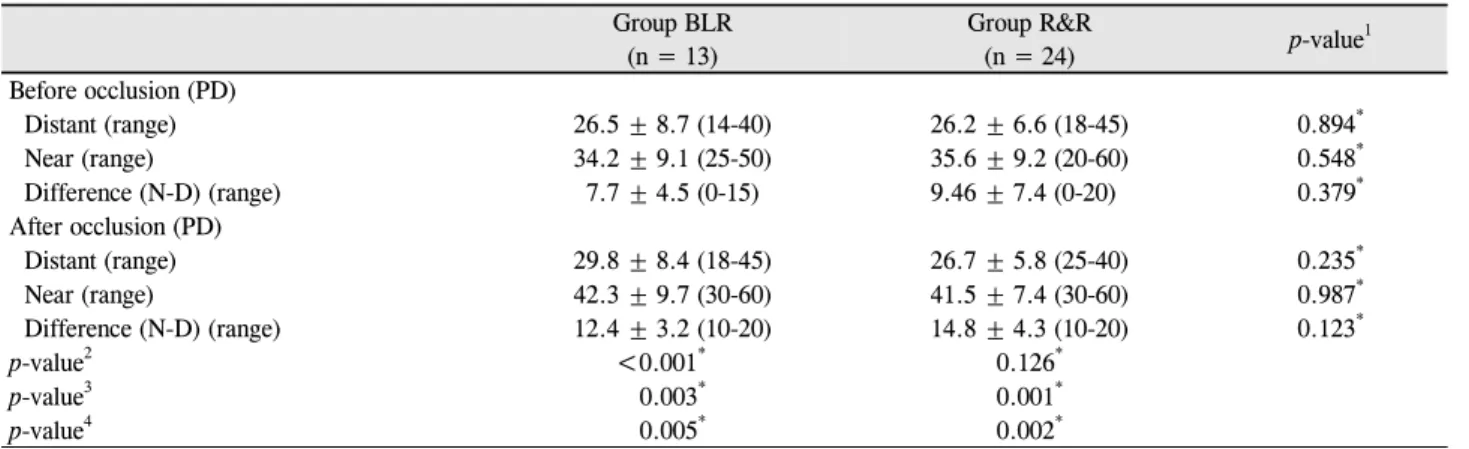
Distant (range) 26.5 ± 8.7 (14-40) 26.2 ± 6.6 (18-45) 0.894*
Near (range) 34.2 ± 9.1 (25-50) 35.6 ± 9.2 (20-60) 0.548*
Difference (N-D) (range) 7.7 ± 4.5 (0-15) 9.46 ± 7.4 (0-20) 0.379*
After occlusion (PD)
Distant (range) 29.8 ± 8.4 (18-45) 26.7 ± 5.8 (25-40) 0.235*
Near (range) 42.3 ± 9.7 (30-60) 41.5 ± 7.4 (30-60) 0.987*
Difference (N-D) (range) 12.4 ± 3.2 (10-20) 14.8 ± 4.3 (10-20) 0.123*
p-value2 <0.001* 0.126*
p-value3 0.003* 0.001*
p-value4 0.005* 0.002*
Values are presented as mean ± SD (range) unless otherwise indicated.
‘p-value1’ means ‘comparison between group BLR and R&R’, ‘p-value2’ means ‘comparison of distant deviation between before and after oc- clusion’, ‘p-value3’ means ‘comparison of near deviation between before and after occlusion’, and ‘p-value4’ means ‘comparison of difference (N-D) between before and after occlusion’.
BLR = bilateral lateral rectus muscle; R&R = unilateral recession-resection;PD = prism diopter; N = near angle; D = distance angle.
*Mann-Whitney U-test: p-value < 0.05.
12개월째 측정한 근거리 또는 원거리 사시각이 10PD 이 상 외편위를 보이는 경우로 정하였다.
본 연구는 헬싱키 선언을 준수하였고 윤리위원회의 승 인을 받아(2017-04-024) 진행하였다. 통계분석은 SPSS for Windows software version 18.0 (IBM Corp., Armonk, NY, USA)을 이용하여 chi-square test, Mann Whitney U-test, Wilcoxon signed rank test, Fisher’s Exact test를 이 용하였으며, p-value가 0.05 미만인 경우를 통계적으로 유 의하다고 판단하였다.
결 과
총 37명의 환자 중 BLR 군 13명, R&R 군 24명이었다.
두 군에서 수술 시 나이, 성별, 술 전 최대교정시력, 술 전 평균 입체시, 추적 경과관찰 기간은 통계적으로 유의한 차
이를 보이지 않았다(Table 1). 두 군 간의 가림 전과 후의 사시각은 통계적으로 유의한 차이를 보이지 않았다(Table 2). 하지만 BLR 군에서 눈가림 검사 전후에 평균 원거리 사시각, 근거리 사시각, 근-원거리 사시각 차이 모두 통계학 적으로 유의한 차이가 있었고(p<0.001, p=0.003, p=0.005, respectively), R&R 군은 근거리 사시각(p=0.001)과 근-원거 리 사시각 차이(p=0.002)는 통계학적으로 유의한 차이가 있었으나 원거리 사시각은 유의한 차이를 보이지 않았다 (p=0.126) (Table 2).
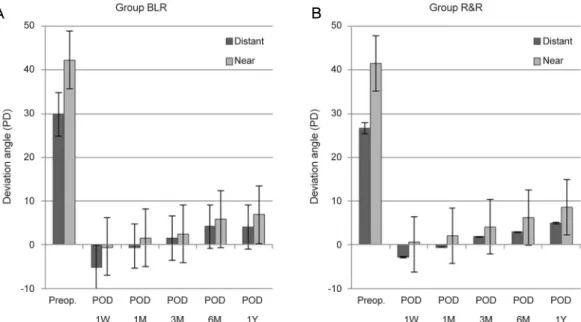
수술 후 12개월째 BLR 군에서 원거리 사시각이 3.8 ± 5.1PD, 근거리 사시각이 4.9 ± 6.1PD로 감소하였고, R&R 군에서 원거리 사시각이 4.7 ± 6.1PD, 근거리 사시각이 7.9 ± 6.6PD로 감소하였으며, 두 군 간의 유의한 차이는 없었다(p=0.708, p=0.162, respectively) (Fig. 1). 평균 근- 원거리 사시각 차이는 수술 후 12개월째 측정 시 BLR 군
A B
Figure 1. Mean preoperative and postoperative distant and near deviation angles according to the follow-up times. (A) At the 1-year fol-
low-up in the bilateral lateral rectus muscle (BLR) group, the mean distance angle was 3.8 ± 5.1 PD, and the near deviation angle was 4.9 ± 6.1 PD; the difference between them was 2.9 ± 5.9 PD. (B) At the 1-year follow-up in the unilateral recession-resection (R&R) group, the mean distance angle was 4.7 ± 6.1 PD, and the near deviation angle was 7.9 ± 6.6 PD; the difference between them was 3.7 ± 5.1 PD. PD = prism diopter; Preop. = preoperative; POD = postoperative day; W = week; M = month(s); Y = year.Figure 2. Changes of mean difference between distance and
near angles in two groups according to the follow-up times.The difference between distance and near angles in two groups showed no significant difference at 1 year postoperatively.
BLR = bilateral lateral rectus muscle; R&R = unilateral re- cession-resection; PD = prism diopter; Preop. = preoperative;
POD = postoperative day; W = week; M = month(s); Y = year.
에서 2.9 ± 5.9PD, R&R 군에서 3.7 ± 5.1PD로 통계적으 로 유의한 차이는 보이지 않았다(p=0.632) (Fig. 2).
두 군에서 수술 후 입체시는 BLR 군 7명, R&R 군 6명 에서 측정하였고 각각 105.71 ± 42.76 arc seconds, 63.33
± 13.66 arc seconds로 수술 후에 비해 평균적으로 향상되 었으나 측정한 환자 수가 적어 통계적으로 의미있게 분석 할 수 없었다.
수술 후 1주일에 BLR 군 13명 중 10명(76.9%), R&R
군 24명 중 13명(54.2%)에서 원거리와 근거리, 또는 원거 리에서만 내사시가 관찰되었고, 이에 의한 복시가 발생하 였다. BLR군 10명 중 6명은 수술 후 2주일, 3명은 수술 후 6주일, 1명은 수술 후 4개월에 내사시 및 복시가 소실 되었다. 이에 반하여 R&R 군에서는 13명 중 5명은 수술 후 2주일, 4명은 수술 후 6주일, 2명은 수술 후 10주일, 1 명은 수술 후 4개월에 내사시 및 복시가 소실되었다. 나머 지 1명(4%)은 수술 후 12개월째까지 원거리에서 4PD의 내사시를 보였으나 복시가 없어 경과관찰 중이다.
수술 후 1년이 경과하였을 때 수술 성공 기준인 원거리 및 근거리에서 사시각이 10PD 이내이면서 근-원거리 사 시각 차이가 10PD 이내인 경우는 BLR 군에서 10명 (76.9%), R&R 군에서 17명(70.6%)으로 BLR 군이 더 높 았으나 두 군 간 통계적으로 유의한 차이를 보이지 않았 다(p=0.690).
재발률은 BLR 군에서 3명(23.1%), R&R 군에서 7명 (29.2%)으로 두 군 간에 통계적으로 유의한 차이를 보이 지 않았다. 수술 전 근-원거리 사시각 차이에 따라 수술 성공률을 비교하였을 경우에도 통계적으로 유의한 차이 는 보이지 않았다(Table 3). 하지만 수술 직후 10PD 전후 의 내사시를 보인 BLR 군 8명 중 7명(87.5%)에서, 정위 혹은 약간의 외사위를 보인 5명 중 3명(60%)에서 수술 후 12개월 시 성공 기준에 부합하였고, 수술 직후 10PD 전후 의 내사시를 보인 R&R 군 13명 중 10명(76.9%)에서, 정
Table 3. Postoperative surgical outcomes
Characteristics Group BLR
(n = 13)
Group R&R
(n = 24) p-value
POD 12 months
Success 10 (76.9) 17 (70.8) 0.690†
Recurrence 3 (23.1) 7 (29.2)
Preoperative N-D (Success)
10-15 PD 7 (87.5) 8 (88.9) 0.471*
16-19 PD 2 (50.0) 3 (42.8) 0.061*
≥20 PD 1 (100.0) 6 (75.0) 0.083*
Values are presented as n (%) unless otherwise indicated.
BLR = bilateral lateral rectus muscle; R&R = unilateral recession-resection;POD = postoperative day; PD = prism diopter; N = near angle;
D = distance angle.
*Fisher’s Exact test: p-value < 0.05; †Chi-squared test.
위 혹은 약간의 외사위를 보인 11명 중 7명(63.6%)에서 수술 후 12개월 시 성공 기준에 부합하여 각 군에서 수술 직후 10PD 전후의 내사시를 보인 경우에 수술 성공률이 정위 혹은 약간의 외사위를 보인 경우에 비해 수술 후 12 개월 경과 시 통계적으로 유의하게 수술 성공률이 높았다 (p=0.038, p=0.044, respectively).
고 찰
눈모음부족형 간헐외사시는 근거리 사시각이 원거리 사시각보다 10PD 이상 큰 경우로 정의하며 외사시 중에 서도 빈도는 1.2-7.8%로 보고되고 있다.18 시각교정치료를 하거나 근거리 작업 시 프리즘 안경 착용 등의 비수술적 치료로 증상을 경감시킬 수는 있으나 효과가 없거나 외사 시가 심한 환자에서는 수술적 치료가 필요하며, 현재까지 단안 및 양안의 외직근후전술, 근경사후전술, 내직근절제 술, 근경사절제술 등의 다양한 수술적 방법이 시도되고 있 으나 결과는 만족스럽지 못하였다.3-12 Hermann9은 13명의 환자에서 양안 내직근절제술을 시행하여 평균 25개월 경 과관찰 하였을 때 54%에서 술 후 근거리 사시각이 10 PD 이상이었다고 하였고, Haldi19는 양안 내직근절제술을 시 행 후 50%에서 술 후 근거리 사시각이 10PD 이상이었다 고 하였다. Kushner20는 양안 내직근절제술을 시행하여 술 후 1년째 83%에서 근거리 저교정을 보였다고 하였다.
Raab and Parks10는 양안 외직근후전술을 시행 6개월 후 근 거리 외사시의 교정이 28%에 불과하다고 발표하였다.
이 밖에도 근거리 사시각에는 조절눈모음과 연관이 있 는 내직근이 주된 영향을 미치고, 원거리 사시각에는 외직 근이 주로 관여한다는 가설하에 근거리의 외사시 각에 따 라 단안의 내직근절제술을 시행하고, 원거리의 외사시 각 에 따른 외직근후전술을 시행하여 결과를 보고한 연구들 이 있었다.21 Choi et al22은 단안에 근거리 사시각을 기준
으로 내직근절제술, 원거리 사시각을 기준으로 외직근후전 술을 시행하여 평균 26.6개월 경과관찰 하였을 때 42.9%의 수술 성공률을 보이고 근-원거리 사시각 차이를 11.3PD에 서 4.6PD로 줄여 효과적인 수술 방법이라고 하였다. 하지 만 Kraft et al13은 내직근 절제를 외직근 후전 정도에 비하 여 더 많이 시행하는 강화된 단안 외직근후전술 및 내직 근절제술을 시행 후 최소 6개월 이상 경과관찰 하였을 때 근거리 사시각 교정 및 근-원거리 사시각 차이를 줄였으 나 43%에서 술 후 원거리에서 과교정이 나타났으며 18%
에서 속발내사시를 보였고 모든 환자에서 외전장애가 나 타났다고 하였다.
위와 같은 여러 수술 방법들에도 불구하고 보고에 따라 서 만족스럽지 못한 수술 성공률 혹은 속발 내사시의 높 은 발생률이 보고되어, 외직근의 하방 부착부를 근거리 사 시각에 맞추어 후전량을 늘리는 외직근후전술이 발표되 었다. Snir et al7은 눈모음부족형 외사시 환자에서 외직근 후전술 시 근경사부착술을 단안 7명 및 양안 5명에서 시 행하여 11명의 환자에서 술 후 12개월에 원거리 및 근거 리 사시각과 근거리와 원거리 사시각의 차이가 8PD 이내 였고 술 후 과교정, 회선사시, 복시 등의 합병증은 없었다 고 하였다. Chun and Kang15은 근경사부착술을 이용한 외 직근후전술이 수술 후 과교정의 위험성이 적으면서 근거 리 및 원거리 사시각 교정 및 근-원거리 사시각 차이를 줄 이는 데 효과적이라고 보고하였다. 하지만 사시 수술에서 수술 결과에 영향을 주는 요소는 후전술과 절제술 자체이 며, 근경사부착술의 여부가 수술 결과에 미치는 영향을 부 정하는 연구도 보고되고 있다.23
본 연구는 눈모음부족형 외사시의 수술성공률을 높이 기 위해 한 눈 가림 후의 사시각을 기준으로 수술량을 결 정하였다. 일정 시간 한 눈을 가림으로써 두 눈을 해리시 키고, 따라서 양안시를 유지하기 위해 지속되던 융합 자극 을 차단하며 눈모음운동을 배재함으로써 잠재된 사시각
을 증가시킨다. Burian and Franceschetti24는 눈벌림과다 형 외사시에서 한 눈 가림 후 60%의 환자에서 근거리 사 시각이 증가하였다고 보고하였으며, Kushner14는 기본형 간헐외사시에서 한 눈 가림 후 13%의 환자에서 원거리 사시각이 증가하였다고 보고하였다. Kim et al25은 한 눈 가림 후 원거리, 근거리 사시각이 모두 증가하였으며, 따 라서 간헐외사시 수술 시 반드시 한 눈 가림을 통한 정확 한 사시각 측정이 필요하다고 하였다.
따라서 본 연구에서는 눈모음부족형 간헐외사시 환자 에서 1시간 한 눈 가림을 시행하여 가림 후의 원거리 사시 각과 근거리 사시각의 평균을 계산하여 이 수치와 가림 전의 근거리 사시각을 비교하여 후전량을 정한 양안 외직 근후전술과 강화된 단안 외직근후전술 및 내직근절제술 을 비교하였다. 술 후 원거리와 근거리 사시각, 근-원거리 사시각 차이가 모두 10PD 이하인 경우는 BLR 군 13명 중 10명(76.9%), R&R 군 24명 중 17명(70.6%)으로 통계 적으로 의미 있는 차이는 없었지만 BLR 군의 수술성공률 이 더 높았다. 한편, 술 전 근-원거리 사시각 차이에 따른 수술 성공률의 영향을 최소화하기 위해 양군에서 근-원거 리 사시각 차이에 따른 수술 성공률을 비교하였을 때도 두 군에서 통계적으로 의미 있는 차이는 없었다.
외사시에서 술 후 초기의 과교정이 최종 수술 성공률과 연관성이 있다는 연구 결과들이 보고되었다.26-29 본 연구 에서도 BLR 군과 R&R 군에서 각각 수술 직후 10PD 전 후의 내사시를 보인 경우가 정위 혹은 약간의 외사위를 보 인 경우에 비해 수술 후 12개월 경과 시 수술 성공률이 통 계적으로 유의하게 높았다(p=0.038, p=0.044, respectively).
Keech and Stewart30는 양안 외직근후전술과 단안 외직 근후전술 및 내직근절제술 후 속발내사시의 발생빈도가 비슷하다고 하였다. Jang et al31과 Lee et al32은 간헐외사 시 첫 수술로 단안 외직근후전술과 내직근절제술을 시행 한 경우가 양안 외직근후전술이나 단안 외직근후전술을 시행한 경우보다 속발내사시가 잘 발생한다고 하였고, Kim and Choi33와 Park et al34은 양안 외직근후전술을 시 행한 경우가 단안 외직근후전술과 내직근절제술을 시행 한 경우보다 속발내사시의 발생빈도가 높다고 하였다. 본 연구를 통해 보정한 양을 기준으로 한 양안 외직근후전술 이 강화된 단안 외직근후전술 및 내직근절제술뿐만 아니 라 기존 연구들에 비하여도 복시 발생 및 지속 기간이 비 교적 짧은 것으로 나타났다. 따라서 본 연구를 통해 보정 한 양을 기준으로 한 양안 외직근후전술이 사시각 교정에 있어서 수술적 치료가 높은 효과와 안전성을 가진다고 볼 수 있다.
본 연구는 후향적 연구로 모집단의 총 수가 37명으로
적고, 경과관찰 기간이 평균 13개월로 추후 경과 관찰 시 수술의 성공률이 낮아질 가능성이 있으며, 많은 환자에서 수술 후의 최종 입체시를 측정하지 못했다는 제한점이 있 다. 결론적으로 눈모음부족형 간헐외사시 환자에서 본 연 구를 통해 보정한 사시각을 기준으로 한 양안 외직근후전 술은 강화된 단안 외직근후전술 및 내직근절제술과 유사 한 수술 성공률을 보였고, 수술 후 장기간 지속되는 내사 시의 위험성이 낮았으며, 원거리 및 근거리에서의 사시각 과 근-원거리 사시각의 차이를 감소시키는 데 효과적인 수술 방법으로 생각된다. 하지만 추후 장기간 경과 관찰 시 근-원거리 사시각 차이 및 수술 성공률의 변화에 대한 관찰이 필요할 것으로 생각된다.
REFERENCES
1) Burian HM. Exodeviations: their classification, diagnosis and treatment. Am J Ophthalmol 1966;62:1161-6.
2) Daum KM. Convergence insufficiency. Am J Optom Physiol Opt 1984;61:16-22.
3) Daum KM. Characteristics of convergence insufficiency. American J Optom Physiol Opt 1988;65:426-38.
4) Birnbaum MH, Soden R, Cohen AH. Efficacy of vision therapy for convergence insufficiency in an adult male population. J Am Optom Assoc 1999;70:225-32.
5) Choi DG, Rosenbaum AL. Medial rectus resection(s) with adjust- able suture for intermittent exotropia of the convergence in- sufficiency type. J AAPOS 2001;5:13-7.
6) Choi MY, Hwang JM. The long-term result of slanted medial rectus resection in exotropia of the convergence insufficiency typ. Eye (Lond) 2006;20:1279-83.
7) Snir M, Axer-Siegel R, Shalev B, et al. Slanted lateral rectus re- cession for exotropia with convergence weakness. Ophthalmology 1999;106:992-6.
8) von Noorden GK. Resection of both medial rectus muscles in organic convergence insufficiency. Am J Ophthalmol 1976;81:223-6.
9) Hermann JS. Surgical therapy for convergence insufficiency. J Pediatr Ophthalmol Strabismus 1981;18:28-31.
10) Raab EL, Parks MM. Recession of the lateral recti. Effect of pre- operative fusion and distance-near relationship. Arch Ophthalmol 1975;93:584-6.
11) Ohtsuki H, Hasebe S, Kono R, et al. Prism adaptation response is useful for predicting surgical outcome in selected types of inter- mittent exotropia. Am J Ophthalmol 2001;131:117-22.
12) Kushner BJ. Surgical pearls for the management of exotropia. Am Orthopt J 1992;42:65-71.
13) Kraft SP, Levin AV, Enzenauer RW. Unilateral surgery for exo- tropia with convergence weakness. J Pediatr Ophthalmol Strabis- mus 1995;32:183-7.
14) Kushner BJ. Exotropic deviations: a functional classification and approach to treatment. Am Orthopt J 1988;38:81-93.
15) Chun BY, Kang KM. Early results of slanted recession of the lateral rectus muscle for intermittent exotropia with convergence insufficiency. J Ophthalmol 2015;2015:380467.
16) Yang HK, Hwang JM. Surgical outcomes in convergence in-
= 국문초록 =
눈모음부족형외사시에서 보정한 양안 외직근후전술과 증량한 단안 외직근후전술 및 내직근절제술의 수술 결과 비교
목적: 눈모음부족형 간헐외사시에서 보정한 양안 외직근후전술과 증량한 단안 외직근후전술 및 내직근절제술의 수술 결과를 비교해 보고자 하였다.
대상과 방법: 눈모음부족형 간헐외사시로 진단 받고 수술을 시행한 환자 37명 중 보정한 양안 외직근후전술을 시행한 13명을 bilateral lateral rectus muscle (BLR) 군으로, 증량한 단안 외직근후전술 및 내직근절제술을 시행한 24명을 unilateral recession-resection (R&R) 군으로 하여 비교하였다. 수술 성공은 수술 후 12개월째 측정한 근거리와 원거리 사시각이 모두 10PD 이내이며 근-원거리 사시각 차이도 10PD 이내인 경우로 정하였다.
결과: 수술 전 평균 사시각은 눈가림검사 후 BLR 군 원거리 사시각 29.9 ± 8.4PD, 근거리 사시각 42.3 ± 9.7PD, 근-원거리 사시각 차이 12.5 ± 3.2PD, R&R 군 각각 26.7 ± 5.8PD, 41.5 ± 7.4PD, 14.8 ± 4.3PD로 두 군 간에 유의한 차이를 보이지 않았다(p=0.235, p=0.987, p=0.123). 수술 후 12개월째 경과관찰 시 BLR 군 원거리 사시각 3.8 ± 5.1PD, 근거리 사시각 4.9 ± 6.1PD, 근-원거리 사시각 차이 2.9 ± 5.9PD, R&R 군 각각 4.7 ± 6.1PD, 7.9 ± 6.6PD, 3.7 ± 5.1PD로 두 군 간에 유의한 차이를 보이지 않았다 (p=0.708, p=0.162, p=0.632). 수술 후 12개월째의 수술 성공률은 BLR 군 76.9%, R&R 군 70.8%로 두 군 간에 유의한 차이는 없었다 (p=0.690).
결론: 눈모음부족형 간헐외사시 환자에서 보정한 양안 외직근후전술은 증량 단안 외직근후전술 및 내직근절제술과 유사한 수술 성공 률을 보였으며, 원거리 및 근거리에서의 사시각과 근-원거리 사시각의 차이를 감소시키는 데 효과적인 수술 방법이다.
<대한안과학회지 2018;59(1):60-66>
sufficiency-type exotropia. Ophthalmology 2011;118:1512-7.
17) Cooper J. Major review: intermittent exotropia. Basic and di- vergence excess type. Binoc Vis Eye Muscle Surg Q 1993;8:185- 216.
18) Kushner BJ, Morton GV. Distant/near differences in intermittent exotropia. Arch Ophthalmol 1998;116:478-86.
19) Haldi BA. Surgical management of convergence insufficiency. Am Orthopt J 1978;28:106-9.
20) Kushner BJ. Selective surgery of intermittent exotropia based on distance/near differences. Arch Ophthalmol 1998;116:324-8.
21) Scott AB. Strabismus muscle forces and innervation. In:
Lenerstrand G, Bach-y-Rita P, eds. Basic Mechanism of Ocular Motility and Their Clinical Implications, Wenner-Gren Center International Symposium Series (Proceedings of the International Symposium held in Wenner-Gren Center, Stockholm, June 4-6, 1974), 1st ed. New York: Pergamon Press, 1975; 181-91.
22) Choi MY, Hyung SM, Hwang JM. Unilateral recession-resection in children with exotropia of the convergence insufficiency type.
Eye (Lond) 2017;21:344-7.
23) Kushner BJ. Insertion slanting strabismus surgical procedures.
Arch Ophthalmol 2011;129:1620-5.
24) Burian HM, Franceschetti AT. Evaluation of diagnostic methods for the classification of exodeviations. Trans Am Ophthalmol Soc 1970;68:56-71.
25) Kim SH, Kim SY, Kwon JY. Change of deviation angle after mon-
ocular occlusion in intermittent exotropia. J Korean Ophthalmol Soc 2005;46:1175-82.
26) Ruttum MS. Initial versus subsequent postoperative motor align- ment in intermittent exotropia. J AAPOS 1997;1:88-91.
27) Raab EL, Parks MM. Recession of lateral recti. Early and late post- operative alignments. Arch Ophthalmol 1969;82:203-8.
28) Ko KH, Min BM. Factors related to surgical results of intermittent exotropia. J Korean Ophthalmol Soc 1996;37:179-84.
29) Kim SJ. Comparison of surgical results between bilateral recession and unilateral recession-resection in intermittent exotropia. J Korean Ophthalmol Soc 1992;33:733-8.
30) Keech RV, Stewart SA. The surgical overcorrection of intermittent exotropia. J Pediatr Ophthalmol Strabismus 1990;27:218-20.
31) Jang JH, Park JM, Lee SJ. Factors predisposing to consecutive eso- tropia after surgery to correct intermittent exotropia. Graefes Arch Clin Exp Ophthalmol 2012;250:1485-90.
32) Lee EK, Yang HK, Hwang JM. Long-term outcome of prismatic correction in children with consecutive esotropia after bilateral lat- eral rectus recession. Br J Ophthalmol 2015;99:342-5.
33) Kim HJ, Choi DG. Consecutive esotropia after surgery for inter- mittent exotropia: the clinical course and factors associated with the onset. Br J Ophthalmol 2014;98:871-5.
34) Park HS, Kim JB, Seo MS, Park YG. A study on the consecutive eso- tropia after intermittent exotropia surgery. J Korean Ophthalmol Soc 1994;35:1327-34.