서 론
한국의 계절적 특성으로 볼 때, 장마기간이 보통 6~8 월 중순이며, 이 기간에 많은 비를 동반한 태풍이8월경 에 여러 차례 찾아오는 실정이다. 장마기간 중 집중호우 로 인한 연안해역의 급격한 저염분 현상은 많은 양식장 에서 이미 경험한 바 있고, 실제 양식생산에 있어 좋지 않은 결과를 초래할 수 있다. 또한 최근 중국 양쯔강에
서 담수유입으로 남서해안 및 제주해역 부근에서의 담 수화 현상은 많은 수산생물(넙치, 전복 및 소라)에 영향 을 주고있다. 한편 넙치(Paralichthys olivaceus) 양식에 서는 최근 연안해수 오염 및 적조 등으로 인하여 지하 해수를 이용한 양식이 활발해지고 있으나 저염분 지하 수가 용출되고 있어, 이를 응용하기 위한 기초적 연구는 아직까지 부족한 실정에 있다.
사육수의 염분 변화는 어체의 삼투압 변화를 유도하 고, 이때 어류는 변화에 대처하기 위하여, 항상성(home-
─
─ 77 ──
저염분에서 사육한 양식 넙치
(Paralichthys olivaceus)
의 생리적 반응,
생존율 및 성장허준욱∙장영진∙이복규*∙이정열**
부경대학교 양식학과, *동의대학교 생물학과, **군산대학교 해양생명과학부
Effects of Hypo-Salinity on Physiological Response, Survival and Growth of Cultured Olive Flounder
(Paralichthys olivaceus)
Jun Wook Hur, Young Jin Chang, Bok Kyu Lee* and Jeong Yeol Lee**
Department of Aquaculture, Pukyong National University, Busan 608-737, Korea
*Department of Biology, Dongeui University, Busan 614-714, Korea
**Department of Marine Aquaculture and Biotechnology, Kunsan National University, Gunsan 573-701, Korea
Effects of hypo-salinity on physiological response, survival and growth of cultured olive flounder (Paralichthys olivaceus) were investigated. Olive flounders (average weight = 52.2 g) of experimental and control groups were abruptly (within 30 min) exposed to salinities from 35‰
to 15‰ (experimental group) and to 35‰ (control group) in a flow through seawater culture system with 8 tanks (250 L/tank). Olive flounders were maintained in these salinities for 30 days. There were no differences in hematological characteristics, cortisol, glucose, Na±, Cl-and osmolality in the experimental and control groups (P¤0.05). Osmolality of the experimental group during 30 days showed hyper-osmoregulation. At the end of this experiment, survival of experimental and control groups were 88.3% and 96.7%, respectively. There was retardation in growth in the experimental group.
Key words : Olive flounder, Paralichthys olivaceus, hypo-salinity, osmoregulation, cortisol
양물질의 농도를 조절하려고 한다(Morgan, 1991). 경골 어류의 삼투압 조절은 아가미, 소화관 및 신장에서 이루 어진다(Laurent and Kunel, 1980; Maina, 1990). 이러한 기관의 작용에 의해 담수 경골어류의 경우, 수분은 저장 의 환경에서 고장의 어체내로 유입되고, 이온들은 고장 의 어체내에서 저장의 담수 환경으로 유출된다. 해수에 서식하는 경골어류에서는 담수 경골어류와는 반대현상 을 나타낸다. 즉, 담수에 서식하는 경골어류는 수분 평형 을 위해 물을 마시지 않고, 반대로 해수에 서식하는 어 류는 삼투압에 의한 고장의 환경으로 빼앗긴 체내의 물 을 보충하기 위하여 해수를 마신다(Kirsch et al., 1985).
물과 이온 등을 마신 해수어류는 1가 이온(Na±, Cl-, K±)을 소화관 벽에서 흡수하여 아가미에서 배출하고, 2 가 이온(Mg2±, Ca2±)은 소화관내에 축적되어 신장에서 배출된다(Kirsch and Meister, 1982).
삼투압 조절을 응용한 연구는 연어과 어류에서 생물 학적인 기초연구만 수행되었을 뿐, 담수순화 양식기술은 매우 취약한 단계에 있다. 그 연구 분야는 해수적응에 따 른 아가미 염류세포의 미세구조적 연구 및 혈장 호르몬 과 이온 등의 변화와 그것에 미치는 내분비학적 연구들 이 그 대부분을 차지한다(Richman et al., 1987; Madesen and Naamansen, 1989; Bakke et al., 1991; Thomas et al., 1991; Soengas et al., 1992; Foo et al., 1993; Mancera et al., 1993; Martine et al., 1993; Mcleese et al., 1994;
Williams and Wigham, 1994). 최근에 삼투압 조절 능력 을 응용한 기초 연구로는 숭어(Mugil cephalus)를 대상 으로 염분별 사육실험(Chang et al., 1996; Lee et al., 1997; Chang and Hur, 1999; Hur and Chang, 1999)이 이루어진 바 있으며, 광염성 어류인 감성돔(Acanthopa- grus schlegeli)을 이용하여 담수순화 양식이 시도 되고 있다(Chang et al., 2002).
넙치의 삼투압 조절에 관한 연구는 Hur et al. (2002) 이 염분 내성에 대하여 보고하였으나, 아직까지 저염분 변화에 따른 생리학적 반응, 성장 및 생존율에 대한 체 계적인 연구가 부족한 실정이다. 본 연구에서는 넙치를 사용하여 저염분(15‰ )과 완전 해수에서 장기 사육에 따른 생리학적 반응, 성장, 생존율 및 사료효율 등을 비 교∙조사하여, 최근 연안해수의 오염으로 지하 해수를 이용한 양식과, 여름철에는 홍수로 인한 저염분 현상에 따른 삼투압 조절과 관련된 생리학적 기초연구가 되고 자한다.
1. 실험어와 실험시설
실험어는 평균전장 17.6±1.1 cm, 평균체중 52.2±7.7 g인 넙치 치어를 사용하였으며, 경북 울진군 인근 육상 수조 양식장에서 사육중인 것을 구입하였다. 이들 실험 어는 대형 콘크리트 수조 2개(18 m3)에 수용하여 상업 용 터봇배합사료(수분10%, 조단백질 56%, 조지방 12%, 조섬유 1.7%, 회분 12%, 인 1.9%, 비타민A 10,000 IU/kg, 비타민 D3 1,750 IU/kg, 비타민 E 200 mg/kg, 비타민 C 250 mg/kg, Le Couessant, France)를 만복공급하면서 3 주간 안정시킨 다음, 실험에 사용하였다. 유수식 사육시 스템인 실험수조를 사용하였으며, 해수(35‰)는 모래여 과후 사용하였고, 담수(0‰)는 지하수를 사용하였다. 모 든 실험수조는 FRP 원형수조(250 L)로 수량은 180 L였 다. 실험수조의 1일 환수율은 수용적의 30배, 용존산소
량은 5 ppm 이상이 되도록 에어레이션하며 조절하였다.
실험어의 안정과 도피방지를 위하여 수조상부에 그물망 을 덮어 주었다.
2. 실험방법
예비사육 수조에서 사육하던 어류를 각각 30마리(6.0 kg/m3)씩 실험수조로 이동시켜 1주일간 안정시키며 사 육하였다. 실험직후 실험구는 해수와 담수를 조절하여 15.0±2.0‰ 해수로 사육수를 교환하였으며, 대조구는 사육수의 교환이 없이 그대로 해수를 공급하였다. 사육 수가 15‰ 해수로 전환된 시간은 30분 이내였다. 혈액 채취를 위하여 2반복 실험하였고, 생존율 및 성장을 위 하여 2반복 실험을 하였다. 실험 후 30일까지 유수식으 로 실험구와 대조구에 각각 담수와 해수를 흘려주면서 유지하였으며, 혈액채취 시각은 실험개시시(0), 실험 후 15 및 실험 후30일째에 실시하였다.
3. 혈액의 채취 및 분석
실험어의 혈액은 채혈시각에 맞추어 24시간 전부터 실험어를 절식시킨 다음 각 실험구에서 5마리씩 무작위 추출하여 20 IU/mL heparin sodium (Sterile Solution HEPARIN Inj., Choongwae Pharma Corporation, Hwa- Sung-Gun, Korea) 처리한 3 mL-23 G의 일회용 plastic syringe (Dong Shin Medical Instruments Co., KongJu- Si, Korea)로 마취없이 1분 이내에 미병부의 혈관에서 채혈하였다. 개체별로 채취한 혈액은 1.5 mL Microtube
(MCT-175-C, AXYGEN SCIENTIFIC INC., Union City, USA)에 분주하였다.
이 중 혈액성상 분석용 시료는 즉시 혈액분석기(Excell 500, USA)로 분석하였으며, 혈장분석용 시료는 실온에 서 20분간 방치한 다음, 5,600 g로 5분동안 원심분리 (Micro Haemtocrit Centrifuge, Hawksley and Sons Ltd., W-Sussex, UK)에 의해 혈장을 추출하여 -70�C의 초저 온냉동고(SW-UF-200, SAMWON Freezing Engineer- ing co., Busan, Korea)에 보관하였다. Cortisol 농도는 Coat-A-Count TKCO Cortisol RIA Kit (DPC, Los Angeles USA)로 항원∙항체반응을 유도한 다음, 1470 WIZARD Automatic Gamma Counter (EG and G Wallac, Turku, Finland)를 사용하여 radioimmunoassay (RIA)에 의해 측정하였다. Glucose, Na±, K±, Cl-, total protein, aspartate aminotransferase (AST) 및 alanine aminotransferase (ALT)는 Chemistry System (VITROS DT60 II, VITROS DTE II, DTSC II Chemistry System, Johnson and Johnson Clinical Diagnostics Inc., New York, USA)에 의해 분석하였다. 혈장의 삼투질 농도는 Na염의 함유량에 따라 동결점이 다른 것을 응용하여 Micro Osmometer (3MO Plus, Advanced Instruments Inc., Massachusetts, USA)로 측정하였다.
4. 생존율 및 성장 조사
생존율은 매일 폐사 개체수를 파악하여 폐사율을 구 하고, 이로부터 생존율을 역산하였다. 성장 및 사료효율 은 실험개시시, 실험 후 15 및 실험 후 30일째에 각각의 수조로부터 혈액을 채취 후, 20마리씩 무작위 추출하여 100 ppm MS-222 (Sigma, USA)로 마취 후 어체를 계측 하였다. 계측당일에는 사료를 공급하지 않았다. 어체의 전장은 1 mm 눈금의 계측판으로, 체중은 전자저울(AND FS-6K, Australia)로 1/100 g까지 계량하였다. 사료공급 량에 따른 실험어의 일간성장률(specific growth rate), 비만도(condition factor), 사료섭식량(feed intake), 일간 사료섭식률(specific feeding rate) 및 사료전환효율(feed conversion rate)은 다음 식에 의해 계산하였다.
�전장성장률= (종료시 평균전장)-(개시시 평균전장)× 100/개시시 평균전장
�체중성장률= (종료시 평균체중)-(개시시 평균체중)× 100/개시시 평균체중
�일간성장률= (종료시 평균체중-개시시 평균체중)× 100/(사육일수/100)
�비만도= (체중/전장3)×1000
�사료섭식량= (섭식된 사료의 건조중량×100)/(사육일
수×수용개체수)
�일간사료섭식률= (사료공급량×100)/(개시시 총체중± 종료시 총체중±폐사개체 총체중/2)×(사육일수)
�사료전환효율= (일간성장률×100)/일간사료섭식률
5. 통계처리
각 실험에서 얻어진 자료값 사이의 유의차 유무는 SPSS-통계 패키지(SPSS 9.0, SPSS Inc., Chicago, USA) 에 의한 ANOVA 및 Duncan’s multiple range test로 P=0.05 수준으로 검정하였다.
결 과
혈장의
cortisol과
glucose농도
혈장 cortisol 농도는 Fig. 1과 같이, 실험개시시 3.5±
Fig. 1. Variations of plasma cortisol and glucose of olive flounder due to rearing in 15‰ and seawater (35
‰). Same letters on the bars are not significantly different (P¤0.05).
mL, 30일째1.6±0.2 ng/mL로 차이가 없었다.
Glucose 농도는 실험개시시 22.5±4.9 mg/dL로부터 실험 후 15일째 실험구는 15.2±0.2 mg/dL, 30일째는 18.7±5.3 mg/dL으로 낮아졌으나 차이는 없었다. 대조구 도 15일째 15.8±1.2 mg/dL, 30일째 14.7±3.7 mg/dL로 낮아졌다.
혈장의
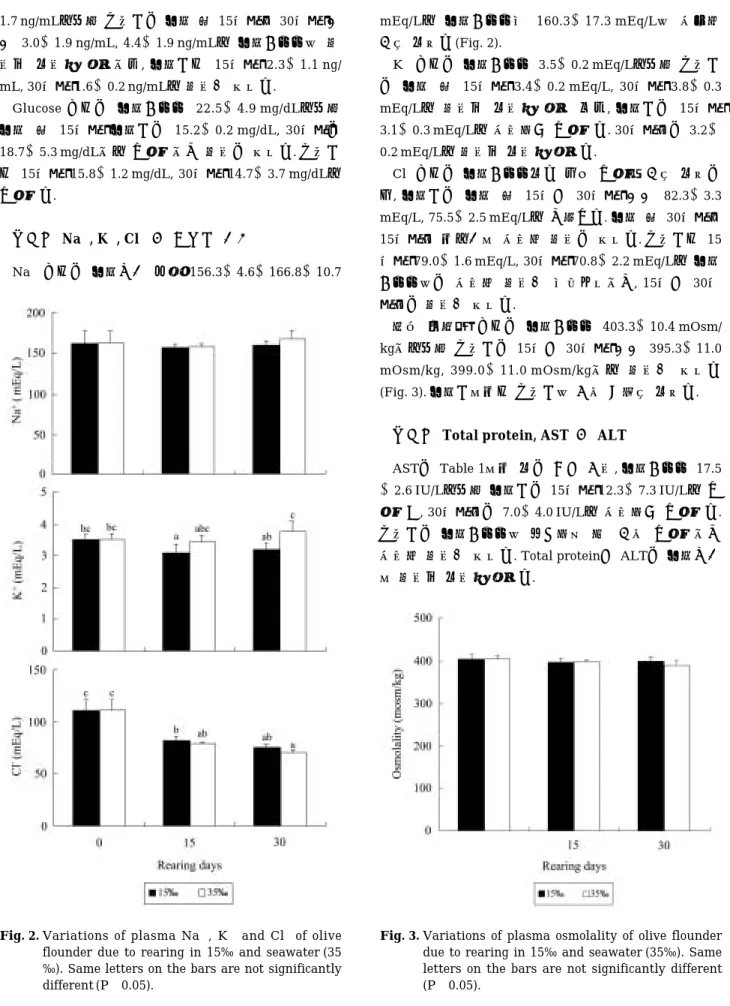
Na±, K±, Cl-및 삼투질 농도
Na±농도는 실험기간 동안 156.3±4.6~166.8±10.7
는 실험 후 15일째 3.4±0.2 mEq/L, 30일째 3.8±0.3 mEq/L로 차이를 보이지 않은 반면, 실험구는 15일째 3.1±0.3 mEq/L로 유의하게 낮아졌다. 30일째에는 3.2± 0.2 mEq/L로 차이를 보이지 않았다.
Cl-농도는 실험개시시보다 모두 낮아진 값을 보였는 데, 실험구는 실험 후 15일과 30일째 각각 82.3±3.3 mEq/L, 75.5±2.5 mEq/L로 나타났다. 실험 후 30일째와 15일째에 서로간에 유의한 차이는 없었다. 대조구도 15 일째 79.0±1.6 mEq/L, 30일째 70.8±2.2 mEq/L로 실험 개시시와는 유의한 차이가 인정되었으나, 15일과 30일 째에는 차이가 없었다.
혈장 삼투질 농도는 실험개시시 403.3±10.4 mOsm/
kg으로부터 대조구는 15일과 30일째 각각 395.3±11.0 mOsm/kg, 399.0±11.0 mOsm/kg으로 차이가 없었다 (Fig. 3). 실험구에서도 대조구와 같은 경향을 보였다.
혈장의
Total protein, AST및
ALTAST는 Table 1에서 보는 것과 같이, 실험개시시 17.5
±2.6 IU/L로부터 실험구는 15일째12.3±7.3 IU/L로 낮 아졌고, 30일째에는 7.0±4.0 IU/L로 유의하게 낮아졌다. 대조구는 실험개시시와 비교하여 평균값은 낮아졌으나 유의한 차이가 없었다. Total protein과 ALT는 실험기간 에 차이를 보이지 않았다.
Fig. 2. Variations of plasma Na±, K±and Cl- of olive flounder due to rearing in 15‰ and seawater (35
‰). Same letters on the bars are not significantly different (P¤0.05).
Fig. 3. Variations of plasma osmolality of olive flounder due to rearing in 15‰ and seawater (35‰). Same letters on the bars are not significantly different (P¤0.05).
혈액의
hematocrit, red blood cell및
hemoglobin농도
실험개시시 hematocrit는 12.5±2.3%였으며, 실험 후 15일째 대조구는 19.3±3.8%로 유의한 차이를 보이지 않았으나, 실험구에서는 35.6±10.3%로 유의한 차이를 보였다(Table 2). 실험 후 30일째 대조구는 17.1±4.3%
으로 실험개시시 보다는 높은 값을 유지하였다. 실험구 에서도20.4±5.0%으로 실험개시시보다 높았다.
Red blood cell은 실험개시시 2.3±0.4×10⁶ cell/UL로 부터 대조구는 실험 후 15일째 3.6±0.5×10⁶ cell/UL, 실험구는 4.6±1.3×10⁶ cell/UL이었으며, 실험종료시인 30일째에는 대조구가 3.0±0.8×10⁶ cell/UL, 실험구가 3.3±0.6×10⁶ cell/UL를 나타냈다.
Hemoglobin 농도는 실험개시시 9.6±0.9 g/dL에서 실 험 후 15일째 대조구는 8.0±0.9 g/dL로 낮아졌고, 실험 후 30일째에는 9.9±2.2 g/dL로 실험개시시 값으로 안정 되었다. 실험구는 실험 후 15일째 9.9±2.2 g/dL, 30일째 10.7±2.6 g/dL로 실험개시시보다는 다소 높은 값이었 다.
생존율 및 성장
실험 후 15일째 생존율은 대조구 96.7±0.0%, 실험구 88.3±2.4%로 나타났으며, 실험 종료시까지 생존율은 변화가 없었다(Fig. 4).
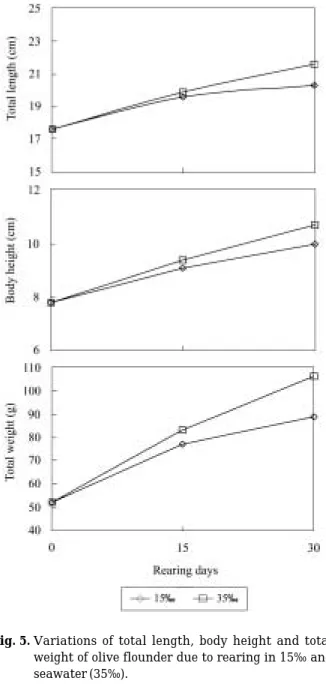
전장 성장은 실험 후 15일째 대조구가 실험개시시 17.6 cm에서 19.9 cm로 성장하였고, 30일째에는 21.6 cm 로 성장하였다(Fig. 5). 한편, 실험구는 실험 후 15일째
19.6 cm로 대조구와 차이를 보이지 않았으나, 30일째에 는 20.3 cm로 대조구보다는 성장이 느렸다. 체중 성장에 있어 대조구는 실험 후 15일째 83.2 g으로 실험구(76.9 g)에 비해 조금 빠른 성장을 보였으며, 30일째에는 더욱 차이를 나타냈는데 대조구가106 g, 실험구가 89.2 g으로 차이를 나타냈다.
일간성장률은 Table 3에서 보는 것과 같이, 대조구가 1.7±0.1%로 나타났고, 실험구는 대조구보다 낮은 1.5± 0.3%를 보였다. 전장성장률은 대조구와 실험구 각각 20.6±4.4%, 18.3±2.8%로 대조구가 조금 높은 것으로 나타났다. 체중성장률도 전중성장률과 같은 경향을 보였 Table 1. Variations of total protein, AST and ALT in plasma of olive flounder due to rearing in 15‰ and seawater (35‰)*
Rearing days Total protein (mg/mL) AST (IU/L) ALT (IU/L)
15‰ 35‰ 15‰ 35‰ 15‰ 35‰
0 30.7±12.4 30.7±12.4 17.5±2.6b 17.5±2.6b 4.5±1.5 4.5±1.5
15 17.5±1.3 23.3±5.4 12.3±7.3ab 11.0±1.4ab 3.3±1.5 3.5±0.6
30 20.5±4.5 32.0±16.2 7.0±4.0a 12.0±2.2ab 3.6±1.0 3.8±1.5
*The values are mean±SD (n = 5). Means within each item followed by the same alphabetic letter are not significantly different (P>0.05).
AST: aspartate aminotransferase, ALT: alanine aminotransferase.
Table 2. Variations of hematological factors of olive flounder due to rearing in 15‰ and seawater (35‰)*
Rearing days Hematocrit (%) Red blood cell (×106 cell/UL) Hemoglobin (g/dL)
15‰ 35‰ 15‰ 35‰ 15‰ 35‰
0 12.5±2.3a 12.5±2.3a 2.3±0.4a 2.3±0.4a 9.6±0.9ab 9.6±0.9ab
15 35.6±10.3c 19.3±3.8ab 4.6±1.3c 3.6±0.5b 9.8±2.2ab 8.0±0.9a
30 20.4±5.0b 17.1±4.3ab 3.3±0.6ab 3.0±0.8b 10.7±2.6b 9.9±2.2ab
*The values are mean±SD (n = 5). Means within each item followed by the same alphabetic letter are not significantly different (P¤0.05).
Fig. 4. Precent survival of olive flounder due to rearing in 15‰ and seawater (35‰).
0.2%)에 비하여 높았다. 사료전환효율에 있어서는 대조 구가42.4±2.0%, 실험구가 37.8±4.3%로 나타났다.
고 찰
염분 변화에 따른 어류의 성장, 대사 및 먹이섭식량에 대한 연구결과는 모순 되게 보고하고 있는 바, 대서양연 어(Salmo salar)에서 성장은 fry 및 parr기의 발단 단계 에 따라 다르게 나타난다고 하였다. fry는 담수(0‰)보다 6~12‰, parr는 22‰보다0~15‰에서 빠른 것으로 보 고하였다(Saunders and Henderson, 1969a, b). 그러나 Shaw et al. (1975)은 parr의 성장은 0.1~20‰에서 차이 를 보이지 않았다고 하였다. 일반적으로 삼투압 조절을 위한 에너지 비용은 환경수의 저삼투성(hyposmotic)과 고삼투성(hyperosmotic)에서보다 등삼투성(isosmotic)에 서 성장이 빠르며, 대사율은 낮은 것으로 보고하고 있다 (McCormick and Bern, 1989). Morgan and Iwama (1991) 는 연어류에서 염분에 따른 성장은 종, 발생 단계, 몸의 크 기, 이동 및 적응과정에 따라서 영향을 받는다고 하였다.
본 연구에 사용한 Paralichthys속의 넙치(P. oliva- ceus)는 광염성 어류로 알려져 있다(Daniels et al., 1998;
Kelsall and Balment, 1998; Atwood et al., 2001; Higa- shimoto et al., 2001; Sampaio and Bianchini, 2002). Hur
et al. (2002)은 해수에서 담수로 사육수를 교환하였을
때, 넙치의 폐사는 48시간 이후라고 하였으며, 15‰에서 는 144시간까지 폐사 개체가 나타나지 않았다고 하였 다. 또한 넙치는 수온(Chang et al., 2001a), 수심 감소 (Hur et al., 2001) 및 수송(Chang et al., 2001b)에 따른 스트레스 반응이 낮게 나타나는 것으로 보고되고 있다. 그 만큼 넙치는 스트레스에 강한 어종으로 알려져 있으 며, 이는 다른 연어과 어류보다 스트레스시 운동성 및 생리∙생태적으로 종특이성의 차이로 설명하고 있다.
Wedemeyer and Yasutake (1977)는 어류의 혈장 cor- tisol과 glucose 농도는 스트레스 지표로 인정된다고 하 였다. 일반적으로 catecholamine, adrenocorticotropic hormone (ACTH) 및 cortisol 농도는 1차 스트레스 지표 로 인정되고, 혈장 glucose, Na±, K±, Cl-, total protein, lactic acid 등은 2차 지표로 인정된다. 3차 스트레스 지 표로는 스트레스가 장기적으로 지속되면 어류는 생존율, 성장, 면역 및 질병에 대한 감염 능력 등으로 영향을 미 치게 된다. 본 연구에서 1차 스트레스 지표로 cortisol, 2 Fig. 5. Variations of total length, body height and total
weight of olive flounder due to rearing in 15‰ and seawater (35‰).
Table 3. Growth results of olive flounder due to rearing in 15‰ and seawater (35‰)
Items Salinity
15‰ 35‰
Specific growth rate (%) 1.5±0.3a 1.7±0.1b
GRL (%) 18.3±2.8 20.6±4.4
GRW (%) 84.0±14.4 97.7±4.5
Feed intake (%) 96.4±2.9a 91.3±1.8b
Condition factor 10.6±0.1 10.8±0.9
Specific feeding rate (%) 3.9±0.2 4.0±0.0 Feed conversion rate (%) 37.8±4.3 42.4±2.0 The values are mean±SD (n = 20). Means within each item followed by the same alphabetic letter are not significantly differ- ent (P¤0.05). GRL: growth rate for total length, GRW: growth rate for body weight.
차 스트레스 지표는 glucose, Na±, K±, Cl-, total pro- tein, AST 및 ALT, 3차 스트레스 지표로는 성장, 생존율 및 사료효율 등을 조사한 결과, 본 연구에 나타난 cortisol 농도는 매우 낮게 나타났다. Hur (2002)는 넙치 가 스트레스를 받지 않은 안정 상태에서cortisol 농도는 0.3~22.7 ng/mL (평균 3.9 ng/mL)로 보고하였다. 연어과 어류에서는 안정 상태이거나 스트레스를 받지 않은 상 태에서의 혈중 cortisol 수준은 30~40 ng/mL이고 (Wedemeyer et al., 1990), 이상적인 것은 5 ng/mL 이하 로 알려져 있다(Pickering and Pottinger, 1989). 한편, Pickering and Pottinger (1989)는 스트레스시 나타나는 cortisol 농도는 40~200 ng/mL인 것으로 알려지고 있으 며, 다른 어종에서는 스트레스시 이보다 더 높게 나타날 수 있다고 하였다. 본 연구에서 나타난 cortisol 농도는 위의 보고에서 나타난 안정 상태의 값과 유사하였으며, 15‰로 장기 사육한 실험구에서도 높아지지 않는 값을 보였다. Cortisol 농도와 스트레스시 동반 상승하는 것으 로 알려져 있는 glucose 농도는 cortisol과 같은 경향을 보여주었다. 따라서 넙치는 광염성 어류로 이미 알려져 있듯이 15‰에 적응하여cortisol과 glucose 농도에는 영 향을 미치지 않은 것으로 판단된다.
실험구에서 Na±, K±, Cl-및 삼투질 농도로 볼 때, 실 험후15일과30일째 삼투압 조절을 위한 항상성 유지에 문제가 없는 것으로 실험구와 대조구에서 차이를 보여 주지 않았다. Sampaio and Bianchini (2002)는 P. orbign-
yanus의 담수와 해수에서 Na±농도는 차이를 보이지
않았다고 하였으며, Hur et al. (2002)의 보고에서도 실험 후 24시간까지 Na±농도는 차이를 보이지 않는다고 하 였는데, 본 연구 결과와 유사한 경향을 보였다. Hur et al. (2002)의 보고에서 0‰과 15‰로 이동시에 Na±과 Cl-농도는 실험 후 24시간까지 조금 낮아지는 경향을 보였으나, 0‰에서는 실험 후 48시간 이후에 폐사 개체 가 나타나 144시간까지 모두 폐사한 결과를 보여주었 다. 그러나 15‰에서는 실험 후 144시간까지 97% 이상 의 생존율을 보여주었다.
이러한 결과로 추측하여 볼 때, 본 연구에서 실험구의 넙치는 실험직후 이온 농도 조절에서 약간의 혼란을 보 였으나, 실험 후15일과 30일째 Na±과 Cl-농도에서 차 이를 보이지 않는 것은 넙치가 15‰ 해수에 적응하였음 을 암시해준다. 또한 삼투질 농도의 변화에서도 실험구 와 대조구 사이에 차이를 볼 수 없었는데, 특히 실험 후 30일째 대조구의 넙치가 실험구보다 약간 높게 삼투질 농도를 유지한 것은 저염분에 대한 고삼투압조절(hy- perosmoregulation)을 하고 있음을 추측하여 볼 수 있 다. 고삼투압조절에 대한 연구 결과는 숭어(Mugil ceph-
alus)와 coho salmon (Oncorhynchus kisutch)에서 보고 하였다(Young et al. 1989; Chang and Hur, 1999). 이는 어체보다 저장성 환경에서 체내의 항상성을 유지하기 위하여, cortisol 감소, Na±, K±-ATPase 활성 감소, 삼투 질 농도 증가 등을 조절하는 것이다. 본 연구에서 실험 후 30일째 cortisol 농도의 실험개시시보다 유의성은 없 지만 낮아진 값과 다른 연구에서 나타난 값보다 평균적 으로 낮은 경향, Na±과 Cl-이 대조구와 차이가 나타나 지 않은 점, 삼투질 농도가 대조구보다 다소 높게 나타난 결과가 고삼투압조절을 하는 것으로 증명될 수 있다.
Davis and Parker (1990)는 AST와 ALT는 조직의 괴 사가 일어나거나, 병적 증상이 나타날 때 활성이 높아져 혈중 농도가 증가하는 것으로 알려져 있으며, 또한 혈액 학적인 지표는 생체내 산소운반 능력 등을 나타내고 있 어 스트레스시 높아지는 것으로 보고하였다. 위의 지표 들은 Hur et al. (2002)의 보고에서도 본 연구와 유사한 경향을 보여주었으며, Chang et al. (2002) 보고에서는 AST와 ALT의 증가는 급격한 염분 변화에 따른 간 및 비장 등의 세포가 생리적 부담을 받고 있음을 시사하였 다. 그러나 본 연구에서 실험 후 15일과 30일째 실험개 시시보다 낮아진 것으로 볼 때, 생리적 부담이 적음을 보여준다. Hematocrit, red blood cell 및 hemoglobin의 증가는 스트레스에 따른 혈액의 산성화 및 비장의 축소 등으로 나타난다. 본 연구에서 hemoglobin은 차이가 없 는 것은 혈액 산소수급에는 문제가 없는 것으로 판단된 다. Ryan (1995)은 만성 스트레스에 의해 hematocrit의 상승은 적혈구 용적의 증가와 낮은 산소 함량이라고 하 였는데, 본 연구에서 산소 함량은 문제가 되지 않은 것 으로 생각된다. RBC와hematocrit의 실험 후15일째 실 험구와 대조구에서 높아지는 값에서 차이는 나타났으나, 동반 상승한 것으로 볼 때, 다른 요인이 작용되어진 것 으로 보인다.
혈액학적인 요인에서는 실험 후 30일째까지 대조구와 실험구에서 차이를 보이지 않았다. 그러나 생존율 및 성 장 결과 대조구보다는 실험구에서 낮은 것으로 나타났 다. 생존율에서는 실험 후 5일에서 10일 사이에 폐사 개 체가 나타났으며, 그 이후에는 폐사 개체가 나타나지 않 았다. 이는 저염분에 대한 실험 초기에 삼투압 조절에 문제가 있어 폐사한 것으로 보여진다. 실험구의 먹이섭 식량은 대조구보다 높게 나타났으나, 사료전환효율에서 는 먹이섭식량과는 반대 현상을 보여주었다. Morgan and Iwama (1991)은 무지개송어(Salmo gairdneri), steelhead trout (O. mykiss) 및 chinook salmon (O.
tshawytscha)을 그들의 서식지가 아닌 다른 염분으로
이동하였을 때, 성장단계인 자연서식지에서 사육하는 것
났다.
본 연구 결과, 넙치는 실험구와 대조구에서 혈액학적 인 측면에서는 실험 후 30일째까지 차이를 보여주지 않 았으나, 성장 및 생존율은 실험구에서 낮게 나타났다. 현 재 넙치 양식장에서 담수화 현상은 30일 이상 지속되지 않는 것으로 볼 때, 단기적인 담수화는 넙치에 큰 영향 을 미치지는 않을 것으로 판단된다. 그러나 지하해수로 양식시 저염분수가 용출 될 경우, 30일 이상 장기적으로 사육에 따른 생리적 반응, 성장, 육질 및 식품 등에 대한 연구가 이루어져야 할 것으로 생각된다.
적 요
양식 넙치(Paralichthys olivaceus)를 사용하여 실험구 (15‰)와 대조구(35‰)에서 장기사육에 따른 생리적 반 응, 성장, 생존율 및 사료효율 등을 비교∙조사하였다. 실 험어는 평균전장 17.6±1.1 cm, 평균체중 52.2±7.7 g인 치어를 사용하였으며, 실험직후 실험구는 해수와 담수를 조절하여 15‰ 해수로 사육수를 교환하였으며, 대조구 는 사육수의 교환없이 그대로 해수를 공급하였다. 혈액 및 성장조사는 실험개시시(0), 실험 후 15 및 실험 후 30일째에 실시하였다. 혈액학적인 요인의 경우, cortisol, glucose, Na±, Cl-및 삼투질 농도 등에서 대조구와 실험 구사이에 차이를 보여주지 않았다. 특히, 삼투질 농도에 서는 실험구에서 고삼투압조절을 하는 것으로 나타났다. 생존율에서는 실험 후 30일째까지 대조구의 96.7%보다 실험구가 88.3%로 낮게 나타났으며, 성장률에서도 실험 구가 대조구보다 낮게 나타났다.
인 용 문 헌
Atwood, H.L., J.R. Tomasso and T.I.J. Smith. 2001. Nitrite toxicity to southern flounder, Paralichthys lethostigma in fresh and brackish water. J. World Aquacult. Soc., 32 : 348~351.
Bakke, H., V. Bjerknes and A. Vreeide. 1991. Effects of rapid changes in salinity on the osmoregulation of postsmolt Atlantic salmon (Salmo salar). Aquaculture.
96 : 375~382.
Chang Y.J. and J.W. Hur. 1999. Physiological responses of grey mullet (Mugil cephalus) and nile tilapia (Oreochro-
Comparison of blood physiology in juvenlile black sea- bream (Acanthopagrus schlegeli) reared in converted freshwater form seawater and seawater form fresh- water. J. Korean Fish. Soc., 35 : 595~600.
Chang, Y.J., J.W. Hur, H.K. Lim and J.K. Lee. 2001a.
Stress in olive flounder (Paralichthys olivaceus) and fat cod (Hexagrammos otakii) by the sudden drop and rise of water temperature. J. Korean Fish. Soc., 34 : 91~97 (in Korean).
Chang, Y.J., J.W. Hur, S.H. Moon and J.U. Lee. 2001b.
Stress response of olive flounder (Paralichthys olivac- eus) and Japanese croaker (Nibea japonica) to live fish transportation. J. Aquaculture, 14 : 57~64 (in Korean).
Chang, Y.J., Y.C. Lee and B.K. Lee. 1996. Comparison of growth and survival rates of juvenile grey mullets (Mugil cephlus) in different salinities. J. Aquacult., 9 : 311~320 (in Korean).
Daniels, H.V. and R.J. Borski. 1998. Effects of low salinity on growth and survival of Southern flounder (Parali- chthys lethostigma) larvae and juveniles. In: United States/Japan Natural Resources Aquaculture Sympo- sium: Marine Finfish and Shellfish Aquaculture, Mar- ine Stock Enhancement, and Open Ocean Engineering, Tech. Rep. 26, pp. 187~191.
Davis, K.B. and N.C. Parker. 1990. Physiological stress in striped bass : effect of acclimation temperature. Aqac- ulture, 91 : 349~358.
Foo, J.T. and T.J. Lam. 1993. Serum cortisol response to handling stress and the effect of cortisol implantation on testosterone level in the tilapia, Oreochromis mos- sambicus. Aquaculture., 115 : 145~158.
Higashimoto, Y., N. Nakao, T. Ohkubo, M. Tanaka and K.
Nakashima. 2001. Structure and tissue distribution of prolactin receptor mRNA in Japanese flounder (Par- alichtys olivaceus): conserved and preferential expres- sion in osmoregulatory organs. Gen. Comp. Endocrinol., 123 : 170~179.
Hur, J.W. 2002. Physiological responses of fishes to the artificial stresses in the process of aquaculture. A paper of doctor’s degree. Pukyong National University. pp.
1~196 (in Korean).
Hur, J.W. and Y.J. Chang. 1999. Physiological responses of grey mullet (Mugil cephalus) and Nile tilapia (Oreochro- mis niloticus) by gradual change in salinity of rearing water. J. Aquacult., 12 : 283~292 (in Korean).
Hur, J.W., B.K. Lee, Y.J. Chang, J.K. Lee, Y.S. Lim, J.H.
Lee, C.H. Park and B.K. Kim. 2002. Stress responses of
olive flounder (Paralichthys olivaceus) to hypo-salinity changes of rearing water. J. Aquaculture, 15 : 69~75 (in Korean).
Hur, J.W., Y.J. Chang, H.K. Lim and B.K. Lee. 2001.
Stress responses of cultured fishes elicited by water level reduction in rearing tank and fish transference during selection process. J. Korean Fish. Soc., 34 : 465
~472 (in Korean).
Kelsall, C.J. and R.J. Balment. 1998. Native urotensins influence cortisol secretion and plasma cortisol concen- tration in the euryhaline flounder, Platichthys flesus.
Gen. Comp. Endocrinol., 112 : 210~219.
Kirsch, R. and M.F. Meister. 1982. Progressive processing of ingested water in the gut of seawater teleosts. J.
Exp. Biol., 98 : 67~81.
Kirsch, R. and W. Humbert and V. Simoneaux. 1985. The gut as an osmoregulatory organ, comparative aspects and special references to fishes. In : Gilles R. and Gilles-Baillien M. (Eds.), Transport Procosses, Ion and Osmoregulation. Springer Verlag, Berlin, pp. 265~277.
Laurent, P. and S. Kunel. 1980. Morphology of gill epith- elia in fish. Amer. J. Physiol., 238 : 147~159.
Lee, Y.C., Y.J. Chang and B.K. Lee. 1997. Osmoregulation capability of juvenile grey mullets (Mugil cephalus) with the different salinities. J. Korean Fish. Soc., 30 : 216~224 (in Korean).
Madesen, S.S. and E.T. Naamansen. 1989. Plasma ionic regulation and gill Na±-K±-ATPase changes during rapid transfer to sea water of yearling rainbow trout, Salmo gairdneri: time course and seasonal variation. J.
Fish Biol., 34 : 829~840.
Maina, J.N. 1990. A study of the morphology of the gills of an extreme alkalinity and hyper-osmotic adapted teleost Oreochromis alcalicus grahami (Boulenger) with particular emphasis on the ultrastructure of the chlo- ride cells and their modifications with water dilution. A SEM and TEM study. Anatomy and Embryology, 181:
83~98.
Mancera, J.M., P. Fernandez-Llebrez and J.M. Grondona.
1993. Influence of environmental salinity corticotropic cells in the Gilthead sea bream (Saprus aurata L.).
Gen. Comp. Endocrinol., 90 : 220~231.
Martine, A., Y. Grahamm, P. Patrick and B.S. Carl. 1993.
Plasma prolactin and cortisol concenturations during salinity chllenges of coho salmon (Oncorhynchus kisut- ch) at smolt and post-smolt stages. Aquaculture, 91 : 359~372.
McCormick, S.D. and H.A. Bern. 1989. In vitro stimulation of Na±, K±-ATPase activity and ouabain binding by cortisol in coho salmon gill. Am. J. Physiol., 256 : 707~
715.
Mcleese, J.M., J. Johnsson, F.M. Huntley, W.C. Clarke and M. Weisbart. 1994. Seasnal changes in osmoregulation, cortisol, and cortisol receptor activity in the gills of parr /smolt of seelhead trout and steelhead-rainbow trout hybrids, Oncorhynchus mykiss. Aquaculture, 93 : 103~ 113.
Morgan, J.D. and G.K. Iwama. 1991. Effects of salinity on growth, metabolism, and ion regulation in juvenile rainbow trout and steelhead trout (Oncorhynchus my- kiss) and fall chinook salmon (Oncorhychus kisutch).
Can. J. Fish. Aquat. Sci., 48 : 2083~2094.
Pickering, A.D. and T.G. Pottinger. 1989. Stress responses and disease resistance in salmonid fish: Effects of chro- nic elevtion of plasma cortisol. Fish Physiol. Biochem., 7 : 253~258.
Richman, N.H., III, S. Tai de Diaz, R.S. Nishioka, P.
Prunet and H.A. Bern. 1987. Osmoregulatiry and endo- crine relationships with chloride cell morphology and density during smoltification in coho salmon (Oncor- hynchus kisutch). Aquaculture, 60 : 265~285.
Ryan, S.N. 1995. The effect of chronic heat stress on cor- tisol levels in the Antarctic fish Pagothenia borchgre- vinka. Experientia, 51 : 768~774.
Sampaio, L.A. and A. Bianchini. 2002. Salinity effects on osmoregulation and growth of the euryhaline flounder Paralichthys orbignyanus. J. Exp. Mar. Biol. Ecol. 269 : 187~196.
Saunders, R.L. and E.B. Henderson. 1969a. Survival and growth of Atlantic salmon parr in relation to salinity.
Fish. Res. Board Can. Tech. Rep., 147, 5 pp.
Saunders, R.L. and E.B. Henderson. 1969b. Survival and growth of Atlantic salmon fry in relation to salinity and diet. Fish. Res. Board Can. Tech. Rep., 148, 7 pp.
Shaw, H.M., R.L. Saunders and H.C. Hall. 1975. Environ- mental salinity: its failure to influence growth of Atlan- tic salmon (Salmo salar) parr. J. Fish. Res. Board Can., 32 : 1821~1824.
Soengas, J.L., J. Fuentas, J. Otero, M.D. Andres and M.
Aldegunde. 1992. Seasnal changes in carbohydrate metabolism in the rainbow trout (Oncorhynchus my- kiss) and their relationship to changes in gill (Na±- K±)-ATPase activity. Aquacultule, 108 : 369~380.
Thomas, M.H., D.M. Stephan and A.B. Howard. 1991.
Effects of prolactin on chloride cells in opercular mem- brane of seawater-adapted tilapia. Gen. Comp. Endo- crinol., 83 : 283~289.
Wedemeyer, G.A. and W.T. Yasutake. 1977. Clinical me- thods for the assessment of the effects of environmental stress on fish health. U.S. Fish and Wildlife Service
P.B. (eds.), Methods for Fish Biology. Am. Fish. Soc.
Bethesda, MD, pp. 451~489.
Williams, A.J. and T. Wigham. 1994. The regulation of prolactin cells in the rainbow trout (Oncorhynchus
coho salmon (Oncorhynchus kisutch): plasma prolactin, growth hormone, thyroid hormones and cortisol. Gen.
Comp. Endocrinol., 74 : 335~345.
Received : April 19, 2003 Accepted : June 4, 2003