2012년 고수온기에 발생한 남동해권역 조피볼락의 대량폐사
이덕찬†⋅박영철⋅전창영⋅양준용*⋅허영백⋅김진우**⋅조기채5)
국립수산과학원 남동해수산연구소, *국립수산과학원 대외협력과, **국립수산과학원 병리연구과
A report on the 2012 mass summer mortalities of black rockfish, Sebastes schlegeli in the Southeast Sea, Korea
Deok Chan Lee†, Yong Chul Park, Chang Yung Jeon, Joon-Yong Yang*, Young Baek Hur, Jin-Woo Kim** and Ki Chae Cho
Southeast Sea Fisheries Research Institute, NFRDI, 398-68, Sanyangilju-Ro, Sanyang-Up, Tongyeong, Gyoengnam, 650-943, Korea
*External Research Cooperation Division, NFRDI, Busan, 619-705, Korea
**Pathology Division, NFRDI, Busan, 619-705, Korea
From July to early September 2012, there was mass mortality of fishes, particularly black rockfish, which were being raised in the floating fish cage along the coast of Gyeongsangnam-do. The amount of damage was 1,802,000 fishes and the causes were confirmed to be rapidly rising water temperature and repeated daily changes in water temperature. The water temperature in this area of the sea rose to the maximum 28.4℃ and the daily range of changes in water temperature was maximum 6.5℃. As a result of investigating biological diseases of 194 fishes in 49 fishery areas, major pathogenic organisms such as red seabream iridovirus (RSIV), Vibrio sp. and Vibrio spp. or Microcotyle sp. were detected in rockfish in some fish farms. It is considered that the major causes of the mass mortality were high water temperature accompanied by repeated daily changes in water temperature, it is considered that biological diseases influenced the increase in the perish of fishes.
Key words :Black rockfish, Sebastes schlegeli, Mass mortality, RSIV, High water temperature
어류는 다양한 스트레스 인자에 영향을 받고 있으 며, 이 스트레스 인자가 어류가 수용할 수 있는 한계 치를 넘게 되면 생리적 문제를 유발하게 되고 나아가 서는 폐사에 이를 수 있다. 해양환경의 급격한 변화, 유기물이나 독성물질 등에 의한 환경오염으로 생물의 대량폐사가 발생하며 (Boesch and Rosenberg, 1981;
Hartly, 1982; Suh et al., 1999), 수온변동이 어류에 미치
†Corresponding author: Deok Chan Lee
Tel: +82-55-640-4772, Fax: +82-55-641-2036 E-mail: [email protected]
는 영향이 큰 것으로 보고되었다 (Davis et al., 1990;
Abele et al., 1998; Chang et al., 2001; Lee et al., 2002).
어류폐사는 무생물학적 원인과 생물학적 원인, 또 는 두 원인의 복합적 작용에 의하여 나타나는 것으로 추정하는 것이 대부분이다. 어류와 같은 변온동물은 일정범위 내의 수온변화에 대하여 항상성을 가지지 만, 서식 가능 환경을 넘어서는 급격한 수온의 변화는 어류의 간에 생화학적 또는/그리고 생리적 장애를 일으킬 뿐만 아니라 조직 내 산화성 스트레스 (oxidative stress)를 야기한다 (Parihar et al., 1996;
Lushchak and Bagnyukova, 2006; Bagnyukova et al., 2007; Shin et al., 2010).
경남권역의 해양환경에 영향을 미치는 대마난류 는 쿠로시오난류의 지류로서 우리나라 대한해협을 지나 동해로 흐르는 고온고염의 해류로 (Nitani, 1972;
Lie et al., 2000; Teague et al., 2003), 남동해권역의 어업과 양식산업에 영향을 미치지만 양식어류 폐사 와 연관하여 해석된 보고의 예는 알려져 있지 않다.
본 연구는 2012년도 고수온기에 대마난류가 영향 을 미치는 남동해권역에 위치한 가두리양식장에서 발생한 조피볼락의 대량폐사 원인과 폐사 형태를 조 사⋅분석하고 이에 대한 대책을 마련하기 위한 기초 자료 수집의 목적으로 수행하였다.
재료 및 방법
대량폐사 발생과 시료채취
2012년 7월부터 8월에 걸쳐 경상남도 연안 (통영 시, 거제시, 고성군, 남해군)에 위치한 가두리양식장 에서 사육중인 조피볼락 (Sebastes schlegeli)을 포함한 양식어류의 대량폐사가 발생하였다. 특히 7월 25∼31 일과 8월 10∼15일을 전후하여 급격한 폐사가 확인되 었다 (Fig. 1). 조피볼락을 사육 중이던 통영 40개 어업 권 (통영 산양 30개, 통영 욕지 8개, 통영 한산 2개), 거제 1개 어업권, 남해 8개 어업권 등 총 49개 어업권 에 대하여 조피볼락 시료를 채취하였다.
수온, 염분, 용존산소 및 pH 조사
2차 대량폐사가 심하게 발생한 8월 14일부터 20일 전후에 통영시 (산양읍, 욕지면 및 한산면 해역), 거제 시 (일운면 해역) 및 남해군 (미조면 해역)의 수심별 수온, 염분, 용존산소 및 pH를 현장조사 하였다. 그리 고 국립수산과학원 수산해양정보과에서 운용중인 실시간 수온정보시스템 6개소 (통영시 사량면, 통영 시 산양읍 풍화와 학림, 통영시 한산면 비산, 거제
일운 및 남해 미조)의 7월 1일부터 8월 28일까지의 관측소 자료를 분석에 사용하였다.
질병 조사
분석실험실로 운반한 어류의 외부 및 내부증상을 확인하고, 바이러스성, 세균성, 기생충성 및 영양성 [macrophage aggregates (MAs) 형성 관찰] 질병에 대 하여 조사하였다.
바이러스성 질병 조사를 위하여 참돔이리도바이 러스병 (Red Seabream Iridovirus, RSIV), 바이러스성 출혈성패혈증 (Viral Haemorrhagic Septicemia, VHS), 바이러스성신경괴사증 (Viral Nervous Necrosis, VNN)에 대하여 PCR 방법으로 분석하였으며, 일부 양성 시료에 대하여 DNA sequencing을 실시하여 관 련 질병과의 상동성을 확인하였다.
세균성 질병 조사를 위하여 시료의 비장과 신장을 무균적으로 도말하고, 배양된 균은 그람염색 후 그람 양성 연쇄구균에 대하여 Multiplex PCR (Cho et al., 2008)과 API Strep kit로 균종을 확인하였으며, 그람음 성균은 API 20 kit에 의한 동정을 실시하였다.
기생충성 질병 조사를 위하여 아가미와 체표점액 외에 육안적으로 비정상적 증상을 보이는 장기 (간, 비장, 신장, 장관, 뇌 및 심장)의 시료에 대하여 생체 슬라이드 표본을 제작하여 현미경 (AXIO Imager A2, Zeiss)으로 관찰하였다
MAs 관찰은 현미경적 검사를 통하여 간, 비장 및 신장 조직의 일부를 압인표본 제작하여 관찰하였다. MAs 형성 정도에 따라 - (음성), + (약), ++ (중) 및 +++ (강)의 4개 등급으로 기준을 정하여 판정하였으며, 각 장기 중의 하나 또는 그 이상에서 ++ 및 +++의 결과로 관찰되었을 때 어류에 영향을 미치는 단계로 간주하였다.
결 과 대량폐사와 시료채취
고수온기인 7월 중순부터 8월말까지 약 1,802천마 리의 조피볼락이 폐사하였으며, 49개 어업권 내 86개 양식장이 피해를 입었다. 청취조사 결과, 대부분의 양식장은 예년과 동일한 사육방법으로 어류를 관리 한 것으로 파악되었으나 7월 중순부터 말경에 발생 한 폐사가 8월초⋅중순에 발생한 규모보다 더 컸다 고 주장하였다. 폐사하는 조피볼락은 힘없이 유영하 며 가두리 바닥에 가라앉는 행태를 보였다. 통영, 거 제 및 남해해역에 위치한 총 49개 어업권에서 0∼
200g 76 마리, 201∼400g 74 마리, 401∼600g 38 마리
및 600g 이상 8 마리를 무작위로 총 194 마리의 조피 볼락을 조사하였다 (Table 1).
수온, 염분, 용존산소 및 pH
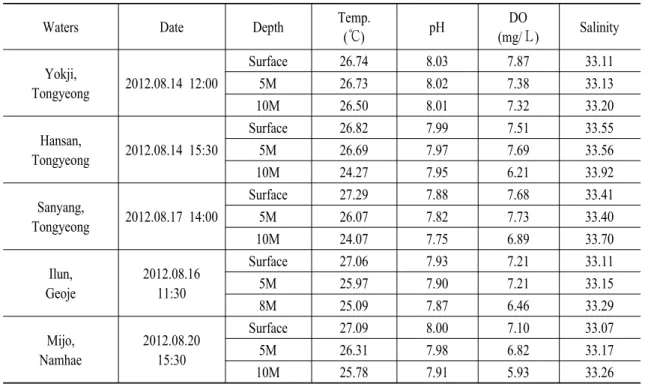
폐사가 집중적으로 발생한 8월 14일과 17일 (통영), 8월 16일 (거제 일운) 및 8월 20일 (남해 미조) 해역의 수심 0∼5M 영역에서의 수온은 26℃ 전후 또는 그 이상을 상회하고 있었으며, 염분농도도 33.1 이상으 로 비교적 높게 나타났다 (Table 2).
Waters Tongyeong
Geoje Namhae Total Sanyang Yokji Hansan
Sampling fishes 107 (30)※
30 (8)
12 (2)
8 (1)
37 (8)
194 (49)
※, Figures in parenthesis: number of sampling farm.
Table 1. Number of sampling rockfish, Sebastes schlegeli by waters
Waters Date Depth Temp.
(℃) pH DO
(mg/ℓ) Salinity Yokji,
Tongyeong 2012.08.14 12:00
Surface 26.74 8.03 7.87 33.11
5M 26.73 8.02 7.38 33.13
10M 26.50 8.01 7.32 33.20
Hansan,
Tongyeong 2012.08.14 15:30
Surface 26.82 7.99 7.51 33.55
5M 26.69 7.97 7.69 33.56
10M 24.27 7.95 6.21 33.92
Sanyang,
Tongyeong 2012.08.17 14:00
Surface 27.29 7.88 7.68 33.41
5M 26.07 7.82 7.73 33.40
10M 24.07 7.75 6.89 33.70
Ilun, Geoje
2012.08.16 11:30
Surface 27.06 7.93 7.21 33.11
5M 25.97 7.90 7.21 33.15
8M 25.09 7.87 6.46 33.29
Mijo, Namhae
2012.08.20 15:30
Surface 27.09 8.00 7.10 33.07
5M 26.31 7.98 6.82 33.17
10M 25.78 7.91 5.93 33.26
Table 2. Temperature, pH, dissolved oxygen (DO) and salinity by the waters
국립수산과학원 수산해양종합정보과에서 제공 한 수심 5M 지점의 해수 수온을 분석한 결과, 경남연 안의 해수 수온은 7월 중순까지 완만한 증가 또는 등락을 보였으나, 7월 하순부터 급격한 상승과 심한 일간변화를 보였다. 즉, 통영 학림은 8월 12일에 27.
4℃, 통영 사량은 8월 17일에 28.4℃, 통영 풍화는 8월 18일에 28.1℃, 거제 가배는 8월 12일 28.6℃ 및 남해 미조는 8월 7일에 27.8℃의 최고 수온을 나타내
었다. 특히 7월 하순부터 8월 초순, 그리고 8월 중순 후반부터 8월말 중반까지 급격한 일간 수온변화가 발생하였는데 일간 수온변화의 최대폭은 통영 사량 과 풍화 약 6.5℃, 통영 산양 학림 3.5℃, 통영 한산 비산 약 3.8℃, 거제 일운 5.8℃ 및 남해 미조 3.0℃로 나타나서 해수의 수온은 8월 중순에 최고를 나타낸 후 8월 하순부터 감소하는 경향을 보였다 (Fig. 1).
Fig. 1. Profiles of water temperature variation of Kyungnam coast from July to August. A, Tongyoung Sanyang (SR); B, Tongyoung Pungwha (PH); C, Tongyoung Haklim (HL); D, Tongyoung Bisan (BS) and E, Namhae Mijo (MJ). Data from KODC, NFRDI. ■, Mass mortality period.
질병 조사
1. 질병 증상
조사한 조피볼락의 주요 외부증상은 주둥이 발적, 아가미뚜껑 발적, 항문 발적, 지느러미 발적과 탈락, 아가미 빈혈과 충⋅울혈 등 이었으며, 안구백탁, 체 표궤양, 항문돌출, 아가미 빈혈과 충⋅울혈 등을 나 타내었다. 내부증상은 내부장기 (간, 신장 및 비장)의 빈혈과 충⋅울혈이었으며, 신장과 비장의 비대, 부레, 위 및 장관의 충⋅울혈이 관찰되는 개체가 많았다.
2. 병원체 조사
총 194 마리에 대한 분석 결과, 바이러스는 19 마리 의 시료 (크기 60∼496g)에서 참돔이리도바이러스 (RSIV)가 검출되었으며, 8 마리의 조사시료에서 lymphocystis가 확인되었다. 세균은 65 마리에서 검출 되었는데, 연쇄구균 (S. iniae and/or L. garviae)이 53 마리, Vibrio 속이 21 마리, Aeromonas 속이 1 마리, Pseudomonas 속이 1 마리에서 검출되었고, 이 중 11 마리에서는 2 종의 세균종이 혼합 검출되었다. 특히 S. iniae가 53 마리 중 50마리에서 검출되어 대부분을 차지하였으며, 3마리가 L. garviae와 혼합하여 검출 되었다. 또한 V. harveyi는 7월과 8월 중순까지 조사한 시료에 비하여 8월 하순에 조사한 시료에서 대부분 검출되었다. 기생충은 33 마리에서 검출되었는데, Caligus 속이 21 마리, Clavella 속이 2 마리, Microcotyle 속이 10 마리, Benedenia 속이 3 마리, Tricodina 속이 7 마리에서 검출되었다. 또한 아가미 에서 Chlamydiales에 의하여 형성된다고 알려진 epitheliocystis 증상이 7 마리에서 확인되었다 (Fig. 2).
3. MAs 조사
MAs가 중단계 (++) 이상으로 관찰되는 어류는 194 마리 중 93 마리로 47.9% 이었다. MAs는 간에 비하여 비장과 신장에서 정도가 심하였으며, 어류의 크기에
상관없이 관찰되었다.
Fig. 2. A list of pathogens and their frequencing from farmed black rockfish, Sebastes schlegeli during mass summer mortality. RSIV, red seabream iridovirus; Figures in parenthesis (%), detection rate.
고 찰
2012년 7월과 8월에 걸쳐 남해 동부해역에 위치한 가두리양식장에서 약 1,802천마리가 폐사하였다 (경 상남도 어업진흥과 자료). 이 해역의 월평균 수온은 25.5℃로, 2006년 관측 이래 가장 높은 월평균 수온이 었다. 과거 6년간의 8월 월평균 수온에 비하여 2.1℃
높아 7월에 이어 고수온 현상이 심화되었으며, 7월말 부터 8월초까지 주기적으로 반복된 수온의 일교차가 최대 6.5℃ 이른 경우도 나타났다. 특이한 것은 거제 일운의 경우 일간 수온차가 5.8℃에 달하였으나 25℃
이하의 수온대에서 나타난 것으로 심해의 냉수대 영 향을 받은 것으로 판단된다.
조피볼락은 성장을 위한 최적 사육수온이 15∼1 8℃로 수온 23℃ 이상으로 올라가면 먹이섭취가 극히 저하되며, 25℃ 이상으로 상승하면 생리기능이 현저히 떨어지는 반면 산소소비율 (oxygen consumption rate)은 증가한다 (Oh et al., 2007; 국립수산과학원, 2007).
어류에서 고수온은 산화 스트레스로 작용하는데 항산화 효소 (superoxide dismutase, SOD)와 catalase의 활성을 증가시킬 뿐만 아니라 면역력을 감소시키며, ROS (reactive oxygen species) 분비를 증가시킨다
(Halliwell and Gutteridge, 1989; Shin et al., 2010). 미꾸 라지 (Misgurnus mizolepis)의 경우 23℃에 비하여 3 2℃에서 에너지 대사, 단백질 대사, 면역/항산화 기 능, 세포골격 및 구조, 물질수송 및 세포 신호전달 등에 관여하는 단백질을 암호화하는 유전자 클론 93 개가 이상발현 증가되며, vitellogenin 전구체 및 리보 좀 단백질류에서 특이적 전사활성 저하가 관찰된다 고 하였다 (Cho et al., 2006). 또한 수온의 급격한 변화는 어류의 헤마토크릿치, 적혈구 수, 백혈구 수 및 헤모글로빈량의 변화 (Davis et al., 1990; Chang et al., 2001)와 생리기능과 면역능에 영향을 미친다 (Barton and Iwama, 1991; Bowden, 2008; Choi et al., 2009). 그리고 수온의 급변은 어류의 점액생산을 중 지시키고 저항력을 감소시켜 병원균의 침입이 쉬워 지게 하며 폐사에 영향을 줄 수 있다 (전, 2000; Lee et al., 2002).
2012년 고수온기에 남해 동부해역에서 발생한 조 피볼락의 대량폐사는 적정 사육수온 영역 이상에서 의 지속적이고 반복적인 수온변화가 어류의 생리적 기능과 면역계에 영향을 미쳤을 것으로 판단되며, 급격한 수온충격에 의한 생리적 변화와 면역반응의 약화로 바이러스성, 세균성 및 기생충성 질병 등의 생물학적 질병이 발생하였거나, 보균하고 있던 병원 체에 의하여 폐사가 가중되었을 것으로 판단된다. 틸라피아의 경우, 사육 수온대를 벗어나 사육할 때 연쇄구균 (S. iniae)에 대한 질병 저항력이 저하되는 것으로 알려져 있다 (Ndong, 2007).
금번 조사 결과, 체표에서 Caligus 속의 기생충 검 출율이 높게 나타났으나, 감염 정도는 심하지 않은 것으로 판단되었다. 또한 다른 기생충에 비하여 조피 볼락에 심한 피해를 일으키는 아가미흡충 (Microcotyle 속)의 검출율은 5.2%로 비교적 낮은 편 으로 수온 25℃에서 조피볼락 아가미흡충인 M.
sebastis의 난 생성과 부화율이 저하된다 (Kim et al., 1998)는 연구결과와 관련이 있는 것으로 판단된다.
세균의 검출율에서 연쇄구균인 S. iniae 그리고/또 는 L. garviae에 의한 감염과 검출율 (27.3%)이 높았 다. 특히 S. iniae에 의한 검출은 연쇄구균이 검출된 조피볼락 53마리 모두에서 확인되었으며, 3마리에서 L. garviae와 혼합감염 형태로 나타났다. 이러한 결과 는 고수온기에 남동해권역의 가두리양식장 조피볼 락에 감염되는 연쇄구균이 주로 S. iniae인 것으로 판단된다. S. iniae는 세계적으로 담수 및 해수 양식산 업에서 심한 경제적 손실을 유발하는 병원체이며 (Shoemaker et al., 2001; Agnew and Barnes, 2007), 우리나라 넙치와 조피볼락에도 폐사를 일으키는 중 요한 병원체이다 (Woo et al., 2006; Choi et al., 2009
& 2010). 다만, 남동해권역에 대한 주기적인 질병 조사를 통해 L. garviae, S. iniae, S. parauberis 및 Streptococcus sp. 등이 나타나는 시기에 대한 다양한 조사와 연구가 필요할 것으로 판단된다.
Vibrio 속 (특히, V. harveyi)의 세균은 해수 상재균 (常在菌)으로 고수온기 또는/그리고 어류의 저항력 이 약화되었을 때 발생하는 기회감염성 병원체이며 (Austin and Austine, 1999), Vibrio 속 중 V. harveyi는 조피볼락에 병원성을 가지며 폐사를 유발하는 주요 병원체로 알려져 있다 (Won et al., 2006; Choi et al., 2007 & 2008). 금번 조피볼락 폐사, 특히 8월 하순의 수온하강 시점에 V. harveyi의 분리 비율이 높았던 것은 고수온 기간 동안 누적된 스트레스와 면역력 저하, 그리고 장기간 사료 공급을 하지 않은 원인 등의 다양한 요인이 복합적으로 작용한 것으로 판단 된다.
194마리의 조피볼락 중 7마리의 아가미에서 epitheliocystis가 확인되었으며, 국내 조피볼락에서 감 염 보고된 예가 있다 (Park et al., 2009). Chlamydiales에 의하여 발병하는 epitheliocystis에 의하여 아가미와 체표 세포의 비정상적 비대와 이로 인한 대량폐사 가능성을 언급하였다 (Draghi et al., 2004 & 2007;
Nowak and Lapatra, 2006; Polkinghorne et al., 2010).
epitheliocystis에 의한 cyst의 형성은 새변의 유착, 염 증세포의 침윤, 상피세포와 점액세포의 증생으로 인 하여 호흡과 삼투조절에 영향을 미칠 수 있다.
조사한 194개 시료의 간, 비장 및 신장의 MAs 침착 은 대부분의 시료에서 관찰되었으나 어류 크기와의 관련성은 확인하기 어려웠으며, 조피볼락 이외의 어 종 (참돔, 볼락, 농어 등)을 비교하였을 때 MAs 침착 이 심한 어장과 심하지 않은 어장에 따른 차이는 있었 다 (data not shown). 생체 내 melanin, ceroid, hemosiderin 또는 다른 색소물질의 집적으로 나타나 는 MAs (또는 melano-macrophage centers, MMCs)는 어류의 비장, 신장의 조혈조직 및 간에서 관찰되는 대식세포의 축적성 구조물로서 면역반응, 염증반응, 외부 및 내부 유래 물질의 저장, 파괴 또는 제독작용 및 철성분 재사용 등의 역할을 하는 것으로 알려져 있어, 어류의 오염 노출, 환경적 스트레스, 질병, 영양 상태, 면역 및 대사에 대한 측정인자로서의 가능성을 언급하였다 (Kranz, 1989; Wada et al., 1991; Wolke, 1992; Park and Huh, 1994; Montero et al., 1999; Wolf and Wolfe, 2005). 2006년 통영지역 가두리양식장에 서 사육중인 조피볼락 장기의 세로이드 침착이 질병 의 감염성을 높여주는 영양성 스트레스로 작용하여 1차적인 면역기능 저하를 유발할 가능성을 언급하였 다 (Choi et al., 2009). 그러므로 남동해권역 49개 어업 권에서 사육 중이던 조피볼락은 어류의 크기에 대한 문제보다는 공급 또는 관리하는 사료의 차이에 의한 것으로 이에 대한 적절한 홍보와 대응이 필요할 것으 로 판단된다.
수산생물질병관리법에서 ‘수산생물전염병’인 RSIV 가 4개 어업권에서 검출되었다. RSIV는 양식 돌돔, 참돔 및 조피볼락에서 국내 감염이 확인되었으며, 25℃ 이상에서 급격히 폐사가 증가하는 것으로 알려 져 있다 (Jung and Oh, 1999 & 2000; Sohn et al., 2000;
Kim et al., 2008). 또한 iridovirus의 분류에 대한 고려 가 있어야 하겠지만, 돌돔이나 참돔보다는 조피볼락
에 대한 병원성이 낮은 것으로 알려져 있다 (Jeong and Jeong, 2008). 이는 조피볼락의 폐사가 바이러스 성 질병에 의한 영향보다는 연쇄상구균 (L. garviae and/or S. iniae)에 의한 영향이 큰 것으로 판단되며, 8월 하순부터는 비브리오 (V. harveyi)에 의한 영향을 추가로 받은 것으로 판단된다. 참돔이리도바이러스, 바이러스성출혈성패혈증 및 바이러스성신경괴사 증 등은 2007년과 2008년에도 통영지역에 나타났으 며, 참돔이리도바이러스병에 의한 조피볼락의 피해 는 돔류에 비하여 매우 낮은 수준이었다 (Choi et al., 2010).
그러므로 2012년 7월과 8월에 발생한 남동해권 역 조피볼락의 대량폐사는 적정 사육수온 이상에서 반복된 심한 일교차의 변동과 장기간 지속된 고수 온의 영향이 생리적 및 면역학적 장애를 일으킨 원인 으로 판단되며, 이후 발생한 병원체 감염과 부적절한 환경이 조피볼락의 폐사를 더욱 확대시킨 것으로 사 료된다.
요 약
2012년 7월에서 9월초까지 경상남도 연안의 해상 가두리 양식장에서 사육중인 조피볼락의 대량폐사 가 발생하였으며, 피해량은 1,802,000마리로 집계되 었다. 폐사 해역의 수온은 최대 28.4℃까지 상승하였 으며, 일간 수온변화의 폭은 최대 6.5℃로 급격한 상 승과 반복적인 변화가 확인되었다. 49개 어업권 194 마리를 대상으로 생물학적 질병을 조사한 결과, 일부 양식장의 조피볼락에서 참돔이리도바이러스(red seabream iridovirus, RSIV), Vibrio sp.와 Vibrio spp.
또는 Microcotyle sp. 등의 주요 병원체가 확인되었다.
대량폐사의 주요 원인은 고수온과 동반하여 나타나 는 반복적인 일간 수온변화, 그리고 생물학적 질병이 폐사의 증가에 영향을 미친 것으로 판단된다.
감사의 글
본 연구는 국립수산과학원이 수행하는 수산생물 전염병 방역 및 검역체계 구축 사업의 지원에 의하여 이루어 졌습니다.
참고문헌
Abele, D., Burlando, B., Viarengo, A. and Pörtner, H.O.:
Exposure to elevated temperature and hydrogen peroxide elicits oxidative stress and antioxidant response in the Antarctic intertidal limpet Nacella concinna. Comp. Biochem. Physiol., B 120, 425-435, 1998.
Agnew, W. and Barnes, A.C.: Streptococcus iniae: An aquatic pathogen of global veterinary significance and a challenging candidate for reliable vaccination. Vet. Microbiol., 122:1-15, 2007.
Austin, B. and Austin, D.A.: Bacterial Fish Pathogens.
Disease of farmed and wild fish (3rd ed.).
Springer, Praxis Publishing Ltd., 1999.
Bagnyukova, T.V., Lushchak, V.I., Storey, K.B. and Lushchak, V.I.: Oxidative stress and antioxidant defense response by goldfish tissue to acute change of temperature from 3 to 23℃. J. Therm.
Biol., 32: 227-234, 2007.
Barton, B.A. and Iwama, G.K.: Physiological changes in fish from stress in aquaculture with emphasis on the response and effects of corticosteroids.
Ann. Rew. Fish Dis., 1:3-26, 1991.
Boesch, D.F. and Rosenberg, R.: Response to stress in marine benthic communities. In Stress effect on natural ecosystems, pp. 179∼200, Barrett,
M. and Rosenberg, R. (eds.), John Wiley, NY, 1981.
Bowden, T.J.: Modulation of the immune system of fish by their environment. Fish Shellfish Immunol., 25:373-383, 2008.
Chang, Y.J., Hur, J.W., Lim, H.K. and Lee, J.K.: Stress in olive flounder (Paralichthys olivaceus) and fat cod (Hexagrammos otakii) by the sudden drop and rise of water temperature. J. Korean Fish. Sci., 34:91-97, 2001.
Cho, M.Y., Lee, J.I., Kim, M.S., Choi, H.J., Lee, D.C.
and Kim, J.W.: Isolation of Streptococcus parauberis from starry flounder, Platichthys stellatus Pallas.
J. Fish Pathol., 21:209-217, 2008.
Cho, Y.S., Lee, S.Y., Noh, C.H., Nam, Y.K. and Kim, D.S.: Survey of genes responsive to long-term heat stress using a cDNA microarray analysis in mud loach (Misgurnus mizolepis) liver.
Korean J. Ichthyol., 18:65-77, 2006.
Choi, H.S., Myoung, J.-I., Park, M.A. and Cho M.Y.:
A study on the summer mortality of Korean rockfish, Sebastes schlegeli in Korea. J. Fish Pathol., 22:155-62, 2009.
Choi, H.S., Jee, B.Y., Cho M.Y. and Park, M.A.:
Monitoring of pathogens on the cultured Korean rockfish, Sebastes schlegeli in the marine cages farms of south sea area from 2006 to 2008.
J. Fish Pathol., 23:27-35, 2010.
Choi, J.H., Won, K.M., Ha, S.J., Kim, Y.C., Byun, S.G., Lee, B.I., Lee, J.H., Huh, M.D. and Park, S.I.:
Characterization and pathogenicity of extracellular products (ECPs) of Vibrio harveyi.
J. Fish Pathol., 21:81-91, 2008.
Choi, J.H., Won, K.M., Sohn, S.B., Park, H.J., Byun,
S.G., Lee, B.I., Lee, J.H., Kim, Y.C. and Park, S.I.: Pathogenicity of Vibrio harveyi to black rockfish, Sebastes schlegeli. J. Fish Pathol., 20:99-108, 2007.
Davis, K.B., Torrance, P. and Parker, N.C.: Physiological stress in striped bass: effect of acclimation temperature. Aquaculture, 91:349-358, 1990.
Draghi, A., Popov, V.L., Kahl, M.M., Stanton, J.B., Brown, C.C., Tsongalis, G.J., West, A.B. and Frasca, S.: Characterization of “Candidatus piscichlamydia salmonis” (order Chlamydiales), a chlamydia-like bacterium associated with epitheliocystis in farmed Atlantic salmon (Salmo salar). J. Clin. Microbiol., 42:5286-5297, 2004.
Draghi, A., Bebak, J., Popov, V.L., Noble, A.C., Geary, S.J., West, A.B., Byrne, P. and Frasca, S.:
Characterization of Neochlamydia-like bacterium associated with epitheliocystis in cultured Arctic charr Salvelinus alpinus. Dis. Aquat. Org., 76:27-38, 2007.
Halliwell, B. and Gutteridge, J.M.C.: Free radicals in biology and medicine (2nd). Oxford University Press, Oxford, UK, 1989.
Hartly, J.P.: Methods for monitoring offshore macrobenthos.
Mar. Pollut. Bull., 13:150-154, 1982.
Jeong, J.B. and Jeong, H.D.: Pathogenicity of iridovirus against marine fish and its detection in culturing seawater. J. Kor. Fish. Soc., 41:20-25, 2008.
Jung, S.J. and Oh, M.J.: Detection of RSIV (red sea bream iridovirus) in the cultured marine fish by th polymerase chain reaction. J. Fish Pathol., 12:66-69, 1999.
Jung, S.J. and Oh, M.J.: Iridovirus-like infection
associated with high mortalities of striped beakperch, Oplegnathus fasciatus (Temminck et Schlegel), in southern coastal areas of the Korean peninsula. J. Fish Pathol., 23:223-226, 2000.
Kim, K.H., Choi, E.S., Cho, J.B., Hwang, Y.J. and Park, S.I.: Influence of temperature on the egg production and hatching of Micrococtyle sebastis (Monogenea: Microcotylidae), parasitic on Rockfish, Sebastes schlegeli. J. Fish Pathol., 11:113-117, 1998.
Kim, S.R., Jeong, B.M., Jung, S.J., Kitamura, S-I., Kim, D., Kim, D.H. and Oh, M.J.: Cumulrative mortality in striped beakperch, Oplegnathus fasciatus infected with red sea bream iridovirus (RSIV) at different water temperature and identification of heat shock protein 70. J. Fish Pathol., 21:13-20, 2008.
Kranz, H.: Changes in splenic melano-marophage centres of dab Limanda limanda during and after infection with ulcer disease. Dis. Aquat. Org., 6:167-173, 1989.
Lee, D.C., Kim, D.H., Kim, S.M., Kang, M.S., Hong, M.J., Kim, H.J. and Park, S.I.: Effects of stress induced by changes of water temperature on the non-specific defense mechanism in cultured olive flounder, Paralichthys olivaceus. J. Fish Pathol., 15:65-75, 2002.
Lie, H.-J., Cho, C.-H., Lee, J.-H., Lee, S. and Tang, Y.: Seasonal variation of the Cheju Warm Current in the northern East China Sea. J.
Oceano., 56:197-211, 2000.
Lushchak, V.I. and Bagnyukova, T.V.: Temperature
increase results in oxidative stress in goldfish tissue. 2. Antioxidant and associated enzymes.
Comp. Biochem. Physiol., C, 143:36-41, 2006.
Montero, D., Blazer, V.S., Socorro, J., Izquierdo, M.S.
and Tort, L.: Dietary and culture influence on macrophage aggregate parameters in gilthead seabream (Sparus aurata) juveniles. Aquaculture, 179:523-534, 1999.
Ndong, D., Chen, Y.Y., Lin, Y.H., Vaseeharann, B. and Chen, J.C.: The immune response of tilapia Oreochromis mossambicus and its susceptibility to Streptococcus iniae under stress in low and hig temperature. Fish Shellfish Immunol., 22:686-694, 2007.
Nitani H.: Beginning of the Kuroshio. In Kuroshio: Its physical aspects, pp. 129-163, Stommel, H., Yoshida, K. (eds.), University of Tokyo Press, Tokyo, 1972.
Nowak, B.F. and LaPatra, S.E.: Epitheliocystis in fish.
J. Fish Dis., 29:573-588, 2006.
Oh, S.Y., Noh, C.H., Myoung, J.-I. and Jo, J.-Y.: Effects of water temperatur and body weight on oxygen consumption rate of black rackfish, Sebastes schlegeli. Korean J. Ichthyol., 19:1-7, 2007.
Parihar, M.S., Dubey, A.K., Faveri, T. and Prakash, P.:
Changes in lipid peroxidation, superoxide dismutase activity, ascobic acid and phospholipids content in liver of freshwater catfish Heteropneustes fossilis exposed to elevated temperature. J.
Therm. Biol., 21:323-330, 1996.
Park, J.-H. and Huh, M.-D.: Histopathological studies on melano-macrophage centers (MMCs) in spleen and head kidney of immuno-modified
tilapia, Oreochromis niloticus. J. Fish Pathol., 7:127-149.
Park, S.W., Yu, J.H. and Lee, K.H.: A mixed infection of epitheliocystis, Microcotyle sebstes and unknown aetiology in cultured rockfish (Sebastes schlegeli) from farms in Huksan Island. J. Fish Pathol., 22:9-14, 2009.
Polkinghorne, A., Schmidt-Posthaus, H., Meijer, A., Lehner, A. and Vaughan, L.: Novel Chlamydiales associated with epitheliocystis in a leopard shark Triakis semifasciata. Dis. Aquat. Org., 91:75-81, 2010.
Shin, H.S., An, K.W. Kim, N.N. and Choi, C.Y.:
Antioxidant defenses and physiological changes in olive flounder (Paralichthys olivaceus) in response to oxidative stress induced by elevated water temperature. Korean J. Ichthyol., 22:1-8, 2010.
Shoemaker, C.A., Klesius, P.H. and Evans, J.J.:
Prevalence of Streptococuus iniae in tilapia, hybrid striped bass, and channel catfish on commercial fish farms in the United States.
Am. J. Vet. Res., 62:174-177, 2001.
Sohn, S.G., Choi, D.L., Do, J.W., Hwang, J.Y. and Park, J.W.: Mass mortality of cultured striped beakperch, Oplegnathus fasciatus by iridoviral infection.
J. Fish Pathol., 13:121-127, 2000.
Suh, H.L., Cho, Y.K. Soh, H.Y. and Kim, D.H.: The mass mortality of macrobentic animals in Cheju Island : A possible role of physical oceanographic factor.
Korean J. Environ. Biol., 17:175-182, 1999.
Teague, W.J., Jacobs, G.A., Ko, D.S., Tang, T.Y., Chang, K.-I. and Suk, M.-S.: Connectivity of the Taiwan,
Cheju, and Korea straits. Continental Shelf Research, 23:63-77, 2003.
Wada, S., Hatai, K. and Kusuda, S.: Histopathological study of culture striped jack with yellow fat disease. Fish Pathol., 26:61-67, 1991.
Wolf, J.C. and Wolfe, M.J.: Toxicological pathology, 33:75-85, 2005.
Wolke, R.E.: Piscine macrophage aggregates, a review.
Ann. Rev. Fish Dis., 1:91-108, 1992.
Won, K.M., Kim, S.M. and Park, S.I.: Characterization of Vibrio harveyi, the causal agent of vibriosis in cultured marine fishes in Korea. J. Fish. Sci.
Technol., 9:123-128, 2006.
Woo, S.H., Kim, H.J., Lee, J.S., Kim, J.W. and Park, S.I.: Pathogenicity and classification of streptococci isolated from cultured marine fishes. J. Fish Pathol., 19:17-33, 2006.
국립수산과학원: 조피볼락 양식 표준지침서. 2007.
전세규 : 양식어류의 질병-해산어편. pp. 11∼24, 한국 수산신보사, 2000.
Manuscript Received : October 24, 2013 Revised : November 20, 2013 Accepted : December 09, 2013