17
Corresponding Author :Pathogenicity and classification of streptococci isolated from cultured marine fishes
Sung Ho Woo, Hyun Jeong Kim , Joo Seok Lee , Jin Woo Kim and Soo Il Park Institute of Fisheries Science, Pukyong National University, Busan, 608-737, Korea
Laboratory of Genome Science, Graduate School of Marine Science and Technology, Tokyo University of Marine Science and Technology, Tokyo, Japan.
Inland Aquaculture Research Institute, NFRDI, 645-806, Korea Pathology Team, NFRDI, 619-900, Korea
Department of Aquatic Life Medicine, College of Fisheries Science, Pukyong National University, Busan 608-737, Korea
Thirty-five streptococcci were isolated from the diseased streptoccoccicosis in oliver flounder (Par- alichthys olivaceus), black rockfish (Sebastes schlegeli) and yellowtail (Seriola quinqueradiata).
The isolates were identified into 3 kinds of streptococccal species, Streptococcus parauberis, Lactococ- cus garvieae and Streptococcus iniae by PCR assay with specific primers, pSP-1, pSP-2, pLG-1, pLG-2, pSI-1, pSI-2. Several characteristics were investigated on the morphological, biochemical, physiological and serological tests. The isolates were constituted as 5 strains of S. parauberis, 11 strains of L. garvieae and 19 strains of S. iniae, L. garvieae and S. parauberis strains appeared non-hemolytic whereas S. iniae showed -hemolysis .
In the serological investigation, S. parauberis antigen of formalin killed cells (FKCs) exhibited specificity against all the tested antisera. The antisera of L. garvieae (KG- phenotype) and the S. iniae showed cross- reaction against to the FKCs of L. garvieae (KG+ phenotype). Five out of 11 strains of L. garvieae were identified as KG- phenotype with serological test and by TEM observation, although S. iniae could not be observed the capsule structure.
In the pathogenicity test with L. garvieae and S. iniae to the oliver flounder and the black rockfish, S.
iniae induced acute or chronic mortality in both fishes, whereas L. garvieae caused hemorrhage at the base of fins of tested fishes without any mortality.
Key words : streptococci, pathogenicity, identification Streptococcus parauberis, Lactococcus garvieae, Streptococcus iniae
1957
Shizuoka , Oncorhynchus mykiss
(Hoshina et al.,
1958), (Boomker et al.,
1979), , Anguilla japonica (Kusuda et al., 1978), , Oreochromis nilotica, , Plecoglossus altivelis (Kitao et al., 1981)
, Ictalurus punctatus (Chang et al., 1996)
Corresponding Author : Soo Il Park, Tel : 051-620-6141, Fax : 051-628-7430, E-mail : [email protected]
, Seriola quinqueradiata (Kusuda et al., 1976; Minami et al., 1979), , Paralichthys olivaceus (Nagatsugawa, 1983), turbot, Scophthal- mus maximus (Domenech et al., 1996), gilthead sea bream, Sparus aurata European sea bass, Dicen- trarchus labrax (Zlotkin et al., 1998a)
. , ,
, Pagrus major Streptococcus sp.
(Kusuda et al., 1976; Kitao et al., 1979).
, ,
(Kitao, 1979),
, Sardinops melanosticta , Ammodytes personatus
6 (Minami, 1979).
(Rasheed and Plumb, 1984; Minami, 1979; Nagatsugawa, 1983), S. iniae
(Nguyen, 2001).
Plumb (1994) ,
.
,
PCR
. , ,
,
.
1.
40 800 g , 200 g
.
, , , , ,
1.5%
NaCl TSA, BHIA
, 28 24 48 .
. Streptococcus
parauberis (KCTC3651), Lactococcus garvieae (ATCC49156) Streptococcus iniae (KCTC3657)
.
2.
1.5% NaCl BHIA 28 , 18 48
colony , , Gram
.
3. PCR
3-1. Chromosomal DNA
DNA
Ausubel (1987) . DNA
100 TE buffer
A
260/280nmDNA .
3-2. Primers
primers
primers GenBank
16S-23S rRNA internal spacer
region (ISR) universal primer
cloning, sequencing S.
parauberis, L. garvieae, S. iniae primers
(Bioneer, Korea) ,
Table 1 .
3-3. PCR 16S-23S rRNA ISR
PCR PCR premix tube (Bioneer, Korea) , Thermal cycler (Perkin-
Elmer) PCR , 1% agarose
gel 100V 30 UV
transilluminator .
4.
MacConkey agar, SS agar Streptococcus fae-
calis broth ,
10%, 40% bile bile esculin medium (BEM), 0.01% TTC BHIA, BHI broth
4%, 5%, 6%, 6.5% NaCl, 10 , 20 , 37 , 45 , pH 9.6
.
5.
1.5% NaCl BHIA MacFaddin (2000)
. H
2S
TSIA , Indole Ehrlich's
. MR test Clark-Lub's medium , VP test Barritt's
. OF test Hugh and Leifson
, Catalase test 3% H
2O
2, Citrate test Sim-
mon's citrate agar 30 2 4
. Oxidase test Cytochrome oxidase , Nitrate reduction
Nitrate broth .
Phenol red 1%, salicin
0.5% , lysine ornithine
decarboxylase arginine dehydrolase
. 5% sheep blood
agar 30 , 24 48 ,
starch hydrolysis agar, esculin bile esculin medium , hip-
purate Facklam s urease pro-
duction Christensen s urea agar .
Table 1. Primers used in this study for PCR
Primer sets Oligo sequence Product size PCR
(bp) program
Streptococcus pSP-1 5'-TCCAGTCTTTCGACCTTCTT-3' parauberis specific
pSP-2 5'-CAAAGAGATGTTCGGCTTG-3'
220 1
aprimers
Lactococcus pLG-1 5'-AAGCAGTCTTTTGATGCAAG-3' garvieae
pLG-2 5'-ACTGTGCGCCCTTATTAACT-3'
307 1
aspecific primers
Streptococcus iniae pSI-1 5'-AAGAGACGCAGTGTCAAAAG-3'
107 2
bspecific primers pSI-2 5'-CGTTTCTTATCTTGTTACTC-3' a, (94 30s, 58 30s, 72 30s) 30 cycles.
b, (94 30s, 55 30s, 72 30s) 30 cycles.
6.
6-1.
PCR S. parauberis J14
, S. iniae BS10 L. garvieae
ATCC49156
. BHI broth 30 , 24
formalin 0.5%
24 . formalin
(formalin killed cells, FKC) 4 10,000 g 30
PBS 3 2 g/ PBS
. FKC
Freund's complete adjuvant (FCA) 1 1.0 kg
3
, 2 1 3
. 10
.
1 , 10,000 g
20 .
56 30
0.1% sodium azide -70
.
KG phenotype cells ATCC
49156 PCR
L. garvieae
KG phenotype J55
.
6-2.
S. parauberis (J14), L. garvieae ATCC49156 (KG phenotype), S.
iniae (BS10), S. parauberis
KCTC3651 L. garvieae (J55; KG phenotype) PBS (0.08% NaCl, 0.002%
KCl, 0.029% NaHPO
42H
2O, 0.002% KH
2PO
4)
15 2 . 15
1.5% NaCl BHIA
15
slide glass 5
. microtiter method
.
7. Capsule
(Williams, 1988)
capsule (fimbrae-like material)
L. garvieae , S.
iniae Cowan
and Steel (1993) capsule (magnification 1000) .
Capsule
TEM .
capsule stain
3 L. garvieae , J55, ST28 ATCC49156
, colony 3
S. iniae , BS5, BS9 J35
. Yoshida et al.
(1997) , L. garvieae J55
, S. iniae BS10
1:8, 1:512 titer .
8.
10.5 11.5 cm,
9 10 g , P. olivaceus 10 11
cm, 16 18 g , S. schlegeli 1
. colony 14
2
2
. 6 1
. 1.5% NaCl BHIA 24
540 nm
0.8 ,
0.1 .
22 0.5 , 10
2 .
0.1 .
cell BHIA plate dilution method CFU
Gram 100 chain
.
< Cell injected per fish CFU average of cells / 100chain >
3
50% .
PCR .
.
1.
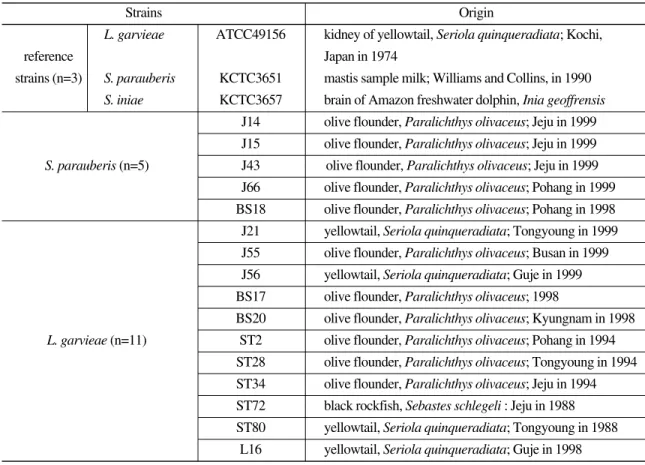
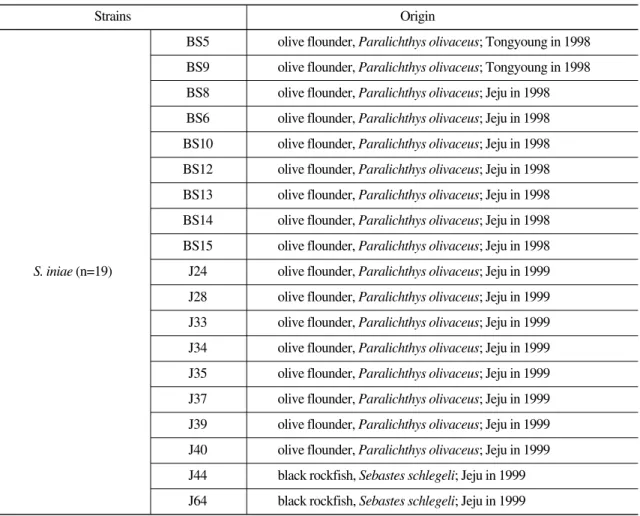
Table 2
. 3
35 .
Table 2. Isolated strains and reference strains used in this study
Strains Origin
L. garvieae ATCC49156 kidney of yellowtail, Seriola quinqueradiata; Kochi,
reference Japan in 1974
strains (n=3) S. parauberis KCTC3651 mastis sample milk; Williams and Collins, in 1990 S. iniae KCTC3657 brain of Amazon freshwater dolphin, Inia geoffrensis
J14 olive flounder, Paralichthys olivaceus; Jeju in 1999 J15 olive flounder, Paralichthys olivaceus; Jeju in 1999 S. parauberis (n=5) J43 olive flounder, Paralichthys olivaceus; Jeju in 1999
J66 olive flounder, Paralichthys olivaceus; Pohang in 1999 BS18 olive flounder, Paralichthys olivaceus; Pohang in 1998 J21 yellowtail, Seriola quinqueradiata; Tongyoung in 1999 J55 olive flounder, Paralichthys olivaceus; Busan in 1999 J56 yellowtail, Seriola quinqueradiata; Guje in 1999 BS17 olive flounder, Paralichthys olivaceus; 1998
BS20 olive flounder, Paralichthys olivaceus; Kyungnam in 1998 L. garvieae (n=11) ST2 olive flounder, Paralichthys olivaceus; Pohang in 1994
ST28 olive flounder, Paralichthys olivaceus; Tongyoung in 1994 ST34 olive flounder, Paralichthys olivaceus; Jeju in 1994 ST72 black rockfish, Sebastes schlegeli : Jeju in 1988 ST80 yellowtail, Seriola quinqueradiata; Tongyoung in 1988
L16 yellowtail, Seriola quinqueradiata; Guje in 1998
, , , ,
, ,
, ,
.
28 , 4
3 , 8
12 .
2.
1.5% NaCl
TSA BHIA colony 1 3 mm
.
colony Fig. 1 homogeneity,
polymorphism, mucoid-like colony 3
, Table 3 .
3. PCR 16S - 23S rRNA ISR 35
primers 16S - 23S rRNA ISR
S. parauberis 5 , L.
garvieae 11 , S. iniae 19
.
98 99
5 S. parauberis 16S - 23S rRNA ISR
S. parauberis (Fig. 2).
94 99 , , , ,
Table 2. Isolated strains used in this study
Strains Origin
BS5 olive flounder, Paralichthys olivaceus; Tongyoung in 1998
BS9 olive flounder, Paralichthys olivaceus; Tongyoung in 1998
BS8 olive flounder, Paralichthys olivaceus; Jeju in 1998
BS6 olive flounder, Paralichthys olivaceus; Jeju in 1998
BS10 olive flounder, Paralichthys olivaceus; Jeju in 1998
BS12 olive flounder, Paralichthys olivaceus; Jeju in 1998
BS13 olive flounder, Paralichthys olivaceus; Jeju in 1998
BS14 olive flounder, Paralichthys olivaceus; Jeju in 1998
BS15 olive flounder, Paralichthys olivaceus; Jeju in 1998
S. iniae (n=19) J24 olive flounder, Paralichthys olivaceus; Jeju in 1999
J28 olive flounder, Paralichthys olivaceus; Jeju in 1999
J33 olive flounder, Paralichthys olivaceus; Jeju in 1999
J34 olive flounder, Paralichthys olivaceus; Jeju in 1999
J35 olive flounder, Paralichthys olivaceus; Jeju in 1999
J37 olive flounder, Paralichthys olivaceus; Jeju in 1999
J39 olive flounder, Paralichthys olivaceus; Jeju in 1999
J40 olive flounder, Paralichthys olivaceus; Jeju in 1999
J44 black rockfish, Sebastes schlegeli; Jeju in 1999
J64 black rockfish, Sebastes schlegeli; Jeju in 1999
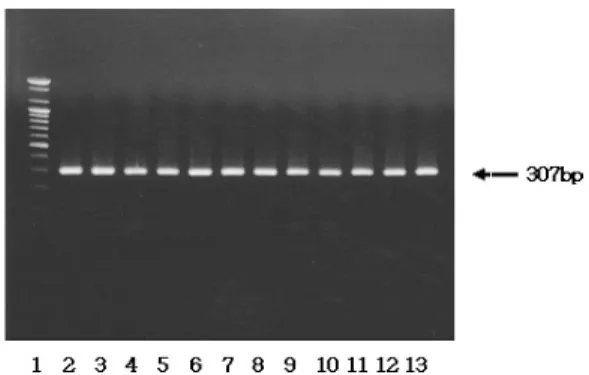
, , 11 L.
garvieae 16S - 23S rRNA ISR
L. garvieae (Fig. 3).
94 99 , ,
19 S. iniae 16S - 23S rRNA ISR
S. iniae (Fig. 4).
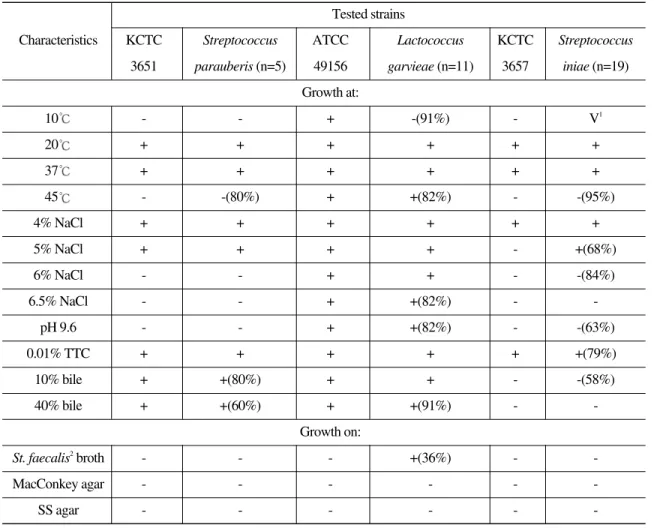
4.
Table 4 .
Table 3. Diversity of colony forms in tested strains
S. parauberis (6 strains) L. garvieae (12 strains) S. iniae (20 strains)
H P M H P M H P M
4 2 - 3 9 - 9 8 3
H, Homogeneity; P, Polymorphism; M, Mucoid-like colony.
Fig. 1. Photograph of colony type from tested strains in this study.
A, homogeneity; B, polymorphism; C, mucoid-like colony.
A B C
Fig. 2. PCR products with the specific primers (pSP-1, pSP-2) from Streptococcus parauberis. lane 1, marker; lane 2, KCTC3651; lane 3, J14; lane 4, J15; lane 5, J43; lane 6, J66; lane 7, BS18. Arrow indicates the amplified products.
Fig. 3. PCR products with the specific primers (pLG-1,
pLG-2) from Lactococcus garvieae. lane 1, marker; lane 2,
ATCC49156; lane 3, J21; lane 4, J55; lane 5, J56; lane 6,
BS17; lane 7, BS20; lane 8, ST2; lane 9, ST28; lane 10,
ST34; lane 11, ST72; lane 12, ST80; lane 13, L16. Arrow
indicates the amplified products.
Table 4. Physiological characteristics of tested strains
Tested strains
Characteristics KCTC Streptococcus ATCC Lactococcus KCTC Streptococcus 3651 parauberis (n=5) 49156 garvieae (n=11) 3657 iniae (n=19)
Growth at:
10 - - + -(91%) - V
120 + + + + + +
37 + + + + + +
45 - -(80%) + +(82%) - -(95%)
4% NaCl + + + + + +
5% NaCl + + + + - +(68%)
6% NaCl - - + + - -(84%)
6.5% NaCl - - + +(82%) - -
pH 9.6 - - + +(82%) - -(63%)
0.01% TTC + + + + + +(79%)
10% bile + +(80%) + + - -(58%)
40% bile + +(60%) + +(91%) - -
Growth on:
St. faecalis
2broth - - - +(36%) - -
MacConkey agar - - - - - -
SS agar - - - - - -
1
, Variable reaction.
2
, Streptococcus faecalis.
Fig. 4. PCR products using the specific primers (pSI-1, pSI-2) from Streptococcus iniae. lane 1, marker; lane 2, KCTC3657;
lane 3, BS5; lane 4, BS6; lane 5, BS8; lane 6, BS9; lane 7, BS10; lane 8, BS12; lane 9, BS13; lane 10, BS14; lane 11, BS15;
lane 12, marker; lane 13, J24; lane 14, J28; lane 15, J33; lane 16, J34; lane, 17 J35; lane 18, J37; lane 19, J39; lane 20, J40;
lane 21, J44; lane 22, ST64. Arrow indicates the amplified products.
Table 5. Biochemical characteristics of tested strains
Streptococcus Lactococcus Streptococcus
Test parauberis garvieae iniae
KCTC Tested ATCC Tested KCTC Tested
3651 strains 49156 strains 3657 strains
Motility - - - - - -
Oxidase - - - - - -
Catalase - - - - - -
Oxidation-Fermentation test F F F F F F
H
2S production - - - - - -
Indole production - - - - - -
Methyl red - +(60%) + + - -(95%)
Voges-Proskauer - - - - - -
Simmon's citrate utilization - - - - - -
Nitrate reduction - - - - - -
Acid from
arabinose - - - - + -
lactose - +(80%) - - - -
maltose + +(60%) + +(91%) - -
mannose + + + + - -(74%)
raffinose - - - - - -
salicin + +(60%) + + - -
sorbitol + - - -(91%) - -
sucrose + + - -(82%) - -(84%)
tagatose - - - - - -
trehalose + + + + - -(79%)
xylose + - - - + -
Arginine dihydrolase + + + + - +(81%)
Decarboxylase of:
lysine - - - - - -
ornithine - - - - - -
Hydrolysis of:
esculin - -(80%) - -(18%) + +(37%)
starch - -(60%) + +(36%) + +(84%)
hippurate + + - - - -
Urease - +(80%) - -(55%) - -(95%)
Hemolysis
45 S. parauberis S.
iniae 1
. , L. garvieae 1
. L.
garvieae 6% ,
6.5% 2 10
. Mac-
Conkey agar SS agar
S.
faecalis broth 36% L. garvieae .
5.
Table 5 . 3
, indole , oxidase , catalase , H
2S , VP , Sim- mon's citrate nitrate reduction
, lysine, ornithine decarboxylase
, raffinose tagatose
.
6.
microtiteration
Table 6 .
S. parauberis (J14) 1024, L. garvieae (ATCC49156) 2048 S. iniae (BS10) 512
L. garvieae (J55)
8 .
L. garvieae (ATCC49156; KG phenotype) S. iniae (BS10) L. garvieae (J55;
KG phenotype) .
7. Capsule
capsule Table 6. Agglutination titers among the tested strains in this study
Rabbit antisera
Streptococcus Lactococcus Lactococcus
Streptococcus Strain of Ag
parauberis garvieae garvieae
iniae
J14 ATCC49156 J55
(KG+ phenotype) (KG- phenotype) BS10 Streptococcus
parauberis 1024 - - -
J14 Lactococcus
garvieae -
12048 512 64
ATCC49156 Lactococcus
garvieae - - 8 -
J55 Streptococcus
iniae - - - 512
BS10
1
, Titers lower than 2.
Fig. 5 . KG phenotype L. garvieae
capsule
, L. garvieae
ATCC49156 KG phenotype
L. garvieae S. iniae
Fig. 5. Observation of the stained capsule of tested isolates by the phase-contrast microscope.
A, Lactococcus garvieae J55; B, ATCC 49156; C, Lactococcus garvieae ST28; D, KCTC3657; E, Streptococcus iniae BS10. Arrows indicates capsular structure.
D
C E
A B
Fig. 6. Transmission electron micrograph of Lacto- coccus garvieae (KG- and KG+ phenotype) and Streptococcus iniae.
A, Cell incubated with antiserum (KG- phenotype) and stained with ruthenium red demonstrating and electron faint layer adjacent to the cell wall (A; arrow head).
B, Cell incubated with antiserum (KG- phenotype) and stained with ruthenium red demonstrating and fimbriae-like appendages adjacent to the cell wall (B;
arrow head).
C, KG+ phenotype cell showing no layer on the cell (C; arrow head).
D, Streptococcus iniae cell (BS5, BS9, J35) showing
no layer on the cell (D; arrow head). Bar indicates
100 nm.
KCTC3657 S. iniae
capsule .
TEM capsule
Fig. 6 .
. ruthenium red
L. garvieae KG- phenotype
fimbrae-like appendages
. KG phenotype
L. garvieae
. colony
S. iniae (BS5,
BS9, J35) cells capsule-like material .
8.
Table 7 4 2
(CFU/fish) (cells/fish)
. S. iniae
2.54 10
7CFU/fish,
6.73 10
7cell/fish , L. garvieae 1.88 10
7CFU/
fish, cell 4.71 10
7cell/fish
, S. iniae
1.38 10
7CFU/fish,
4.12 10
7cell/fish , L.
garvieae 2.1 10
7CFU/fish, 5.00 10
7cell/fish .
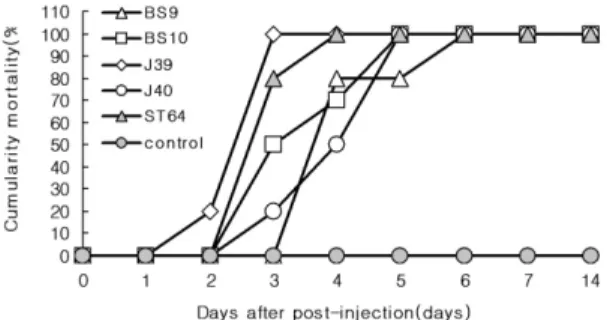
Fig. 7 S. iniae
. colony
Homogeneity J39 J40
6 , 2
BS10 70%
colony 10 40%
.
.
.
. L. garvieae
, 50%
, .
Fig. 7 Cumulative mortality of olive flounder, Paralichthys olivaceus, after intraperitoneal injection with the tested strains, Streptococcus iniae, and reference strain, Strepto- coccus iniae. The tested groups were challenged with 0.1 ml of bacteria suspension for 0.8 optical density at 540 nm and the control group was injected 0.1 ml saline fish
-1.
Fig. 8. Cumulative mortality of Korean rockfish, Sebastes schlegeli, after intraperitoneal injection with the tested strains, Streptococcus iniae and Lactococcus garvieae, and reference strains, Lactococcus garvieae (ATCC49156).
The tested groups were challenged 0.1 ml of bacteria sus-
pension for 0.8 optical density at 540 nm and the control
group was injected 0.1 ml saline fish
-1.
Fig. 8 5 S. iniae
L. garvieae J55 ATCC49156
S.
iniae 6
. L. garvieae
.
1
, Each fish received 0.1ml of diluted bacterial suspension by intraperitoneal injection; CFU was determined by BHI agar plate dilution method.
2
, The mean number of cells which composed one bacterial chain was determined by microscopic observation of smear preparation of the bacterial suspension on slide glasses.
3