Association of Helicobacter pylori with Elevated Blood Ammonia Levels in Cirrhotic Patients: A Meta-Analysis
Hai-Xing Jiang,
1Shan-Yu Qin,
1Zhi-gang Min,
2Ming-Zhi Xie,
1Tao Lin,
1Bang-Li Hu,
3and Xiao-Yun Guo
11Department of Gastroenterology, the First Affiliated Hospital of Guangxi Medical University, Nanning, Guangxi;
2Jiangsu University Affiliated Yixing People’s Hospital, Yixing, Jiangsu; 3Guangxi Information Institute, Nanning, Guangxi, PR China.
Received: July 13, 2012 Revised: August 27, 2012 Accepted: August 30, 2012
Corresponding author: Dr. Hai-Xing Jiang, Department of Gastroenterology, the First Affiliated Hospital of Guangxi Medical University, Shuang-Yong Road 6, Nanning 530021, Guangxi, PR China.
Tel: 86-13978861818, Fax: 86-0771-5867794 E-mail: [email protected]
∙ The authors have no financial conflicts of interest.
© Copyright:
Yonsei University College of Medicine 2013 This is an Open Access article distributed under the terms of the Creative Commons Attribution Non- Commercial License (http://creativecommons.org/
licenses/by-nc/3.0) which permits unrestricted non- commercial use, distribution, and reproduction in any medium, provided the original work is properly cited.
Purpose: The association between Helicobacter pylori (H. pylori) and blood am- monia levels in cirrhotic patients is controversial. We aimed to clarify this contro- vercy by performing a meta-analysis of published studies. Materials and Meth- ods: We searched PubMed, EMBASE and Cochrane library for studies which explored the association between H. pylori and blood ammonia levels in cirrhotic patients before May 2012. Six cohort studies involved in 632 H. pylori positive and 396 H. pylori negative cirrhotic patients were eligible for our analysis. The summary estimates were presented as standard means differences (SMD) and 95%
confidence intervals (CI) from individual studies. Results: Overall, there was sig- nificant association between H. pylori infection and the elevated blood ammonia levels in cirrhotic patients (SMD=0.34, 95% CI=0.21-0.47, I
2=42.1%). Sensitivity analysis further confirmed this association. Subgroup analysis showed that the as- sociation was found only in Asian ethnicity, but not in Caucasian ethnicity. Con- clusion: H. pylori infection is associated with elevated blood ammonia levels in cirrhotic patients, and more large scale studies and stratify analysis are warranted in order to further evaluate this association.
Key Words: Helicobacter pylori, blood, ammonia, meta-analysis
INTRODUCTION
Cirrhosis represents the final common histological pathway for a wide variety of chronic liver diseases. The blood ammonia levels of cirrhotic patients are usually higher than that of normal people. Generally, ammonia is produced by glutamine metabolism in the small bowel and bacterial flora in the large bowel.
1However, the stomach is an another source of ammonia when Helicobacter pylori (H. pylori) are present.
2Previous studies have showed that the ammonia produced in stomach contributes to the increase of blood ammonia levels in cirrhosis, and the eradica- tion of H. pylori may reduce the blood ammonia levels.
3,4Several studies showed that ammonia levels both in gastric juice and blood were
significantly higher in cirrhotic patients with H. pylori infection than those with-
out.
5-9However, Vásconez, et al.
10and other studies
11-13failed to find that signifi-
cant differences between cirrhotic patients with and without H. pylori infection in
publication year, the country where the study was per- formed, sample size (numbers of cirrhotic patients with H.
pylori infection and without), diagnosis methods of H. py- lori infection, etiology of cirrhosis, Child-Pugh class, and means and SDs value of blood ammonia levels in each group. The review team used a standardized form adapted from the Cochrane Effective Practice and Organisation of Care (EPOC) Group’s Risk of Bias criteria to systematical- ly identify study quality.
15The instrument recorded 9 crite- ria, including whether studies used random and concealed allocation, documented similar baseline characteristics and outcomes between the intervention and control groups, and described a plan for missing data, as well as the likelihood of contamination between study groups, with maximum of 9 scores. Two authors independently conducted a literature search and extracted data. The discrepancy in data extrac- tion was resolved by repeating the study review and discus- sion. Two blinded reviewers independently performed data extraction. Disagreements between the reviewers were re- solved through discussion or by the third reviewer.
Statistical analysis
We used standard mean differences (SMD) and corre- sponding 95% confidence intervals (CI) to evaluate the es- timates of the association between blood ammonia levels and H. pylori infection. Because the studies were done with populations of varying effect sizes, thus, the study weights of in-study and between-study variances were considered with heterogeneity, we, therefore, used the random-effects method of DerSimonian and Laird
16to calculate the sum- mary results. When the distributions of value of ammonia is skewed and the data are presented in the form of median and inter-quartile range (IQR) in the study, we converted these data into the form of means±SD by using the method recommend by the Cochrane reviewers. The estimator SD=IQR/1.35 was used to estimate SD from the IQR.
17We assessed the heterogeneity between studies in meta- analysis by the Cochran Q test, and considered p values lower than 0.10 as an indicator of significant heterogeneity because of the low statistical power. We also calculated the inconsistency index I
2to quantify heterogeneity. I
2was doc- umented for the percentage of the observed variation be- tween studies which was caused by heterogeneity rather by chance.
18In addition to exploring sources of heterogeneity, we per- formed sensitivity analysis and subgroup analysis. Sensitivi- ty analysis was performed to assess robustness and examine term of blood ammonia levels. In addition, Chakrabarti, et
al.
5showed that the blood ammonia levels were not concor- dantly increased, although the gastric juice ammonia levels were increased when H. pylori infection was present simul- taneously. Therefore, the current understanding of the asso- ciation between H. pylori infection and blood ammonia levels in cirrhotic patients remains obscure. In an attempt to resolve this conflict, we conducted a meta-analysis of the data from all the published studies.
MATERIALS AND METHODS
Search strategy and study selection
In order to find all the studies which examined the associa- tion between H. pylori infection and blood ammonia levels in cirrhotic patients, we conducted meta-analysis according to the guidelines of Preferred Reporting Items for Systematic Reviews and Meta-Analysis.
14We systematically searched the Cochrane clinical trials database, PubMed, EMBASE, Chinese Biomedical Database and Chinese National Knowl- edge Infrastructure prior to May 30, 2012. We used the fol- lowing search terms: “Helicobacter pylori” or “H. pylori”,
“ammonia” and “liver cirrhosis”. The search was not limit- ed by language or publication status. We searched the refer- ences of all retrieved publications again to trace additional relevant studies. Moreover, relevant review articles and their references were checked. In cases of multiple publications of the same or overlapping cohort, only the studies with the largest sample size were included. Potentially relevant arti- cles were then screened by at least two independent review- ers; disagreements were resolved by discussion or upon con- sensus from the third reviewer.
Inclusion and exclusion criteria
Studies that we identified should meet the following criteria:
1) study was observational design in human beings; 2) study investigated the association between H. pylori infection with blood ammonia levels in cirrhotic patients; 3) study must provide sufficient information about blood ammonia levels in cirrhotic patients with and without H. pylori infection.
The exclusion criteria were: laboratory studies, review arti- cles, animal studies, studies which provided no sufficient in- formation of H. pylori infection and blood ammonia levels.
Data extraction and quality assessment
The following data were extracted: the first author’s name,
Characteristics of included studies and quality assessment
Among the 6 studies, 3 were Caucasian ethnicity,
5,10,13the other 3 were Asian ethnicity.
8,21,22Two studies used only one method to detect H. pylori infection.
10,13One study provided blood ammonia value in the form of median and IQR.
21The blood sample of one study was arterial blood,
5the other 5 studies were venous blood sample. Two studies showed sig- nificant association between H. pylori infection and blood ammonia levels in cirrhotic patients;
8,22the remaining 4 studies did not find the association.
5,10,13,21The quality of in- cluded studies was assessed by EPOC criteria, with the scores ranging from 5-7 (Table 1).
Overall analysis
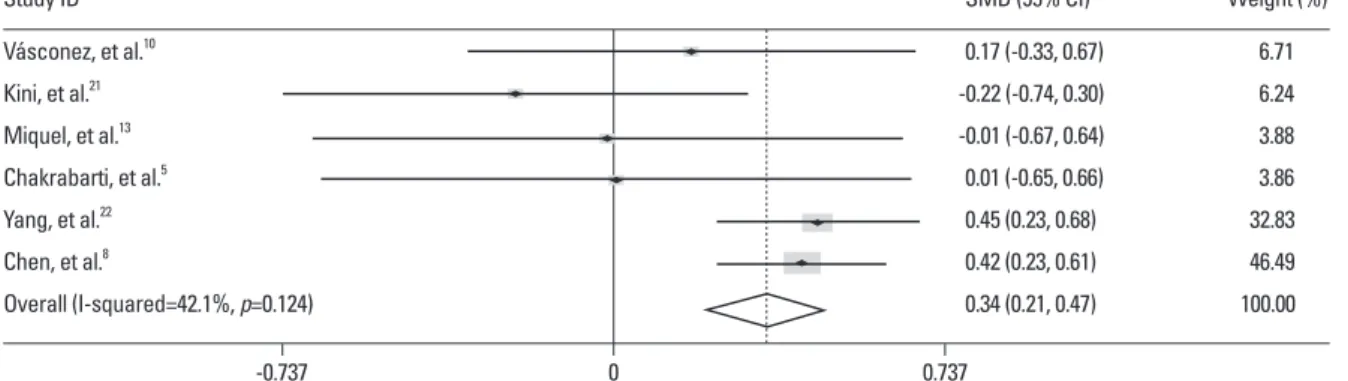
The overall analysis of 6 studies showed significant associa- tion between H. pylori infection and elevated blood ammo- nia levels in cirrhotic patients [standard means differences (SMD)=0.34, 95% CI=0.21-0.47, p=0.000]. There was no significant heterogeneity across the studies (I
2=42.1%, p=0.124) (Fig. 2).
Sensitivity analysis
After omitting one study which used arterial blood as a de- tection sample, the results were similar to the overall analy- sis (SMD=0.28, 95% CI=0.06-0.49, p=0.011) and without significant heterogeneity (p=0.107, I
2=47.4%). After ex- cluding one study which provided the data in the form of median and IQR, the association became more prominent (SMD=0.38, 95% CI=0.24-0.51, p=0.000) and without sig- nificant heterogeneity (p=0.427, I
2=0.0%).
the results for possible bias. Subgroup analysis was carried out to look at more narrowly drawn subsets of the studies.
In order to evaluate the effect of Child-Pugh class on the blood ammonia levels, a multivariate meta-regression analy- sis was performed by including other possibly confounding factors that may be relevant.
To investigate whether publication bias might affect the validity of the estimates, funnel plots were constructed. Fun- nel plot asymmetry was assessed by using Begg’s test and Egger test.
19,20All statistical tests were two-sided and we considered a p value <0.05 as an indicator of significance except where specifically noted. Software STATA version 11.0 (Stata Corporation, College Station, TX, USA) was used for all statistical analysis.
RESULTS
Literature search
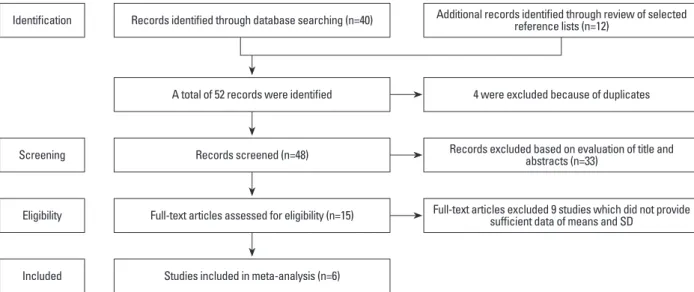
Primary literature search retrieved 48 records. After screen- ing the titles and abstracts, 33 studies were excluded because they were either laboratory studies, review articles, or irrele- vant to the current analysis. The remaining 15 studies were selected for detailed evaluation. Of them, 7 studies were ex- cluded because they did not provide sufficient data of means and SD after contacting original authors, 2 studies were ex- cluded because the data of ammonia provided was from gas- tric juice instead of blood levels. Therefore, 6 cohort stud- ies
5,8,10,13,21,22involved in 632 patients with H. pylori infection and 396 cirrhotic patients without H. pylori infection were fi- nally included in the present meta-analysis (Fig. 1).
Fig. 1. Flow diagram of the study selection process.
Identification
Screening
Eligibility
Included
Records identified through database searching (n=40)
A total of 52 records were identified
Records screened (n=48)
Full-text articles assessed for eligibility (n=15)
Studies included in meta-analysis (n=6)
Additional records identified through review of selected reference lists (n=12)
4 were excluded because of duplicates
Records excluded based on evaluation of title and abstracts (n=33)
Full-text articles excluded 9 studies which did not provide sufficient data of means and SD
Meta-regression analysis
In order to evaluate the effect of Child-Pugh class on the blood ammonia levels, we performed a multivariate meta-re- gression by including patients’ age, gender and ethnicity.
However, the results suggested that Child-Pugh B/C (coeffi- cient=-0.503, p=0.300) did not significantly affect the associ- ation between H. pylori infection and blood ammonia levels.
Subgroup analysis
We preformed subgroup analysis between Caucasian and Asian ethnicity, and the results showed significant associa- tion in Asian ethnicity (SMD=0.38, 95% CI=0.24-0.52) without significant heterogeneity (p=0.057), however, this association was not found in Caucasian ethnicity (SMD=
0.08, 95% CI=-0.26-0.42) and without significant heteroge- neity (p=0.877).
Publication bias
No publication bias was detected (Egger’s test: p=0.106, Begg’s test: p=0.260) (Fig. 3).
DISCUSSION
H. pylori, a bacterium which commonly infects human stomach, has urease activity which is many times more po- tent than that of enterobacteria.
23,24The H. pylori urease in the gastric juice breaks down urea into ammonia and car- bon dioxide, and the ammonia is then rapidly absorbed into the blood.
25Previous studies showed that ingestion of am- monia leads to a rise in arterial levels in half of normal sub- jects and in virtually all cirrhotic patients, the latter demon- strating a considerable increment with peak levels at 15 min.
26,27The different pattern of change of blood ammonia between normal subjects and cirrhotic patients may due to severe dysfunction of cirrhosis; the hepatic capacity of urea synthesis is significantly reduced.
28However, there are also several studies to show that blood ammonia levels are not significantly different between cirrhotic patients with and without H. pylori infection. Furthermore, although H. pylo- ri infection is able to generate ammonia in the stomach, the amount appears to be too small to affect blood ammonia levels.
11,29-31Generally, the inconsistent results among the studies may be due to inadequate statistical power of small sample size, ethnic differences, publication bias or others reasons. Meta-analysis is a powerful means to estimate the
true effect size as opposed to a less precise effect size de- Ta bl e 1. C ha ra ct er ist ic s o f S ix In cl ud ed S tu di es
Child-Pugh class EPOCPatients ofAmmonia ofPatients ofAmmonia of Study/CountryMale (n)HP detectionEtiology of cirrhosisSample detection (B/C) n (%)criteriaHP(+)HP(+)HP(-)HP(-) 10 Vásconez, et al./ HCV&HBV (49), 14 36 (58)C urea breath test 14 (21.9)Fasting venous blood5 32 47±24 30 43±22 USA Alcohol (13) Rapid urease test,21 Kini, et al./ 54 (93.1) histology staining, India14 C urea breath testAlcohol (9), HCV (4), HBV (4), HBV&HCV (2), others (39) 28 (48.3)Fasting venous blood6 31 29 (18-47) 2734 (15-48) Miquel, et al.13 / Spain 28 (75.7)14 C urea breath testAlcohol (16), HCV (12), alcoholic&HCV (4), HBV (2), HBV&HCV (1), others (1). 35 (94.6)Fasting venous blood5 2262.05±33 1562.5±33 Chakrabarti, et al.5 / Italy 39 (60.0)Rapid urease test, histology, and cultureHBV (21), HCV (7), alcohol (5), others (5) 29 (87.9)Arterial blood6 12 37.7±18.6 34 37.6±18.8 Yang, et al.22 / China 266 (72.3)IgG antibodies, rapid urease test, histology stainingNA281 (76.4)Fasting venous blood6258 79.3±61.8110 52.7±49.8 Chen, et al.8 / China337 (73.7)Rapid urease test, histology staining, 14 C urea breath testNA335 (73.3)Fasting venous blood7277 78.4±63.6180 53.8±51.4 HP, Helicobacter pylori; NA, not available; EPOC, Effective Practice and Organisation of Care.
maximal rate of urea synthesis becomes less than 30%.
28Because cirrhotic patients with Child-Pugh class B/C are prone to develop hyperammonemia compared to patients with Child-Pugh class A, we hypothesized that cirrhotic pa- tients with Child-Pugh class B/C are likely to affect the as- sociation between H. pylori infection and blood ammonia levels. In the present studies, however, the multivariate me- ta-regression analysis did not indicate that Child-Pugh class B/C can affect the association. Of note, due to limited origi- nal data available, we could not directly compare blood am- monia levels between patients with Child-Pugh class B/C and Child-Pugh class A. The effect of Child-Pugh class on the association between H. pylori infection and blood am- monia levels needs to be investigated in future studies. The prevalence of H. pylori infection is higher in developing countries than in developed countries.
32In the subgroup analysis, the results showed that the association of H. pylori infection and blood ammonia levels was significant in Asian ethnicity, but not in Caucasian ethnicity. Such discrepancy is very likely due to different prevalence of H. pylori infec- tion in Asian and Caucasian ethnicity, and the high infection of H. pylori in Asian ethnicity leads to a relatively higher ammonia production in the stomach, especially in cirrhotic patients. However, this conclusion should be interpreted with caution because of limited study number.
There are several study limitations. First, for accurate de- tection of H. pylori infection, at least two methods should be used.
33,34However, two of the six studies included used only one method to detect the status of H. pylori infection, even though we omitted them in sensitivity analysis to elim- inate the potential bias. Second, a few published studies are available, thus affecting the statistical power to detect sig- nificant findings. Third, the etiology of cirrhosis in the in- cluded studies was diverse, possibly undermining the ro- bustness of the results and also making it uncertain whether rived in a single study under a given single set of assump-
tions and conditions.
18In the present meta-analysis, the number of patients with or without H. pylori infection was 632 and 396, respective- ly, which provided more reliable estimates. Meanwhile, the negligibility of heterogeneity suggested the uniformity of the studies included in regard with patients selection, diag- nosis and design, etc. Furthermore, we performed sensitivi- ty analysis to further test the robust of the overall results, and confirmed significant association of the overall results.
However, SMD expresses the size of the intervention effect by standardized the variability of each study but it is not in- dicate the real differences among study, therefore, the vaule 0.34 of SMD in the present study is not indicate the abso- lute difference of blood ammonia levels and cannot directly be used for clinical application.
Child-Pugh class has been widely used as a descriptive indicator of chronic liver disease. At the stage of Child- Pugh class B/C, the capacity of urea synthesis is reduced significantly, and hyperammonemia will occur when the
Fig. 2. Meta-analysis of nine included studies. SMD, standard means differences; CI, confidence intervals.
Fig. 3. Funnel Plot of the Meta-Analysis (Beggʼs test). SMD, standard means differences.
Study ID
-0.737 0 0.737
Vásconez, et al.10 Kini, et al.21 Miquel, et al.13 Chakrabarti, et al.5 Yang, et al.22 Chen, et al.8
Overall (I-squared=42.1%, p=0.124)
SMD (95% CI) 0.17 (-0.33, 0.67) -0.22 (-0.74, 0.30) -0.01 (-0.67, 0.64) 0.01 (-0.65, 0.66) 0.45 (0.23, 0.68) 0.42 (0.23, 0.61) 0.34 (0.21, 0.47)
Weight (%) 6.71 6.24 3.88 3.86 32.83 46.49 100.00
-0.5 0 0.5 1
SMD
0 0.2 0.4
s.e. of: SMD
dez RM, et al. Helicobacter pylori, hyperammonemia and subclin- ical portosystemic encephalopathy: effects of eradication. J Hepa- tol 1999;30:260-4.
11. Zullo A, Hassan C, Morini S. Helicobacter pylori infection in pa- tients with liver cirrhosis: facts and fictions. Dig Liver Dis 2003;
35:197-205.
12. Zullo A, Rinaldi V, Efrati C, Hassan C, Caroli S, Riggio O, et al.
Zinc, ammonia, and Helicobacter pylori infection in liver cirrho- sis. Dig Liver Dis 2000;32:836-8.
13. Miquel J, Barcena R, Boixeda D, Fernández J, SanRoman AL, Martín-de-Argila C, et al. Role of Helicobacter pylori infection and its eradication in patients with subclinical hepatic encephalop- athy. Eur J Gastroenterol Hepatol 2001;13:1067-72.
14. Moher D, Liberati A, Tetzlaff J, Altman DG; PRISMA Group.
Preferred reporting items for systematic reviews and meta-analy- ses: the PRISMA statement. PLoS Med 2009;6:e1000097.
15. Group CEPaOoC. EPOC resources for review authors. [accessed on 2011 July 5]. Available at: http://epoc.cochrane.org/epoc-re- sources.
16. DerSimonian R, Laird N. Meta-analysis in clinical trials. Control Clin Trials 1986;7:177-88.
17. Higgins JPT, Green S. Cochrane Handbook for Systematic Re- views of Interventions Version 5.0.1. 2008. The Cochrane Callab- oration. Available at: http://www.cochrane-handbook.org.
18. Normand SL. Meta-analysis: formulating, evaluating, combining, and reporting. Stat Med 1999;18:321-59.
19. Egger M, Davey Smith G, Schneider M, Minder C. Bias in meta- analysis detected by a simple, graphical test. BMJ 1997;315:629-34.
20. Begg CB, Mazumdar M. Operating characteristics of a rank cor- relation test for publication bias. Biometrics 1994;50:1088-101.
21. Kini D, Aggarwal R, Saraswat VA, Naik SR. Role of Helicobacter pylori infection in hyperammonemia and subclinical hepatic en- cephalopathy in cirrhosis of liver. Indian J Gastroenterol 2001;20:
237-40.
22. Yang CS, Cao SY, He XJ, Wang YX, Zhang YL. [Study of corre- lation between Helicobacter pylori infection and hyperammone- mia and hepatic encephalopathy in cirrhotic patients]. Zhongguo Wei Zhong Bing Ji Jiu Yi Xue 2007;19:422-4.
23. Dunn BE, Campbell GP, Perez-Perez GI, Blaser MJ. Purification and characterization of urease from Helicobacter pylori. J Biol Chem 1990;265:9464-9.
24. Turbett GR, Nandapalan N, Campbell IG, Nikoletti SM, Mee BJ.
Characterisation of the urease from Helicobacter pylori and com- parison with the ureases from related spiral gastric bacteria. FEMS Microbiol Immunol 1991;3:19-24.
25. Neithercut WD, Rowe PA, el Nujumi AM, Dahill S, McColl KE.
Effect of Helicobacter pylori infection on intragastric urea and ammonium concentrations in patients with chronic renal failure. J Clin Pathol 1993;46:544-7.
26. Evans WB, Aoyagi T, Summerskill WH. Gastrointestinal urease in man. II. Urea hydrolysis and ammonia absorption in upper and lower gut lumen and the effect of neomycin. Gut 1966;7:635-9.
27. Conn HO. Studies of the source and significance of blood ammo- nia. IV. Early ammonia peaks after ingestion of ammonium salts.
Yale J Biol Med 1972;45:543-9.
28. Rudman D, DiFulco TJ, Galambos JT, Smith RB 3rd, Salam AA, Warren WD. Maximal rates of excretion and synthesis of urea in normal and cirrhotic subjects. J Clin Invest 1973;52:2241-9.
29. Huber M, Rössle M, Siegerstetter V, Ochs A, Haag K, Kist M, et al. Helicobacter pylori infection does not correlate with plasma
these results can be extrapolated to cirrhotic patients with single etiology. Fourth, due to limited information avail- able, the etiology of cirrhosis, the number of H. pylori and their distribution in the stomach, gastric pH, gastric mem- brane permeability to ammonia, and portal vein branch cir- culation were not included in our analysis. These factors are considered to be a major threat to the validity of inferences made on the cause and the effect.
35Finally, converting non- normally distributed statistics (median and range) to nor- mally distributed statistics (means and SD) in our analysis could be a cause of bias.
In summary, our results suggested that H. pylori infection is associated with elevated blood ammonia levels in cirrhot- ic patients. And this association seems to be more prominent in Asian ethnicity than Caucasian ethnicity. However, be- cause of the limited number of published studies and meth- odological flaws of the studies included, more large ran- domized studies are warranted in order to further confirm this association.
REFERENCES
1. Souba WW. Interorgan ammonia metabolism in health and disease:
a surgeon’s view. JPEN J Parenter Enteral Nutr 1987;11:569-79.
2. LeVeen HH, LeVeen EG, LeVeen RF. Awakenings to the pathoge- nicity of urease and the requirement for continuous long term therapy. Biomed Pharmacother 1994;48:157-66.
3. Demirtürk L, Yazgan Y, zci O, Ozel M, Toğrol E, Gültepe M, et al.
The effect of Helicobacter pylori eradication on gastric juice and blood ammonia concentrations and on visual evoked potentials in cirrhotics. Helicobacter 2001;6:325-30.
4. Queiroz DM, Rocha AM, Rocha GA, Cinque SM, Oliveira AG, Godoy A, et al. Association between Helicobacter pylori infection and cirrhosis in patients with chronic hepatitis C virus. Dig Dis Sci 2006;51:370-3.
5. Chakrabarti P, Zullo A, Hassan C, Pandit A, Chowdhury A, Santra A, et al. Helicobacter pylori, gastric juice, and arterial ammonia lev- els in patients with cirrhosis. J Clin Gastroenterol 2002;34:578-81.
6. Dasani BM, Sigal SH, Lieber CS. Analysis of risk factors for chronic hepatic encephalopathy: the role of Helicobacter pylori in- fection. Am J Gastroenterol 1998;93:726-31.
7. Miyaji H, Ito S, Azuma T, Ito Y, Yamazaki Y, Ohtaki Y, et al. Ef- fects of Helicobacter pylori eradication therapy on hyperam- monaemia in patients with liver cirrhosis. Gut 1997;40:726-30.
8. Chen SJ, Wang LJ, Zhu Q, Cai JT, Chen T, Si JM. Effect of H py- lori infection and its eradication on hyperammo-nemia and hepatic encephalopathy in cirrhotic patients. World J Gastroenterol 2008;
14:1914-8.
9. Abdel-Hady H, Zaki A, Badra G, Lotfy M, Selmi C, Giorgini A, et al. Helicobacter pylori infection in hepatic encephalopathy: re- lationship to plasma endotoxins and blood ammonia. Hepatol Res 2007;37:1026-33.
10. Vásconez C, Elizalde JI, Llach J, Ginès A, de la Rosa C, Fernán-
meat-eaters. Epidemiol Infect 1992;108:457-62.
33. Nardone G, Coscione P, D’Armiento FP, Del Pezzo M, Pontillo M, Mossetti G, et al. Cirrhosis negatively affects the efficiency of se- rologic diagnosis of Helicobacter pylori infection. Ital J Gastroen- terol 1996;28:332-6.
34. Taylor-Robinson SD, Jackson N, Buckley C. Helicobacter pylori, ammonia and the brain. Gut 1997;40:805-6.
35. Johnston SC. Identifying confounding by indication through blinded prospective review. Am J Epidemiol 2001;154:276-84.
ammonia concentration and hepatic encephalopathy in patients with cirrhosis. Hepatogastroenterology 2001;48:541-4.
30. DuBois S, Eng S, Bhattacharya R, Rulyak S, Hubbard T, Putnam D, et al. Breath ammonia testing for diagnosis of hepatic encepha- lopathy. Dig Dis Sci 2005;50:1780-4.
31. Calvet X, Nogueras C, Roqué M, Sanfeliu I. Helicobacter pylori is not a risk factor for hepatic encephalopathy. Dig Liver Dis 2001;33:414-9.
32. Webberley MJ, Webberley JM, Newell DG, Lowe P, Melikian V.
Seroepidemiology of Helicobacter pylori infection in vegans and