2014, Vol. 58, No. 1
Printed in the Republic of Korea http://dx.doi.org/10.5012/jkcs.2014.58.1.33
Synthesis and in Vitro Antimicrobial Evaluation of Benzothiazole Incorporated Thiazolidin-4-ones Derivatives
Shikha Agarwal*, Dinesh Kumar Agarwal†, Naveen Gautam‡, Kshamta Agarwal§, and Dinesh Chandra Gautam§
Department of Chemistry, Mohan Lal Sukhadia University, Udaipur-313001, India. *E-mail: [email protected]
†Department of Pharmacology, Arya College of Pharmacy, Jaipur-303101, India
‡Department of Chemistry, L.B.S. Govt. P.G. College, Kotputli-303108, Jaipur, India
§Department of Chemistry, University of Rajasthan, Jaipur-302004, India (Received September 1, 2013; Accepted November 14, 2013)
ABSTRACT. In the course of work on new pharmacologically active antimicrobial agents, we have reported the synthesis of a new class of structurally novel derivatives, incorporating two bioactive structures, a benzothiazole and thiazolidin-4-one, to yield a class of compounds having interesting antimicrobial properties. The antimicrobial properties of the synthesized com- pounds were investigated against bacteria (Staphylococcus aureus and Escherchia coli) and fungi (Candida albicans and Aspergillus niger) using serial plate dilution method. The structure of the synthesized compounds have been established by elemental analysis and spectroscopic data.
Key words: Benzothiazole, Thiazolidin-4-ones, N-(5,7-dimethylbenzo[d]thiazol-2-yl)hydrazine carboxamide, Antimicrobial activity
INTRODUCTION
Nitrogen heterocycles are the basis of many essential pharmaceuticals and of many physiologically active nat- ural products. Despite the numerous attempts to develop new structural prototype in the search for effective anti- microbials, benzothiazole still remain as one of the most versatile class of compounds against microbes and there- fore, are useful substructures for further molecular explo- ration. Benzothiazole derivatives have attracted continuing interest because of their varied biological activities viz.
antitubercular,1,2 antihelmintic,3 anti-inflammatory,4 anti- microbial,5,6 and antiviral.7 Thiazolidin-4-one derivatives are known to exhibit diverse biological activities such as antimicrobial,8−14 anticonvulsant,15,16 antihistaminic,17,18 and antioxidant.19 In continuation of our interest in the syn- thesis of heterocycles containing benzothiazole moiety, to identify new candidates that may be of value in designing new, potent, selective, and less toxic antimicrobial agents, we report here the synthesis and antimicrobial evaluation of some novel structural hybrids incorporating the ben- zothiazole moiety with thiazolidin-4-one ring systems through different linkages. This combination was taken in an attempt to investigate the influence of such hybridization and struc- tural variation on the anticipated antimicrobial activity, hoping to add some synergistic biological importance to the target molecules. The substitution pattern of thiazo-
lidin-4-one rings was carefully chosen so as to confer var- ied electronic environment to the molecules.
EXPERIMENTAL
Melting points (m.p.) of the synthesized compounds were determined in open capillary tubes and were uncor- rected. All the compounds were subjected to elemental analysis (CHN) by Perkin Elmer 2400 CHN analyzer and the measured values agreed within ±0.4% with the cal- culated ones. The IR spectra were recorded in KBr pellets on SCHIMADZU 8400 S FTIR spectrophotometer. 1H NMR and 13C NMR spectra were obtained from JEOL AL 300 FT NMR using TMS as internal standard in CDCl3/DMSO-d6. The mass spectra were recorded on JEOL SX 102/DA600 using Argon/Xenon as FAB gas. The purity of synthesized compounds were checked by TLC using Silica gel “G” as adsorbent and visualization was accomplished by UV light or iodine.
Synthesis of 3,5-Dimethylphenylthiourea 2
3,5-dimethylaniline 1 (0.1 mol), hydrochloric acid (9 ml), and water (25 ml) were taken and refluxed for 30 min in a round bottomed flask. The contents were cooled down to room temperature and then ammonium thiocyanate (0.1 mol) was added. The reaction mixture was again refluxed for 4 h. The solid obtained was cooled down, filtered,
washed well with water, dried, and crystallized from eth- anol.
Synthesis of 2-Amino-5,7-dimethylbenzothiazole 3 In a round-bottomed flask equipped with a mechanical stirrer and a dropping funnel, 5,7-dimethyl phenylthio- urea 2 (0.1 mol) and chloroform (100 ml) were taken. A solution of bromine (0.1 mol) in chloroform (100 ml) was added dropwise with stirring for a period of two hours.
Temperature of reaction mixture remains below 5oC dur- ing the reaction. Stirring was continued for a period of 4 h.
After the addition of bromine solution, the contents of round-bottomed flask were refluxed for about 4 h till the evolution of HBr ceased. The solid obtained was treated with SO2 water and filtered. The filtrate was neutralized with aqueous ammonia solution. The precipitate was fil- tered, washed well with water, and crystallized from eth- anol.
Synthesis of 1-(5,7-Dimethylbenzo[d]thiazol-2-yl)urea 4 To the solution of sodium cyanate, dissolved in mini- mum quantity of water, glacial acetic acid (5 ml) was added.
An alcoholic solution of 2-amino-5,7-dimethylbenzothi- azole 3 was added and the solution was heated till the con- tents of the mixture became turbid and the volume reduced to half of the original. The contents were further added to ice cool water. The solid obtained was filtered off, dried and recrystallized from a suitable solvent. White solid; Yield:
90%; m.p. 132oC; Anal. Calcd. for C10H11N3OS: C, 54.29; H, 4.97; N, 19.00%. Found: C, 54.23; H, 4.90; N, 19.08%; IR (KBr) (νmax/cm−1): 3300 (NH), 1630 (C=O), 1565 (C=N), 645 (C−S−C benzothiazole); 1H NMR (300 MHz, DMSO-d6, δ/ppm): 9.12 (1H, s, NHC=O), 6.65−6.89 (2H, m, Ar−H), 6.35 (2H, s, NH2); MS, m/z (%) 221 (M+).
Synthesis of N-(5,7-Dimethylbenzo[d]thiazol-2-yl)hydra- zine Carboxamide 5
A mixture of compound 4 and hydrazine hydrate (1:1 mol) was dissolved in methanol at room temperature. To the solution, conc. NaOH was added and refluxed for 6 h.
The reaction mixture was poured into crushed ice and the solid obtained was filtered off, dried and recrystallized from a suitable solvent. Light solid; Yield: 85%; m.p.141oC;
Anal. Calcd. for C10H12N4OS: C, 50.84; H, 5.08; N, 23.72%.
Found: C, 50.80; H, 5.14; N, 23.80 %; IR (KBr) (νmax/cm−1):
3305 (NH), 1650 (C=O), 1575 (C=N), 652 (C−S−C ben- zothiazole); 1H NMR (300 MHz, DMSO-d6, δ/ppm): 9.15 (1H, s, NHC=O), 7.50−7.80 (2H, m, Ar−H), 6.35 (2H, s, NH2), 7.30 (1H, s, NHNH2); MS, m/z (%) 236 (M+).
Synthesis of 2-Substituted Benzylidene-N-(5,7-dime- thylbenzo[d]thiazol-2-yl)hydrazine Carboxamide 6a−h A equimolar mixture of 5 (0.1 mol) and substituted ben- zaldehyde (0.1 mol) was dissolved in methanol at room temperature. Few drops of glacial acetic acid was added to the reaction mixture and was then refluxed on a water bath for 5−6 h and was then allowed to cool, poured onto crushed ice and recrystallized from methanol.
2-Benzylidene-N-(5,7-dimethylbenzo[d]thiazol-2-yl) hydrazine carboxamide 6a
Yellow solid; Yield: 74%; m.p. 151oC; Anal. calcd. for C17H16N4OS: C, 62.96; H, 4.93; N, 17.28%. Found: C, 63.01; H, 4.98; N,17.40%; IR (KBr) (νmax/cm−1): 3320 (NH), 1670 (C=O), 1590 (C=N), 665 (C−S−C benzothi- azole); 1H NMR (300 MHz, DMSO-d6δ/ppm): 9.14 (1H, s, NHC=O), 7.75−7.90 (7H, m, Ar−H), 6.08 (1H, s, NH), 7.95 (1H, s, N=CH); MS, m/z (%) 324 (M+).
N-(5,7-dimethylbenzo[d]thiazol-2-yl)-2-(2-chloroben- zylidene) hydrazine carboxamide 6b
White solid; Yield: 70%; m.p. 172oC; Anal. Calcd. for C17H15ClN4OS: C, 56.90; H, 4.18; N, 15.62%. Found: C, 56.99; H, 4.25; N, 15.75%; IR (KBr) (νmax/cm−1): 3318 (NH), 1675 (C=O), 1585 (C=N), 655 (C−S−C benzothi- azole); 1H NMR (300 MHz, DMSO-d6, δ/ppm): 9.15 (1H, s, NHC=O), 7.70−7.82 (6H, m, Ar−H), 6.10 (1H, s, NH), 7.98 (1H, s, N=CH); MS, m/z (%) 358.5 (M+).
N-(5,7-dimethylbenzo[d]thiazol-2-yl)-2-(2,4-dichlo- robenzylidene)hydrazinecarboxamide 6c
Dirty white solid; Yield: 72%; m.p. 136oC; Anal. Calcd.
for C17H14Cl2N4OS: C, 51.90; H, 3.56; N, 14.24%. Found:
C, 51.98; H, 3.65; N, 14.34%; IR (KBr) (νmax/cm−1): 3320 (NH), 1665 (C=O), 1582 (C=N), 661 (C−S−C benzothi- azole); 1H NMR (300 MHz, DMSO-d6, δ/ppm): 9.16 (1H, s, NHC=O), 7.75−7.88 (5H, m, Ar−H), 6.15 (1H, s, NH), 7.96 (1H, s, N=CH); MS, m/z (%) 393 (M+).
N-(5,7-dimethylbenzo[d]thiazol-2-yl)-2-(2-methylben- zylidene) hydrazine carboxamide 6d
Light brown solid; Yield: 65%; m.p. 145oC; Anal. Calcd.
for C18H18N4OS: C, 63.90; H, 5.32; N, 16.56%. Found: C, 63.75; H, 5.44; N, 16.70%; IR (KBr) (νmax/cm−1): 3310 (NH), 1668 (C=O), 1585 (C=N), 645 (C−S−C benzothiazole);
1H NMR (300 MHz, DMSO-d6, δ/ppm): 9.12 (1H, s, NHC=O), 7.72−7.80 (6H, m, Ar−H), 6.16 (1H, s, NH), 7.98 (1H, s, N=CH); MS, m/z (%) 338 (M+).
N-(5,7-dimethylbenzo[d]thiazol-2-yl)-2-(4-methoxyben- zylidene) hydrazine carboxamide 6e
White solid; Yield: 68%; m.p. 157oC; Anal. Calcd. for C18H18N4O2S: C, 61.01; H, 5.08; N, 15.81%. Found: C, 61.12; H, 5.02; N, 15.91%; IR (KBr) (νmax/cm−1): 3317
(NH), 1660 (C=O), 1582 (C=N), 652 (C−S−C benzothi- azole); 1H NMR (300 MHz, DMSO-d6, δ/ppm): 9.10 (1H, s, NHC=O), 7.75−7.82 (6H, m, Ar−H), 6.17 (1H, s, NH), 7.96 (1H, s, N=CH); MS, m/z (%) 354 (M+).
N-(5,7-dimethylbenzo[d]thiazol-2-yl)-2-(4-nitroben- zylidene) hydrazine carboxamide 6f
Dirty white solid; Yield: 58%; m.p. 162oC; Anal. Calcd.
for C17H15N5O3S: C, 55.28; H, 4.06; N, 18.97%. Found:
C, 55.42; H, 4.15; N, 18.80%; IR (KBr) (νmax/cm−1): 3320 (NH), 1670 (C=O), 1588 (C=N), 650 (C−S−C benzothiaz- ole); 1H NMR (300 MHz, DMSO-d6, δ/ppm): 9.15 (1H, s, NHC=O), 7.75−7.85 (6H, m, Ar−H), 6.25 (1H, s, NH), 7.95 (1H, s, N=CH); MS, m/z (%) 369 (M+).
N-(5,7-dimethylbenzo[d]thiazol-2-yl)-2-(2-hydroxy- benzylidene) hydrazine carboxamide 6g
Yellow solid; Yield: 79%; m.p. 180oC; Anal. Calcd. for C17H16N4O2S: C, 60.00; H, 4.70; N, 16.47%. Found: C, 60.15; H, 4.82; N, 16.6%; IR (KBr) (νmax/cm−1): 3315 (NH), 1663 (C=O), 1585 (C=N), 650 (C−S−C benzothiazole); 1H NMR (300 MHz, DMSO-d6, δ/ppm): 9.12 (1H, s, NHC=O), 7.70−7.80 (6H, m, Ar−H), 6.15 (1H, s, NH), 7.98 (1H, s, N=CH); MS, m/z (%) 340 (M+).
N-(5,7-dimethylbenzo[d]thiazol-2-yl)-2-(2-bromoben- zylidene)hydrazine carboxamide 6h
Pale yellow solid; Yield: 65%; m.p. 138oC; Anal. Calcd.
for C17H15BrN4OS: C, 50.62; H, 3.72; N, 13.89%. Found:
C, 50.47; H, 3.85; N, 13.80%; IR (KBr) (νmax/cm−1): 3315 (NH), 1665 (C=O), 1589 (C=N), 651 (C−S−C benzothi- azole); 1H NMR (300 MHz, DMSO-d6, δ/ppm): 9.15 (1H, s, NHC=O), 7.75−7.92 (6H, m, Ar−H), 6.15 (1H, s, NH), 7.95 (1H, s, N=CH); MS, m/z (%) 403 (M+).
Synthesis of 1-(5,7-Dimethylbenzo[d]thiazol-2-yl)-3-(4- oxo-2-substituted phenylthiazolidin-3-yl) urea 7a−h
A mixture of 6 (0.01 mol) and thioglycolic acid (0.01 mol) was dissolved in methanol, with a pinch of anhydrous ZnCl2, was refluxed for 15 h. The reaction mixture was cooled to room temperature and then poured onto crushed ice. It was set aside at room temperature overnight. The solid thus separated was filtered, washed several times with water and recrystallized from methanol.
1-(5,7-Dimethylbenzo[d]thiazol-2-yl)-3-(4-oxo-2-phe- nylthiazolidin-3-yl) urea 7a
White solid; Yield: 77%; m.p. 220oC; Anal. Calcd. for C19H18N4O2S2: C, 57.28; H, 4.52; N, 14.07%. Found: C, 57.35; H, 4.65; N, 14.20%; IR (KBr) (νmax/cm−1): 3210 (NH), 3125 (C−H aromatic), 1725 (C=O thiazolidinone), 1660 (C=O), 1540 (C=C aromatic), 1442 (C−N benzothiazole), 690 (C−S−
C thiazolidinone), 615 (C−S−C benzothiazole); 1H NMR
(300 MHz, DMSO-d6, δ/ppm): 11.80 (1H, s, CONH), 8.05 (1H, s, NH), 7.62−7.80 (7H, m, Ar−H), 2.46 (2H, s, CH2
thiazolidinone); 13CNMR (300 MHz, DMSO-d6, δ/ppm):
174.5, 168.8, 153.3, 147.8, 129.2, 134.2, 127.1, 131.5, 129.0, 138.3, 128.9, 128.4, 126.9, 128.5, 128.9, 56.8, 38.0 (CH2 thiazolidinone), 21.0, 17.2; MS, m/z (%) 398 (M+).
1-(5,7-Dimethylbenzo[d]thiazol-2-yl)-3-(2-(2-chlorophe- nyl)-4-oxo-thiazolidin-3-yl)urea 7b
Yellow solid; Yield: 75%; m.p. 238oC; Anal. Calcd. for C19H17ClN4O2S2: C, 52.71; H, 3.93; N, 12.94%. Found: C, 52.82; H, 3.76; N, 13.03%; IR (KBr) (νmax/cm−1): 3208 (NH), 3120 (C−H aromatic), 1720 (C=O thiazolidinone), 1666 (C=O), 1545 (C=C aromatic), 1440 (C−N benzothi- azole), 695 (C−S−C thiazolidinone), 619 (C−S−C benzothi- azole); 1H NMR (300 MHz, DMSO-d6, δ/ppm): 11.81 (1H, s, CONH), 8.02 (1H, s, NH), 7.55−7.72 (6H, m, Ar−H), 2.44 (2H, s, CH2 thiazolidinone); 13C NMR (300 MHz, DMSO- d6, δ/ppm): 174.5, 168.8, 154.3, 147.9, 129.8, 134.2, 127.2, 131.8, 120.3, 138.7, 134.2, 128.9, 128.2, 126.5, 130.3, 48.8, 37.5 (CH2 thiazolidinone), 21.2, 17.6; MS, m/z (%) 432.5 (M+).
1-(5,7-Dimethylbenzo[d]thiazol-2-yl)-3-(2-(2,4-dichlo- rophenyl)-4-oxo-thiazolidin-3-yl)urea 7c
Light brown solid; Yield: 68%; m.p. 212oC; Anal. Calcd.
for C19H16Cl2N4O2S2: C, 58.25; H, 3.42; N, 11.99%. Found:
C, 58.41; H, 3.55; N, 12.12%; IR (KBr) (νmax/cm−1): 3215 (NH), 3110 (C−H aromatic), 1732 (C=O thiazolidinone), 1660 (C=O), 1530 (C=C aromatic), 1425 (C−N benzothi- azole), 678 (C−S−C thiazolidinone), 610 (C−S−C benzothi- azole); 1H NMR (300 MHz, DMSO-d6, δ/ppm): 11.85 (1H, s, CONH), 8.02 (1H, s, NH), 7.62−7.80 (6H, m, Ar−H), 2.45 (2H, s, CH2 thiazolidinone); 13C NMR (300 MHz, DMSO- d6, δ/ppm): 174.5, 168.9, 154.0, 149.2, 129.0, 134.5, 127.0, 131.2, 129.5, 136.8, 135.6, 129.2, 133.6, 126.5, 130.2, 48.7, 37.2 (CH2 thiazolidinone), 20.2, 15.6; MS, m/z (%) 467 (M+).
1-(5,7-Dimethylbenzo[d]thiazol-2-yl)-3-(4-oxo-2-o-tolyl- thiazolidin-3-yl)urea 7d
Yellow solid; Yield: 70%; m.p. 245oC; Anal. calcd. for C20H20N4O2S2: C, 58.25; H, 4.85; N, 13.59%. Found: C, 58.41; H, 4.91; N, 13.70%; IR (KBr) (νmax/cm−1): 3220 (NH), 3115 (C−H aromatic), 1730 (C=O thiazolidinone), 1670 (C=O), 1532 (C=C aromatic), 1425 (C−N benzothi- azole), 690 (C−S−C thiazolidinone), 608 (C−S−C benzothi- azole); 1H NMR (300 MHz, DMSO-d6, δ/ppm): 11.75 (1H, s, CONH), 8.02 (1H, s, NH), 7.65−7.79 (6H, m, Ar−H), 2.45 (2H, s, CH2 thiazolidinone), 2.25 (3H, s, CH3); 13C NMR (300 MHz, DMSO-d6, δ/ppm): 174.5, 168.9, 154.5, 147.2, 130.0, 134.5, 127.9, 130.2, 129.5, 139.0, 138.1, 129.1, 126.8, 129.4, 128.8, 58.2, 38.2 (CH2 thiazolidinone), 20.2, 15.6,
14.5; MS, m/z (%) 412 (M+).
1-(5,7-Dimethylbenzo[d]thiazol-2-yl)-3-(2-(2-meth- oxyphenyl)-4-oxo-thiazolidin-3-yl)urea 7e
White solid; Yield: 59%; m.p. 278oC; Anal. Calcd. for C20H20N4O3S2: C, 56.07; H, 4.67; N, 13.08%. Found: C, 56.17; H, 4.78; N, 13.01%; IR (KBr) (νmax/cm−1): 3228 (NH), 3120 (C−H aromatic), 1722 (C=O thiazolidinone), 1672 (C=O), 1545 (C=C aromatic), 1433 (C−N benzothi- azole), 690 (C−S−C thiazolidinone), 608 (C−S−C benzothi- azole); 1H NMR (300 MHz, DMSO-d6, δ/ppm): 11.80 (1H, s, CONH), 8.05 (1H, s, NH), 7.65−7.72 (6H, m, Ar−H), 2.53 (2H, s, CH2 thiazolidinone), 3.85 (1H, s, OCH3); 13C NMR (300 MHz, DMSO-d6, δ/ppm): 174.5, 168.5, 154.0, 149.2, 129.5, 134.8, 128.5, 131.6, 129.0, 128.9, 160.2, 125.0, 127.9, 120.7, 129.9, 56.9, 36.5 (CH2 thiazolidinone), 21.2, 15.6, 56.3 (OCH3); MS, m/z (%) 428 (M+).
1-(5,7-Dimethylbenzo[d]thiazol-2-yl)-3-(2-(4-nitrophenyl)- 4-oxo-thiazolidin-3-yl)urea 7f
Pale yellow solid; Yield: 52%; m.p. 215oC; Anal. Calcd.
for C19H17N5O4S2: C, 51.46; H, 3.83; N, 15.80%. Found:
C, 51.35; H, 3.92; N, 15.89%; IR (KBr) (νmax/cm−1): 3235 (NH), 3140 (C−H aromatic), 1739 (C=O thiazolidinone), 1690 (C=O), 1554 (C=C aromatic), 1460 (C−N benzothiazole), 690 (C−S−C thiazolidinone), 621 (C−S−C benzothiazole), 1367 (NO2); 1H NMR (300 MHz, DMSO-d6, δ/ppm): 11.75 (1H, s, CONH), 8.10 (1H, s, NH), 7.52−7.59 (6H, m, Ar−H), 2.56 (2H, s, CH2 thiazolidinone); 13C NMR (300 MHz, DMSO-d6, δ/ppm): 174.5, 168.8, 153.8, 148.2, 129.0, 134.1, 126.9, 131.8, 129.2, 133.4, 147.2, 123.5, 127.8, 134.5, 129.5, 48.2, 38.5 (CH2 thiazolidinone), 20.5, 15.0; MS, m/z (%) 443 (M+).
1-(5,7-Dimethylbenzo[d]thiazol-2-yl)-3-(2-(2-hydrox- yphenyl)-4-oxo-thiazolidin-3-yl)urea 7g
White solid; Yield: 68%; m.p. 203oC; Anal. Calcd. for C19H18N4O3S2: C, 55.07; H,4.34; N, 13.52%. Found: C, 55.21; H, 4.43; N, 13.41%; IR (KBr) (νmax/cm−1): 3231 (NH), 3135 (C−H aromatic), 1736 (C=O thiazolidinone), 1687 (C=O), 1548 (C=C aromatic), 1447 (C−N benzothiazole), 696 (C−S−
C thiazolidinone), 617 (C−S−C benzothiazole); 1H NMR (300 MHz, DMSO-d6, δ/ppm): 11.68 (1H, s, CONH), 8.02 (1H, s, NH), 7.45−7.51 (6H, m, Ar−H), 2.48 (2H, s, CH2
thiazolidinone); 13C NMR (300 MHz, DMSO-d6, δ/ppm):
174.5, 168.5, 154.3, 149.0, 129.2, 134.5, 127.2, 131.5, 128.5, 141.5, 132.5, 131.0, 129.1, 127.4, 131.6, 49.2, 35.6 (CH2
thiazolidinone), 20.5, 15.2; MS, m/z (%) 414 (M+).
1-(5,7-Dimethylbenzo[d]thiazol-2-yl)-3-(2-(2-bromophe- nyl)-4-oxo-thiazolidin-3-yl)urea 7h
Brownish yellow solid; Yield: 62%; m.p. 220oC; Anal.
calcd. for C19H18BrN4O2S2: C, 47.79; H, 3.56; N, 11.74%.
Found: C, 47.93; H, 3.67; N, 11.70%; IR (KBr) (νmax/cm−1):
3242 (NH), 3125 (C−H aromatic), 1729 (C=O thiazolidinone), 1688 (C=O), 1552 (C=C aromatic), 1442 (C−N benzothiazole), 698 (C−S−C thiazolidinone), 620 (C−S−C benzothiazole);
1H NMR (300 MHz, DMSO-d6, δ/ppm): 11.62 (1H, s, CONH), 8.11 (1H, s, NH), 7.44−7.55 (6H, m, Ar−H), 2.53 (2H, s, CH2
thiazolidinone); 13C NMR (300 MHz, DMSO-d6, δ/ppm):
174.5, 168.9, 153.0, 148.2, 129.0, 134.5, 129.0, 130.6, 129.2, 157.6, 120.5, 131.8, 129.1,130.2, 129.2, 52.3, 39.2 (CH2 thiazolidinone), 21.2, 15.9; MS, m/z (%) 477 (M+).
BIOLOGICAL STUDY
The synthesized compounds 7a−h were tested for their in vitro antimicrobial activity against the Gram positive bacteria Staphylococcus aureus and the Gram negative bacteria Escherchia coli in nutrient agar media and fungi (Candida albicans and Aspergillus niger) in Sabouraud dextrose medium at 200, 100, 50, 25 and 12.5 µgmL−1 by using serial plate dilution method in DMSO. Standard antibiotics ofloxacin and ketoconazole were used as ref- erence drugs at 50, 25 and 12.5 µgmL−1 concentrations. The MIC’S (minimum inhibitory concentration) values were determined by comparison to ofloxacin and ketoconazole as the standard drugs for bacterial and fungal activity respec- tively.
RESULTS AND DISCUSSION
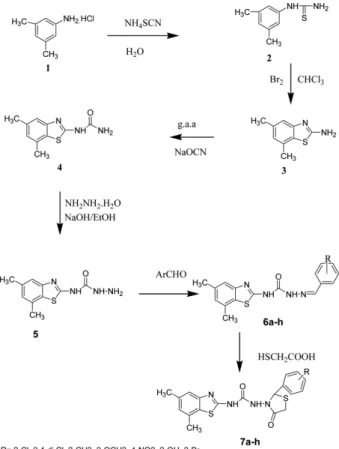
The synthesis of compounds 6a−h was accomplished by reacting N-(5,7-dimethylbenzo[d]thiazol-2-yl)hydrazine carboxamide 5 with substituted aromatic aldehydes in eth- anol. The salt 6a−h underwent ring closure via conden- sation with thioglycollic acid to give 1-(5,7-dimethyl benzo [d]thiazol-2-yl)-3-(4-oxo-2-substituted phenyl thiazolidin-3- yl) urea 7a−h. The synthetic pathway followed for the syn- thesis of the title compounds is described in Scheme 1.
The structure of the synthesized compounds was con- firmed by elemental analysis and spectral data (IR, 1H NMR,
13C NMR and MS spectroscopy). The IR spectra of com- pounds 6a−h showed absorption peaks at 3310−3320 and 1660−1675 cm−1 due to N−H and C=O stretching vibrations.
The appearance of the stretching of the C=O of thiazoli- dine at 1720−1739 cm−1 in the spectra of derivatives together with the C=O stretching at 1660−1690 cm−1 confirmed the formation of the compounds 7a−h.
The 1H-NMR spectra of compounds 6a−h showed a mul- tiplet at δ 7.75−7.90 ppm for the aromatic ring and singlets at δ 6.25 and 7.98 ppm for –NH and –N=CH respectively.
The disappearance of the singlet peak of –N=CH and the presence of a singlet peak at δ 2.46 ppm of –CH2 of thi- azolidinone proved that these compounds participated in the cyclization reaction and formed the desired compounds 7a−h. This was further confirmed by 13C NMR of the synthesized compounds 7a−h which showed peaks at δ 35.6−39.2 ppm conforming the presence of –CH2 of thi- azolidine ring. The elemental analysis and molecular ion peak of compounds 7a−h were consistent with the assigned structures.
ANTIMICROBIAL ACTIVITY
The synthesized compounds were tested for their anti- bacterial and antifungal activity using serial plate dilution method. The compounds showed good to moderate inhi- bition at 12.5−200 µgmL−1 in DMSO. The compounds 7b, 7c, 7f and 7h showed comparatively good activity against all bacterial strains. The good activity is attributed to the presence of biologically active 2-chloro (7b), 2,4-dichloro (7c), 4-nitro (7f) and 2-bromo (7h) groups attached to the phenyl group at position 2 of the thiazolidin-4-one ring.
Compounds 7a, 7e and 7g exhibited moderate activity com-
pared to that of ofloxacin against all the bacterial strains (Table 1).
Compounds 7b, 7c and 7f showed good activity against all the fungal strains. The structure of these compounds contain biologically active 2-chloro (7b), 2,4-dichloro (7c) and 4-nitro (7f) and groups attached to the phenyl group at position 2 of the thiazolidin-4-one ring. Compounds 7a and 7h showed moderate activity compared to that of keto- conazole against all the fungal strains (Table 2).
CONCLUSION
The newly synthesized compounds 7a−h presented here differ in their corresponding antimicrobial activity depend- ing upon the type of substituent in hybrid molecules. The presence of 2,4-dichloro, 2-chloro, 4-nitro and 2-bromo groups attached to the phenyl group at position 2 of the thiazolidin-4-ones ring showed good activity against all the bacterial strains. The presence of 2,4-dichloro, 2-chloro and 4-nitro groups attached to the phenyl group at posi- Scheme 1. Reaction scheme for synthesis of compounds 7a−h.
Table 1. Antibacterial activity of the synthesized compounds (7a−h) Compounds Zone of inhibition in mm and MIC in ug/mL
S.aureus E.coli
7a 14(100) 17(50)
7b 22(25) 30(12.5)
7c 22(25) 25(25)
7d 7(<200) 9(<200)
7e 15(100) 20(50)
7f 27(12.5) 30(12.5)
7g 12(100) 27(12.5)
7h 24(25) 30(12.5)
Ofloxacin 22(25) 30(12.5)
The figures in the table show the zone of inhibition (mm) and the corresponding MIC (µg/mL) values in brackets.
Table 2. Antifungal activity of the synthesized compounds (7a−h) Compounds Zone of inhibition in mm and MIC in ug/mL
C.albicans A.niger
7a 18(50) 19(50)
7b 30(12.5) 29(12.5)
7c 29(12.5) 28(12.5)
7d 19(50) 12(100)
7e 20(50) 15(100)
7f 29(12.5) 27(12.5)
7g 19 (50) 13(100)
7h 22(25) 23(25)
Ketoconazole 30(12.5) 28(12.5)
The figures in the table show the zone of inhibition (mm) and the corresponding MIC (µg/mL) values in brackets.
tion 2 of the thiazolidin-4-one ring showed good activity against all the fungal strains. The result also showed that gram negative showed better activity than gram positive organisms. Thus, heterocycles accommodating sub units i.e. benzothiazole and thiazolidin-4-one are expected to prove the therapeutic relevance and their utility in medic- inal chemistry. Our ongoing research focuses on the same molecular hybrids with incorporation of more effective substituents in search of new effective antimicrobial agents.
Acknowledgments. We thank the Department of Chemis- try, MLSU, Udaipur, Department of Chemistry, University of Rajasthan, Jaipur for providing necessary facilities, CDRI, Lucknow for CHN and mass spectralanalysis, S.M.S. Med- ical College, Jaipur, for antimicrobial activity of synthe- sized compounds. UGC, New Delhi is duly acknowledged for financial assistance. And the publication cost of this paper was supported by the Korean Chemical Society.
REFERENCES
1. Andreani, A.; Granaiola, M.; Leoni, A.; Locatelli, R.;
Morigi, R.; Rambaldi, M. Eur. J. Med. Chem. 2001, 36, 743.
2. Shiradkar, M. R.; Murahari K. K.; Gangadasu, H. R. Bioorg.
Med. Chem. 2007, 15, 3997.
3. Raemakers A. H. M.; Alleuigin, F. T. N.; Vandenherk, J.;
Domoen, P. J. A.; Ottenwert, T. T. T.; Janssen P. A. J. J.
Med. Chem. 1966, 54, 545.
4. Sharma, P. K.; Sawhney, S. N.; Gupta, A.; Singh, G. B.;
Bani, S. Indian J. Chem. Sect., B 1998, 37, 376.
5. Baviskar, B.; Patel, S.; Baviskar, A.; Khadabadi, S. S.;
Shiradkar, R. Asian J. Res. Chem. 2008, 1, 67−69.
6. Pandeya, S. N.; Sriram, D.; Nath, G.; Declercq, E. Eur. J.
Pharm. Sci. 1999, 9, 25−31.
7. Sharma, S. K.; Tandeon, M.; Lown, J. W. J. Org. Chem.
2000, 65, 1102.
8. Sharma, R. C.; Kumar, D. J. Ind. Chem. Soc. 2000, 77, 492.
9. Sattigeri, V. J.; Soni, A.; Singhal, S.; Khan, S.; Pandya, M.;
Bhateja, P.; Mathur, T.; Rattan, A.; Khanna, J. M.; Mehta, A. ARKIVOC 2005, 46.
10. Prasad, D.; Kumar, A.; Shukla, P. K.; Nath, M. Design, Org. Med. Chem. Lett. 2011, 1, 1.
11. Baviskar, B. A.; Khadabadi, S. S; Deore, S. L. J. Chem.
2013, 1.
12. Vartale, S. P.; Kadam, D. B.; Halikar, N. K. Pharma Chem- ica 2011, 3, 213.
13. Patel, D.; Kumari, P.; Patel, N. Eur. J. Med. Chem. 2012, 48, 354.
14. Nandagokula, C.; Poojary, B.; Vittal, S.; Shenoy, S.; Shetty, P.; Tangavelu, A. Med. Chem. Res. 2013, 22(1), 253−266.
15. Ergenc, N.; Capan, G. Farmaco 1994, 49, 449.
16. Gaikwad, N. J.; Tripude, R. N. Ind. Drugs 1994, 31, 593.
17. Diumo, M. V.; Mazzoni, O.; Correale, G. Farmaco 1999, 54, 579.
18. Diumo, M. V.; Mazzoni, O.; Piscopo, E.; Calignano, A.;
Giordano, F.; Bolognese, A. J. Med. Chem. 1992, 35, 2910.
19. Cacic, M.; Molnar, M.; Sarkanj, B.; Schon, E. H.; Kovic, V. R. Molecules 2010, 15, 6795.