Preparation of Nanosized Gold Particles by Microwave Irradiation and Kinetics Study for Reduction of 4-Nitroaniline under Various Conditions
Jae Jin Kim and Weon Bae Ko
†Department of Chemistry, Sahmyook University, Seoul 139-742, Korea (Received September 15, 2015, Revised October 8, 2015, Accepted October 14, 2015)
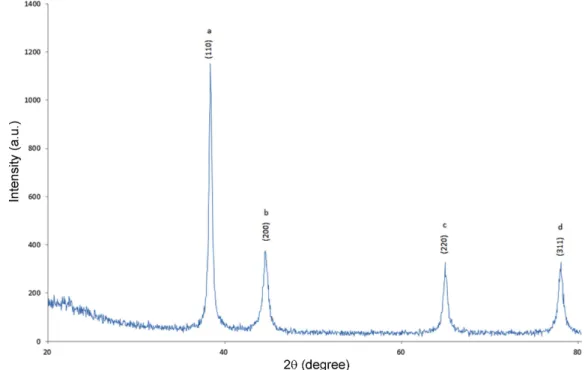
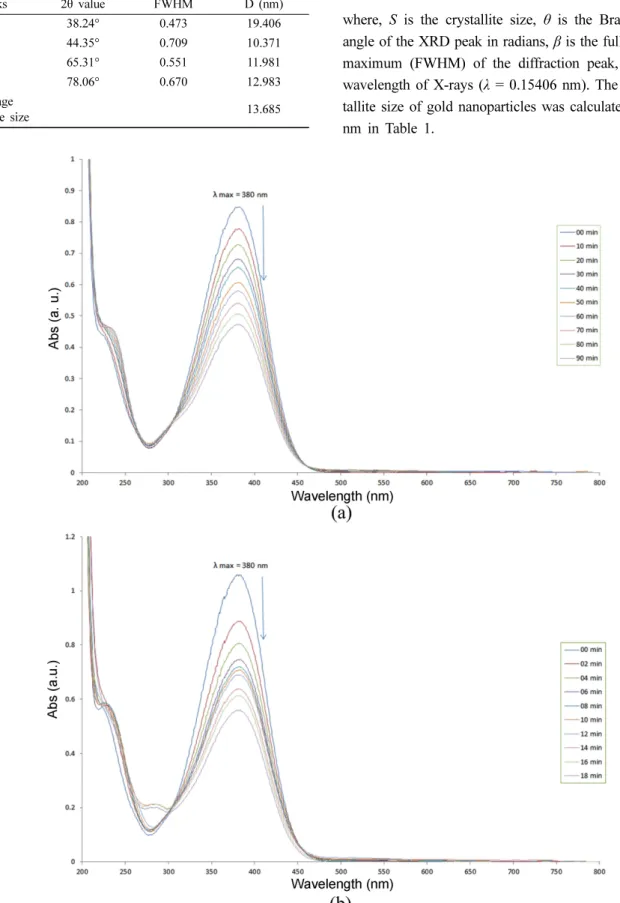
Abstract: Nanosized gold particles were synthesized by microwave irradiation in a mixture composed of potassium tet- rachloroaurate(III) n-hydrate, sodium citrate dihydrate and Tween 20. The synthesized gold particles were characterized by UV-vis spectrophotometer, scanning electron microscopy, and X-ray diffraction techniques. Using UV-vis spectroscopy, it was confirmed that gold nanoparticles act as a catalyst in the reduction of 4-nitroaniline with sodium borohydride to form 1,4-diaminobenzene. Additionally, we studied the kinetics of this reductive reaction in the presence of these gold nanopar- ticles under various conditions.
Keywords: nanosized gold particles, 4-nitroaniline, reductive reaction, catalytic activity
Introduction
Recently, metal nanopaticles have attracted significant attention among researchers due to their outstanding plas- monic activity, chemical stability, and catalytic properties.
1,2,5In particular, nanometer sized gold particles are frequently employed in the preparation of hybrid nanocomposites that have uses in electrochemical and molecular electronics appli- cation.
3,4It is known that gold nanoparticles are able to catalyze the reduction of nitro compounds to their amino analogs with sodium borohydride.
7In this reaction, the hydrogen is trans- ferred from the borohydride anion to the aromatic nitro com- pound by the gold nanoparticles.
7The catalytic activity of many metal and semiconductor nanoparticles in the reductive reaction of 4-nitroaniline is also known.
84-Nitroaniline is a known toxin and is found in wastewater discharged from chemical manufacturing industries. The chemical is dangerous to aquatic organisms and may cause long-term damage to the environment.
61,4-diaminobenzene is known as an important component in the industrial chem- icals, such as rubber antioxidants, precursor to aramid textile fibers, thermoplastics and elastomers.
9-11Preparation of 1,4- diaminobenzene is obtained by the catalytic hydrogenation of 4-nitroaniline.
10,11The mechanism of reductive reaction from 4-nitroaniline to the 1,4-diaminobenzene has been reported to follow either a direct route or a condensation route.
7The condensation route is more advantages than the direct route, as the nitro com- pound is adsorbed on the surface of nanosized gold parti- cles.
7,12,13We have studied the catalytic activity of nanosized gold particles for the reductive reaction of 4-nitroaniline to 1,4- diaminobenzene in an aqueous solution of NaBH
4.
14We used UV-vis spectroscopy at various temperatures to investigate the progress of the reductive reaction of 4-nitroaniline to 1,4- diaminobenzene.
Experimental
1. Chemical reagents
Potassium tetrachloroaurate(III) n-hydrate (KAuCl
4·nH
2O) was purchased from Wako Pure Chemical Industries, Ltd.
Sodium citrate dihydrate (C
6H
5Na
3O
7·2H
2O) was obtained from Samchun Chemicals. Tween 20 was supplied by Sigma- Aldrich.
2. Preparation of nanosized gold particles
0.01 M Potassium tetrachloroaurate(III) n-hydrate (KAu- Cl
4·nH
2O) solution was added to a beaker, containing 50 ml
†