• 검색 결과가 없습니다.

Transurethral Resection of the Prostate with a Bipolar Tissue Management System Compared to Conventional Monopolar Resectoscope: One-Year Outcome

N/A
N/A
Protected

Academic year: 2022

Share "Transurethral Resection of the Prostate with a Bipolar Tissue Management System Compared to Conventional Monopolar Resectoscope: One-Year Outcome"

Copied!
6
0
0

로드 중.... (전체 텍스트 보기)

전체 글

(1)

Vol. 47, No. 5, pp. 715 - 720, 2006

The purpose of the present study was to evaluate the effi- cacy and safety of bipolar transurethral prostatectomy (TURP) using the Gyrus

TM

PlasmaKinetic System compared with conventional monopolar TURP. This study included 102 patients with benign prostatic hyperplasia (BPH) who under- went TURP from January 2003 to March 2005. In all, 49 consecutive patients had bipolar and 53 had monopolar TURP. All patients were assessed by preoperative and postoperative International Prostate Symptom Score (IPSS), uroflowmetry, transrectal ultrasonography, operative time, weight of resected tissue, change in serum sodium and hemoglobin, duration of catheter use, length of hospital stay, and complication rates. Significant improvement was seen postoperatively in both groups, and no difference was observed in the resection time, weight of resected tissue, change in serum sodium and hemoglobin, improvement of IPSS and peak flow rate (Qmax), or complication rates over the 12-month follow-up in both groups. There was, however, a significant difference in duration of catheter use and hospital stay. Duration of catheter use (2.28 days vs. 3.12 days) and hospital stay (3.52 days vs. 4.27 days) were shorter in the bipolar group (p = 0.012 vs. p = 0.034, respectively).

Our results demonstrate that bipolar TURP using the Gyrus

TM

Plasma Kinetic System is as effective as conventional monopolar TURP with the additional advantage of reduced length of catheter use and hospital stay. Bipolar TURP is a promising new technique that may prove to be a good alternative to conventional TURP in the future.

Key Words: Prostatic hyperplasia, transurethral resection of prostate

INTRODUCTION

There are numerous treatment alternatives available for patients with bladder outlet obstruc- tion (BOO) secondary to benign prostatic hyper- plasia (BPH), including watchful waiting, pharma- cological therapy, minimally invasive therapy, transurethral resection (TURP), and open pros- tatectomy. Despite the widespread use of medical treatment, a significant proportion of patients require surgical intervention.

1

TURP remains the most frequently performed operation for men with BPH,

2

despite the availability of numerous minimally invasive alternatives, because these fail to equal TURP and require costly instruments, a steep learning curve, and long-term follow-up to establish their efficacy and safety.

3-5

At the same time, TURP often requires ex- tended Foley catheterization and hospital stays, and is associated with various complications, including bleeding, TUR syndrome, incontinence, impotence, and urethral stricture. In conventional TURP, most morbidities are related to the use of nonelectrolyte irrigation fluid, monopolar current, poor visibility due to bleeding, and mechanical factors.

Recently, transurethral resection with bipolar energy was introduced to overcome some of these complications. Bipolar TURP results in less ther- mal damage and better visibility, and most impor- tantly, the ability to use physiologic saline for irrigation.

The purpose of this study was to compare the efficacy and safety of this newer bipolar TURP using the Gyrus

TM

PlasmaKinetic Tissue Manage-

Transurethral Resection of the Prostate with a Bipolar Tissue Management System Compared to Conventional Monopolar Resectoscope: One-Year Outcome

Chang-Jun Yoon, Ji-Yoon Kim, Ki-Hak Moon, Hee-Chang Jung, and Tong-Choon Park Department of Urology, Yeungnam University College of Medicine, Daegu, Korea.

Received April 17, 2006 Accepted May 17, 2006

Reprint address: requests to Dr. Ki-Hak Moon, Department of

Urology, Yeungnam University College of Medicine, 317-1

Daemyung-dong, Nam-gu, Daegu 705-035, Korea. Tel: 82-53-620-

3693, Fax: 82-53-627-0515, E-mail: [email protected]

(2)

ment System (Gyrus Medical Ltd., Bucks, UK) with conventional monopolar TURP over a follow-up period of 12 months.

MATERIALS AND METHODS

This study included a total of 102 patients with BPH who underwent TURP using the Gyrus

TM

PlasmaKinetic Tissue Management System (Gyrus Medical Ltd., Bucks, UK) or conventional mono- polar resectoscope between January 2003 and March 2005. Forty-nine consecutive patients underwent bipolar TURP using the Gyrus

TM

system and fifty-three consecutive patients under- went monopolar TURP using the conventional monopolar resectoscope. For inclusion, patients were required to be older than 50 years with symptomatic BPH requiring surgical intervention.

Patients were excluded if they had an abnormal digital rectal examination (DRE), increased serum prostate specific antigen (PSA), evidence of neuro- genic bladder, urethral stricture, bladder stone or tumor, or a history of prostate surgery.

All patients were preoperatively evaluated in detail by medical history, physical examination with DRE, multiple serum analyses including PSA, uroflowmetry, and transrectal ultrasound (TRUS).

One expert surgeon performed all operations.

Bipolar TURP was performed with a 24 Fr. Karl Storz (Tuttlingen, Germany) continuous flow resectoscope using saline irrigation and the Gyrus

TM

PlasmaKinetic Tissue Management System. The PlasmaKinetic device had a maximum power of 200 W and delivered a radio frequency wavelength of 320-450 kHz and a voltage range of 254-350 V.

The TUR loop consisted of an 80/20 platinum/

iridium alloy electrode with the active and return electrode on the same axis (axipolar) separated by a ceramic insulator.

Conventional monopolar TURP was performed with an ACMI (Southborough, MA, USA) 24 Fr.

resectoscope using Urion (Hwaseong, Korea) irrigation.

At the end of the procedure, a 22 Fr. 3-way Foley catheter was inserted. Saline irrigation was continued at a rate sufficient to maintain a clear returning fluid and the catheter was removed if the urine was clear in the absence of irrigation.

The patient was subsequently given a voiding trial and discharged from the hospital if voiding spontaneously.

Serum electrolytes and hemoglobin were measured after TURP. Resection time, weight of resected tissue, duration of catheter use and hos- pital stay, and presence of any complications were documented in detail. Patients were observed at 1, 6 and 12 months after TURP to allow for the detection of early and late complications, Interna- tional Prostate Symptom Score (IPSS) assessment, and uroflowmetry.

Statistical analysis was carried out using Student's t-test, Mann-Whitney test and Chi- square test. A p-value < 0.05 was considered to be statistically significant. Statistical data are pres- ented as mean ± SD.

RESULTS

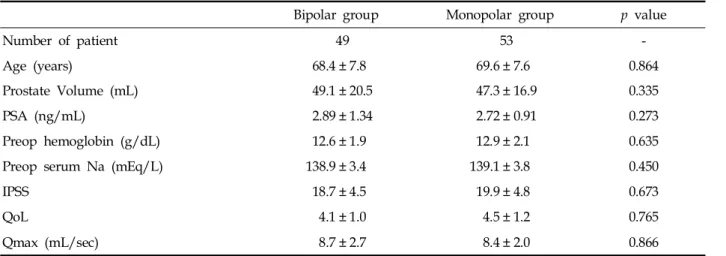
Table 1 shows the characteristics of the 102 patients. The mean operative time was 72.6 ± 31.8 minutes in the bipolar group and 74.2 ± 26.6 minutes in the monopolar group (p = 0.451). With bipolar resection, 14.1 ± 6.9g of prostatic tissue was resected versus 13.7 ± 8.7g in the monopolar group (p = 0.514). Postoperatively, there was no statistical difference in the mean changes of hemo- globin (Hb) and serum sodium between the two groups (p = 0.278 and p = 0.51, respectively) (Table 2).

Mean catheter duration was 2.28 ± 1.37 days in the bipolar group and 3.12 ± 0.69 days in the monopolar group (p = 0.012). The hospital stay was also shorter in the bipolar group (3.52 ± 2.55 days vs. 4.27 ± 1.89 days) (p = 0.034) (Table 2).

IPSS and peak flow rate (Qmax) improvements at 1, 6 and 12 months were equal in the two groups (Table 3).

In the early postoperative period, complications

were noted in three cases (6.1%) in the bipolar

group and four cases (7.5%) in the monopolar

group. One patient required blood transfusion

due to severe reduction in Hb (1.9%) and two

patients required a second operation for TUR

fulguration due to bleeding in the monopolar

group (3.8%). In the bipolar group, no patient

required blood transfusion and one patient

(3)

Table 3. Preoperative and Postoperative Improvement of IPSS and Qmax (mL/s) at 1, 6 and 12 Months

Bipolar group* Monopolar group

IPSS Qmax IPSS Qmax

Preoperative 18.7 ± 4.5 8.7 ± 2.7 19.9 ± 4.8 8.4 ± 2.0

1 month 6.6 ± 4.9 17.4 ± 3.8 8.1 ± 4.3 16.9 ± 3.7

Improvement 12.1 ± 4.6 8.7 ± 4.5 11.8 ± 3.4 8.5 ± 3.9

6 months 6.5 ± 4.0 18.9 ± 3.1 7.7 ± 4.9 18.5 ± 4.3

Improvement 12.2 ± 4.1 10.2 ± 4.8 12.2 ± 5.5 10.2 ± 5.2

12 months 7.0 ± 4.6 18.8 ± 4.2 7.8 ± 4.4 18.6 ± 2.9

Improvement 11.7 ± 3.5 10.1 ± 5.1 12.1 ± 5.1 10.2 ± 3.5

Values are presented as mean ± SD.

IPSS, international prostate symptom score; Qmax, peak flow rate.

*p > 0.05 by Mann-Whitney test.

Table 2. Perioperative Data

Bipolar group Monopolar group p value

Weight of resected tissue (g) 14.1 ± 6.9 13.7 ± 8.7 0.514*

Operative time (min) 72.6 ± 31.8 74.2 ± 26.6 0.451*

Change in serum Na (mEq/L) 0.06 ± 3.63 -0.64 ± 3.56 0.51*

Fall in hemoglobin (g/dL) 0.67 ± 0.62 0.62 ± 0.78 0.278

Duration of catheter (days) 2.28 ± 1.37 3.12 ± 0.69 0.012*

Hospital stay (days) 3.52 ± 2.55 4.27 ± 1.89 0.034*

Values are presented as mean ± SD.

* p value by Mann-Whitney test.

p value by t-test.

Table 1. Patient Characteristic

Bipolar group Monopolar group p value

Number of patient 49 53 -

Age (years) 68.4 ± 7.8 69.6 ± 7.6 0.864

Prostate Volume (mL) 49.1 ± 20.5 47.3 ± 16.9 0.335

PSA (ng/mL) 2.89 ± 1.34 2.72 ± 0.91 0.273

Preop hemoglobin (g/dL) 12.6 ± 1.9 12.9 ± 2.1 0.635

Preop serum Na (mEq/L) 138.9 ± 3.4 139.1 ± 3.8 0.450

IPSS 18.7 ± 4.5 19.9 ± 4.8 0.673

QoL 4.1 ± 1.0 4.5 ± 1.2 0.765

Qmax (mL/sec) 8.7 ± 2.7 8.4 ± 2.0 0.866

Values are presented as mean ± SD.

IPSS, international prostate symptom score; QoL, quality of life; Qmax, peak flow rate.

(4)

required a second operation for TUR fulguration due to bleeding (2.0%). Urinary tract infection (UTI) was observed in two (4.1%) and one (1.9%) patients in the bipolar and monopolar groups, respectively (Table 4).

At 12 months, late postoperative complications were noted in three cases (6.1%) in the bipolar group and two (3.8%) cases in the monopolar group. Urethral stricture was observed in two (4.1%) and one (1.9%) patients in the biopolar and monopolar groups, respectively. Urge inconti- nence was observed in one (1.9%) patient in monopolar group, and persistent obstructive symptom was observed in one (2.0%) patient in the bipolar group (Table 4).

DISCUSSION

BPH is a common problem that affects aging men. Treatment of this condition includes medical and surgical approaches. Despite the availability of medical treatment, about twenty percent of patients with symptomatic BPH require surgical intervention.

1

Even with new advances in mini- mally invasive techniques, TURP remains the standard surgical therapy.

2

The large amount of data currently available allows adequate assess- ment of the efficacy of TURP compared with these new minimally invasive techniques.

3-5

Conventional monopolar TURP is considered

safe with a low associated mortality rate. High perioperative morbidity rates largely due to intra- operative and postoperative hemorrhage or per- foration, however, have been reported. Moreover, TUR syndrome, caused by absorption of irrigation fluid, has been known to occur.

6-8

Typically, TURP is performed using a monopolar electric current whose direction flows from the active electrode to a ground. To avoid conduction of this electrical energy to surrounding tissues, a nonconductive irrigating solution is used which, when absorbed in excess, may cause TUR syndrome. The reported rates range from 0.18% to 10.9%, with Mebust and his colleagues reporting an incidence of 2% in conventional monopolar TURP.

9-11

The risk of TUR syndrome increases with a larger prostate (>

45 g) or longer resection time (> 90 min).

Recently, transurethral resection and vapori- zation with bipolar energy has been introduced as a technical modification of TURP.

12-14

The biggest advantage of bipolar current in TURP is the use of saline for irrigation, which may reduce the morbidity associated with the absorption of fluid.

Performing TURP with saline eliminates the risk of TUR syndrome, thereby enabling the removal of a large bulk of prostate tissue by resection or vaporization.

In our results, the change in serum sodium concentration was not significantly greater in the monopolar resection group when compared to the bipolar group (p = 0.51). In bipolar TURP, the Table 4. Complications

Bipolar group* Monopolar group

Early postoperative complications 3 (6.1) 4 (7.5)

Severe fall of hemoglobin 0 (0.0) 1 (1.9)

Secondary hemorrhage 1 (2.0) 2 (3.8)

UTI 2 (4.1) 1 (1.9)

Late postoperative complications 3 (6.1) 2 (3.8)

Urethral stricture 2 (4.1) 1 (1.9)

Urge incontinence 0 (0.0) 1 (1.9)

Persistent obstructive symptom 1 (2.0) 0 (0.0)

Total 6 (12.2) 6 (11.3)

Values are presented as number (%).

*p > 0.05 by Chi-square test.

(5)

change in serum sodium was 0.06 mEq/L, whereas in the monopolar group, the mean change was -0.64 mEq/L. Two patients of the monopolar groups were found to have serum sodium levels of less than 135 mEq/L (125 mEq/L and 130 mEq/

L respectively). Although these patients did not develop symptoms, they were at risk for TUR syndrome.

In conventional monopolar TURP, radiofre- quency energy is directed into the tissue where electrical resistance creates temperatures as high as 400 . In bipolar TURP, however, radiofrequ- ency energy converts a conductive medium (saline irrigant) into a plasma field of highly ionized particles that disrupt the organic molecular bonds between the tissues. By directing the radiofrequ- ency current from an active electrode to an adjacent return electrode, tissue temperature is reduced to 40-70 . The low temperatures of bipolar TURP allow for minimal tissue damage.

15

The absence of a return current in bipolar surgery also removes the risks of burns and car- diac pacemaker problems.

Moreover, bipolar electrocautery seems to be more efficient for removing tissue and simulta- neously controlling bleeding when compared to the monopolar procedure. Coagulation is also accurate and effective, which decreases the time for control of bleeding and improves intra- operative vision. Wendt-Nordahl and co-workers reported that bleeding rate was significantly reduced using the bipolar resectoscope in their ex-vivo experiments, compared to the monopolar resection device.

14

Our results show that bipolar TURP was equivalent to conventional monopolar TURP in improvement of IPSS and urinary flow rates at 1, 6 and 12 months of follow-up. In addition to the aforementioned advantages, bipolar TURP allows more rapid catheter removal and a shorter hospital stay. Botto and co-workers

12

reported a mean hospital stay of only 2.2 days, and all patients were discharged without a catheter, while Eaton and Francis

13

reported that 85% of patients were able to return home on the day of surgery and have their catheters removed at 48 hours in the bipolar TURP group. In another study, the patients treated by Gyrus TURP had their catheter removed a mean of 1.4 days earlier than the

standard group, improving patient comfort, length of hospital stay, and costs.

16

Our results also show that both duration of catheter use and hospital stay were significantly shorter in the bipolar group (p = 0.012 and p = 0.034, respectively).

Other studies with bipolar TURP have reported high rates of recatheterization and that irritative symptoms were more common in the bipolar group, probably as a result of edema secondary to higher current with lower frequency exerted on the tissue.

17

Urethral stricture formation was also more commonly observed in the bipolar group.

Several risk factors, such as the use of higher ablative energy or larger resectoscope diameter, may account for increased urethral stricture formation. Higher recatheterization rates with the bipolar device were also described in a rando- mized study by Dunsmuir and collegues.

15

Singh and his collegues,

18

however, reported that post- operative dysuria was less with bipolar TURP than with monopolar TURP. This difference could be attributed to the greater thermal damage and formation of granulation tissue with monopolar current. In our results, there was no difference in the incidence of recatheterization, irritative symp- toms, or postoperative dysuria between the two groups.

We encountered six complications (12.2%) in the monopolar and six (11.3%) in the bipolar group.

Only one patient in the monopolar group required transfusion for secondary hemorrhage. With re- gards to overall complication rates, there was no significant difference between the two groups.

In conclusion, the bipolar transurethral pros- tatectomy (TURP) using the Gyrus

TM

Plasma Kinetic System is as effective as conventional monopolar TURP with the additional advantage of decreased duration of catheter use and hospital stay. Therefore, bipolar TURP is a promising new technique that may prove to be a good alternative to conventional TURP in the future.

REFERENCES

1. Barba M, Leyh H, Hartung R. New technologies in transurethral resection of the prostate. Curr Opin Urol 2000;10:9-14.

2. Wasson JH, Reda DJ, Bruskewitz RC, Elinson J, Keller

(6)

AM, Henderson WG. A comparison of transurethral surgery with watchful waiting for moderate symptoms of benign prostatic hyperplasia. The Veterans Affairs Cooperative Study Group on Transurethral Resection of the Prostate. N Engl J Med 1995;332:75-9.

3. Madersbacher S, Schatzl G, Djavan B, Stulnig T, Marberger M. Long-term outcome of transrectal high- intensity focused ultrasound therapy for benign prostatic hyperplasia. Eur Urol 2000;37:687-94.

4. Kaplan SA. Minimally invasive alternative therapeutic options for lower urinary tract symptoms. Urology 1998;51 (4A Suppl):32-7.

5. Larson TR. Rationale and assessment of minimally invasive approaches to benign prostatic hyperplasia therapy. Urology 2002;59 (2 Suppl 1):12-6.

6. Doll HA, Black NA, McPherson K, Flood AB, Williams GB, Smith JC. Mortality, morbidity and complications following transurethral resection of the prostate for benign prostatic hypertrophy. J Urol 1992;147:1566-73.

7. Horninger W, Unterlechner H, Strasser H, Bartsch G.

Transurethral prostatectomy: mortality and morbidity.

Prostate 1996;28:195-200.

8. Uchida T, Ohori M, Soh S, Sato T, Iwamura M, Ao T, et al. Factors influencing morbidity in patients under- going transurethral resection of the prostate. Urology 1999;53:98-105.

9. Kolmert T, Norlen H. Transurethral resection of the prostate. A review of 1111 cases. Int Urol Nephrol 1989;

21:47-55.

10. Koshiba K, Egawa S, Ohori M, Uchida T, Yokoyama E, Shoji K. Does transurethral resection of the prostate pose a risk to life? 22-year outcome. J Urol 1995;153:

1506-9.

11. Mebust WK, Holtgrewe HL, Cockett AT, Peters PC.

Transurethral prostatectomy: immediate and post- operative complications. A cooperative study of 13 participating institutions evaluating 3,885 patients. J Urol 1989;141:243-7.

12. Botto H, Lebret T, Barre P, Orsoni JL, Herve JM, Lugagne PM. Electrovaporization of the prostate with the Gyrus device. J Endourol 2001;15:313-6.

13. Eaton AC, Francis RN. The provision of transurethral prostatectomy on a day-case basis using bipolar plasma kinetic technology. BJU Int 2002;89:534-7.

14. Wendt-Nordahl G, Hacker A, Reich O, Djavan B, Alken P, Michel MS. The Vista system: a new bipolar resec- tion device for endourological procedures: comparison with conventional resectoscope. Eur Urol 2004;46:586- 90.

15. Dunsmuir WD, McFarlane JP, Tan A, Dowling C, Downie J, Kourambas J, et al. Gyrus bipolar electro- vaporization vs transurethral resection of the prostate:

a randomized prospective single-blind trial with 1 y follow-up. Prostate Cancer Prostatic Dis 2003;6:182-6.

16. Starkman JS, Santucci RA. Comparison of bipolar transurethral resection of the prostate with standard transurethral prostatectomy: shorter stay, earlier catheter removal and fewer complications. BJU Int 2005;95:69-71.

17. Tefekli A, Muslumanoglu AY, Baykal M, Binbay M, Tas A, Altunrende F. A hybrid technique using bipolar energy in transurethral prostate surgery: a prospective, randomized comparison. J Urol 2005;174:1339-43.

18. Singh H, Desai MR, Shrivastav P, Vani K. Bipolar versus monopolar transurethral resection of prostate:

randomized controlled study. J Endourol 2005;19:333-

8.

수치

Table 3. Preoperative and Postoperative Improvement of IPSS and Qmax (mL/s) at 1, 6 and 12 Months

참조

관련 문서

¾ Since bipolar differential pair can be analyzed using half- circuit, its transfer function, I/O impedances, locations of poles/zeros are the same as that of the half

Conclusion: The students with reading difficulties performed poorly compared to the normal peers in determining the semantic appropriateness of a

웹 표준을 지원하는 플랫폼에서 큰 수정없이 실행 가능함 패키징을 통해 다양한 기기를 위한 앱을 작성할 수 있음 네이티브 앱과

The index is calculated with the latest 5-year auction data of 400 selected Classic, Modern, and Contemporary Chinese painting artists from major auction houses..

SigmaNEST 펀칭 파워팩 제품 관리, 자동 다이나믹™ 배 열 및 펀칭 툴 관리를 갖춘 터렛 펀칭 프로그래밍을 위한 가장 완벽하고 최적화된

The “Asset Allocation” portfolio assumes the following weights: 25% in the S&amp;P 500, 10% in the Russell 2000, 15% in the MSCI EAFE, 5% in the MSCI EME, 25% in the

The comparison reveals cost saving by 19.2% compared with conventional distribution cost for one head of Ansim Farm Hanu (Korean cattle). Therefore, the estimated distribution

1 John Owen, Justification by Faith Alone, in The Works of John Owen, ed. John Bolt, trans. Scott Clark, &#34;Do This and Live: Christ's Active Obedience as the