267
Sang-Min Han, Sang-Min Bae, Jae-Won Han, Ji-Yoon Kim, Jong-Soo Lee and Ha-Kun Kim*
Department of Biomedicinal Science and Biotechnology, Paichai University, Daejeon 35345, Korea
ABSTRACT : Significant differences in annual precipitates on Jeju island have been reported depending on the location. We collected soil samples from east and west areas of Jeju Island to identify yeasts by plating on yeast peptone dextrose plates and subsequent analysis for the polymerase chain reaction amplified D1/D2 region of 26S rDNA of colonies. As a result, 20 yeast strains of 12 species were isolated from 7 different sampling sites in east area and 13 yeast strains of 6 species from 5 different sampling sites in west area. Some differences in yeast flora were observed depending on the sample collection sites having different annual precipitates.
KEYWORDS : D1/D2 region of 26S rDNA, Jeju Island soil samples, Yeast identification
효모는 드물게 질병을 일으킨다고 보고되기도[1] 하지만, 전통적으로 식음료 발효에 사용되는 중요한 미생물이다[2].
최근 우리나라 생물자원을 확보하기 위한 노력의 일환으로 토양[3], 야생화[4], 메주[5] 등 다양한 원천에서 효모를 분 리하기 위한 시도가 있었다. 26S rDNA의 D1/D2 지역을 연 쇄중합반응으로 증폭하면 약 600 nucleotides (nt) 길이의 DNA 조각을 얻을 수 있는데[6], 이곳에서 일어난 염기서 열 변이를 비교함으로써 효모 동정을 쉽게 행할 수 있다.
제주도는 연평균기온이 15.4oC에서 16.6oC로 기온의 연교 차나 일교차가 육지에 비하여 작으며, 해양성기후를 보인 다. 1981년부터 2010년까지 30년 간의 자료를 평균한 기상 청 국가기후데이터센터(http://sts.kma.go.kr)의 자료에 따르
면, 제주도의 연 강수량은 지역별로 큰 차이를 보인다. 즉, 제주도 동부지역(성산)이 1,966.8 mm로 최다강수량을 보 이며 이는 서부지역(고산)의 연 강수량 1142.8 mm나 북부 지역인 제주시의 연 강수량 1,497.6 mm에 비해 상대적으 로 많다. 특히 월별로는 여름에 강수량이 집중되어 북부에 위치한 제주시는 7월부터 9월까지 각각 239.9, 262.5, 221.6 mm의 강수량을 보이며, 서부지역인 고산은 7월부터 9월까 지 각각 178.0, 201.8, 116.2 mm의 강수량을 기록하였다.
남부지역에 속하는 서귀포는 5월부터 9월까지 각각 205.8, 276.9, 309.8, 291.6, 196.6 mm의 강수량을 보이며, 동부지역 인 성산은 6월부터 9월까지 각각 223.7, 283.2, 360.6, 228.4 mm으로 서부와 북부지역보다 많은 강수량을 보였다.
제주도 야생화에서 분리한 효모의 종 다양성에 대한 연 구는 이미 보고한[9] 바 있으며, 본 연구에서는 제주도 동 부지역과 서부지역에서 채취한 토양에서 서식하고 있는 야 생효모들을 분리, 동정하였다. 지역적 기후 자료의 차이를 고려하여 2015년 7월 초에 제주도에서 강수량이 상대적으 로 많은 동부지역 7곳(Fig.1, A~G site), 강수량이 상대적으 로 적은 서부지역 5곳(Fig.1, H~L site)에서 표층 5 cm 이하 에서 5~10 g의 토양을 무균적으로 채취하였다. 채취한 토 양시료는 50 mL 멸균 튜브에 넣어 분석 전까지 냉장고에 보관을 하였고, 멸균된 증류수 10 mL을 사용하여 채취된 토양을 30분간 진탕하여 현탁시켰다. 앰피실린(50 µg/mL) 이 들어 있는 yeast extract peptone dextrose (YPD) 한천배
*Corresponding author E-mail: [email protected] Received December 5, 2015 Revised December 8, 2015 Accepted December 10, 2015
This is an Open Access article distributed under the terms of the Creative Commons Attribution Non-Commercial License (http://
creativecommons.org/licenses/by-nc/3.0/) which permits unrestricted non-commercial use, distribution, and reproduction in any medium, provided the original work is properly cited.
Kor. J. Mycol. 2015 December, 43(4): 267-271 http://dx.doi.org/10.4489/KJM.2015.43.4.267 pISSN 0253-651X • eISSN 2383-5249
© The Korean Society of Mycology
지 여러 장에 토양 시료 현탁액 0.1 mL씩을 도말한 후 30oC 에서 48시간 배양하여 효모 균락을 얻었다[7]. 동일한 배지 를 사용하여 획선배양을 2차례 반복하여 균락을 분리함으 로써 순수배양체를 얻었다. LN1 (5 GCA TAT CAA TAA GCG GAG GAA AAG 3)과 NL4 (5 GGT CCG TGT TTC AAG ACG G 3) 프라이머를 사용하여 콜로니 polymerase chain reaction (PCR) 반응을 수행하여 26S rDNA D1/D2 부위를 증폭시켰다[7]. 증폭된 PCR 반응물들을 1.5% (w/v) 아가로스 젤에서 전기영동을 수행함으로써 0.6 kb 크기의 DNA들이 증폭되었음을 확인하였다. QIAEX II 젤 추출 키 트(QIAGEN, Germantown, MD, USA)로 증폭된 DNA를 회수하여 염기서열 결정에 사용하였다. 회수된 DNA의 염 기서열 결정은 코스모젠텍(Seoul, Korea)에서 ABI 3730xl DNA analyzer(Applied Biosystems, Foster City, CA, USA) 로 분석하였다. 분석된 염기서열은 BLAST로 데이터베이스 에 축적되어 있는 염기서열들과의 상동성을 조사하였다[7].
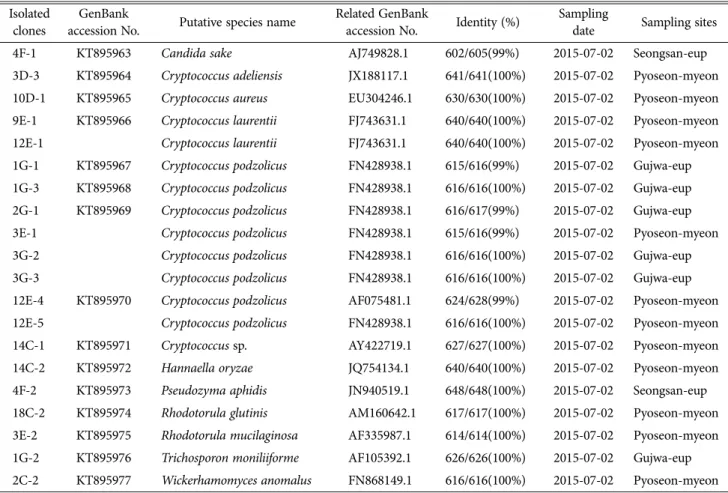
본 연구를 통해 얻은 효모의 염기서열 정보들은 BankIt을 통해 GenBank에 등록하였다(Table 1, 2).
제주도 동부지역에서 채취한 토양에서 효모의 분리 제주도 표선면과 성산읍을 비롯한 동부지역 7곳에서 토 양을 채취하여 효모를 분리하여 동정한 결과는 Table 1과 같다. 시료를 채취한 7곳 중 봉개동 4.3 평화공원(Fig. 1, A site)과 절물자연휴양림 (Fig. 1, B site)에서 채취한 시료를 제외한 5곳에서 12종에 속하는 20균주를 분리하였다.
분리된 12종 중 Cryptococcus adeliensis, Cryptococcus au- reus, Cryptococcus laurentii, Cryptococcus sp., Hannaella oryzae, Pseudozyma aphidis, Rhodotorula glutinis, Rhodo- torula mucilaginosa, Wickerhamomyces anomalus 등 9종의 효모들은 본 연구진에 의해 내륙의 과일이나 꽃 등에서 여
러 차례 분리되어 보고된바 있다[4, 8-14]. 반면에 Candida sake, Cryptococcus podzolicus, Trichosporon moniliiforme는 제주도 채집 탐사에서 처음 분리된 균주들이다. 이들 중 Trichosporon moniliiforme는 페놀을 살리실산으로 혹은 살 리실산을 페놀로 가역적으로 전환시키는 반응이 존재한다 고 알려져 있다[15].
Table 1에서와 같이 분리된 20균주 중에서 Cryptococcus podzolicus종이 8균주가 분리되어 가장 흔하게 분리되는 종 이었다. Cryptococcus podzolicus종은 Cryptococcus laurentii 와 함께 토양 효모로 토양에서 흔히 분리되는 것으로 알려 져 있다[16]. 이들 Cryptococcus podzolicus종 8균주 중 7균 주는 GenBank accession number FN428938.1 서열과 동일 하거나 혹은 거의 유사함을 보였지만 클론 12E-4는 이들과 상이하여 AF0754581.1의 서열과 4개의 nt 차이를 보여서 GenBank에 새로이 KT895970으로 등록 번호를 부여 받았 다. 이 균주는 신종일 가능성에 대한 추후 연구가 더 필요 할 것으로 보인다.
제주도 서부지역에서 채취한 토양에서 효모의 분리 제주의 애월읍 및 한림읍을 비롯한 서부지역 5곳에서 토 양을 채취하여 효모를 분리하여 동정한 결과는 Table 2와 같다. 시료를 채취한 5곳 중에서 고산(Fig. 1, K site)과 대 정(Fig. 1, L site)에서 채취한 시료에서 효모를 분리하는데 실패하였으며, 이들을 제외한 3곳에서 6종에 속하는 13균 주를 분리하였다.
분리된 6종의 효모들 중 Cryptococcus laurentii, Rhodo- torula mucilaginosa, Wickerhamomyces anomalus, Crypto- coccus podzolicus 등 4종의 효모들은 제주도 동부지역에서 도 공통적으로 분리되었다. 이들 4종의 효모 중 Cryptoco- ccus podzolicus를 제외한 3종은 전술한 바와 같이 본 연구 Fig. 1. Distribution of sampling sites in Jeju Island, Korea. Sites A to G are belonged to east area and sites H to L are belonged to west area.
진에 의해 여러 차례 분리되어 보고된 바 있다[4, 8-13].
본 연구진이 최근 수년간 전국에 걸쳐 실시하고 있는 채 집 탐사에서 Tetrapisispora iriomotensis와 Williopsis satur- nus는 분리된 적이 없었던 효모들로 Tetrapisispora iriomo- tensis는 일본의 난세이섬의 토양 및 식물에서 분리된 바 있
다[17]. Table 2에서와 같이 제주도 서부지역에서 채취한 토양에서 분리된 13균주 중 7균주는 Wickerhamomyces ano- malus[8]로 이들은 GenBank accession number FN868149.1 서열과 동일하거나 혹은 거의 유사함을 보였다.
2G-1 KT895969 Cryptococcus podzolicus FN428938.1 616/617(99%) 2015-07-02 Gujwa-eup
3E-1 Cryptococcus podzolicus FN428938.1 615/616(99%) 2015-07-02 Pyoseon-myeon
3G-2 Cryptococcus podzolicus FN428938.1 616/616(100%) 2015-07-02 Gujwa-eup
3G-3 Cryptococcus podzolicus FN428938.1 616/616(100%) 2015-07-02 Gujwa-eup
12E-4 KT895970 Cryptococcus podzolicus AF075481.1 624/628(99%) 2015-07-02 Pyoseon-myeon 12E-5 Cryptococcus podzolicus FN428938.1 616/616(100%) 2015-07-02 Pyoseon-myeon 14C-1 KT895971 Cryptococcus sp. AY422719.1 627/627(100%) 2015-07-02 Pyoseon-myeon 14C-2 KT895972 Hannaella oryzae JQ754134.1 640/640(100%) 2015-07-02 Pyoseon-myeon 4F-2 KT895973 Pseudozyma aphidis JN940519.1 648/648(100%) 2015-07-02 Seongsan-eup 18C-2 KT895974 Rhodotorula glutinis AM160642.1 617/617(100%) 2015-07-02 Pyoseon-myeon 3E-2 KT895975 Rhodotorula mucilaginosa AF335987.1 614/614(100%) 2015-07-02 Pyoseon-myeon 1G-2 KT895976 Trichosporon moniliiforme AF105392.1 626/626(100%) 2015-07-02 Gujwa-eup 2C-2 KT895977 Wickerhamomyces anomalus FN868149.1 616/616(100%) 2015-07-02 Pyoseon-myeon
Table 2. List of yeast species isolated from soil samples collected in the west region of Jeju Island, Korea Isolated
clones
GenBank
accession No. Putative species name Related GenBank
accession No. Identity (%) Sampling
date Sampling sites 5H-1 KT895978 Cryptococcus laurentii FJ743631.1 640/640(100%) 2015-07-03 Hwabuk 1-dong 6I-2 KT895979 Cryptococcus podzolicus FN428938.1 616/616(100%) 2015-07-03 Aewol-eup 9I-1 KT895980 Rhodotorula mucilaginosa EU285542.1 613/613(100%) 2015-07-03 Aewol-eup 6J-1 KT895981 Tetrapisispora iriomotensis AF398489.1 577/577(100%) 2015-07-03 Hallim-eup
7H-1 Tetrapisispora iriomotensis AF398489.1 577/577(100%) 2015-07-03 Hwabuk 1-dong
2J-2 KT895982 Wickerhamomyces anomalus FN868149.1 615/616(99%) 2015-07-03 Hallim-eup
3I-1 Wickerhamomyces anomalus FN868149.1 616/616(100%) 2015-07-03 Aewol-eup
3J-1 KT895983 Wickerhamomyces anomalus FN868149.1 616/616(100%) 2015-07-03 Hallim-eup
3J-2 Wickerhamomyces anomalus FN868149.1 616/616(100%) 2015-07-03 Hallim-eup
3J-3 Wickerhamomyces anomalus FN868149.1 616/616(100%) 2015-07-03 Hallim-eup
4J-2 Wickerhamomyces anomalus FN868149.1 616/616(100%) 2015-07-03 Hallim-eup
5J-1 Wickerhamomyces anomalus FN868149.1 615/616(99%) 2015-07-03 Hallim-eup
4I-3 KT895984 Williopsis saturnus EU293426.1 612/613(99%) 2015-07-03 Aewol-eup
분리 효모들의 지역별 분포 특성
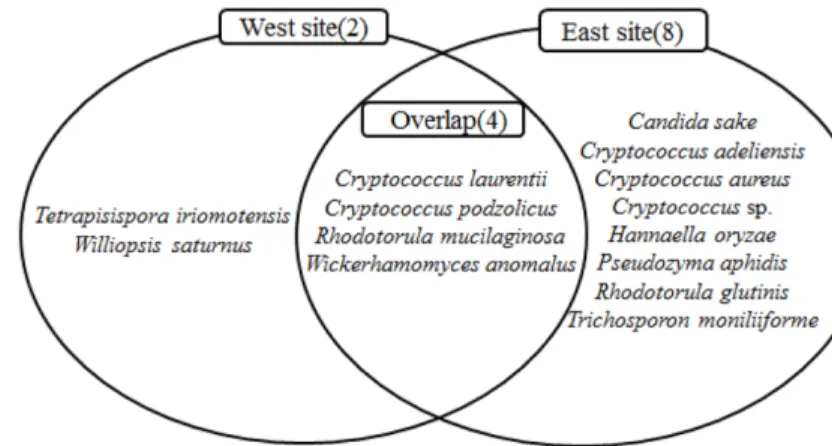
위와 같이 제주도 동부지역에서 20균주 12종, 서부지역 에서 13균주 6종의 효모들이 분리되었다. 동부지역과 서부 지역에서 공통적으로 분리된 효모들은 Cryptococcus laur- entii, Rhodotorula mucilaginosa, Wickerhamomyces anoma- lus, Cryptococcus podzolicus 등 4종이었다(Fig. 2). 반면에 Candida sake, Cryptococcus adeliensis, Cryptococcus aureus, Cryptococcus sp., Hannaella oryzae, Pseudozyma aphidis, Rhodotorula glutinis, Trichosporon moniliiforme 등 8종의 효 모는 동부지역에서만 분리되었으며, Tetrapisispora iriomo- tensis와 Williopsis saturnus 등 2종은 서부지역에서만 분리 되었다(Fig. 2). 지역적인 차이에 기인한 제주도 자생버섯의 종 다양성의 차이가 보고된 것[18]과 같이, 제주도 서부지 역과 동부지역의 큰 강수량 차이로 인해 지역적으로 독특한 생태적 특성을 갖게 되고 따라서, 지역별로 효모 종 분포에 서 이러한 차이를 보였을 가능성이 있을 것으로 보인다.
적 요
제주도 토양에 서식하는 야생효모들의 분포 특성을 조사 하기 위해, 동부지역 7곳, 서부지역 5곳에서 토양을 채취하 여 효모를 분리한 후, 콜로니 PCR에 의해 증폭된 26S rDNA D1/D2 지역의 염기서열을 결정하여 BLAST를 이용하여 효 모를 동정하였다. 동부지역에서 채집한 토양에서 12종에 속하는 20균주를, 서부지역에서 6종에 속하는 13균주를 분 리하였다. 분리되는 효모 종은 강수량 차이를 보이는 지역 에 따라서 현저한 차이가 있는 것을 알 수 있었다.
Acknowledgements
This work was funded by the project on survey and excavation of Korean indigenous species of National Ins- titute of Biological Resources (NIBR) under the Ministry of Environment.
REFERENCES
1. Palmisano A, Benecchi M, De Filippo M, Maggiore U, Buzio C, Vaglio A. Candida sake as the causative agent of spondylo- discitis in a hemodialysis patient. Spine J 2011;11:e12-6.
2. Bal J, Yun SH, Song HY, Yeo SH, Kim JH, Kim JM, Kim DH.
Mycoflora dynamics analysis of Korean traditional wheat- based nuruk. J Microbiol 2014;52:1025-9.
3. Hong SG, Lee KH, Bae KS. Diversity of yeasts associated with natural environments in Korea. J Microbiol 2002;40:55- 62.
4. Hyun SH, Han SM, Kim HK, Lee JS. Yeasts diversity of wild flowers in mountains of Korea and their physiological functionalities. Kor J Mycol 2015;43:137-41.
5. Kim DH, Kim SH, Kwon SW, Lee JK, Hong SB. Mycoflora of soybeans used for meju fermentation. Mycobiology 2013;41:
100-7.
6. Kurtzman CP, Robnett CJ. Identification and phylogeny of ascomycetous yeasts from analysis of nuclear large subunit (26S) ribosomal DNA partial sequences. Antonie Van Leeu- wenhoek 1998;73:331-71.
7. Min JH, Kim YH, Kim JH, Choi SY, Lee JS, Kim HK. Compa- rison of microbial diversity of Korean commercial Makgeolli showing high β-glucan content and high antihypertensive ac- tivity, respectively. Mycobiology 2012;40:138-41.
8. Hyun SH, Lee JG, Park WJ, Kim HK, Lee JS. Isolation and diversity of yeasts from fruits and flowers of orchard in Sinam- myeon of Yesan-gun, Chungcheongnam-do, Korea. Kor J Mycol 2014;42:21-7.
9. Hyun SH, Mun HY, Lee HB, Kim HK, Lee JS. Isolation of yeasts from wild flowers in Gyonggi-do province and Jeju island in Korea and the production of anti-gout xanthine oxidase inhibitor. Korean J Microbiol Biotechnol 2013;41:383-90.
10. Hyun SH, Han SM, Lee JS. Isolation and physiological func- tionality of yeasts from wild flowers in Seonyudo of Gogunsan- yeoldo, Jeollabuk-do, Korea. Kor J Mycol 2014;42:201-6.
11. Min JH, Lee HB, Lee JS, Kim HK. Identification of yeasts iso- lated from wild flowers collected in coast areas of Korea based on the 26S rDNA sequences. Kor J Mycol 2013;41:185-91.
12. Min JH, Ryu JJ, Kim HK, Lee JS. Isolation and identification of yeasts from wild flowers in Gyejoksan, Oseosan and Beak- amsan of Korea. Kor J Mycol 2013;41:47-51.
Fig. 2. Yeast diversity of soil samples collected from Jeju Island, Korea.