794
Copyright © 2020 The Korean Society of Fisheries and Aquatic Science pISSN:0374-8111, eISSN:2287-8815
서 론
황성대과
(Peristediidae)
어류는전세계에6
속45
종이보고되 어있으며,
우리나라에는2
속2
종[
황성대(Peristedion orientale, Temminck and Schlegel, 1843);
별성대(Satyrichthys rieffeli, Kaup, 1859)]
이보고되어있다(Nelson et al., 2016; MABIK, 2019; Fricke et al., 2020).
황성대과어류는전세계의온대및열대해역의
50-800 m
까지다양한 수심의바닥에서식한다(Miller and Richard, 2002; Tenda and Kawai, 2012; Kawai, 2013).
황성대과어류는몸을둘러싸는4
열의골판을몸의양쪽 에가지는점,
신장된주둥이를가지는점,
양쪽전안와골이뒤 쪽으로돌출되어있는점,
가슴지느러미하단에2
개의유리연 조를가지는점,
아래턱에수염을가지는점등의특징을가진다(Kawai, 2013; Nelson et al., 2016).
외부형태학적특징및골격 형태를기반으로한황성대과의계통분류학적연구결과,
황성 대과어류는성대과(Triglidae)
어류와밀접한관련을가지는것 으로밝혀졌으며(Washington et al., 1984; Imamura,1996),
최근분자계통학적연구에서황성대과의일부종이성대과내에 위치하는결과를보여두과간의분류학적위치가재조명되고 있다
(Portnoy et al., 2017; Smith et al., 2018).
우리나라에서는Mori (1952)
가황성대를성대과의1
종으로기재하였으며,
이후Chyung (1977)
은Mori (1952)
가성대과로분류하였던황성대 를황성대과로전과시켰다.
이후우리나라에서황성대과에관 한연구는거의이루어지지않았다.
2019
년5
월5
일우리나라제주도근해244-6
해구에서국립 수산과학원시험조사선(
탐구22
호)
에의해황성대과치어1
개 체가처음으로채집되었다.
본개체는안상극이뾰족한산모양 을띠는점,
후측두극이매우길게발달한점,
몸통의흑색소포 형태등에서Okiyama (2014)
에기재된황성대과의Peristedion sp.
와유사하였으나,
황성대과자치어의정보가부족하여형태 정보만으로는종동정이불가능하였다.
따라서mitochondrial DNA COI
영역을사용한DNA
분석을수행하였으며Periste- dion liorhynchus
로동정되었다.
본연구에서는우리나라에서 처음보고되는P. liorhynchus
의형태학적,
유전학적특징을기한국 제주도 근해에서 출현한 황성대과(Peristediidae) 어류 1미기록종, Peristedion liorhynchus 치어의 형태기재 및 분자동정
장서하·김진구*·유효재
1부경대학교 자원생물학과, 1국립수산과학원 수산자원연구센터
Morphological Description and Molecular Identification of Juvenile Peristedion liorhynchus (Peristediidae, Pisces) from Jeju-do Island, Korea
Seo-Ha Jang, Jin-Koo Kim* and Hyo-Jae Yu
1
Department of Marine Biology, Pukyong National University, Busan 48513, Korea
1Fisheries Resources Research Center, National Institute of Fisheries Science, Tongyeong 53064, Korea
In April 2019, a single Peristediidae juvenile (14.1 mm SL) was collected from the waters off of Jeju-do Island, Ko- rea. DNA barcoding identified the juvenile as Peristedion liorhynchus , an unrecorded species in Korea. P . liorhynchus has eight dorsal fin spines, 22 dorsal and 19 anal fin rays, and a long third pectoral fin ray that passes through the middle of the tail at the juvenile stage. Juvenile also have large heads, extensive head spination, and serrated edges on the ocular and parietal spines. This is the first record of P. liorhynchus in Korea; therefore, we propose the new Korean name, “Nam-bang-hwang-seong-dae”.
Keywords: Peristedion liorhynchus , Peristediidae, DNA barcoding, Korea, First record
*Corresponding author: Tel: +82. 82. 51. 629. 5927 Fax: +82. 51. 629. 5931 E-mail address: [email protected]
This is an Open Access article distributed under the terms of the Creative Commons Attribution Non-Commercial Licens (http://creativecommons.org/licenses/by-nc/3.0/) which permits unrestricted non-commercial use, distribution, and reproduction in any medium, provided the original work is properly cited.
Received 4 June 2020; Revised 29 July 2020; Accepted 29 September 2020 저자 직위: 장서하(대학원생), 김진구(교수), 유효재(연구사) https://doi.org/10.5657/KFAS.2020.0794
Korean J Fish Aquat Sci 53(5), 794-799, October 2020
재하였다
.
재료 및 방법
채집
2019
년5
월5
일 제주도 근해244-6
해구(32°45.532’ N, 127°22.856’ E)
에서황성대과치어1
개체가국립수산과학원수 산과학조사선탐구22
호(
총톤수1,458
톤)
에의해봉고네트(
망 구80 cm,
망목500 μm)
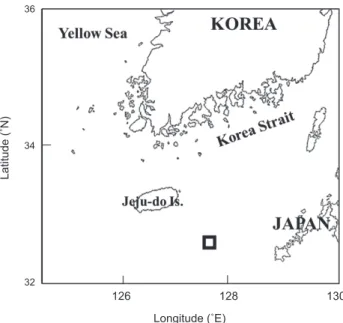
로경사채집되었다(Fig. 1).
채집된표 본은즉시5%
중성해수-
포르말린수용액에고정하였으며, 1
시 간후세척하여99%
알코올에보존하였다.
이후,
표본은부경 대학교어류학실험실어류플랑크톤표본실(Pukyong National University, Ichthyoplankton Laboratory, PKUI)
에등록및보 관하였다.
형태분석
치어의부위별용어와명칭은
Kim (1989), Yamada and Ya- gishita (2013)
와Okiyama (2014)
를참고하였다.
외부형태는 입체해부현미경(SZH-16, Olympus, Tokyo, Japan)
을이용하 여관찰하고, Mosaic 2.0 (Fuzhou Tucsen phoyonics, Fuzhou, China)
을이용하여0.01 mm
까지측정한뒤스케치하였다. 분자분석
채집된치어
1
개체의우측눈알에서Chelex
®100 resin (Labo- ratories, Inc., Burns, OR, USA)
를사용하여기본protocol
에따 라total DNA
를추출하였다.
추출한total DNA
는PCR (poly- merase chain reaction)
실험전까지5°C
냉장고에서보관하였 다. Mitochondrial DNA cytochrome c oxidase subunit I (mtD- NA COI)
영역은VF2 (5’-TCA ACC AAC CAC AAA GAC ATT GGC AC-3’)
와FishR2 (5’-ACT TCA GGG TGA CC G AAG AAT CAG AA-3’) primer (Ward et al., 2005)
를이용하 여증폭하였다. PCR
은10X PCR buffer 2 μL, 2.5 mM dNTP 1.6 μL, VF2 primer 1 μL, FishR2 primer 1 μL, Takara Taq polymerase 0.1 μL
를섞은혼합물에total DNA 2 μL
를첨가 한후,
총20 μL
가될때까지3
차증류수를넣고thermal cycler (MJ mini PCT-1148, Bio-rad, Hercules, CA,USA)
를이용하여 다음과같은조건에서PCR
을수행하였다; Initial denaturation 95°C
에서5
분; PCR reaction 35cycles (denaturation 95°C
에서1
분, annealing 52°C
에서1
분, extension 72°C
에서1
분); final extension 72°C
에서5
분.
염기서열은ABI 3730XL DNA Ana- lyzer
에서ABI Prism BigDye Terminator v3.1 Ready Reaction Cycle Sequencing Kit (Applied Biosystems, Foster City, CA, USA)
를이용하여얻었다. Mt DNA COI
염기서열은BioEdit Ver. 7 (Hall, 1999)
의CLUSTAL W (Thompson et al., 1994)
를 이용하여정렬하였다.
유전거리는MEGA 7
프로그램(Kumar et al., 2016)
을이용하여kimura 2-parameter model (Kimura, 1980)
로계산하고1,000
번의bootstrap
을수행하여작성하였Fig. 1. Map showing the sampling area of Peristedion liorhynchus juvenile in the south-eastern Jeju-do Island (fishing block 244-6, 32°45.532’ N, 127°22.856’ E).
126 128 130
36
34
32
Longitude (˚E)
Latitude (˚N)
(B)
(C) (A)
Fig. 2. Photo (A) and Illustration (B) of juvenile Peristedion lirhyn- chus (PKUI 811, 14.1 mm SL), Illustration (C) of Peristedion sp.
[Okiyama (2014), 12.4 mm SL]. Scale bars=1.0 mm. SL, Standard length.
126 128 130
36
34
32
Longitude (˚E)
Latitude (˚N)
(B)
(C)
(A)
다
.
염기서열을 비교하기 위하여NCBI
와BOLD
에 등록된Peristedion
속의3
종, P. liorhynchus (JN312126),
황성대(P.
orientale; KU892829, KU943390), P. barbiger (MF956940, MF956946)
와Satyrichthys
속의별성대(Satyrichthys rieffeli;
KU892828, MK777566)
염기서열을이용하였다.
분석한치어 의염기서열은NCBI (national center for biotechnology infor- mation)
에등록하였다(MT521707).
결 과
Peristedion liorhynchus (Günther, 1872) (Fig. 2) (New Korean name: Nam-bang-hwang-seong-dae)
Peristethus liorhynchus Günther, 1872: 663 (type locality:
Manado, Sulawesi, Indonesia)
Peristedion liorhynchus: Okamura et al. 1982: 283, 399 (Ja- pan); Randall and Lim 2000: 607 (China); Paxton et al. 2006:
926 (Australia); Kawai 2008: 24 (Japan); Shao et al. 2008: 247 (Taiwan); Fricke et al. 2011: 381 (New Caledonia), Psomada- kis et al. 2020: 370 (Myanmar)
관찰 표본
PKUI 811, 1
개체,
체장14.1 mm,
탐구22
호, 2019
년5
월5
일,
제주도근해244-6
해구(32°45.532 N, 127°22.856 E),
수심131 m,
봉고네트(
망구80 cm,
망목500 μm),
경사채집,
표층(5 m) 19.82°C, 34.57 PSU,
저층(120 m) 15.75 °C, 34.58 PSU.
형태 기재
채집된황성대과치어
1
개체의계수자료는Table 1
에나타내 었다.
체장에대한계측비(%)
는다음과같다:
체고(body depth) 25.4,
두장(head length) 37.3,
두고(head depth) 30.6,
등지느 러미앞길이(predorsal fin length) 41.0,
뒷지느러미 앞길이(preanal fin length) 49.4,
항문전장(preanus length) 47.7,
주둥이길이
(snout length) 15.8,
상악장(upper jaw length) 18.2,
하 악장(lower jaw length) 21.5,
안경(orbit diameter) 10.4,
가슴지 느러미상부유리연조길이(length of upper detached pectoral fin length) 20.5,
가슴지느러미하부유리연조길이(length of lower detached pectoral fin length) 20.4,
미병장(caudal pe- duncle length) 8.5,
미병고(caudal peduncle depth) 5.3.
황성대과치어는머리와눈이크고몸통은길게신장되었다
.
머리는폭이다소넓은반면,
몸통은꼬리로갈수록폭이좁아 졌다.
체고는가슴지느러미기부에서가장높았으며,
꼬리지느 러미쪽으로갈수록낮아졌다.
체절수는32
개였다.
각체절에 는골질판이형성되지않았다.
문은몸의중앙보다약간앞쪽에 위치하였다.
머리의등쪽외곽선은골질융기가발달하여,
눈앞 쪽부위에서심하게굴곡져있었다.
주둥이는크고전방을향해 돌출되어있으며,
앞끝은위쪽으로약간경사져있었다.
위턱의 뒤끝은눈의중앙에약간미치지못하였다.
머리에는여러부 위에서극(spine)
이두드러지며,
노정극(parietal spine),
후측두 극(posttemporal spine),
안상극(supraocular spine),
안하극(in- fraorbital spine),
안후극(postorbital spine),
새개극(opercular spine)
등이발달되어있었다.
안상극은기저부가넓고끝이뾰 족한산모양으로가장자리에톱니모양의소극이나있었다.
머 리양쪽에는후측두극(posttemporal spine)
이매우길게발달하 였으며,
후측두극의길이(
체장의20.1 %)
는안경(
체장의10.5
%)
보다길며그끝이뾰족하고몸의후방을향하였다.
후측두극의가장자리에도톱니모양의소극이여러개존재하였다
.
새 개부에는3
개의큰전새개극(preopercular spine)
이있으며,
끝 이뾰족하였다.
안하극은3
개로,
전새개극보다크기가작으나 끝이뾰족하였다.
양턱에이빨은관찰되지않았다.
등지느러미 는극조가연조보다짧았다.
등지느러미연조부와뒷지느러미 의높이는비슷하였다.
가슴지느러미는기저부가넓고위쪽두 번째,
세번째줄기가길게신장되며,
특히세번째줄기는꼬리 의중앙을지나길게뻗어있었다.
가슴지느러미아래쪽줄기2
개중,
위쪽의것은중반부까지위쪽줄기와막으로연결되어Table 1. Measurements and counts of Peristedion liorhynchus, two Peristedion species, and Satyrichthys rieffeli
Peristedion liorhynchus Peristedion orientale Peristedion nierstraszi Satyrichthys rieffeli Present study Ono and Kawai (2014)1 Ono and Kawai (2014) Ono and Kawai (2014)2 Kawai (2013)
Standard length (mm) 14.1 112.0-242.0 64.3-159.0 50.8-146.0 78.3-254.0
Myotome 32 - - - -
Dorsal fin rays VIII, 22 VII-IX, 20-22 VII-IX, 19-21 VII-IX, 20-23 VI-VIII, 16-18
Anal fin rays 19 20-22 19-21 20-23 16-18
Pectoral fin rays 14 13-14 12-15 13-15 14-16
Pelvic fin rays I, 5 I, 5 I, 5 I, 5 -
Principal caudal fin rays 12 11-12 11-12 12-13 -
1Including holotype specimen. 2Including syntype specimens.
있으나
,
맨아래쪽줄기는나머지줄기들과완전히분리되어있 었다.
꼬리지느러미는중앙이약간볼록한형태를띠고있었다.
흑색소포는두정부,
후두부,
가슴지느러미기저부,
복강에작은 점또는별모양으로나있었다.
복강의배쪽에는전체적으로작 은점또는별모양흑색소포가분포하였다.
복강의뒤쪽에는흑 색소포가밀집되어검은색을띠었다.
꼬리에는등간격으로꼬 리자루까지3
개의흑색소포군이나있었다.
분자 동정
황성대과
(Peristediidae)
치어1
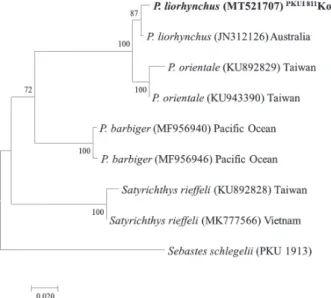
개체의mtDNA COI
영역493 bp
의염기서열을NCBI
에등록된Peristedion liorhynchus
의염기서열과비교한결과,
황성대과치어1
개체는P. liorhyn- chus
성어와유전거리0.009
로가장가깝게유집되었으며,
그 다음으로황성대(P. orientale)
성어와유전거리0.026-0.038, P.
barbiger
와유전거리0.137, P. cataphractum
와유전거리0.156,
별성대(Satyrichthys rieffeli)
성어와유전거리0.172-0.185
로 유집되었다(Fig. 3).
분 포
한국의제주도 남동부근해
(
본연구),
일본(Ochiai and Ya- tou, 1984),
대만(Monkolprasit et al., 1997),
필리핀(Richards, 1999),
인도네시아(Gloerfelt-Tarp and Kailola, 1984),
호주(Paxton et al., 2006),
괌(Richards, 1999),
뉴칼레도니아(Rich- ards, 1999).
고 찰
본연구는
2019
년4
월제주도남동부근해에서채집된황성대과
(Peristediidae)
치어1
개체를대상으로분자동정을실시한 결과, Peristedion liorhynchus
으로확인되었다.
본종은DNA
barcoding
연구에서유전적으로근연종간에잘구분되었으며(Ho et al., 2013),
이번분석결과치어의염기서열은성어와99%
이상잘일치하였다.
이처럼기존에형태정보가부족하거 나전혀알려져있지않던자치어를대상으로성어염기서열과 의비교분석을통해새로운자치어형태정보를확보하려는노 력이계속되고있다(Shin et al., 2018; Park et al., 2019; Kim et al., 2020).
국내황성대과어류에는황성대(P. orientale),
별성 대(Satyrichth rieffeli) 2
종만이알려져왔으나(MABIK, 2019),
본연구를통해새롭게P. liorhynchus
가추가되어총3
종이국내에 서식하는 것으로밝혀졌다
.
본연구에서 확인된P. lio-
rhynchus
치어를Okiyama (2014)
에기재된황성대속어류의 미동정종(Peristedion sp.)
치어와비교해보면,
계수형질,
두부 극의분포및형태,
체측의흑색소포분포등에서유사하였으나,
본개체는후두부에점모양흑색소포가분포한다는점,
신장된 가슴지느러미연조에흑색소포가없다는점등에서미세한차 이를보였다(Fig. 2). Okiyama (2014)
에기재된Peristedion sp.
치어는한국
,
일본주변해역에서출현하는황성대(P. orientale)
일가능성이있으나향후황성대과자치어를대상으로좀더면 밀한연구가필요할것으로사료된다.
본연구에서
P. liorhynchus
치어1
개체의계수형질을유사종 인P. nierstraszi
와비교하면,
뒷지느러미줄기수(19 in P. lio- rhynchus vs. 20-23 in P. nierstraszi)
에서잘구분되었다.
한편, P. liorhynchus
의계수형질은황성대(P. orientale)
와거의구분 되지않았고,
별성대(S. rieffeli)
와는등지느러미줄기수(22 in P. liorhynchus vs. 16-18 in S. rieffeli)
와뒷지느러미줄기수(19 in P. liorhynchus vs. 16-18 in S. rieffeli)
에서잘구분되었 다(Table 1).
본연구에서채집된
P. liorhynchus
치어를일본산P. liorhyn-
chus
성어와비교하면,
성어는주둥이선단부에길게돌출된한쌍의뿔과아래턱가장자리에수십개의수염모양의돌기를가 지는반면
(Ono and Kawai, 2014),
치어에서는관찰되지않았 다.
또한,
치어시기에는가슴지느러미줄기가길게신장되어꼬 리자루까지뻗어있지만,
성어의경우그끝이항문을지나지않 아(Yamada and Yagishita, 2013),
성장하면서가슴지느러미줄 기가짧아지는것으로생각된다.
이처럼치어기에지느러미줄 기가길게신장된것은포식자의위협으로부터자신을보호하 기위한생존전략으로사료된다(Suntsov, 2007).
황성대과
(Peristediidae)
어류는성대과(Triglidae)
와근연분 류군으로,
주둥이에돌출된극을가지는점,
머리가투구모양 의단단한골질판으로덮여있다는점에서유사하다. Okiyama
(2014)
의형태기재에의하면,
성대과어류의자치어는황성대Fig. 3. Neighbor joining tree based on partial mitochondrial DNA cytochrome oxidase subunit I sequences, showing the relation- ships among four Peristediidae species, and one outgroup (Se- bastes schlegelii). The tree was constructed using the K2P model and 1,000 bootstrap replications. The bar indicates a genetic dis- tance of 0.02.
과의
Peristedion sp.
치어와두정부극의크기및형태,
가슴지 느러미의유리연조수(3 in Triglidae vs. 2 in Peristediidae),
길 게신장된가슴지느러미상부연조유무(absent in Triglidae vs.
present in Peristediidae)
에서잘구별된다.
본연구에서는본종 의새로운국명으로“
남방황성대”
를제안한다.
사 사
이논문은
2020
년도국립수산과학원수산과학연구사업(
근해어업자원조사
, R2020021)
과2020
년도해양수산과학기술진흥 원해양수산생명공학기술개발사업의지원을받아수행된연구 입니다(No. 20170431).
References
Chyung MK. 1977. The fishes of Korea. Ilji Publishing, Seoul, Korea, 727.
Fricke R, Eschmeyer WN and JD Fong. 2020. Eschmeyer’s cat- alog of fishes: species by family/subfamily. World wide web eletronic publication. Retrieved from www.researcharchive.
calacademy.org on Apr 9, 2020.
Fricke R, Kulbicki M and Wantiez L. 2011. Checklist of the fish- es of New Caledonia, and their distribution in the Southwest Pacific Ocean (Pisces). Stutt Beitr Naturkd A 4, 341-463.
Gloerfelt-Tarp T and Kailola PJ. 1984. Trawled fishes of south- ern Indonesia and northwestern Australia. Australian Devel- opment Assistance Bureau (ADAB), Directorate General of Fisheries, Indonesia (DGF), and German Agency for Tech- nical Cooperation (GTZ), Jakarta, 407.
Günther, A. 1872. Report on several collections of fishes recent- ly obtained for the British Museum. Proc Zool Soc Lond 39, 652-675.
Hall TA. 1999. BioEdit: A user-friendly biological sequence alignment editor and analysis program for Windows 95/98/
NT. Nucl Acids Symp 41, 95-98.
Ho HC, Chee WL, Chang CH and Shao KT. 2013. Taxonomic review and DNA barcoding of the fish genus Peristedion (Scorpaeniformes: Peristediidae) in Taiwan. Platax 10, 37- Imamura H. 1996. Phylogeny of the family Platycephalidae and 55.
related taxa (Pisces: Scorpaeniformes). Species Divers 1, 123-233. https://doi.org/10.12782/specdiv.1.123.
Kaup JJ. 1859. Description of a new species of fish Peristethus
rieffeli. Proc Zool Soc Lond 22, 103-107, Pls. 8.
Kawai T. 2008. Phylogenetic systematics of the family Periste- diidae (Teleostei: Actiopterygii). Species Divers 13, 1-34.
https://doi.org/10.12782/specdiv.13.1.
Kawai T. 2013. Revision of the peristediid genus Satyrichthys (Actinopterygii: Teleostei) with the description of a new species, S. milleri sp. nov. Zootaxa 3635, 419-438. https://
doi.org/10.11646/zootaxa.3635.4.5.
Kim JS, Kim JK, Park JH, Ji HS and Lee HW. 2020. Molecular identification and morphological description for larvae and juveniles of deepwater dragonet Bathycallionymus kaianus (Callionymidae, PISCES) from Korea. Korean J Fish Aquat Sci 53, 74-82. https://doi.org/10.5657/KFAS.2020.0074.
Kim YU. 1989. Introduction of Ichthyology. Taehwa, Busan, Korea, 270.
Kimura M. 1980. A simple method for estimating evolutionary rates of base substitutions through comparative studies of nucleotide sequences. J Mol Evol 16, 111-120. https://doi.
org/10.1007/BF01731581.
Kumar S, Stecher G and Tamura K. 2016. MEGA7: molecular evolutionary genetics analysis version 7.0 for bigger datas- ets. Mol Biol Evol 33, 1870-1874. https://doi.org/10.1093/
molbev/msw054.
MABIK (Marine Biodiversity Institute of Korea). 2019. Na- tional list of marine species. Namu Press, Seocheon, Korea.
Miller GC and Richard WJ. 2002. Peristediidae. In: FAO species identification guide for fishery purposes and american soci- ety of ichthyologists and herpetologists special publication.
The living marine resources of the Western Central Atlantic.
Vol. 2. Bony fishes part 1 (Acipenseridae to Grammatidae).
FAO, Rome, Italy, 1278-1285.
Monkolprasit S, Sontirat S, Vimollohakarn S and Songsirikul T.
1997. Checklist of fishes in Thailand. Office of environmen- tal policy and planning, Bangkok, Thailand, 353.
Mori T. 1952. Check list of the fishes of Korea. Mem Hyogo Univ Agric Biol Ser 1, 156-158.
Nelson JS, Grande TC and Wilson VH. 2016. Fishes of the world. 5th ed. John Wiley and Sons, Inc., New Jersey, NJ, U.S.A., 475-477.
Ochiai A and Yatou T. 1984. Peristediidae. In: The fishes of the Japanese Archipelago. Masuda H, Amaoka K, Araga C, Uy- eno T and Yoshino T, eds, Tokai University Press, Tokyo, Japan, 301-364.
Okamura O, Amaoka K and Mitani F. 1982. Fishes of the Ky- ushu-Palau Ridge and Tosa Bay. The intensive research of unexploited fishery resources on continental slopes. Japan Fisheries Resource Conservation Association, Tokyo, Japan, 1-435.
Okiyama M. 2014. An atlas of the early stage fishes in Japan.
Tokai Univ Press, Tokyo, Japan, 640-641.
Ono M and Kawai T. 2014. Review of armored searobins of the genus Peristedion (Teleostei: Peristediidae) in Japanese wa- ters. Species Divers 19, 117-131. https://doi.org/10.12782/
sd.19.2.117.
Park GH, Kim JK, Ji HS and Choi JH. 2019. Molecular iden- tification and morphological description of juveniles of the previously unrecorded species Notoscopelus japoni-
cus (Tanaka, 1908) (Myctophidae) in Korean waters. Ko-
rean J Fish Aquat Sci 52, 424-429. https://doi.org/10.5657/KFAS.2019.0424.
Paxton JR, Gates JE, Bray DJ, Gomon MF and Hoese DF.
2006. Triglidae. Armourd gurnards, armoured sea robins, gurnards, sea robins, searobins. In: zoological catalogue of Australia. Vol. 35. Fishes. Part 2. Actinopterygii: acanthop- terygii (in part): mugiliformes to perciformes (Zoarcoidei to Labroidei). Hoese DF, Bray DJ, Paxton JR and Allen GR, eds. ABRS & CSIRO Publishing, Melbourne, Australia, 921-930.
Psomadakis P, Thein H, Russell BC and Tun MT. 2020. Field identification guide to the living marine resources of Myan- mar. FAO species identification guide for fishery purposes.
Rome, FAO and MOALI, 694.
Randall JE and Lim KKP. 2000. A checklist of the fishes of the South China Sea. Raffles B Zool Suppl 8, 569-667.
Richards WJ. 1999. Triglidae. In: FAO Species Identification Guide for Fishery Purposes. The Living Marine Resources of the Western Central Pacific. Vol. 4. Bony Fishes Part 2 (Mugilidae to Carangidae). Carpenter KE and Niem VH, eds. FAO, Rome, Italy, 2359-2382.
Shao KT, Ho HC, Lin PL, Lee PF, Lee MY, Tsai CY, Liao YC and Lin YC. 2008. A checklist of the fishes of southern Tai- wan, Northern South China Sea. Raffles B Zool Suppl 19, 233-271.
Shin UC, Jeong YK, Yoon SC, Choi KH and Kim JK. 2018.
Genetical identification and morphological description of the larvae and juveniles of Porocottus leptosomus (Pisces:
Cottidae) from Korea. J Fish Aquat Sci 21, 1-10. https://doi.
org/10.1186/s41240-018-0115-y.
Smith WL, Everman E and Richardson C. 2018. Phylogeny and taxonomy of flatheads, scorpionfishes, sea robins, and stonefishes (Percomorpha: Scorpaeniformes) and the evolu- tion of the lachrymal saber. Copeia 106, 94-119. https://doi.
org/10.1643/CG-17-669.
Suntsov AV. 2007. Brotulotaenia (Teleostei: Ophidiiformes) larval development revisited: an apparently new type of mimetic resemblance in the epipelagic ocean. Raffles Bull Zool 14, 177-186.
Temminck CJ and Schlegel H. 1843. Pisces, Parts 2-4. In: de Siebold’s Fauna Japonica. Sieold PF, ed. Müller, Amster- dam, NL, 21-72.
Tenda MT and Kawai T. 2012. Record of the armored searobin
Peristedion barbiger (Garman, 1899) (Actinopterygii: Te-
leostei: Peristediidae) off Peru with taxonomic notes. Spec Div 17, 135-144. https://doi.org/10.12782/sd.17.2.135.Thompson JD, Higgins DG and Gibson TJ. 1994. CLUSTAL W: improving the sensitivity of progressive multiple se- quence alignment through sequence weighting, position- specific gap penalties and weight matrix choice. Nucl Acid Res 22, 4673-4680.
Ward RD, Zemlac TC, Innes BH, Last PR and Hebert PDN.
2005. DNA barcoding Australia’s fish species. Phil Trans Biol Sci 360, 1847-1857. https://doi.org/10.1098/
rstb.2005.1716.
Washington BB, Eschmeyer WN and Howe KM. 1984. Scor- paeniformes: relationships. In: Ontogeny and Systematics of Fishes. Moser HG, Richards WJ, Cohen DM, Fahay MP, Kendall AW Jr. and Richardson SL, eds. American society of ichthyologists and herpetologists, special publication No.
1, Lawrence, KS, U.S.A., 438-447.
Yamada U and Yagishita N. 2013. Peristediidae. In: Fishes of Ja- pan with pictorial keys to the species, third edition. Nakabo T, ed. Tokai University Press, Hadano, Japan, 727-1952.